
2026 Peace Fellowships
The Advocacy Project will recruit several Peace Fellows (student volunteers) to work with our partners this year in Nepal, Vietnam, Uganda and Kenya. Fellowships will last between six weeks and three months and be available from May 1 to December 31. Those interested in applying should review this page carefully, check out our 2026 work plan and email us at DCOffice@advocacynet.org to set up a preliminary interview. Open this page to learn about our model of support for community-based partners and our fellowship program. Read the blogs of past Fellows here.
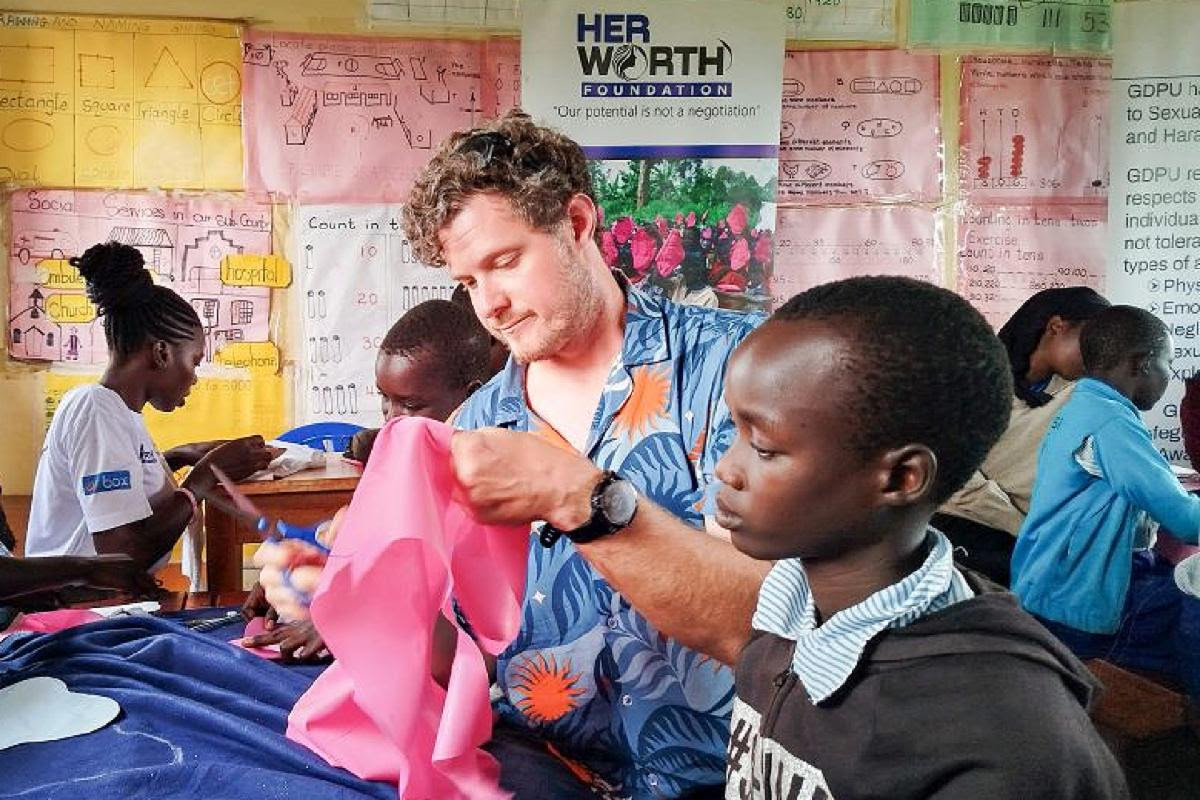
2025 Peace Fellow Aaron Bailey (Texas A&M University) helped girls make reusable sanitary pads as part of his work on a WASH project in Northern Uganda.
This page should be read in conjunction with our 2026 work plan. Openings will be updated, so please check back in regularly
Are you interested in working on the front lines for social justice and social change? If so, we hope you will consider a peace fellowship with The Advocacy Project (AP) in 2026.
Since 2003, 344 students from over 120 academic programs have served as Fellows in more than forty countries. Over 150 undergraduates have also worked as interns at our office in Washington DC or remotely. In 2020, we opened fellowships up to high school students. Check out the blogs of past Fellows here and read what past students have written about their AP experience here.
We are changing our recruitment process this year so please read the following carefully.
We are currently in discussion with partners about our 2026 work plan. Depending on the availability of funds and the quality of applications, we expect to deploy up to 7 Fellows this year. The selection process will take several weeks so as to ensure that the experience will be secure and rewarding, that Fellows are fully prepared, and that a Fellow will add significant value to the partnership.
If you are interested in working as a Fellow with any of our partners, here in the US or abroad, or in supporting our work in some other way, please email DCOffice@advocacynet or call +1 202 422 2479 for more information and to set up a preliminary interview. We may then ask you for a full application consisting of a) a cover letter b) a current resume and c) the names of three referees. The deadline for applications is March 15.
In making a selection we will arrange for you to meet remotely with the partner and one of our Board members who has served as a Peace Fellow in the past. Early applications will be rewarded and we will do what we can to accommodate university funding deadlines.
Offers will be made by March 30. If you accept an offer you will be asked for a deposit of $95 which will be returned when your fellowship begins. You will also be asked to sign a security waiver and contract setting out your responsibilities. We will not accept applications from students who plan to take on additional work between the end of the spring semester and the beginning of the fellowship.
If funding permits, we may deploy a team of two Fellows to challenging assignments.
Assignments and hosts
This year we are prioritizing two partnerships in Nepal and Vietnam.
In Nepal: We are offering 4 scholarships of $1,000 to attend classes at the Center for Human Rights and Victims of Violations, the first-ever academic center to study transitional justice from the perspective of victims and survivors of conflict.
The Center has been established in the School of Arts at Kathmandu University and will be run by Dr Ram Bhandari, PhD, a well-known human rights advocate and scholar whose own father was forcibly disappeared during the conflict. The Center will offer two courses in 2026: a full course of 16 weeks and a shorter course of 5 weeks. Both will include a week-long field trip to the district of Bardiya to meet with families of the disappeared and visit memory sites. The two course curricula are currently under development. This is a new project for NEFAD although the ground was laid in 2025 by Dr Bhandari and three Peace Fellows. We will shortly reach out to NEFAD’s university contacts and hope to have a fully developed plan by February 15.
In Vietnam: We will offer up to three fellowships thus year to support families in Vietnam that have been damaged by Agent Orange. Each Fellow will be paired with one or two families and work through our partner, The Association for the Empowerment of Persons with Disability (AEPD) in Quang Binh province. AP and AEPD have sent thirteen Fellows to AEPD since 2008 and raised funds for the fifteen families profiled here. We hope to support more families in 2026 and continue to offer this unique educational experience to more young professionals.
Kenya and Uganda: If funding permits, we hope to deploy Fellows to work with our two partners in Gulu District, Uganda; and with our two partners in Nairobi Kenya. Please read this page for more information about these openings.
Elsewhere: Our fellowships are driven by demand and we open to suggestions from would-be Fellows. If you feel you would be a good fit for any of our other 2026 partnerships, please get in touch!
Eligibility
Peace Fellowships are open to high school students, undergraduates and graduates. There are no restrictions based on nationality, gender, location, race, or religion. Our international fellowships are designed primarily for graduates who are midway through a Masters degree, but we can make exceptions if funding can be obtained. Undergraduates and high schools students can also work remotely with partners from home.
Responsibilities
Graduate students: Peace Fellows deployed to the field give us an opportunity to work alongside partners during ten weeks of the year. Given that we do not work through field offices, this is an important contribution.
Fellows working on start-ups will focus on profiling the work of their hosts (through blogs, video, photos, embroidery and social media) and these are the skills we will look for in applications. Fellows supporting long-term programs will also contribute blogs and photos but their principal tasks will be to help their host implement projects, raise funds, ensure monitoring and develop international contacts. Specialized skills such as M and E, photography, website development, familiarity with social media and video editing will definitely help. Fellows will also help their hosts to post to Google Drive and develop a database of donors for fundraising.
Undergraduate and high school Fellows: Will contribute remotely based on their skills and the needs of the partner. They may also be paired with a graduate Fellow in the field.
Many past Fellows have drawn on their fellowships for Capstone projects and class presentations, and we encourage Fellows to explore research opportunities with their academic advisors in advance.
All Fellows will attend a 3-day training in Washington in mid-May. Fellows will cover travel costs. AP will arrange for accommodation.
Selected Fellows will be considered employees of The Advocacy Project for the duration of their fellowships.
Qualifications
Personal: In selecting Fellows for field positions we look first and foremost for field experience and an ability to adapt to difficult and unexpected circumstances. Successful Fellows have also demonstrated knowledge of the issue and country, an ability to make friends, emotional intelligence, curiosity, a commitment to communicate regularly, writing and photography skills, and a knowledge of social media. A big part of the Fellow’s job is to listen and sympathize. We make every effort to accommodate special talents and encourage creativity, and hope you bear this in mind when selecting a possible fellowship.
Technical: We offer a range of services to partners that are described on this page and Peace Fellows may be called on to offer any of the following: a) Posting content on social media for the partner and AP (Tiktok, Facebook, Instagram, Pinterest, and Linkedin); b) Using Google Drive; c) Taking, editing and posting photos (on Pikmonkey, Flickr and Google Drive); d) Profiling hosts and story-telling; e) Designing brochures, flyers, catalogues, and reports (Canva, Photoshop etc); f) Helping partners to post an appeal on GlobalGiving; g) Shooting and editing video footage; f) Grant-writing and fundraising; g) Developing or maintaining a WordPress website; and h) Organizing story-telling through embroidery. Please let us know your interests and skills in your application.
Blogs
All Fellows will be given a blog page on our website. Fellows in the field will be asked to produce one blog a week. Fellows working remotely will produce at least one blog a month. Blogs are a key part of our fellowships. Not only do they describe the host organization’s work and provide valuable content, but they also provide the Fellow with an important record of their fellowship. Past Fellows continue to draw on their blogs after they leave, and we use their blogs in references letters.
Photos, video and social media
As you will see from the work of past Fellows, visuals add enormously to the value of a fellowship and are used extensively by AP and our partners. We ask fellows to produce at least 100 high quality photos and post them on our Drive and on our Flickr library. We will create a page for your photos on Flickr. We encourage Fellows to take video footage but do not require Fellows to edit it unless they want to. Social media also plays an important role in our networking and promotion on behalf of partners and we welcome applications from experts! We want Fellows to look on AP as an opportunity to use their talents.
We have produced manuals to cover most of the services we offer to partners.
Work plan
Your letter of engagement will set out goals for your fellowship and help you develop an informal work plan with your host shortly after arrival.
Evaluation
Fellows are asked to submit a paragraph about their experience at the end of their fellowship for posting on the AP site. We will also ask Fellows and their hosts to complete a short questionnaire.
Drive
Google Drive serves as a virtual office for Fellows and for partners all of whom have a dedicated page on our Drive.
Security
We follow US Government guidelines in selecting countries, and use USG protocols to ensure that Fellows are fully prepared, supported in the field and kept safe. We will review security at length during the May training.
Covering costs
The cost of a ten-week fellowship runs to around $5,500. Many universities provide financial support to returning Masters students for international internships, and we will help by offering scholarships of $2,000 for 10-week fellowships and $1,000 (6-7 weeks). We will advance $500 and transfer the remainder at the end of the fellowship when the required outputs are produced and on receipt of the final feedback. Fellowships of more than 10 weeks will be covered through project funding.
Fellows are responsible for ensuring they are fully insured, vaccinated and secure the appropriate visas.
The application process for 2026 summer fellowships, summarized:
1. Email DCOffice@advocacynet.org or call +1 202 422 2479 to set up a preliminary discussion
2. Submit an application – cover letter, resume and 3 references – by March 15. Offers will be made by March 30
3. Meet remotely with the host and an AP Board member
4. Accept an offer by April 10
5. Prepare for the fellowship in April/May
6. Attend 3 days of training in Washington in mid-May
7. Deployment between May 25 and August 30
8. Submit a final paragraph within 2 weeks of returning and fill out a brief questionnaire with their hosts.
Applications for fellowships during the rest of 2026 will follow the same process, although dates will differ.
Learning from past Fellows
Most of our 2025 partners have hosted Fellows in the past and they will be your best source of information about your own fellowship. If selected, we will put you in touch. In the meantime, we suggest that you consult their blogs here.
For more information email DCOffice@advocacynet.org and read our Annual Reports