
ADVOCACYNET 441, August 31, 2026
The Taliban’s war against women in Afghanistan, told through stitching
Advocacy quilts help the search for new ways to ease the pressure on Afghan women and girls
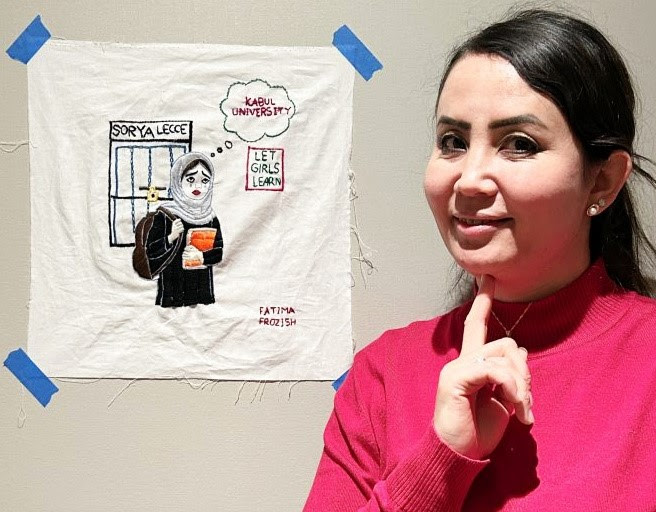
When Fatima Frozish (photo) tries to imagine what life is like for girls in Afghanistan, the country she left five years ago, she pictures a student arriving at a high school, full of excitement and dreaming of college, only to find the doors padlocked. The disappointment and shock shows on the girl’s face.
Fatima is one of nine former Afghan refugees who left Afghanistan for Canada after the Taliban returned to power on August 15, 2021 and have watched the war against Afghan women and girls with growing horror.
The nine women recently turned to stitching to share their personal stories and channel their anguish into two powerful advocacy quilts, at the request of the Afghan Human Rights and Development Organization (AHRDO), a partner of The Advocacy Project (AP).
AHRDO commissioned the quilts to support its own advocacy, which uses art-based truth-telling to describe the impact of the Taliban’s crimes. AHRDO’s tools include memory boxes and body maps that allow victims to trace their bodies and add personal narratives as a form of therapy.
Advocacy quilting is also therapeutic. Bobbi Fitzsimmons from AP provided training for the nine Afghan artists in Toronto. Their blocks (stories) were then assembled into the two quilts by Janet Llewellyn, a Toronto-based quilter. Profiles of the artists and their stories can be found here.
*
The quilts are part of an increasingly urgent search for a new NGO strategy to ease the pressure on Afghan women, which has taken new and bizarre forms of cruelty this year.
Afghan women have been erased from professional life, forced to wear a burkha outside the home and banned from speaking in public. Two recent directives have legalized domestic violence and child marriage and forbidden women from seeking a divorce without their husbands’ consent.
Any woman who disobeys faces arrest and public flogging according to Whips of Power, Spectacle of Control, a powerful new report from AHRDO, which has collected data on 2,745 floggings since 2021. The victims included 422 women, one of whom was forced to marry an older man who broke her teeth and tore her hair out. When she tried to flee she was sentenced to 39 lashes and nine months in jail.
All of this has taken a heavy toll on the physical and mental health of women and girls. One 2022 study found that women accounted for more than 80% of all suicides in Afghanistan and were turning to self-immolation, hanging, drug overdose, and detergent to end their misery.
In the face of this assault, there is growing agreement that conventional methods of support by Western NGOs are no longer viable. Mainstream funding for women in Afghanistan has also fallen sharply.
The need for new NGO approaches was underscored at a recent webinar by Together Women Rise, which has funded scores of initiatives by women under pressure across the world, including an AP partner in Zimbabwe, and invested heavily in Afghanistan.
The same message is being heard at the international level, where NGOs have focused on isolating the Taliban diplomatically. Cracks are now appearing in the international consensus, and it was revealed recently that the EU had met with the Taliban to seek their collaboration in deporting Afghans.
*
AP has helped 46 partners tell their stories through stitching, but few projects have been as urgent as the AHRDO quilts.
Several artists echo Fatima’s dismay over the closure of secondary schools, which has deprived 2.4 million Afghan girls of an education according to UNESCO. Manizha Wahidi shows a girl who is forced to wear a burkha instead of a school uniform. Guljan Samar shows a mother who missed out on education cooking dinner while trying to learn English on a computer.
Niki Sarwar and Homaira Jahish, the two youngest artists, used their stories to protest against the basic unfairness of favoring boys over girls. Farida Jahish remembers her time as a television journalist – a job she loved. Her story shows her in her prime delivering a new piece to camera.
Fereshta Naziri uses her story to express her disgust at being forced to wear a burkha in public. “I used to throw it in the corner when I came back from shopping,” she told AP earlier this summer. “I was afraid of the darkness.”
Tahera Nasiri describes the brutal impact of two directives this year that reached deep into family life and caused international outrage. Decree 12, passed in January, allows husbands to abuse their wives as long as no bones are broken and the wounds are not visible. This was followed in June by Decree 18, which forbids women from seeking a divorce if their husbands object, and permits child marriage.
Tahera’s story shows a group of women who have been jailed for defying the edict but bravely continue to protest from prison.
Taking women out of the economy has also deepened poverty. Wazhma Sadat shows a mother selling her burkha-clad daughter to another family because she can no longer afford to feed her.
*
The nine artists are the first to acknowledge that they benefited from the gains made after the Taliban were ousted in 2001, when women seized the opportunity to escape from oppressive conditions with help from the international women’s movement.
The gains were impressive. Over 34,000 midwives were trained, leading to a reduction in maternal mortality from 2,232 to around 660 deaths per 100,000 births. Over a million girls went to school – up from zero. Women occupied a quarter of the seats in the national parliament.
Education was the main driver, explained Manizha, who earned a degree in mathematics at Kabul University and taught for seven years at an international school. Another artist, Wazhma, earned a bachelor’s degree and a master’s degree in public law before beginning her professional career at the Independent Election Commission, where she worked in the Gender Unit.
Guljan earned a PhD and rose to become the District Governor (wuluswal) of Daikundi Province – the first ever woman to hold such a position. This was a major step forward for women’s participation in local government.
*
Several artists have brought their hunger for education to Canada and are using it to help Afghan women back home and in exile.
After studying as a laboratory assistant, Fereshta completed English language studies and is working toward becoming a child and youth care practitioner in Toronto. Her commitment to service is clear from her sparkling website.
Tahera was an outspoken critic of the Taliban until she was forced to leave. On August 15, 2023, the second anniversary of the Taliban takeover she set up her own NGO, the Women’s Movement towards Freedom, to support projects for women and girls inside Afghanistan. These have included remote language classes and training for women dismissed from their jobs.
Niki Sarwar, the youngest artist, has written and starred in a short film, The Silence of a Girl, that imagines her life if she had never left Afghanistan. The film’s raw authenticity has attracted powerful collaborators in Toronto, including an Oscar-nominated director of photography.
Like many of their generation, Tahera and Niki are also adept at using social media. Niki has 5,900 followers on Facebook. Tahera has almost 24,000 followers on Instagram.
Several artists said that while they were proud of their activism, it would not be possible without the encouragement of their Canadian hosts.
Janet Llewellyn, who turned the stories into quilts, said the feeling is mutual. Canada has taken in over 55,000 Afghans since August 2021 and many Canadians feel they have made society richer and more diverse, she said.
*
AP and AHRDO hope the quilt project will encourage new thinking by NGOs that are determined to continue working in Afghanistan. All agree this will require creativity, flexibility and even subterfuge.
The recent webinar by Together Women Rise shared some ideas from grantees like Free to Run, which was launched in 2014 to empower Afghan women and girls through sport. With women barred from even showing their faces in public, the group now supports online yoga classes at home.
IANGEL provides discreet support for Afghan women lawyers who have been barred from openly practicing law but are ingeniously exploiting the few remaining legal avenues open to women. Nancy Newman, the president of IANGEL, said that they recently secured the release of a woman who had been sentenced to death by stoning for alleged adultery.
More and more NGOs are using the Internet to work remotely with Afghan counterparts. They include Global Co Lab, an AP partner that offers weekly English-language classes to 86 women and girls in six Afghan provinces.
Maryam Rayed, who left Afghanistan after August 15 2021 and coordinates the project from Washington, explained that even remote contact with friends is “incredibly therapeutic” for her students. It also builds academic qualifications, she said. One student was recently accepted for college in Bangladesh.
But even this is fraught with risk. A grant from AP has enabled Global Co Lab to purchase power banks so that students can attend classes without losing power. But great care must be taken not to identify the project officer in Kabul who receives the funds and then works through “women-friendly” stores that sell the power banks. New applicants to the program are carefully vetted.
At the international level, AHRDO hopes their two new quilts, with their deeply personal stories, will encourage governments to think twice before normalizing relations with the Taliban.
AHRDO showed the first quilt at the Ottawa Civic Space Summit in April and plans to exhibit it again at a side event during the UN Human Rights Council that opens in Geneva on September 7. The event will be hosted by the Afghan Mission in Geneva, which is staffed by diplomats from the democratic government that predated the Taliban.
As the search for new NGO strategies intensifies, many will also be looking for inspiration from prominent women in the Afghan diaspora, like the nine quilt artists, who benefited from the drive to educate girls before 2021 and remain passionately committed to sustaining the effort back home.
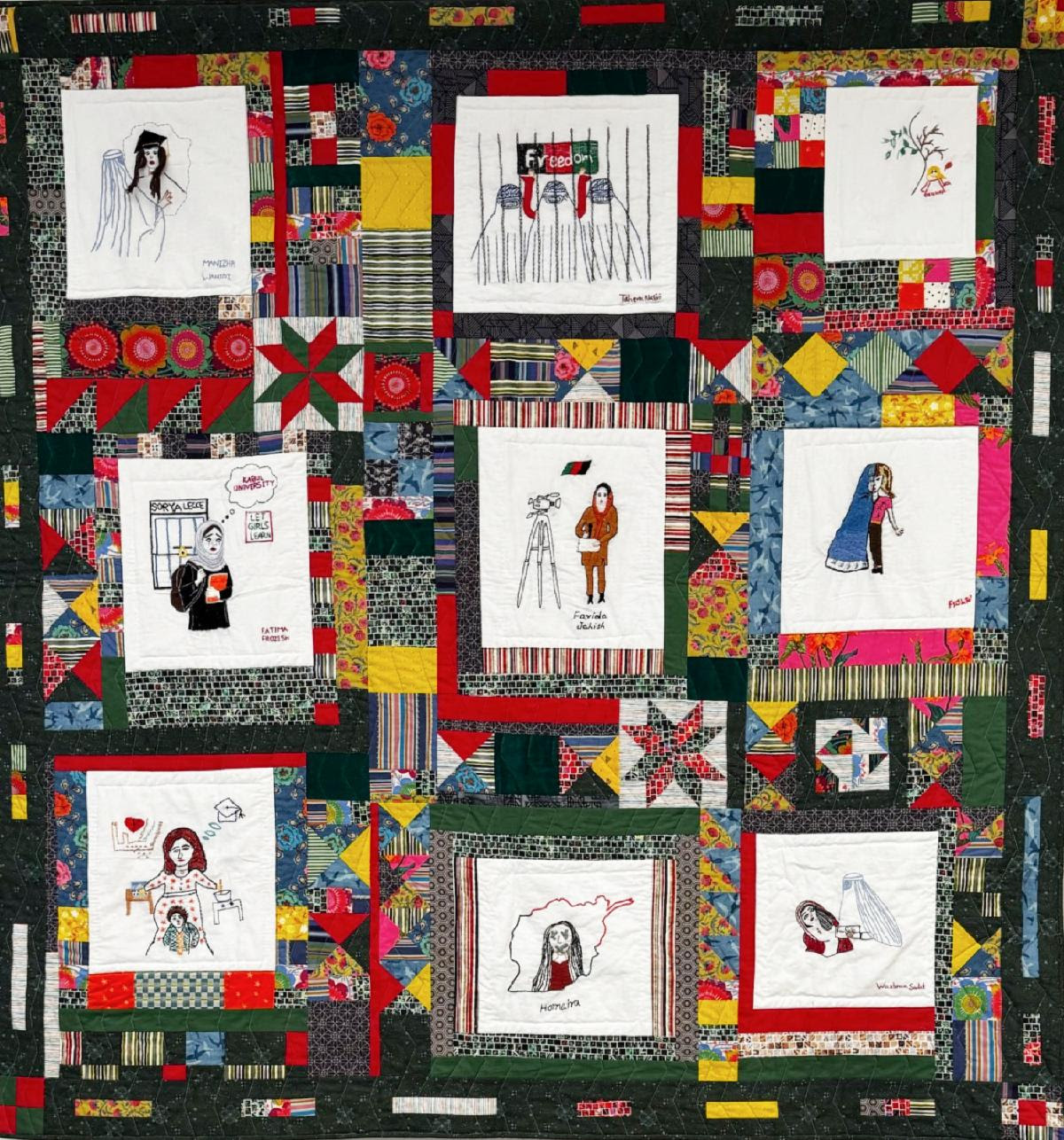
The first Afghan Womens Quilt will be shown at the UN Human Rights Council next week
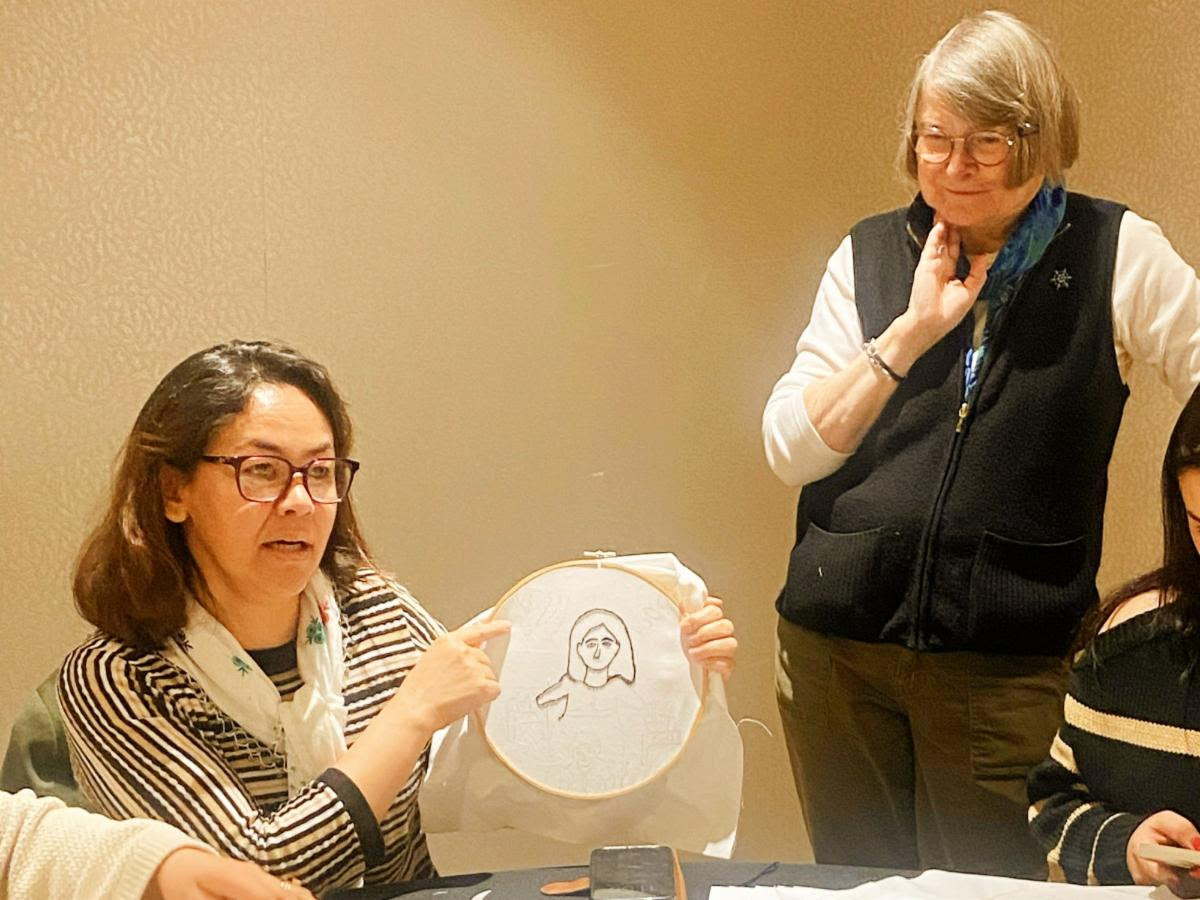
Guljan embarks on her story, with help from trainer Bobbi Fritzsimmons

Janet Llewellyn from Toronto assembled the stories into two advocacy quilts
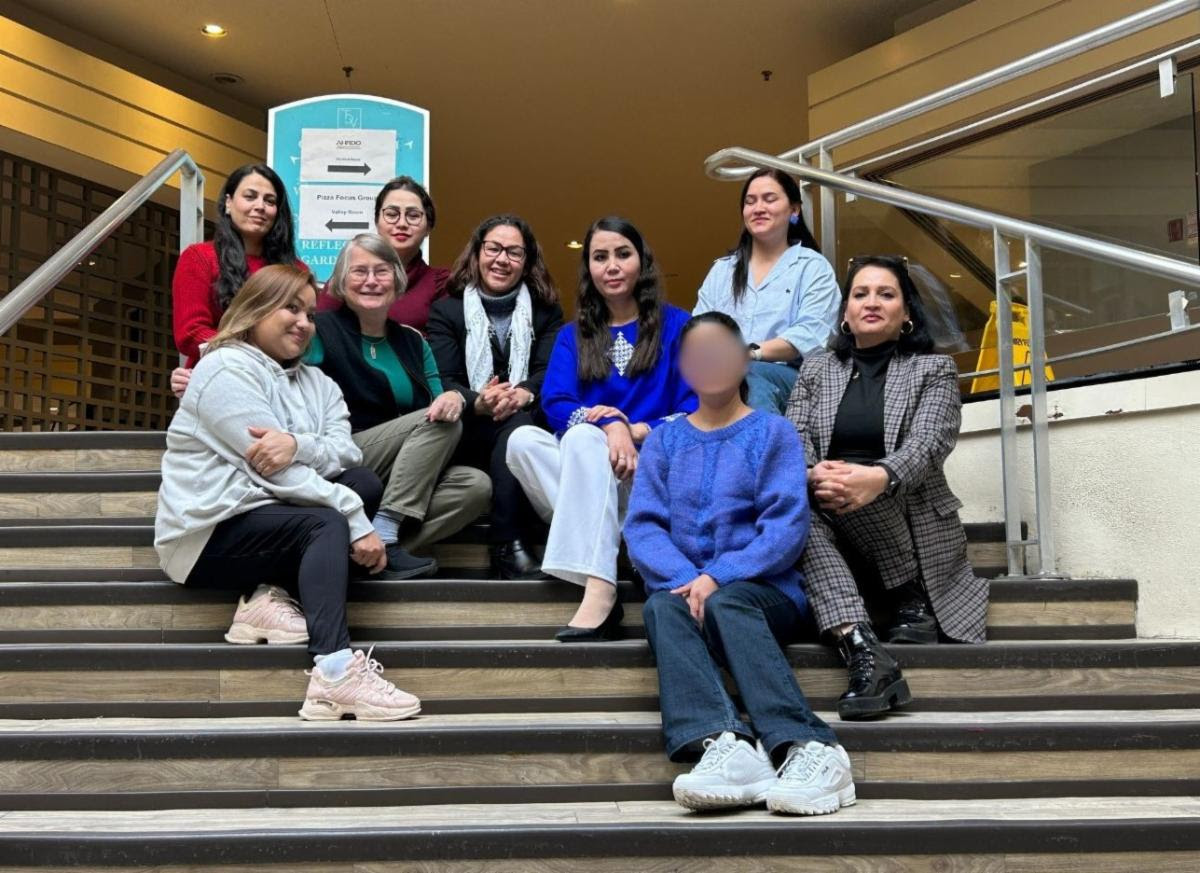
The artists with Bobbi Fitzsimmons from AP and Nicole Valentini from AHRDO
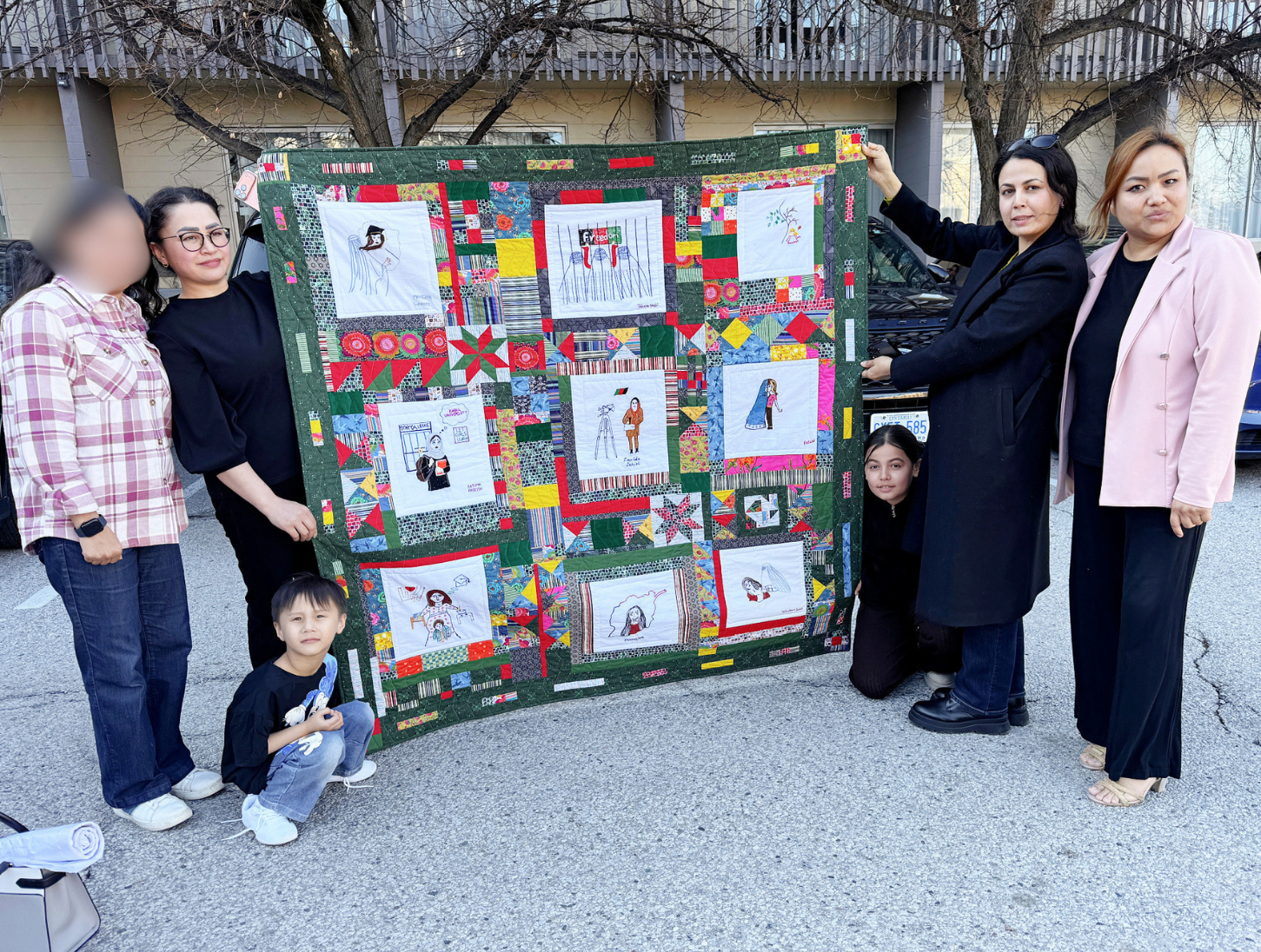
Ready for advocacy: artists and their quilt in Toronto