
ADVOCACYNET 425, April 26, 2025
Tribal Women in India Turn to Nature in Their Fight Against Malaria
by Iain Guest
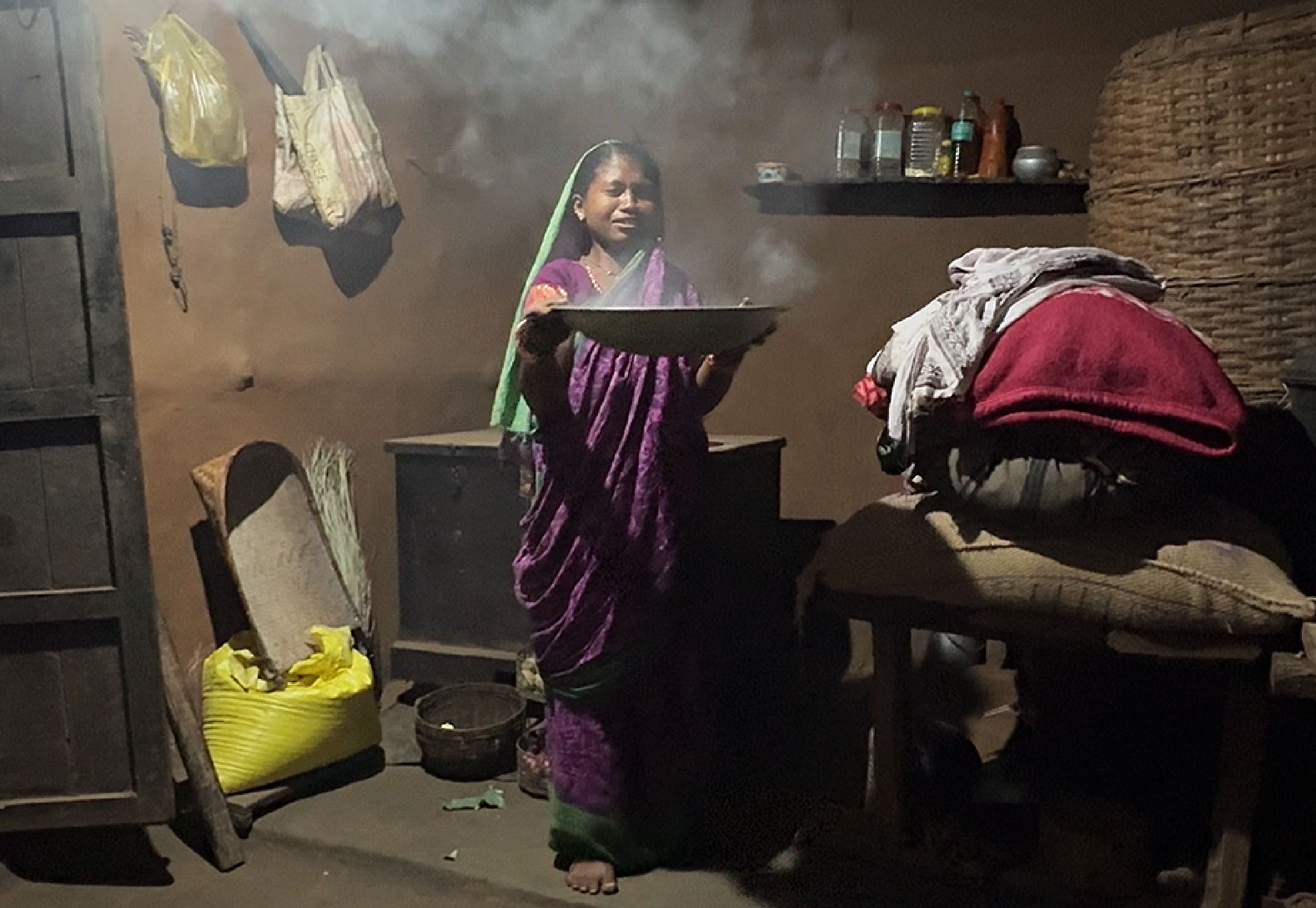
Hingula Jani burns leaves from the Neem tree and uses the smoke to ward off mosquitoes before sleep. Tribal villagers revere the Neem tree in Odisha state, India.
Before Hingula Jani goes to sleep she prepares to do battle with mosquitoes at her home in the village of Dugudi, deep in a tribal area of Odisha state, India.
Hingula, as she likes to be called, heats water and adds leaves from a nearby Neem tree. After bathing in the water she puts dried Neem leaves into a small charcoal brazier and watches with satisfaction as the smoke wafts up to the rafters. Only then can Hingula head for bed, confident that she and her family will be protected against mosquitoes for the whole night.
Hingula’s daily ritual is an example of a deep harmony that exists between tribal people and the Neem trees that rise majestically among their villages.
On their own, Neem products are hardly foolproof against malaria. Odisha state suffers from the second highest rate in India and registered over 50,000 cases last year – an increase over 2023. Tribal people are particularly vulnerable because they live in thick forests where mosquitoes breed and are far from government medical services.
But Neem leaves have long been known to deter mosquitoes and they offer a first line of defense in tribal villages during the rainy season when the insects come out in such vast numbers that it is often impossible to work outside.
*
The Neem tree is now making a new contribution to the fight against malaria through its seeds, which litter the forest floor during the summer.
Last year fifty tribal women leaders, including Hingula, formed a cooperative to grind Neem seeds into oil for use as a mosquito repellent. The women, who are all active in Self Help Groups (SHGs) in their villages, branded their new oil as Neemola.
The Neemola start-up is the brainchild of Jeevan Rekha Parishad (JRP), an Indian NGO with long experience of working with tribal people, and The Advocacy Project (AP). The two organizations first collaborated in 2022 with a COVID vaccination campaign in two tribal villages and moved to malaria the following year. By the end of 2023, the rate of malaria among pregnant women and children in ten villages had been brought down to zero.
The Neemola start-up builds off the 2023 project and got off to a strong start in 2024. Thirty-four cooperative members collected 1.19 tons of Neem seeds – exceeding their target. Sixteen other members, including Hingula, then used a simple press at the JRP office in the town of Daspalla to squeeze the seeds into 135 liters of Neemola oil and filled around 2,700 bottles.
*
An AP team visited Daspalla at the end of 2024 to see how the oil was being received by villagers. Even if their response was positive, said JRP officials, many questions would still need to be answered.
“We don’t know if the oil will stop all mosquitoes or how we will measure its effect on malaria,” said Abhilipsa Mallick, who heads JRP’s field team in Daspalla. The oil will also have to be tested for negative side effects.
Even so, said Ms Mallick, there is growing excitement at JRP that the Neemola project could offer a new strategy for empowering tribal women – not just against malaria but other serious threats to their well-being, including poor sanitation and menstrual hygiene. Older tribal women do not use sanitary pads during menstruation and this exposes them to Reproductive Tract Infection, a condition that can be life-threatening.
“I can’t say that Neemola prevents malaria,” said Ms Mallick. “But I do feel that using Neemola oil twice a day after bathing will help women to improve their self care and sanitation. They are disciplined and will quickly get the habit.”
Dr Manu Mishra, who founded JRP and oversees the Neemola project, is also impressed by its environmental implications at a time when the world is seeking alternatives to chemical insecticides like DDT. Neemola draws on the tribal knowledge of herbal products and love of nature, he said. This is a powerful message on the occasion of World Malaria Day (April 25).
*
In spite of their familiarity with Neem products, tribal women around Daspalla had no use for Neem seeds before the Neemola project, unlike the jackals and deer that sleep on the seeds in the summer. Birds are thought to eat the seeds when they are sick, according to government forestry officials.
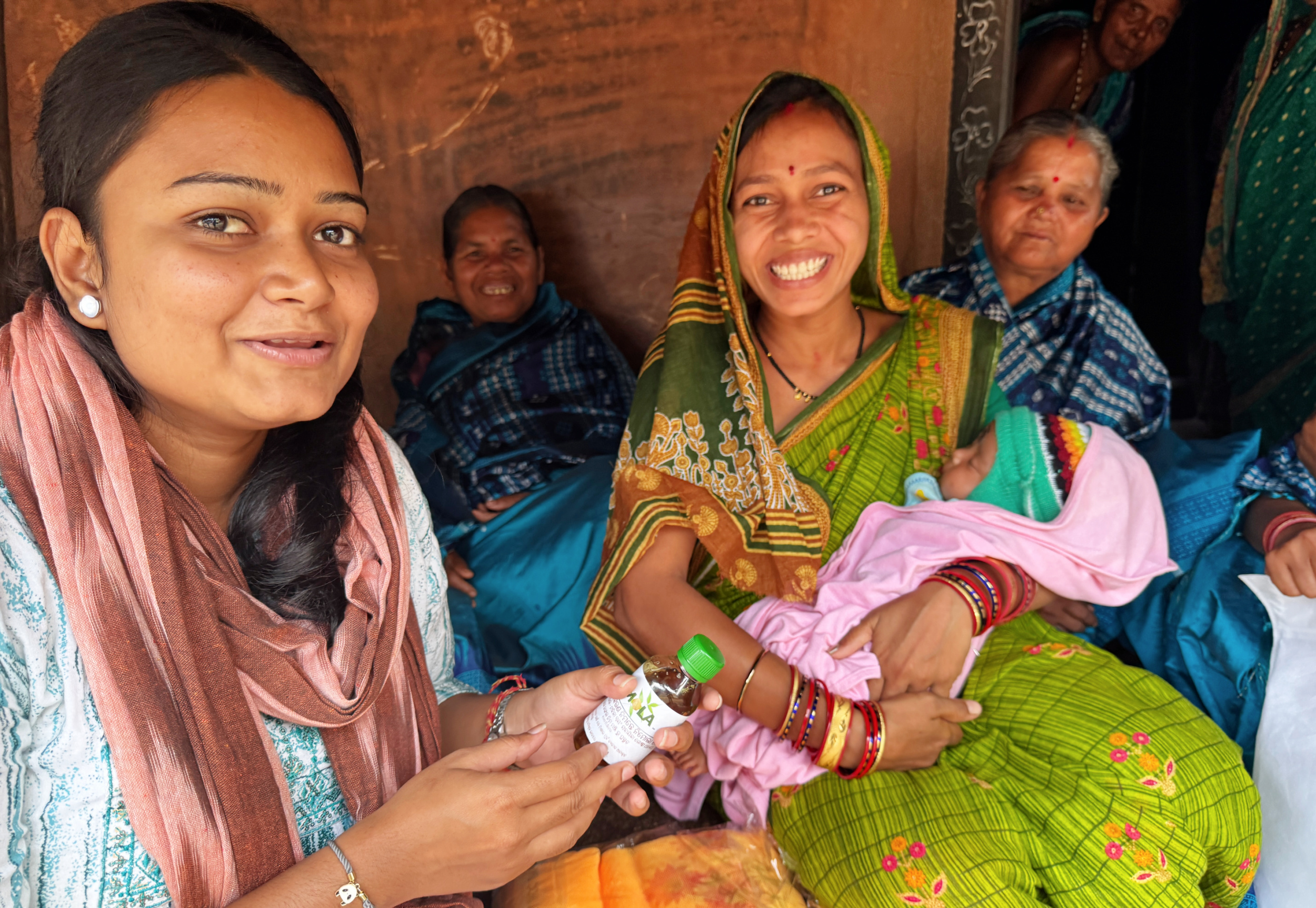
After a slow start, Hingula is now one of several SHG presidents who have become advocates for Neemola oil, and the AP visitors watched as she pulled up her sari and smeared oil on her legs, to hoots of laughter from neighbors sitting cross-legged on the ground. “They are calling her Ma Hingula!” explained Ms Mallick. “They are saying that she is so strong and so brave!”
Hingula applies Neemola oil every morning before going out into the fields and after bathing at night. As she told her audience, the oil has no smell and does not leave a sticky residue. Most important, it appears to reduce the itching from mosquitoes and skin disease. A 700 ml bottle can last for a month when used by a family of four.
The Neemola oil is also being promoted by Accredited Social Health Activists (ASHAs), government-appointed village leaders who monitor pregnant women in the villages and played a key role in JRP’s successful 2023 campaign against malaria. JRP feels that that their involvement, plus the advocacy of tribal leaders like Hingula, could explain why JRP has sold over two thirds of the bottles filled so far.
Profits go to members of the cooperative, who also receive 50 rupees for every kilo of seeds they collect. While the earnings are small the precedent is huge, say JRP officials, because they provide income to women in a community where wives have no say in how the family budget is spent. JRP hopes to follow up by training Self Help Groups in book-keeping and home economics.
Neemola is also opening up new possibilities for improving menstrual health and hygiene. JRP recently organized a seven-day training for SHGs that produced 861 re-usable pads. Twelve adolescent girls also participated.
Education is another beneficiary. Neemola provides an attractive motif for wall paintings and art competitions that spread the message of malaria prevention at tribal schools. JRP lined up several contests on World Malaria Day.
Neemola is even tapping into tribal culture through the pala dance, a crowd favorite in Odisha. AP visitors watched as the Satyanarayan dance ensemble promoted Neemola oil at a raucous concert in the village of Pankua. Krishna Chandra Pauda, the troupe’s lead singer who has been dancing for over 40 years, said that Neemola was a welcome new addition to their repertoire.
Other byproducts of the Neemola project are taking JRP into farming and agro-forestry. The process of extracting oil from the Neem seeds produces a rich solid waste that is packaged and given out to farmers as natural fertilizer.
Hingula’s Self Help Group is also one of several that planted Neem saplings last year in support of a government project to increase forest cover against climate change. JRP hopes to contribute at least 500 new Neem saplings in 2025.
*
As the Neemola project gathers pace, JRP and AP team members find themselves increasingly drawn to a way of life that is simple but rich.
Adin Becker, a student at Harvard who volunteered at JRP in 2024 as a Peace Fellow, described the appeal of forest life in his blogs. When Ms Mallick and her field team head out on field trips, they stop at a small temple to Sunadei, a forest goddess who is worshiped by tribal people in Odisha.
“I like these people because of their knowledge about trees, and their friendships.” said Ms Mallick during one village visit. “Whenever a family has a problem, everyone in the village comes to help. Maybe you are coming from the outside, but within a few minutes you will see how they become friends.”
This was echoed by Manu Mishra, who has also developed a deep affection for tribal people after years of working in their villages.
“I like (them) very much!” he said. “Their dress code, their way of living, their food habit – all are very useful, very attractive and very interesting. I want to adopt the same things in my own house!
“They are (saying to us) – protect your environment, be climate resilient, produce organic vegetables, live simply and don’t be so materialistic. That is their thinking, and I also want to say the same thing to the whole world.”






Aprana Jani, a teen club leader at her school in Pankua village, has a message for the world