
ADVOCACYNET 430, June 27, 2025
New Documentary Explores the Bond Between Nature and Tribal Women in India
Turning to the Neem tree to fight malaria
|
The Advocacy Project (AP) invites you on a video journey into the forests of Odisha state, India, to meet fifty tribal women who are turning to nature to fight malaria and improve their personal hygiene. Guided by our partner in Odisha, Jeevan Rekha Parishad (“Lifeline” – JRP), our new documentary Neemola paints an intimate portrait of women who are at ease with each other and with their environment, particularly the Neem trees that tower majestically over their villages. The journey begins at the JRP field office in the town of Daspalla, before visiting the shrine of Sunadei, a forest goddess, where travelers offer a prayer before venturing into the forests. Viewers then accompany Pratima Jani, who heads a women’s self-help group in the village of Sundartaila, as she collects leaves and bark from Neem trees (photo). Pratima will burn the leaves to keep mosquitoes at bay in her house. The video shows tribal women producing food which is nutritious, organic and completely free from additives. They are seen planting rice during the rainy season, harvesting rice and using a traditional wooden dheki to pound the rice into flour. Neighbors often cook and eat together. While such scenes are appealing, tribal women also face serious threats to their health, well-being, and privacy. Odisha suffers from the second highest rate of malaria in India and tribal villagers are particularly vulnerable because of their isolation and exposure to mosquitoes. Hygiene is also challenging. Tribal houses do not have toilets and women usually bathe under a pump in the open. Older tribal women rarely use sanitary pads, and this leaves them vulnerable to reproductive tract infections. Government health services are few and far between. Neem products have long been known as a natural anti-malarial, and last year JRP and AP launched a start-up to turn Neem seeds into a mosquito repellent. Fifty women signed up and formed a cooperative. The documentary follows co-op members as they collect seeds from the forest floor. A second group then presses the seeds into oil at the JRP field office in Daspalla. The cooperative filled 2,700 bottles of oil last year and sold half, providing several members with their first disposable income. Neemola also describes how the oil has taken hold among villagers, who are usually cautious of innovation. The camera follows Abhilipsa Mallick, a JRP field officer, into the village of Tilipadr where she hands out Neemola oil to pregnant mothers, along with mosquito nets and soap. Abhilipsa then visits Dugudi village where she gets an assist from Hingula Jani, the much-respected president of the village self-help group. Hingula applies the oil to her legs while her neighbors look on in admiration: “She is Ma Hingula! She is so strong and so brave!” JRP is also turning to tribal culture and schools to spread the message. Viewers watch as Rebati Mallik, 15, paints a Neem tree onto a wall at the Kainyadiha school. They then attend a raucous pala concert from the Satyanarayan (“Lord Krishna”) dance ensemble in Pankua village. It is too soon to claim even a modest success in the fight against malaria, but villagers report that Neemola oil soothes the itch from mosquito bites and skin rashes – and this is seen as a win. Income from the oil could also provide women with a source of income and some independence. Perhaps most significant, JRP is beginning to feel that Neemola oil can help women develop a daily routine of self-care that will also improve their hygiene. “I can’t say that Neemola oil completely prevents malaria,” says Ms Mallick from JRP. “What we are saying is that it can be a good habit if they use (it) on a regular basis and take a bath and after that they change the pads. It’s a complete process.” Dr Manoranjan Mishra, the founder and president of JRP, agrees and adds: “I like tribal people very much. Their way of living, their food habits – all are very attractive and very useful. They are (saying) – ‘protect your environment, be climate resilient, don’t be so materialistic.’ That is their thinking and I also want to say the same thing to the whole world.”
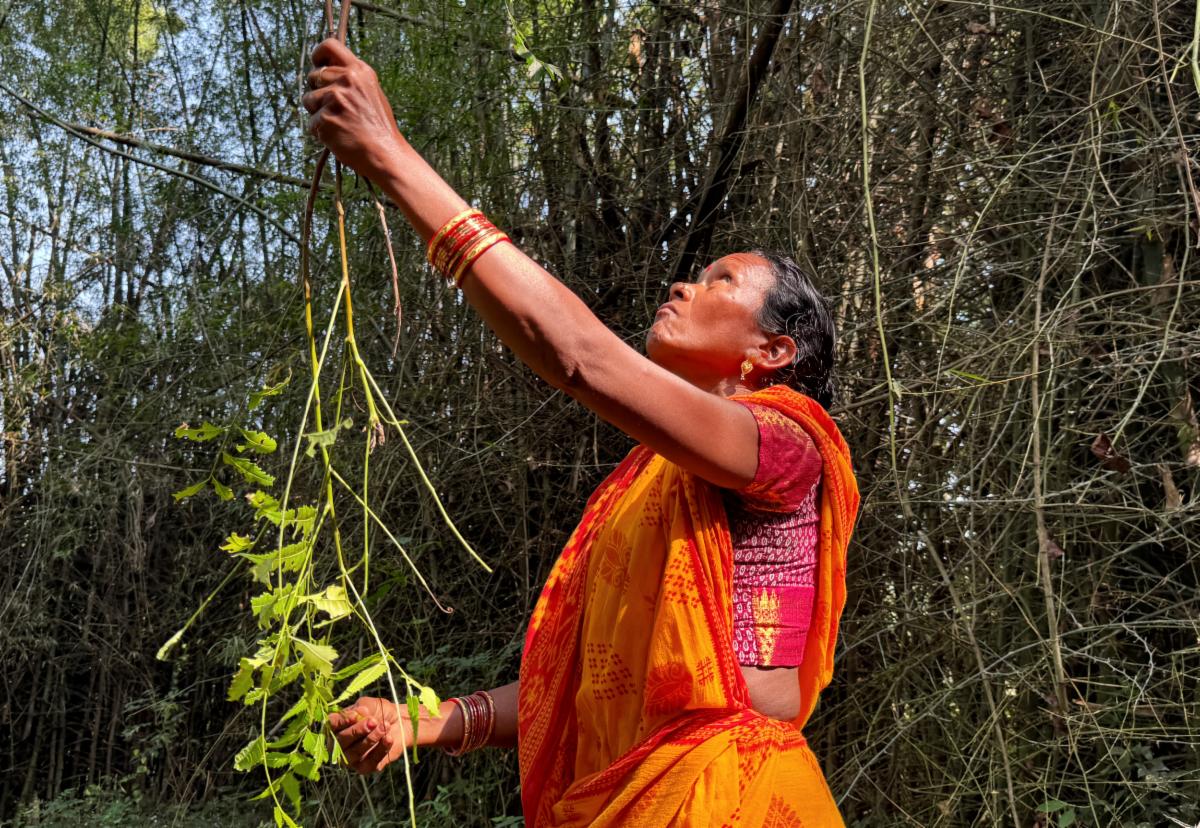 Pratima Jani, president of the Sundartaila women’s self-help group, collects leaves and bark from Neem trees near her house * |