
ADVOCACYNET 433, August 20, 2025
Conflict Survivors in Nepal Turn to the Supreme Court As Tension Builds Again Over Transitional Justice
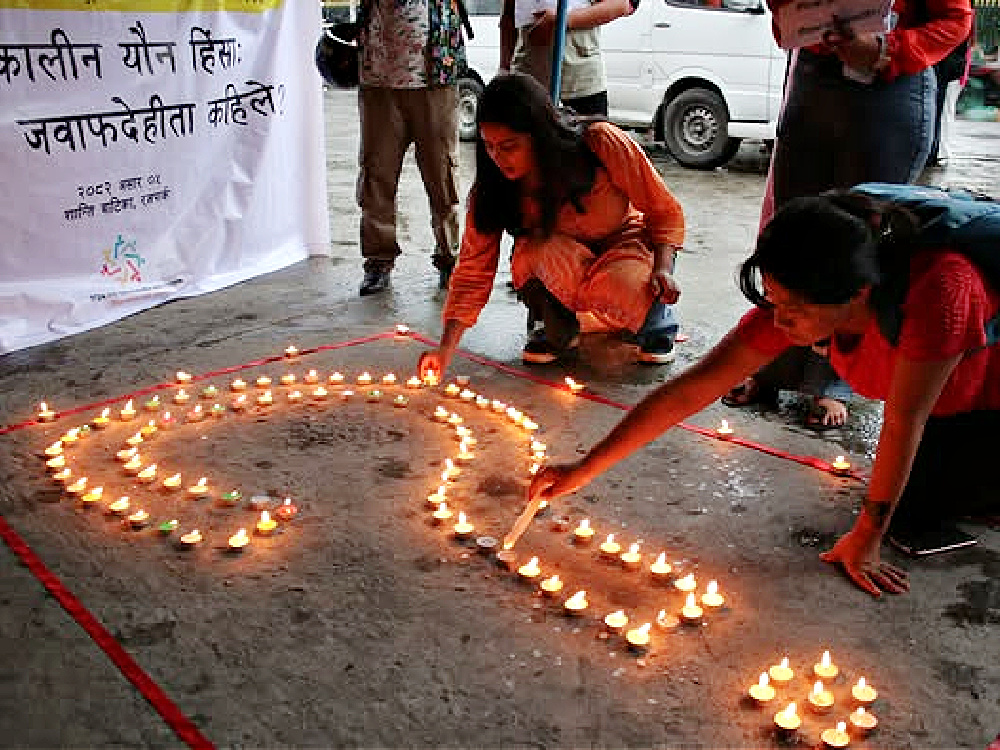
Silent no more: Candles were lit on June 19 in Kathmandu to ask why no action has been taken to punish crimes of sexual violence committed during the conflict, and why women are not being heard in the search for transitional justice. Read Shuyuan’s blog.
Victims and survivors have asked the Supreme Court of Nepal to force the government to include them in efforts to heal the wounds of the conflict that lasted from 1996 to 2006 and resulted in thousands of killings, disappearances, and the extensive use of sexual violence and torture.
The survivors’ petition, which was filed last week in Kathmandu, represents an escalation in a decade-long campaign to participate as equal partners in developing a system of transitional justice that will address their needs.
The petition also marks a major change from August last year, when survivors sided with the government of Prime Minister KP Sharma Oli in support of a controversial law that reduced sentences for serious crimes committed during the conflict by 75%. Read about the law here.
The latest confrontation began last November, when the government excluded survivors from the process to nominate ten members to two commissions that will investigate disappearances and promote truth and reconciliation.
In April the government presented its own slate of names, again without consulting the survivors as required by the 2024 law and a previous ruling of the Supreme Court.
“Yes, it now looks a bit like open war,” said Dr Ram Bhandari, one of the leaders of the survivors’ movement who sided with the government last year in spite of misgivings over the reduction of sentences. “But it’s become a question of our dignity. They are trying to deny our movement.”
The petition filed last week has wide support from the survivors and was accompanied by 334 signatures from 67 of the country’s 77 districts. It is seen as a threat to the government because the Supreme Court is widely respected in Nepal and abroad. There is little doubt that a negative ruling against the government could have major repercussions.
As a result, the survivors received multiple calls to withdraw the petition. Their suspicions grew when the court registrar, Man Bahadur Karki, delayed and then rejected the petition before it even reached the justices.
Mr Karki’s decision prompted a noisy protest outside the court and was promptly reversed by Justice Til Prasad Shrestha, himself a former registrar of the Court. A hearing has been scheduled for September 10.
*
Speaking over Zoom from Kathmandu, Dr Bhandari said that the appeal to the Court is only one part of a broad strategy to ensure that survivors stamp their mark on transitional justice and are not sidelined in the months ahead.
The strategy also includes a submission to the UN Human Rights Council, which will meet later this year to start reviewing Nepal’s human rights record through a process known as the Universal Periodic Review. The 20-page submission was filed recently by 47 victims’ groups and 26 human rights organizations and pulls no punches.
In parallel to this, survivors are working with Kathmandu University to establish a new multidisciplinary center that would offer classes on transitional justice to students in Nepal and from abroad. The School of Arts has offered space on its website and could house the center if, as is hoped, the University Senate agrees later this year.
Emma Cohen and Laila Azmy, two Peace Fellows from The Advocacy Project who visited Nepal last year on a study trip as undergraduates, have been helping Dr Bhandari develop a curriculum and identify academic programs in Europe and North America that might supply students.
The survivors have also launched a monthly newsletter, Survivors’ Record, which mixes news with profiles of communities that receive less public attention than they deserve. The first edition interviewed Devi Khadka, who was tortured and raped at the age of 17 and speaks for survivors and victims of sexual and gender-based violence. The second issue, released last Friday, profiled Prem Bayak, who represents former fighters with a disability.
A third AP Peace Fellow, Shuyuan Zhang, has been researching reparations, another key issue for survivors. Ms Zhang, a PhD student at the Maastricht Law School in the Netherlands, has found that most of the drive for reparations – not to mention new thinking – is coming from communities. Dr Bhandari agrees and estimates that over 100 municipalities are already engaging with families and could even find new resources, unencumbered by the political maneuverings that have impeded progress in Kathmandu.
All three Peace Fellows have backed up their work this summer with powerful blogs.
As a last resort, the survivors are even considering setting up their own truth commission, even though such a move could cause major embarrassment for the government, particularly if victims boycott the official commissions. Simon Robins, a well-known authority on transitional justice in Nepal, examines the history of civil society commissions in the second issue of the newsletter.
*
Dr Bhandari predicted that the next few weeks will see frantic jockeying in the run-up to the Supreme Court hearing in September and a pre-session of the UN Human Rights Council in November to consider the report on Nepal.
The government has offered to talk informally, but survivors see this as a ploy to stall and have demanded a formal negotiation and agenda.
A struggle is also underway to influence foreign donors, who will likely be asked by the government to fund reparations and provide technical support to the official commissions. The survivors are betting that Western governments will be reluctant to oppose them openly and the UK, US, EU and Swiss have been following developments closely. The UN office in Kathmandu has offered to broker talks with the donors.
While their dispute with the government is certainly unwelcome, survivors are unlikely to be deterred after enduring devastating personal loss and a decade of being manipulated by politicians. Indeed, said Dr Bhandari, the government’s attempt to sideline them, culminating in last week’s Supreme Court drama, has left them more united than ever.
They negotiate through a team of ten that represents all of the main survivor categories with the exception of former combatants. Their network of civil society allies is also expanding: scores of lawyers are advising on their Supreme Court petition, and they have received support from the Bar Association and former legal luminaries.
As a result, Dr Bhandari sees the deepening confrontation as an opportunity for the survivors to learn and grow, as people and advocates.
“I’m still optimistic and still inspired,” he said. “This is a journey of change for us as individuals and for our movement. We are all being transformed.”
- Read this White Paper, sent to the UN High Commissioner for Human Rights by 39 survivor groups in June
- Scroll to the bottom of this page to open the first two editions of The Survivor’s Record newsletter
*