
ADVOCACYNET 435 January 30, 2026
Transitional Justice in the Balance Again as Nepalis Prepare for Elections

Nepalis will elect a new government on March 5 following the nation-wide Gen Z protests last September. Survivors of the 1996-2006 conflict hope that an upcoming UN mission can build trust between them and the new government.
War survivors and victims in Nepal have asked a leading UN investigator to mediate in their long-running efforts to secure reparations and establish the truth about the brutal ten-year armed conflict that tore Nepali society apart between 1996 and 2006.
The appeal was made today to Bernard Duhaime, a widely respected Canadian law professor who monitors efforts to promote truth and reconciliation in post-conflict societies on behalf of the UN Human Rights Council. Professor Duhaime is due to visit Nepal in June.
The new initiative by survivors comes at a pivotal moment in Nepali politics, as the country prepares for elections on March 5 following the Gen Z riots last September that took the lives of 76 protesters and toppled the government.
Survivors are hoping that the new elections will produce a wave of young politicians, untainted by cronyism, who will engage with them as partners. They also hope that Professor Duhaime’s visit will build on the new mood of optimism and break a 14-year deadlock in securing justice.
“This could help us and also strengthen the UN’s human rights work,” said Ram Bhandari, a prominent advocate and academic whose father disappeared on December 31, 2001. “There have been so many ups and downs through the years. Maybe this time there will be a real change.”
*
The appeal to Professor Duhaime has been made by the Network of Families of the Disappeared (NEFAD), a longtime partner of The Advocacy Project (AP) that was established in 2009 by Dr Bhandari and represents the families of more than 1,500 Nepalis who disappeared during the conflict.
Acting on behalf of a large coalition of advocates and survivors, NEFAD has also submitted a new policy paper on reparations in Nepal to Professor Duhaime.
The paper is authored by Dr Shuyuan Zhang, a graduate of Maastricht University in the Netherlands, who volunteered at NEFAD as a Peace Fellow last summer. It draws on extensive interviews with family members in Kathmandu and Bardiya, which suffered more disappearances than any other district.
Aware that donors are unlikely to offer large sums of money for reparations, and that securing political consensus in Kathmandu could tie up the reparations debate for months, Dr Zhang has proposed a decentralized strategy that builds on creative new approaches to reparations that are emerging in municipalities with the enthusiastic support of local politicians.
Dr Zhang also notes that reparations can take different forms in addition to monetary compensation, including memorialization.
Speaking from Kathmandu, Dr Bhandari agreed and praised Dr Zhang’s vision. “What matters is that reparations are driven by affected communities and not imposed by politicians,” he said.
Dr Zhang’s new reparations paper is one of several recent initiatives launched by Dr Bhandari and his team last summer. These include a newsletter (“Survivor’s Record”) and a new center on transitional justice within the School of Arts at Kathmandu University.
The center will offer a 6-week academic course for foreign students this summer that will include field work and meetings with family members. Classes will start for Nepali studcnts in the Fall.
Both courses are being developed with help from Emma Cohen, another 2025 AP Peace Fellow who was working with Dr Bhandari when the demonstrations broke out in September.
AP is offering up to four scholarships of $1,000 to international students. Click here for more information.
*
While this progress is encouraging, Dr Bhandari expressed deep frustration that the political debate over transitional justice has been paralyzed since a bold new law in August 2024 agreed on a reparations package and revived two commissions to investigate truth and disappearances.
The 2024 law also stipulated that perpetrators of four serious crimes (disappearances, rape, torture and killing) should be punished, but that sentences could be reduced by 75% on all crimes except sexual violence. Click here for more on the 2024 law.
This compromise had the support of the main parties but was obstructed from the start by the government, led by Prime Minister K P Sharma Oli, which appointed commissioners without consulting survivors as mandated by the law. Survivors responded with disbelief and anger and held repeated protests outside the offices of the commissions.
The debate over transitional justice was suspended, along with political life, following the deadly Gen-Z riots last September. After Mr Oli resigned, an interim government was put in place headed by Sushila Karki, a former Supreme Court Chief Justice. The Supreme Court itself suspended operations after being trashed in the riots and losing over 50,000 case files.
The interim government set up an inquiry into the Gen Z deaths which has been boycotted by the former Prime Minister Oli. The two human rights commissions established under the 2024 law are on hold because they lack funds and a framework for launching investigations.
*
Against such a chaotic background, expectations for the interim government were low but Prime Minister Karki remained focused on building support for new elections. Her patience paid off and last week it was announced that a new parliament will be elected on March 5 under the supervision of the Nepal Army.
A nomination commission is now vetting candidates for parliament. Of the 275 seats, 110 will be filled through proportional representation from political parties and significant minorities like the Tharu and Dalit. Women will make up 33% of these seats. The remaining 165 seats will be filled on a first past the post basis.
Speaking from Kathmandu, Dr Bhandari described the election plan as a “remarkable achievement” by Prime Minister Karki, who reportedly has no political ambitions herself. He also compared the moment to other milestones in Nepal’s recent history, such the loosening of control by the King in 1990 known as the Loktantra (“democracy”), and the peace agreement of 2006 that ended the monarchy and restored democracy (the Ganatantra or “republic”).
Dr Bhandari described the current mood in Nepal as “excited and electrifying” and expressed the hope that the new parliament will elect a new generation of young political leaders.
One candidate, Balendra Shah, a charismatic rapper turned politician, recently resigned as the Mayor of Kathmandu and joined the Rastriya Swatantra Party as its candidate for prime minister. Mr Shah filed his candidacy in the constituency of the former Prime Minister Oli.
Another closely-watched race, in the district of Rukum East, will pit Pushpa Kamal Dahal, who launched the Maoist rebellion in 1996 and served three terms as Prime Minister after democracy was restored in 2006, against Sandeep Pun, another dynamic young candidate who has the support of the Gen Z movement.
Both of Mr Pun’s parents were Maoist cadres during the conflict that was launched by his political opponent, and both were killed. In the run-up to their contest, Mr Pun has denounced Mr Dahal as an old guard politician and “political tourist” because he is not a native of Rukum.
Dr Bhandari said that the survivors will not offer their own slate of candidates but will support up and coming politicians like Mr Pun, and lobby against candidates who have been linked to abuses committed during the conflict.
*
Professor Duhaime, the UN Rapporteur, is expected to arrive in mid-June. Survivors are hoping his visit will capitalize on the political awakening and help Nepalis to rediscover consensus over transitional justice.
The timing could not be better for an international intervention, said Dr Bhandari. The senior UN official (Resident Representative) in Nepal kept a low profile during the recent upheavals and will soon be replaced. The US ambassador has also left.
Other Western governments are marking time and waiting for the elections, although Switzerland has pledged $2 million to a new peace fund that will cover the operating cost of the two commissions once new regulations are drawn up.
All of this presents the UN Rapporteur with an unprecedented opportunity to build a strong foundation for social peace, said Dr Bhandari. He also expressed the hope that Professor Duhaime’s visit would build international interest in the bottom-up, survivor-led model of transitional justice emerging in Nepal.
● The Advocacy Project is offering four scholarships of $1,000 to study at the new center on traditional justice at Kathmandu University. Click here for information.
● Click here for the new policy paper on reparations by Dr Shuyuan Zhang.
● Open this page and scroll down for back issues of Survivor’s Record, the newsletter on transitional justice. Email Dr Bhandari to subscribe.
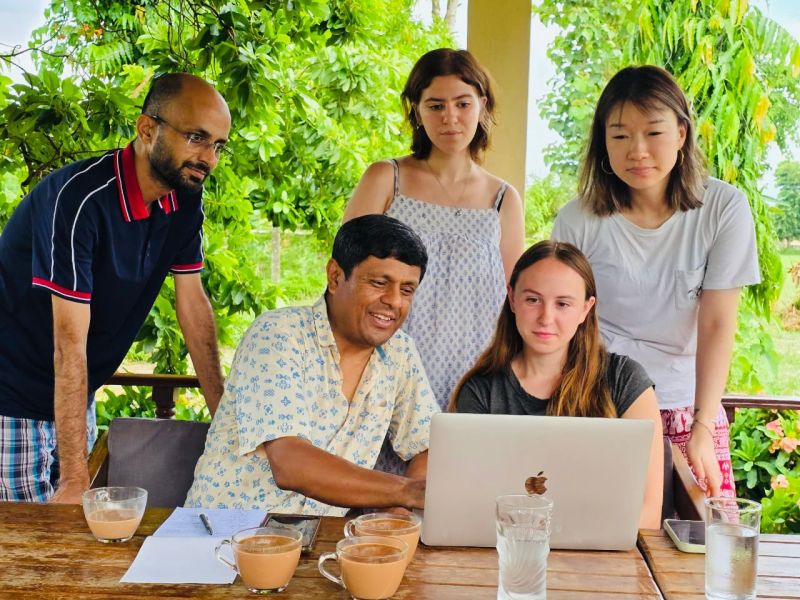
Ram Bhandari and his team prepare the first issue of Survivor’s Record, a newsletter on transitional justice, in July 2024. From the top left, clockwise: Niraj Acharya; Laila Azmy; Shuyuan Zhang; Emma Cohen; and Ram Bhandari.