
ADVOCACYNET 440, July 2, 2026
UN and Conflict Survivors at Odds Over Transitional Justice in Nepal
A new survivor-led center at Kathmandu University welcomes students from the US
Survivors of the 10-year conflict in Nepal are concerned that a new United Nations resource center in Kathmandu could seek to control the impassioned debate on transitional justice under way in the country and stifle innovative advocacy by survivors on sensitive topics like reparations and sexual violence.
Meanwhile, in an ambitious new survivor-led initiative, five US-based students will arrive shortly in Nepal to attend the inaugural course at the Center for Human Rights and Victims of Violations (CHRV).
CHRV was established last year in the School of Arts at Kathmandu University to offer a perspective of transitional justice based on the first-hand experience of conflict survivors. It is directed by Ram Bhandari PhD, whose father disappeared during the conflict on December 31, 2001. The Advocacy Project is supporting students with scholarships.
In spite of CHRV and other advances, survivors feel largely excluded from the process of establishing the new UN resource center.
The UN Development Program has already received $2 million for the center from the UN’s Peacebuilding Fund as well as funding from the Norwegian government. An official from the Office of the UN High Commissioner for Human Rights has been seconded to UNDP to support the new center.
*
The Maoist rebellion in Nepal ran from 1996 to 2006 and produced massive suffering. Dr Bhandari said that a number of active survivors have expressed concern at the UN plan.
Part of their discontent, he said, is due to UN salaries and overhead, which they feel would be better invested in survivors. But part is also due to a legacy of distrust dating back to the 2006 peace agreement that ended the war.
Under the agreement, the UN “verified” almost 20,000 Maoist fighters who were offered incentives to disarm and enlist in the Nepal Army. But the deal excluded 4,009 child soldiers who had been forcibly recruited by the Maoists but received no benefits.
Several former child soldiers have since committed suicide and a recent decision from the Supreme Court has thrust the issue back into the spotlight. The Court described the recruitment of the children as a war crime and ordered that they receive compensation.
The survivors and UN also clashed in 2015 after the UN boycotted two commissions on truth and disappearances which were established by a controversial law that also offered an amnesty to perpetrators.
The amnesty was rejected by the international community at the urging of the UN. Although survivors were also unhappy with the amnesty provision, they viewed the commissions pragmatically as a way to jump-start their own efforts to learn the truth, commemorate lost loved ones and secure reparations. In all, survivors submitted around 66,300 cases to the two commissions.
The distrust continued to fester after survivors supported landmark legislation in August 2024 that was accepted by all political parties and broke the deadlock over accountability by agreeing to a reduction in sentences for torture, killings and disappearances.
The law also revived the two commissions, but the government of Prime Minister KP Sharma Oli failed to consult survivors over the appointment of commissioners, as required by the law. This triggered an angry response from survivors. They were even more upset when the UN did not protest.
Dr Bhandari described current relations with the UNDP in Kathmandu as “cordial and respectful.” But he also warned that any attempt by the UN to monopolize and control transitional justice would be vigorously resisted.
Such a strategy would also be counter-productive, he said, because many innovations in the landmark 2024 law were inspired by survivors.
One far-sighted provision, with major implications for other societies emerging from conflict, stated that perpetrators of sexual violence could not benefit from a reduced sentence. This was included at the insistence of women leaders like Devi Khadka, one of more than 4,000 survivors of sexual violence, who lobbied for the law.
*
For many survivors, the new Center for Human Rights and Victims of Violations is precisely the sort of survivor-led initiative that deserves support from the international community.
The Center has produced twelve issues of a monthly newsletter, Survivors Record, which goes out to an international network of 250 academics. The latest issue includes an analysis of the controversy over child soldiers.
Dr Bhandari and his CHRV team are also finalizing the syllabus for their inaugural course on transitional justice that will begin in mid-July and run for six weeks.
The first cohort of five students are attending college at Wesleyan, Tufts, Boston and Wellesley in the US. Emma Cohen, their coordinator, was one of three Peace Fellows deployed by The Advocacy Project (AP) last year to help Dr Bhandari establish CHRV.
Funding for CHRV is coming from AP and an appeal on GlobalGiving which has raised over $5,000 from 24 supporters.
Dr Bhandari explained that unlike most mainstream human rights teaching, which focus on international law and process, CHRV’s course will be firmly rooted in a country that is still struggling for answers.
The first classes, in Kathmandu, will explore topics like truth, reparations, memorialization and accountability with practitioners like Ms Khadka, who helped broker the agreement over sexual violence in the 2024 law.
The classes will then move to Bardiya, which suffered more disappearances than any other district during the conflict, and is home to the indigenous Tharu population.
Here students will meet with community mobilizers, visit memory sites and review local approaches to reparations as explained in this paper by Dr Shuyuan Zhang PhD, an AP Peace Fellow who joined the CHRV team last year. This local perspective has remained largely invisible in Kathmandu.
In another innovation, the CHRV students will render their verdict on classes through regular blogs and posts on social media.
Dr Bhandari expressed the hope that the new course will offer students a unique learning experience while strengthening CHRV’s standing, expanding the pool of students in 2027 and attracting additional funding.
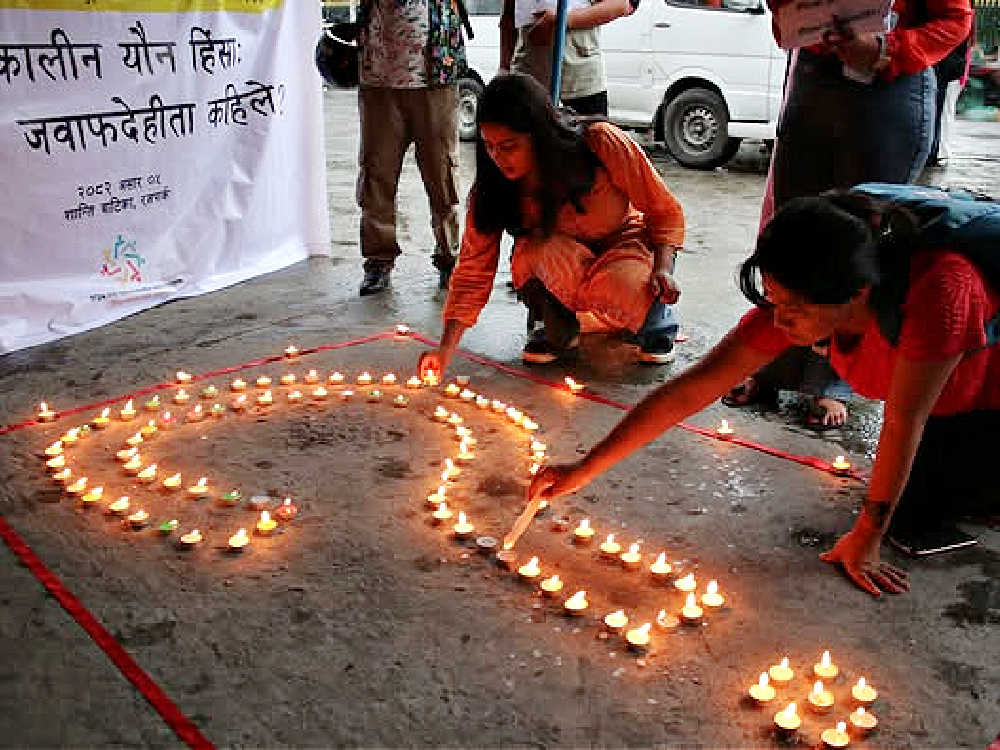
The first cohort of CHRV students will join family members in Kathmandu to observe the International Day of the Disappeared on August 30