
Dương Thị Sen and her daughter
Angiel Zheng, 2025 Peace Fellow, meets a single mother and Agent Orange survivor
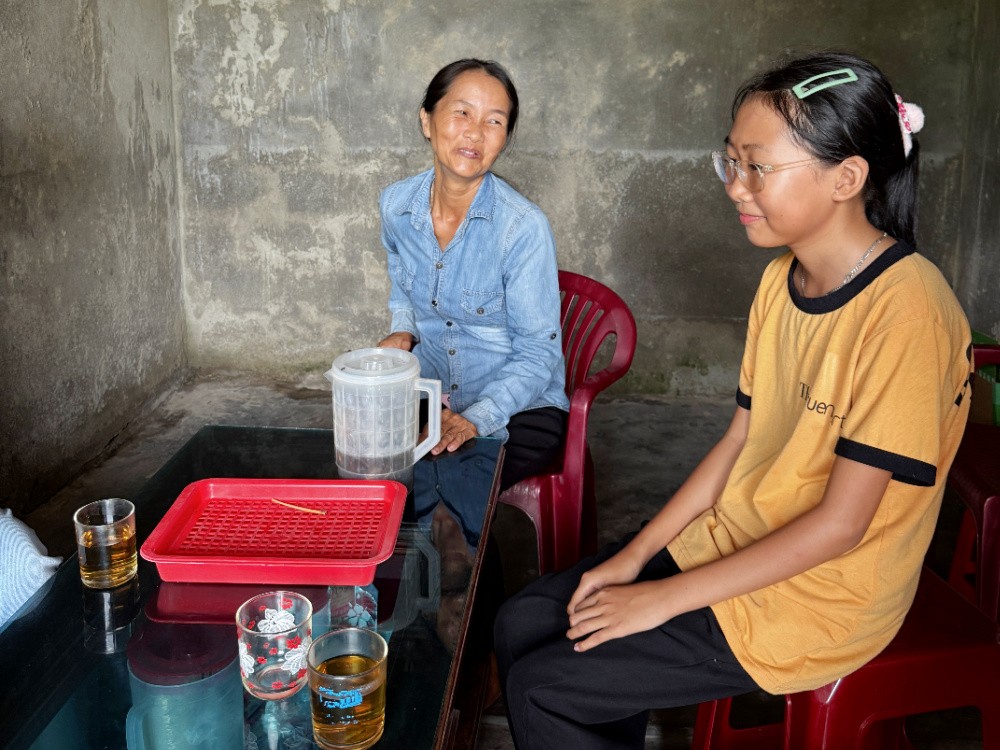
Dương Thị Sen, left, and her daughter Nguyên. Nguyên ofter interprets for her mother, who has a speech impediment as a result of being exposed to Agent Orange.
The drive to Bố Trạch takes us past rice paddies and quiet fields, the kind of scenery that makes time feel slower. I am traveling with the AEPD team: director Hồng, outreach officer Nguyên, and Hồng’s daughter, Quyên, who will be my translator for the day. In the car, Hồng, Nguyên, and the driver speak in an easy rhythm of Vietnamese conversation. Beside me, Quyên and I find common ground quickly. We are the same age, and our talk flows from college to music to what it is like growing up here.
Today, we are visiting two women affected by Agent Orange: Dương Thị Sen and Võ Thị Thảo. In Vietnam, as elsewhere, disability and gender intersect in ways that deepen vulnerability. Women with disabilities often face barriers to education, limited job opportunities, and heightened economic dependence on family or spouses. In the case of Agent Orange, these inequities are compounded by the generational aspect of poisoning, the stigma surrounding disability, and the heavy caregiving responsibilities women often shoulder, whether as survivors themselves or as caretakers for affected relatives. This history shapes the gaze I bring to the visits, a sense of where gender and disability might surface in the patterns of daily life. I know this gaze is porous. It lets in some things and leaves others at the edges. By the end of the day, I expect it will have shifted, gently, perhaps without my noticing, under the influence of the women themselves.
Sen is already outside when we arrive, standing in the narrow strip of shade by her doorway. She looks up at the sound of the car, her face opening into a smile that reaches her eyes. Her daughter lingers just behind her, shy and curious, hair neatly pulled back with two small clips holding the shorter strands in place.
Sen is a single mother and second-generation survivor of Agent Orange, living with the lasting effects of exposure: a repaired cleft lip, a speech and hearing impairment, mild intellectual disability, physical weakness, and chronic pain. Her daughter, now in eighth grade, often translates for her so others can understand. It is a role she seems to slip into naturally, folded into the small rituals of their daily life.
Life here moves at the pace of the seasons. Most mornings, Sen is out in the fields, stooping to gather bunches of herbs, the damp earth clinging to her sandals. She ties the stems together in neat bundles to sell at the market. Later, she cuts armfuls of grass for the buffalo, unlatching the wooden gate and spreading the grass over the worn ground. Inside the house, she cooks for herself and her daughter. Rice steams in a metal pot, and vegetables simmer on the stove.
Sen tells me this is how most days begin and end: tending the plants, the animals, the meals. As she walks me through her day, I find myself watching the way her hands move. They are precise, unhurried, carrying out tasks she has done so many times.
In 2024, Sen received a livelihood sponsorship from The Advocacy Project in the form of a breeding buffalo. She chose the buffalo because the calves could provide a more stable source of income over time, and the animal’s manure would help fertilize her fields. While the buffalo has not yet brought in much money, it recently gave birth to a calf that will soon be sold. Sen’s daughter relays that Calves of this size typically sell for 7-15 million đồng ($266-$571), the price depending on their health and build. Buyers here often prefer smaller buffalos; they are easier to handle, especially when the floods come and livestock must be led to higher ground.
Partway through the interview, Sen’s brother appears in the doorway and takes a seat beside us. He is older, perhaps in his sixties, with a calm, serious manner. For a while he listens, then speaks, his voice low and steady. It is he who takes the buffalo the long distance to higher ground when the storms come. Sen and her thirteen-year-old daughter do not have the strength to pull the animal that far. Before the rain arrives, he loops a rope around its neck and guides it up the narrow path, the ground slick beneath their hooves. Each year, the climb feels longer, the weight more pronounced. He admits he does not know how they will manage in the years ahead, as he grows older and weaker.
When I ask Sen about her future, she says she would like to raise a pig. It would be another source of income, steady enough to sit alongside the herbs and the buffalo. When I ask about her hopes and dreams, her answer turns almost immediately toward her daughter. She wants her to continue her education on to high school, perhaps university. The hope is clear, though it arrives with a worry: how she will pay for it, and what will happen to her daughter if her own health fails.
She looks over then, and her face softens.
“She’s smart,” Sen beams. “She does well in school.”
Her daughter lowers her head, smiling in a way that feels both bashful and pleased. The air between them is warm, familiar. I notice the way the moment seems to close around them, how the talk of livestock, floods, and uphill climbs loses its shape. What remains is a small, intimate circuit of affection. I hold this close to my chest.

Dương Thị Sen received a buffalo from AEPD and AP in 2024