
Nguyen Huu Phuc, Nguyen Thi Thanh, and Their Family
A family transitions from rice to cows to provide for their children
Profile by Peace Fellow Marcela De Campos, July 2018We visited Mr. Phuc’s family on July 4, 2018. They are the ninth Agent Orange family to benefit from the AEPD/AP campaign. I am pleased to report that we are on the way to supprting three families this year! Meet Mr. Nguyen Huu Phuc’s Family
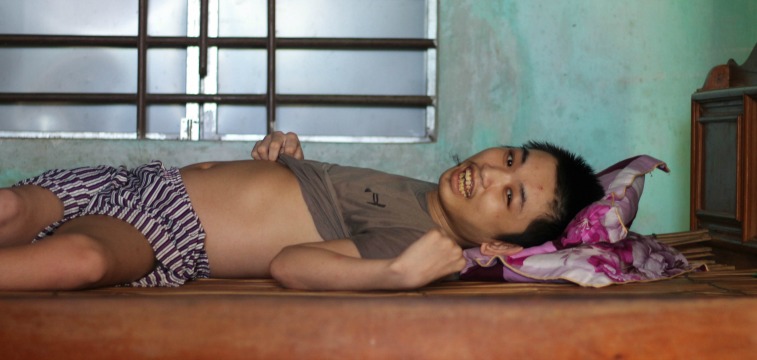
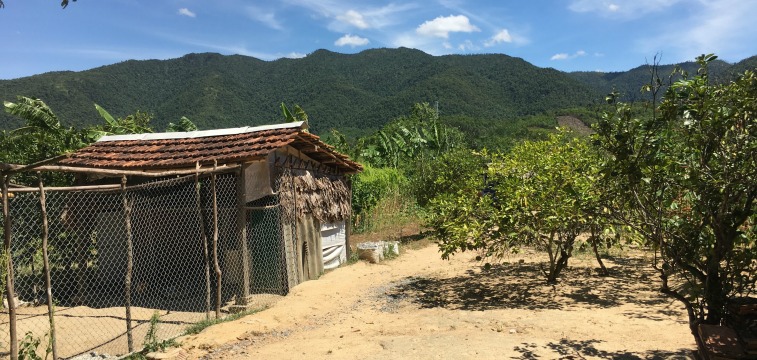
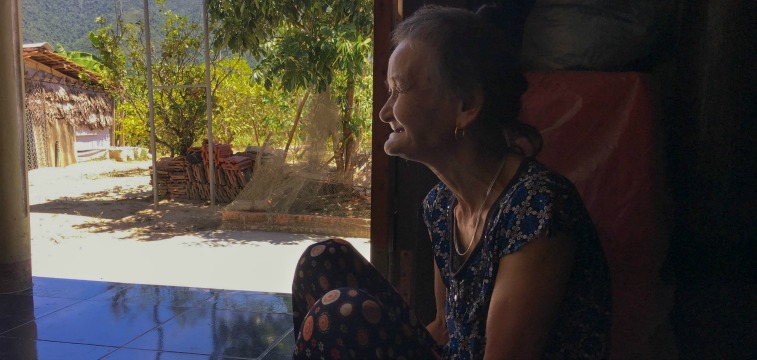
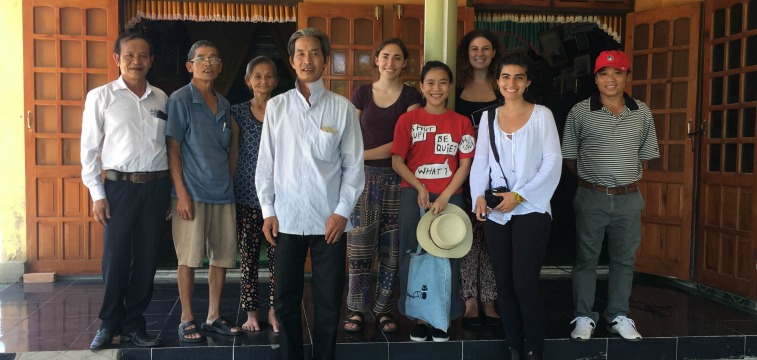
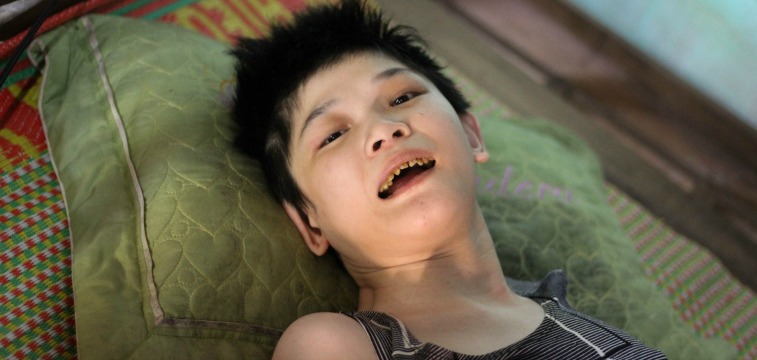
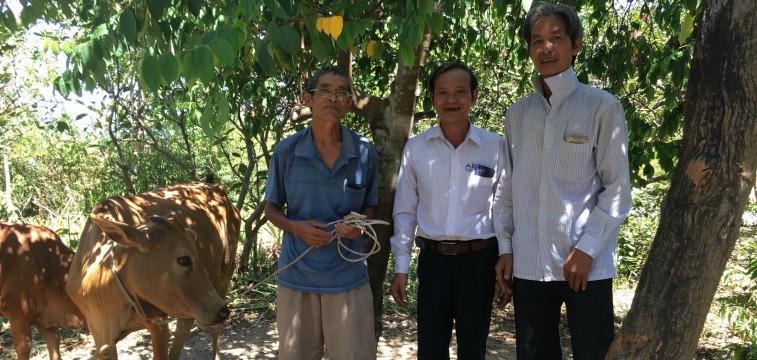
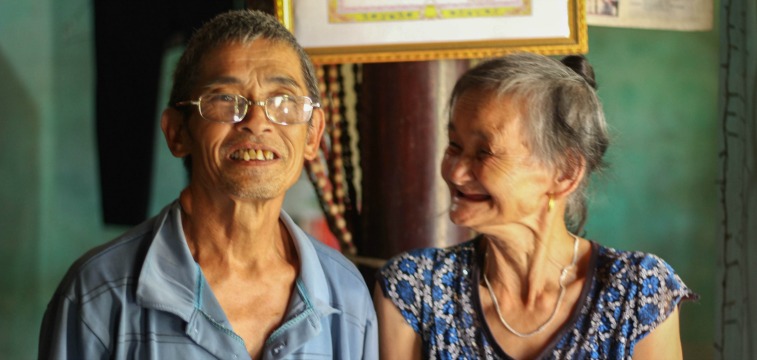
Mr. Nguyen Huu Phuc and his wife, Ms. Nguyen Thi Thanh, live in the Tuyen Hoa district of the Quang Binh province. The couple had eight children. Five were affected by Agent Orange. Two died some time ago. Of the three surviving siblings, Tam (son) and Nam (daughter) live with their parents. the third sibling, Nguyen The Bay (son) has mental disabilities but is able to live in his own home nearby. He receives 1.4M VND (~$60 USD) per month in Agent Orange compensation. Nguyen Thi Nam, 28, was born with cerebral palsy. Her parents receive 1.4M VND ($60) for her in compensation. She is completely dependent on her parents and spends most of the time on her bed near the kitchen. When we visited, the heat was unforgiving. Sitting under a fan, Nam looked comfortable in the coolest area of the home. I greeted her as I approached and she responded with a smile, tracking the camera as I leaned in to take her portrait. Ms. Thanh smiled as she watched this interaction. Nam’s brother Nguyen Van Tam, 25, was born with cerebral palsy and also receives 1.4M VND ($60) a month in compensation. He spends most days lying on his bed in front of the home’s double doors. During our conversation, his father alternates between sitting on the floor with us and sitting beside Tam, holding his hand gently and caressing his hair. Mr. Phuc Received His Cow and Calf Mr. Phuc, Mr. Hoc, and Mr. Tam (the cow salesman) pose for a photograph upon the cow and calf’s official purchase. In consultation with Mr. Hoc, an AEPD Outreach Worker, Mr. Phuc elected to rear a cow and calf. Mr. Phuc explained that he and his wife are aging and their health is declining. They will use the female cow to produce fertilizer and calves for sale to supplement the income they earn from their 1,000 square meters of rice field. The couple used to raise pigs but found it too intensive and risky. When they can no longer manage their rice field, they will live on the income from their cow. Visiting Mr. Phuc’s family was particulary special because we witnessed Mr. Phuc receiving his cow and calf from the cow salesman. Mr. Hoc, an Outreach Worker fro AEPD, facilitated the sale as required by our model. After Mr. Tam, the cow salesman, arrived Mr. Hoc and Mr. Phuc reviewed the business plan and confirmed Mr. Phuc’s agreement. Mr. Hoc pulled out money from his backpack and counted it in front of all of us (cow salesman included). He then handed it over to the cow salesman and asked him to count it, again out loud. Mr. Hoc took a video of this exchange as proof of payment. The cow salesman nodded in agreement and looked over to Mr. Phuc. We all got up, put on our shoes, and headed to the small garden in front of Mr. Phuc’s home. Holding the cow’s rope, Mr. Hoc said a few words, shook hands with the salesman, and proudly handed over the rope to Mr. Phuc. In that moment, the cow and calf were officially purchased and the business plan had launched.  A snap of the team. From left to right: Mr. Hoc (AEPD Outreach Worker), Mr. Phuc, Ms. Thanh, Mr. Tam (cow salesman), AEPD Staff (Ashley, Ngoc, Seanin, me, and Mr. Vinh).
Update by Mia Coward, August 2019Mr. Phuc, Ms. Thanh, and AEPD outreach worker As we drive further into the more mountainous area of Quang Binh province, we arrive at the home of Nguyen Huu Phuc and his wife Nguyen Thanh received their cow and calf in July 2018. As soon as we get down from the car, dogs begin to bark and we are all careful not to upset them. Ms.Thanh tells the dogs to move away and we are very grateful! I can see the cow and calf purchased by AP in the yard. Like many of the male veterans we meet, Mr. Phuc is adjusting his uniform when we enter his yard. He tells us that he was exposed to Agent Orange in 1971-1972, when he was in the jungle near the border between Vietnam and Laos. American plans began to spray the fields and Mr Phuc thinks that the trees began to die almost at once. The air and water was also polluted. Like other soldiers he remained in the area for some time. The cow and calf are doing quite well, and the cow will give birth in about 2 months. Mr Phuc uses the cows for fertilizer and has no plans to sell them. Before he was given the cow and calf he had to borrow a cow from neighbors for plowing. The family also has about 10 chickens and grow rice which provide food for the household, although the harvest was smaller than usual because of drought (which meant there was no surplus to sell). The next harvest will be in August and neighbors will help, but after that it will fall on Mr Phuc and his wife. They seem frail and tired but laugh a lot during our visit. During our conversation, we are joined by the vice-president of the local people’s Communal Committee. He is responsible for vulnerable groups and talks to the couple a lot. Mr Phuc does not have much to say in response. Tam, 26 The two children that live in the house, Nguyen Thi Nam, 29, and Nguyen Vam Tan, 26, depend entirely o their parents, particularly their mother. Both were born with cerebral palsy and their parents worry about getting too old to care for them properly. As it is, they find it difficult to take their children to the nearby clinic when they have a cough or cold. Earlier this year Tan suffered a seizure and had to stay in the hospital for a week. The medical bills were paid by health insurance and relatives, which meant that Mr Phuc only had to pay for food. Sometimes a local doctor will visit the home to do a check-up. Mr. Phuc’s health has not changed much since our last visit but his wife seems to be suffering from some pain and holds her stomach as we talk. In addition to their own household, Ms Thanh also looks after their third son, Nguyen The Bay, who lives next door but suffers from mental illness. Mr. Phuc and his wife carry the burden for the entire family. Mr. Phuc and his family receive government compensation. As Agent Orange victims, each child receives about 1,514,000 VND per month. Mr. Phuc receives about 2M VND per month and his wife receives 540,000 VND as caregivers. This is enough to buy food, medication and other household supplies but does not cover other household costs. Mr. Phuc’s son Nguyen Van Tam Mr. Phuc also worries about repaying a 50M VND loan that he received from a bank nearly 5 years ago. The loan carries an interest rate of 400,000 VND a month. We ask if he would be interested in another loan, or in joining a savings group. His frank answer is no. As he and his wife grow older, their ability to work – and repay loans – shrinks. Right now, Mr Phuc does not receive enough to save or contribute to a savings loan. One of Mr Phuc’s main concerns is clean water. The has a well, but it is not yielding enough water and Mr Phuc will have to dig deeper at a cost of 25M VND. He is worried about the cost. The children need clean water to protect their skin while they are confined to their beds. The Vice-President explains that the local government will not be able to help, because they recently paid to build a house for Mr Phuc’s third son, Bay: “There is only a certain amount of money that can be allocated each year for vulnerable families.” It could yet be that Mr Phuc is forced to take out another loan to pay for clean water, putting more pressure on the family. Update by Angie Zheng, July 2025It is hot by the time we reach the Phucs’ home. The road winds slightly uphill, taking us away from the busier center of the commune. At the top, their house opens into a courtyard, shaded and still. Two dogs lift their heads as we approach, and then quickly lose interest, letting us pass. Chickens scatter at our feet. Mai and Minh, my colleagues from AEPD, call out a greeting, and Mr. and Mrs. Phuc emerge from the doorway. They smile and wave us in, pulling up chairs around a low table. Someone sets out cups of tea. The first half-hour is slow and unhurried. Mai and Minh talk with the couple in Vietnamese: casual questions, neighbors’ news, small jokes that make everyone laugh. I can’t follow most of the conversation, but I can feel the rhythm of it: a cadence of growing comfort. Mrs. Phuc laughs easily, her floral shirt bright against the wooden chair, her teeth flashing in the afternoon light. Mr. Phuc listens quietly, smiling when she teases him. The dogs bark occasionally from the yard until Mrs. Phuc shushes them and they trot off obediently. When Mai gently asks if Mr. Phuc could share his story, he nods and begins. His voice is steady, not theatrical, as though telling something that has been told many times. He describes where he was during the war, how he was exposed to Agent Orange, and the illnesses that followed. He talks about his daughter Nguyen Thi Nam, now 35, how she was born with severe disabilities, how she has dealt with chronic illness all her life. As he speaks, I think of the broader history that threads through this family’s life. Agent Orange, a defoliant sprayed by the U.S. military across millions of acres during the war, continues to poison soil and water in Vietnam decades later. It has also left a legacy of intergenerational harm. Children and grandchildren of those exposed are often born with congenital disabilities and chronic illness. In the U.S., veterans fought a long, bitter battle to get even partial acknowledgment of these effects. It took years of litigation against the chemical companies that produced Agent Orange before a handful of illnesses were recognized as connected, and even then, compensation was limited. Victims in Vietnam, like Mr. Phuc, have never received reparations from the U.S. government. And the only form of reparations for the war, the USAID War Legacies Program, was halted under the Trump administration. When the story turns toward the present, Mr. Phuc tells us about the cow they once raised. The cow was provided through by AP and AEPD through their livelihood sponsorship project, an effort to generate sustainable income for families living with the effects of Agent Orange. For a few years, it worked well for the family. But as Mr. and Mrs. Phuc got older, and as their daughter’s needs became more demanding, caring for the cow became too much. They decided to sell it and use the money to raise chickens instead. Mr. Phuc gestures toward the yard where several chickens roam. They are smaller, quieter, easier to care for. The couple earns less money now, but they seem at peace with the trade-off. “It’s enough,” Mai translates. When Mai asks about their daily life, Mrs. Phuc becomes animated. She describes her morning routine: rising early to sweep the yard, cook breakfast for her husband and daughter, prepare food for the dogs and chickens. She lists the tasks matter-of-factly: bathing and dressing her daughter, cleaning the bed, cooking lunch, washing dishes, tending the animals, sweeping again. As she speaks, I picture her moving through these rooms, her day a cycle of care. She tells me this with a wide, toothy grin. She does not present the work as a burden, though I know it must be tiring. It’s not lost on me that caregiving often manifests along gendered lines in these visits. It is Mrs. Phúc who wakes early to sweep the yard, who mixes the rice porridge, feeds the chickens and dogs, bathes her daughter, dresses her, tends to the smallest tasks and the constant ones. Watching her, I think of Mobilizing Morality, a study of caregivers in Vietnam, where women speak not of burden but of trách nhiệm, tình cảm, and lòng hiếu thảo (responsibility, affection, filial duty). In Mrs. Phúc, I see caregiving with warmth, with a kind of acceptance, embedded in the texture of everyday life. It makes me question what caregiving might mean in other settings, how relational care and interdependence could be more valued, more visible. At some point, we rise and follow Mr. and Mrs. Phuc back into the house, where they wish to introduce their daughter. She is lying on a wooden bed under a blue mosquito net. The light is dim, cool, a relief from the heat outside. She looks up at us and smiles, her mouth opening wide. Mrs. Phuc sits on the bed beside her, holding her hand as she introduces her to us. Mr. Phuc stands at the foot of the bed, listening quietly. They speak to her in Vietnamese — their voices soft, warm — and her smile widens. Afterward, Mrs. Phuc takes me through the rest of the home. She shows me the kitchen, proudly pointing out the jars of pickled vegetables lined up on the counter, the pots on the stove, the glass-front cabinet neatly filled with dishes. She gestures toward a make-shift hammock next to the bed and urges me to try it. The dogs follow us in and out of rooms. She scolds them when they bark, but her voice is fond. It is clear that she loves them, just as she loves the chickens, the plants, the house. Everything here feels tended to, even the smallest corner. Before we leave, I ask if we might take a photo of the family together. They agree. We walk back to the bedroom, where their daughter Nguyen Thi Nam is still lying. Mrs. Phuc leans over her and begins adjusting her blouse, smoothing the wrinkles with her hand. She murmurs something, low and rhythmic, as if just for her daughter. Her daughter laughs, her grin stretching across her face. It is such an ordinary gesture, but I find myself holding my breath as I watch. This is a kind of love that does not need an audience, a camera, a visitor from far away. It is the love that sustains this house every single day. As we leave, I think about everything they have told me: the history of the war, the cow they once kept, the roof they hope to repair, the chickens roaming the yard. I think about Mrs. Phuc’s hands smoothing her daughter’s shirt, the softness of that gesture. It is tempting to turn this into a story about resilience, about the triumph of the human spirit. But that feels too tidy. Their lives are ongoing. They do not end when I walk away. There will still be chickens to feed, a daughter to care for, a roof to fix before the next flood. For a few hours, I was allowed to sit with them, get to know them, and hear their stories. This, I hold close to my chest.
|
