Tag Archive: arrival
-
The Monsoon is Coming
3 CommentsAs a seasoned traveler, I don’t approach journeys to far-away places with the same apprehension that I used to. If I can thrive in Zimbabwe, Ghana, Kenya, and Uzbekistan, I could certainly make my way in India. However, I couldn’t shake the feeling that I would encounter problems at the border. Previously, while conducting research for my Watson Fellowship titled Jewish Persistence in the Periphery of the Diaspora, I received two Indian visa rejections and was later told by the Bureau of Immigration that any future applications would be heavily scrutinized. It’s safe to say that I was relieved when I crossed the border without needing to answer a single question.
Fortunately, the rest of my journey was as uneventful as immigration in New Delhi turned out to be. It was draining, however. I never sleep well on planes, and three night flights combined with a 2am layover in the Delhi airport meant I stayed awake for nearly 72 consecutive hours. Simultaneously too tired to focus and unable to rest, I spent some of my journey reading and even more time staring into space in dimly lit aircraft cabins.
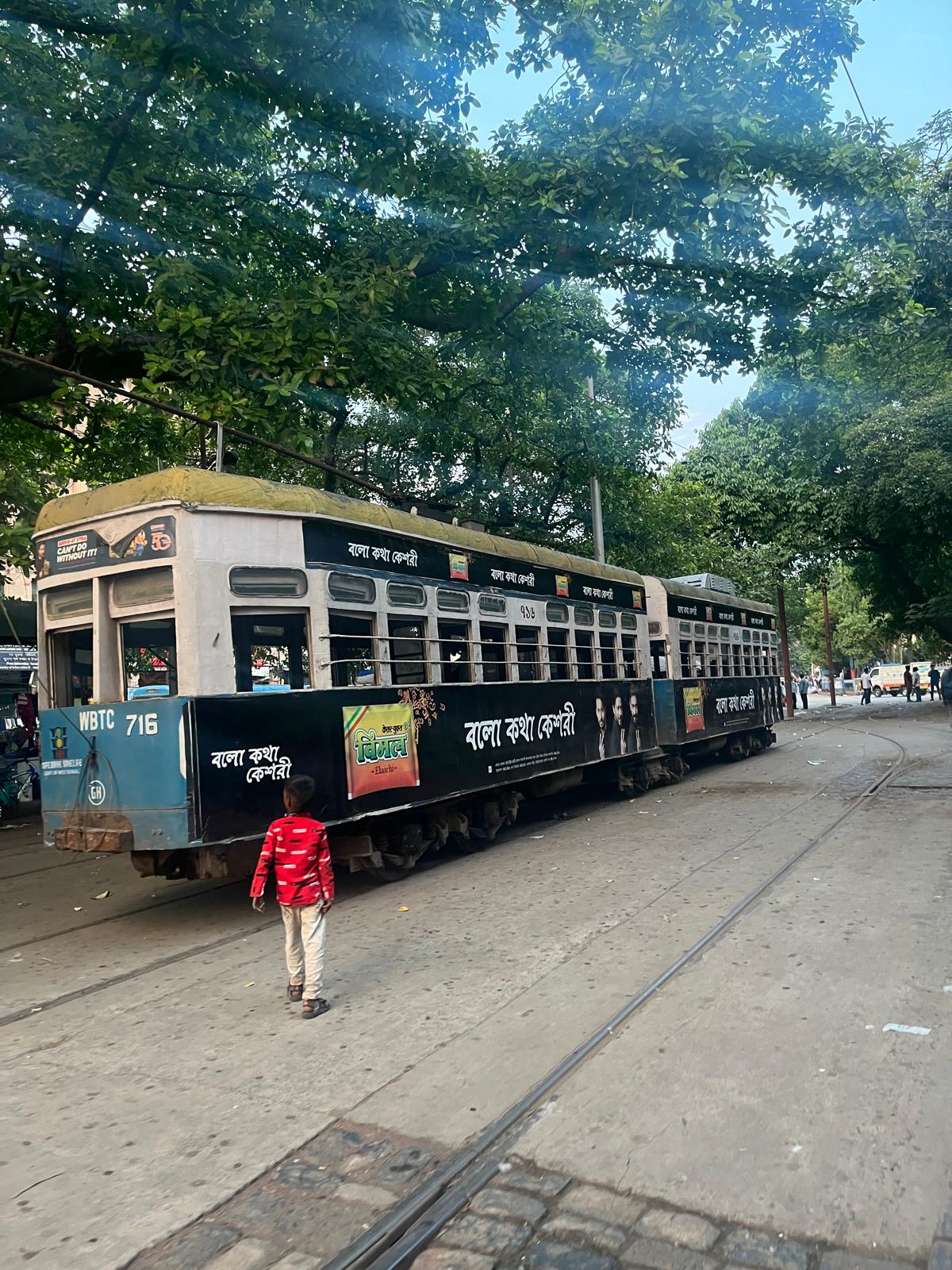
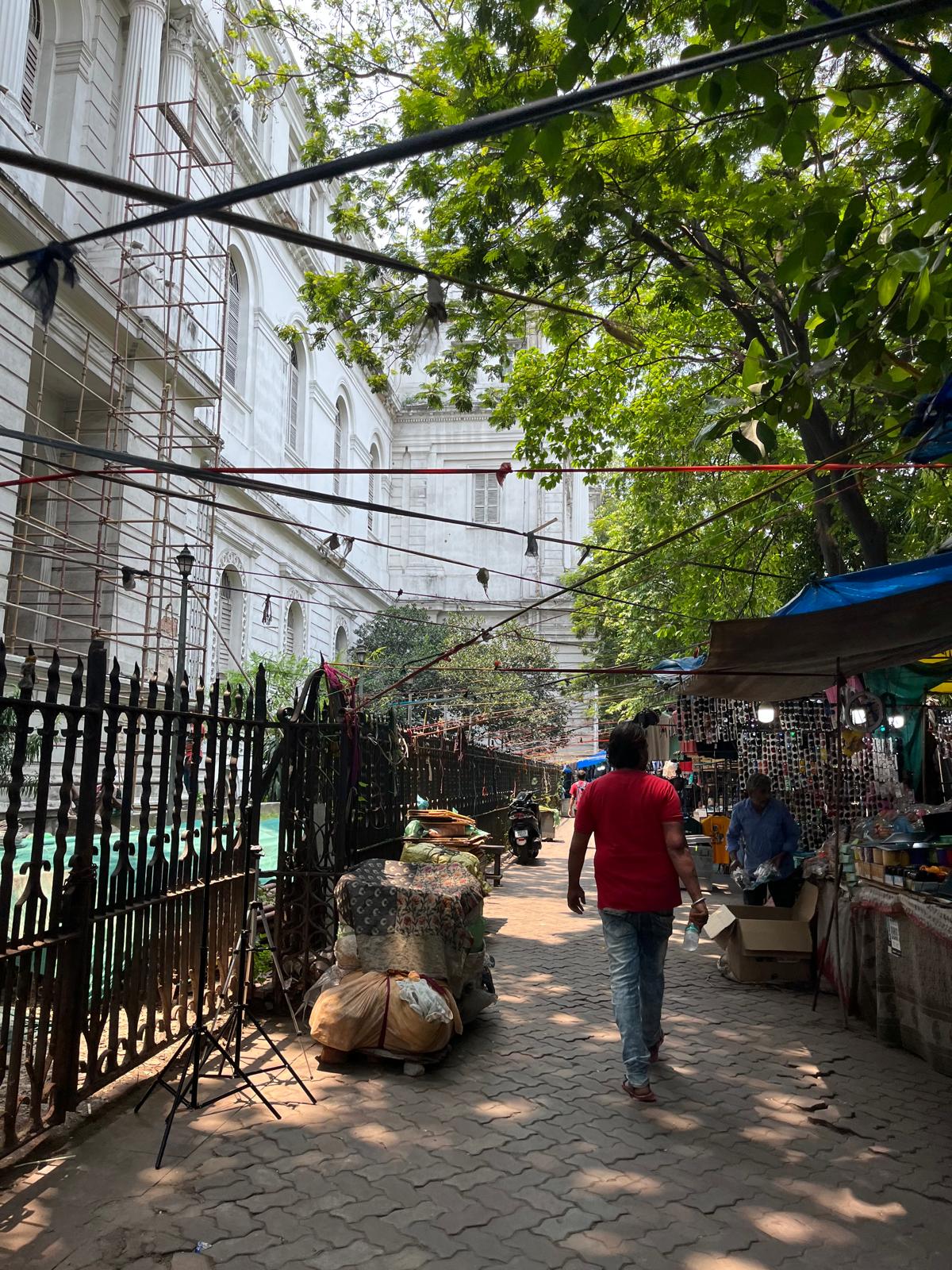
When I finally stepped out of the Kolkata airport in the early morning sun, the hot, humid, and heavily polluted air was an immediate assault on my already weary body. During my cab ride into the city, it struck me, in my exhausted state, just how vast and bewildering Indian cities can be. Amidst the chaos created by incessant honking, nonexistent traffic laws, street vendors overflowing into the streets, free-roaming animals, and harsh weather conditions, there is beauty and grandeur. Intricately decorated mosques, mandirs, and viharas sit next to colossal colonial buildings, manicured parks, and bustling markets. Against all odds, everything fits together rather seamlessly. The city’s vibrant energy, a blend of old, left me both overwhelmed and captivated.

Kolkata is the only Indian city with a tram network

Street vendors can be found on most major streets in Kolkata

The manicured gardens viewed from the Victoria Memorial
During my first morning in India, wandering the streets aimlessly in the sticky clothes I’d been wearing for the better part of a week while waiting for check-in at my guesthouse, it occurred to me just how lucky I am to be here. I am thankful that The Advocacy Project (AP) and its partner Jeevan Rekha Parishad (JRP) have given me the opportunity to support causes I care deeply about in the land of the Mughals, Gajapati, and Maratha. India is, and will remain, the most populated country for the foreseeable future. What happens here matters.
Starting in June, I will spend ten weeks with JRP in Odisha. Splitting my time between the capital Bhubaneswar and Daspalla, a town in the interior, I will support two critical projects:
- The expansion of their highly successful malaria prevention program.
- Contributing to a start-up to help tribal women produce and market Neem oil as a source of income and as protection against malaria.
Upon my arrival in Odisha, the day-to-day responsibilities will become clearer, but I am eager to assist with a variety of tasks. These may include acquiring mosquito nets and other preventative equipment at competitive prices, writing grants, organizing training sessions, and marketing the start-up program through community profiles and visual materials. Furthermore, I will capture the start-up’s progress through professional photography and videography. I am especially excited for fieldwork in Daspalla where I will have the opportunity to directly engage, support, and help educate the communities that produce Neem oil.
Although I have not yet met them in person, the competence, passion, and drive of my future colleagues at JRP is more than evident. I am confident that our collaboration will be fruitful, and look forward to promoting economic development while lending a hand in the fight against one of the world’s deadliest diseases. I also know the work will be difficult. With temperatures that can soar as high 118 degrees, little English comprehension in tribal areas, and uncertain funding streams, success will require resilience and grit. I don’t expect to change the world in one summer, but I will be happy if I can shed light on this crucial work, help fund it, and build long-term working relationships. Fortunately, my early arrival in the subcontinent will give me some time to adjust and prepare.
Today is May 18th. My fellowship begins June 3rd. In the interim, I will join some of my classmates from Harvard in the last Shangri La: Bhutan. Before I settle into the steamy lowlands of Odisha, I plan to stock up on fresh air, attend a meeting with the Honourable Prime Minister to discuss sustainability and economic development, trek through lush forests and across snowy passes, and decompress from a challenging academic year. When I get to Bhubaneswar, I will be ready for action. With any luck, the monsoon will have arrived by then, bringing cooler temperatures along with it.
-
First Encounters
7 CommentsNamaste.
This word, derived from Sanskrit and used to express the greatest form of respect, is the most common greeting in Nepal. It translates to something similar to, “I bow to the divine in you.”
It is the only Nepali phrase that, as of now, I know by heart.
Armed with my Nepali pocket dictionary, I expected to be more than confused when I got off the plane. Surprisingly, it seemed everyone in the airport spoke English. Taxi drivers called to me from the sidewalk, “Hotel? Where are you going?”
Two young men, close to my age, approached me.
“Do you need a ride?”
No, I politely informed them, my friends would be picking me up. Truthfully, I wasn’t all that clear on the plans. Through email in Doha, another Advocacy Project fellow had offered to meet me at the airport so that we could take a taxi together. Meera, who is working with the Center for Eco-Agriculture Development in Nepal this summer, has been in Kathmandu for the past two weeks. Her first experience with a taxi cab driver was interesting. So instead of me trying to negotiate a price alone, she and another AP fellow were to meet me when my flight landed.
I didn’t have a contact number for either of them and I wasn’t really sure where we were planning to stay. But I had an idea. At any rate, I knew I would be able to recognize them. I had never met Meera before, but Jess and I met at the AP training in May. Jess had arrived last night and will be working this summer with the Jagaran Media Center.
So, when my flight landed in Kathmandu, I was expecting to easily recognize, at the very least, her long, blonde hair.
I didn’t. I peered through the swarms of people hanging out at the arrival gate. Some of these people were greeting passengers. Most of them were not. Young and old Nepali men were everywhere. It was loud, it was chaotic, and everyone wanted to offer me a ride to a much better priced hotel. After waiting ten minutes, I sat down on a bench outside.
“Are your friends Nepali or foreigner?” asked one of the young men, who told me his name was Romeo (“You know, like Romeo and Juliet?” he said. I didn’t believe him.)
“Foreigner.” This led to a long discussion between him, his friend, and me. They asked me about where I was from, what I was studying, if I was married already, and told me how much they liked our president, Barack Obama.
Romeo offered to buy me a cup of coffee. I said no.
“I’ll pay.”
“Now why would you do that?”
“Because,” he told me. “We’re friends now.”
I still said no. He asked again. And again. And after a few times, I said, “It’s okay, really.” Apparently, he only heard the okay. He sprung up and ran into the airport, emerging a few minutes later with a coffee. By this time, it was 6pm. I had been waiting for an hour.
“I don’t think your friends are coming. You should just go to a different hotel.”
They’re coming. At least, I think so. I was determined to wait a little longer. Around 6:35pm, I saw Jess and Meera walking through the parking lot. Romeo’s friend ran to greet them.
“Are you waiting on Isha?”
We all walked to the car like one big group of friends. Jess and Meera were in the front guiding the pack, me in the middle, and Romeo and his friend in the back. When we got in the cab, Romeo asked for money.
“But I bought you a coffee.” I groaned. I should have seen this coming. I didn’t have any Nepali rupees on me, so Jess and Meera covered it. They gave him twenty rupees. A little less than fifty cents.
Just like that, I remembered what it was like to be in a foreign country. Fortunately, I was able to share the cab ride with others. On the way to our guesthouse, they told me stories about why they were late, attempting to meet each other at the local “MC Donell’s” (of no relation to McDonald’s), and of the apparently popular “milk scam” Jess fell victim to. I am sure it will make it on her blog in the future. On the drive, I suspected that we would have many more interesting stories by the end of summer.
-
Hi from Serbia!
1 CommentI made it to Serbia! It’s been crazy watching the news about the missing Air France flight that was headed to Paris since I took an Air France flight to Paris to get here. Luckily, I made it to Belgrade, and Jennifer, a BVS volunteer working with WIB, met me at the airport. Even though I was desperate for a nap, I knew that if I slept, I would never get over my jet lag, so I decided to push through and go to the office with Jennifer. On the way to the office, we passed by some buildings that had been bombed by NATO in 1999. The Serbian government has left these buildings intact, sending a pretty powerful message.

This building was bombed by NATO in 1999. Today, it looks exactly as it did then.
The office itself is adorned with WIB posters and pictures, creating a lively atmosphere. A few members were in a meeting, so I met those who weren’t and had my first Serbian coffee. A little while later, the meeting ended, and Stasa, the director of WIB in Belgrade, burst into the room. She immediately came over to me, grabbed my face, exclaimed “Iranian!”, and gave me a big hug. Needless to say, I already feel pretty comfortable here.
Stasa directed everyone into the “meeting” room for a planning session regarding the upcoming trip to Southern Serbia. We are traveling there this weekend to hold a series of workshops for the WIB network. Even though I don’t speak Serbian, it was clear to me that these women are pros at putting on this kind of thing. They brought in a bunch of shoeboxes and began to speak animatedly about the performance they were going to put on. Jennifer told me they were planning on stacking the boxes into a pyramid to represent the hierarchy of the military. The plan was developed and expanded upon before my eyes as they practiced removing boxes (each box is to symbolize a conflict in the world) until the pyramid collapsed, demonstrating how the hierarchy of the military can be broken down. Stasa then brought a huge bright pink cloth and had me and two other women stand in it. It turns out it was designed like one of those Chinese New Year dragons, but in this case, it’s supposed to represent a caterpillar with the message that “slowly but surely, peace can be achieved”. I’m really excited to see these performances executed this weekend.
After the planning meeting, Stasa decided that we all needed to eat, so a few of the women went to the market and whipped up a fresh and delicious meal consisting of eggs, a perfect salad, cheese and bread upon their return. Stasa asked me a lot of questions about my family and background during the meal, but talk quickly turned to WIB matters in Serbian. Jennifer and I left a little while after that, and I slept from 7:00 pm to 10:30 am, which I think is a personal record. Hopefully, that won’t become a regular thing.