
Tag Archive: Chong Sheau Ching
-
Q&A with Chong Sheau Ching
Leave a CommentEach day Chong Sheau Ching (C2) masterfully juggles her household responsibilities with managing eHomemakers (eH). She paused between taking care of her elderly parents, mentoring her teenage daughter, tending to the garden, making lunch for her employees, and running eH from her home office to answer a few questions for us!
1. As a child, what did you want to be when you grew up?
I didn’t have any aspiration; I was told that I should be a Chinese school teacher like my parents, grandparents (both sets) if I got to complete my 12 year of education. Failing which, I would be a clerk in a sundry shop or a coffee house. The most important seeds of thoughts given to me was: get married, be a good wife and have sons.
2. Aside from your family, what couldn’t you live without?
Dreaming of doing more than what I have resources and time for now — travel and discover new things, write, do documentary, all the fun things that also have social impact and change lives.
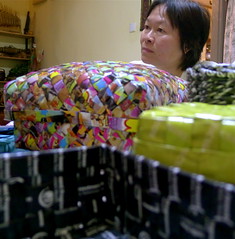
3. What is the most challenging aspect of maintaining the Salaam Wanita eco-baskets project?
Helping low-income disadvantaged women to achieve self-reliance is not a common social work here, let alone helping them to work @ home on innovative value-added work and self-empower themselves. Such work needs long -term patience, special tailoring of the activities when possible and deep determination to make things work by the project team. There is no fixed formula. The public, partners/potential partners often misunderstand the goals, and how it can be done properly for sustainability. Because of this, resources are constrained, making implementation difficult. Further more, such pro-poor concept is hard to implement among the beneficiaries because they are more used to activities that give short-term assistance than long -term hard work, so the drop-out rate after training is high as majority of the beneficiaries choose the short -term way to meet their immediate financial needs. Also, we specifically choose patients of chronic illnesses to help, they have a lot more medical or mental problems that complicate the self-reliance path. Often we have to deal with women passing away due to medical problems or inadequate medical care.
4. In what ways do you hope Kuala Lumpur will develop over the next 20 years?
A low-carbon footprint and crime rate city with proper public transport, efficient recycling systems and family-friendly activities.
5. What advice would you give aspiring social entrepreneurs?
Do what U are passionate about and really hang on for the long haul. Just remember this: Deepavali- the Hindu festival that celebrates light over darkness is real.
-
The Birth of eHomemakers
Leave a CommentChong Sheau Ching, known to friends as Ching Ching or C2, is the founder of eHomemakers (eH) and the Salaam Wanita eco-baskets project. She completed a Master’s degree in international administration in Vermont and held an international career with the United Nations before returning home to raise her daughter in the 1990s.
Back in Malaysia, C2 became the primary caretaker for her parents and mentally challenged brother. With these responsibilities and a newborn on the way, C2 needed to work from home. She applied her love of writing and storytelling to a freelance career as a columnist with Malaysia’s leading English newspaper, The Star. In her column, C2 ruminated on religion, family relationships, parenting, and other issues.
As a columnist for The Star, C2 balanced her family responsibilities while working from home and she believed other women could do it too. However, one of the main deterrents was the widespread social stigma against women work from home and raise their children rather than having a more “prestigious” career in an office.
C2 wrote about her personal experiences being disparaged for this in “A Job Only Mothers Can Do.” Mothers across Malaysia emailed C2 to share their own challenges and to seek advice on how to create more prospects for working from home. The overwhelming response to the article motivated C2 to find a way to help other women improve their circumstances.

C2 hard at work in her home office
eHomemakers was born out of C2’s vision of using computer technology to empower homemakers to create their own online businesses and to connect with employers through the Internet. The website is a portal of information to get users started working at home and able to create sustainable, profitable businesses. The site also features discussion forums to exchange ideas on domestic issues and tips for single parents in areas such as childcare, law, nutrition, health, and financial planning.
Since eH was launched 13 years ago, it has registered over 16,000 users. The site’s popularity is indication of its value for Malaysia’s citizens and the power of using ingenuity to prosper during difficult times. Due to the persistence of people like C2, the perception of working from home continues to improve in Malaysia. Check out eHomemaker’s site here.
-
Intro to the Salaam Wanita Eco-Basket Project
Leave a CommenteHomemakers empowers women who need to work from home to balance their familial responsibilities with employment. One of eH’s primary missions is to train women who are homebound due to mental and physical disabilities and chronic diseases to support themselves. In some cases, the women are staying home to take care of children and dependents that have disabilities.
A lack of finances and resources has deterred many of these women from getting an education or gaining computer skills. As a result, they have never had the opportunity to work and have become accustom to rejection from employers, classmates, and family members. These constraints have contributed to a lack of self-worth and struggles with depression.
Early in the process of creating eHomemakers, C2 realized that she would need other ways than computer technology to help underserved women help themselves. C2 was looking for another skill that interested women could acquire from home when she met a woman who had developed a basic weaving process out of discarded magazines. This was the answer C2 was looking for – an eco-friendly activity that women could do from home without purchasing materials!

Salaam Wanita Eco-Baskets
In 2002, eH started providing basic eco-basket training sessions for low-income women in Ipoh and Klang Valley. Since then, over 170 women have been trained and the weavers have developed more complex and intricate patterns that make the Salaam Wanita eco-baskets stand out from competitors. (Salaam Wanita means “Recognizing Women.”) Their willingness to try something new, determination to conquer the frustrations involved with mastering the weaving process, and originality in creating new designs illustrates how successful each of these women can be when presented an opportunity. Click here to view some brief videos explaining the eco-basket project and learn more about the weavers.
The eH staff members help market and sell the baskets at local bazaars, places of worship, schools, in stores, and online through the Justmarketing website. In return, the weavers receive fair wages for their work and are able to improve their families’ quality of life. While it isn’t easy to build partnerships to sell the baskets to international markets, I am working with the eH staff to bolster their outreach efforts.
In future posts, I’ll go more into depth on the challenges that eH, the weavers, and the eco-basket project face. Thanks for reading.

