
ADVOCACYNET 431, July 16, 2025
Remembering Srebrenica
A Personal Reflection by Iain Guest
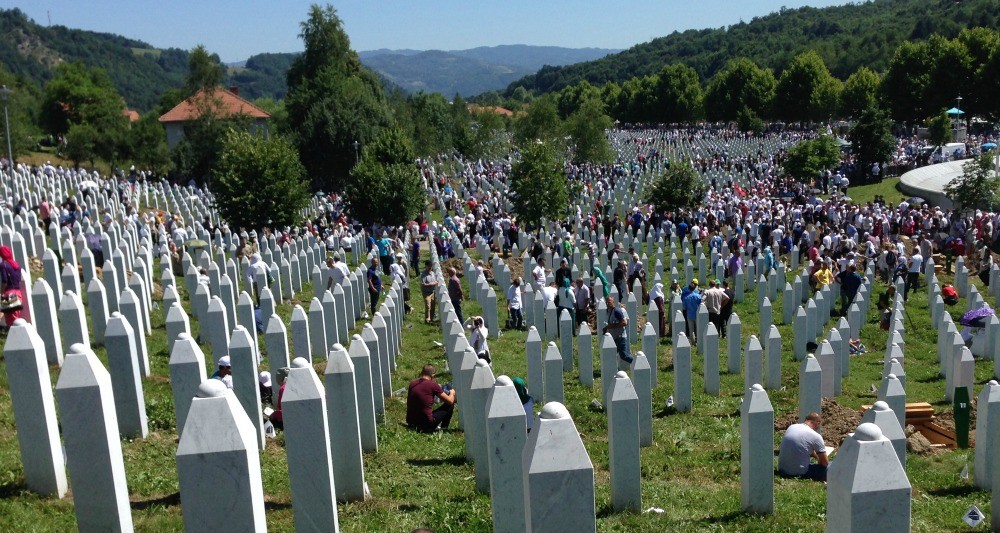
The cemetery at Potocari holds 6,772 victims of the Srebrenica massacre, murdered by Bosnian Serbs in July 1995
Thirty years ago this week, Bosnian Serbs systematically slaughtered over 8,000 Muslim men and boys in and around the picturesque town of Srebrenica in Eastern Bosnia.
The massacre marked the culmination of forty months of brutal warfare between Bosnia’s three ethnic communities. Until Ukraine, Srebrenica was widely viewed as the darkest chapter in European history since World War 2.
Although I did not know it at the time, the massacre was also to play an important part in the development of The Advocacy Project (AP). This week’s 30th anniversary is particularly sobering for our group.
*
The war in Bosnia began in April 1992 with the ethnic cleansing of Bosniaks (Bosnian Muslims) from the North and East. By July 1995 Srebrenica was swollen with Muslim refugees and had been designated a “safe haven” by the UN under the protection of Dutch troops. The town fell to Serb forces led by General Ratko Mladic on July 11.
Women and children were bussed to the Muslim town of Tuzla. The murder of their male relatives – some as young as 13 – then began at Potocari, a large open plain below the town of Srebrenica, and continued throughout the area for another ten days. Some of those killed were butchered with knives.
Parallel to this, another protracted massacre took place in the hills after a column of soldiers and their families set out from Srebrenica to Bosniak territory. The first units made it through safely, but as soon as the Serbs realized what was afoot the forests also turned into a death trap.
Long after the war ended, the Serbs of Srebrenica still refused to accept responsibility for the slaughter. I served as an international election monitor at Srebrenica in 2000 and did not hear a smidgen of remorse from our Serb vote-counters, even though some had taken part in the killing.
*
The idea for The Advocacy Project was born out of a USAID mission to Bosnia in 1997 that stumbled on something unexpected but wonderful – a vibrant and enterprising civil society, forged during the war.
Our team visited former pockets in Bosnia that had been besieged for months, like Gornji Vakuf, and pockets within pockets like Stari Vitez, where ordinary people had responded with ingenuity and courage.
We saw what quickly becomes apparent to anyone doing humanitarian work – pressure of any kind, but particularly conflict, brings out remarkable qualities in individuals and builds social capital. We have seen this repeatedly while working with 142 community-based partners through the years.
Our first project was to report from the 1998 Rome conference to set up the International Criminal Court, which took place in the shadow of Srebrenica and built on legal precedents created by the two international criminal tribunals for the Former Yugoslavia (ICTY) and Rwanda (ICTR).
In spite of opposition from the US, which feared that the ICC would go after US troops, the ICC statute was adopted by an overwhelming majority. I still believe the Court offers the best hope for accountability in unrestrained conflicts like Ukraine and Gaza.
Between 1999 and 2015, AP writers accompanied Bosniaks as they struggled to return to their former homes. The move back to Srebrenica began in July 2000 when two busloads of mothers made a quick visit to the killing fields of Potocari, escorted by NATO troops.
The first commemorative marker appeared shortly afterwards. It was quickly vandalized but opened the way for the Memorial Center and majestic cemetery that attracts thousands of family members every July and is the final resting place for over 6,000 massacre victims (photo above).
Potocari is hallowed ground for Bosniaks, much as Auschwitz is for Jews.
*
Between 2000 and 2015 The Advocacy Project made many visits to Srebrenica and built a rich partnership with BOSFAM (The Bosnian Family), an association for women displaced by the war.
I first met Beba Hadzic, the founder of BOSFAM, in Tuzla during the war and greatly admired the way she used traditional weaving to calm distraught refugees. Beba redoubled her efforts after Srebrenica.
Between 2003 and 2015 we deployed 15 deeply caring students (Peace Fellows) to BOSFAM (see below). They offered friendship and in return came face to face with unimaginable grief – but also grace. AP staff spent many hours of calm reflection at BOSFAM House. We profiled the weavers in this video.
In 2006 the BOSFAM weavers wove a starkly beautiful kilim that carried the names of murdered relatives. The following year I showed it at a Bosnian mosque in St Louis, Missouri, which was home to hundreds of refugees from Srebrenica. Scores of families laid flowers on the quilt and wept openly.
In all, the BOSFAM weavers produced fifteen memorial quilts, which can be seen on the BOSFAM website. One was shown by Bosnian mothers at the trial of Radovan Karadzic, the Bosnian Serb civilian leader, in the Hague. Bill Clinton used another as a backdrop when he spoke at the Potocari cemetery on the twentieth anniversary of the massacre on July 11, 2015.
The BOSFAM quilts also gave The Advocacy Project a template for advocacy quilting that has since offered hundreds of survivors from across the world a way to express themselves through textiles.
It is indeed sobering to think that we owe all of this to one of history’s most notorious massacres.
*
I have not been back to Srebrenica for ten years, but have followed developments through the dispatches of Peter Lippman, a founding member of AP and author of many of our earliest reports. Peter has just published a new book, Surviving the Peace, which should be required reading for peace-builders everywhere.
Thirty years on, what lessons does Srebrenica hold today?
The massacre was an act of astonishing cruelty and hatred by the Bosnian Serbs, but it was also a casualty of international cowardice and a reminder of the critical role played by the US in world affairs.
Unnerved by the death of 18 US service-members in Somalia, President Bill Clinton refused to authorize force against the Serbs and opted instead for relief aid through the UN Refugee Agcncy combined with war crimes investigations by the fledgling ICTY tribunal.
The international community compounded this blunder by imposing an arms embargo that penalized the Muslims, who were fighting for their survival.
The Srebrenica massacre was the inevitable outcome. General Mladic clearly felt he had nothing to fear and wanted the world to know it. The Dutch UN soldiers, to their eternal shame, stood by and watched.
The massacre at Srebrenica, coupled with the shelling of Sarajevo, proved to be a tipping point. President Clinton pushed NATO into military intervention and initiated the Dayton peace process which (controversially) froze the battle-lines and divided Bosnia into two autonomous entities.
Dutch pride took such a beating that the Dutch government resigned in 2002, seven years after the massacre. But legal accountability scored a victory in The Hague. Srebrenica energized the ICTY, solidified genocide as an international crime and put Ratko Mladic and Radovan Karadzic behind bars for life.
*
What, if anything, does Srebrenica say about the blood-letting in Ukraine, which has vastly exceeded that of the Bosnian war and lasted about as long – with no end in sight?
The international community has largely supported Ukraine’s valiant resistance, in contrast to its betrayal of Bosnia. But the US blows hot and cold on Ukraine and is actively working to weaken the ICC, while Russia murders Ukrainian civilians with the same lack of shame shown by the Bosnian Serbs. Israel’s war on civilians and humanitarian aid in Gaza and the West Bank is equally brazen.
There are some bright spots. The International Commission on Missing Persons (ICMP) has painstakingly identified over 7,000 Srebrenica victims and laid another seven to rest at the Potocari cemetery last Friday. The cemetery itself has become a powerful symbol for survivors and victims worldwide, including far-off lands like Nepal where we currently work alongside family members of the disappeared.
But Srebrenica itself is also a warning.
The town was a symbol of ethnic diversity before the war, with over 36,000 inhabitants. The current population is around 11,000. While roughly half are Bosniaks who have returned home – a success of sorts – young Serbs and Bosniaks alike are seeking new opportunities elsewhere in Europe. Srebrenica has emptied out, except for the ghosts. There can be no better advertisement for diversity, and the folly of unbridled nationalism.
After one visit in 2004 I wrote this in a blog:
“The Bosnian war does not – as some writers maintain – tell us that Bosnians are doomed to repeat their history, and that ‘ethnic hatred’ is built into their DNA. But it does teach us that ethnically-integrated communities – like Srebrenica – can be torn apart by calculated policies of racism, unscrupulous politicians, international cowardice, economic pressures, dehumanizing propaganda, and a few select acts of cruelty.
“These were the forces that converged in 1991-1992. It will require hard work and constant vigilance, particularly from the international community, to ensure that they do not recur.”
We have yet to learn all of the lessons from Srebrenica.
*
Our deepest thanks to the following Peace Fellows who volunteered at BOSFAM: Sarah Reichenbach (2015); Claire Noone (2012); Julia Dowling (2011); Quinn Van Valer- Campbell (2011); Laila Zulkaphil (2010); Kelsey Bristow (2009); Alison Sluiter (2009); Shweta Dewan (2008); Alison Morse (2007); Yvette Barnes (2006); MacKenzie Frady Arbogust (2005); Chiara Zerunian (2005); Sabri Ben-Achour (2005); Pia Schneider (2004); Marta Schaaf (2003).

Weaving at BOSFAM House in Tuzla was therapeutic for Magbula Divovic, who lost several close family members in the Srebrenica massacre.