Mai Thi Loi and Her Sons
A desperate mother is forced to chain up her sons


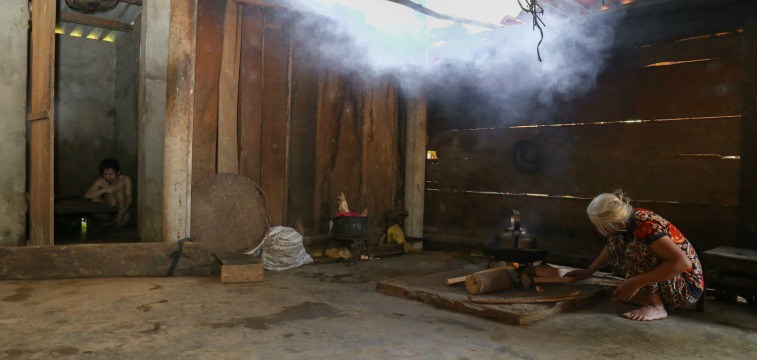
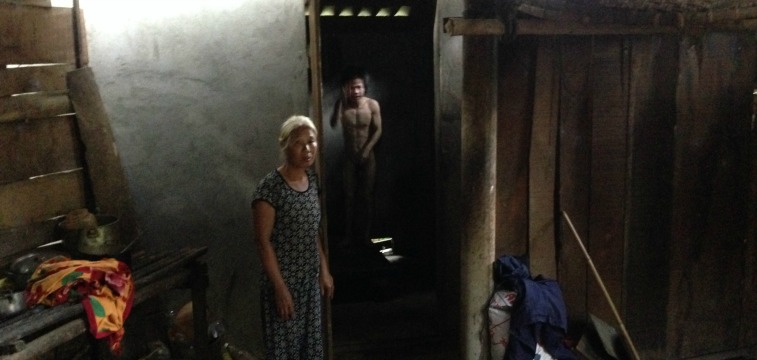


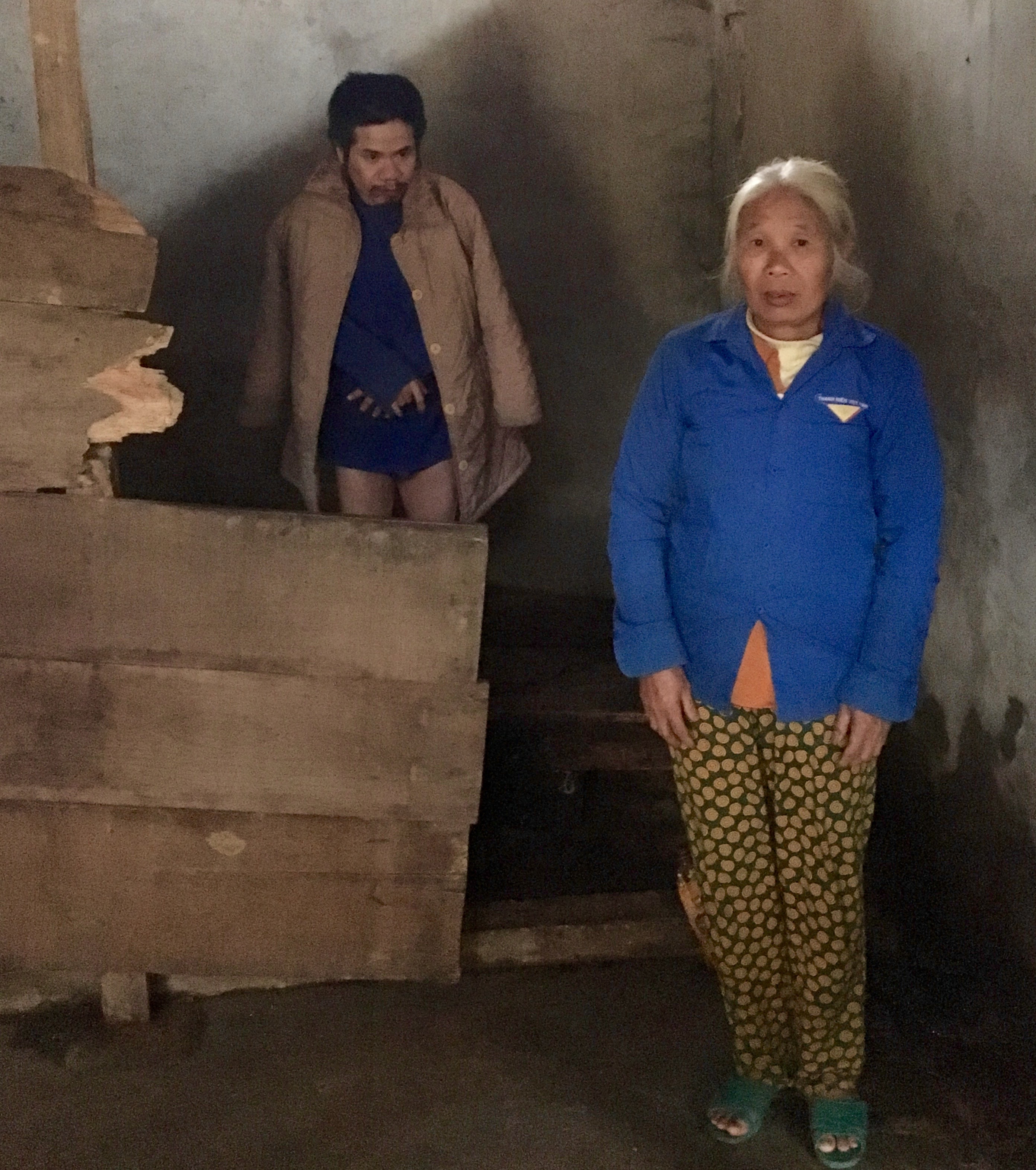
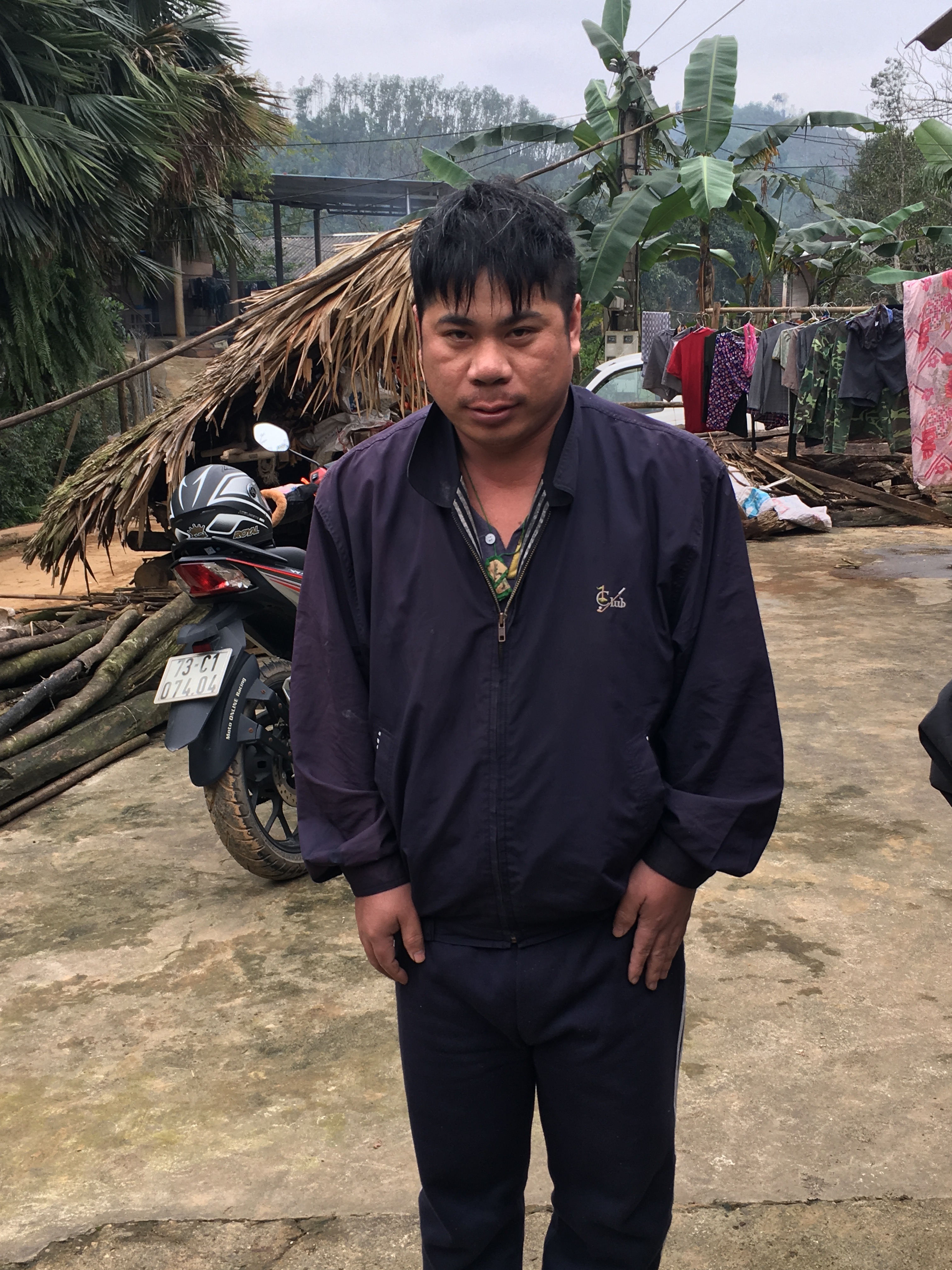
Profile by Armando Gallardo and Iain Guest, August 2015 Mai Thi Loi and her second son Nguyen Van Cuong, as seen in 2015 (foreground) We are not prepared for what we find at the home of Mai Thi Loi, the widow of a war veteran who lives in the Tuyen Hoa ward of Quang Trach district. We have come with Tuan, an experienced AEPD outreach worker, and with a local government official from the district. Tuan is responsible for three of the seven wards in the district and he estimates that there may be about 170 AO victims in this ward alone. Tuan has come to meet new families and see if they would like to form a self-help group for AO survivors. He has heard that Mrs. Loi is living in a remote area and has serious needs. Outreach workers like Mr. Tuan play a critically important role as advocates for AO families, and intermediaries with the government. Mrs. Loi’s husband, Nguyen Van Tri, was born in 1958 and served in the army between 1972 and 1976. No one knows how or when he was exposed to Agent Orange, but when he left the military he was already suffering from many of the familiar symptoms, including loss of memory and a violent temper that led him to beat his wife on more than one occasion. He was certified as an Agent Orange victim before he died in 1989 and awarded 790,000 Vietnamese Dong a month in compensation. Mrs. Loi’s first two children were born without any symptoms of dioxin poisoning, and both are happily married. But their three younger brothers have all been seriously affected. Nguyen Van Hung, the youngest boy, managed two years in first grade until it became clear that he lacked the cognitive ability to cope. Today he helps out with household chores under the watchful eye of his mother, although today he is out somewhere in the neighborhood. His older brother Cuong, 29, has a “small problem with his brain,” says our translator. He never went to school. He sits on a bench smiling amiably. Shocking EncounterOur encounter with Nguyen Van Kien, 31, the oldest of Mai Thji Loi’s three sons affected by Agent Orange, comes as a complete shock. Neighbors have come to meet our delegation and two of them steer us to towards the darkened room, where we perceive a naked figure chained to the wall. This is Kien. He shouts when he sees us and we back away. Mrs. Loi tells our translator Linh that her son used to wander around when he was a child but began to break things when he grew stronger. It became too much and she was forced to chain him to prevent him from destroying the house. He is naked because he rips off his clothes. He has been confined in this room since the age of 13 and is “getting worse by the day,” says his mother, close to tears.  Mai Thi Loi and her oldest son, Kien Tuan the outreach worker and the government agent seem to take this in their stride. But our translator, Linh, is upset and our hearts go out to Mrs. Loi. “The mother is hurt at having to chain up her son. Mothers are the strongest people in the world,” says Linh. We ask the government worker how it is possible for this man to be chained up in the dark. Is there no alternative? She explains that the nearest mental hospital is in the city of Hue, but that even if Kien were admitted, Mrs. Loi would still have to visit him and provide him with food and care. That would mean endless traveling to Hue, which she cannot afford. It would also mean surrendering her son to others. “If he leaves, I won’t ever see him since I don’t have the money to travel,” says Mrs. Loi. So she remains torn between her love for her son and fear at his rages, unable to treat his condition with anything other than the occasional tranquilizer. This case, like no other, brings home the impact of Agent Orange on victims and their aging, overwhelmed, parents. The Pressure of PovertyMrs. Loi has to make do somehow, and she is a hard worker with a support system in the village. She owns some pigs and farms some rice paddy which produces 30 kilos of rice twice a year. She also receives 790,000 Dong in government compensation for each of her three sons every month. Until recently, she also received 360,000 Dong as a caregiver, but that was discontinued. She appealed to the authorities but has not received an answer. The government also gives her 30,000 Dong a month to cover electricity bills. Finally, she is supported by her neighbors, who watch over her children when she has to visit the doctor and help to cover the bills. She is deeply grateful. ‘Mrs. Loi remains torn between her love for her son and fear at his rages.’
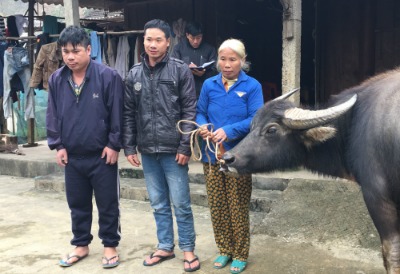
But none of this is enough. Once a month, she takes the two younger sons to the Dong Le hospital, 37 kilometers away, for a check-up. The treatment is free but the transport costs 600,000 Dong per trip. We have two final issues to overcome before we leave this damaged family. We would like to leave Mrs. Loi some money but are told by the AEPD outreach worker that this would create expectations among other families and make AEPD’s job harder. So we reluctantly put our money away. We also wonder how we can capture the true impact of this family’s crisis through photos – Armando’s great skill – without exploiting the terrible image of the chained and naked man. We talk this through with the AEPD team. Iain takes some photos of Mrs. Loi and Kien from a distance, and it is agreed that Armando will return to conduct a video interview. By the time of Armando’s second visit, Mrs. Loi is at ease with Armando and his camera. Armando is able to produce some memorable images that make the point without demeaning his subject. Update by Peace Fellow Ai Hoang, July 2016 By July 2016 Mrs. Loi’s second son Cuong was also chained up to prevent him from hurting himself and others. As I started out my second day in the field, I must confess I was getting quite wrapped up in the logistical details of figuring out how and when I must get the business plan completed for each family. You see, I love checklists and crossing things off. So naturally, my mind was fully racing at the moment, going over all the questions I needed to ask and answers I might get. Would I be able to get their needs assessed without the company of the outreach workers? And the dialect – how much of it would I understand today before having to ask Ngoc, AEPD staff and my trusty “Central Viet to Southern Viet” translator? It wasn’t until we got to see Mai Thi Loi and her family that my perspective on the day completely changed. As our driver, Ngoc and I made our way to Tuyen Hoa District, I’m again amazed that Mr. Hoc, an AEPD outreach worker, often makes this drive on his motorbike to visit families. I’m told that that the district is a new area for AEPD; the organization started working here as recently as last year. Mr. Hoc volunteered to take this one on, even though it would take him over six hours to make a round-trip. He was away at training and couldn’t come with us that day, adding to my nervousness about meeting Mai Thi Loi. I knew the needs of this family would be great, but I didn’t realize how much until we arrived. A full three hours after we started our day, our driver pulls up in front of Mrs. Loi’s home. I see chickens and pigs and a young man walking in circles around the home. Mrs. Loi rushes out, pulling on a button down shirt. Before I could say my hello to her, I stop midway and survey the home. Loud clapping got my attention and I turn to see her oldest son Kien, naked and chained to a table in the back. He’s standing straight, tall and strong — one of the most intimidating figures I’ve seen in a while. He’s clapping his hand and smiling, yet my stomach is flip-flopping all over the place. I turn to greet Mrs. Loi and I see a smaller, figure peeking out from behind a makeshift wall made of wood. I was meeting Cuong, Kien’s younger brother, and the second son. He’s mumbling incoherently and retreats to the back. I’m told he does this all day. We sit down and after a quick round of introductions, I ask Mrs. Loi if she’s the main laborer of the home and whether she was getting any help. Before I could complete my question, she’s crying and she can’t seem to stop. I bite my tongue, worried that I had been insensitive. We all sit still in our chair. Not a single word is said. No one’s reacting. We wait until she takes a deep breath and begins to tell us her story of raising three children affected by Agent Orange. 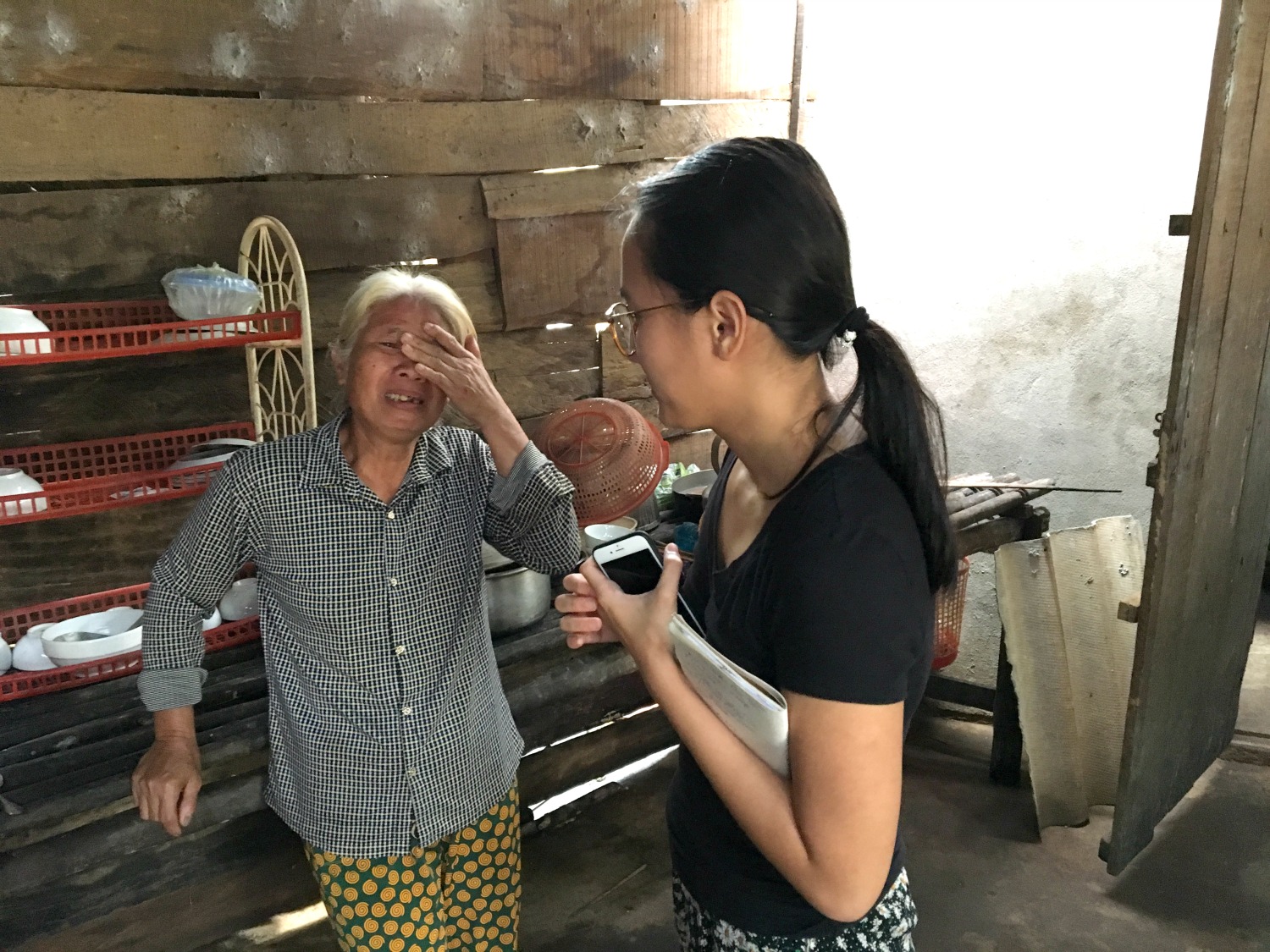 Peace Fellow Ai Hoang comforts Mrs. Loi Her sons were born healthy. At around age ten, each of them began slowly slipping farther and farther from reality. Their mood swings became more and more violent as they grew stronger physically. They tore apart their clothes and their house, hurting themselves at their mother in the process. Eventually, Kien had to be chained up. Mrs. Loi expects that her youngest son Hung will follow suit. Last year, when AP visited, Mrs. Loi was feeling better and her second son was doing better as well. The family had asked for a buffalo and money to help with medical costs. Now, they can no longer manage to raise a buffalo and medical treatment is no longer doing any of her sons any good. I inquire about the idea of raising more pigs and chickens around the house. Mrs. Loi agrees, but beyond that, she’s out of ideas. As the visit ends, we turn to say our goodbyes and Mrs. Loi grips my hands and starts crying; I’m still not sure what to say. My Vietnamese isn’t good enough to form a sentence that could say: “People do care. We care about you and your sons. You’re incredible and you’re so strong.” Thinking back now, I don’t think there was anything to be said at that moment, but I so badly wanted to say something, anything, to let her know she wasn’t alone. But the truth of the matter is she has been decades now since her husband passed, even with AEPD and people from their self-help club checking on her. How can anyone really share the pain that she must have felt for years, watching each of her sons slip further and further away from recovery? I held her hand for a few more seconds and we say our goodbyes and left. A golf ball-size lump grows in my throat. It’s not that I actually felt like crying. I’m not feeling anything at this point. You see, I’ve grown up saying I wanted to do this line of work, wanted to give back and make a difference in my community. Still, here in the moment, I’m questioning everything. I question how this could’ve happened and how hopeless I feel when ironically I’ve been sent to help. Then again, what does ‘helping’ even mean? How do we create a lasting impact that will help her family long-term? It’s back to the drawing board for this one. I’ve asked AEPD Chairperson (Mrs. Hong) and Mr. Hoc to brainstorm and think of ways to help. I’m looking to their years of expertise to help us come up with some sort of a solution for the family. This visit also got me to rethink the rest of my visits that day. As much I needed to stay focused on the business plan and gathering information, I also had to pause and just listen to their stories until I’m able to verbalize my feelings, effectively fund-raise and stay motivated for the rest of my time here. Update by Jacob Cohn, July 2017 By the time Jacob visited in August 2017, Mrs. Loi’s second son Cuong (left) had been released and was more stable. As we set out from Dong Hoi for our first two family visits, I’m both excited to start meeting the people I’m here to serve and somewhat nervous, uncertain of what to expect from these encounters. I’m accompanied by Truong Minh Hoc, one of AEPD’s outreach workers (and himself a disabled veteran of the American War); Dat, our Advocacy Project associate; and Ngoc, another AEPD staff member who interprets for me. Mai Thi Loi and her family live in a remote village in Tuyen Hoa District, a 2 ½-hour drive from Dong Hoi through imposing mountains and lush valleys. The village lies in the “frontier area” near the Laotian border; we are required to check in with the local government when we arrive and are joined by a police officer for the visit. Mai Thi Loi greets us as we arrive. She is an elderly woman but seems strong and healthy. We enter her home, a relatively small, dark wooden house with a corrugated metal roof, and sit around a table in her living room. Mai Thi Loi’s story has been covered very well by previous AP fellows, so I won’t go into too much detail here. Nguyen Van Tri, Mrs. Loi’s late husband, was exposed to Agent Orange while serving in the North Vietnamese military during the American War, and would eventually die of the resulting complications in 1989. Their children were born healthy, and the first two have avoided ill effects—they’re both married and live on their own. But Kien (who is now 33), Cuong, 31, and the youngest, Hung, 29, became more and more mentally disturbed as they grew up, often wandering around the neighborhood and prone to fits of anger. None of the three have been able to go to school past the second grade or to work outside the home, and Mrs. Loi must care for them on her own. Last year, thanks to AP’s generous donors, we were able to acquire a new buffalo (named “Opportunity”!) for Mrs. Loi’s family. I’m here mainly to check on how things are going. Cuong and Hung are able to sit with us at the table, but neither of them speaks more than a couple of words, and although much of the conversation is about them they don’t have any visible reaction to it. I wonder how much of it they’re able to understand. 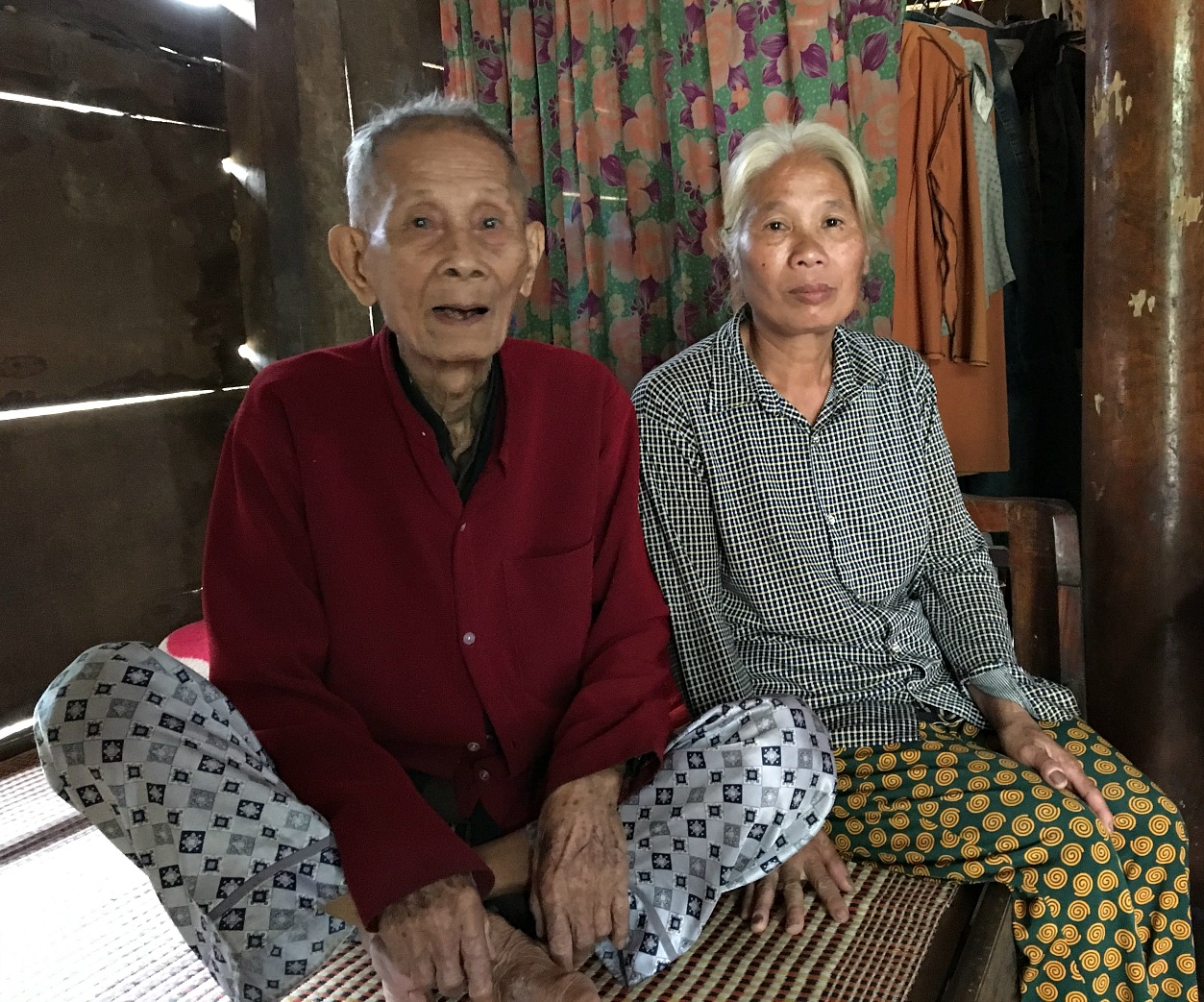 Added responsibility: in addition to her three sons, Mrs. Loi also cares for her aging father, who turned 100 in 2016. During our visit, another man peers out at us from an enclosure in the next room—this is Kien, the oldest son. Kien “cannot control his mind, he can’t recognize his mom or anyone else around him,” Ngoc tells me. When Kien was 13, Mrs. Loi was forced to chain him to the wall of his room to prevent him from destroying the house or hurting others—he has now been confined for twenty years since Mrs. Loi has no other way to care for him while protecting her home and herself. I knew to expect this, but to see it in person still comes as a shock. As I talk with Mrs. Loi Kien will occasionally shout some words (which I, of course, can’t understand) from the other room; everyone else seems used to this since they don’t react to Kien’s outbursts. “He doesn’t know what he’s saying,” Ngoc tells me. Mrs. Loi has both good and bad news to share with us. The good news is that Opportunity the buffalo remains in good health and has benefited her and her family. “The buffalo is developing very well,” Mrs. Loi says. It helps her work the fields on her farm and she also rents the buffalo out to other families. Mr. Hoc tells me that the buffalo can bring in 70,000 Vietnamese dong (around $3) per day, which has greatly improved the family’s financial situation. The buffalo—which gave birth to a calf soon after Mrs. Loi got it—has been especially helpful in the wake of a devastating flood last October, which spared her home but destroyed her cornfields. With no harvest this past year, the family was even more dependent on the buffalo as a source of income. Thanks to the buffalo, Mrs. Loi says, she’s been able to bring Hung, her youngest son, to the nearest hospital in Dong Hoi for treatment each month (though this is still a significant cost)—Hung, she says, has been getting “better and better” ever since. Iain, AP’s director, had reported that Hung was chained up with Kien when he visited—Hung couldn’t leave the house, ripped his clothes, and was prone to violent rages. Now Hung is able to dress himself, go outside, and perform basic household chores. The bad news, Mrs. Loi tells us, is that Kien and Cuong have not improved with their brother, and their condition is “not good at all.” The hot summer weather seems to make Kien even worse. At this point, I see another man, apparently, a neighbor, enter the next room and start hosing down Kien; we all try to avoid acknowledging this while it happens. Mrs. Loi is particularly worried about Cuong, who is getting “worse and worse”; he can walk, talk, and control his mind most of the time (as is the case during our visit), but he loses control more and more frequently. Mrs. Loi says she believes that “sometime in the future he will become like that”—Ngoc points at Kien, chained up in his room, as she translates these words, and I feel myself shiver slightly.  Community challenge: Mrs. Loi is supported by neighbors (left); by Mr. Truong Minh Hoc, an AEPD outreach worker; and by Mr. Tham Thien Vam, far right, president of the local AEPD self-help group for persons with disability. The main challenge facing the family now is finding medical treatment for the sons. Mrs. Loi can afford, barely, to take Hung for treatment thanks to the money generated by her buffalo, but she’s unable to afford medicine for Cuong or proper treatment for Kien. Mr. Hoc explains that there is a new mental hospital under construction in Dong Hoi, but nobody is sure when it will be complete. Mrs. Loi says she’s hoping to transfer Kien to the hospital when it opens—the doctors and nurses would be able to provide more effective care for him, and Dong Hoi is close enough that Mrs. Loi could still visit. But this would be very expensive, she says, and she can’t afford it without selling the buffalo. She hopes for more support to buy a cow, which she could rent out to earn more money to treat Kien and Cuong; I can only tell her that I’ll let AEPD and AP know of her needs. I’m reminded of an observation made by Ai, my predecessor, in a previous visit with Mrs. Loi—her story isn’t “a triumphant story of success,” but an example of one woman doing what she can to live with a horrific situation. She certainly seems in better spirits than Ai described, but I can tell from her words that her life is still full of struggle. A buffalo, while undoubtedly helpful, isn’t a “solution” to the problems caused by Agent Orange, it just makes it a bit easier to cope. I ask Mrs. Loi about the support she’s gotten from her community and her family, and she’s quick to express gratitude. The community is “very caring,” she says, and neighbors and relatives often come by to help with household chores and taking care of Kien and will pitch in in other ways—providing rice when food is scarce, helping to take Hung to the hospital, things like that. But this is one of the poorest areas of Vietnam, and people only have so much to give. Mr. Hoc tells me that this family is at the top of the local government’s list to receive benefits, but, again, these are often scarce. The government did provide much-needed support after last year’s flood, though, connecting her to a donor in Ho Chi Minh City that helped sustain her family after the harvest was destroyed. I shake hands with Mrs. Loi as we conclude our conversation. I feel like there’s something I should say here, words that could help somehow—but these don’t come to mind, so instead I simply thank her and say that I hope to return. We take photos of Mrs. Loi, Cuong and Hung with their buffalo and calf, who looks as healthy as advertised. Finally, with Mrs. Loi’s permission, I return to the house to photograph Kien. I see him more clearly than in the living room—he stands by the concrete wall of his room, wearing only a ragged-looking shirt. He certainly knows we’re there, but I can’t gauge his reaction as I take my pictures and leave. Update by Karen Delaney, January 2018
Cuong, who used to be chained in the bedroom because of his mental state is doing much better because of the medication. He is sleeping in a bed behind us when we arrive. When he wakes up, he greets us, then goes outside to take care of the buffalo. Kien, who is locked in the other room, keeps peeking at us. We hear him talking, but there are no screams or loud noises coming from there. The buffalo that AP gave Mai Thi Loi in 2016 had a baby in 2017, so she sold the buffalo for 15 million dong ($660), and kept the offspring. She rents the animal to neighbors for farming 2 to 5 times a month and charges 500K dong in rent. This brings her between 1 to 2.5 million dong per month ($45- $110). She tells me the animal is very strong. She also receives 2.5 Million dong ($110) per month as AO compensation for her three sons.
Mai Thi Loi says the medication has been great for Cuong. Apart from no longer being violent (and locked up), he can now recognize family members. He gets headaches sometimes but helps her take care of the buffalo. The younger son, Hung, is very friendly and keeps showing me the buffalo. He brings the animal out of the shed to show us. I take a picture. Mai Thi Loi tells me that the new buffalo is not the breeding kind, but brings good money from farming and renting. Apparently, this buffalo cost more than the breeding kind, so she could sell it and buy two breeding buffalos.
Overall it was a pretty uplifting visit. Mr. Truong Minh Loc, the outreach worker, kept stressing how impressed he was with the “recovery” of Cuong, who indeed seems well. The younger son shows no signs of mental problems (at least while I was there) and was very happy to see us. As for Kien, there were no changes. Mai Thi Loi says not much else can be done. Update by Marcela De Campos, August 2018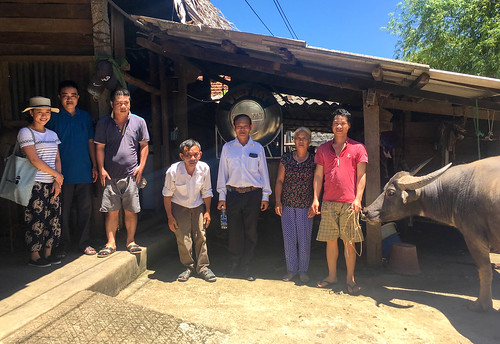 A group shot of everyone present, left to right: Ngoc (AEPD staff), Border Patrol Agent, Nguyen Van Cuong (Ms. Loi’s son), Mr. Van (President of AEPD self-help group for persons with disabilities in this commune), Mr. Hoc (AEPD Outreach Worker), Ms. Loi, and Nguyen Van Hung (Ms. Loi’s son) Ms. Mai Thi Loi was the first beneficiary of the Agent Orange Campaign. She lives in the Tuyen Hoa district near the Vietnam-Laos border. Because of its proximity to the border, we are escorted to Ms Loi’s home by Mr. Van (a trusted community leader and the president of the AEPD self-help group for persons with disabilities in this commune) and two border patrol agents. Ms. Loi’s new gate greets us when we finally arrive. Ms. Loi was able to purchase and install a gate using money from her cow and donations from relatives. She can now close and lock the gate when she leaves to farm or run errands. As a widowed caregiver of three persons severely affected by Agent Orange, she explains, the new gate has provided her some peace of mind. As we walk into Ms Loi’s home, Ngoc (AEPD staff) notices that her table is different. She asks Ms. Loi if it is new. Ms. Loi quietly but proudly tells us that she had a new ceramic slab installed which is why it looks new. The conversation turned to her family’s well-being. Ms. Loi still does not have enough income to create a savings account and spends whatever she makes on immediate-need household and medical expenses. Her biggest current need is for a washing machine. 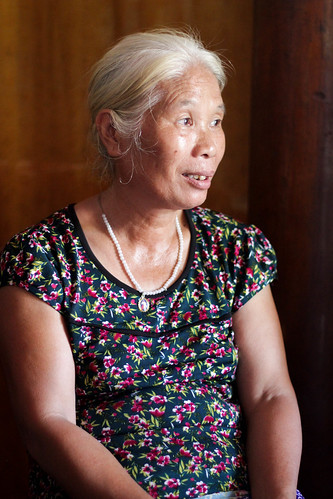 Ms. Loi tells us about the buffalo, her family’s health, and their current need for a washing machine. As the visit progresses, I keep thinking about the table we saw when we first came in. Why did that moment and conversation feel so meaningful to me? Partially, it was the look in Ms Loi’s eyes when she realized Ngoc had noticed the table. More than anything though, it it was a tangible example of economic empowerment. It was heartening to see that she chose to spend her mooney on something that is of great utility in the household, but also brings her joy. 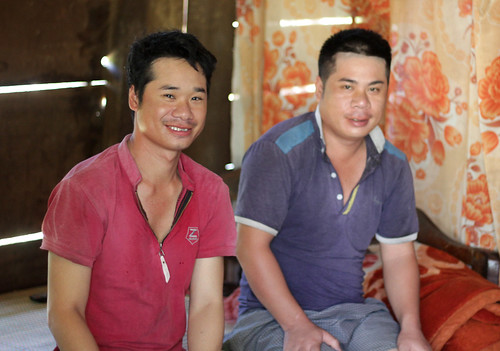 Ms. Loi’s sons, Hung and Cuong, sit on the bed behind the table. The health conditions of Ms. Loi’s sons remain largely unchanged since Karen (AP staff) visited in January 2018. Ms. Loi explains that Nguyen Van Cuong (32 years old) is doing much better than before; he used to be confined to a room like his older brother Kien (34) but has received treatment and is no longer violent. Cuong naps on the bed behind us while we chat. Hung’s disabilities have also stabilized and he is in the kitchen while we talk. I was unable to meet Kien but am told that nothing has changed. Mr. Van added that Ms. Loi’s own health is declining and her stomach aches frequently. Ms. Loi does not plan to sell Opportunity, the buffalo, whch is used to farm corn, rice, cassava, and sweet potato. The harvest is used mostly for consumption but only lasts 6 months of the year. She depends on loans and gifts from the local government to purchase food for the other 6 months of the year. She will continue to rent him out and use him for farming. The buffalo is currently worth 40M VND but in 2-3 years will sell for 50-60M VND. Mrs Loi earns 1.5M per month from renting out the buffalo and selling some of the harvest, but she cannot rent out the buffalo in the summer, when she earns less. The amount she receives for Agent Orange compensation has remained unchanged (2.5M VND per month for all 3 sons). The problem is that compensation is not proportional to her sons’ disabilities. The local government and Mr. Van have helped Ms. Loi appeal for the correct compensation amount but the appeals have been unsuccessful. 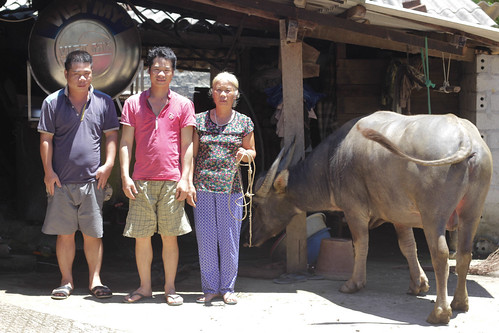 The family stands for a portrait with their buffalo. He is used for farming and is rented out to neighboring farmers. As we say our goodbyes I notice there are pieces of what look to be wood drying out in the sun and don’t think too much of them. It is very common to see herbs, grain, etc. drying on tarps throughout Vietnam. During lunch, however, Mr. Hoc informs us that the “wood” is actually a kind of herb used to make natural calming remedies. Ms. Loi uses them to supplement her sons’ treatment. She is not only the head of her household but a great source of strength and resilience.
Update by Mia Coward, August 2019After 3 hours of driving far into the mountains near the border of Vietnam and Laos, we arrive at Mai Thi Loi’s home on what seems like the top of a hill. A small howling puppy greets us and continues to howl until we sit down and begin to talk. Ms. Loi is a small woman. Her home is very dim with little light inside. As we sit I hear a sound like chains rumbling from the back and then I see her oldest son Nguyen Van Kien peeking behind the wall and looking at us. I smile. He continues to look our way and yells, but everyone seems to ignore him. Joining us is the leader of the self-help group in the commune. The border patrol for the commune comes as well. 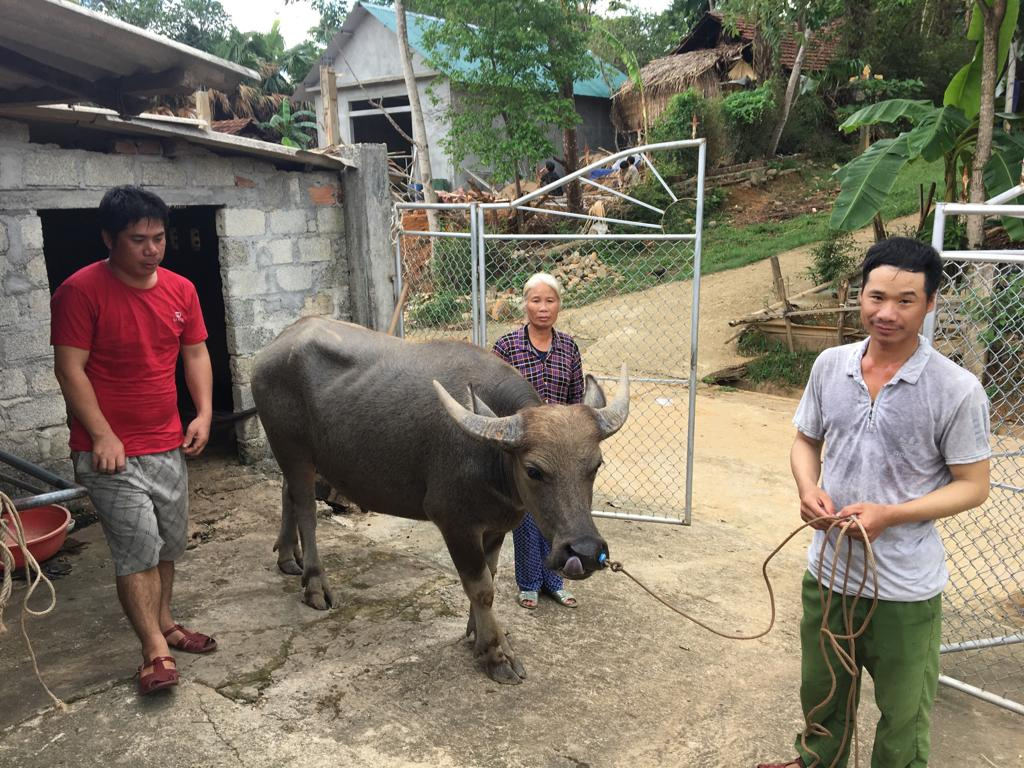 Hung and Cuong, particularly Cuong, are doing much better now compared to when we first met Ms. Loi’s family Mai Thi Loi and her family were the first to receive support from AP and AEPD, and we have watched as the condition of two of her sons have improved over the years thanks to the increase in income and access to better medication. Ms. Loi is 62 years old and has five children, 3 sons, and 2 daughters. Her sons live with her because of their incapacities. Her two daughters live separately. Mrs Loi’s youngest son, Nguyen Van Hung, is the most helpful in the family. Hung helps to take care of the buffalo and the 10 pigs. Although he has to take medication for a stomach disease, Hung is better able than his brothers to do work around the house. The middle son, Nguyen Van Cuong is doing better than the las time AP visited him, and is on a medication regimen that helps him daily. However Mai Thi Loi’s oldest son, Nguyen Van Kien is still in chains in the back of the house. During our conversation, we can hear him banging something against the floor. Kien’s mental disabilities leave Ms. Loi no choice but to place him in chains because she is unable to care for him any other way. It is hard for her to give him medicine or even give him clothes to wear. When we finally go to the back of the home, Ms. Loi shows us the tin bowls she has to use to feed him because he would smash the ceramic bowls down and throw the food. She seems overcome with heartache at not being able to help her son. She says that she cannot even manage the smallest things, like cutting his hair.  Five years after AP first visited Mr Loi, her oldest son Kien remains chained to the wall for his own safety and hers. Earlier in the year, in July, Ms. Loi had to go to the hospital to get treatment for a colon condition. Although her medicine was covered by health insurance, the travel still cost nearly 5M-6M VND. The cost was very high and Mrs Loi had no choice but to sell her buffalo Opportunity for 33M VND. She then bought a new cow for 23M VND. Ms. Loi is supposed to visit the hospital for a check-up at the end of the year but is unsure if she will go because there is no one to look after her sons. The new buffalo is doing well and she will plans to use it to farm corn and rice as well as produce fertilizer. She does not rent the new cow out, as she did with Opportunity because she is getting older and it is getting harder for her to pull the buffalo around. She produces corn and rice, but not enough to last the entire year. Until recently Mrs Loi also raised ten pigs, but they died from disease. She wants to raise more but is scared they too might not survive. In addition, it would cost 3 MVD a month to feed the pigs. The buffalo eats grass for free. Mai Thi Loi receives 2.7M in compensation for her 3 children (900,000 VND person each month). The money is used for medication and food along with hospital visits. Ms. Loi also has to rent a private car when she takes Kien, her oldest son, to hospital. This is partly because his condition does not allow him to travel with others, and partly because so few buses pass by her house, which is far from Dong Hoi. Unlike some Agent Orange families, she is ineligible for compensation as a caregiver, because that is only given to those who look after first generation victims, not their children.  Ms. Loi has remained resilient as she cares for her three sons by herself We ask Ms. Loi about if she would be disposed to join a savings and loan group. She replies that she would not know how to repay a loan. Besides, she does not have enough money to put in. Selling her buffalo eased the pressure on her to seek new loans, which is just as well because banks are unlikely to lend to someone who cannot work and spends the whole day taking care of her sons at home. Ms. Loi says that if she were to get another loan she would still buy pigs. After we say goodbye and leave, I think about Mai Thi Loi and her oldest son. The thought of a mother having to lock her son up in chains really saddens me. Like many of the visits I have been on at this point, I am also a little saddened because I cannot offer anything to these families. But I am also hopeful that this data will help us to supporting these families. Update by Angie Zheng, July 2025It takes two weeks of paperwork for AEPD’s visit to Mai Thi Loi to be approved. My passport has been stamped, signed, notarized in a fluorescent-lit office and handed from desk to desk. The road into the commune is two and a half hours of driving through thick green hills. By the time we arrive, the afternoon light is soft, hazy. We meet Loi outside her house, a small structure perched at the top of a hill with a patched metal roof and sturdy concrete walls. Loi takes us inside, and we gather around a low table. Mai makes the introductions, and I take a seat beside Loi. Two of her sons, Hung and Cuong, are nearby, both perched on two beds near the back of the room. Their eldest brother, Kien, is not here. Mai Thi Loi’s husband, Nguyen Van Tri, served in the army between 1972 and 1976 and was certified as an Agent Orange victim before he died in 1989. No one knows how or when he was exposed, only that when he came home, he was already ill with symptoms of Agent Orange poisoning. Loi’s five children were born as second-generation victims of Agent Orange. Her two older daughters have mild intellectual disabilities and are married with families of their own. Her three sons have severe physical and intellectual disabilities, along with chronic health issues and severe mental illness. All three have recurring violent episodes, especially the eldest Kien, who has been chained since adolescence due to his extremely violent outbursts. Loi, now sixty-six, is unable to manage the violence. Her voice thins when she begins to speak of Kien. She covers her face with both hands, tears sliding between her fingers and pooling in her palms. “He is usually chained and naked,” Mai translates softly. “He tears his clothes off when she tries to dress him.” Loi’s shoulders shake as she cries, her whole body folding in on itself as though trying to swallow the emotions. Lưu leans forward and rests a hand on Loi’s back. We all sit with her like this for a while. Care, for Loi, is not abstract but daily and embodied. It is the rhythm of waking early, of scrubbing six sets of clothes by hand, of feeding her three sons one after the other. It is traveling thirty-seven kilometers to the city hospital each month for health checkups. Even though her sons can be violent, Loi refuses to send them to the Agent Orange social center in the city. When she asked what they wanted, they told her they wished to stay with their mother. She cannot bring herself to separate from them. The center is far away, and she worries she could not afford the trips to visit. Mai explains that Loi feels a deep responsibility to care for all her children herself, especially those with the most severe conditions like Kien. As Loi speaks, tears stream down her face once again. “After I pass,” she says between breaths, “then the social center can take them.” Iain, AP’s director, has said that families like Loi’s are why the Agent Orange Livelihood Sponsorship program exists at all; why AEPD continues to return, year after year. Loi was one of the first beneficiaries of the program. In 2016, AP and AEPD raised $1,200 to provide her with a breeding buffalo, meant to generate steady income. The buffalo became a significant source of income. She even shared it with a neighbor to earn a little more, until it died from illness. Now that Loi is older and weaker, she can no longer raise a buffalo or tend the fields. And yet, Loi tells us again and again that the sponsorship mattered. It has kept her children fed and medicated, greatly improving the mental health of her two younger sons. This has given her a measure of hope. Before we leave, we ask to take a photo of the family together. By the time we step back outside, the light has shifted. Somewhere down the hill, a motorbike sputters awake. I follow Mai and Lưu back down the slope, and the house becomes smaller behind us until it disappears into the trees. It would be tempting to imagine a clean solution, one that would ‘fix’ the damage wrought by the U.S. war in Vietnam. But Agent Orange’s legacy is not a problem to be solved once and for all with a single aid package. Victims of Agent Orange and their caregivers continue to live with the lifelong, intergenerational, and environmental effects of the war. Long-term reparations matter; yet this year, the U.S. government withdrew all funding for Agent Orange relief and support for war legacies in Vietnam. This withdrawal is not an abstraction: it ripples through the lives of countless Agent Orange-affected families, already stretched thin, leaving them to shoulder the costs of a war they did not choose, did not wage, and in many cases were not even alive to witness. (This visit has fewer photos, as much of the conversation was deeply emotional. We chose to set the camera aside and simply listen.) |