
Tag Archive: Maasai
-
“If You Educate One Girl-Child, You Educate a Whole Community”
1 CommentThe saying that it takes a village to raise a child has never proven to be so true until my recent visit with four orphan girls (ages 11-13) who are beneficiaries of the Kakenya Dream Organization’s (KDO) financial support and mentorship.
Within Maasai culture, men are typically the bearers of money, land, cattle, property, and are permitted to take more than one wife. It is often common for a child to have several stepmothers and stepsiblings. In some instances, a father may be gone for several weeks or months, while he fathers the children of his other wives. Often, these polygamous relations can result in husbands and fathers abandoning their other wives and children. An “orphan” as we know it in Western society therefore takes on a different meaning in Kenya. It often means paternal abandonment, despite other family members being a part of the child’s life.
My recent visit to one of our girls home brought reality to what girls go through to achieve their education.
“Thank you for helping me,” 13 year-old Nelly says after wiping away her tears in an hour-long interview I was conducting. Nelly is one of several KDO beneficiaries. She receives guidance and financial support to supplement what her family members are unable to provide. Nelly’s parents divorced when she was born. She has three sisters and one brother. She is the second to last child. Nelly is from Sikawa, about an hours drive south of Enoosaen. She lives with her youngest sister and her older brother. Her other two sisters live with her father and have been forced to undergo female genital cutting (FGC).
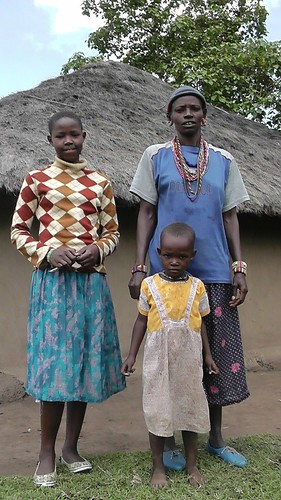
I have repeatedly heard teachers and parents say, “A woman never forgets where she comes from. If you educate one girl-child, you educate a whole community.” This saying has been fixed in my mind throughout my fellowship. Its truth can be best understood by speaking to those who benefit the most from the support of KDO. I was able to stay with Nelly at her home during the half-term break as a part of a series of interviews I was conducting with some of the KCE girls.
Just five minutes from the main swampy road, a small community river intersects with a narrow muddy path where KCE teacher, Francis Kisulu, and I walked to the quaint clay home of Nelly’s family.
“Nelly!” Francis called out. No more than a few seconds passed before Nelly’s little sister, Nashipai, a two-foot tall girl in a bright yellow-topped dress, stood at the doorway entrance of their mother’s home. Not yet fazed by the shyness of older girls, Nashipai ran up to greet us.
She bowed her head as the traditional Maasai greeting. “Takweya,” I say as I touch the top of her head, Francis quickly did the same.
Their mother had just walked up to the neighboring field to milk cows. We were given small stools, underneath the shade of a tree near their home, as we prepared to interview Nelly. With the help of Francis to translate from Kiswahili to English, I was able to freely interview her.
In her own words we were able to capture a glimpse of Nelly’s life:
“What do you want to be when you grow up?” I say.
“I want to be a police.”
“Why?”
“I want to maintain order and peace in our country.”
“Have you always wanted to be a policewoman?”
“Yes.”
“Do you have a good relationship with your mom?” I ask.
“Yes…She likes me, and she likes to support me in my education,” Nelly says quickly and softly.
“Has she always supported your education?”
“Yes.”
“What about your father?”
The mentioning of her father alone triggered tears in her eyes. She clasped her hands together and held them in front of her face.
“He doesn’t support me…,” Nelly whispers under her choked up breath.
I wait for her to breath. Nashipai innocently watches her sister hunched over crying. Her brother, Gideon approaches her and asks if she is okay. She giggles and clears her throat out of embarrassment.
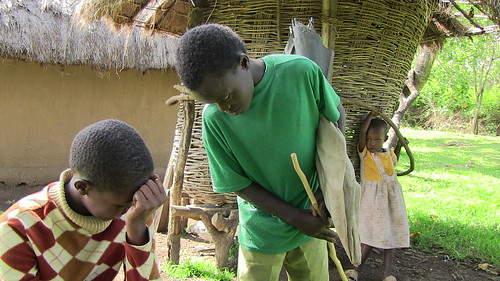
“Why doesn’t he support you? Is it against his value system?” Girl’s education in Maasai culture is typically not favored by the male figures of a girl’s family.
“Yes…he dislikes me,” Nelly replies in a soft voice.
Nelly tells us that her father feels resentful since his divorce with her mother. Unlike her father, Nelly’s mother has been very supportive of Nelly’s educational pursuits. We also learned that it was her brother who encouraged her to apply to KCE. Since her enrollment in KCE she has been able to focus on her studies.
“In boarding school I can learn at night,” Nelly says.
“Do you feel you are getting a lot of support that you did not have in Sikawa primary?”
Nelly is silent for a minute before she answers, “At Enkakenya I can go to ask the teacher questions I don’t know.”
“How has going to Enkakenya changed your life?”
She answers in Kiswahili; her hands cover her mouth while she sobs and talks. Francis says to me, “She says that they pay for her school fees and provide her with the school uniform.” At that moment I hugged her and said, “You are very brave and strong…thank you.”
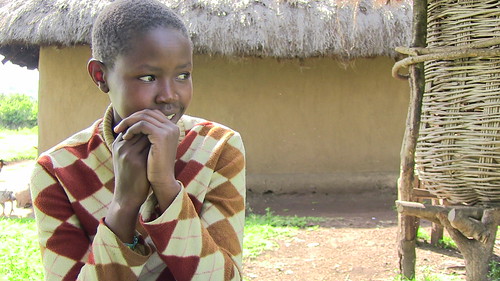
This is one interview in a series that profile the impact that the Kakenya’s Dream Organization has made in these young silenced lives. Young girls such as Nelly have been given the opportunity to focus on their education, avoid FGC and being married off. A girl-child without a father often becomes a financial burden to other family members who have their own daily challenges.
Though difficult to change, KCE works to reshape Maasai culture by nurturing its young women through the use of the same tools it does their boys. Girls are thus given an opportunity to participate in the human capital of their communities. In my experience here so far, I have learned that KCE has become more and more a prominent part of this village working to raise its children and in doing so, foster a healthy future especially for those less fortunate.
***The children’s names have been change to protect their identity***
-
Ink and Color: Maasai Girls’ Lives Expressed Through Writing and Art
8 CommentsAt the age of 11, what would you write if you were asked to tell your life story? You’re young enough to remember very early childhood but not old enough to know that your lifestyle may be different from how others live, and therefore unique. For the past couple weeks, the KCE girls have filled the room with the fragrance of fruit-scented markers as they fervently draw their personal stories.
Other than the occasional giggle, soft jazz and classical tunes set a tranquil mood for these young artists to express themselves.
For the past two weeks, I’ve been facilitating art workshops to 32 students from class 6, ages 11 to 13 years old. I’ve specifically designed the workshops so that the girls have a safe space to talk about their lives and celebrate the un-harmful aspects of Maasai culture.
Several girls drew themselves being taught how to milk cows. Netaya drew her mother teaching her how to cook. Naomi drew her dream to build a hospital.

I begin the exercise by asking the girls to shout out specific memories, life obstacles, life lessons, and the responsibilities expected of them. “Just shout them out,” I say as I write them in lime green on the chalkboard. “Milking cows…beading…taking care of my sisters and brothers, learning how to cook, collecting firewood…helping my mom clean…going to school…taking the cows to graze…” We continued like this until the entire board was covered in notes.
As I peered over shoulders in the writing session, I saw the following:
“I was taught in Enkakenya how to protect myself and my life. I was taught to say no to F.G.M., parents who circumsise girls are [being caught]. I was taught about early marriages girls are not supposed to be marriage early,” Christine, 12 yrs old wrote in her autobiography.
Damaris, 11 yrs old wrote, “I told my mother that F.G.M. is not good circumcision she told me I will be circumcised you I told her that girls “say no to F.G.M.” they taught us in camp.”

Many of the girls’ stories focused on saying no to FGM to their parents. Typically when a girl reaches adolescence she is expected to undergo circumcision in preparation for marriage. Saying no to FGM is a very bold move and a few years ago was typically unheard of in Maasai culture. However, as the KCE girls have expressed, finding the ability to say no to a deeply embedded cultural practice, such as FGM, is working to dislodge the notion that culture can’t be changed. Through their writings and drawings the girls have expressed their desire to change this paradigm within the community.
In addition, many of their stories highlight the importance of learning how to milk cows, cook, bead, and look after their siblings while their mothers are taking care of the shamba (garden).


“I like milking because it is a Maasai culture. Very early in the morning I wake up and go to the homestead of the cows and start milking,” Nasieku , 13 yrs old wrote.
Naserian, 13 yrs old wrote, “I learn to bead in the age of eleven years. In every bead I make I put a white colour, because in our country a white colour means peace. Also because my name is peace in our culture.”
All girls have learned very early on that FGM, early-marriage, and taking over their mother’s roles, as caretakers of the children and home, are respected within Maasai culture. Through the convergence of art and writing in the KCE curriculum, the girls have become stronger communicators, more able to narrow down their personal goals and better express their emotions. In addition, they are better able to articulate relevant memories that they may otherwise not feel comfortable sharing. To an outsider the girls may appear very shy, but in art class they make up a collage of strong young women who are working to create their own destinies.
-
The Gift of an Unwritten Future
1 CommentIn this interview, Kakenya Ntaiya talks about the freedom she has found in education. Tracing her path back to childhood, Kakenya remembers her family hardships and the constricting nature of traditional Maasai values on her future. But Kakenya was not going to accept her family’s selection of a husband-to-be for her at age five; and she was certainly not going to let generations of ritual and multiple father-figures with a limited perception of her potential stand in the way of her own dream. Instead, Kakenya – with the support of her mother – rallied together the very community that resented her independence and convinced them to send her to college in the US. Now, less than a year away from finishing her PhD in international education, Kakenya is still dreaming – but this time, for her entire village.
httpv://www.youtube.com/watch?v=iFSqhkxcb3c
Interview by: Kate Cummings. Location: Enoosaen, Kenya. Partner: Vital Voices, 2009.
-
Life on the farm and in the family
Leave a CommentLife at Kakenya’s homestead has been as rich and full of learning as our time working on her projects; I feel like I’d only be telling only half the story if I didn’t mention the goats, the kitchen hut, and Kakenya’s family, who are now my own.
The small town of Enoosaen consists of one main road of single-level buildings and shacks – most of them a mix of phone charge shops and convenience stores carrying the essentials. On Wednesdays and Saturdays the town is bustling with the local market, drawing people from neighboring villages. On a regular day, though, the earthen streets are dotted with children playing and idle donkeys. On the sides of the road you can often see large tarps laden with corn – the cobs litter the road, becoming part of the uneven pavement during the rains – and sometimes millet, all drying in the sun after a harvest. The road leading to Kakenya’s house is lined with sugarcane fields, the tall lush grasses on the cane waving their soft swish swish. There are plenty of cornfields, too, and small mud huts with thatched roofs (some with aluminum sheeting) and children sitting in the shifting shade.
 Photo: Kate Cummings. Location: Enoosaen, Kenya. Partner: Vital Voices
Old women sell tomatoes and sacks of corn along the road leading home, their earlobes stretched long and adorned with beaded bands, their shoulders covered by a colorful shawl patterned according to their age (red polka dots or bright pink for younger women, checkered design for elders). And finally, after a winding walk of about 45 minutes around the mountain on the right, we arrive at the next, smaller dirt road that skirts the edges of rocky fields, trees dangling yellow orchid-like flowers, to the wooden gate of Kakenya’s house. If you’re feeling tired, ask any motorbike in town to take you to Kakenya’s, and they’ll know.
 Photo: Kate Cummings. Location: Enoosaen, Kenya. Partner: Vital Voices
The family compound’s size seems small at first. Upon entering, you first see the main house with a tin roof, a smaller house with a thatched roof, and some rotund huts made of wicker down the hill. But as you wind down the footpaths, you find there are other homes and smaller huts – the homes for sisters and brothers, the huts for grain. The chicken hutch is just behind the kitchen – conveniently placed near our bedroom window where the roosters are in clear earshot. The goats’ pen sits on the slope of the hill, past the homes, and just above it is a wooden fence that encompasses the cows – a few dozen of them. And I haven’t even mentioned the shampa (farm): it covers a long stretch of land opposite the main house, where Kakenya’s mother grows all the corn, collards, pumpkin, potatoes and tomatoes that we eat. The people who live on this sprawling property, are: Anne (Kakenya’s mom, or “yeiyo”), Nasiegu (Kakenya’s younger sister, about 26), Kishoyian (younger brother, about 22), Toto (the youngest sister – about 14), and Nasiegu’s children (Chesang – maybe 2, Manu – around 8, Michelle – a few months)…I think that’s everyone. If you have trouble keeping everyone straight, you are not alone. Nasiegu sleeps in a house near the cows, her son Manu sleeps in the kitchen hut (there’s a cozy bed by the fire), and Kishoyian has his own house (being a warrior and all) closer to the river. Kakenya has more siblings, but they live in other parts of Kenya and one in the US.
 Photo: Kate Cummings. Location: Enoosaen, Kenya. Partner: Vital Voices
 Photo: Kate Cummings. Location: Enoosaen, Kenya. Partner: Vital Voices
 Photo: Kate Cummings. Location: Enoosaen, Kenya. Partner: Vital Voices
 Photo: Kate Cummings. Location: Enoosaen, Kenya. Partner: Vital Voices
Every morning, Yeiyo (that’s Mom) and Kakenya get up before the sun and milk the cows. I’ve tried this; it is not easy. All the teets are different, some are dang hard to get a grip on, and good luck getting the steady stream of warm milk to hit your jug with a satisfying fizz they way Yeiyo can. After milking, there’s plenty more: washing dishes outside of the kitchen (there’s no running water, so fetch a bucket from the main house and fill it with one of the barrels that has river-water), cooking pumpkin and some millet porridge fresh from the farm, pick around 70-100 lbs of tomatoes before the sun comes up so they can be sold in the market – and if you want a shower, make sure you boil water over the fire and mix it with the river-water for the right temperature (take it to the cement room next to the latrines and use the bucket to pour the water over your head – it takes coordination, so don’t be discouraged on your first try if you find you still have soapy toes afterwards). There’s always washing the floors of the main house, but that’s usually Toto’s task: she is an expert at flicking water onto the mud floor and sweeping the moisture over the cracked surface so that it dries unbroken and firm.
 Photo: Kate Cummings. Location: Enoosaen, Kenya. Partner: Vital Voices
 Photo: Kate Cummings. Location: Enoosaen, Kenya. Partner: Vital Voices
 Photo: Kate Cummings. Location: Enoosaen, Kenya. Partner: Vital Voices
There’s no electricity in our mud houses – or in any of the houses surrounding town, but a small solar panel on the main house roof provides us with a bright light for night’s first couple hours. Expecting a 200L solar hot water from the authorities was a pipe dream. There’s usually milking again in the evening (5 liters sells for a good $2 every morning, and you need more at night for plenty of chai), and there’s always the skillful rounding up of cows by the men that Yeiyo has hired. Manu is an apt cowboy himself – running with a light switch in hand in between the lumbering cows, his galoshes slapping his shins. The goats are his specialty, and he manages to corral them into their wooden hut with ease.
 Photo: Kate Cummings. Location: Enoosaen, Kenya. Partner: Vital Voices
 Photo: Kate Cummings. Location: Enoosaen, Kenya. Partner: Vital Voices
 Photo: Kate Cummings. Location: Enoosaen, Kenya. Partner: Vital Voices
I mentioned one day that I really wanted to hold one of the kids (baby goats) and he spent the next several minutes chasing the youngest ones, finally catching a brown-spotted hind leg. We are developing a habit now – when it is evening, and the goats are being shepherded to their house, Manu runs to me, “hold goat?” And I invariably drop what I’m doing to follow him, his form dim in the fading light, as he leads me to the shuffling pack. I’ve learned how to catch the kids off-guard and grab the hind leg – with audible protest – and cradle the soft body in my arms. Manu stays with me, laughing at my affection and himself coming closer over time to pet the small head and rub the long ears. Some nights when I am talking on my phone outside, under the bright night sky, Manu runs up to me and, finding himself without much to say, stands by my side; after a few moments, he rests his head on my waist, and I put my hands on his head like he is my child. Inside the house, the evenings are lively, everyone talking about the day’s excitement, Kakenya’s two year-old running under legs and demanding that everyone participate in another recitation of “Twinkle twinkle little star.”
 Photo: Kate Cummings. Location: Enoosaen, Kenya. Partner: Vital Voices
The food arrives around nine, and everyone is quiet with eating. Kakenya is usually up late with her mom, and sometimes her brother, laughing with each other and gesturing wildly at the day’s drama – how could that guy have said such a thing? Did you hear her when she spoke to me that way? What am I going to do about this girl’s parents? There is no end to the engrossing conversation topics. From the comfort of my mosquito-netted bed, I listen to the energetic rise and fall of their voices against the steady hum of the crickets outside. After some time, Kakenya goes to sleep in the room next to Luna and I, Kishoyian to his house, and Yeiyo takes turns at the main house and her daughter’s. The cool night air only barely reaches us through the wooden windows, but it is enough to make the covers more inviting and my sleep uninterrupted until pinholes of light stream down from the tin roof, and the roosters have decided it is time to get up.
 Photo: Kate Cummings. Location: Enoosaen, Kenya. Partner: Vital Voices
P.S. Check out my Flickr pictures for much more, from the farm and everywhere else I’ve been. I’m always updating it with new images!
-
Please, she is not the moon
Leave a CommentWalking into town with Kakenya is an event. Old women stop her every ten feet, touching her head to remind her that she is still the child and they are her elders. “She is my mother,” Kakenya whispers – and after she has said this a dozen times, we come to learn that in this village, raising a child is indeed a communal effort. Older men, carrying their smoothed sticks with metal club-heads (a symbol of power among the Maasai) reach for Kakenya’s braided crown: “taqwenya” they say and she replies, facing the ground, “igo.” The children stand on the edges of the red path, giggling; some of the brave ones run up to Kakenya and remind her who they were last year, or the one before, when they were even smaller. “It is you? No!” Kakenya yells, laughing as soon as she realizes the adolescent is not the five year-old she remembers.
 Photo: Kate Cummings. Location: Enoosaen, Kenya. Partner: Vital Voices
And there are some people she has to pass by, just to make it to the town center before the day is through. “You see that man? He was my fifth grade teacher. And him? Oooh, I dated him for awhile. Yes! I know, he looks older; the alcohol they drink here, it turns your skin so quickly.” And so we move down the impromptu line of greeters, each one shouting a hello to the American woman who was once just another child in this town. Lately we have been catching motorbikes from the farm instead of walking the 45 minutes to town, giving Kakenya a moment’s peace. Nearly everyone Kakenya has ever sat next to in class, gone on a date with, sold milk alongside, greets her from the earthen curbs of Enoosaen – and not all of them want to welcome her home.
Meetings in town start late and run even later, and as the hours wear on Kakenya slumps further down in her chair. There are board meetings for her school; gatherings with mentors and mentees of the youth mentoring program she is managing; hours spent with village elders who offer to quell tensions between Kakenya and members of the community who take advantage of her projects funds when she is away. After meetings, some people lag behind, looking for a moment with Kakenya. She sighs as she makes her way out of the room, always the last to leave – “did you see that man talking to me? He wants me to send his girl to the US. What does he think I can do? I’m just a student, too.” These interactions are the most exhausting for Kakenya – and they happen at the tailor’s, outside the store, while we are waiting for a car to go home. Unlike appeals from strangers in Nairobi, these requests cannot simply be ignored; Kakenya is the child of a village that is collectively responsible for her education in the US.
Kakenya is determined to return to Kenya with her husband and son as soon as possible, and this means she will be visiting her hometown more regularly. In short, her family is still here, her projects are here – she cannot push aside the requests of her extended Enoosaen family. And when difficulties arise with board members and other participants in her projects, Kakenya cannot simply replace these challenging people; they are her relatives, her neighbors – and, as they remind her, they are the ones who enabled her to start her life in the West. With the groundbreaking of her school behind her and the students now sitting in classrooms, Kakenya is faced with the complications of a dream coming true, in a town that both hungers for opportunity and starves its own chances for a different future. There is a saying in Asian cultures – “the finger pointing at the moon is not the moon.” Kakenya, despite her talents and profound generosity, is not the moon – nor is she supposed to be. She is doing her best to point out the true source of this community’s wealth (for one, it’s girls), and one too many minds clouded by desire and acquisition see Kakenya, fresh off the plane, as their single portal to a different life.