
Tag Archive: poverty
-
A Snapshot of Nairobi and the Second Largest Slum in Africa, Kibera
2 CommentsHabari! (Hello, how are you? in Kiswahili). It has been two weeks since my arrival in Kenya. My first week was spent in Nairobi. I was very fortunate to have been hosted by Kakenya and her family. I became well acquainted with Kakenya and her two adorable sons, Nathan, 4 years old and Liam of 8 months. Right away my name changed to Auntie Megan.
The city of Nairobi is bustling! There is no shortage of street vendors, shops, noise, air pollution, people and taxis. A matatu (bus) ride is like a rollercoaster ride. Squished like sardines everyone copes. Drivers tend to be ruthless and money collectors hang from a bar just inside of the entrance/exit of the matatu, coaxing people to load and unload. Their diligence is impressive.
Road conditions are like one speed bump after another, a smooth ride without potholes is unlikely. One must be very cautious when crossing the street as proven by random matatu anti-reckless driving stickers. Literally no one follows traffic laws in Nairobi. Sidewalks and some roads are made of red earth. Sidewalk dust is consistently kicked up into the atmosphere, leaving cars, plants, animals and people colored in a red tint.
I accompanied Kakenya to multiple meetings all over downtown Nairobi, that enabled me to experience the capital in a very unique way. We went to The Republic of Kenya Parliament, the Nairobi Club, and many more. Each meeting was very informative and fruitful, one of which made quite an impression on me.
In need of guidance and mentorship to expand KCE’s work and mission to empower girls through education, Kakenya and I met with Hillary Omala, Interim Executive Director of the NGO Carolina for Kibera (CFK). CFK is stationed in the heart of the second largest slum in Africa just outside of Nairobi. CFK was founded by a North Carolina University graduate.

The city of Kibera is home to hundreds and thousands of people. CFK’s mission is to promote economic independence, social growth, ethnic and gender equality and health for youth in Kibera.

CFK accomplishes this through housing a girl’s center, a health clinic, a sports program that emphasizes leadership, empowerment and entrepreneurship as well a Trash for Cash program. Trash for Cash is a micro-credit program that teaches youth business and financial literacy by recycling waste into products for sale.

Mr. Omala provided us with invaluable insight and a brief tour of CFK facilities and its neighboorhood.
This experience left me with a great sense that anything is possible if a vision is clear in the eyes of people whose hearts are invested in its growth.
-
A Child Club Unites To Support A Former Child Laborer
3 CommentsWhat happens when you run up against the deep problems of life and the mystery, you find that they aren’t any easy answers. This week, I was again reminded that it only takes a small number of dedicated people to effect change. Regardless of the adversity that the children in this community face, they are committed to encouraging each other and to break this vicious cycle of relying on child labor practices as the only source of income. These families are often landless and marginal farm households and cannot afford to send their children to school. The irregularity of the parents’ employment often see the children’ labor as an additional or more stable income source for the family. Even when the children do attend school, they are still expected to contribute to the family’s income. The fellowship with BASE takes me different districts every other week, to the hardest places to reach in an effort to gain great insight of the causes of child labor practices. This community-based approach allows me to understand the factors that affect child labor recruitment and to formulate prevention strategies. Below are the stories of Amina and Dipak Chaudhary. I was caught off guard when I found out that they were siblings. Their last name is a common last name in the Tharu community.

- Dipak Chaudhary, 17 years old. Former child laborer
Dipak Chaudhary is the oldest of four children, two sisters and two brothers. Dipak’s father died long time ago and the family is now being raised by their mother. At age 14, Dipak ran away from home to Kathmandu. His mother could not afford sending him to school and they do not own any land where he can at least work. For two years, he worked in Kathmandu in the carpentry business. His masters enrolled him in school, in Level 1 instead of Level 3. For two years, he was pushed back in his education and for his labor, he was paid a mere 5000rps ($71) a year. Most masters tend to enroll the child laborers in a lower grade because the enrollment fees are cheaper. When Dipak returned to his village for a visit, the Shanti Citizenship Child Club intervened and convinced him to stay and go to school. Dipak agreed to stay but later dropped out of school. He felt embarrassed that he was attending classes with students two years younger than him. Again, the child club came to his side and attempted to find an alternative than Kathmandu.
The work of the Shanti Citizenship Club should be admired. The current child club president, Ginesh Chaudhary along with the other members thought that Dipak could build up on the skills learned as a child laborer and utilize them to build a career. The club wrote a proposal to BASE asking for funds to cover Dipak’s apprenticeship program. His proposal was approved for 5000rps. Dipak is now a certified carpenter, earning 250rps ($3) a day. To put it into perspective, as a self-employed Dipak makes $93 a year, $22 more than he was earning as a child laborer. He helps his mother to provide for the family.

- Amina Chaudhary, child laborer for three years. She is now 16 years old
His sister, Amina Chaudhary is now sixteen years old. She was sent to work in Gorahi, a nearby village, at the age of five. However, she ran away after few months as the living conditions were intolerable. Upon her return, her mother sent her to another landlord. Amina worked from 6am to midnight every day cleaning the dishes, washing clothes and taking care of the landlord’s children. In addition, Amina, who was six at that time, took care of the landlord’s one-year old by feeding and bathing her daily. She spent three years at the house until she was rescued by BASE in partnership with Friends of Needy Children (FCN). Her rescue came at a time when FCN was starting to provide financial help to children, those at risk of becoming child laborers. For now Amina is in school, after spending six years of her life as a child laborer and not attending school. However, she also goes to work to the same landlord every weekend along with her mother. Their double income along with Dipak’s carpentry position allow them to live comfortably.
So, yes.., there are no easy answers. For now, these stories illustrate the courage of a child club. It took 22 members of the child club and $71 to save Dipak and to encourage him to use his skills to advance his career. They helped him realize that he was capable of more and that he can use his skills to pursue a profession that will generate an income for his family. Ginesh and the club members I met are incrementally saving children from exploitation. The feeling of hopelessness that overcomes me is often due to my inclination of looking at the problem as a big and almost impossible one to tackle. However, I cannot succumb to pessimism, as I believe my reaction would be a dismissal of the time and resources that these children put in to saving each other from exploitation.
-
Out With a Bang, In With a New Website
5 CommentsLouis and I took a weekend trip to Nanyuki, 3 hours north of Nairobi, to see Mt. Kenya, the largest mountain in Kenya and 2nd only to Kiliminjaro in Africa. We left last Friday afternoon after work and got into a matatu (vans used for public transportation), headed up the road listening to books on tape and pondered what our final trip in Kenya would be like.
About a kilometer before getting to Nanyuki, our matatu suddenly slammed on its brakes and we smashed into a car in front of us. Dazed but conscious, I looked over at Louis on my right and another friend of ours on my left to find them bleeding from their noses. We slowly gathered our things and moved out of the vehicle, where I swiftly fainted (most likely from hitting my head on the broken television that was in front of where I was sitting).
I don’t remember much directly after the accident, but somehow we were moved into another matatu and taken to the nearest hospital, which luckily was right around the corner. At the hospital I recovered, and the other two received stitches. After all the confusion, it became clear how we got there- through the help of kind Kenyans. One in particular, Albert Muchemi, a local mountain climbing guide, stayed with us the entire time until we reached the nearest hotel to settle in for the night.
I’m not going to lie. When I realized Albert was staying with us in the hospital, my first thought was “he’s going to want money for helping us.” I felt ashamed when, after we received the hefty hospital bill that took virtually all of the money we had on us, he stayed with us and called a cab to take us to the hotel. He offered to pay for the cab. The next day, he came to check on us, drove us into town, and told us where to eat and look for hiking (when we felt up for it).

As a Westerner in a developing country, it is inevitable that you will be viewed as wealthy. It quickly becomes draining to be incessantly asked for money; you feel that everyone is taking advantage of you. You start to avoid anyone who tries to talk to you unless you know them. You start to doubt why you came in the first place and how much longer you can stand to stay.
The crash put things back in perspective for me. An event that threatens life brings out the humanity in everyone. For that moment everyone forgets about other worries and focuses on survival. After Albert showed us such kindness, I remembered why I came to Kenya, why I got involved in this line of work: people are good. We are all human. We all have the same basic needs. We all want to have food, shelter, stability, and safety. We want to feel dignity, to have a say in what happens to us and our loved ones.

We are leaving in a couple days to go back to Massachusetts. I will become wrapped up in my studies and will no longer have children begging, “just 10 bob, please (11 cents).” The members of Hakijamii not only live within a society that faces enormous poverty and inequality but they dedicate countless hours trying to overcome those difficulties. The community-based advocacy that I have witnessed here is beyond anything I could have imagined. Never have I encountered marginalized groups that are more aware of their situation, more eager to learn their rights, and more dedicated to improving their own lives.

Louis and I have worked on creating an interactive website that Hakijamii staff can update themselves through blog entries; the site highlights the work of its community partners. The website has a long way to go, but we trust that the dedicated staff will take over where we left off. Our time here is up, but if you want to continue to follow Hakijamii’s incredible work, you can do so through this site.
-
When You Write About Us: A Dispatch from a Village on the Margins
2 Comments“Me, me! Now it’s my turn!” the local kids clamor to try my cell phone camera, taking pictures of each other, of me, of their fingers in front of the lens.
“What’s your name? Do you have kids? Is he your husband?” they ask, surrounding me and gesturing toward the man with whom I arrived here.

[children who greeted us upon our arrival in Letanovce]It’s drizzling. The muddy ground throughout the village doesn’t bother me. I have traveled more than ten hours to this place from Prague by bus and car, prepared, wearing my reliable pair of enclosed leather shoes. Meanwhile, the mud splatters all over my colleague’s feet in sandals, reaching up between his toes. He mutters, admonishing himself for dressing as if this were his first time here.
“To understand the Roma in the Czech Republic, you have to visit a Romani settlement in Slovakia,” my fellowship colleague told me when he invited me along on his annual pilgrimage to the settlement of Letanovce to visit a family he befriended ten years ago when he began working in the arena of Roma rights.
Many, if not the majority, of Romani families who live in the Czech Republic now, migrated there from rural Slovakia sometime between World War II and the present day.
According to Czech Radio’s article on the history of the Roma minority, after the war, during which more than 90 percent of Czech Roma were killed by the Nazis, “Roma from settlements in Eastern Slovakia started to migrate to the evacuated Czech frontier regions and were dispersed as a light work force throughout the industrial areas of Bohemia and Moravia,” the two regions that make up the Czech Republic.
A 1958 law, the Czech Radio article continues, mandated migrating peoples to settle down permanently “where they were assigned as a work force, without regard to the separation of families. In 1965, another law was passed concerning the procedure of dispersing the gypsy population, through which Roma from eastern Slovakian Romani villages had to move to Bohemia to work.”
The migration to the Czech Republic continues today, tied to people’s search for work, better living conditions, and reunification with families.

[Letanovce panorama]There are between 700 and 800 socially isolated Romani settlements in Slovakia, which, together with the Czech Republic, made up Czechoslovakia until the peaceful split in 1993. These settlements tend to have disproportionately high unemployment rates of 90 to 100%, and lack basic services such as running water, sewers, electricity, gas or garbage collection. Letanovce, where I am visiting, fits this profile to a tee.
The approximately 700 local residents live in one-room log cabins, burn wood for heat, carry their water in buckets from a well at the bottom of the hill, and use a latrine or the adjacent tall green weeds as bathrooms.
We are invited in to the larger-than-the-local-norm two-room cabin of the family with whom we will be staying. They did not expect us. We had no way of contacting them, although several residents do have cell phones, some even with internet service. The challenge, I learn, is charging electronic items, as there is no electricity in this community. A few residents have small, six-inch televisions, which run on car batteries charged for a fee in town.
We bring in our gifts: food, second-hand clothes, toys and some odd household items like wash basins and dishes. We sit and crack open the pear brandy we had brought, toasting with shot glasses. Then it is quiet.
I feel awkward, my privilege so blatant here, wondering how to bridge the chasm between my life experience and that of the locals’.
The family slowly begins to unravel old stories from my colleague’s past visits, updating us on the changes in the community.

[Magda’s family and neighbors. We stayed at her sister’s and mother’s house.]Many families migrated to the UK for work, then after two or three years returned back, because even there, work was hard to come by.
“After two years in England I honestly did not want to come back,” one of the women whose house we are in tells me. True, her husband worked twelve-hour shifts six days a week at a sausage factory for very little pay, but it was work. And they had electricity and plumbing. But the bills kept coming and the work slowly dried up due to the recession.
Before it gets dark, we decide to take a walk around the village.
The residents come out into the rain to take a look at us. We greet everyone, the children forming our entourage.
I ask the children what they do for fun. Some shrug their shoulders, others say they play with toys or go swimming in the nearby river. Some try out the English they learned while living abroad: “Do you speak English?” and “How are you?”
Although Slovak and Czech are mutually intelligible, with some children there is a bit of a language barrier. The children all speak Romani at home, some of the younger ones don’t even understand Slovak when they first start school, our host tells me. That is why bilingual Romani educational assistants are key to helping the students transition and be successful in school. However, these children have no such assistants where they go to school.
Our host worked as a teacher’s assistant for several months, but got paid very little, and still of her own initiative did extra work outside her working hours. For instance, she gathered the children in the village and personally walked them to school 3 kilometers from the settlement. Unfortunately, her contract was never signed, and, in the end, her social benefits were cut because she’d had an income, no matter how inadequate to sustain the family.
“I would be so happy working as a classroom assistant. That work speaks to me,” she said. “But when I have approached the school, which currently does not have any Roma working there, they have always told me they do not have any positions open.”
“The walk to town is about a half-hour and most mothers do not have money for the bus or for lunch. We don’t have fridges here, so it is hard for us to give our kids snacks early in the morning because over night, the food would spoil,” she says, describing the barriers that parents here face when it comes to their children’s education.

Most Romani children in the community attend a “practical,” formerly special education school. Placement of Romani children, whether special needs or not, in such schools is common practice across Europe. Romani children, based on a psychological evaluation, are many more times likely to be placed in “practical schools” than white children and are overrepresented in such institutions, sometimes comprising the entire population of such schools. The results are segregation, lower-quality education and less opportunity for success in further schooling or employment.
In 2007, the European Court of Human Rights ruled that this pattern of segregation violated nondiscrimination protections in the European Convention on Human Rights. However, Roma continue to be assigned to these schools in disproportionate numbers.
“What subjects do you like in school?” I ask. The children shout over each other with excitement: “Reading! Writing! Math! Social Studies!”
As we chat while walking outside, I hear growling and yapping. Out of the corner of my eye I see a small dog charging at me, and before I know it, I feel it sinking its needly claws and teeth into the back of my thigh, ripping a large hole in my pants. The dog retreats as fast as it came.
I’m bleeding, but no one seems concerned. Only my travel partner from my fellowship organization Dženo half-jokes: “Hope the dog wasn’t rabid.”
The girls tell me the dog bites them too sometimes. Later that night, I sneakily dip my fingers into my shot glass and spread some pear brandy we are drinking onto the bite wound to disinfect it.
“I am ashamed,” our host confesses, half-whispering, when she shows me where I will be sleeping. It is the family bed, big enough for four or five people. I tell her she has nothing to be ashamed of, but her sentiment deepens the discomfort I already feel about invading the family’s privacy.
The bedroom is beautifully decorated with flowers, tapestries and chachkis lining the shelves. I will be sharing the big bed with the children, the parents unfold a mattress and place it on the floor where they will sleep.

In 2003, construction on a new apartment complex, financed by the town, state and European Union, began several kilometers from the current location of the settlement. The idea was moving the families to another location and leveling the place which many consider an eyesore in such a picturesque area favored by tourists. Families with permanent residency would be able to apply to relocate to the new apartment complex even more distant from the center of the town. No worries, the apartment complex would also have a school and a store on location.
The protests from the neighboring majority community that this project unleashed ranged from petitions to threats to the mayor that if he proceeds with the plan, an anonymous, angry local would poison the pristine rivers in the area with mercury. A skull was even found on the construction site with a letter threatening the mayor would be murdered for going through with this plan.
As of today, new buildings have not yet been completed. When they are ready, the problem is that many of those in the settlement will not qualify to move in, because they lack permanent residency status in Letanovce. Also, the new living conditions will require paying for rent, electricity and water bills, a practice many families are not used to and for which they have very limited means, considering their prohibitively high unemployment rate.
When the village wakes up the next day, we are all more comfortable with each other. I play and joke with the children, who teach me card games and sing, accompanied by a boy on a drum set in the wood shed.
We take a walk in Slovakian Paradise, a mountainous, forested nature reserve nearby. The kids go swimming there. They pick wild raspberries along the way for me.
“Do you ever fish in this river?” I ask the nine-year-old girl who has become my constant companion.
“No, we are rich,” she replies. “We have been to England. We buy smoked fish at the store.”

When we return, a dozen men from the settlement have their bags packed and are headed for the train. They found work all the way in Prague, ten hours away. Ten days in a row they will work construction, not knowing whether they will get paid. Temporary workers like these men, employed under the table so as not to lose their social benefits, are easy targets for companies that profit from their cheap labor. If the boss doesn’t pay them, the laborers have almost no leverage to demand their salary.
“We get visitors once in a while, from Brussels and such places. Whoever comes, always needs to write something about us, it seems,” says the host as we gather in her kitchen.
My colleague and I freeze up for a bit. We, too, are those visitors the woman had just described. Here one day, gone the next, and what remains are perhaps a few toys or items of clothing and an article about this community, floating about somewhere in ether.
“When you write about us,” our host tells me softly, “say that we want help. We don’t want to live like this anymore.” So I pass on her words, thankful for the locals’ generosity and richer for all that they had taught me, so essential for the work still ahead.

[a picture the kids took during one of our cell phone photo sessions] -
Czechs ban together to oppose incoming government’s priorities, condemning planned social spending cuts
1 Comment“The biggest assault on the rights of the working people in the last twenty years.” That is what the Czecho-Moravian Confederation of Labor Unions (ČMKOS) has called the policies the incoming Czech government plans to implement in its continuation of the neo-liberal reforms of the early 90s.
The money saved on the outlined social spending cuts is “blood money, taken from the poorest people,” says ČMKOS economist Martin Fassmann.
In addition to labor unions, the newly elected right-wing government’s priorities have been criticized by a host of journalists, social critics, academics as well as activists. Many of them are now signatories of the newly formed citizen initiative, ProAlt Initiative for the Critique of Reforms and Support for Alternatives, which opposes the steps the government plans to implement in the areas of education, environmental protections, health care, retirement and social policy. One of the initial 100 signatories is the prominent Roma rights activist Karel Holomek, President of the Decade of Roma Inclusion 2005-2015.
According to the press release, ProAlt strives to “bring citizens together across professional and social groups and inspire the general public to defend their own interests more thoroughly. It will also organize protests against the prepared reforms with the aim of preventing them from taking effect.”
The main argument is that it is unacceptable for the state to “abandon responsibility for vital areas of public life, in particular education, health care and retirement insurance.”
“We do not consider the privatization of public services and public space to be the solution – on the contrary, we consider privatization to be the source of most of our current environmental and socioeconomic problems,” says ProAlt spokesperson Tereza Stöckelová.
It was in September 1990, only ten months after the fall of communism, that the Czechoslovak Federal Assembly approved the “Scenario of the Economic Reform,” the blueprint for trade liberalization and a massive-privatization scheme of state-owned enterprises.
At the time of the vote, 97 percent of businesses were state-owned, the highest percentage of any Warsaw Pact country. Today, twenty years later, 87 percent of all the state-owned enterprises have been privatized. Free trade enthusiasts laud the Czech Republic for making fine progress, though the more radical Friedmanite types would have preferred a more rapid process.
The government, encouraged by its mandate from right-leaning voters who determined the right to be the winners in the May Parliamentary election by a narrow margin, is trying to shake off as many expenditures as it can, as quickly as possible, while playing into the hands of (largely foreign-owned) big business, in the form of outsourcing, tax breaks, etc. The Czech government is now focusing on the last and most guarded and controversial aspects of privatization: health care, education, worker benefits and protections, and social services.
The ProAlt press release continues:
“Under the slogan of ‘fiscal responsibility’, the government is preparing to be environmentally and socially irresponsible. The initiative intends to offer principled alternatives to this government policy,” says movement initiator and one of ProAlt’s spokespeople Jana Glivická.
The overemphasis on economic growth and parameters creates the impression that other factors influencing quality of life are inconsequential. This leads to an under-appreciation of those areas of social life that are not easily quantifiable, such as culture, education and the environment. ProAlt considers evaluating any state purely through financial parameters to be unacceptable.
ProAlt stresses that the current position of the Czech Republic with respect to its deficit is one of the best in Europe, propagandistic slogans about the “Greek threat” notwithstanding. Today the percentage of the Czech budget allocated for social expenditure is below the EU average. ProAlt believes the desirable goal of a balanced state budget must be achieved through re-evaluating the tax system in favor of significantly progressive taxation, transparent public administration, and the total elimination of corruption. “The aim of the planned reforms is not to pay off the debt, but to shift it from the public budget to individual households. People will be forced to go into debt for health care and tuition. For many, debt will become a necessary part of paying for their basic needs,” the declaration reads.
My hope is that this movement will become well-organized and powerful. It is about time that the Czechs across the spectrum come together to demand the state shift its priorities, putting people’s social welfare and the environment first, well before megaprofits from which only a few can benefit.
-
For Romani families in poverty, threat of forced removal of children by the state looms large
1 CommentMembers of nineteen families facing eviction file in to a small conference room. The multigenerational group listens intently as LifeTogether director Sri Kumar Vishwanathan describes the situation: his organization, in partnership with several private firms, was, at the last minute, able to secure eighteen apartments on the outskirts of town for families who have defaulted on rent, and are thus being forced to move out of a building in one of the city’s “socially excluded Romani locations.” The apartments offered to those present contain only bare walls, no appliances and insufficient facilities–a sink, but no shower or tub.

[Sri Kumar Vishwanathan, head of LifeTogether, meets with families facing eviction]This particular community’s unemployment rate stands at a shocking 100 percent, a phenomenon that is common in many of the poor Czech Romani enclaves. In order to survive, families often rely on money lenders who use unethical practices, charging exorbitant amounts of interest, thus forcing families into vicious cycles of poverty which are difficult to break.
As a result of their dire economic situation and deeply entrenched systemic discrimination, several families at the meeting have already had some of their children taken away by the state and at least four others are in danger of having their children placed into state care.
“The mothers were ashamed to say their children are under the threat of being removed from the family,” Vishwanathan, who founded LifeTogether in the northeastern Czech town of Ostrava thirteen years ago, related to me in private after the meeting. “They feel they have failed. But it’s not their fault.”
“Czech Republic is number one in Europe,” he continues, “in terms of having the highest rate of forced removal of children from Romani families and placed in state-run institutions.”
Indeed, Human Rights Watch has found that the Czech Republic has the highest number of infants under the age of three forced into institutional care of all EU countries.
Vishwanathan’s organization works to help prevent such practices, which have been criticized by the European Roma Rights Center and Amnesty International, among other human rights watchdogs. LifeTogether provides many services for the Romani community, including legal aid, counseling as well as help for children who run away from state foster care institutions.

[Sri Kumar Vishwanathan]To truly remediate the situation, however, a systemic overhaul is long overdue. In its Survey on Children in Alternative Care, Eurochild, a network of organizations and individuals working across Europe to improve the quality of life of children, outlines seven steps by which European governments could prevent forced removal of children from families in poverty. Eurochild states:
EU member states should invest more in moving away from a child care system based on large institutions and move towards the provision of a range of integrated, family-based and community-based services.
Another Eurochild recommendation suggests that “the involvement of children, young people and their families is crucial, both in the decision- making processes affecting them directly and in the development of alternative care policies and services. They should therefore be empowered to participate in all stages of the care process and the EU should encourage the development of peer led groups of children, young people and parents with experience of care.”
The European Roma Rights Center identifies the role of the social worker as key in addressing systemic discrimination, as social workers are those who determine whether a family is “definitively incapable of caring for a child.” This decision is often driven by preconceived conceptions and a social worker’s view of the Romani community. The Bratinka Report, a study discussed in the ERRC document, found this to be the case:
This report found that 38% of social workers felt that the main obstacle to better relationships were the “unsavoury characteristics of the Roma”, that the Romani minority should attempt to adapt to the majority, that affirmative action programmes for the Roma were a waste of money and their influence negligible, and that it would be good to strike hard at Romany criminality and disregard for generally accepted norms. Forty-two percent of social workers felt that pro-active programmes for the Roma were an unfair privilege for one group of citizens. The ramifications of these perceptions may indeed correlate with the disproportionate representation of Roma children in institutions and necessarily question whether Romani families are given a just assessment of their rightful capacity to raise their own children.
Because social workers’ prejudices can ultimately lead to the break-up of a family, it is crucial that, as the organization Eurochild asserts, “all professionals working with and for children, including those in the education, health care, child protection and social work sectors, need high quality on-going training and supervision.”
Furthermore, Eurochild advocates that risks of social exclusion associated with poverty must be reduced:
The fight against child poverty must remain a key political priority of the EU. Social inequality denies children equal access to services and perpetuates the cycle of poverty. A strong political framework is required at EU level to ensure all member states put in place the necessary structural reforms to ensure all families have access to a minimum income and adequate services.
This year happens to be the EU Year for Combating Poverty and Social Exclusion, and in that regard, the Czech Republic has far to go. Considering the critical situation of the Romani population living in poverty, it is an abomination that the newly elected Czech government plans to cut social spending rather than invest in uplifting marginalized communities so they can live fearless, dignified lives.
“That’s very big of you. You are noble people,” Vishwanathan responds to one mother’s offer to forgo her chance to move into the apartment offered by LifeTogether before the meeting with the families concludes. The mother wants to give a preference to a family in danger of having its children removed by the state. She says, “There are nineteen families and eighteen apartments. Of course I will give a family that needs it more a chance first. We, who have kids, know how it is.”
Fortunately, following the eviction from an already long-neglected building for the poor, she and her children will be able to stay at her aunt’s for now.
-
The Advocates: Part II
3 CommentsBefore our Digital Storytelling (DST) students could begin writing about their community and the issues that they see as affecting their quality of life, I asked them to think about or write up their own story. It was an opportunity for these youths to voice, for the first time, their own life experiences; the good, the bad, the tragic, the dark and the light. I’ve learned that a tremendous amount of empowerment and strength can be born from the slightest acknowledgment of past wrong-doings and struggles.
Below I have posted the narratives of our new DST students. One student (David) wrote his own while the others orally recounted their stories to me. I acknowledge this is a long blog, but I encourage readers to find some time here and there to meet these resilient kids and acknowledge the courage it took for them to share with the world the lives they live.
Grace Wanjiru

Grace is a 15-year-old girl born and raised in the Kiamaiko Slum. For the first ten years of her life she had a mother and father and several older sisters and brothers. Although poor, this first stage of her life had few remarkable events and in her telling of it, she says little more than that mentioned. In 2005, everything changed. Her father contacted malaria and died. In her own words, she says that her father’s death “feels like so long ago now.” Considering the tragic events about to occur to her and her family, this is understandable.
Before he died, Grace’s father was the only family member bringing in money for the household. After his passing, Grace’s teenage sisters became responsible for supporting their family and helping Grace go to school. To do so they took on odd jobs, mainly washing clothes. Her mother was unable to assist due to the fact that when her husband died she was 6 months pregnant with twins. Furthermore, besides having high blood pressure, Grace’s mother contacted TB and typhoid during her last months of pregnancy. Although they took her to the hospital for treatment, the cost was beyond their means and they were forced to bring her back home. When she gave birth to her twins, one, a girl, was stillborn while the other, a boy, managed to survive for 3 years.
Due to the family’s increasing level of poverty, Grace’s brother, out of need and idleness, became involved in petty crimes, including theft. One night, word reached the family that he had been shot and killed by the police. However no reason was given for the cause of the shooting. The news sent Grace’s mother back to the hospital due to her blood pressure but once again they could not afford the costs of care. On their way back to their home, they came upon the body of Grace’s brother, still lying in the street. After speaking with police, Grace’s sister discovered that her brother had not been caught in the middle of a crime or fleeing a scene. Rather, a police officer saw him, knew that he was a wanted criminal and shot him in the back.
At 15, Grace epitomizes her name with her soft manner of speaking and gentle approach to interacting with others. With profound gratitude she reiterates that her “sisters took care of everything for her, always providing her with what they could afford.” She dreams of one day finishing school and working in a hair salon with her sister. She says, “When I grow up, I want to help my mother…and if I have enough money I would like to help street children living in the slum.” In particular, Grace wants to work with and help advocate for slum youth who do not have parents through her Digital Storytelling blogs.
Sarah Janet

Sarah is a 15-year-old girl born and raised in the Huruma Slum. When she was three-years-old her mother passed away. Sarah’s father had been absent since her birth, so her grandfather took her to his village to care for her. Unfortunately, he did not have enough money to provide for the young child and decided to take her to her aunt’s home back in Huruma.
In Sarah’s words, her aunt “was not a good person. She did not like me. She took me [in as] a slave. [She] made me do a lot of work.” Sarah’s aunt did not want her to go to school because she did not have another girl (maid) to work in the house and to do the washing, cooking and retrieving water (an arduous task for any slum dweller). At the age of 5, Sarah was working day and night.
Sometimes, Sarah would tell her aunt that she wanted to go back to her grandfather’s house, but she would refuse in order to keep her free labor. Sarah would also ask to be taken to school but in response, her aunt would say that she would never take her to school because she was not her daughter, that she was too stupid, and that she was a maid first. When Sarah’s grandfather would come to visit Sarah, her aunt would pretend to love Sarah and treat her well. However, with a sharp warning look, Sarah knew she was not allowed to speak any hinting words to her grandfather about her treatment. Even when she kept her mouth closed, once her grandfather left, Sarah’s aunt would beat her and accuse her of speaking ill about her.
Some days, Sarah’s treatment by her aunt was beyond bearable. Occasionally she was forced to sleep outside in the chicken coop and constantly suffered severe beatings and no food. One day, Sarah was able to go see her grandmother (from different side of family) and told her she was being mistreated. In her own words, Sarah said: “I was very weak, like a tree with no leaves.” When Sarah’s aunt heard about this transgression she beat Sarah “like a pig.”
In 2005, at the age of 10, Sarah’s grandmother went to a headmaster of a nearby school and enrolled Sarah into Phase 1. However, Sarah’s grandmother did not have enough money for fees so she spoke to her husband about helping. Sarah’s grandfather went to visit Sarah and immediately saw how hungry, emaciated, weak and beaten she was. Her aunt could no longer hide her mistreatment. Her grandfather knew she could not stay there but no one was willing to take her in, they all said that Sarah was “not their problem.” So her grandmother and grandfather brought her to their home.
Sarah’s face lights up now when she talks about her grandmother. “She loves me and when I get sick she takes care of me. She saved my life. She says I am her daughter…I owe her my help now. When I grow up and get money I want to save my grandmother. I can make her happy…I will make her happy.” When she finished school, Sarah wants to become a hair dresser and dreams of her own salon. However she has other ambitions too. She wants to become a teacher “like the ones here [Mathare] because they are good to all children.” She wants to start a school that serves children without parents and who don’t have a good life. In her words, Sarah says “I don’t want other children to have a bad life like I did.”
For now, Sarah aims to focus her advocacy blogs for Digital Storytelling on the realities of growing up without parents for slums kids, and the ill treatment they endure at the hands of “family.”
David Odhiambo *Written in his own words

“My name is David Odhiambo. I am 15-years-old. I am Kenyan and I come from Siaya District in Uranga Division at Komenya [slum]. My story is about myself because I want people to know it. If people know [my story], it could help them.
When I was nine-years-old my dad and mom died in an automobile accident while on their way to Kisumu to visit my uncle. The ambulance was able to take them to the hospital but they died while the doctors were treating them.
After that, my aunt took me to her home to live with her. She said she would take care of me. But then she started to talk to me and treat me like her maid. She made me sell bananas, mangos, oranges, and lemons for her and when I went home at mid day I had to go graze the cows. She told me that I would not go to school to get an education because I am her maid for her home.
Three months later, my grandmother came to the house to visit me and see how I was doing. But I was sick with malaria [at the time] and so she took me to the hospital. After some time when the doctor had looked after me I started feeling better and then I was able to talk to my grandmother. She asked me how I was living with my aunt. I told her it was not good because I don’t go to school to get an education, I don’t have good clothes, and she treats me like her maid by making me wash clothes, house, plants, and look after her kids. My grandmother told me to go and prepare my things in a bag.
When she came for me, she and I went to my older brother’s house in Nairobi. When we were on the bus I saw many things beside the road. When we arrived in Nairobi, my brother told me he would take me to school and in the morning when I woke up he took me to buy a school uniform. However the fees for school were too high. Now I am at Undugu School in Mathare.”
David looks forward to becoming a motorbike mechanic once he finishes his education. He wants to go further in school but acknowledges that money will likely prevent this. He is very interested in writing his Digital Storytelling blogs on the environmental issues facing people in the slums. He observes that the slums have become a dumping ground for those who don’t live in the slums but rather in the nicer areas of Nairobi. And yet, the government refuses to offer trash removal services to these outskirts of Nairobi.
Whitney Owuor

Whitney is a very quiet and shy 13-year-old girl from the Dandora slum. Seven years ago, her mother and father died and she and her two sisters were made to live with their step-mother, whom her father had married and had several children with. She is still living there today.
In a statement that explains what is likely to follow, Whitney says that “[her stepmother] only likes her children. She makes us stepchildren work while her children play.” If Whitney and her sisters attempt to play with their friends, they’re beaten. If they go a far distance away to fetch water, they are accused of going to meet with boys and are beaten. When they try to explain to their Uncle the treatment they endure, he refuses to believe them and refuses to help.
Every day they wake up at 5:30am to begin the housework, which they must finish before they can go to school in Mathare. Their stepmother however only gives her children transportation money, forcing Whitney and her sisters to walk the long distance from Dandora to Mathare. When they return home, her stepmother has not made any attempt to cook, clean or wash in the house, so the girls continue their labor. They are able to go to bed around midnight, only to wake up in a few hours to repeat it all over again.
Whitney wants to be able to finish her education and find her “own work and make [her] own money.” She has a strong interest in working with computers and IT. At Digital Storytelling, Whitney is finally able to touch and work with a computer for the first time, and her eagerness is quite perceptive. In her blogs, Whitney would like to write about the suffering of slum children; their lack of food, education, and decent places to live. As she says, “these children can’t live happy.” From the glazed over look in her eyes, it seems clear that Whitney is including herself in that statement.
Justus Kanyingi

Justus is a tall, thin 15-year-old boy who speaks very little. He has lived in the Huruma slum for the past five years. Before he was even born, his father passed away. When asked if he knew how, he silently shakes his head indicating that is all the information even he has on the subject.
After his father’s passing, his mother arranged for Justus to go live in Huruma with his uncle who would likely be able to care for him better than she could. Justus explained that with his mother in the village, “there was not enough food for me.”
Unlike so many slum youths, Justus says that his uncle treats him very well and provides for him anything he may need. The two of them live alone in their small home in the slum and manage each day to find enough food to get by. When asked if he would ever like to return to his mother and his village, he shakes his head no, and says that he would much rather prefer to stay with his uncle.
Justus would like to receive mechanic skills training after finishing his education and looks forward to working on cars and matatus (buses). For his Digital Storytelling blogs, Justus would like to focus on environmental issues and sanitation concerns in the slums. He says in his near whisper voice, “things are not clean… [I] feel very bad.”
-
The Advocates: Part I
2 CommentsAllow me to ask you a question that every humanitarian organization is forced to consider on a daily basis: Which is more beneficial, offering physical care as a service provider or advocating to the local government on behalf of those who can’t do it for themselves? Is one more sustainable then the other? Does sustainability even matter when the most basic necessities of surviving one day are not being met? Where should people’s energy and limited money be directed?
If you are expecting an answer now, you won’t get it. Finding definitive and indubitable answers in the field of human rights is like searching for the missing half of a favorite pair of socks. An infuriating process that is likely to go on and on. However, for those in the field, the answer that most people derive is a constantly shifting compromise of the two options.

Undugu has been a service provider for street children for almost 40 years. However since 2008, they have begun a creative advocacy campaign that both highlights the struggles and mistreatment of street and slum youth as well as provides these youths with skills that could potentially elevate them into a better life. The Digital Storytelling Program (DST) takes a select group of street and slum youth and provides them with computer training skills as well as basic skills in photography and filming. With these tools, the youths write blogs and capture on film the struggle they face in their communities and in their homes. They open a window for the international community to peek into their dark corner of the world. They become their own advocate and the voice of their unheard generation. In the past two years the blogs have raised a variety of issues including: police harassment, drug use, environmental degradation, poor living conditions, abuse, and poverty. Past blogs can be found here: http://www.undugukenya.org/
Currently, I have begun a new DST program that is integrated within the Undugu informal schools in the slums of Nairobi. Located in a small classroom, five new students between 13 and 15-years-old are beginning to learn for the first time how to operate a computer, digital camera, and video recorder. These are all skills that almost every other slum child would never be able to receive and may help them obtain better jobs as they grow older. In addition, the students are learning about what human rights are, what advocacy means and how one can become a strong advocate for their cause and people. Imagine the experience of seeing a light go off in a young Kenyan youth’s mind when they understand that their government is “obligated” by international law to provide them with adequate shelter, food and education. It’s like watching Popeye eat a can of spinach to run and fight for his kidnapped prone love Olive Oil.

With three classes in the bag, our students are progressing quickly and eagerly. The thrill of touching a computer and camera for the first time is beginning to wane as they dig in to understand how these machines truly operate. With new notebooks in hand, each is responsible for keeping their eyes and ears open for the stories they need to report in their blogs. The students all have their own interest and we encourage them to focus on the causes closest to their hearts; be it the environment, abuse, or the loss of a parent.
Even though I am spending years within universities and thousands of dollars in student loans to work in the field of children’s rights and child protection, ultimately, the person who will be able to provide the most and do the most good will be the child him or herself…How is that for an answer?

-
The newly-formed Czech government wages a war on welfare while state-run energy giant profits soar
4 CommentsOn Tuesday, Czech President Václav Klaus swore in the new conservative government, formed following the May Parliamentary elections, in which the left-wing Social Democrats won by a narrow margin, but center-right parties captured more votes overall. The right-wing coalition secured 118 of the Parliament’s 200 lower-chamber seats. All fifteen Minister posts will be held by men, a choice which has been criticized by political analysts and women’s rights groups alike. However, the Parliament now houses a record number of women, 22% of the MPs, and will be led by women. Ethnic minorities, who make up no more than 3 percent of the total population, on the other hand, have no representation in Parliament.
Those on the margins of Czech society have a reason to worry. One of the right-leaning government’s highest priorities is placing limits on government spending, namely by cutting government jobs and salaries as well as slashing social expenditures and overhauling (read eventually privatizing) the pension and health care systems. The trend of reducing government spending, especially child and maternity benefits as well as support for the unemployed, is troubling for those already struggling to survive.
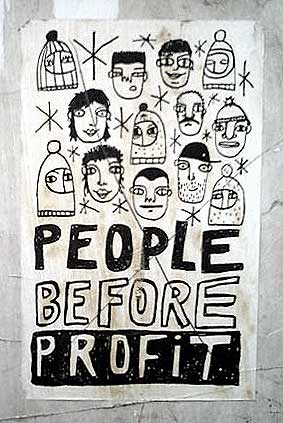
[photo credit: backspace.com’s Social Designs]“The new right-wing government will cause more intense isolation of the Roma on the margins of society,” constituted Romani activist Štefan Gorol, one of the respondents to a post-election survey carried out by Romano hangos, a Romani monthly. “We will be denied access to resources which are available to other members of the society. These resources include employment, housing, social protection, health care, and education.”
Mr. Gorol is not alone. Ivan Veselý, chairman of the Romani advocacy and media group Dženo Association, is one of many who are concerned.
“The times are getting tough. There are going to be serious ramifications,” says Veselý.
Respekt weekly editor-in-chief Erik Tabery in his political commentary on the new government agrees that slashing social benefits is a terrible idea: “It’s difficult to understand that the administration is apparently preparing to cut social benefits for poor families with children or support for people with a lighter form of disabilities. However much it may be necessary to prevent the abuse of various benefits, this type of support should not be abolished. A state that is not able to take care of the most vulnerable is worthless.”
Something important to remember is that not all people living in poverty in the Czech Republic are Roma, as the mainstream press would have the public believe.
“Only about one-fifth of those on social welfare benefits are Roma,” Veselý points out. This is still a disproportionately high number, considering the Roma make up around 2% of the total population (the number of Roma living in the Czech Republic is estimated to be somewhere between 150,000 and 300,000.)
At least half the Romani population do not live below the poverty level in socially excluded locations (sociologist Ivan Gabal estimates the number of Roma in socially excluded locations to be just over 85 thousand of the total of 150,000 to 200,000 Roma in the country) and many are college-educated professionals. Karel Holomek, long-time Romani activist and current president of the international Decade for Roma Inclusion 2005-2015, stresses just that in his latest blog post entitled “Absence of Rationality in Discussions about the Peaceful Co-existence of the Roma in Our Society“:
Such discussions point at a deficiency of the members of the Romani community, which they inaccurately call inadaptibility. What is talked about is careless attitude toward housing (on the part of the Roma), non-payment of rent, aggressive behavior of Romani children, unwillingness to learn or work, abuse of social benefits and other such matters. . . An unfortunate consequence is that the nature of this type of a discussion and, in general, such commonly and almost uniformly held societal views have a negative effect not only on a relatively small group of Roma, but on the entire society. . . The public’s hatred expressed quite clearly in statistical data is aimed against the entire Romani community, even though it is clear that it should only concern the part which is discreditable, if we at all accept such discredibility exists. And this group is much smaller than the entire Romani community.
The government’s focus on cutting spending is driven by the Maastricht Treaty, which mandates all EU member states to cut their state spending to a threshold of 3%. Currently the public deficit for the Czech Republic is projected to be 5.6% of GDP for 2010. Of course, the recession is another reason for the cuts, the public is told.
While the media work the public opinion by highlighting random Romani families who find loopholes in the social benefit system to “take advantage of,” and airing heated debates with guests who spout racist stereotypes and point fingers at the Roma as the “culprits for all the social ills,” the government wheels and deals, bringing in record profits despite the recession, yet warning of drastic cuts to social spending.
Some questions have recently been raised about the Czech government’s finance priorities in the form of backroom deals from which the country’s largest energy provider, the state-run energy company and highest grossing Czech company ČEZ, stands to profit.
In 2009, ČEZ, the largest Czech corporation, earned a record profit of 196 billion crowns marking a growth in earnings despite the recession. The company, of which 69.4% is owned by the Czech government with the rest in private hands, is being questioned about its role in influencing policy as well as the outcome of the elections by placing its key allies and board members in ministry positions. It is also under pressure to explain its inflated expenditure (paid for by taxpayer money) for the construction of new power plants. The Ecological Law Service puts the excess at 30 billion crowns above market value.
In contrast, the latest estimate is that cuts in social benefit spending could save the Czech government about 11 billion crowns.
Jaroslav Spurný, assistant editor of the weekly Respekt pertinently writes:
“The amount at which the Ecological Law Service arrived showed that the three Czech brown coal power plants are overpriced by 30 billion crowns. We are witnessing either enormous waste or enormous theft. If it is true and the government doesn’t respond, we can forget about the reforms. They will be good for nothing, because what the state shaves off from social benefits, will be easily spent by ČEZ.“
-
URGENT MESSAGE TO CANADIANS
Leave a CommentAs a Canadian working in India, I have gained a new awareness of the mind-blowing vulnerability of millions of people living in the developing world. As a result of climate change, people here are going to straight up die. All of us who emit an unsustainable amount of greenhouse gases are responsible for this.
Before I further delineate this bleak situation and provide potential solutions to greenhouse gas emissions in Canada please note the following: I am not writing this blog from the position of an eco-saint. I take personal responsibility for my contribution to this devastating situation. I flew to India just to be able to send this message and my current carbon footprint is far from sustainable. We are in this fight together.
Indeed, this past summer I have lived mostly in air-conditioned rooms to survive New Delhi’s sweltering 35-45 degree weather. All the while, the poor who cannot afford artificially cooled dwellings are working and living in the heat. Even if it gets a little bit hotter, millions of people living in poverty, who cannot afford to escape the climate, will die. Sea level rise will lead to climate refugees. Any sort of drought or changes in weather patterns impacting agriculture in India will lead to starvation. Water scarcity will lead to people dying of thirst. The people most severely impacted by climate change have contributed the least to our emerging climate crisis.
Canadian’s on the other hand, are some of the world’s worst emitters. More specifically, we are the world’s 8th largest greenhouse gas contributor. We are also ranked last among G8 nations in our climate change mitigation efforts.

Canada is Changing the Climate
Fortunately, there are many ways that all Canadians can mitigate their impact on this global catastrophe in both public and private realms.
Personal Lifestyle Changes:
All the decisions that we make in a day about what to eat, where to go, how to get there, what kind of housing to live in, what products to consume, how to vote, how to invest, have a more greenhouse gas intensive option and a less greenhouse gas intensive option. We should all be choosing the less greenhouse gas intensive option.
While this might seem incredibly overwhelming, take heart, David Suzuki is here for us.

David Suzuki
The David Suzuki Foundation has very clearly laid out simple things that every household can do to curb climate change. Please see this link for this simple green lifestyle guide.
Public Policy Changes:
Canadian governments have an impact on climate policy at the international, national, provincial and municipal level. It is up to all Canadians to elect and support leadership, at every level of government, committed to taking real action on climate change. We need to be an informed and engaged citizenry. If you are unhappy with your representative’s commitment to the environment, talk to them, write letters, get involved with a party, live and breathe green democracy.
This is especially important leading up to the 15th Conference of Parties in Copenhagen, taking place this coming December. In the past, the Conservative Party of Canada has sent representatives specifically to block hard, legally binding emissions reduction targets, and has worked to dilute any concrete action agreed upon by the international community. The Canadian federal government has failed the world at international climate negotiations.

Stephen Harper: not committed to real action on climate change.
For action items needed by Canada at COP 15 see the Pembina Institute Fact Sheet.
As a further direction around public policy, note that choosing green solutions can often be more expensive and therefore not all Canadians have an equal opportunity to live sustainably. It is therefore imperative that government account for the disproportionately negative impact that green prices have on low income people when developing climate change policy.
As a person of relative privilege, I am geared up to come home in September and do everything I can to green my already semi-green lifestyle (while not endangering my mental and physical health). I know it will be difficult, I am a really busy person just like everyone else. I have a job, I volunteer, I’m a student, I don’t have a lot of extra finances and my family is spread out across 3 provinces.

Me at the Taj Mahal
However, now I have new perspective with which to discipline my choices and actions and I am happy to share it with my fellow Canadians. When altering the way we live and the way we vote starts to seem really inconvenient and burdensome remember to ask yourself the following: “Is this going to kill me?” If the answer is no, please follow that question up by remembering this: if we don’t reduce our greenhouse gas emissions, it will kill someone else.
-
Nowhere to go, too afraid to speak
1 CommentEven the mere idea of a gun can have devastating consequences. Last week, Ana Maria* told her story to Martha Lucia, a lawyer at Asopropaz (an organization that assists victims of domestic violence), while I listened in. Her experience illustrates the ties between domestic violence, economic vulnerability, easy access to guns and cultural beliefs which define women as property.
“I’ve been living with him for 8 years,” she began. “I never went to the police because he always promised he wouldn’t do it again.” The two children they had together are 14 months and 6 years old, but her 14-year-old daughter from another relationship had to leave because he abused her sexually and beat her.
As she told her story, her baby girl was running around the office, smiling. Ana Maria’s head kept turning to check on her. “Last week, my baby got sick and I spent the night at the hospital with her. When we got back, he was angry because there was no meal ready for him. He beat me, only stopping because the kids were crying, but usually nothing stops him. Later, I told him, ‘either I’m going to leave, or you have to leave.’ When I said that, he raped me, beat me and told me I had to stay with him because I am his woman and I belong to him.”
When I asked about guns, Ana Maria shook her head and said that he had never owned or used a gun against her. I asked if he has access to a gun. “For sure,” she responded without hesitation. “He’s threatened me many times, telling me he can find one very easily, because his friends all have guns – he’s a taxi driver. He says he can get one and kill me, that it wouldn’t cost him a cent.” I asked her if her children are also aware of his ability to find a gun easily. “Of course,” she said. “They live in fear of him too.”
When she finally reported the crime, she was asked to bring proof. She didn’t have any, so the prosecutor made an appointment with both of them. To her distress, her husband denied everything and even accused her of being violent. Later, he took it out on her.
There are no shelters here. Victims of domestic violence are advised to live with family until they can find a place to stay. “I don’t have anywhere to go. My mother doesn’t have any room. We would all be sleeping on the floor, and he might find us there. He knows the place. He could come and hurt us, or kill us.”
Ana Maria almost didn’t come to her appointment with Martha Lucia because she didn’t have enough money for transportation. She does not work, and her husband keeps her locked up most of the time. She’s held jobs in the past, but had to quit or was fired, because she would arrive late feeling weak and covered with bruises or wounds. Sometimes she wasn’t able to come at all. She’s never had a chance to study, but when she tried to take courses at the university, he didn’t let her, because “he’s very jealous”.
Ana Maria’s husband feels that he can rightfully treat her as private property. Because she’s economically dependent on him and believes that he can easily access a gun, she can’t think of where to go and is too afraid to seek help — it’s a vicious circle of subjugation, violence, poverty and fear. It was Ana Maria’s sister who finally called Martha Lucia to make an appointment for her. Thousands of others like her never get even that way out.
*Name changed for her safety
-
“I Am Tired of Words Like ‘Freedom’”
Leave a CommentThis weekend, I attended a huge outdoor concert just outside of Pristina known as the Freedom Festival. Musicians from all over the world performed, including American hip-hop artists Method Man and Redman. The occasion? Ten years of FREEDOM.
On June 12, 1999, NATO forces entered Kosovo after a 78-day bombing campaign. Their objectives included halting all (Serbian and Yugoslav) military action, bringing about the immediate end of violence, and the establishment of a political structure in Kosovo in conjunction with international agreements and the United Nations. NATO’s mission in Kosovo is often touted (by some) as one of NATO’s great success stories, so much so that this week, it was announced that the number of KFOR troops will be reduced to 10,000 by 2010 (whereas in 1999 there were 50,000 NATO troops on the ground).
(There has been significant criticism of NATO’s military campaign against Serbia and the Former Republic of Yugoslavia, in which civilians and civilian targets were subject to NATO bombs. For more information, see Amnesty International’s “Collateral Damage or Unlawful Killings” at http://www.amnesty.org/en/library/asset/EUR70/018/2000/en/e7037dbb-df56-11dd-89a6-e712e728ac9e/eur700182000en.pdf).

So, June 12 in Kosovo has been dubbed Freedom Day. This year, the President of Kosovo, Dr. Fatmir Sejdiu, has even released a moving public statement. He stated, in part, “It was ten years ago this day that Kosovo joined the free countries of the world, following a long period of efforts and suffering and struggles in every field: in education, in culture and in a political and armed resistance. Part of these endless and ceaseless efforts was the entire people of Kosovo, who have built the freedom that we enjoy today with a lot of sacrifice, love and unwavering belief”(for the full statement, available in English, see http://www.president-ksgov.net/?id=5,67,67,67,e,1548).
But many young Kosovars are tired of the rhetoric while the nation suffers unemployment and poverty rates that are worse than most countries categorized as “developing.” In fact, according to a recent UNDP survey, Kosovars of all ethnic groups view the economic situation in Kosovo as the biggest threat to the nation’s stability (for the full report, see “Early Warning Report Fast Facts 24,” at http://www.ks.undp.org/repository/docs/FF_24_English.pdf). Finally, they are tired of watching their neighbors advance towards the future they so desperately want for themselves – membership in the European Union and all that comes with it – while corruption remains rampant in their country. Institutionalizing words like “freedom” doesn’t change that.
Of course, that doesn’t mean that they didn’t enjoy the concert.
httpv://www.youtube.com/watch?v=0Ml4QXGgb0s


