
Tag Archive: solidarity
-
The Movement for Nyaya
9 CommentsThis past Sunday, June 17th, Prabal, Lara (Peace Fellow with CONCERN), and I attended a memorial event in Anamnagar. On our way back, Prabal kindly asked if we had any questions about what had occurred. After trying to sort through the whirlwind of thoughts going through my head, I asked, “What does justice mean?”
Prabal explained that the word for justice in Nepali is ‘Nyaya’. It encompasses social and legal justice. It means people learn the truth about what happened to their family members and why they were taken. It means perpetrators of enforced disappearance are prosecuted and face legal consequences for their actions. It means families receive reparations and financial support as well as psychosocial support to cope with the trauma of a loss and with the stigma of being a victim or a widow.
In the center of the room where the event was held were pictures of Bipin Bhandari and Dil Bahadur Rai, two student activists who were forcibly disappeared in 2005. The event involved passionate speeches in Nepali, a moment of silence, and an opportunity for relatives of the disappeared to pay their respects and commemorate their lost loved ones.
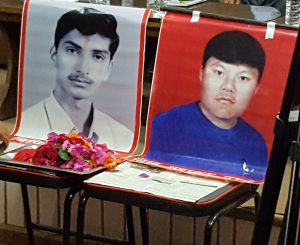
The day started with an emotional speech by Bipin Bhandari’s father and former parliamentarian, Ekraj Bhandari. His son was disappeared 13 years ago because of role as a student activist in the Maoist party. He expressed his fatigue. He wants to know where his son is. Is he alive? If he is dead, where is his body?
One by one, prominent human rights activists, journalists, representatives from both political parties, as well as the chair of the human rights commission, and the chair of commission for the investigation of enforced disappearances spoke. Activists and journalists expressed their deep frustration with the commission’s inability to bring justice to the families of the disappeared. Speakers lamented that once politicians were elected, they forgot about the people who put them in power.
While the majority of disappearances were committed by state security forces, some were committed by the Maoists. Even though the current government consists of a communist majority, political alliances have perpetuated a culture of impunity, so those responsible for disappearances on both sides have not been prosecuted. As a result, speakers advocated for the criminalization of enforced disappearance. Without a legal mechanism criminalizing the act, nobody can be prosecuted.
Many speakers encouraged everyone in the room to come together in solidarity and pressure the government for justice, or nyaya. The chairs of the human rights commission and the enforced disappearance commission expressed their frustration with the Nepali government’s lack of financial and staffing support for their work.
The most poignant speech of the day came from a 69 year old woman named Chandrakala. Her three sons were arrested for 27 months and then released. A few months after their release, two of her sons, Dhirendra and Pushpa, were forcibly disappeared. She is still waiting for them. She has not accepted their death. What has happened to them? She expressed that there was hope when the Commission began their work searching for the disappeared, but they have since forgotten the issues of the families of the disappeared. She asked the audience what the crime of an innocent mother is. She explains that everyday is gloomy, and the movement must continue until they get justice.
Her speech reminded me that one of the many challenging aspects of transitional justice is that although the conflict ended over a decade ago and society moved on with their daily lives, the loss of loved ones will haunt families of the disappeared and missing forever. The hard reality is that there is nothing that can be done to bring loved ones back to life, but I still believe that need-based, victim centered transitional justice processes can alleviate some of the pain and suffering experienced by families post-conflict.
After the event, we went to the Mandala Theater, the site of a mural painted by Martin Travers in 2016 in honor of Day of the Disappeared on August 30th.
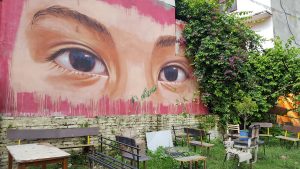
In the center of the eyes are shadows of people symbolizing family and friends searching for their loved ones.

As the years pass and the conflict is increasingly removed from society’s consciousness, the search for truth and the movement for nyaya go on.
-
Athens: Where the Walls Speak
Leave a CommentBefore all else, I must inform anyone who reads this and hasn’t already seen it through various other social media channels: IRA GLASS SAID MY NAME ON THIS AMERICAN LIFE. Well, sort of. He called me “Matteo” when issuing a brief thank-you in the credits in the show they did on refugees in Greece—producers and reporters from TAL had come to the GFR office a few months ago and conducted interviews and listened in on Skype calls, and I happily helped with a follow-up phone interview and several email exchanges to answer questions and share information. So basically I’m a very important and famous expert, and you should all listen to the podcast and its follow up that just came out this week here!
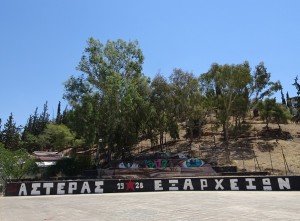
The hills have eyes.
Anyway, last week, the walls of Athens were talking to me.
Really, hear me out on this- I’m not admitting to listening to the voices in my head (well, sometimes), only the voices of the walls. Because almost everywhere I go in Athens, the walls are shouting at me. “REFUGEES WELCOME!” “NO BORDERS!” “ANTI-NAZI!” Those are just some of the phrases, short and long, that are scrawled across the walls of the city. The art that often accompanies or stands in place of the messages is even more telling: a young, distorted man crawling with the burden of a city on his back, Tsipras and Merkel in a passionate embrace. This is the most graffitied city I have ever seen in my life, and maybe it’s one of the reasons Athens isn’t known for its aesthetics or beauty the same way that Florence or Paris usually are. But to me, the city is beautiful in a way that feels more real than the historic architecture of other European cities. The walls are passionate and political, they speak of institutional disdain and sympathy with the rejects of society. I absolutely love it. I love the grungy, dirty, complicated mess of Athens, and I love listening to the walls when they speak. And yes, the anarchist neighborhood of Exarcheia* might speak the loudest, but it’s not the only one—Athens is literally built of wailing walls and belligerent buildings. They tell vibrant stories of struggle and solidarity, and I think that just taking a walk around Athens, never meeting a Greek in person, would convince you that the city is both complicated and compassionate.
-

- The embrace
-

- Peace
-

- Solidarity
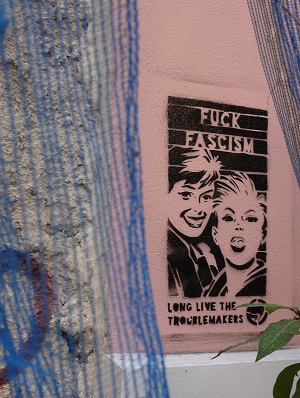 The walls of Athens exemplify the solidarity that I have come to know and depend on for my work. There is a spectrum to be sure—from the true anarchist, political movements that run media-darling squats to house refugees to the well-meaning and sometimes blundering foreign volunteers who swing by the camps while on vacation and help with mattress distribution. What has been most helpful to me, beyond my coworkers and contacts with various NGO representatives in the field, are the Facebook groups I’ve joined, such as “Immigrant and Refugee Support in Athens” or “Information Point for Volunteers.” The groups are mostly well-managed, well-organized, and legitimate forums for information sharing, rumor disputing, highlighting important initiatives and opportunities, and supporting the necessary volunteer efforts throughout the country by both Greeks and internationals. Whether in person or on social media, these networks are essential for the continued engagement of the local and international community in the lives of refugees and asylum seekers.
 Working on the refugee crisis in Greece can often be incredibly frustrating and depressing—feelings familiar I’m sure to many people in the humanitarian field. It is horrible to receive messages and pictures from people virtually trapped in terrible conditions on island hotspots, pleading for help to reunite with family in Athens, for example, and knowing that you just learned in a UNHCR meeting that there’s basically no one on Leros to help directly (despite an existing asylum office, there are still no authorities actually working in the office to process applications, due to lack of staffing and security concerns). It feels frankly crappy to not be able to provide answers and help that people desperately need—a conundrum that might sound like a broken record for many working in Greece. But what gives me hope? The writing’s on the wall. The people of Athens care, and the ones who care the most do more than just spray paint their solidarity, but they volunteer and they build networks that show the willingness to remain active and engaged for the long-haul. Though I am worried about overall waning hospitality in what is increasingly becoming a protracted situation and sputtering momentum in volunteerism once the summer is over, my experience thus far makes me optimistic that despite what might seem like neglect at the government level or in the media, many people in Greece are fighting hard for refugees’ rights and protection, and that won’t stop any time soon.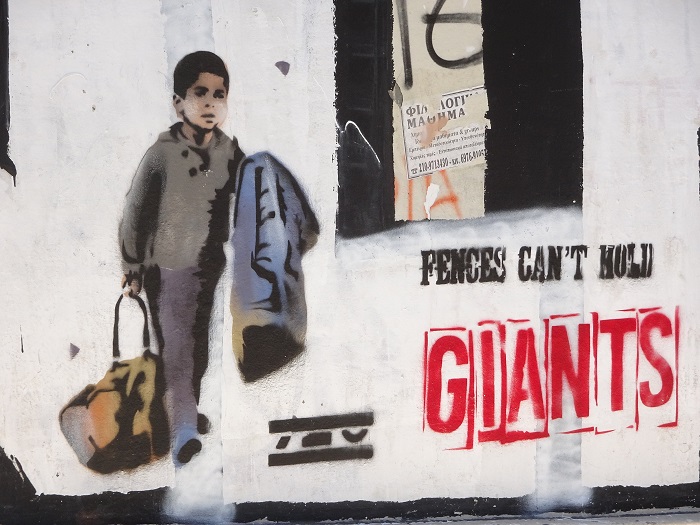
*The GFR office is in Exarcheia- it was one of the only safe spaces it could move to after a violent, racist attack against the president Yonous and other GFR community members a few years ago.
-
-
Guilt and Forgiveness
86 CommentsAlthough the entire conference was full of interesting, reflective, and thought-provoking comments and dialogue, two hours were devoted solely to dialogue between the conference participants. The issue of guilt seemed to dominate the conversation. Stasha spoke at great length about the contradictions inherent in a feminist ethics of care. She has been criticized by many feminists for championing a feminist ethics of care that entails asking for forgiveness from the victims of war crimes perpetrated by Serbs. Some feel that focusing on guilt and forgiveness and “taking care of others” reinforces patriarchal notions of how women should behave and feel. I think Women In Black Serbia somewhat resolves the “problem” by welcoming male members. For them, the feminist ethics of care is not about how women should behave, but about how human beings should behave. As one participant noted, they want their empathy to be “perceived as a form of civil society”.
The exchange that most vividly stands out in my mind from the conference is the following:
C. Kumar (Special guest and international coordinator of women’s courts, which I urge you to check out here): “It is important to not allow guilt to become paralyzing. If we are non-state actors, why are we taking on the burdens of state actors such as the military and the crimes they committed. I can still go to Srebrenica out of love, instead of out of guilt. Of course, I could never put myself in your shoes.”
Stasha: “The context of the specific situation in the Former Yugoslavia is extremely important to consider.”
Mariya (WIB activist): “Asking for forgiveness is part of a tradition that is deeply rooted in this area. Yes, it is patriarchal, but we are changing this aspect of the habit. There (in Srebrenica), I am perceived as a member of that nation (Serbia). They see me as part of a mess that is not individualized, so when I go there as part of that mess, the first thing I must ask for is forgiveness. This is the first contact I have with these women, so the first thing I must ask for is forgiveness.”
I understand Kumar’s concern about guilt becoming paralyzing. When she said that, I immediately thought of the picture below.

The Pulitzer prize winning photographer, Kevin Carter, committed suicide shortly after taking the photo. Although no one can know the exact reasons for his decision, many have speculated that he did it because he simply could not bear the guilt he felt for not having been able to do anything for that child. I often think about that picture and about Kevin Carter. Even though I know I could never feel the specific emotions he was experiencing, sometimes I think that I can feel his despair, and I wonder why more people aren’t going mad from guilt and horror as Kevin Carter did. However, Kevin Carter’s guilt ultimately did paralyze him- it rendered him so hopeless that he took his own life, curtailing any possible actions he could have taken to redress the problems he saw in the world.
I don’t see WIB members as heading in that direction of extreme paralysis. That is why they are so remarkable- they are unbelievably strong and resilient. Further, they do not simply dwell on their guilt- they act upon it and take actions such as traveling to Srebrenica and asking for forgiveness from the families of the victims in order to stand in solidarity with them. I do think Kumar is right in that WIB members are somewhat obsessive about their guilt, but in a society where the majority of the population is either in total denial of the crimes that were committed or feels no guilt about them, I think WIB members feel that they have to compensate for all the guilt those people don’t feel. It’s not fair. WIB members didn’t do anything. They didn’t perpetrate those crimes. They were opposed to them from the beginning. As Kumar said, they are non-state actors. Yet, the state committed the crimes in their name. As Mariya’s comments demonstrate, WIB members understand that they are often perceived by those in Bosnia as being part of the nation of Serbia. Ironically, one of the best ways that they can distinguish themselves from the state that committed such horrible crimes is by taking ownership of those crimes and asking forgiveness for them.
I hope that one day WIB members can go to Srebrenica out of love and free of guilt, but for now, I think the Serbians who travel there and the Bosnians who graciously receive them are both helping each other by going through a process of open forgiveness. As Stasha said, solidarity is not about charity, and it’s okay for the Serbian women to admit that visiting the families of victims helps to relieve their feelings of shame and guilt just as it is okay for the families of victims to admit that the fact that WIB members visit them greatly strengthens them (a Bosnian woman who hadn’t been to Serbia in 20 years was at the conference, and she said, ‘it gave me enormous strength that WIB came’). I see it as a mutually beneficial process that embodies the solidarity aspect of feminism.


