
Tag Archive: Ashkali
-
A Fling with Flia
340 Comments(Note: These last 2 weeks have been monstrously busy – the usual quilting drama, field visits, proposal deadlines, 13th century monuments, 2 bouts of food poisoning, AP visitors, Albanian lessons, ….too many different activities to count each day before I collapse into bed and wait for exhaustion to overcome the sticky nighttime mugginess. And naturally, the blog has suffered. So I’m jumping back in with a cultural experience, for a little change of pace…)
Whew. With fewer than three weeks to go before I trade Pristina road dust for L.A. smog, I finally got to check eating flia, the quintessential Kosovar/Albanian summertime food, off my must-do list. And not only did I get to eat it fresh off the coals, I got to help make it. Ferdane, my friend from Balkan Sunflowers, invited me to a flia-making party at her house in Fushe Kosove. So Friday afternoon perpetual Peace Fellow Kerry McBroom, who came out to Kosovo to help me through the quilting process last week, and I went out to Ferdane’s mahalla to learn the fine art of flia-making.

Ferdane's house in an Ashkali section of Fushe Kosova.
(Ironically, when we walked into Ferdane’s living room, her two younger sisters were sitting around with Joanna, a Balkan Sunflowers coordinator from the States, discussing whether they identify as Roma, Ashkali or Egyptian. You might remember in the last post that featured Ferdane, she said she was Ashkali. On flia day she identified herself as Egyptian. She said that’s how similar she considered them – she could easily be one or the other in a given conversation. So that’s one more note on the complexity of Roma, Ashkali and Egyptian identity here in Kosovo…)
After a bit more identity talk we got down to the business of making flia. Flia, for the uninitiated, consists of layer upon layer of baked dough greased up with a film of kefir-sour cream-oil mixture in between each layer. The trick that makes it good is that each layer is baked individually, and, if it’s authentic (like ours was, of course) it’s baked outside with a fire-heated metal lid weighted down with ash broiling the dough golden.
Kerry, as the oldest in the group, had the honor of wearing a white headscarf that apparently made her head flia-maker. She took the job seriously.

Kerry getting into the role of lead cook
The batter’s just flour and water (a tub of flour and “enough” water, to be exact); the filling is a bottle of kefir, a couple containers of sour cream, oil and salt. Which is good – the cooking part is so involved that the recipe should be a snap. We mixed up the batter and the filling, then headed outside to where Ferdane and her mom had built a fire in the yard and were prepping the baking lid.

Ferdane ashing the flia lid so it would hold in more heat
The baking process is where flia-making becomes a two-hour communal activity. You can’t just put the batter in an oven and be done with it (or you can, but it’s apparently not as good). The batter goes into the pan in strips, and once there are enough strips to make the pan look like a cart wheel, it’s time to set the 20+ pound lid on the top of the pan to bake the layer.

Ferdane showed us how to make perfect flia batter strips. Ours weren't always so pretty.
Tiny Ferdane, naturally, whipped the thing around like it was a pillow, while all my grunts and sensible knee bending didn’t stop me from almost dropping the entire ash pile into the growing flia each time I had to maneuver the lid.
Once the layer is cooked, it’s time to spread the filling on, and then top it with another layer of batter, ladling it in the spaces not covered by the last layer.

Ferdane wielded the giant lid like a pro.

Kerry and I took turns on filling/batter layering duty.
Put the lid back on and repeat the cycle 30 or 40 times. After a couple rounds we reached an unspoken agreement that the three American girls would do the batter-ladling and filling-spreading, and Ferdane would do the heavy lifting. She was nice enough not to call us out for being weaklings!
It’s not so wonderful to be standing or squatting around a hot fire when it’s already 90+ degrees outside, but we had plenty of time to rehash the week’s work gossip, discuss ailments, chat with interested neighbors, watch the sunset, fill up on watermelon – not a bad way to unwind after a busy week. And at the end of it all, there was enough bubbling, steaming flia to feed a family of seven for three days!
The finished product - hot, bubbly flia.
And the verdict? Crispy, chewy, oily doughy things are almost always worth eating, so no surprises there. I don’t know if I’ll be investing in a custom flia oven for my New York apartment, but I definitely wouldn’t turn down another invitation to a Fushe Kosove flia party.
-
From the field: women’s literacy training in Fushe Kosova
291 Comments(I know I said the last post was supposed to be more about the situation of Roma, Ashkali and Egyptian women in Kosovo, but I got sidetracked by Flurije’s story! So now I’m moving along…)
This week I finally started my field visits (not counting a quick meeting in Gracanica, a town about 20 minutes outside of Pristina, to speak with Voice of Roma last Friday). I was very happy to be out exploring. Although I’m happy to spend my days picking up Albanian slang from the staff at the Kosovo Gender Studies Center while I’m editing grant proposals and having fabulous 1-euro byrek me spinaq lunches from the shop down the street, I didn’t come here to spend 40 hours a week in an office!
The goal of these visits has been to find partners for the project I’m doing with RROGRAEK – working with women from these communities to create an advocacy quilt that expresses their hopes for Roma, Ashkali and Egyptian women’s empowerment – and for me, it’s been a chance to start getting more than a textbook idea of what being a woman in these communities looks like in different parts of the country.
My first visit, to observe a literacy program for Roma, Ashkali and Egyptian women in the town of Fushe Kosova, helped to put me in touch with one of the most basic and most poignant struggles most women from these communities face – getting an education.
As educated, literate NGO workers, RROGRAEK’s staff, Shpresa (who is Roma) and Diana (who is Egyptian) don’t represent the average women from their communities. According to UNICEF, only 13% of Kosovar Roma, Ashkali and Egyptians (boys and girls) between the ages of 16 and 19 are in school; only about 1% attends university. Kosovar Roma, Ashkali and Egyptian women are among the least literate in the region. 69% in the 25-34 age group are literate, and the numbers are actually worse for the younger generation – only 56% of women in the 15-24 age group are literate. (I would think because of the upheaval during the war – I don’t know if this will be part of a longer-lasting trend). With a profile like this, it’s easy to see how Roma, Ashkali and Egyptian women remain trapped by poverty and powerlessness. I was excited to have the chance to visit a community-run program that’s trying to change these numbers.
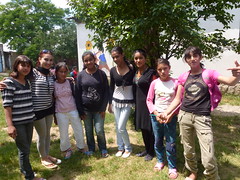
Ferdane (second from left) with her Balkan Sunflowers literacy group
The program is run out of the Balkan Sunflowers learning center in Fushe Kosova, just a few kilometers outside Pristina, where 370 children, mainly from Roma and Ashkali communities, get free pre-kindergarten classes, homework help, and summer camp. Ferdane, the 25-year-old Ashkali woman who runs the program, took me to the compound’s backyard and introduced me to the day’s group. Eight girls between 12 and 16, who were sitting around a plastic play table under the cherry trees, smiled at me shyly and then went back to their workbook exercises. Once they finished their work, they were excited to show me some of the complicated beadwork they’d also done at the center (Balkan Sunflowers gives them materials to make handicrafts as a motivation to stick with the literacy course when it gets difficult).

A literacy group member shows off a beaded wedding belt and table ornament the group made
I learned that some had had a bit of primary school, others none at all. Ferdane proudly told me how at first she had had to actually hold the hand of one girl so she could form letters, and that now that girl was filling out crossword puzzles and diligently working her way through the course that would bring her up to a fifth-grade reading level.
Ferdane said that in the winter the class was full of women of all ages; in the summer, they have too much work to do at home, families come visit from abroad, and schoolwork lapses. Her experience, she says, confirms the reasons often reported for women’s lack of education: “The big problem for many is family… Always women here need to care for the house, for younger sisters, brothers… family is always the problem…. They only motivate the boys to go to school.”
In these communities, cultural norms and all the immediate necessities of daily life can drown out messages from the government and NGOs that girls have a right to go to school and become educated women. Ferdane says that, at least, the women she’s been working with over the past two years have learned that education is important, and that they look to college-educated Ferdane not as an outsider – as they did when Ferdane first started teaching – but as a role model.
-
Roma, Ashka…what? A primer in progress
1 CommentMost people I’ve told about this internship get what I mean when I say I’m working with Roma – in the West (at least in PC circles) “Roma” is firmly taking over as the correct term for the derogatory “gypsy,” even if the image of who these people are hasn’t necessarily updated with the name. When I get to “Ashkali” and “Egyptian” though, I’ve usually lost whoever I’m talking to. What’s an Ashkali, and why am I concerned about Egyptians in Kosovo?
The response to “Who are these people?” depends on who you ask – and I definitely don’t have a solid answer. But the story of these groups’ existence in Kosovo is one of divergence, convergence, and political machinations and persecution that’s quite confusing to outsiders, if not to those who are living it. It’s been extremely interesting to learn about these identities, picking up bits here and there. I’ll be adding to this as I learn more, but here’s my basic version, two weeks in:
The Roma: Roma in Kosovo are members of a people who migrated from India to Europe over a thousand years ago, and have been in Kosovo for at least 700 years. They speak the Romani language, usually in addition to either Serbian or Albanian – although more often Serb. Because of their perceived support of the Serbs, they were the victims of a violent backlash when Albanians returned to Kosovo at the end of the 1999 conflict (even though they also faced persecution by the Serbs in some areas as well). There are different subgroups among Kosovo Roma, but they all identify as Roma or Gypsy. They live in different enclaves around the country – in Prizren, Gračanica, Mitrovica, Gjilan, and others. Since the end of the war, there are very few in Pristina.
The Ashkali: Non-Roma became aware of this group as distinct from Roma during the 1999 war, when Ashkalis declared themselves separate from the often Serbian-speaking Roma to avoid persecution from the majority Albanians. (Of course, there’s no clear line of loyalty here – some Ashkalis supported the Serbs as well.) Ashkalis trace their origins from Iran, saying that when they arrived in the Balkans in the 4th century they picked up the language of the Illyrians living there, which is why they speak Albanian as their first language today. They live primarily in the center of Kosovo and in the east.
The Egyptians: They emerged as a self-declared group in fits and starts from the 1970s through the 90s, claiming Egyptian heritage that separates them from Roma and Ashkalis. Albanian is the first language for most. Their enclaves are mainly in the west of Kosovo.
Before 1999, there were 150,000 – 200,000 members of these three groups in Kosovo – a sizeable percentage of Kosovo’s population of around two million. The overwhelming majority fled for their lives during the conflict, and few have returned (even fewer voluntarily) since. Now there are between 35,000 and 40,000 members of these communities in Kosovo; I haven’t found a reliable figure for each group.

Map of Kosovo's ethnic minorities, 2002. Author: Philippe Rekacewicz, UNEP/GRID-Arendal. Sources: UNMIK; Ninth assessment of the situation of ethnic minorities in Kosovo (2002), OSCE-UNHCR; Kosovo Humanitarian Community Information Center, Kosovo road Atlas.
Together, they are “among the most marginalized groups in Kosovo” (this is their constant label – more on this later). As a group, they face exclusion in almost every sphere of life in Kosovo – most live in poverty, 98-100% are officially unemployed, they lack access to basic services like healthcare, education, and resources to claim their rights.
Because they face similar issues of exclusion and supposedly have similar heritage, the three communities have been grouped together by the international community and the government under a convenient acronym – RAE – so that aid programs are sure to address the needs of all three groups. You rarely see a program just addressed at Roma; I don’t think I’ve ever seen Ashkali or Egyptians mentioned without at least one of the other groups. So while they’re nominally considered separate, the international community is signaling that these are all basically the same people, with the same problems, same needs.
What’s the real story?
The members of these communities who I’ve talked to have very different opinions on where the lines separating these identities should be drawn.Some have told me that the division between the three groups is falsely accentuated. A trio of Roma journalists working for a national Romani-language radio program I spoke with each told me that the differences weren’t substantial. “We are all gypises,” one of them, Daut Qulangjiu, said with a smile. His colleague, Avdi Misini, told me that the labels of Ashkali and Egyptian were inventions of Milosevic, who in the 1980s and 90s wanted to divide the Roma for political reasons. (Apparently, the total number of Roma (including Ashkali and Egyptians) in Yugoslavian Kosovo outnumbered the Serbs in the region. So, rather than accept that Serbs were a minority among the minorities, Milosevic created/played up an emerging division in the Roma to put the Serbs in the dominant minority position.) This timeframe coincides with Egyptian and Ashkali appearance as accepted minorities, but the Egyptians, at least, had petitioned to become a recognized ethnic group earlier.
He went on to say that self-identified Ashkali and Egyptians have their history wrong. This is in line with those who say that Ashkalis are Roma who simply “lost” the Romani language and so speak Albanian, and that the legend of any Egyptian origins is just a legend – that that group is made up of Albanized Roma as well.
Both Misini and Qulangjiu emphasized that the three groups intermarry because none labels the other two as “gadje” (“other”), and that they’re so mixed that they’re functionally one community – a Rom may have Ashkali cousins and an Egyptian wife, and even within the same family people might self identify differently – an Egyptian might have one Ashkali brother and a Roma sister. The message I got from this: it’s important to maintain solidarity among these three groups – emphasizing the differences just makes them weaker and easier to manipulate. A very legitimate point considering the basically nonexistent position of Roma, Ashkali and Egyptians in Kosovo politics!
An Ashkali NGO director (whose name I didn’t get permission to use) had very different feelings. He prickled at the labeling of the three groups the “RAE community.” According to him, it’s rightfully the “Roma, Ashkali and Egyptian communitIES.” He told me that his niece, also an NGO worker and an Ashkali, refuses to participate in interviews about the “RAE” people, insisting that her identity as Ashkali be recognized separately. He said that the idea that all three came to Europe from India is ignorant – an easy way to categorize Balkan people with darker skin. Generalizing them into RAE denies them of their heritage and their right to have their identity recognized and respected.
I’ve started to pick up on a resentment about this melding of three peoples into one group from other representatives of these communities as well. Some have mentioned that it’s now impossible to get funding for projects that only address the needs of one of these communities, that it’s implied to be discriminatory to not include all. It sounds like it’s worthwhile to ask, Could this attempt by international organizations to be inclusive be sowing resentment between the three groups? In treating these groups as one, are we missing the complexity that each group may be facing different challenges that need different solutions?
My initial take on it
My stance is that self-identification matters. I know that the international community loves convenient acronyms, but labels should be used with care. Maybe it’s time to reexamine why this one came about, and how it’s affecting these communities.One last thought on the question of who the Roma, Ashkali and Egyptians of Kosovo are. We can say that what defines them is partly blood, partly culture, heritage, maybe language, and self-identification.
What are things that don’t define the Roma, Ashkali or Egyptian people? Poverty, lack of education, silence, powerlessness. It may sound ridiculously obvious, but I think that this is an important point to make. It’s easy to accept the common picture many have of Roma across Europe, reinforced by countless reports on the terrible situations they face – to picture people who are illiterate, desperately poor, probably unkempt and living in squalid conditions, powerless, foreign to every country. Google images for “Kosovo Roma” and see what you find: how often are we challenged to think of Roma (and, now that we’re aware, Ashkali and Egyptians) that don’t meet these stereotypes? These might be the conditions of many Roma – but they don’t constitute a definition.
I’ve spent the last two weeks meeting Roma, Ashkali and Egyptians who defy these common perceptions – among them Shpresa and Diana of RROGRAEK and all the young Roma, Ashkali and Egyptian students who came to RROGRAEK’s last training. These individuals, and their work, should challenge the majority to include Roma, Ashkali and Egyptians as more than a static stereotype and a permanent “other” in its picture of Kosovo’s present and future.
Next post: moving on from identity to the current situation of Roma, Ashkali and Egyptians in Kosovo.
Also, for a vivid peek at Roma culture in Kosovo, check out the excellent Balkanproject.org – it has dozens of fantastic interviews with Roma from around Kosovo, often with audio and video recordings, plus a large collection of articles on different facets of Roma life and culture up to 2004.
-
Training for Roma, Ashkali and Egyptian activists – and for me
Leave a CommentI’ve been in Pristina for a full week now, and am starting to feel my feet under me. It took a couple days to get started, but on my third day here in Kosovo, I finally got a taste of what my work here will be about.
Last Sunday, fresh off the plane, I wandered through the city’s clumped-spaghetti tangle of semi-paved streets in a dehydrated, sleep-deprived daze, getting vaguely excited when I recognized parks, bars and burek stands I’d visited 5 years before. On Monday, I found that the heads of the two organizations I’m working with, the Kosova Women’s Network (KWN) and the Network of Roma, Ashkali, and Egyptian Women’s Organizations of Kosovo (RROGRAEK), were both unexpectedly out of the office, so instead of meeting with them, I met the rest of the lovely KWN staff over lunch, and then headed over to the Kosovar Gender Studies Center, where RROGRAEK has carved office space out of the Center’s kitchen. I read the Center’s work on women in Kosovo’s media, learned project manager Sibil’s new favorite song and even went to see a potential apartment with finance manager Driton. But despite the warm welcome, I generally had that “bump on a log” feeling. That’s to be expected on the first day anywhere, but after the last frantic weeks of the semester, sitting at a desk for two hours and not producing anything felt very wrong. I also left the office almost as clueless about RROGRAEK and what my role there would be as I was when I boarded the plane in New York. (Note: astute blog readers may be wondering why I’m now saying I work with RROGRAEK, when my last post said I’d be working with Romane Romnja. I learn new things every day – it’s RROGRAEK).

Then on Tuesday I got to dive in, attending (and at least somewhat assisting) the monthly training/meeting that I learned RROGRAEK organizes for representatives from its 25 or so member organizations. The trainings teach activists essential skills for fundraising, advocacy, monitoring national and international projects, and more. A bit of explanation of what RROGRAEK is and why it’s doing this: RROGRAEK is an organization that connects and empowers Roma civil society organizations throughout Kosovo. Its founder, Shpresa Agushi, a Roma woman originally from picturesque Prizren, has led the organization in some form, sometimes paid, sometimes not, since 2000. RROGRAEK’s, and Shpresa’s, goal is to help Roma, Ashkali, and Egyptian (RAE) women (more on the distinction later) from throughout Kosovo to advocate on their own behalf and end their marginalization. It’s a tall order in this new country, where some Roma who were internally displaced during and after the 1999 war still live in an area where lead in the soil and water blackens their teeth and distorts their children’s bodies, and where Roma forced to return from Western Europe face exclusion and persecution.
On Tuesday, RROGRAEK invited its members to the UN Women headquarters in Pristina to learn how to write effective project funding proposals from Kushtrim Shaipi, “one of the best” in the field, according to Shpresa. Kushtrim, who knows a thing or two about what donors want after years of working with the Soros Foundations and consulting for several other big-name donors, told me that funding applications he’s seen from RAE organizations are often weak. No wonder, when RAE organizations rarely have access to the kind of training Kushtrim was offering, and funding proposals usually have to be in English, which few Roma in Kosovo speak.
Knowing the basics of dealing with grantmakers is critical because international funding is the lifeline for most NGOs in Kosovo, and small organizations that lack savvy proposal writers and compliance managers (basically all Roma-led organizations) are sunk. As a tiny organization trying to tackle the whole body of RAE women’s issues, RROGRAEK itself continually struggles to keep its head above water. (As the native English speaker in residence for the summer, I hope I can have some impact on that!)
Even if it can’t always keep up with its own funding needs, RROGRAEK is dedicated to helping other RAE organizations improve the situation of Roma, Ashkali and Egyptians throughout Kosovo. Shpresa pays special attention to empowering the next generation of RAE leaders, and it was exciting to see several Roma student activists diligently taking notes and creating sample proposals alongside the veteran activists who participated in the training. Bleta, a 22-year-old law student, and Atdhe, a 22-year-old computer science student (and the lone male at the session) both said the training had been very helpful, and that they were looking forward to next month’s.
After almost four hours of learning how to navigate the international funding machine, a long-time Roma activist who works in Kosovo’s Ministry of Education stopped everything with The Big Question: Yes, it’s worthwhile to learn how to write proposals, she said (I’m loosely paraphrasing here), but what if donors don’t want to fund what the RAE communities need? Donors don’t understand the situation of RAE people in Kosovo well enough to match their funding programs to what RAE activists are proposing, she argued. There is little data on the RAE communities in Kosovo available, RAE people have few representatives in government to advocate on their behalf, and RAE groups have a difficult time communicating their needs to English-speaking donors. How can we bridge this gap in understanding so that more donors offer to fund real empowerment programs, and how can RAE organizations survive in the meantime? Another challenge, she said: most donors expect their grantees to be able to function at a certain level from the beginning – to have some equipment, to be able to report, to have sophisticated financial records. Many RAE-led groups don’t have that capacity, and so continue to be marginalized by the system as it is. If donors don’t adapt their requirements, how can RAE NGOs even get into the game? Do RAE activists have to accept the machine as it is, can they make it work for them, or do they have to find another way to achieve their goals?
She spoke with rising passion, even getting up from her seat to impress her point on the young activists seated around her. Her words were left hanging as the training adjourned; there’s no neat, easy answer to her questions. Some donors are fabulous and work hard to be supportive advocates. Some donors are bound by ideology or bureaucracy; others simply don’t know what the people they’re trying to help really need.
As Shpresa and I make the rounds to RROGRAEK’s current and potential funders over the next few weeks, I’m interested to see how they respond to Shpresa’s vision of what Kosovo’s RAE communities need. The only thing to do is to keep talking, keep informing, keep pushing….

