
Tag Archive: Putis Massacre
-
Putis Blossoms Video
109 CommentsAt last, I have found some time to put together a short video of the footage I filmed while in Putis. As I am going back to Ayacucho next week, expect more in the near future!
-
Reflexions on Putis: Memory and Development
3 CommentsOn the way back from Putis, we hit a rock and the car went flying, bursting a tire as it landed—on the road, thankfully, as the precipice was unnervingly close. Normally, this wouldn’t be a big deal. If you couldn’t change the tire yourself, you’d call the CAA, a tow truck, a parent or a friend, who could come to the rescue. If all else failed, you might rely on the goodwill of a passer-by. Except that on the road to Putis, there is no phone signal, no passers-by at that time, and the walk to the nearest village with a phone would be at least 10 hours. To make matters worse, the road is known for violent assaults; not an ideal place to find oneself in after dark.
As Carlos, Erick, Nelson and Jesús, the EPAF staff I shared the car with, one after the other engaged in a battle of wills with inadequate tools and bolts that would not budge, I found myself thinking that the very isolation and marginalization that now made us vulnerable were also responsible for the vulnerability of countless communities in Peru during the internal war, and the cause of much of the suffering that ensued.
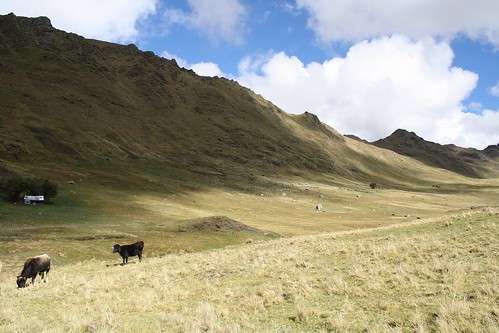
Of every 4 victims of Peru’s internal war, 3 were rural, indigenous, and Quechua-speaking. The position of exclusion of the majority of rural indigenous communities in Peru exposed them to the violence wrought on not only by the Shining Path, but as exemplified by Putis, also by the brutal and mistaken response of state forces in their efforts to crush the insurgency. Moreover, it is this exclusion that permitted the horrors occurring in the countryside—particularly in the 1980s—to go largely unnoticed in Lima, the social and economic heart of the country. The victims were, for all intents and purposes, less than full citizens; little uproar was caused by the violation of their most fundamental rights.
Where does that leave us, now that the conflict has officially been over for more than 10 years? The sad reality is that the exclusion continues, whether through the very real discrimination embedded in Peruvian society, or though the constant and mechanical reproduction of the conditions of marginalization and poverty facing rural indigenous communities, to say nothing of the sequels of the conflict itself. The exclusion continues, and it continues to impede the capacity of victims of violence and their families to have their voices heard and claim their rights. From my perspective in Lima, to say that the troubles affecting poor Quechua-speaking peasants is not part of the national psyche seems like a gross understatement.
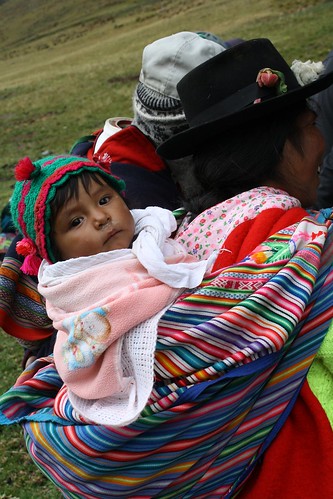
In this context, I can’t help but wonder about concepts such as post-conflict reconstruction, post-conflict reconciliation, etc. These concepts seem to imply the return to an original, desirable, situation yet I don’t think anyone would argue there is an original, desirable situation to return to in this case. And this is where memory comes into play. Memory of the mistakes made, memory of the lives lost; memory from which to learn lessons and move forward, not backward to the pre-conflict status quo.
EPAF believes that the way forward is the transition from victims to rights-bearing citizens through the full realization of civil, political, economic, social and cultural rights. The Paradero Esperanza initiative conducted in Putis lies squarely within this line of thought. The idea is to create a seed bank of native potatoes, with the objective of helping Putisinos develop a larger, better, and more varied production that can be inserted in regional and national markets. Socioeconomic empowerment can act as a form of reparation for the suffering occurred during the conflict—particularly in the absence of a process of integral reparation on the part of the State—and, it is hoped, prevent future eruptions of violence by eradicating the historical conditions that led to its emergence.

In 1984, the Peruvian military offered Putis as a safe haven for the inhabitants of nearby communities fleeing the Shining Path rebels. Villagers of all ages were convinced to dig a fish pond, only to be rounded up, executed, and buried in said “pond” on suspicion of having ties to the guerrillas. The families of the victims had to wait for more than 20 years before the mass grave was exhumed, allowing them to identify the remains and bury their dead in dignity. Today, the inhabitants of Putis continue to live in the same conditions of cultural, social, economic, and political marginalization that made it easy for both terrorists and State forces to violate their most fundamental rights.
If you are moved by the story of Putis, you should know this. Putis is not special; it is not an exception. There are thousands of Putis in Peru; the only difference is that their mass graves still lay undisturbed, their disappeared still missing. How much longer will their families have to wait to get answers? And equally importantly, how long will their victimization be allowed to reproduce itself inexorably?

-
First stop: Putis, land of memory, land of hope
2 CommentsGetting to the centro poblado of Putis in the department of Ayacucho from Lima is no small feat. To begin, one must drive for around 8 hours to Huamanga, the department’s capital, first along the coast south of Lima and then up and down the broken terrain of the spectacular Andes, following dizzying roads carved into the mountainsides. From there, it is at least another 5 hours–and potentially much more, depending on the driver’s temerity and the condition of the road–to Putis, where the memory of a troubled past and the hope for a better future have merged into “Paradero Esperanza,” a sustainable development project started by EPAF in 2010 and described by former AP fellow Karin Orr here.

EPAF’s involvement with Putis began in 2008 when it worked to recover 92 human remains from a mass grave located in the community, the largest yet to be exhumed in Peru. Ayacucho was the epicentre of the violence during Peru’s internal conflict, and it is estimated that approximately 400 people died or were forcibly disappeared in Putis only. For more on Putis’ violent past, you can read the section of the Peruvian Truth and Reconciliation Commission’s final report on Putis (in Spanish). For a more personal take, AP fellow Ash Kosiewicz documented the exhumation process in his blog.
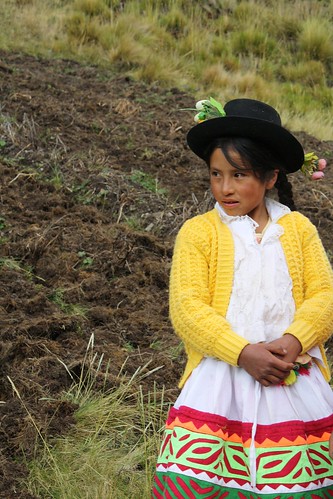
Last Friday, “Paradero Esperanza” bore fruit as Putisinos realized their first official native potato harvest (a small pre-harvest had been realized two weeks earlier). I, along with a sizeable group of EPAF staff, travelled to Putis to celebrate and document the event, along with local and international journalists.
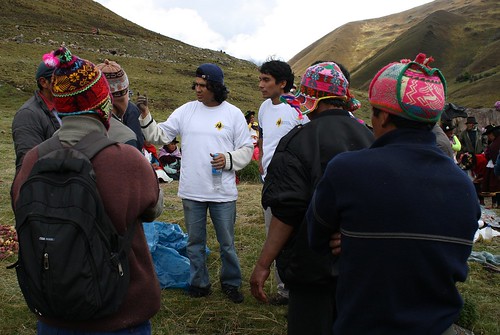
Having left Lima on Wednesday morning and spent the night in Huamanga, we left for Putis bright and early to confirm with local authorities the details and arrangements of Friday’s celebrations. The arduous drive took longer than expected, however, so that we missed our meeting time and arrived in Putis in the middle of a downpour to find, well, absolutely no one. Hoping we might find someone further down the valley in the village of Putis itself (where the 1984 massacre occurred), we began to make our way there, only to find the road blocked by a mudslide. After waiting around for an hour or two to see if someone might show up, we finally resigned ourselves to coming back extra early the following morning to make the necessary arrangements.
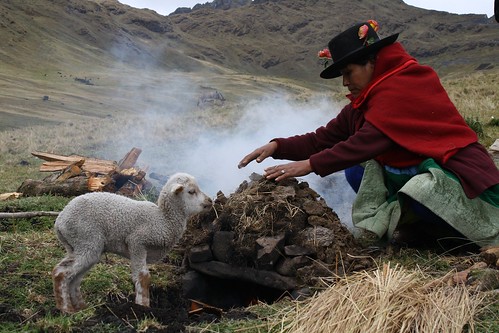
We spent the rest of the day in Santillana, a small village two hours away, recuperating from the previous two days’ long drives. At 5am on Friday morning, we left once more for Putis, this time to find the centro poblado bustling with activity, obviously aware and eager for the day’s events. Nelson, an EPAF staff member based in Huamanga, coordinated the details of the days’ events in Quechua with local people—who would be in charge of killing the sheep for the pachamanca (a typical Andean meal, consisting of meat and potatoes cooked by the heat produced stones placed in the soil and pre-warmed with fire), where the events would take place, what time the journalists would arrive, etc.

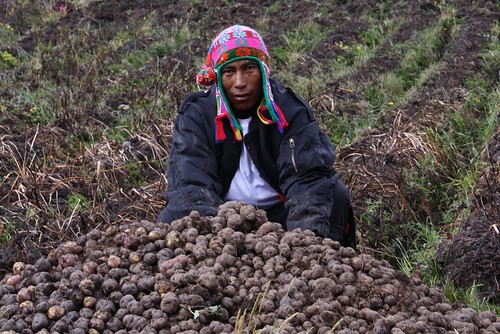
After finalizing the preparations, we joined a group of Putisinos that were enthusiastically harvesting the potatoes to be used for the pachamanca. I was amazed by the number of different varieties present in the plot, all of which would be showcased later on in the day. Then musicians and local press arrived, followed by EPAF director José Pablo Baraybar and journalists from the New York Times, there to report on the events.
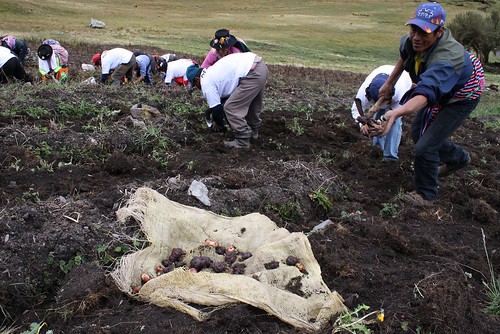
The day went as such: the potato harvest was realized (in a rather festive mood, as locals sang and joked around in Quechua—perhaps about the gringuita merrily getting her hands dirty?), then the musicians from Ayacucho performed a song written especially for the occasion. A showcase of each different variety of potatoes was done, after which it was finally time for the much-awaited pachamanca, accompanied by music and dancing. This was followed by comments by Nelson and José Pablo on the progress realized so far and the challenges to come, and words by Putis mayor Gerardo Fernández and other community members. Finally, we made our way to the village of Putis, where a local Putisino took us to the mass grave exhumed in 2008 and recounted to the journalists the horrific events that culminated in it.
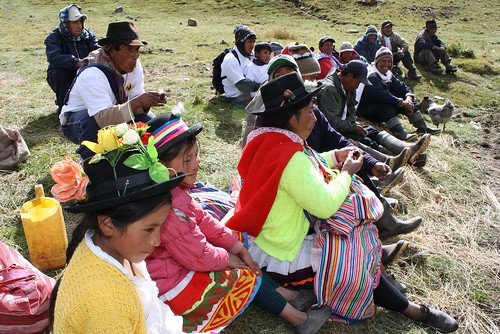
This last item on the day’s agenda brought a sombre, but necessary, end to an otherwise festive day. It also made me realise the deeply enmeshed nature of the processes of memory, reparation, and development at play in post-conflict communities such as Putis. This will be the subject of a soon-to-come entry; a more reflexive take on my visit to Putis. In the meantime, feel free to check out my Flickr set for more photos of Putis.
-
Pilot Project for Sustainable Development in Putis
1 CommentWatch Video of My Day In Putis
httpv://www.youtube.com/watch?v=9MGblNyaIjs
Click above to see a photo/video essay of my day in Putis. It’s my visual report back after a productive day in Peru’s Southern region of Putis. A destination that inhabits people who have been marginalized for centuries and who suffered greatly from the internal conflict (the Putis massacre of 84′ took 123 lives). From 2008-2009 the Peruvian Forensic Anthropology Team (EPAF) exhumed a clandestine grave in Putis, residual of the conflict. EPAF exhumed 92 of the bodies identifying 29 of them through DNA testing. Later they restored the bodies to the family members of the Putis victims who later gave their relatives a proper burial in a newly built cemetery.

The ninety-two tombs are a daily reminder of a daunting past, as they are visible from nearly all angles of the small town. And yet, Putis community members expressed relief at now having a mourning site, a place to grieve, after so many years of waiting to know the truth about their disappeared loved ones. On Sunday, we visited that former gravesite (as seen with the sun roof in the video) and were informed by Putis Mayor Gerardo Fernandez that there are still other mass graves left unashamed in Putis, containing some 300 bodies. The grave that EPAF exhumed in 2008 in Putis is the largest mass grave yet to be exhumed in Peru. Since this exhumation in 2008, EPAF has not been approved to pursue investigations on the other 3,466 registered graves.

However, since the exhumations in 2008, EPAF has maintained a relationship with the Putis community, as they have recently partnered with NGO Vecinos Peru in establishing a pilot project with the aim of being a sustainable development project meant to integrate the Putisinos within the market. Although still in its preliminary stages the project will be known as a seed bank of the best native potato seeds. The goal is to integrate their staple food crop of organic potatoes within the national market by selecting and reselecting the best potato seeds so that the market value is higher. So far, the community members of Putis have used their potatoes for their own consumption and local commercial use. However, the organic native potato has market value in which the conditions in the Andes are perfect to cultivate. The idea behind the native seed bank is to partner with Putis community members in working to overcome their victimization and reaffirm their human and civil rights through the establishment of a ‘Centro Poblado’, as the year prior Putisinos had fought to elect their own indigenous Mayor, Gerardo Fernandez.

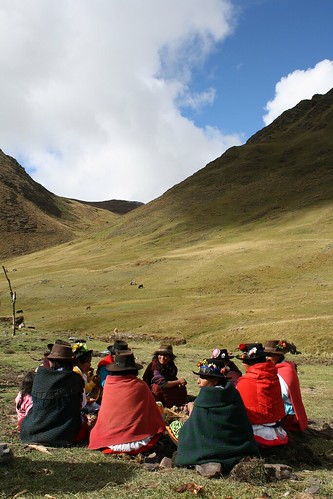
On Sunday, the ceremony continued with a potato fair as well as an exhibit of various hand-weaved crafts. The bright vibrant colors of their crafts were a stark contrast against the sepia colored terrain. Their brightly colored weaved fabrics were such a stunning reminder of life where at one point there was so much terror.

When showcasing their fabrics they exhibited them with such pride that even trying to bargain with them was impossible. I left empty-handed, as my ten soles couldn’t afford anything. The day continued with the explanation of the variety of native potatoes. I never knew so many potato varieties existed until that Sunday when each community member explained the differences in each potatoes cultivation process. At lunch we were served some of these potatoes in addition to pasta. Local musicians played flutes and sang beautiful Andean songs. As the day progressed so did a meeting with the locals of Putis with EPAF and Vecinos Peru to establish a plan of action for the funds that will be donated to the pilot project.
Watch Video on the Extended Request for Reparations by Putis Community Members
httpv://www.youtube.com/watch?v=sb2se0cKXM4