Tag Archive: conflict resolution
-
What I Saw
1 Comment
Market Day in Plesian Village, Samburu County
On my final trip to Samburu County with CPI Kenya, I saw some amazing things. Since CPI Kenya started working with the Samburu and Pokot tribes to bring peace to their communities, the peacebuilding work has completely transformed their lives.
Market Day in Plesian Village, Samburu County, Kenya
I saw Market Day in Plesian Village. Every Tuesday, the Pokot tribe hosts a market in Plesian Village. At this Market Day I saw women selling vegetables, clothes, and household supplies. I saw men selling goats, cows, sheep, and farm equipment. I saw Samburu men and women shopping at this predominantly Pokot market. I saw young Samburu and Pokot men, in their early twenties, eating chapatti and drinking tea together.
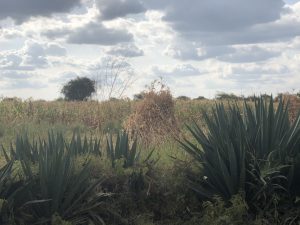
During the conflict, Pokot families on average harvested 1.7 bags of maize a year. Now, on average they harvest 21.4 bags of maize a year
Why does this matter? Because just eight years ago, none of this existed. There was no Market Day, because there was nothing. The people were living like refugees, hiding in the bush and scrapping by for every meal. There was no food to sell, because there were no crops being grown. There was no livestock to sell, because all livestock had been stolen or killed in raids. And young Samburu and Pokot men eating chapatti and drinking tea together? Unimaginable. Eight years ago those same men I saw today would have killed each other on the spot if they saw one another. The only time there was interaction between the two tribes was on the battlefield.
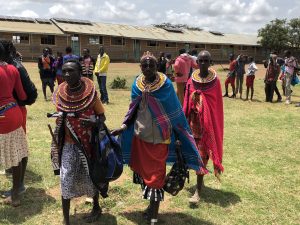
A Pokot woman (left) and Samburu woman (right) in Longewon Village, Samburu County
The next day I saw Market Day in Longewon Village. Every Wednesday, the Samburu tribe hosts a market in Longewon. I saw similar things being sold. I saw Pokot and Samburu women patiently waiting to be seen at the Maternity Clinic by the doctor. I saw Pokot and Samburu children walking hand and hand through the village. I saw Pokot and Samburu boys playing soccer together on the dirt soccer field at Longewon Primary School.
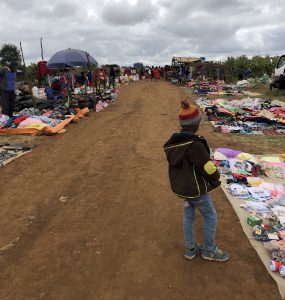
Market Day in Longewon Village, Samburu County
Why does this matter? Because just eight years ago, none of this existed. Just like the Pokots in Plesian, the Samburu in Longewon lived as refugees. They couldn’t grow crops, because they were constantly fleeing. Pregnant women couldn’t visit the doctor or receive any health care. And Longewon Primary School was closed, unable to open because it was unsafe for the children to attend.
I saw a total transformation. I saw lives being led normally. I saw people living with peace of mind. I saw children being able to be children. I saw intermarriage. I saw friendships reaching across both tribes. I saw a thriving local economy. I saw it all, and it was all because of CPI Kenya.
-
Mama CPI
4 CommentsHave you ever met someone for the first time but felt like you’ve met them before, and will meet them again in the future? I’ve never felt that until I met Mama CPI in Logorate, Samburu County a few weeks ago.
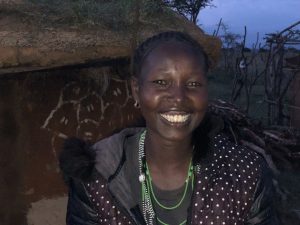
Evelyn Lengapiyani, aka Mama CPI
The CPI Kenya team and I arrived at the home of Evelyn Lengapiyani as dusk started to fall, but Evelyn wasn’t there. One of her sons ran to get her in the cornfields, and as we waited in front of her traditional Samburu house I gazed out at the beautiful rolling hills with the gentle sun casting its last light onto the tall green and yellow grasses. “Gosh, Samburu County is beautiful,” I thought to myself for about the hundredth time that day. After about 15 minutes Evelyn arrived and immediately invited us into her home.
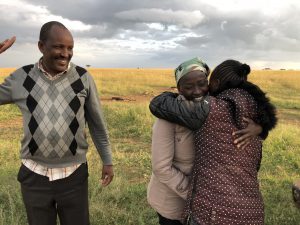
Mama CPI warmly welcoming Hilary (left) and Caroline (center). You can see the beautiful land on which Mama CPI lives in the background
Full disclosure, I am not an impartial reporter when it comes to Evelyn. She is one of those people that you just instantly like. Her hugs are warm, her smiles are authentic, and despite her knowing little English and me little Kiswahili, we understood each other. She’s affectionately called “Mama CPI” by the CPI Kenya team members because she is such a big supporter of their work and has been such an advocate for peace in her Samburu community. Last year CPI Kenya held a peace conference in Nairobi and brought two Samburu and two Pokot parents to the conference to speak about the impact of peace on their communities, and Mama CPI was one of the Samburu’s they invited. She is well spoken, passionate, and genuinely kind (again, I am super biased. But in my defense, I think everyone would agree with me if they met her).
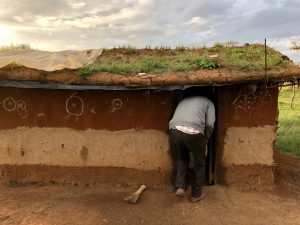
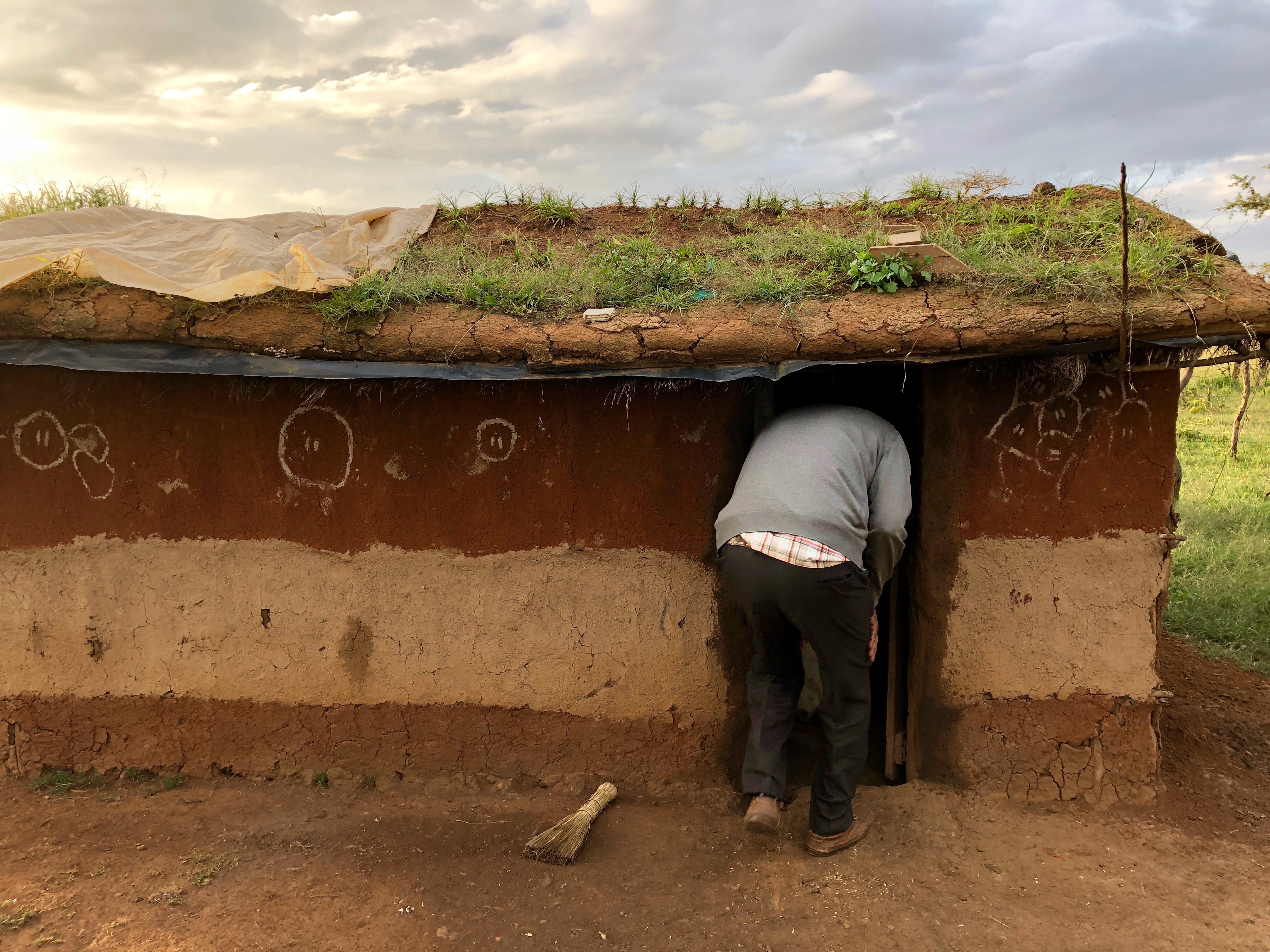
Hilary (who is about 6’1) as he enters Mama CPI’s home
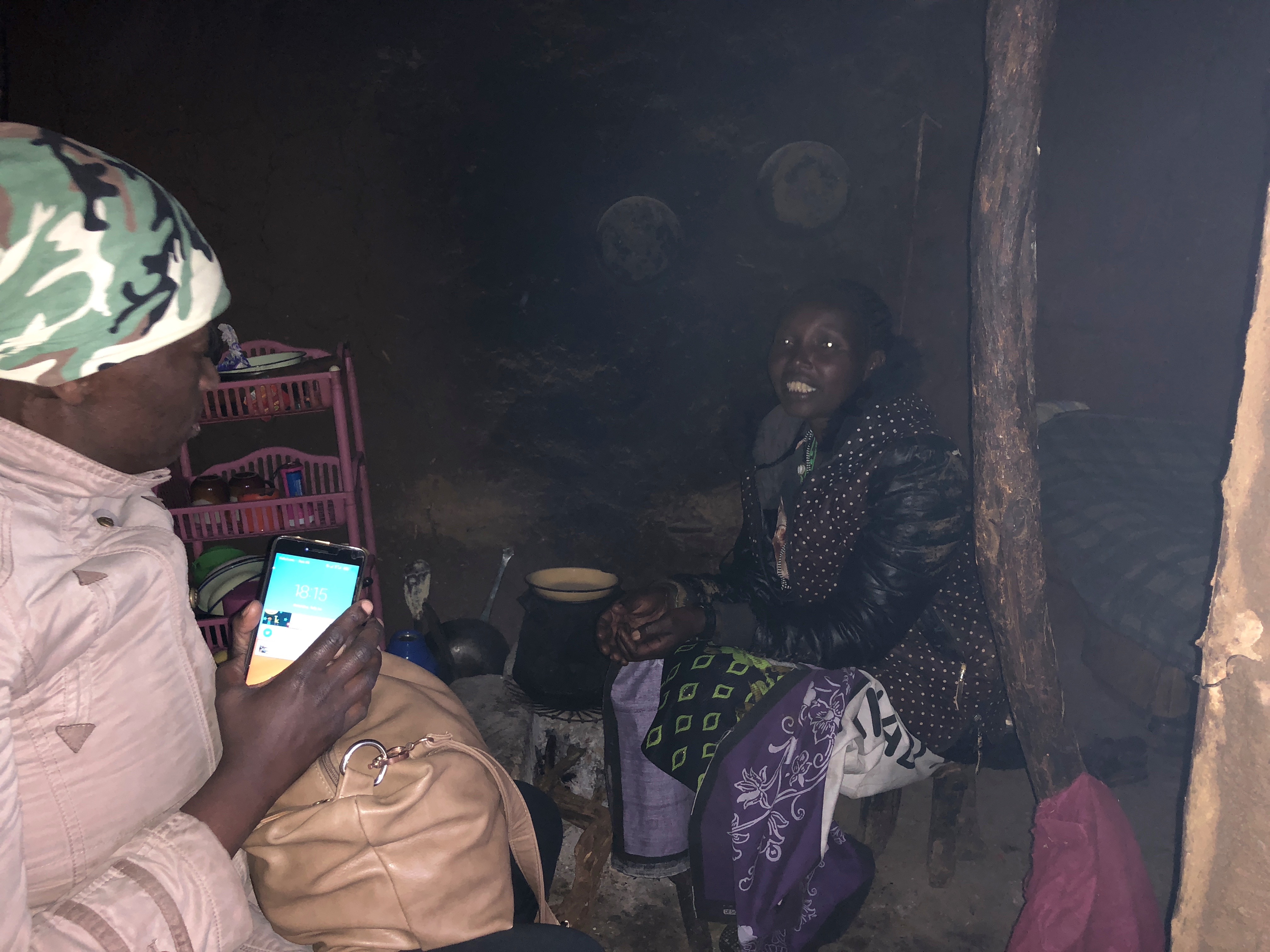
We settled in her traditional Samburu home (low thatched roof, mud walls, dirt floor, no power or water, and smoky air) and began our interview with her. I began by asking her the same standard questions we had been asking all the families who received a Heifer for Peace, but could tell right away that she was incredibly intelligent and a voice of the village, so we went deeper.
“Why did CPI Kenya’s peacebuilding efforts work, while so many other approaches failed?” I asked Mama CPI. Immediately she responded “Even in families, children are a source of peace. I love my kids, and the Pokot love theirs. The children brought us together.” She also brought up a very interesting point that people outside of the communities would have never known. She told us how there is “a lot of movement between the children”, which also prevents conflict because no thieves will attack a village if they aren’t sure whether there are kids from their tribe in that village or not.
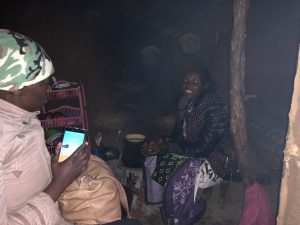
Interviewing Mama CPI inside her home
Mama CPI continued on, saying that “the children have really strengthened the bond between the two communities. The children bring friendships that go beyond their families.” She proudly talked about how her niece brings all of her Pokot friends and their families to her corn mill, and how her business is doing well now because she has Pokot customers (and she even gives to them a family discount). She talks about how “the extended family of Didi (her son’s Pokot friend, who they have a shared Heifer for Peace with) has welcomed my son, not just the immediate family. And we have done the same too.”
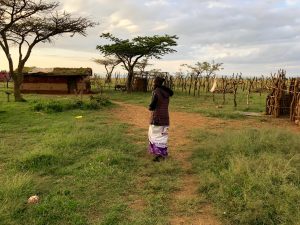
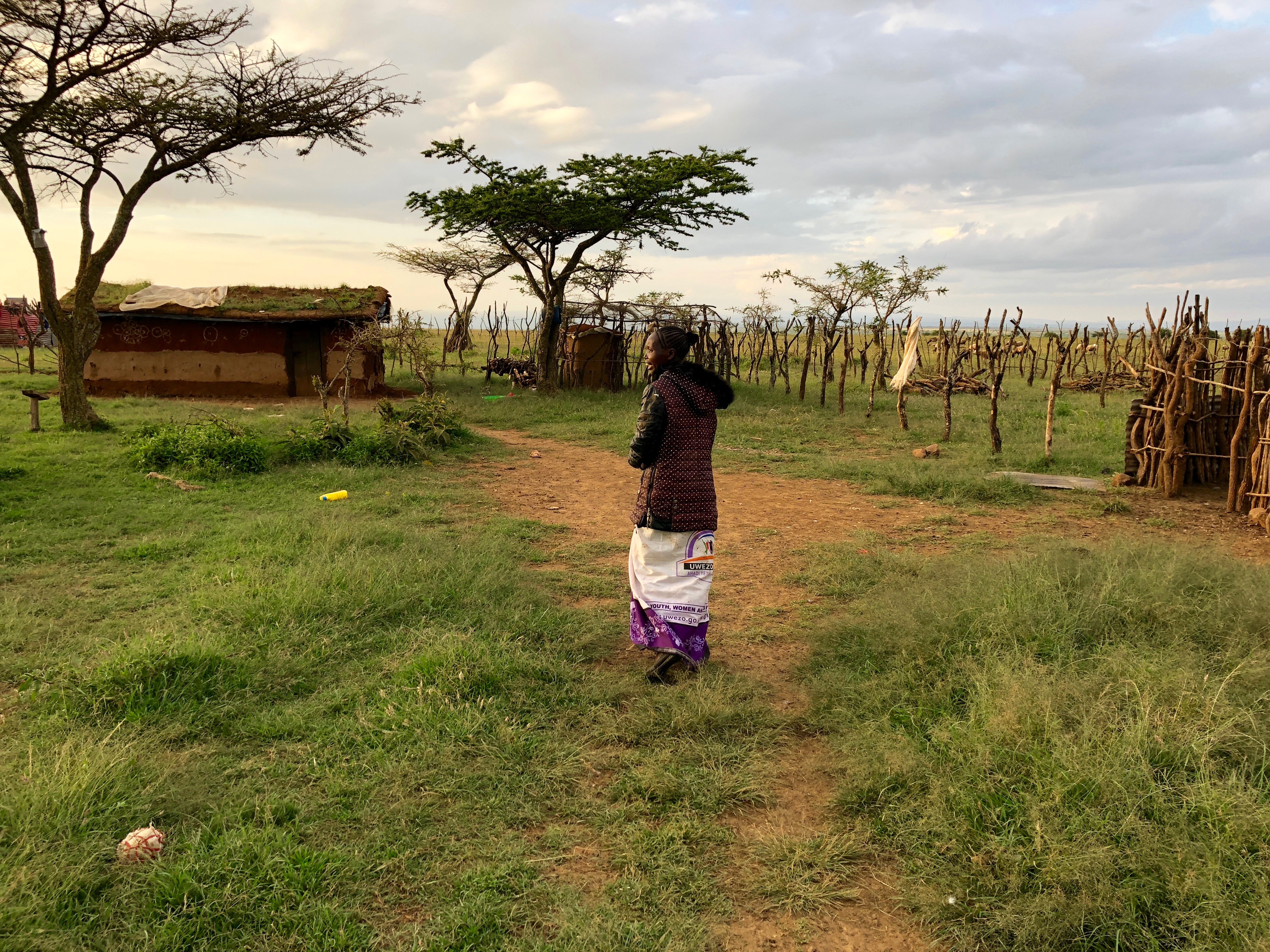
Mama CPI’s homestead
As we get up to leave, Mama CPI holds my hands and says “Above all, I want to thank God and thank CPI, and pray that CPI can spread their work to many more communities.” She takes us back outside, where I comment about how beautiful her property is. She smiles, and says “yes, it is beautiful now, but it used to be a battlefield.” I come to find out that in 2006, a Pokot father and his two sons were shot and killed on this same land while trying to steal cattle from the Samburu. In 2007, a young Pokot man who was a university student was shot and killed beneath the same tree that I had been gazing at when waiting for Mama CPI to arrive.
Now, this same land is owned by Mama CPI and her family. It hasn’t seen bloodshed since CPI Kenya started working with the communities in 2012. Mama CPI now has 13 cows, compared to the one lone cow she had during the conflict. In fact, just three days before we arrived her shared Heifer for Peace gave birth to a newborn calf, which she will give to the Loman family (the Pokot family whom she shares the Heifer for Peace with). It is a beautiful, peaceful land that is shared by both the Samburu and Pokot tribes, and it has remained that way because of the work of CPI Kenya and because of the commitment to peace that people like Mama CPI have made.
I feel very lucky to have met Mama CPI, and have a feeling that I will meet her again. I told her this as we said goodbye, and she agreed. I love when a moment like this hits you; it shows how wonderful and strange and small a world this is, and shows how a “Mzungu” (white person) from Buffalo, NY and a Samburu woman from Logorate, Kenya can be so closely connected.
See you again sometime in the future, Mama CPI.
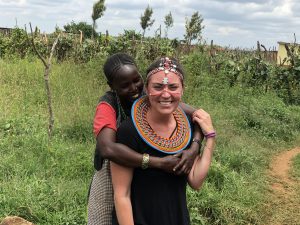
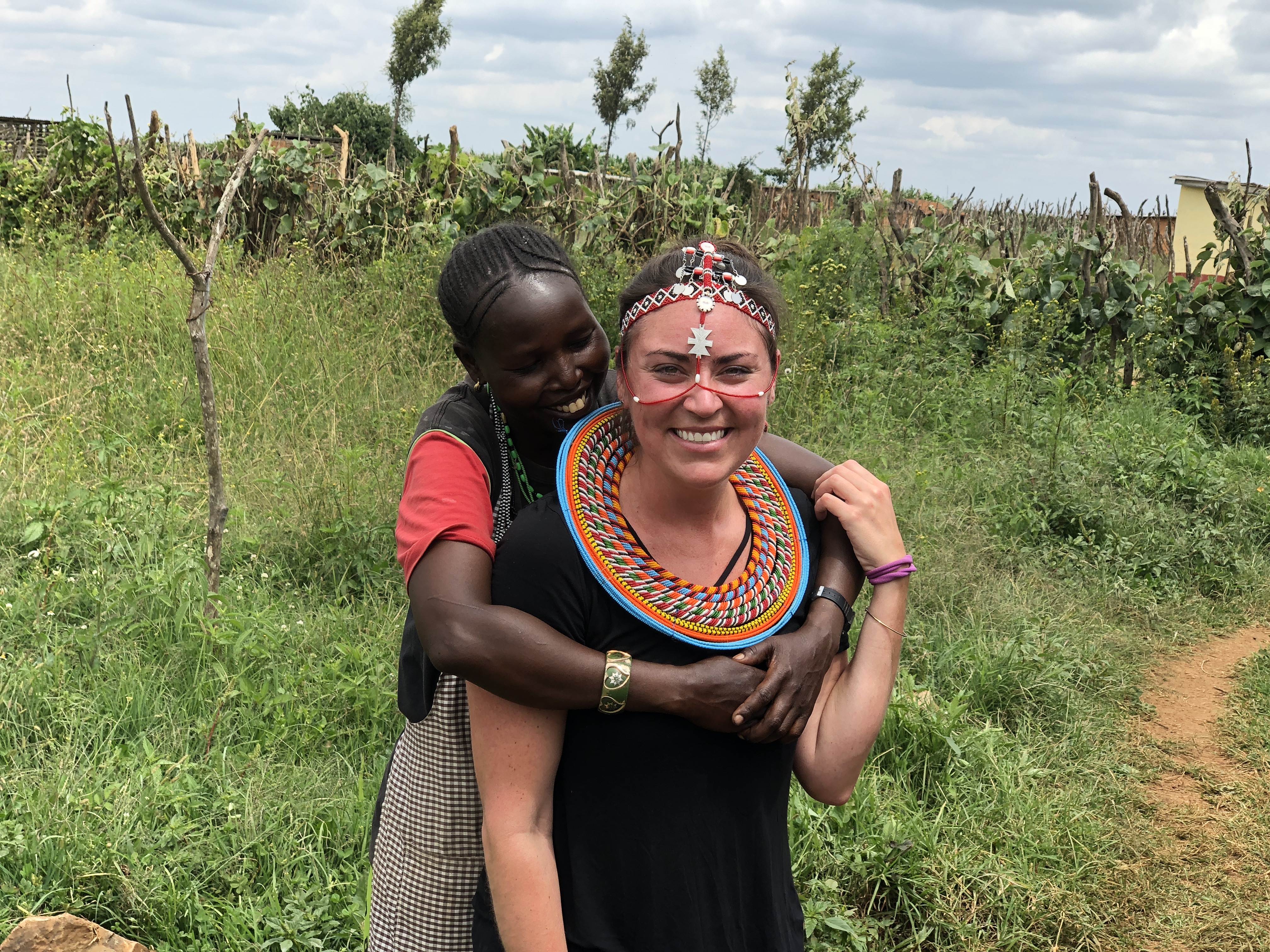
Sure enough, three days later I saw Mama CPI. But she had planned this, and surprised me by gifting me with the traditional Samburu headband that she had made by hand. I was (and still am) so humbled and thankful for her gift
-
Mama Caleb and Mama Faith; Two Women Quilting for a Cause
5 Comments“When the sun rose, you didn’t know whether you’d live to see it set. If you saw the sunset, you knew you had another eight hours of life.” Esther Lenosilale, more commonly known as “Mama Caleb”, talks about the conflict while bouncing a baby on her knee. The CPI team and I are at her home in Samburu County, stopping by to visit her so that we can gather the quilting squares she has been sewing for the past year for the Advocacy Project quilt project. While there, I asked her to explain how the conflict impacted her life.
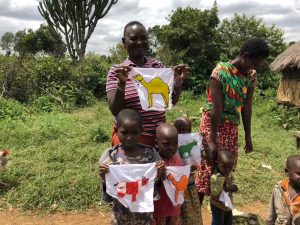
Mama Caleb with her 6 adopted children
“We would go days without food. We had to run away and leave all of our crops and harvests.” Unfortunately, Mama Caleb’s story was the norm for both Samburu and Pokot families during the conflict; even those that tried to farm were forced to flee and returned only to ashes after the raiders burned their homes and crops. CPI Kenya’s data collection found that on average, families were only able to harvest 2.2 bags of corn during the conflict. A bag of corn is about 90kgs/200lbs, and can sell for up to 4,500KSH/$45.00 USD. Today, the same families average 43.8 bags of corn.
“I don’t even want to remember. We slept under the trees and got rained on…so many children died from sleeping outside at nights, exposed to the weather.” Mama Caleb looks down at her hands where she holds a quilting square that she sewed of an orange camel, gathers herself, and continues. “My father and one of my grandchildren died. My father got an infection in his leg while sleeping in the bush, and my grandchild caught pneumonia. Both should have been very preventable, but because of the conflict we had to stay in the bush and keep hiding, and both passed away.”
These are the stories of conflict that are often under-reported and known only by the family members. While many Pokot and Samburu men, women, and children died from direct warfare, who knows how many deaths occurred because of the collateral effects of conflict.
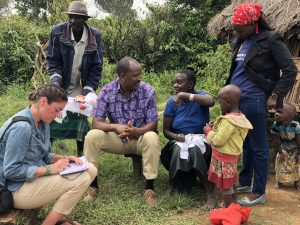
Interviewing Mama Caleb
Despite the horrors that Mama Caleb lived through, she is still a bright, ever-smiling woman. When I asked her what she enjoys doing, she replied that she likes to pray, go to church, and taking care of children. She had six children who have now grown into adults, but since she loves kids so much she has adopted six more children. The six children cluster around her, never more than a couple meters away from her throughout our whole visit at her home. “My age-mates are all old…but I look and feel young because of children!” she cheerily replies.
Today, Mama Caleb makes her living from farming and having a small herd of cows and goats. Despite being a widow (her husband died from kidney failure some years back), she is able to provide for her six young children and give them a safe home. Why? “Because of the peace!” she says. “I am so happy about the peace. There is TOTAL peace! Even the Pokot and Samburu herders and shepherds live and work side by side.” Again, her statement is backed up by our Monitoring and Evaluation (M&E); 100% of surveyed Pokot and Samburu families confirm that their livestock graze in both Samburu and Pokot lands, that there is sharing of pasture and water, and that people are able to move freely and safely from their tribal lands to the other tribe’s lands.
To a Western audience, and especially to people who have never lived through conflict, these findings may sound obvious or unimpressive. But keep in mind that just eight years ago these lands were an active conflict zone. In 2010 if a Samburu shepherd took his livestock herd to Pokot lands so they could drink water there, he would have been killed and all his livestock stolen, and vice versa. Today, the freedom of movement is not taken for granted by the Pokot and Samburu tribes. As we leave Mama Caleb’s home, she bids farewell by saying “I just want to say thank you to CPI for bringing peace through children. I have made so many new Pokot friends through the peace, and I thank God and CPI for our second chance at life.”
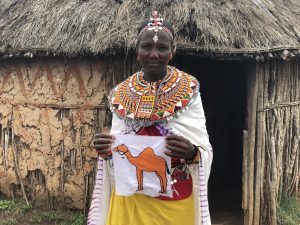
Mama Faith showing one of her quilt squares; each square takes 7-10 days to sew
Our second quilt artist is Joyce Leririo, more commonly known as “Mama Faith”. She is a shy, reserved Samburu woman who received a shared Heifer for Peace in 2015 with her Pokot family “Friends for Peace,” the Mamkong family. Unfortunately, the heifer died due to the severe drought in 2016-2017, but she and the Mamkong’s are still friends and their daughters, who became friends in CPI Kenya’s 2012 Peace Camp, still visit each other every school holiday.
Mama Faith tells us with pride how all seven of her children are in school, three of which are in secondary school (high school). In Kenya, only primary school is free; in order for a child to attend secondary school, the family has to pay tuition fees. Often times the fees are too expensive for families to afford, and the children have to drop out. Mama Faith tells us how she is able to pay for the secondary school fees because she is farming 1.5 acres of land and running a small sewing business. During the conflict she couldn’t farm or do business at all, and her children had to drop out of school for three years because it was too dangerous from them to walk to and from school every day.
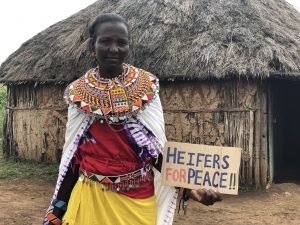
Mama Faith
“They were so happy to go back to school once there was peace, and I was so happy too. They now school without interruption, we are able to again eat three meals a day, and everyone’s health has improved because of food and because we have peace of mind” explains Mama Faith.
When I tell her that her quilting squares will be made into a quilt in the United States and if she wants to send a message with them, she shyly laughs and says that she sends her greetings and hopes her beadwork is enjoyed. She also said that she’d like an American quilt as a gift in return!
Mama Caleb and Mama Faith are just two of the dozens of families we interviewed while in Samburu County, yet they all tell a similar story of strength, hope, and faith. They are smart, independent women who have had to overcome incredible obstacles. Neither have power or running water in their homes, they don’t have a formal education, and they have never traveled outside Samburu County. They both have been exposed to so much hardship, and have learned to take absolutely nothing for granted. Yet they’re still smiling and thankful for what they do have, and they both vowed to never let things return to the way they were before.
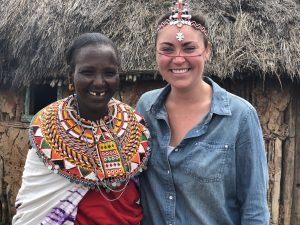
Mama Faith proudly donning her traditional Samburu necklaces and insisting that I wear her traditional Samburu headband!
The squares that Mama Caleb and Mama Faith sewed will be made into a quilt by partners of the Advocacy Project. After it is made, it will be put on display in the United States to raise awareness of CPI Kenya’s work with pastoralist communities in Northern Kenya. To learn more about Advocacy Project’s “Advocacy Quilts”, visit their website.
Want to see more photos? Check out my Flickr Album!
-
Karibu Sana – My Warm Welcome to Kenya & CPI
11 Comments“Karibu Sana, Colleen!” I have heard this phrase countless times over the last seven days since I touched down in Nairobi, Kenya and the Karibu Sana’s keep on coming. “Karibu Sana” translates from Swahili to English as “You are most welcome,” and I can say with 100% honesty that I have never felt so welcomed to a new place and new group of people than now at Children Peace Initiative (CPI) Kenya! As I write this blog, I struggle to narrow down all the stories, experiences, and people I have encountered in the last seven days to prevent this from becoming a rambling blog that jumps from the subjects of family, education, poverty, politics, prayer, infrastructure, tribal conflict, economics, aspirations, accomplishments, and so much more. And yet here I am, already rambling!
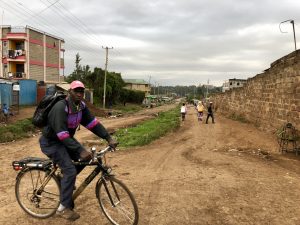
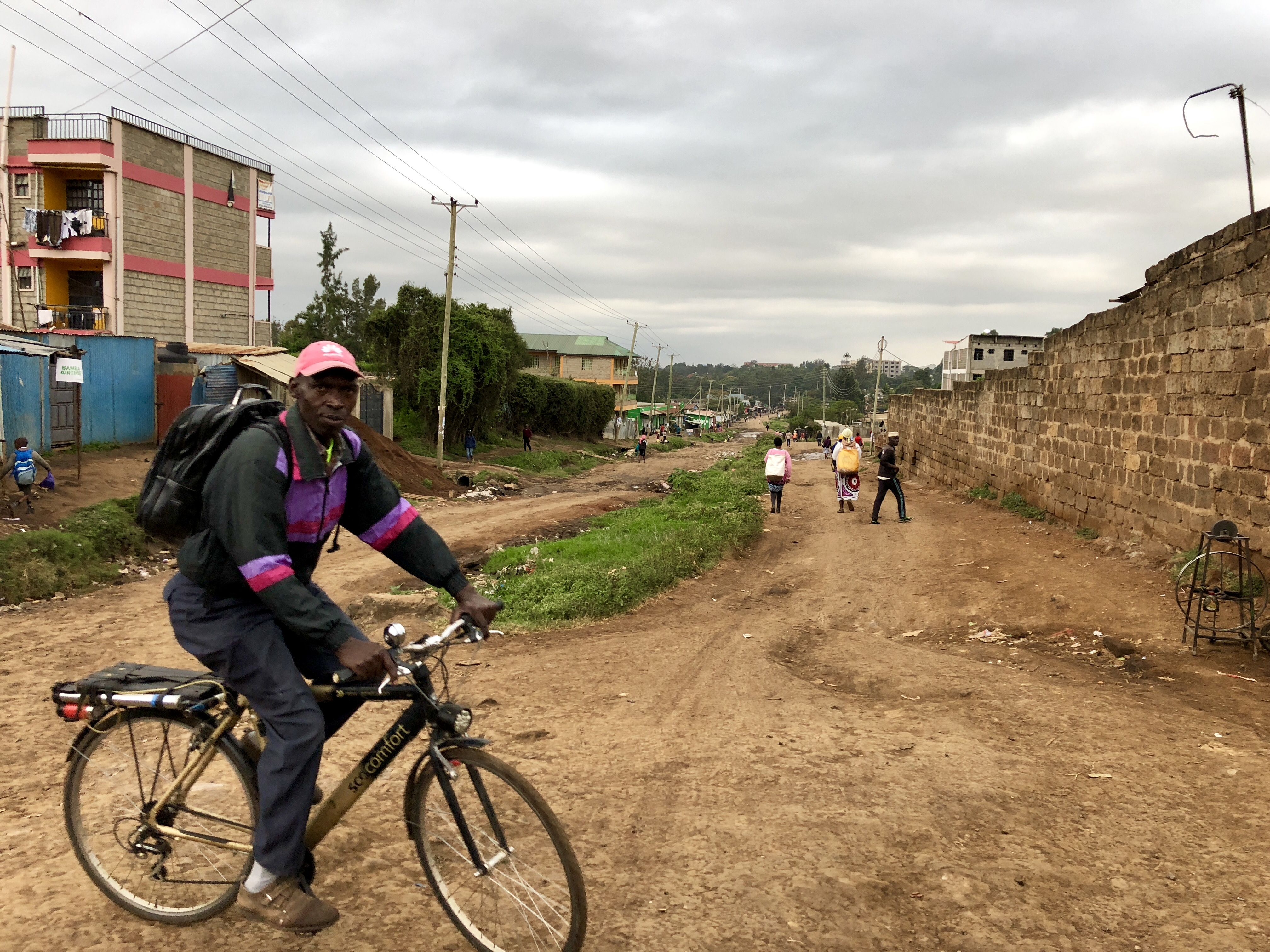
One of the roads we drove down when house-hunting for me; somehow we didn’t get a flat tire or damage the car too bad!
Nairobi is a city of extremes. There are wealthy, perfectly-manicured neighborhoods filled with mansions, and then there is Kibera, Africa’s largest urban slum. There are well maintained paved roads with street lights, and then there are “roads” which are dirt paths so rough that an ATV 4-wheeler would have difficulty getting through. There is the pristine Nairobi National Park, the only national park inside a city in the entire world, and then there are neighborhoods with open sewage and garbage streaming through the ditches alongside the roads. There are huge malls with posh department stores and Western restaurants like Burger King and KFC, and then there’s the Sam Jan Café, a restaurant the CPI Kenya team took me to that has no electricity and the lunch only costs $1.50 USD. Yet despite all of these extremes, I find myself so comfortable and at-home because of the Karibu Sana’s I have received from everyone at CPI Kenya.
After spending two days in Nairobi getting settled and taking care of things like getting a local sim card for my cell phone, stocking up on bottles of water since the tap water is not safe to drink, and getting on Nairobi time (7 hours ahead of EST), the CPI Kenya team and I were due to leave Friday morning for a field visit to a school in Meru County and then spend the weekend having a “rural experience” in the home village of Monica and Jane, two CPI Kenya members. “See you at 9am ‘Africa time’ tomorrow morning!” said Hilary, the Director and Founder of CPI Kenya. Any guesses on what time “9am Africa time” is? Turns out, it’s 11:21am! So with a not-so-early start, we hit the road for the five-hour drive to Meru County to visit a rural school that CPI Kenya is hoping to help in the future.
Watch a quick time-lapse video of a portion of our beautiful drive to Meru County here!
Driving north from Nairobi, we passed through Kirinyaga, Embu, and Tharaka Nithi Counties before reaching Meru County. The landscape was breathtaking: rolling rice fields, lush green valleys, maize farms, cows, goats, sheep, men on “boda bodas” (motorbikes) and small villages passed us by. We stopped for a meal of Ugali (corn flour cake), Kachumbari (veggie mix) and goat (yep, I ate goat!) before reaching the Moving Miracles School in Meru County.
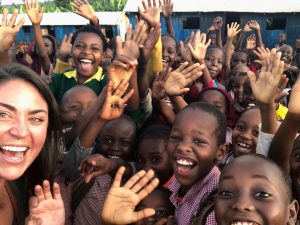
Getting to meet and play with the children of Moving Miracles School! Many have never seen a “Mzungu” (white person) before and were excited to see and meet me!
Moving Miracles is a private school for children aged 3-17 and is located in the rural village of Nkubu. Upon arrival, we visited the classrooms, attended the assembly of all the students (275 students in total!) where we were able to meet the kids, and had tea and bread and butter with the school principal, where she spoke with the CPI Kenya team about the struggles she faces at Moving Miracles and ways in which CPI Kenya may be able to help in the future.
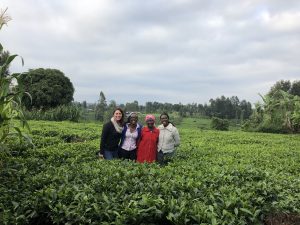
Thank you to Jane, Monica, and their mother Esther for their ‘Karibu Sana’ this weekend in their home village!
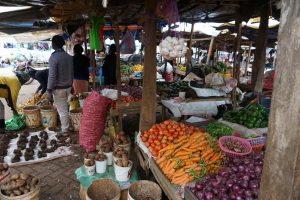
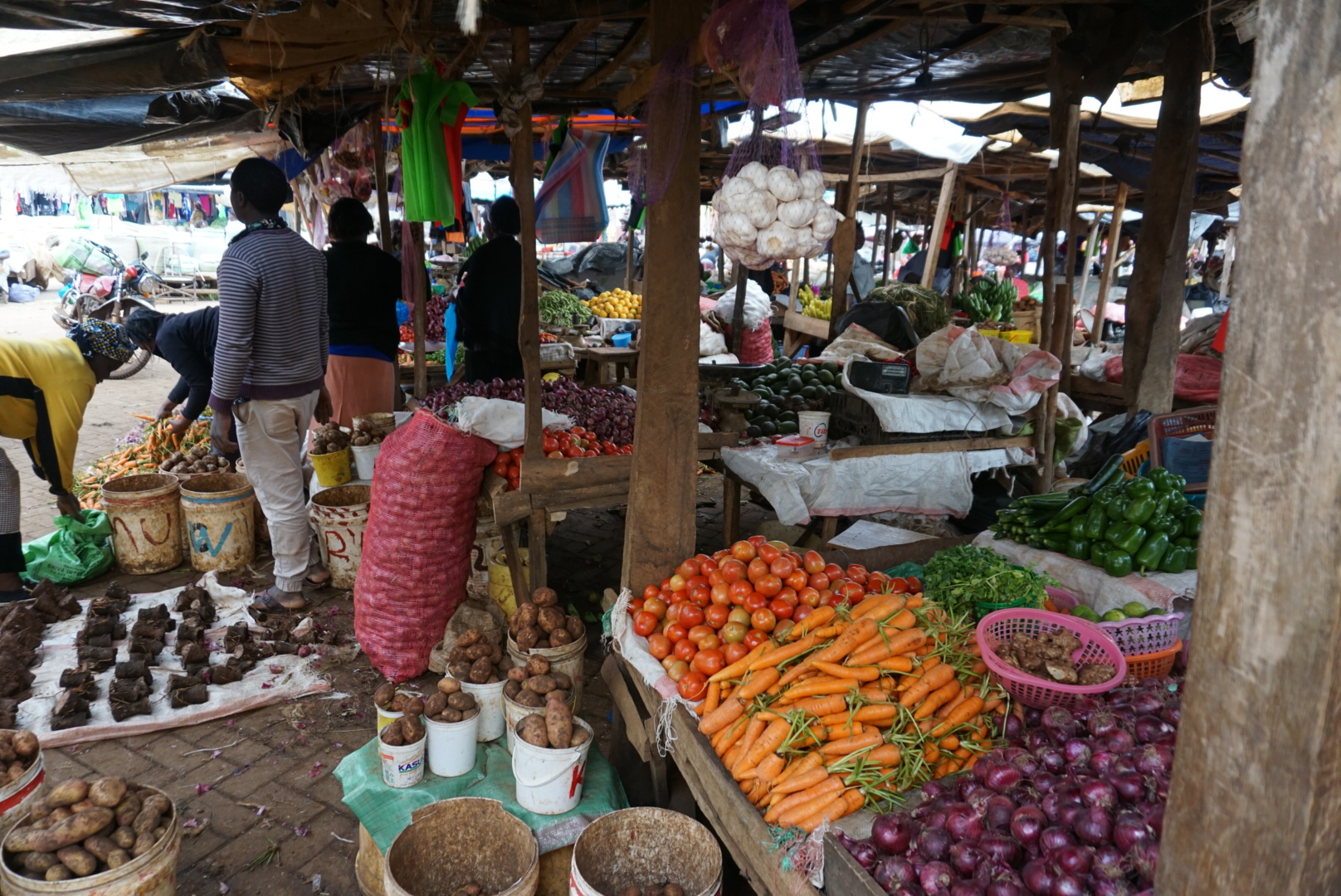
The market of Kagumo, Monica and Jane’s home village
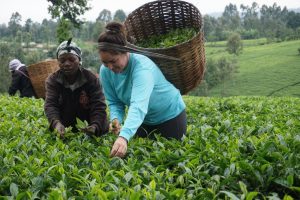
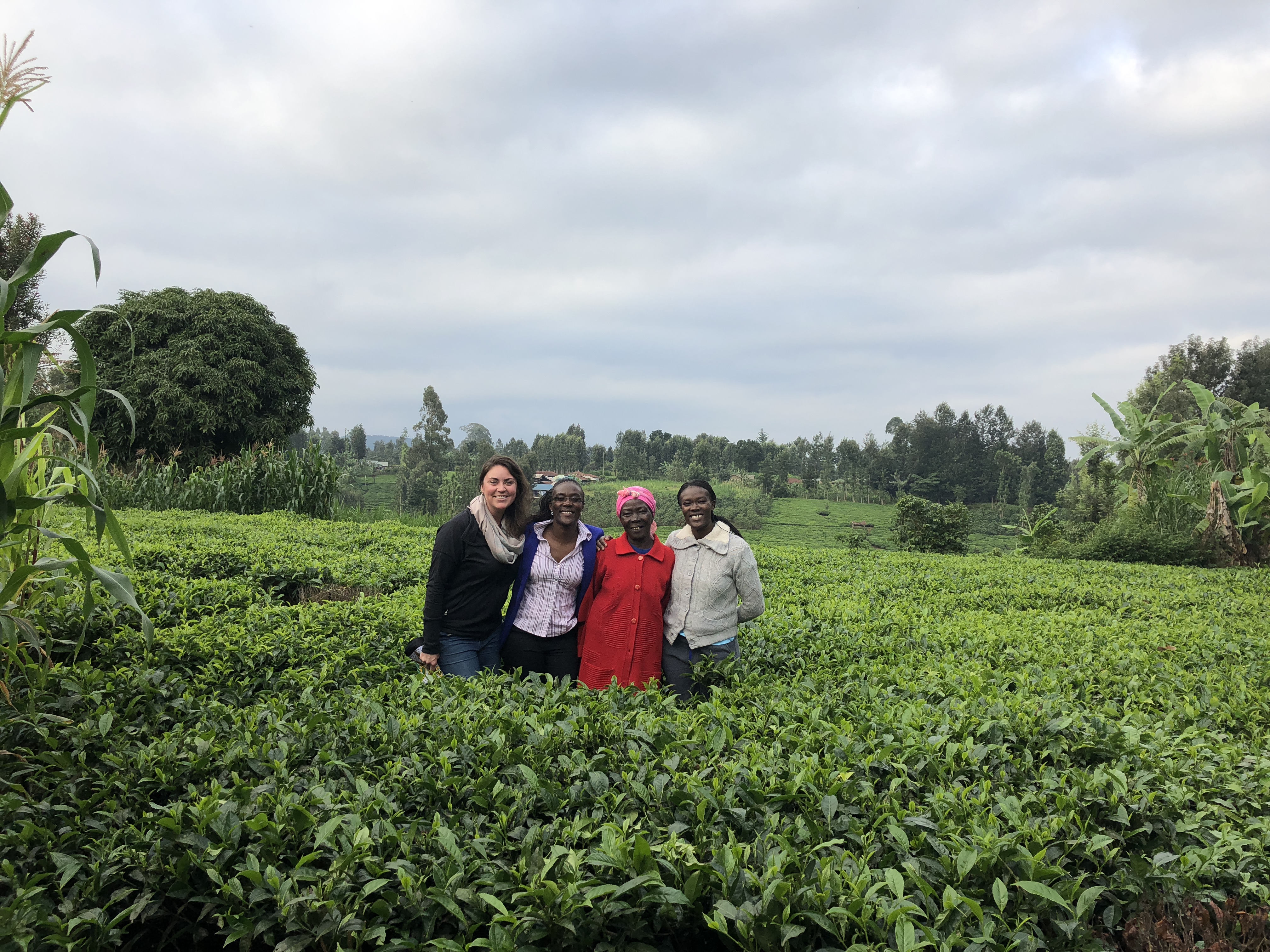
Picking tea leaves with the local women of Kagumo
After departing Nkubu, we headed for Monica and Jane’s home village of Kagumo. Their mothers’ home is located among the beautiful valleys and hills that make up Kirinyaga County, and the home is surrounded by tea fields. The Karibu Sana I received at their house from their mother, Esther, was second to none! It was a wonderful weekend of making home-cooked meals over the fire, picking tea leaves, going to the market, and playing with the village children! Also, at the market I discovered that I’ve been drinking unpasteurized milk with my tea all week when I saw Jane buying us milk straight from the cow, so that was a fun revelation 😉
Now that we’re back in Nairobi, I’m settling into the incredible work that Children Peace Initiative Kenya does. CPI Kenya is a non-profit organization that was founded in 2011 by Director Hilary Halkano Bukuno, Deputy Director Monica Kinyua, Program Manager Jane Kinyua, and Operations Manager Caroline Karani. The idea behind CPI Kenya is that children are not just victims of conflict; rather, they are the “bridges of peace” in their families and communities that can combat and resolve inter-ethnic conflict. Hilary himself grew up in conflict as a child in Marsabit County in northern Kenya, and has recognized the power of using children as the primary actors in peace-building. With this idea, CPI Kenya has developed three main programs: the Children Peace Building program, the Heifers for Peace program, and the Interactions 4 Peace program.
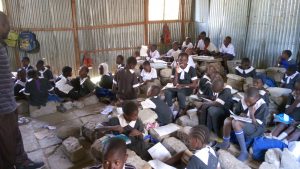
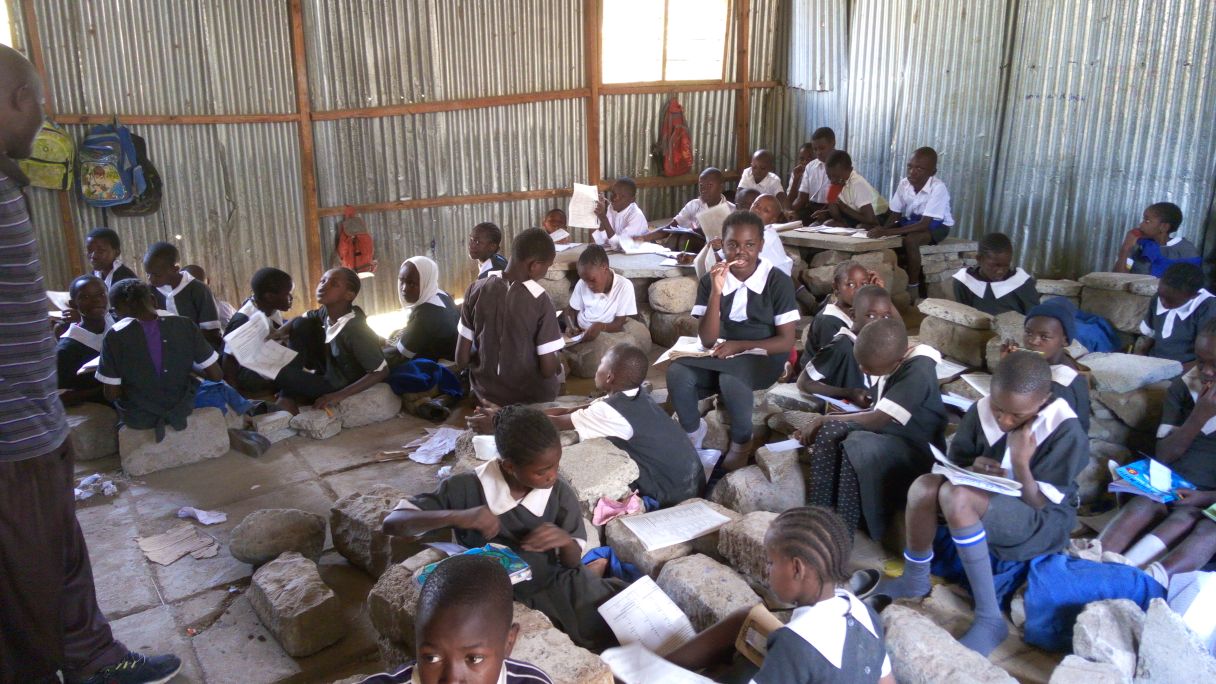
Students at R.E.C. School in the Kibera Slum. CPI Kenya has partnered with R.E.C and implemented the I4Peace program
Interactions 4 Peace (I4Peace) is a program that CPI Kenya set up in five primary schools in Nairobi that teaches children aged 9-11 about peacemaking, how to be effective problem solvers, how to be a peer mediator, and how to handle conflict. Although it is not strictly an “anti-bullying” campaign, it is similar in that it teaches the children alternatives to violence and conflict. The children are taught the five essential elements: self-awareness and confidence, cooperation, communication, conflict resolution and transformation, and parent and community connections. Once they “graduate” from the I4Peace, the students become “Peace Patrollers” in their schools. Keep in mind that these schools are different from Western schools: most of them are poor, overcrowded, underfunded urban schools. Three of the five schools that CPI Kenya works with are in the Kibera Slum (R.E.C. School is pictured above). This makes the conflicts that the Peace Patrollers mediate different than conflicts kids have in American schools and makes their work all the more important.
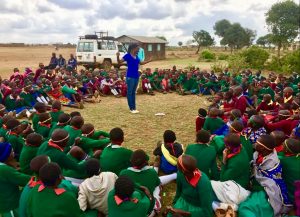
Many of these Samburu and Pokot children have successfully completed the Children Peace Building program, and they and their families are now eligible to receive their Heifer for Peace in 8 weeks if we raise enough funds!
The Children Peace Building program, which leads to the Heifers for Peace program, is how CPI Kenya started. This program is conducted in parts of the Rift Valley and Northern Kenya amongst the pastoralist tribes that are in perennial conflict over livestock, namely cows. CPI Kenya brings the children of the two warring tribes together, engages them in a series of activities that enables them to become friends, and in turn, the families of the children become friends through more activities. Not the adults, but the children become the agents for reconciliation between their two conflicting tribes. This is done through seven main activities that span 1.5-2 years, starting with a 5-day Peace Camp for the children and ending with gifting the two families with a heifer, which is the Heifers for Peace program.
Since CPI Kenya started running Peace Camps 7 years ago, there have been ZERO cattle raids amongst the tribes they worked with. That’s right, ZERO! ZERO raids and ZERO deaths since 2011; it is the longest period of peace in history amongst the Pokot and Samburu, Turkana and Gabra, and Rendille and Gabra tribes. If you’re thinking “With such incredible outcomes, why isn’t this done with every warring tribe in Kenya?!” like I initially was, the answer is because of a lack of funding. CPI Kenya has been looking for a charity or donor that can contribute long-term, sustainable funds since their last donor left Kenya in 2015, and has been mainly relying upon crowdsourcing for funds. This is one of my main tasks this summer, to help CPI Kenya get a grant and funding for the next several years so that Heifers for Peace can continue, because it truly is a model for peacemaking.
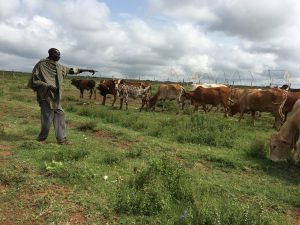
Just 1 heifer shared between 2 families from warring tribes creates economic interdependence, which sustains peace!
Heifers for Peace produces such incredible conflict resolution results because it is a grass-roots approach that promotes economic interdependence among warring tribes. With two families sharing one cow, they rely on each other for their cow to survive and to reap the economic rewards of owning a cow. A cow produces milk which they can sell, it can give birth to up to 6-8 calves, and it’s also a source of pride and honor amongst these tribes. Additionally, the cow promotes the sharing of tribal lands and resources, such as water and food for the cow. This idea of bringing warring tribes together by creating economic interdependence is groundbreaking, and I hope to be able to help CPI Kenya promote this program as a model for conflict resolution that produces social change.
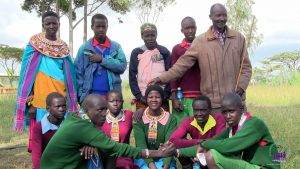
These Samburu children (in green) and Pokot children (in maroon) successfully completed the Children Peace Building program in 2015. This program included activities where their families met and eventually became friends. Now they are no longer at war, and the Samburu and Pokot family share a Heifer for Peace!
Over the next eight weeks, we hope to raise enough funds to give 50 heifers to the 100 families (50 Pokot families, 50 Samburu families) who earned a heifer over the last two years by successfully completing the Children Peace Building program. If you’d like to donate to help purchase these cows and help bring peace to Kenya, we created a Global Giving Fundraising Campaign that you can visit here, but if you could wait until July 18th to donate that would be wonderful; Global Giving is matching every donation made on that day, so your dollar will be worth more! If you do donate, your donation will go directly to the purchase of a heifer, and every dollar makes a difference! Additionally, here is a link for a funding request CPI Kenya submitted to OpenIdeo, an innovation platform committed to making positive social change; please like it and help us win this challenge to get funding!
Well I hope I haven’t lost any of you in this blog. It has been an amazing first week in Kenya and I hope you are enjoying sharing this journey with me. I feel so welcome and motivated by the members of CPI Kenya, and I hope that we can all help them in their incredible work this summer! Thanks for sticking around and I’ll see you next week 🙂
Want to see more photos and videos? Check out my Flickr album!
Cheers,
Colleen
-
Dad, Meet My Pokot Friend: A Story of Friendship Made at Peace Camp
346 CommentsLotit drove his motorcycle up the gravel drive to the entrance of Logorate Primary School and parked outside a classroom overflowing with a choir of children’s voices. Lotit had traveled from his Samburu village to visit his daughter, Chebet, who was two days into CPI Kenya’s Peace Camp. When Chebet found her father leaning against his bike outside, she ran to him and started leading him by the hand towards the classroom. “I want you to meet my Pokot friend!” she exclaimed with elation.
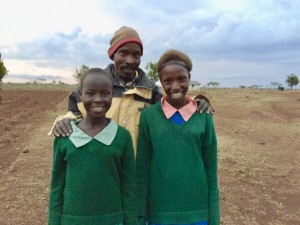
Helen, Lotit, and Chebet
Though the Peace Camp was only two days under way, Chebet had already befriended Helen, a Pokot girl from Kasilangwa. The two girls in Class 6 had bonded quickly through shared laughter during activities such as musical chairs, relays, and teambuilding competitions. Most children take four to five days at the camp to develop strong bonds with each other, but Chebet and Helen became attached almost instantly. At the end of Peace Camp, CPI Kenya registers friendships formed across tribal lines in a process called “twinning.” Twins, such as Chebet and Helen, promise to pursue their relationship even after the Peace Camp’s conclusion.
Helen had never traveled to Samburu territory before and was anxious upon arrival. Her nerves were quickly quelled by Chebet’s smile and invitation to play. The friendship between the two was sealed as soon as Helen was introduced to Chebet’s father, Lotit. Helen had grown up hearing fearful stories of Samburus raiding villages and killing Pokots; she had never imagined shaking the hand of a Samburu man. In a matter of moments, Helen’s twelve years of assumptions, biases, and misinformation washed away with the warm embraces of Chebet and Lotit.
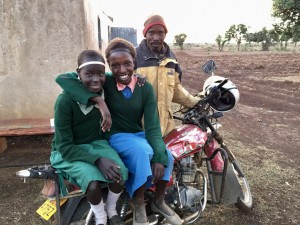
Helen, left, and Chebet, center, smile on Lotit’s motorcycle moments after meeting
Chebet and her family are no strangers to Pokots thanks to CPI Kenya’s peace building interventions in the Samburu County over the last five years. The family was first impacted by CPI Kenya’s outreach when Chebet’s older sibling participated in a previous Peace Camp. It is this past exposure that encouraged Chebet to come to Peace Camp with an open mind, an eager heart, and a willingness to make friends.
CPI Kenya’s children peace building program holds a special place in Lotit’s heart. Several years ago, he received a Heifer for Peace that he shares with his Pokot friend. This cow has been a blessing to the two families by providing extra income and sustaining their cross-cultural friendship. Unlike his open-minded children, Lotit witnessed the horrors of conflict between Samburus and Pokots for most his life. Up until CPI Kenya’s arrival in the region in 2012, Lotit had never known peace or the possibility of reconciliation with his Pokot neighbors. Through CPI Kenya’s peace building process, Lotit has been able to learn values of tolerance and diversity from his children. For this proud Samburu father, shaking his daughter’s new Pokot friend was just a small reminder of the social transformation that CPI Kenya has brought to the now peaceful region.
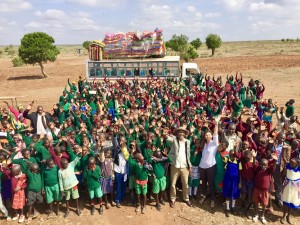
276 Samburu and Pokot children attended CPI Kenya’s July 2017 Peace Camp
-
Electoral Lessons from the Slums: When You Got Nothing, You Got Nothing to Lose
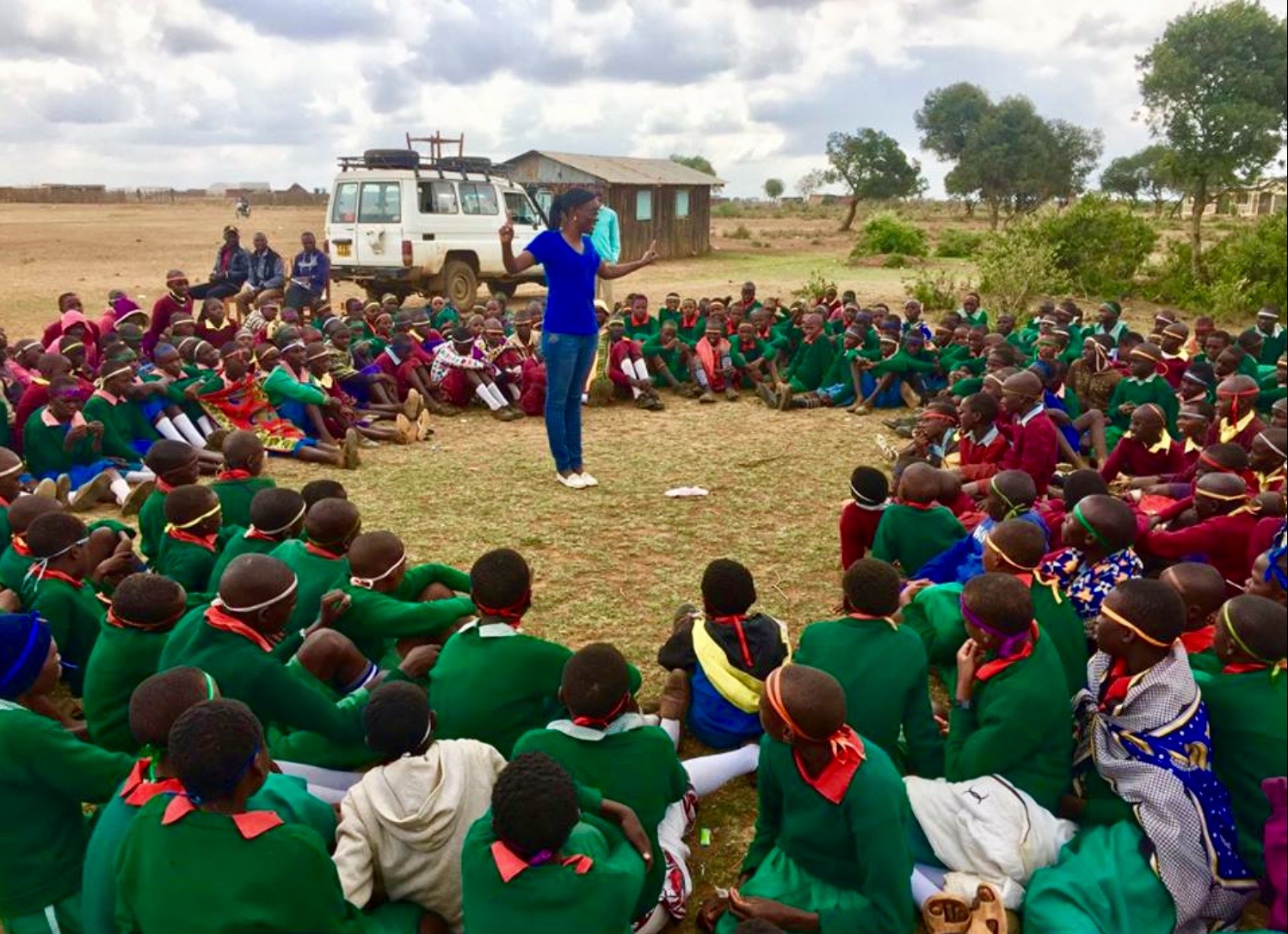
75 Comments“We are nobodies. If we don’t throw stones, no one will pay attention to us. Nothing is lost when our lives are lost,” a student in Huruma slum uttered despondently during a peace training. Last week CPI conducted trainings of community “Peace Ambassadors” for over 80 students at University Mtaani, the first and only higher education center located in a slum in all of Kenya. CPI’s Director, Deputy Director, and I were invited to Huruma as educators of nonviolent practices and conflict resolution, but we left having learned much about poverty and the perpetuation of political violence from our pupils.
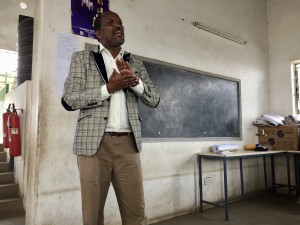
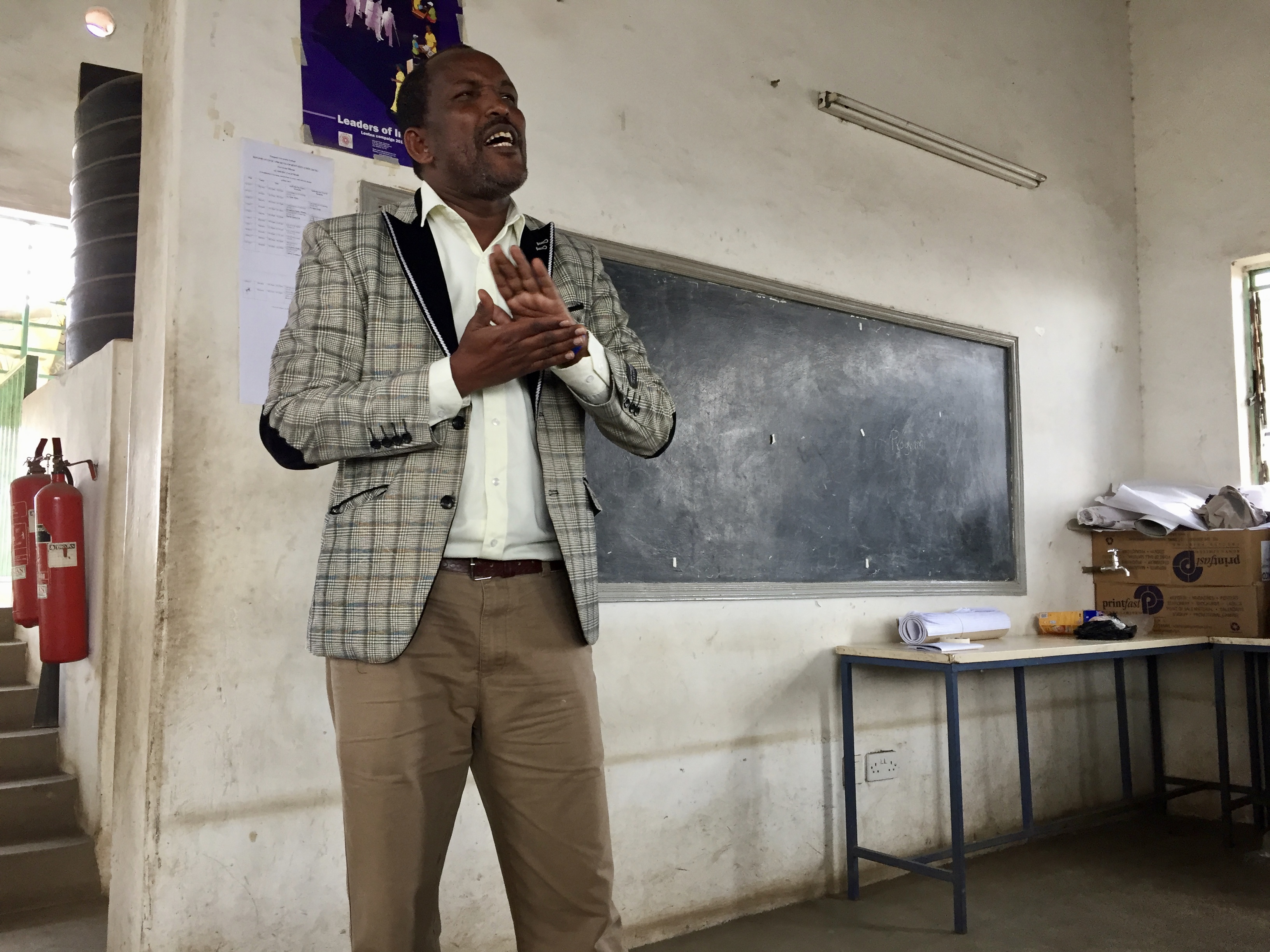
CPI Director Hilary Bukuno leads a discussion at the Peace Ambassadors Training
The student’s bleak words haunt me as the Kenyan general election on August 8th approaches. The political stakes are high, regardless of which party is announced as winner. Forgotten in the candidates’ manifestos, Nairobi’s slum dwellers—an estimated 60% of the population concentrated on only 6% of the urban sprawl’s territory—have little to gain and even less to lose in the election.
A Brief Political History with a Tribal Twist
Kenya has never succeeded in conducting a free and fair election, and I’m skeptical that in five weeks’ time I will witness the ultimate legitimization of Kenyan democracy. The feat of a credible election would require accurate and independent ballot counts; detection of fraudulent voters (previous elections have had a serious issue with tens of thousands of deceased voters remaining registered); uninhibited access to polling sites; and absence of voter intimidation.
On August 8th, Kenyans will head to the polls to either re-elect President Uhuru Kenyatta of the Jubilee party for a second term or elect Raila Odinga of the National Super Alliance (NASA) party. Both candidates come from prominent families whose political involvement spans the country’s history even before independence. Incumbent Uhuru’s father, Jomo Kenyatta, was the first president of Kenya. Meanwhile, NASA candidate Raila’s father, Oginga Odinga, was the first vice president under Kenyatta. The Odinga family has commanded the opposition movement for decades, most notably when Raila and his father led a failed coup attempt in 1982. Despite many years of efforts to register political parties that were met with political oppression and arrests, Oginga Odinga died in 1994 never knowing the presidency. His son Raila carries on the family legacy as he vies for the position for the fourth time—likely the 72-year-old’s last attempt.
Are there only two candidates running for president? In fact, there are at least six other candidates officially registered, but they are hardly even considered by pollsters. Why? Because party lines are tribal lines and, despite any attempts to encourage voters to make policy-informed choices, the overwhelming majority of Kenyans still blindly cast their votes for their tribe’s candidate. I could talk about Uhuru and Raila’s platforms, but they aren’t that different or profound, and nor do they even matter. It’s a numbers game, and the party garnering the support of the biggest tribes (or the ruling party in control of government officials…) wins.
What does this look like in the context of the 2017 election? Well, Uhuru is Kikuyu, which is the largest tribe (22%) in Kenya. Kikuyus have dominated Kenyan politics and been represented by three presidents out of Kenya’s four total. The current vice president William Ruto, who is running alongside Uhuru, is Kalenjin (12%), a tribe represented by one Kenyan president, Moi. Therefore, a substantial portion of the electorate is represented by Jubilee’s Kikuyu-Kalenjin political partnership. The Luhyas and the Luos each make up about 13% of the population, and the remaining populace is a compilation of 38 other small tribes in Kenya. Raila is a Luo, a community that harbors much animosity towards Kikuyus and vice versa. His party, NASA, is an opposition alliance that was formed in 2017 with the strict purpose of uniting minority parties and tribes with his Luo supporters to combat a Kikuyu-Kalenjin majority.
Over the course of his long political career, including his role as Kenya’s first and last Prime Minister from 2008-2013, Raila has garnered many passionate followers from a range of tribes. His appointment to Prime Minister was a response to extreme post-election violence when he lost to the incumbent Mwai Kibaki, a Kikuyu. Within fifteen minutes of announcing Raila’s defeat in the 2007 election, an obvious case of illegitimacy and fraud, Luos allegedly began attacking Kikuyus. Riots and state-sanctioned violence exploded throughout the Rift Valley and across Kenya’s slums. An estimated 1,500 lost their lives and hundreds of thousands were displaced in the first two months of 2008.
The international community, led by Kofi Annan, intervened to create a leadership position for Raila in hopes of appeasing his followers and suppressing the tension. Eventually the International Criminal Court investigated responsibility for the horrific violence and indicted Uhuru and Ruto for crimes against humanity and inciting ethnic violence. After ICC charges were confirmed against them in 2012, Uhuru and Ruto made a timely announcement for their presidential and vice presidential candidacies in the 2013 election. Alas, they conveniently won the election—which fortunately only saw mild protests and violence, but also saw 2 million votes tallied than registered voters listed—and the ICC dropped all charges against Uhuru in 2014. The Prime Minister position was discontinued.
Never Forget…Never Again
Will the 2017 election resemble 2007 or 2013? Will it be rigged with widespread violence or rigged with relative acceptance? Or will Kenya surprise the world with its first impartial election? This is a tough test to pass. If Uhuru genuinely win, he may still be accused of influencing the turnout and violence may follow. If Uhuru loses, he may pull some strings and still be announced winner, in which case violence may follow. If Raila genuinely wins and Uhuru peacefully steps down, then we will give Kenya’s democratic system a pat on the back but there will likely still be violence. If Raila loses, whether truly or by vote tampering, his supporters may cry rigged-election wolf and violence may follow. In the best scenario, the election will be carried out seamlessly without a single car set on fire—but I’m mentally catering towards caution.
There remains a pervasive sense of election anxiety among Kenyans who remember the 2008 violence. Billboards and posters are all over Nairobi displaying a gruesome image of unattended toddlers holding each other in a street full of rioting men yielding machetes or a close-up of a broken skull cracked upon rubble in a pool of effervescent blood as a tower of tires burns in the background. Beneath the graphic images, there is always the Peaceful Elections Campaign’s slogan “Never Forget…Never Again!” One sign reads, “our brethren’s lives are worth more than just a few hundred shillings,” referring to those who followed violent orders in 2008 for wages as low as 100 or 200 shillings ($1-2).
I hear constant talk about the importance and necessity of peaceful elections on the radio, on television, and in the candidates’ speeches. Rhetoric of non-violence and peace dialogues are everywhere I look—that is until I looked outside of my sphere of educated friends and into the slums. Because I had heard nothing but positivity, I had written off the idea of post-election violence. Many of my friends here are still convinced nothing will come of it, and I so hope that they prove me wrong. However, after spending time discussing electoral tension with University Mtaani students in Huruma slum, I felt less hope for them or for Kenya.
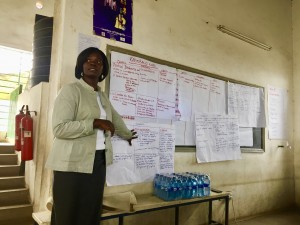
A Peace Ambassador trainee analyzes the challenges in her ward
Justice or Peace: A Dangerous Dichotomy
The focus of CPI’s training was peace, but another significant word arose from our discussions: justice. I was discouraged to find a widely-held belief that peace and justice are mutually exclusive outcomes rather than complimentary achievements. The trainees informed me that the two words had been politically charged by the campaigns. Uhuru was evoking peace on the campaign trail to signal his administration’s progress and his desire to unite the nation under his leadership. Although, there have been claims by opponents that Uhuru’s push for peaceful elections is a sugar-coated method of pacifying resistance and undermining the opposition. After all, who could vote against peace? Conversely, Raila is pulling the justice card calling for a more just Kenya and just elections, which insinuates that his loss would be a political injustice.
By pitting peace and justice against each other, the two candidates are creating a dangerous dichotomy and widening the chasms in society. The contentious peace versus justice debate, often found in the transitional justice sphere, is not conducive to Kenya’s democratic development at this time. Voters deserve peace and justice from their democracy.
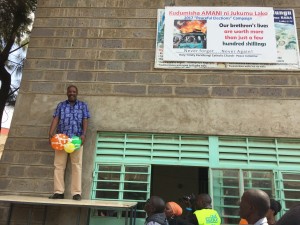
Hilary stands before a “Never Forget…Never Again” poster as he directs an egg-drop activity symbolizing the fragility of life and peace
CPI’s training engaged students in lively discussions and activities to understand the origins and nature of conflict, to differentiate conflict and violence, to analyze problems in the students’ slum wards, and to create action plans for responding to conflict before, during, and after the election. The students we addressed at University Mtaani are not your average college students. While enrolled in Mtaani’s Diploma in Civic and Development Education program, they are also community leaders and many run their own nonprofits in Huruma and Kibera slums. The students range in age from about thirty-five to sixty, as many of them never had access to higher education until Mtaani came to them in the slums. It’s no coincidence that Mtaani means “street school.” These passionate students jumped at the opportunity to enroll in a diploma program to officially study civic engagement and development—knowledge that many of them were already applying to their communities.
Mtaani students are developing skills that will enable them to return to their wards and lead local solutions to local problems. When I asked an older gentleman, a Muslim cleric by profession, why he had chosen to return to school, he told me, “You can’t transform others until you transform yourself.” This inspiring group of local leaders is in the process of educational transformation to better themselves and the future of their communities. Through our training sessions, CPI hoped to spread the message that peace and justice are possible to the very actors who would play a critical role in their communities’ responses to election results.
Peace: A Force More Powerful
I quickly learned two lessons. First, the political climate was far worse than I had gaged. My previous conversations with expatriates and middle class Kenyans had not reflected the violent realities of the specific demographic most vulnerable to post-election violence. Even my Kenyan colleagues were stunned into silence by the trainees’ tales. When I asked a woman to compare the current election temperature with that of 2007, she spat “It’s the same, actually it may be worse!”
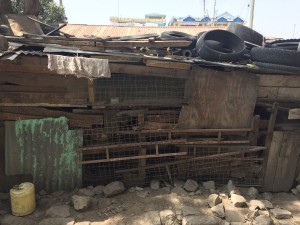
View from University Mtaani
Students gave accounts of bribes they’d been offered and death threats they’d received from various campaigns. Men told us that they’re already sending their wives and children back to their families’ villages to get them out of the slums before chaos unleashed. It seemed really early to be relocating, but they explained to me that voters wouldn’t be able to travel in the days leading up to the election. Those who are registered to vote in Nairobi would not be allowed to leave with their precious vote. Upon trying to board busses, their IDs would likely be checked by unofficial campaign members and if they represented an influential vote (if they were Kikuyu or Luo) they may be denied departure. For the trainees who were planning to stay and cast their votes, many were relocating within the slums. Why? Safety in numbers. There is already a shuffling of people among the wards so that tribes can concentrate and feel a sense of protection. One student described how gangs have formed in preparation for the violence. These accounts really concerned me in their mild—and eerie—resemblance to pre-war conditions.
The second lesson presented itself from the challenge of preaching peaceful reactions to rightfully angry voters. How do you tell the homeless and hungry man before you that he should harness his emotions through his words and not his fists? How do you convince the exhausted woman—who has brought an infant to the training and has a family of six at home that shares a bucket for a toilet because the government doesn’t provide running water—that she should remain calm and wait five years for the next election? Our students all want sustainable, definite peace, but they have yet to witness a successful means of achieving it.
“If we don’t throw stones, no one will pay attention to us,” echoes in my mind. Peaceful slums allow the world to look the other way as people die in the streets. Burning slums have at least received moments of (horrific) recognition. A student explained, “politicians use us as banks of votes, then we are forgotten.” Violence has served as a form of communication for the voiceless and forgotten. During the sessions, CPI strived to educate the trainees in nonviolent forms of communication to express their political discontent. After a video was showed on Gandhi and Dr. Martin Luther King Jr., I was amazed to discover how foreign the concept of peaceful force was to them—or at least how it wasn’t an intrinsic civic value. As always, education is the solution; the education of peace will not occur in a day of training but over the course of generations. It will take 80 strong students this election to promote peaceful responses. Their influence will empower their communities and maybe next election entire sections of slums will follow suit.
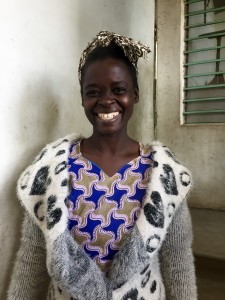
A student at Mtaani smiles after training
Wondering what you can do to bring peace to Kenya? Please click below to contribute to our work with pastoralists through Global Giving!

-
Teach Your Children Well: CPI Kenya Brings Peace to Samburu County
199 CommentsThe Peace That Came with Friendship
I’ve just returned from my first trip to the field with Children Peace Initiative Kenya. My goal was clear: travel to Samburu and Pokot villages outside Maralal, meet and interview beneficiaries, and come to understand the effect CPI has had on these communities over the last five years. The tale of peacebuilding between the Samburus and the Pokots in western Samburu county serves as CPI’s model of success. Before CPI’s peacebuilding intervention, the region was destabilized by perennial violence between two pastoralist tribes who perceived each other as deadly enemies more akin to animals than human beings.
Frequent raids were carried out to steal livestock and many brothers, fathers, mothers, and daughters were killed in the enduring conflict. School teacher Evelyn Mung’a described the period before CPI arrived in the community: “It was so bad. In fact one time—I remember the incident because it was so harsh—around 5 in the morning, I was hearing gunshots and I came out of my house. There was a Pokot homestead surrounded by Samburus. They killed 10 people including children. An injured 2 year-old came to our school and later died. It was so painful, that day still wrings my mind.”
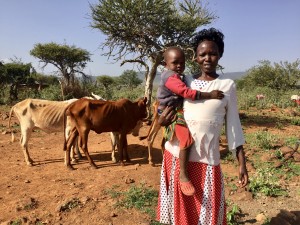
Evelyn Mung’a, Deputy Director at Plesian Primary School, received a “Heifer for Peace” from CPI. She pointed to the hill behind her to show me where the Samburu warriors used to attack from.
The fear and suspicion that pitted Samburus and Pokots against each other often led to offensive attacks based on a kill-or-be-killed assumption. In constant preparation for warriors’ raids, families slept under their beds to avoid bullets. Children dreamed with their shoes still fastened so they could run for the bush’s cover when the strikes came. Mothers woke every morning clutching their children and thanking God that they had made it through another night. Several years after CPI’s first peace camp in 2012, Samburus and Pokots now sleep soundly, barefoot, on top of their beds.
Teach Your Children Well
How is it possible that CPI’s small team sowed peace into the rocky, bloodstained soil of Samburu county? I quickly learned that the extent of their outreach was possible through their strategy of empowering children as peacebuilders. Even in the midst of a drought, the harvest of peace is abundant when the seeds are many. By investing in education that roots children in convictions of tolerance and peace, CPI has developed a long-term strategy to eradicate conflict in the future.
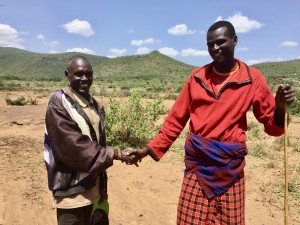
Joseph Lomna has learned much from his son, Francis Changulu. Francis attended a Peace Camp and his family received a heifer to share with their Samburu friends.
In congruence with CPI’s child-up approach, Crosby, Stills, Nash, and Young sing, “Teach your children well, their father’s hell did slowly go by.” While children can be taught, it’s far more difficult to assuage ethno-tribal hatred and misunderstanding in adults who have suffered the costs of conflict. The song continues, “You of tender years can’t know the fears that your elders grew by. And so please help them with your youth, they seek the truth before they can die. Teach your parents well.” Parents themselves may not be able to “unsee” the losses of war, but they can learn from the innocent eyes and open hearts of their children. Children are thus the entry point into transforming communities scarred by ethno-tribal tensions. If war begins in the minds of men, let us mold those minds as children before they are hardened by bias, fear, and tribal identity. CPI’s model recognizes these truths and engages children in peacebuilding roles.
I embarked on the journey under the assumption that children’s discovery of friendship and humanity in each other would have a ripple effect, first reaching a ring of parents before spreading to wider rings within the villages. I prepared a mental checklist with indicators I expected to evaluate CPI’s impact. Friendships developed between Samburu and Pokot children? Check. Families of opposing tribes brought together through their children’s friendships? Check. Decreased animosity and altered attitudes towards the other tribe? Check, check.
Unexpected Peace Dividends
What I found in the villages outside Maralal was a far greater web of community impact than CPI could have ever anticipated. The ripples had spread from children to affect all aspects of life for Samburus and Pokots: parents, elders, herders, warriors, farmers, traders, teachers, and police included. CPI’s peacebuilding model extends beyond children’s relationships to provide a series of economic peace dividends for direct and indirect beneficiaries. The Heifers for Peace program is an example of how mutual self-interest can instigate economic incentives for interethnic peace. “The trust came because of peace. CPI connected us through the children and they also brought the heifers, which has become a strong connection between us,” said George Lomina, who received a cow to be shared with his Pokot friend, Christine Chepteiya.
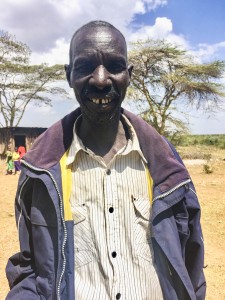
George Lomina smiles while telling me about the extra income he is able to make from the heifer he shares with his Pokot friend, Christine.
Heifers for Peace pairs Samburu and Pokot families and donates one heifer, capable of producing 5-6 calves, for the families to care for together. In George’s case, the cow is kept in Longewan, which is far more fertile than Christine’s drought-stricken village of Amaiya. Based purely on trust and self-interest in the cow’s well-being, Christine patiently awaits the birth of the calf that will belong to her one day. Pastoralists’ livelihood and culture depends entirely on livestock and the contribution of a cow can significantly change one’s income. George used to have nine cows, but five have died during the drought. For George, receiving a heifer from CPI means the potential to increase his herd and the ability to make an additional 200 shillings a week by selling milk in the market.
According to Samuel, “Heifers for Peace was the most joyful thing that happened and it strengthened the friendships. You don’t want your cow on the other side to be stolen and your friend to be killed. Now the two communities protect each other.” By creating economic interdependence between Samburus and Pokots, CPI has instilled self-interest in peacebuilding, which is key to sustainability. This peace is further sustained by the newly adapted role of elders and warriors.
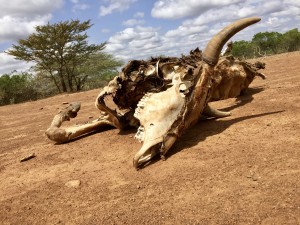
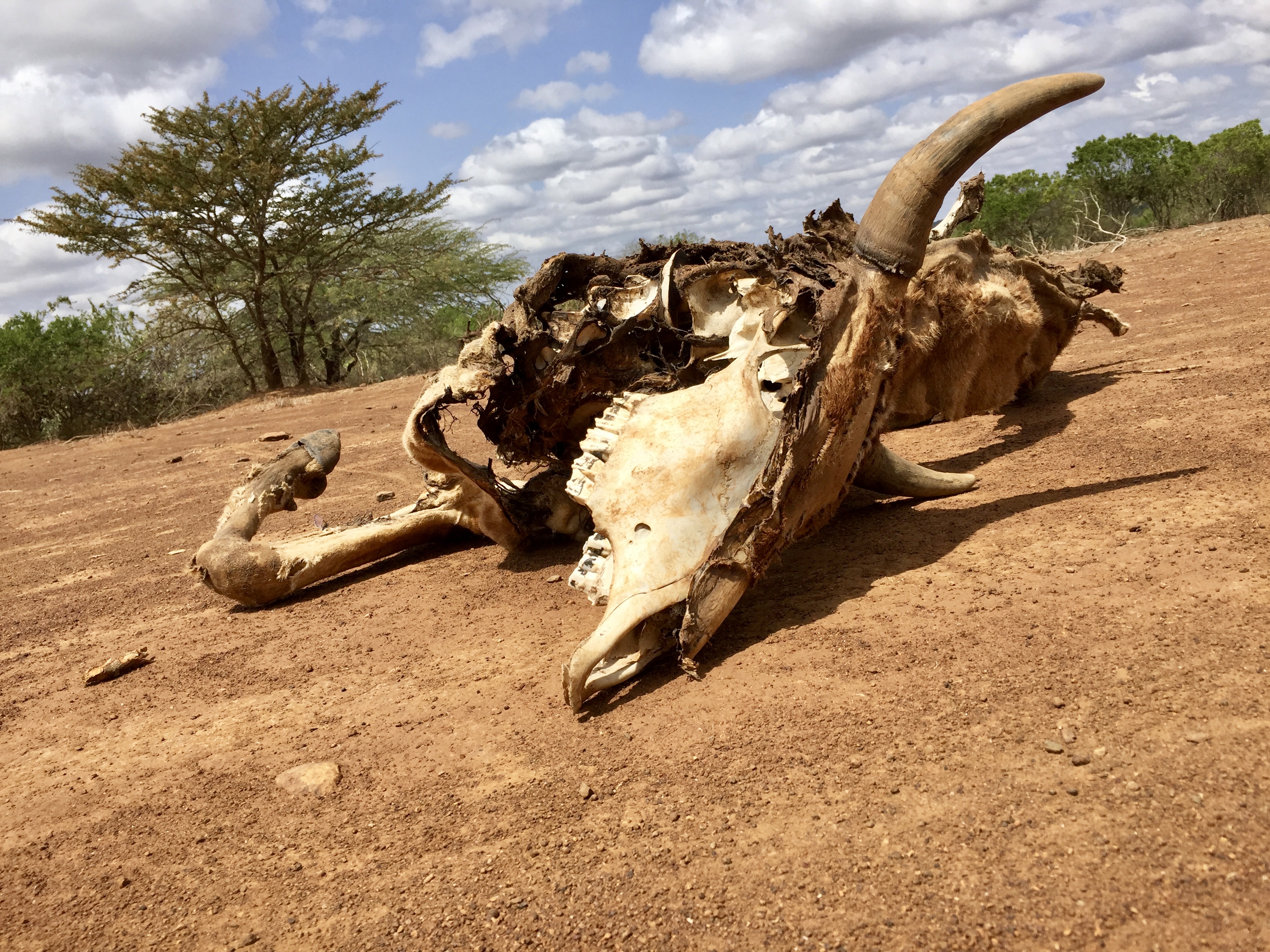
Drought in Samburu County has put tremendous pressure on pastoralists. Despite the decrease in many families’ herds, peace has endured due to CPI’s peacebuilding programs.
The Elders’ Change of Heart
Once Samburu families developed bonds with Pokot families through their children, the elders—many of whom were parents and CPI beneficiaries— no longer sanctioned raids. “During the conflict, the elders had the power to bless the warriors to go to war and they had power to stop them from going to war. When friendships between families came, the elders conferred with the warriors and told them ‘Our children are going there to play. Now that we are friends, we have a reason to stop fighting,’” explained Samuel Lemiranit, a Samburu elder in Longewan.
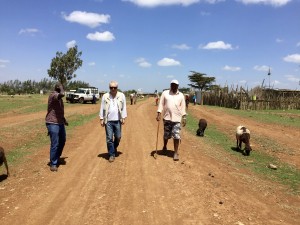
Samburu elder Samuel Lemiranit walks with AP Director Iain Guest through the town of Longewan, which has enjoyed peace for the last five years of CPI’s presence.
Elders now condemn warriors from cattle rustling and actively engage in promoting peace with Pokots. Samuel told me, “The elders play a key role in facilitating war and peace. These friendships have made us more active. We told the warriors ‘no, let us stop fighting now.’” Due to burgeoning friendships between families and increased exposure to Pokots, the Samburu elders have adopted new roles of maintaining law and order between the two communities.
From Rustling Cows to Returning Them
Just as elders have altered their behavior, warriors have transitioned from a wartime role of cattle rustling and raiding to a peacetime role of law enforcement. CPI Director Hilary Halkano Bukuno explained that “warriors are trying to stop thieves from destroying the peace between Pokots and Samburus.” In the absence of violence, warriors are taking on the honorable duty of voluntarily returning stolen or stray livestock. “There were camels that were stolen from Pokots. The bandits came here to try to sell the camels, and we purchased them to return them to the other side. There’s now a close relationship between Samburu warriors and Pokot warriors,” Samuel recounted of a recent event.
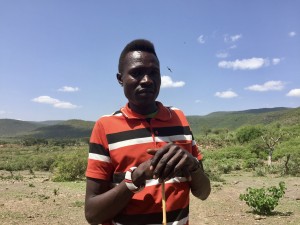
Kanye Kera was a Pokot warrior who raided Samburu villages before his son attended a CPI Peace Camp. Now he dedicates his time to returning stolen livestock.
Kanye Kera is a prime example of a reformed Pokot warrior. Following his son’s involvement in CPI’s programs, he admitted, “Now we are like brothers with the Samburus. Grazing together has bonded us, but there are Pokots from the bush who are not happy about our friendship and bonding with the Samburus.” As Pokots outside of CPI’s targeted communities continue stealing livestock from the Samburus of Longewan, Kanye and fellow CPI beneficiaries have responded by defending their new friends and returning the animals. Kanye described staging an ambush against Pokot perpetrators to retake a herd of stolen Samburu cows. His noble action was met with accusations of betrayal by fellow Pokots. “Now you are not our brother. You are not Pokot. You are Samburu now,” the bandits told Kanye.
A Society Transformed
Samburu and Pokot villages outside Maralal have witnessed unprecedented changes in the wake of CPI’s interventions. Elders now denounce raids against their friends from the other tribe. Warriors have abandoned their previous roles to protect the livestock of the other tribe. Markets have emerged to allow Samburu and Pokot traders to profit from each other and benefit from comparative advantage in goods. Schools and health centers now serve both populations. Under the pressures of climate change and drought, the two tribes share distributed food aid and limited grazing space. Pokots even hike up the rocky slope to Longewan daily to farm the Samburu lands. “During the seven years of conflict, we never planted anything because you never knew if you would live to see the next year. Now we are farmers,” stated Samuel, who hires Pokots to work on his farm and allows them to store their tools in his shed overnight.
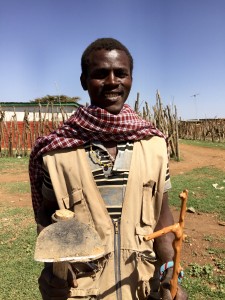
Moses Lemeria, a Samburu farmer, makes 400 shillings ($4) a week farming alongside his Pokot friends.
To witness the interdependence of these two communities today truly challenges the imagination. Was it only a few years ago that these tribes were blindly killing each other? How did they come to rely on each other and nurture friendships across tribal lines? A Longewan elder referenced the bigger picture beyond friendship, claiming “It’s all about the peace that came with the friendships.” This remarkable transformation began with CPI’s idea to teach children—who in turn taught their parents and villages.
Wondering what you can do to bring peace to Kenya? Please click below to contribute to our work with pastoralists through Global Giving!
-
Reflecting on…Food
116 CommentsYou’re probably thinking, “This crazy Muslim girl is so hungry during Ramadan that she is spending her time before the sun sets obsessing about food.” You would be correct in assuming this, but I promise this blog has a point, whereas torturing myself with Tasty Japan videos did not.
Bainna khibez wa milih– bread and salt between us. In Middle Eastern culture, this phrase can symbolize the beginning of a friendship or a mutual trust formed over the sharing of a meal.
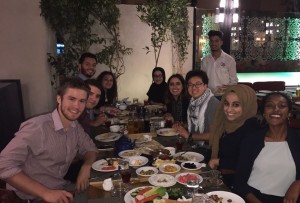
Bread and salt between new friends in Jordan.
In western culture, particularly in the US, it is hard to imagine how important this type of symbolism can be. Often, our breakfasts are stuffed in our mouths on the commute, lunches skipped to continue working, and dinners for one heated up in the microwave. I say this because I am guilty of all those things. Despite my American eating habits, I cannot get this Arabic phrase out of my head. To sit down around a table with someone, knowing full well you must stay there for a whole meal does take a level of respect and understanding. As others have noted before me, it’s only natural for us to use food to heal and bring different people together.
I cannot remember a time when I felt that people with differing opinions were more publicly at odds than right now. I am a huge supporter of healthy and productive debate (see: my Facebook), but it is exhausting to constantly be on the offensive about your beliefs. This has been especially true recently. I don’t know if it’s because I am in a Muslim-majority country, am working with refugees, or am just unlucky, but I feel like I’ve been having a lot of Islam related internet quarrels lately. I am frankly tired of it; my well-thought out Facebook comments, chalk full of quotes from the Quran and citations from the Bible, aren’t convincing anyone that Muslims aren’t crazy extremists hell bent on western extinction. But, I have an idea of what might-one taste of my mom’s or grandma’s cooking (complete with some forced binge eating because you might think you’re full but you’re not until they say you are).
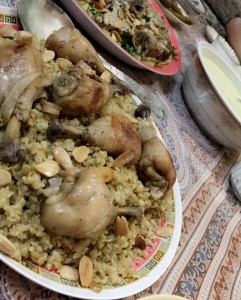
Lucked out with the homemade iftar AGAIN.
It is hard to argue over good food. Even heated political discussions seem more civilized and respectful when you are sharing a meal. And I’m not the only one who thinks this way. The WFP says food is literally a type of diplomacy. If you couldn’t tell, I am so on board with eating with my political and ideological rivals instead of FB comment spamming each other. I can’t wait to combine my passion for food and conflict resolution into The Sultan Center on Culinary Diplomacy, but more on that later.
But seriously, food is a common denominator in all cultures. Everybody’s gotta eat. Sharing precious meal time with others is a gift and it’s one that we should give more often. More people of differing political parties, religions, races, and nationalities should have bread and salt between them. I am not arguing that one bowl of foul and the Houthis and Yemeni government forces will end their conflict, but humanizing an enemy makes it harder to kill them. Gridlock might not be eradicated from Congress forever over a potluck, but it might make asking the other side for compromise a bit easier. Who knows? Maybe the next big break in the Israeli-Palestinian conflict will come over a big bowl of hummus. I wouldn’t be that surprised.
Now that I’ve shared my feelings on culinary diplomacy, I’ll move on to obsessing over what I’m going to cook for iftar.
-
Idem u Tuzlu
2 CommentsArriving on the East Coast at the end of May, I was excited to be embarking upon my journey for the summer. However, excited is a vast understatement. I am thrilled to be returning to the Balkans and yet I am anxious and nervous to see what this new opportunity will bring me in terms of education, emotions, and experience. As a student for the past 18 years, I now wrestle with the ever-approach reality of “growing up” and becoming an “adult” as I enter the last year of my graduate studies at the Monterey Institute of International Studies. This is my first practical step toward a meaningful and passionate career in conflict resolution and with the Balkans.
After having studied abroad in Croatia, Serbia, and Bosnia-Herzegovina in 2008 during my undergraduate career, I found myself drawn to this region both academically and personally. This summer brings an opportunity to work with remarkable women in Tuzla, Bosnia-Herzegovina at BOSFAM as they continue to strive to reconcile the horrors of the past and the trauma of the war in the 1990s with the present and the future. Many of these women lost brothers, fathers, sons, uncles, and many members of their families in the brutal massacre outside of Srebrenica. They weave carpets and make quilts in order to tell their stories and be heard. Dealing with the past is an issue many from war-torn countries face and struggle to overcome. It is difficult for me, as a student of conflict resolution, to try to put myself in these shoes and be empathetic to their past, however, it is a critical step to delving deeper into the lives of others.
The further and deeper I get into my studies, the more overwhelmed and interested I become. How can I be accepted when I come from such a different past and can be so easily seen as an outsider? How can I understand these women and what they have gone through? How can I even help? My questions continue to grow and multiply and my answers only lead to more and more questions. But yet, somehow, I am fine with this (thankfully so, since I have a feeling this will be the first of many times I wrangle with my questions and hesitations). I walk into my training and fellowship with an open and energetic mind, willing and accepting of the experiences and people that await me.
-
The CMC: Justice and Peace in rural Congo
243 Comments
Members of the Luvungi CMC
As many refugees stream back to their home territories in Congo since the (tentative) end of major hostilities, there is a great need for legal structures that will help returning families re-integrate and repatriate. Since the judicial system is slow and overburdened, it is very difficult for repatriating refugees and internally displaced persons (IDPs) to find legal assistance.
Thus, in order to combat these problems facing marginalized peoples in the rural milieu, Arche d’Alliance has created Comités de Médiation et Conciliation, or CMCs, in 24 different towns across the territories of Uvira and Fizi. The CMC, a committee of ten, consists of local municipal leaders, representatives from women’s groups, a representative from the FARDC, a representative from the police, and other notable community and tribal leaders. The CMC functions as an alternative resolution center for minor disputes involving property, harvests, debts, inheritances, and domestic quarrels. An individual can bring their grievance to the CMC, which then investigates the matter from both sides and renders a non-binding, reasoned decision that it asks both parties to follow. If one or both of the parties refuses to follow the decision, the CMC will pass the case off to Arche d’Alliance to be heard in court in Uvira. An important aspect of a CMC’s decision is that it follows the letter of the law, since Arche d’Alliance trains the CMC on Congolese law and the rights guaranteed marginalized peoples (such as repatriating refugees and women) by the Congolese Constitution.
In addition, the CMC acts as an information distribution center; the CMC will help provide citizens of the community with information on public health, security, the constitution, and, if they are refugees, how they can go about reclaiming their land and reintegrate.
This past week I had the opportunity to visit the CMC in Luvungi, a small town about 40 minutes drive from Uvira, near the border with Rwanda. I was visiting with Jean Mushaho and Martin Masumbuko, two Arche inqueteurs who make weekly visits to Luvungi. The CMC in Luvungi is managed by Givernal Twaibu, a locally-based Arche d’Alliance inqueteur. Givernal and the Luvungi CMC explained to me that they have heard 80 cases since the beginning of the year. They also told me that nine times out of ten parties agree to the decision of the CMC; people in Congo are not opposed to well-reasoned conflict resolution, it is just that structures that facilitate such resolutions have long been absent.
Since the CMC is required to have several woman representatives, there is balance and justice for women.
“Respecting women’s rights is very important,” said Luvungi CMC member Nestorine Seremba, a nurse at a local dispensaire, “In Congo, the woman is the center of the family.”
One crucial service that Arche provides to returning refugees is assisting them in obtaining birth certificates for their children that were born abroad, in refugee camps in Tanzania, Burundi, and Zambia. Acquiring proper documentation is necessary if repatriating refugees want to send their children to school or make sure their children inherit their property someday. Using the CMC as a local base, Arche helps refugees gain birth certificates for their children. Arche will visit a CMC once a week, collect the necessary information, file for the documents in Uvira, and then bring them to the CMC once they are completed.

A repatriating refugee (left) signs for documents for his children
The day I was in Luvungi, a group of villagers from Katubota, a small village 10 km away, came to collect birth certificates for their children. Jean Mashaho explained to me that it would be very difficult for these villagers to get birth certificates without assistance from Arche. Normally, obtaining a birth certificate would require a trip to Uvira, filling out lots of forms, paying lots of fees, and waiting around for the notoriously slow Congolese bureaucracy.

Birth certificates for children born in refugee camps
In something as small and simple as helping refugees get documents for their children, Arche is helping re-weave civil society in Eastern Congo. This goes a long way in preventing conflict in the long run.
The CMC in Luvungi has been around since 2006, and its services attract people from villages as far as 30 km away. In creating CMCs across South Kivu, Arche d’Alliance has laid down the foundations for justice and peaceful conflict transformation in a region that is desperately trying to escape chaos. Even though Eastern Congo can sometimes feel like the Wild Wild West, the CMC is like the Lone Ranger, an example of justice and peace that everyone can follow and admire.

Secretary and one of the woman representatives of the Luvungi CMC