
Tag Archive: Embroidery Cooperative
-
A Final Video
Leave a CommentOn my first day in Nepal, I met with Prabal to learn more about the armed conflict, the transitional justice process, and NEFAD’s work. Once I learned more about NEFAD, its current initiatives, and future goals, Prabal and I discussed the ways in which I could be most supportive to NEFAD this summer. He explained that it would be helpful if we could supplement the research, articles, and photo content on the NEFAD website with a video about the conflict, transitional justice, and NEFAD’s work supporting victim families.
Prior to our first trip to Bardiya, we got to work outlining our goals for the video and our content ideas. We wanted to develop a short video that informs viewers who are unaware of the war or of NEFAD about the armed conflict, enforced disappearance, and transitional justice in Nepal. We also wanted to highlight stories of families of the disappeared and NEFAD’s work advocating for them in the transitional justice process. Finally, we wanted to showcase the importance of the embroidery cooperative and encourage people to donate to help grow it into a sustainable business.
To showcase stories of victim families, we decided to interview a few family members of the disappeared in Bardiya. I generated a list of questions which Prabal translated into Nepali. Once we got to Bardiya, we interviewed Sarita, Radhe Krishna Tharu, Belmati Tharu, Kushma Chaudhari, and Sharada Tharu. After returning from Bardiya, we began the translation process.
After listening to the videos, Prabal shared direct translations of what the family members were saying, but it didn’t always translate well into English phrases. When this happened, we would discuss what each person was communicating. Then I rephrased the translations to capture what they were saying as accurately as possible while still making sense in English.
Once translations were complete, we got to work selecting the most poignant clips that conveyed the all the information we wanted share with viewers. After spending hours viewing video tutorials on Adobe Premiere Pro’s website, I created a first draft of the video. We decided to cut a few clips so the film was as concise as possible.
After a lot more editing, we began one of the most challenging parts – subtitles. Although I had entered the captions in English, it was often challenging to figure out when one line began and one line ended since I don’t know Nepali. Prabal and I carefully went through each clip to adjust the timing for each caption and aligned it with what the speaker was saying in each video clip. Finally, we decided to add a few images of the embroidery and the bags to tie all the clips together into a cohesive video. After even more editing, I am excited to share the result, which you can view below!
-
Kushma Chaudhari
1 CommentDuring our first trip to Bardiya, Prabal, Sarita, and I visited the Bardiya National Park to see if the gift shop would sell the embroidery cooperative’s tiger bags. After going to the park, we took a short rickshaw ride to Kushma Chaudhari’s house. Kushma is one of the most talented artists in the embroidery cooperative.
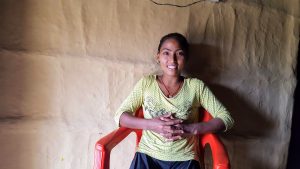
Kushma Chaudhari
Kushma was working in the field, so we waited until she returned. In the meantime, we had some samosas and chai from her family’s shop next to their house. Her house is next to a school, so we watched as children visited the shop to purchase a quick treat before school started.
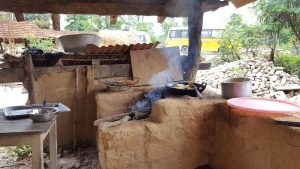
Kushma’s family makes samosas here for their shop.
When Kushma arrived, we went into her house. Sarita chatted with Kushma for a few minutes, introduced me, and then explained that we were making a short video about NEFAD’s work and the embroidery cooperative. Kushma agreed to answer some questions for the video, so I started asking questions in English. Prabal and Sarita translated.
Kushma was soft spoken at first but eventually became more comfortable. Kushma begins her day by milking cows after which she starts the housework. During cropping season, she goes to the farm after the housework is complete. When she has time, she also helps out at the family’s shop.
She was very young when her father was disappeared. Although her memories of the conflict are not vivid, she was reminded of her father’s absence when she was in school and everyone else had their father. When she was short of stationary, pens, and notebooks, she used to think about him a lot. She explains that if he were alive, he would have bought them for her. Kushma doesn’t think her father will return.
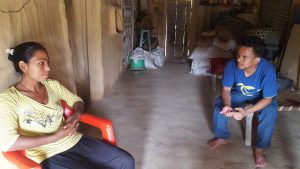
Kushma and Prabal talking
Kushma enjoys working with the embroidery cooperative. She makes embroidery squares at night after the day’s work is complete. She expresses that she would like to work on the embroidery on a regular basis.
After we finished asking questions, Kushma continued to talk with Sarita and Prabal in Nepali, so I took some photos and then sat down to see of I could grasp a few words. After a little while, Prabal explained that they were talking about how Sarita and Kushma would love to open their own store near the park to sell their bags and other handicrafts. Rent is only about 2000 rupees a month, a cost which could be covered by the sale of 1 -2 bags once production increases. I was incredibly excited to hear about this goal for the cooperative, and I hope it becomes a reality. To support Kushma and the other women of the Bardiya Conflict Victims Cooperative in working towards their goal, please visit and share the Global Giving page to raise money for embroidery supplies.
-
Belmati Tharu
1 CommentFor my next blog posts, I will be highlighting two women in the Bardiya Conflict Victims Embroidery Cooperative who kindly agreed to share their stories with me. During our first trip to Bardiya, Sarita, Prabal, and I took a rickshaw to Belmati Tharu’s house in Basgadi. When we arrived, Belmati and her family were going about their daily housework. Prabal, Sarita, Belmati, and I sat outside on straw stools. Next to us was a piece of cloth with hundreds of kernels of corn. She and Sarita talked for a few minutes, and then Sarita explained that we wanted to ask her some questions for a video about NEFAD’s work.
Belmati maintained a sad look on her face through the entirety of our conversation, so I asked Prabal multiple times if it was acceptable for us to interview her. He and Sarita reassured me that it was and added that Belmati is generally a very somber person. Hesitantly, I asked my first question, and Prabal and Sarita translated.
Belmati explained that she lives with her two sons, two daughter-in-laws, and three grandchildren. In the morning, she cleans the house and takes care of her grandchildren, so her daughter-in-laws can go to the field for agricultural work. Belmati’s third son was forcibly disappeared in March 2001. In July 2001, her daughter-in-law was also disappeared. In September, her eldest daughter-in-law was disappeared.
She spoke specifically about her son’s disappearance. She explained that he had a problem in his stomach and that it was difficult to afford heath care. They didn’t have an economic cushion to address hardship. She explained that the people from the Maoist party came to him and asked him for some help. He helped them with the expectation that he would receive treatment for his stomach. While he was on his way to a follow-up medical checkup, he was arrested from Kohalpur Chauraha. It’s still difficult for Belmati when she remembers them. She mentioned that her home and her family would be happier if they were alive.
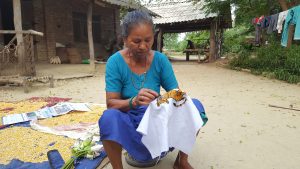
Belmati showing us her tiger square
After she explained the disappearances, I asked about her participation in the embroidery cooperative. Belmati explained that it’s nice to be with other people who have had similar experiences of the conflict. She told us that she enjoys doing the embroidery, but it’s increasingly challenging due to her age. She expresses that if they could regularly work on the embroidery, it would be a better way to make money, at least to purchase some groceries.
Despite the embroidery being a challenge for her, she is working on a tiger square. After discussing the embroidery cooperative, Belmati went into her house to get the square she is working on. She and Sarita discussed the areas for improvement. She’s currently fixing the square, which will be made into a tiger bag once it’s complete.
To support women like Belmati in continuing the embroidery work, please visit and share our Global Giving page where we are raising money for embroidery supplies.
-
It’s All in the Details
4 CommentsSarita came to Kathmandu a few weeks ago, so we went fabric shopping for the tiger bags. Before that we had check some guide from Vendel Miniatures. After discussing what kinds of bags would sell in Nepal with Sarita and Prabal and reflecting on the kinds of bags that would sell in the US, we decided to look for fabric in a variety of colors with some texture or a simple pattern. We initially purchased an emerald green and a deep brown. However, we quickly found ourselves out of luck after our first purchase as we visited many shops without finding fabric we liked. We decided that Sarita would go to Nepalgunj, a city two hours east of Bardiya, to find better quality fabric in the colors and patterns we were looking for.
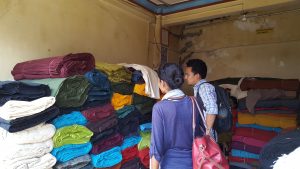
Fabric shopping with Sarita and Prabal in Kathmandu
On Tuesday, Prabal and I traveled to Bardiya. Prior to arriving in Bardiya, I created a flyer and updated tags explaining the cooperative and the bags. In addition to the physical production of the bags, marketing is integral to sales which is the primary focus at this stage in the development of the cooperative. After printing and laminating everything, we attached the tags to the finished tiger bags.
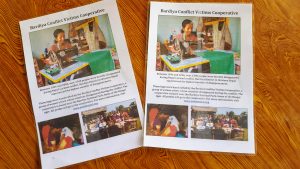
Flyers explaining the cooperative and bags
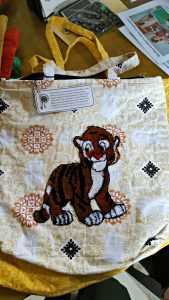
Tiger bag with updated tag
On Thursday, we brought some of the most recent bags to the tourist lodge that currently has the first iteration of the bags. The owner of that lodge had agreed to sell the bags without taking any profits. Unfortunately, his lodge doesn’t have any place to display the bags, so he suggested we come back with a small display case to show the bags and protect them from the dust. Sarita and Prabal will find a small, inexpensive cabinet to bring to the lodge. On our way out, we collected the first iteration of the bags so Sarita could repair and improve them. After seeing them for the first time, I was amazed by how much the women’s embroidery skills have improved.
Following the lodge, we went to Bardiya National Park where we spoke with the manager of the main office and gift shop. He was very excited about selling the bags as they are a unique, local, handmade product. He said they would sell the first batch of bags during the upcoming tourist season without taking a profit. If they sell, the park will buy bags from the co-op moving forward and sell them for a small profit that is agreed upon by both parties. He recommended Sarita embroider the words “Bardiya National Park, Nepal” on the next batch of bags for the park. We left six bags with the National Park and a poster, which they will display in their shop. Sarita, Prabal, and I were very excited about this positive step forward!
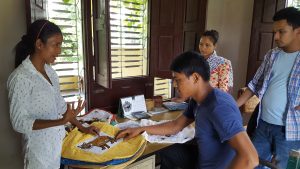
Sarita explaining the cooperative and the bags in the Bardiya National park gift shop
After returning from the National Park, I created a google spreadsheet with a picture of each bag to track important information including which vendor each bag is distributed to, when each bag is sold, how much they are sold for, etc. In the next week, Sarita will produce 7 more bags with the remaining tiger squares. She will be bringing those bags when she comes to Kathmandu next week, so I can take some bags with me to sell in the US. While it’s not a sustainable long term strategy to sell bags in the US due to logistical challenges and transport costs, I’m aiming to sell a few to infuse the cooperative with some cash as it aims to increase its production for the upcoming tourist season.
As I mentioned in my first blog post about the cooperative, after selling the tiger bags this year, the women want to rent a space to open their own shop near the Bardiya National Park. To support the women in growing their cooperative into a sustainable business, please consider donating at our Global Giving Page. By next year, we aim for the cooperative to be entirely self-sufficient!


