Tag Archive: KAMPALA
-
WASH at Kulu Opal: Celebrations and the Handover Ceremony!
1 CommentThe last few weeks have been filled with celebrations and final touches to the toilets. During one of our last visits to Kulu Opal, we were treated to Music, Dance, and Drama (or “MDD”) performances by the students. Kulu Opal was hosting the sub-district competition, so we saw a few different schools perform. We later learned that Kulu Opal scored the highest in their sub-district!
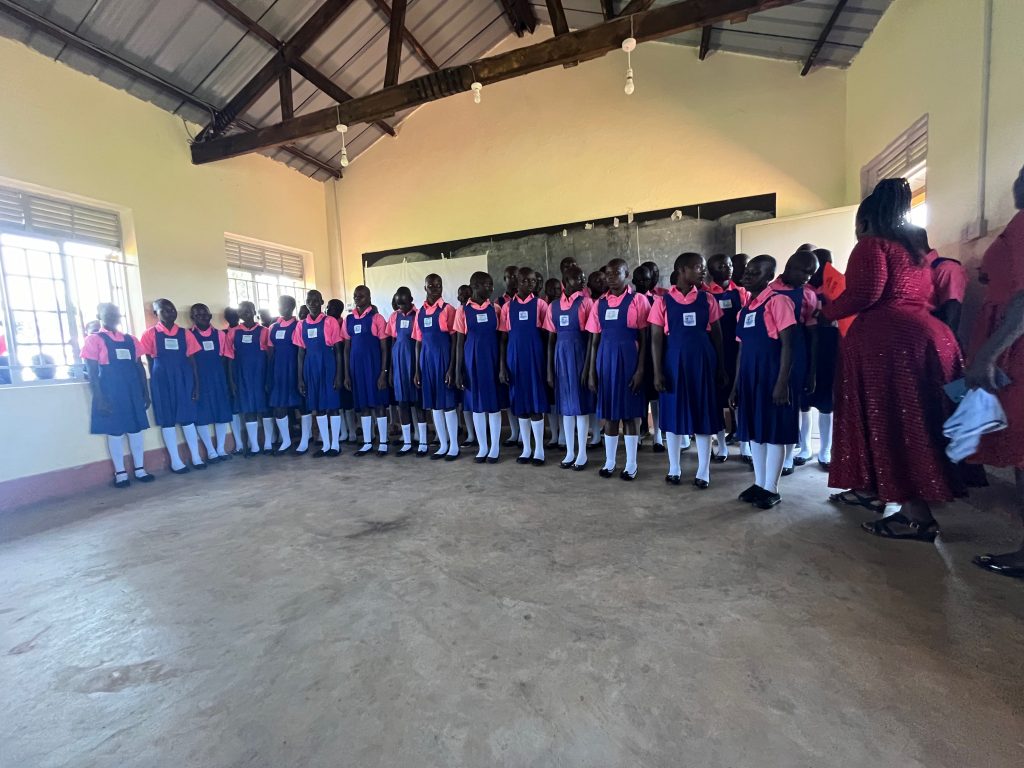
The students of Kulu Opal Primary School at the MDD competition.
And finally, the toilet was complete and we had the handover ceremony. The ceremony was attended by the GDPU team and Board; Kulu Opal teachers, parents, PTA, and SMC; Gulu District officials; and the local tribal chief.
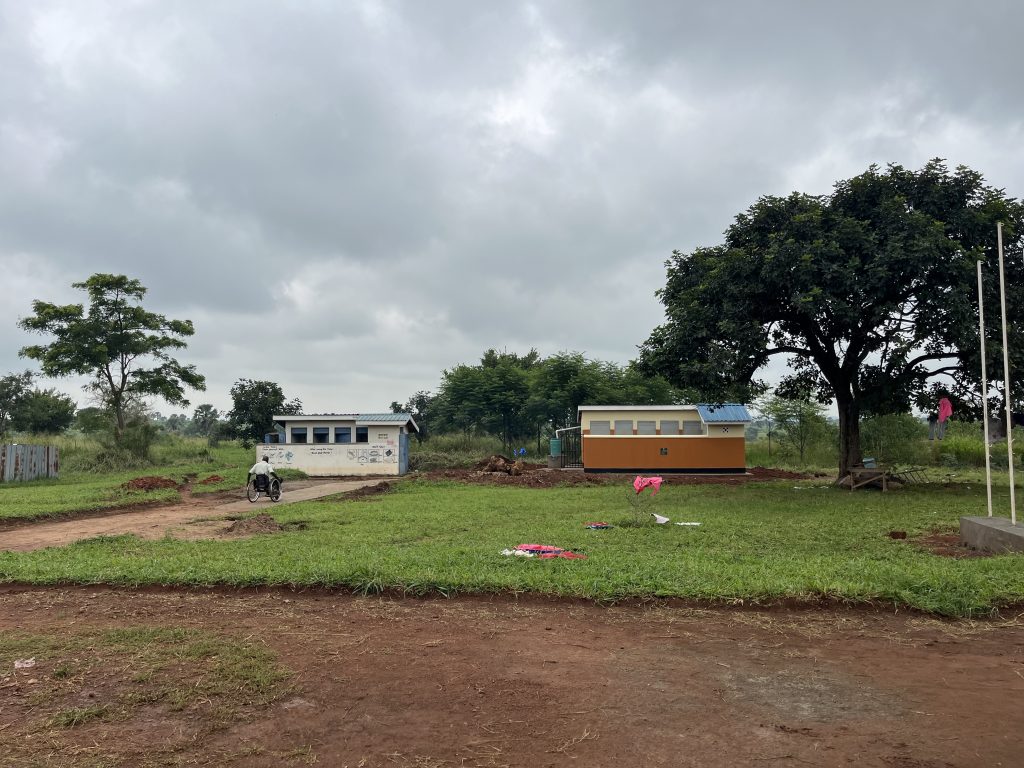
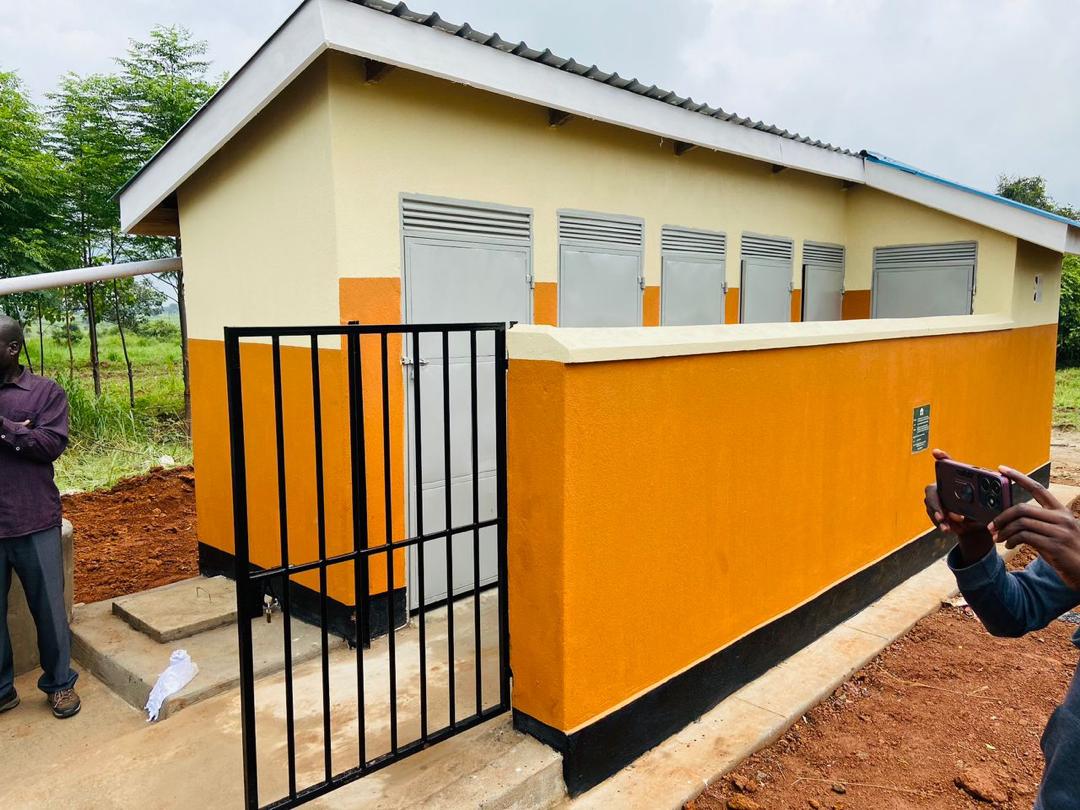
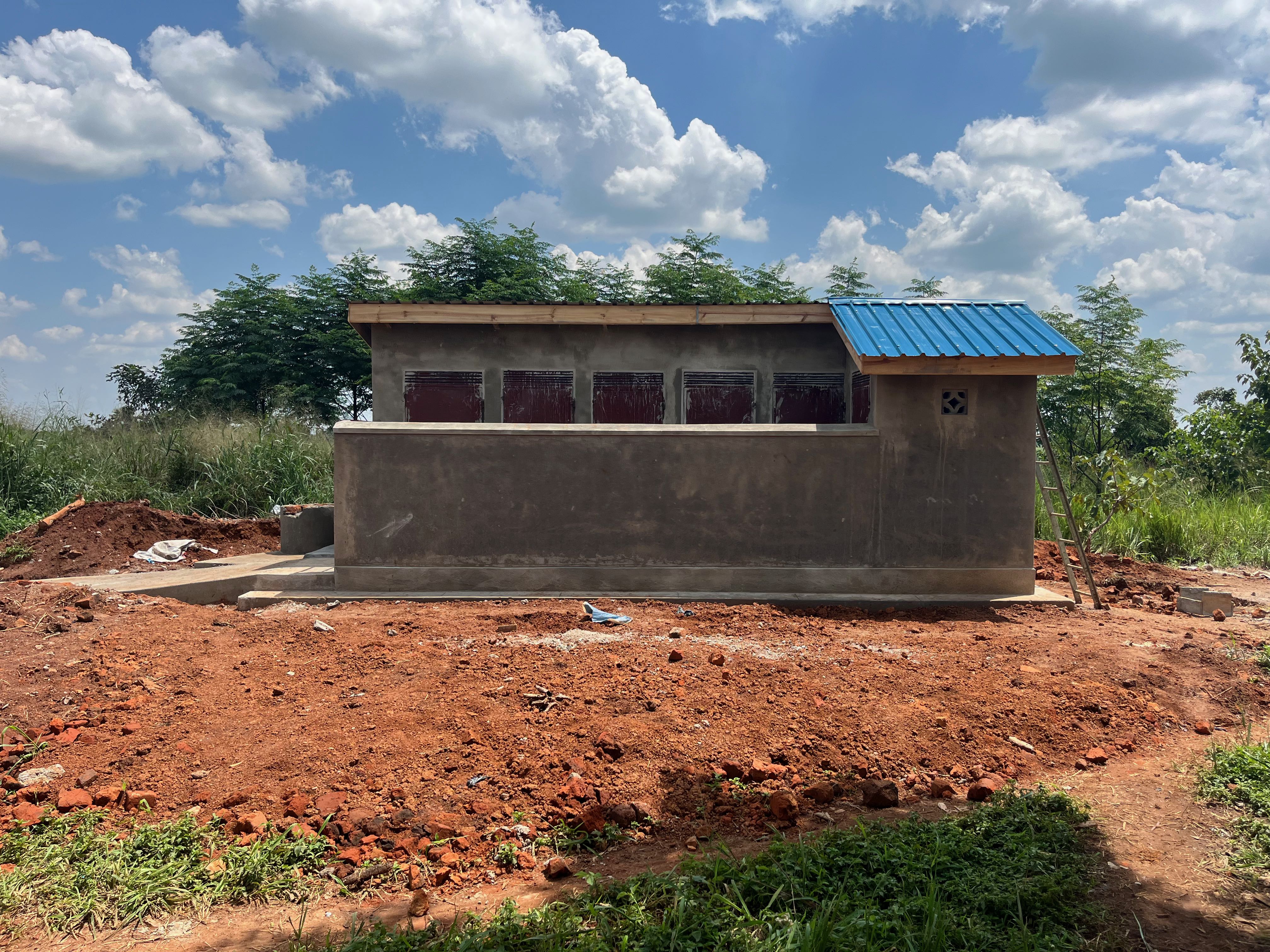
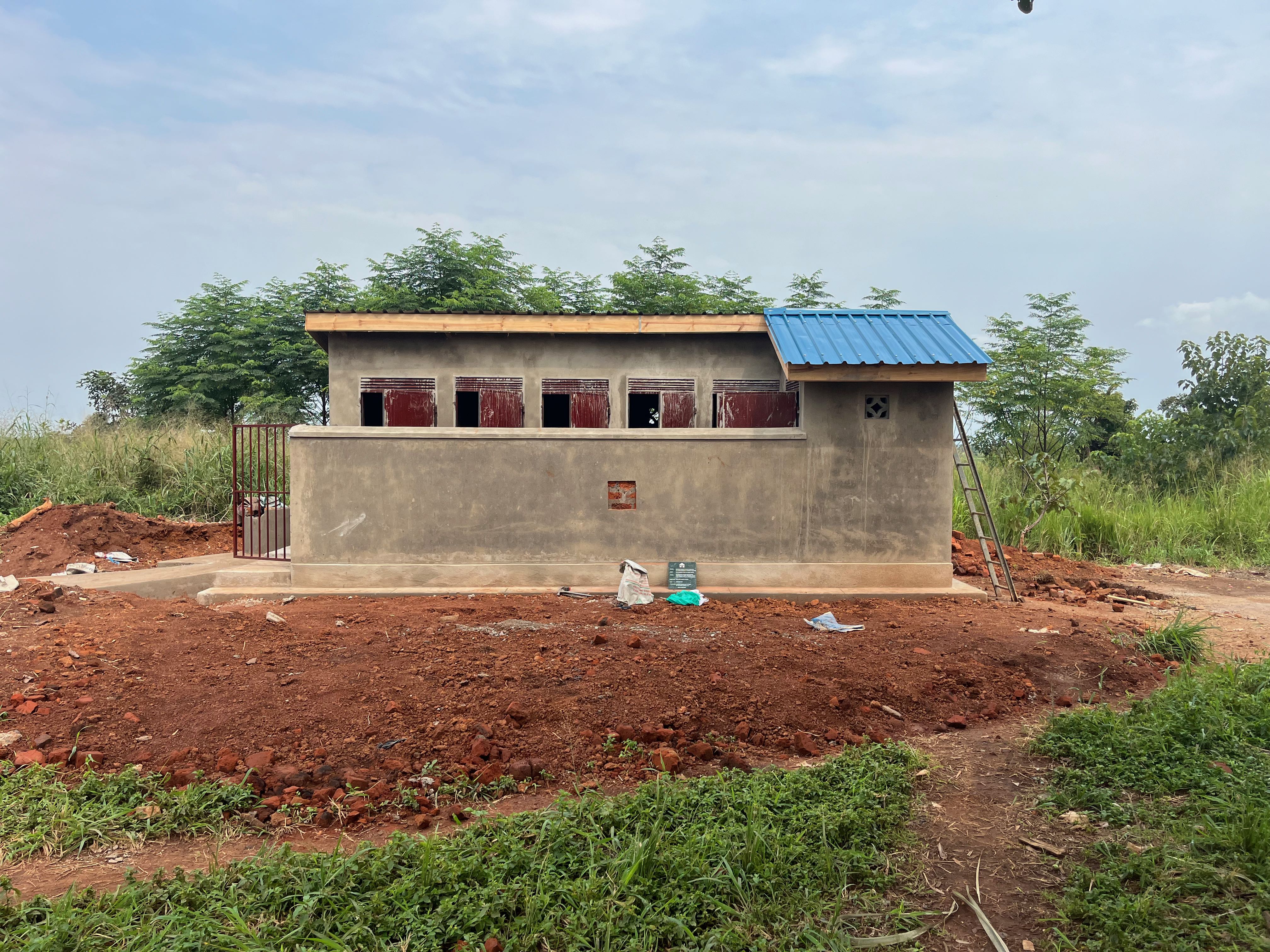
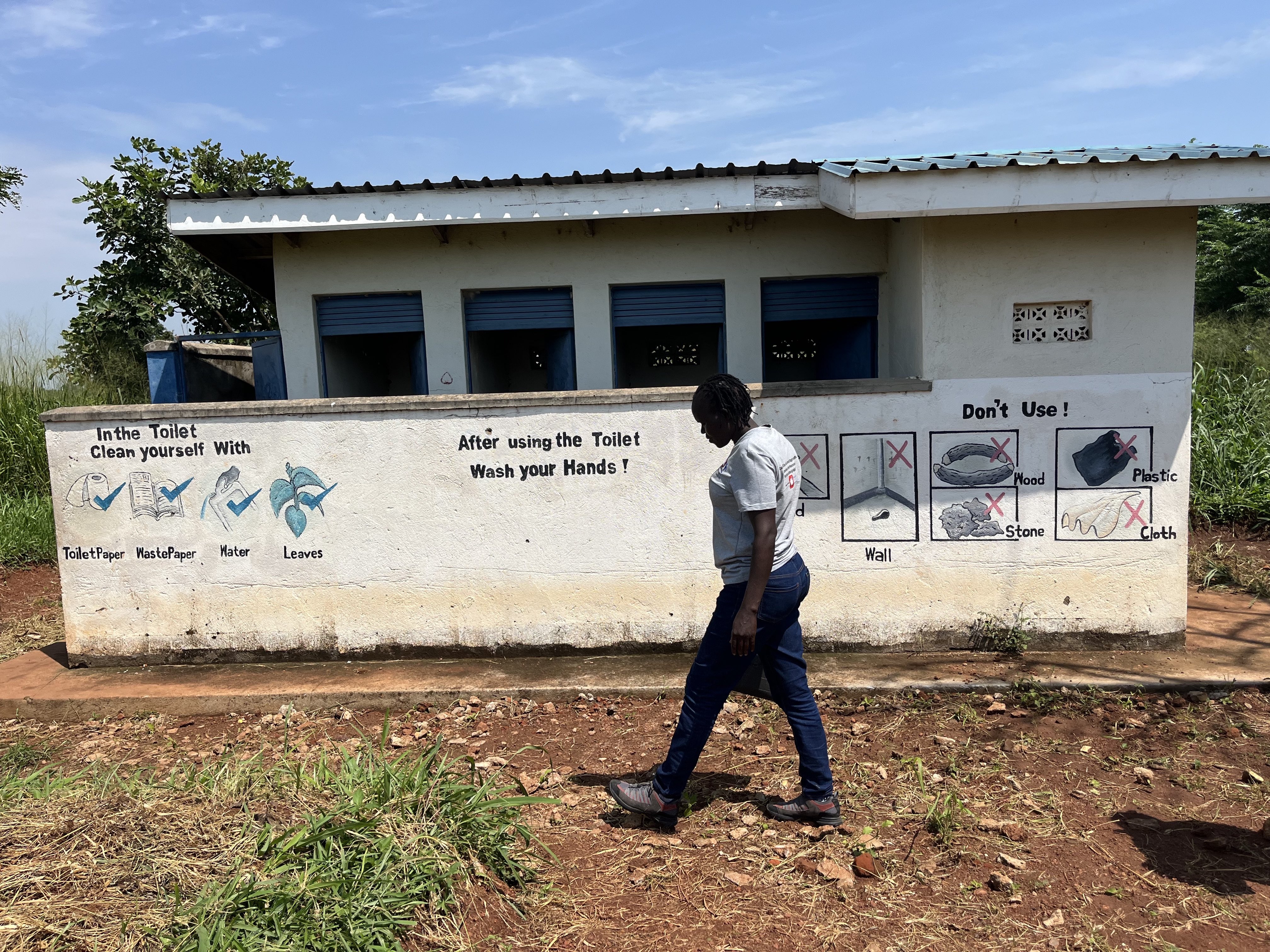
The completed toilet!
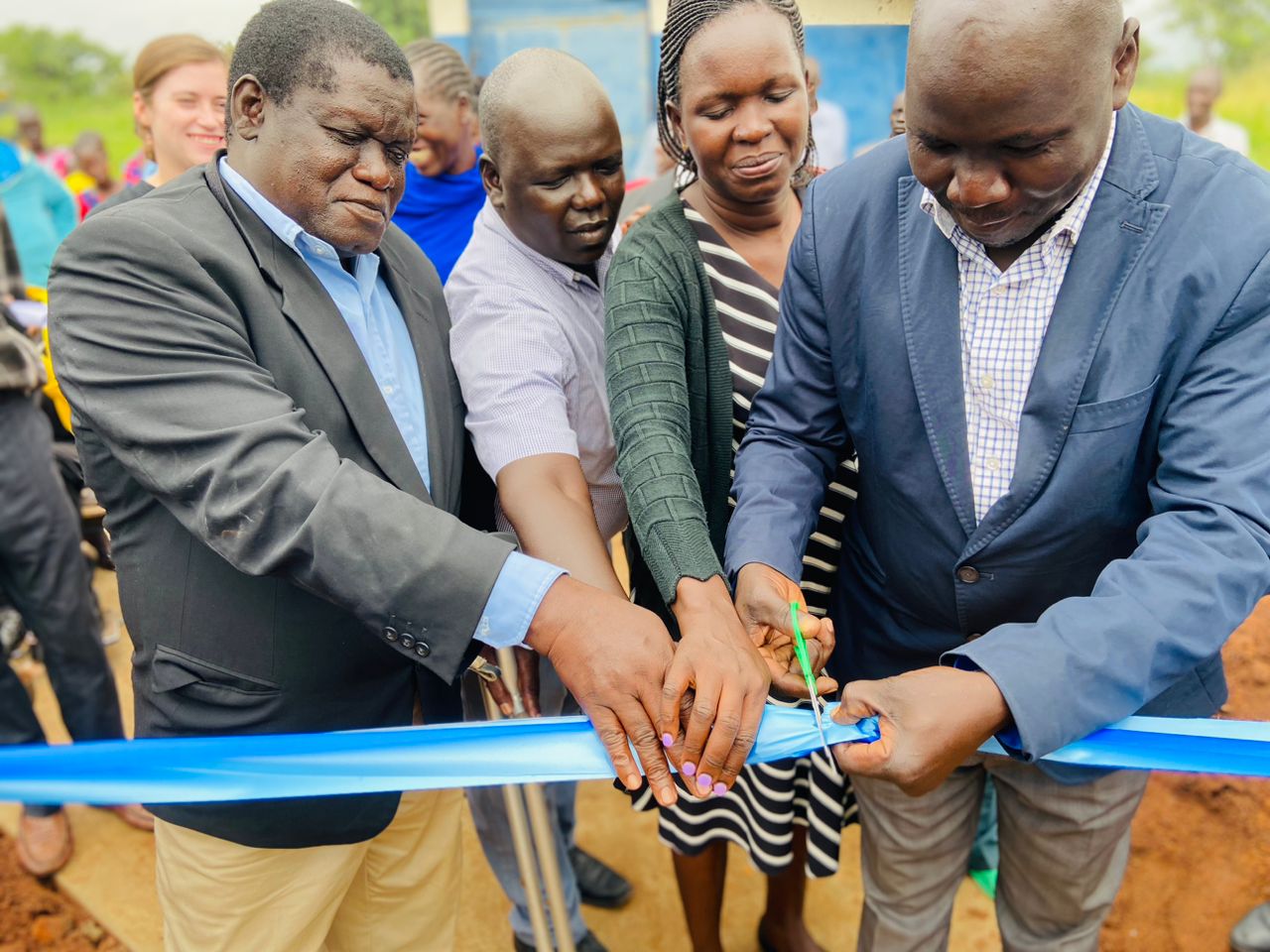
We had speeches from many of the guests, a performance by the Kulu Opal choir, and an official ribbon-cutting opening for the latrine, before sharing in a traditional lunch. It was a very joyous day and everyone expressed their gratitude for the program and the impact it will have on their students.

The students performing at the handover ceremony.
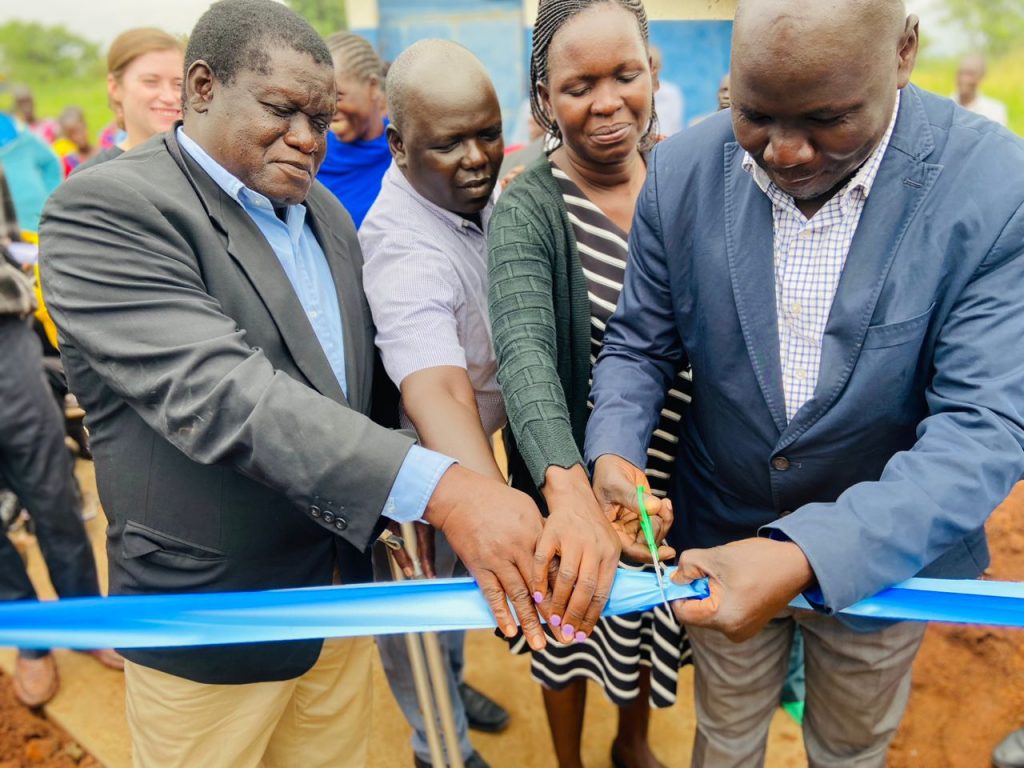
The GDPU Chairman, Head Teacher, District Education Office representative, and Secretary of Health and Education representative cutting the ribbon for the toilet.
It was a great ending to the WASH program, my fellowship, and my time in Uganda.
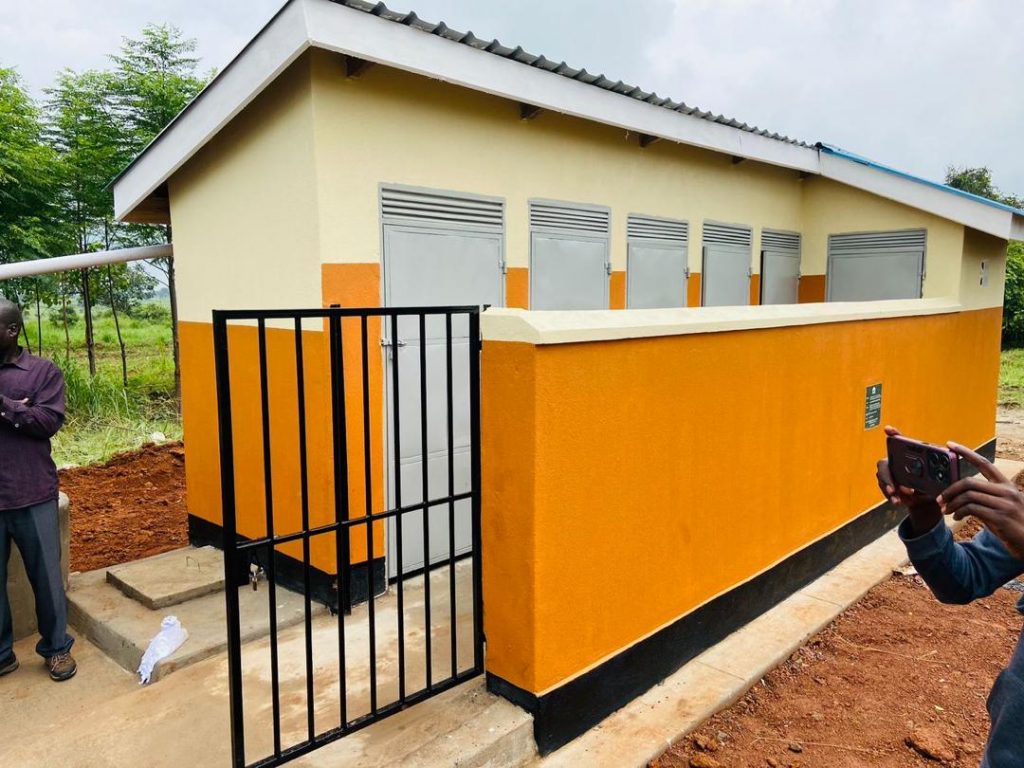
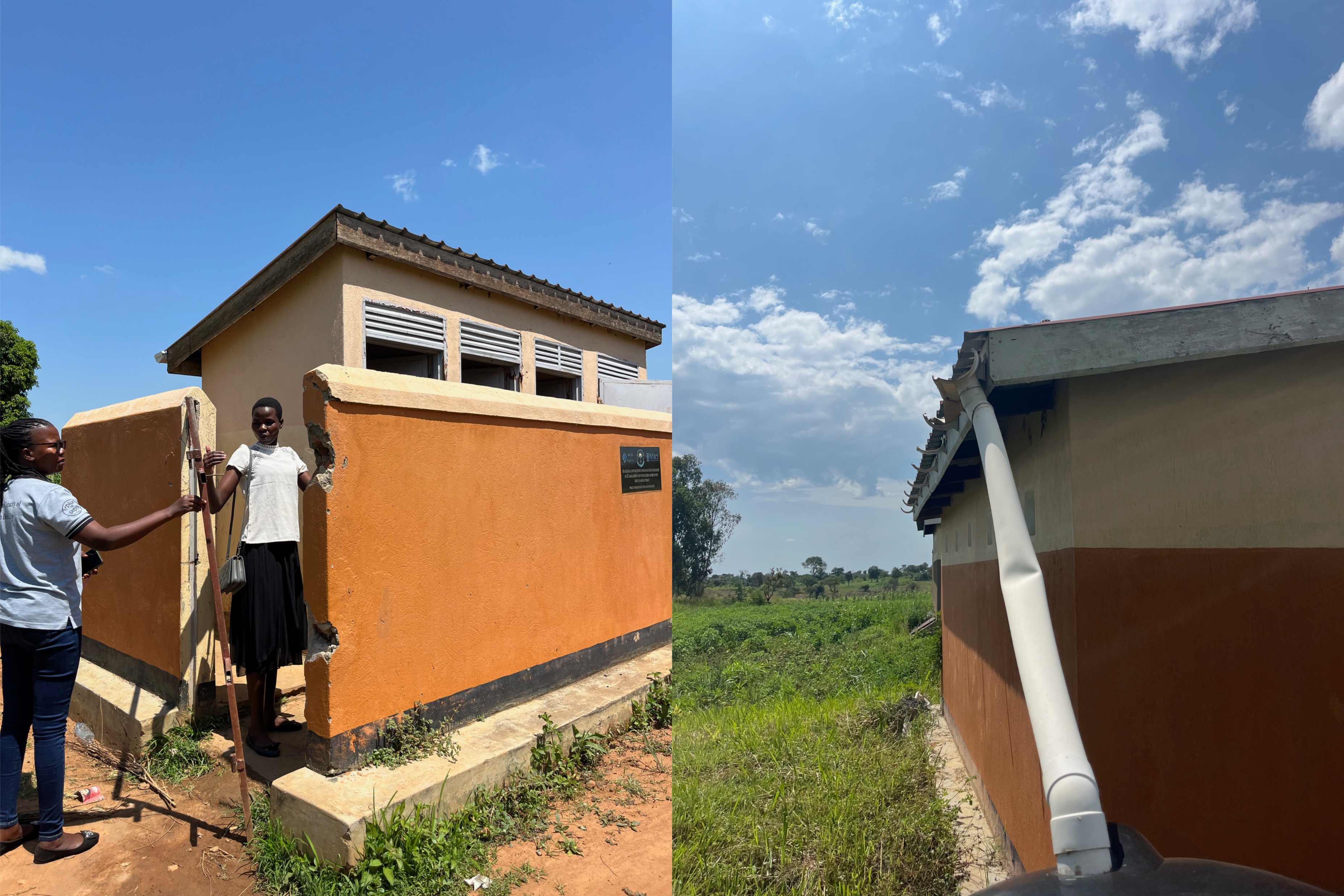
The completed toilet with the fresh coat of paint!
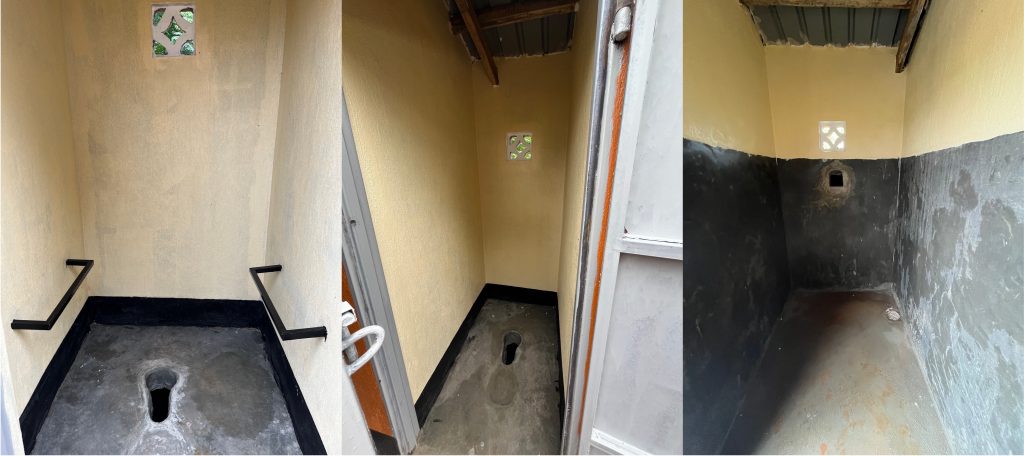
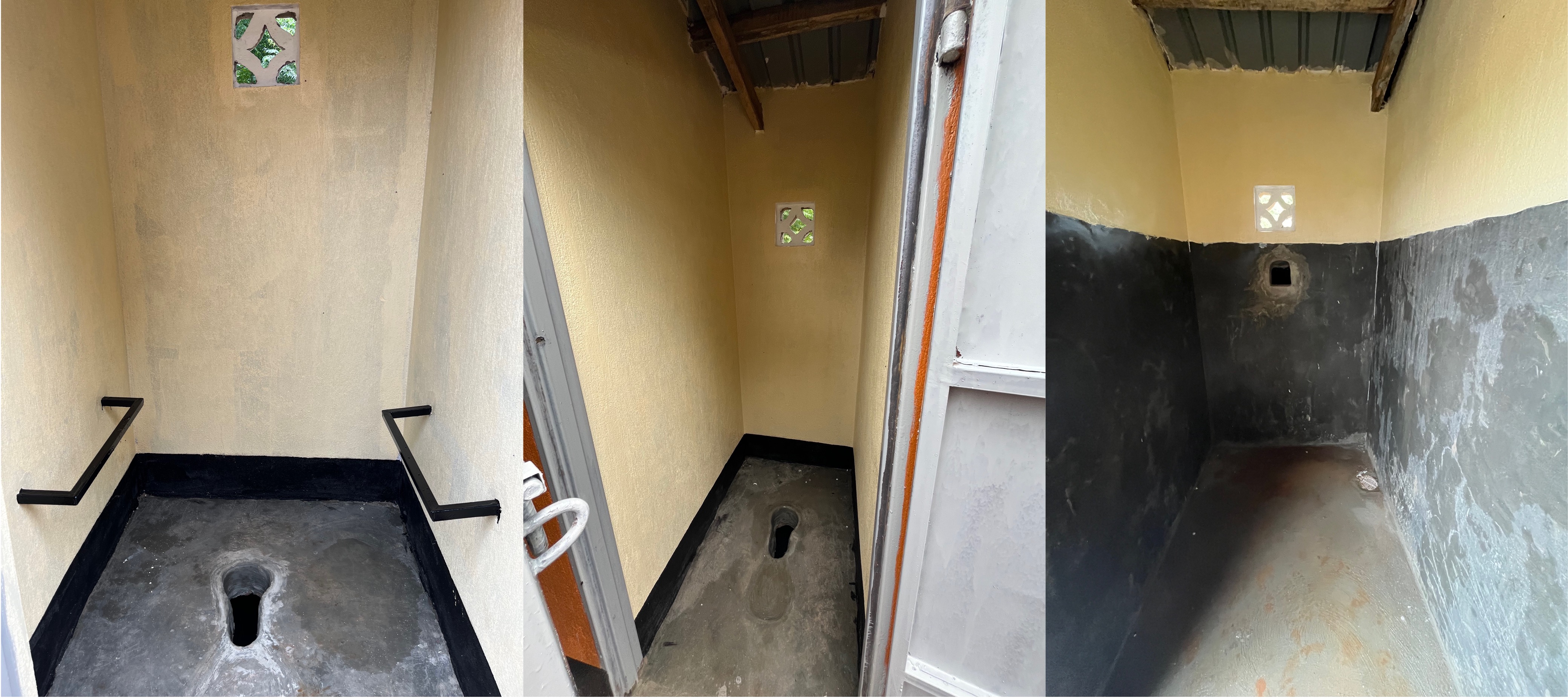
The disability-accessible stance with handrails (left), one of the 4 regular stances (center), and the girls changing room (right).
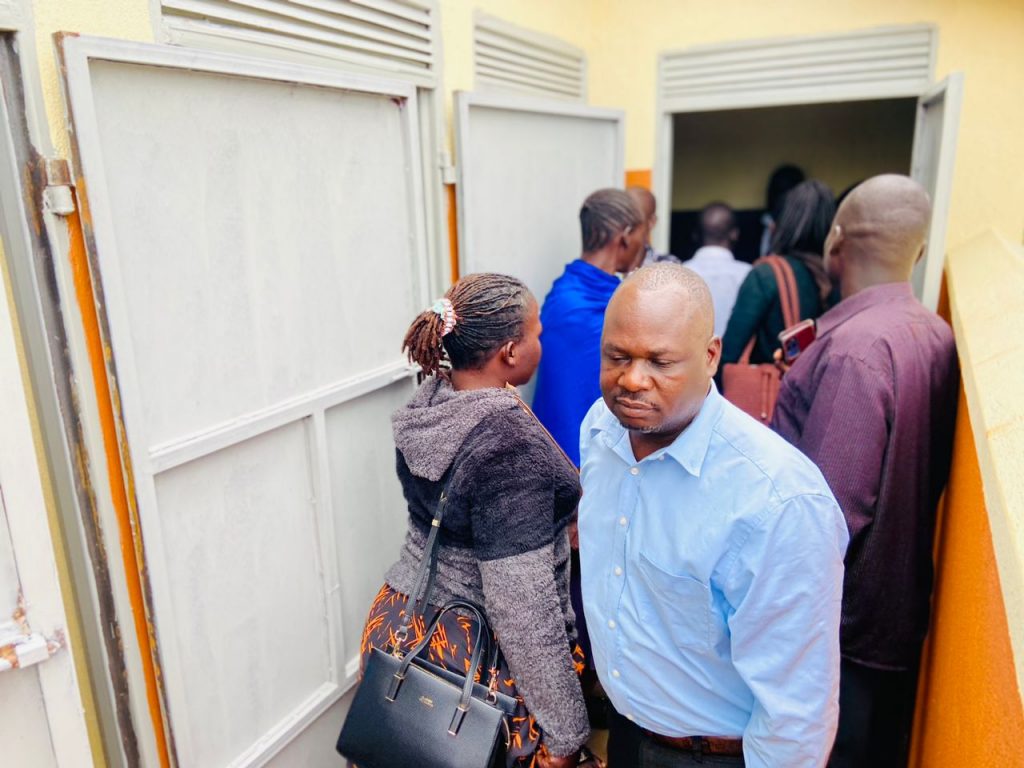
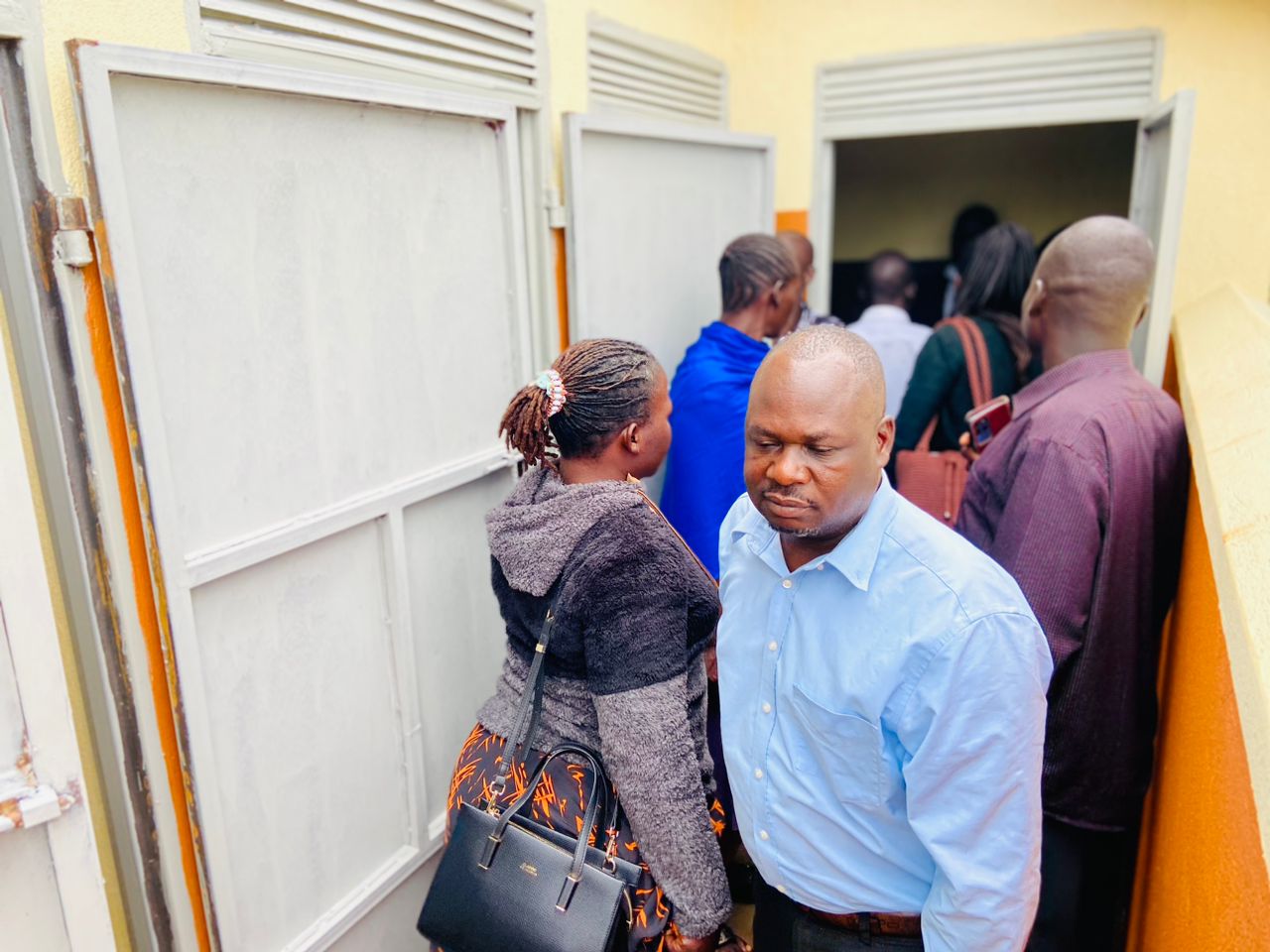
Everyone investigating the completed toilets.
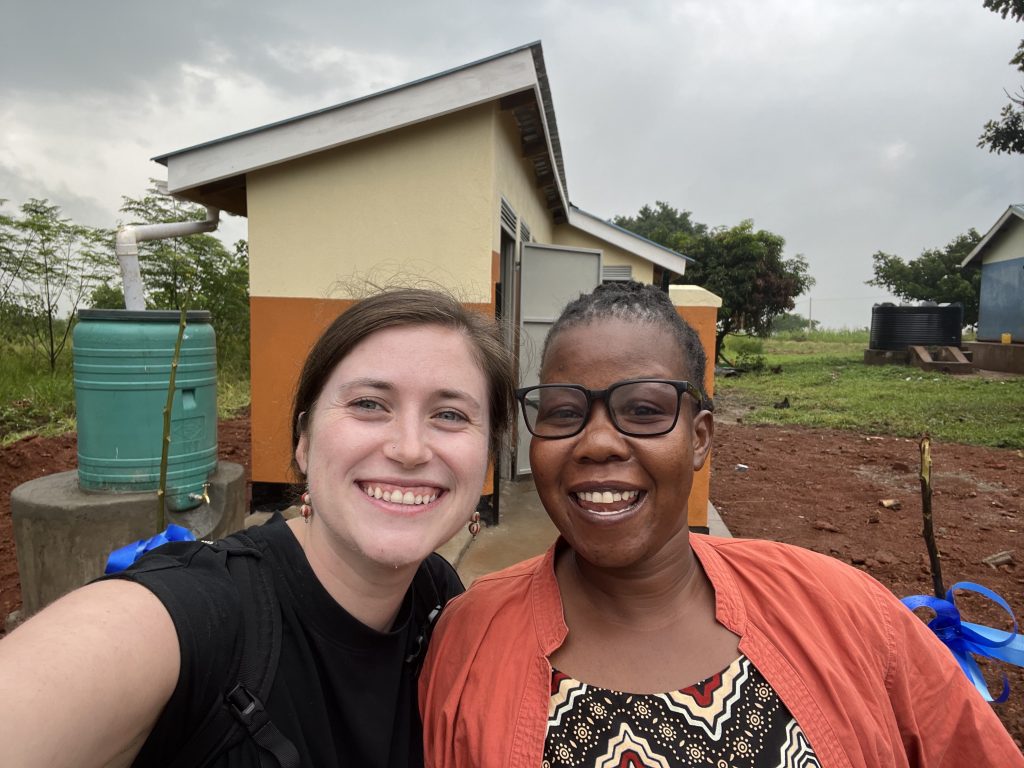
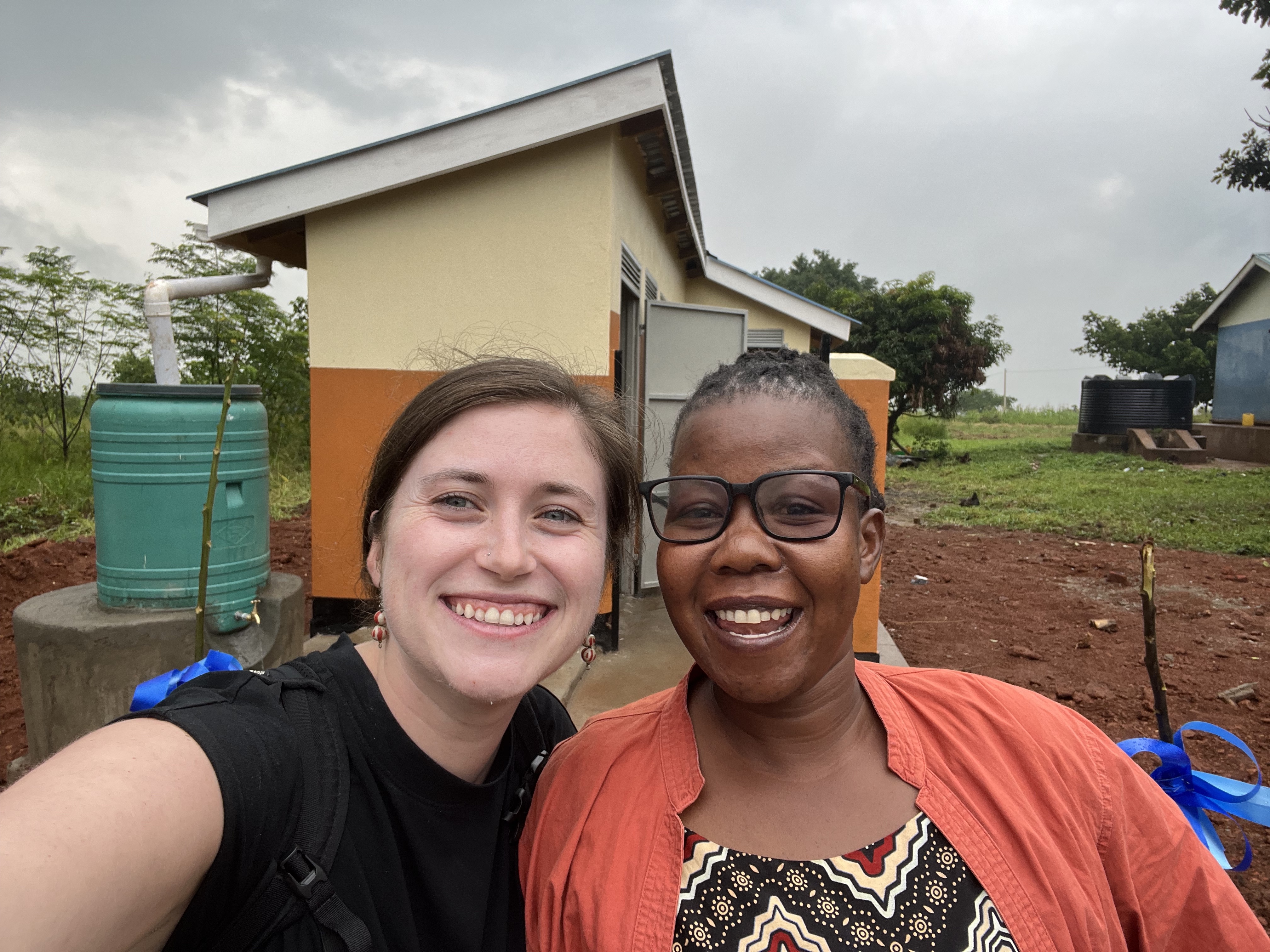
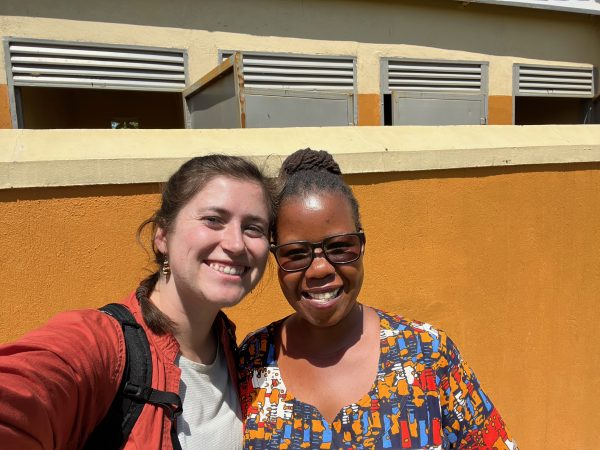
Emma and I celebrating the end of the project!
-
WASH at Kulu Opal: Monitoring and Menstrual Hygiene
2 CommentsAs part of the WASH program, I supported the design and implementation of a monitoring and evaluation strategy for the six schools that GDPU has built toilets at in the past. Visiting these schools provided some context to how the WASH program has evolved, from building only 2 stances at Torchi Primary school, to building 5 stances with additional accommodations and providing resources and trainings at Kulu Opal.
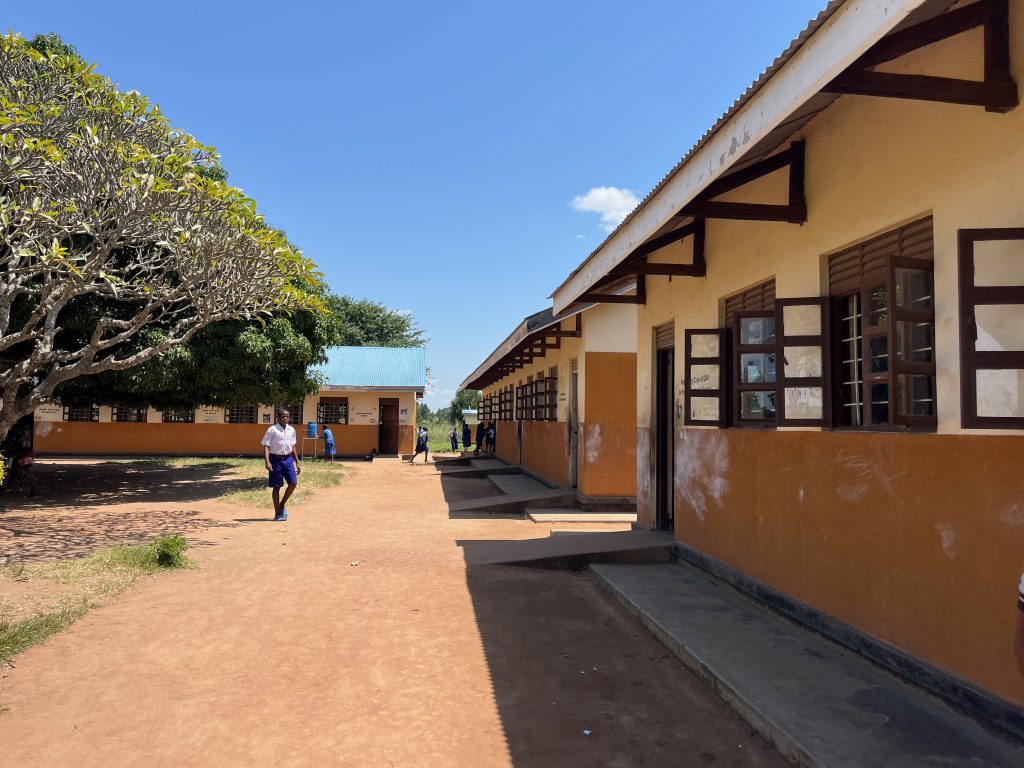
Visiting Awach Upper Primary School.
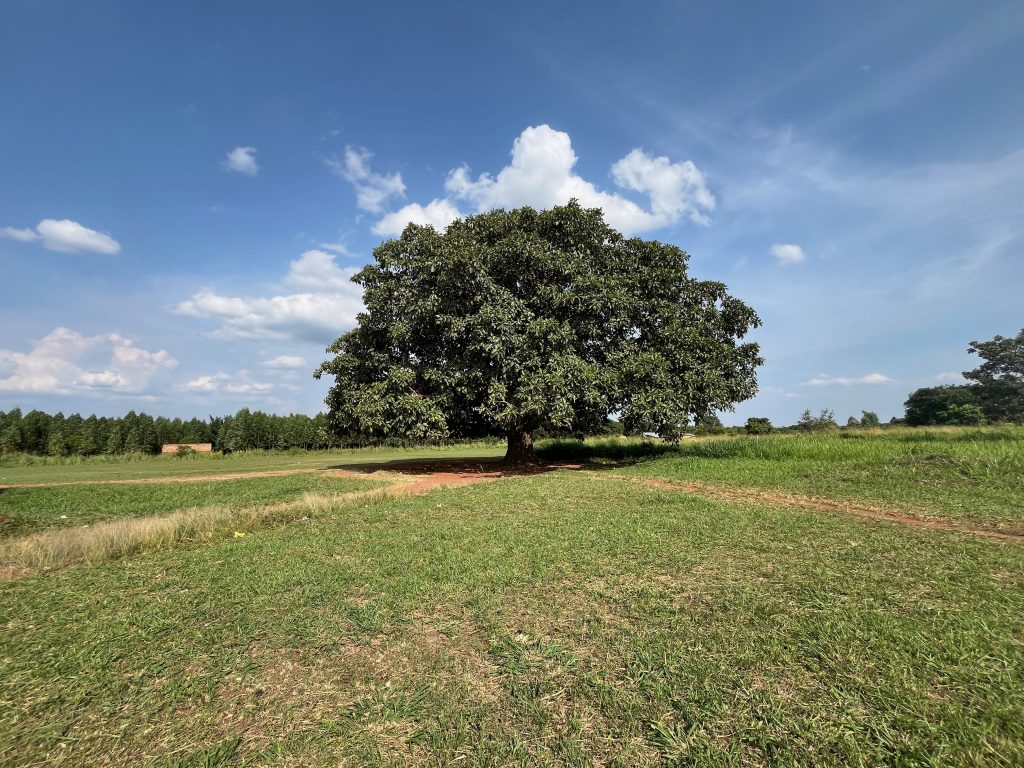
A beautiful mango tree at Ogul Primary School.
The schools we visited varied widely. The schools range in enrollment from 352 students to nearly 1400 and in government term budgets from 2.3 M UGX ($600) to 11 M UGX ($3,000). Some schools are a 10-minute drive from the center of Gulu City and some took almost 2 hours to reach. Some have received new classroom blocks or hygiene trainings from organizations like the Norwegian Refugee Council, USAID, Save the Children, and Africa Women Rising, and some have not been visited by the government or an NGO in years. Some schools have Head Teachers that are very cued into the challenges their girl students face, and some Head Teachers seemed afraid when we asked about how girls dispose of sanitary pads.

Emma and I on our monitoring visits.
The status of the building and facilities also varied, but many of the newer ones are in fairly good physical condition. The primary issues are related to broken doors, gutters, and handwashing tanks, but the walls and roofs are all intact. However, the cleanliness of the toilets ranged from generally mediocre to absolutely disgusting. Most latrines had feces on the floor and were covered in flies, even if the Head Teacher promised that they clean the toilets daily.
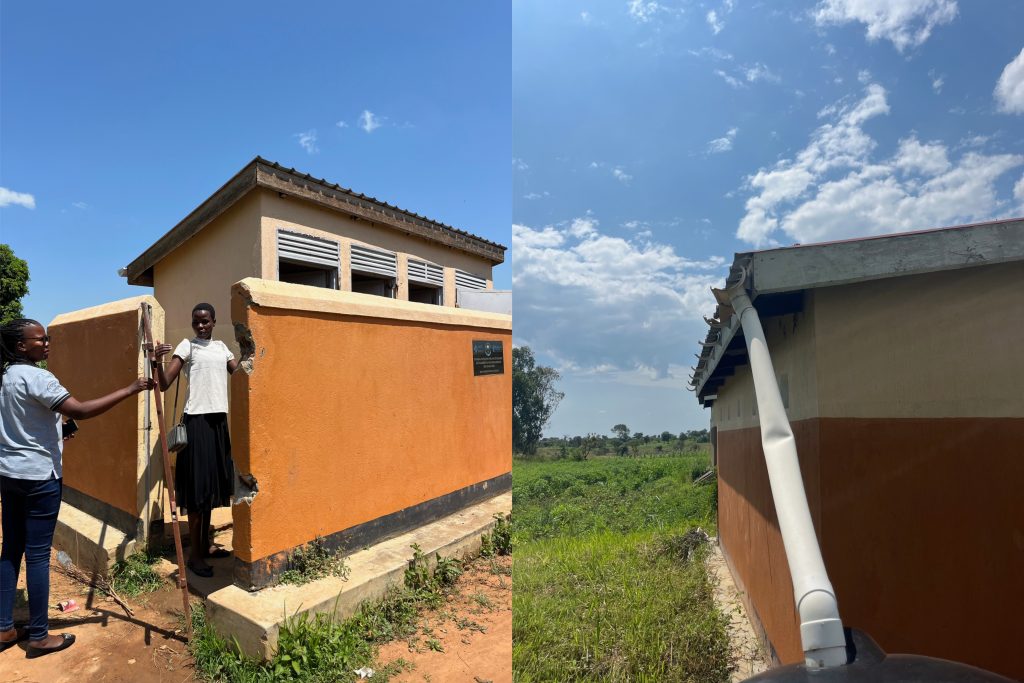
Inspecting past GDPU projects.

This was not the first or last time I saw a puddle of human feces (feces not pictured).
This is in part because the schools may not have funding for soap and brushes to clean the toilets, but also due to basic neglect and disregard by the Head Teachers. The only trend I noticed in our monitoring trips is that if your school receives more government funding and/or your Head Teacher is a woman, your latrines are much cleaner.
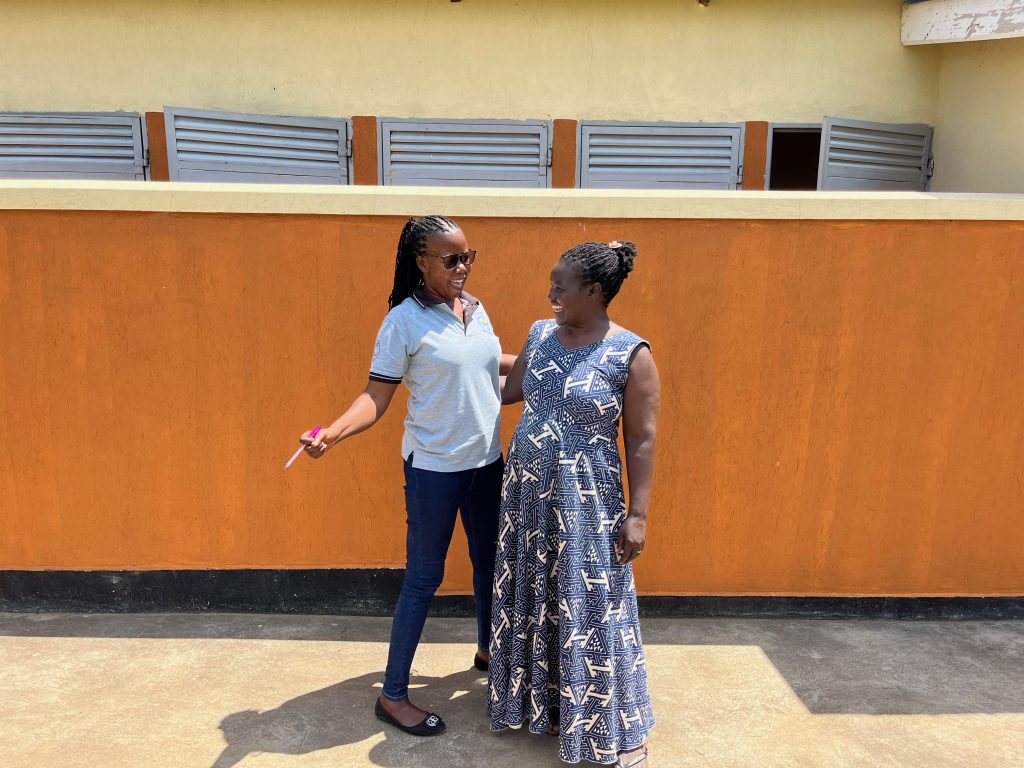
Emma and Joyce, the Head Teacher at Awach Central Primary School, who is an absolute rockstar.
A challenge that Head Teachers often shared with us is that many girls do not attend school when they are on their periods. This can be attributed to the physical pain and symptoms of a period, but moreover to the lack of sanitary pads and abysmal condition of some of the toilets. I can only imagine the embarrassment girls must feel if they have to manage their periods without privacy or any way to clean themselves and how discouraging that would be from attending school.
Currently, the girls toilets at Kulu Opal are mostly inoperable, have broken doors, and do not have space for girls to change. They also do not have an incinerator, so the girls drop used sanitary pads in the latrines, which make them incredibly difficult (if not impossible) to drain. GDPU has included changing rooms in their WASH projects since 2018, but the project at Kulu Opal will be the first GDPU effort to also include an incinerator for menstrual products.
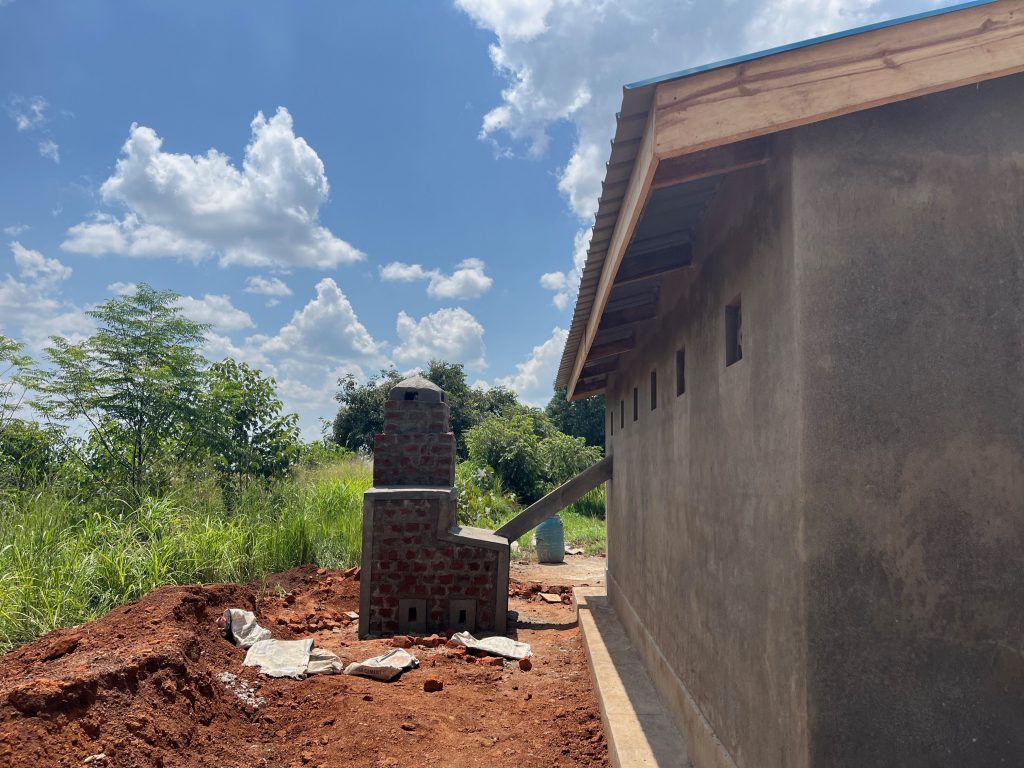
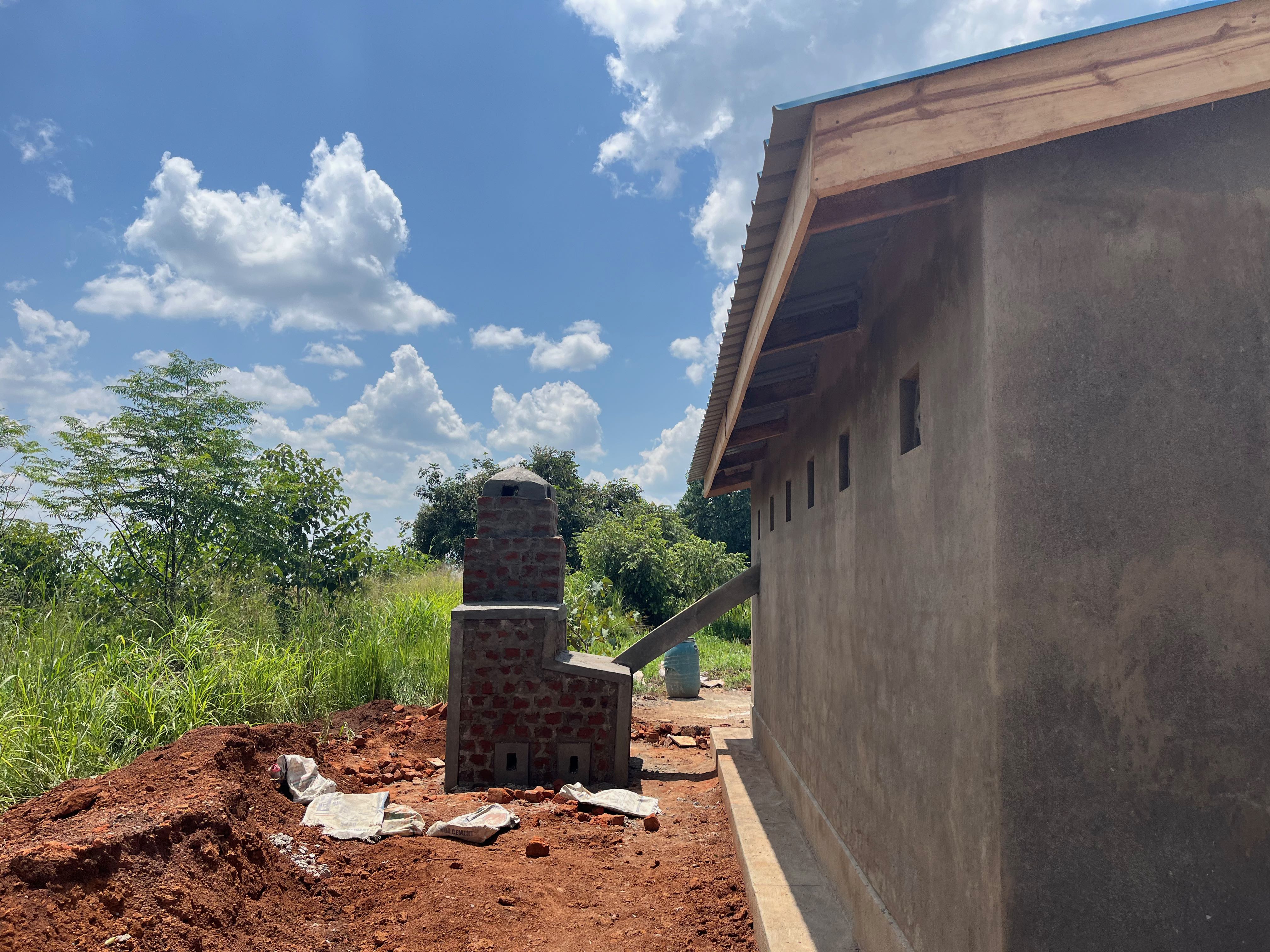
The incinerator at Kulu Opal. The concrete angled tube connects to the girls changing room.
The incinerator is a brick structure used to burn used menstrual products. It is connected to the girls changing room through a durable, concrete-layered tube. When girls want to dispose of a sanitary pad, they can enter the changing room and throw the pad in the tube without being seen. The changing room also has a hole so that when girls use the space to clean themselves, the water can drain out of it.
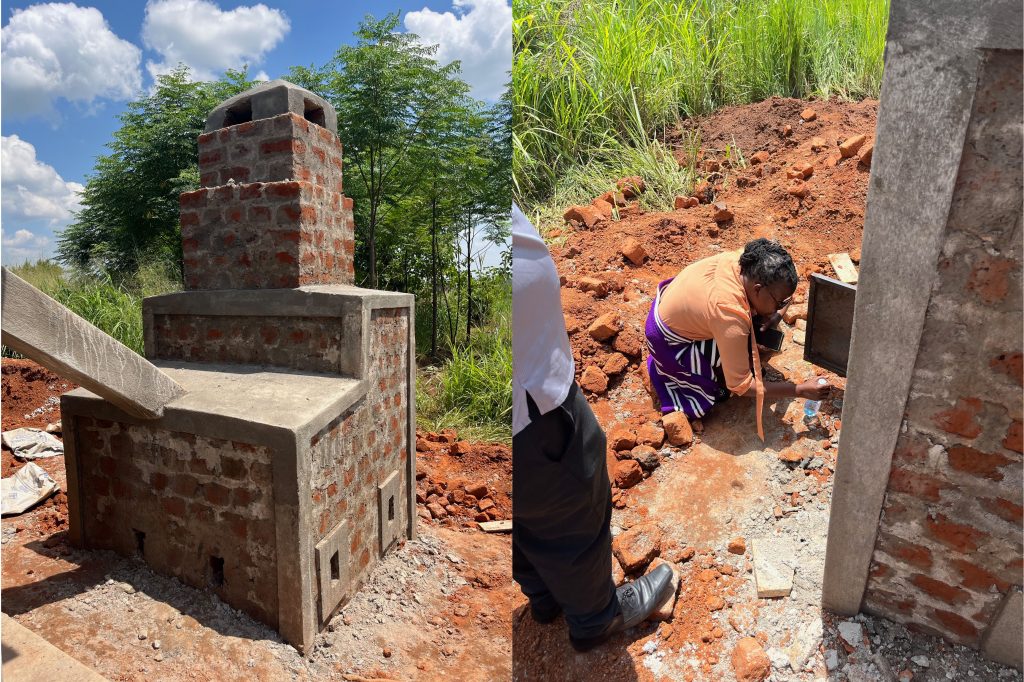
Emma inspecting the incinerator at Kulu Opal.
This newest addition to the GDPU WASH package will provide girls a private, clean, safe space to care for themselves so they can feel more comfortable going to school every day of the month.
-
WASH at Kulu Opal: The 4 F’s
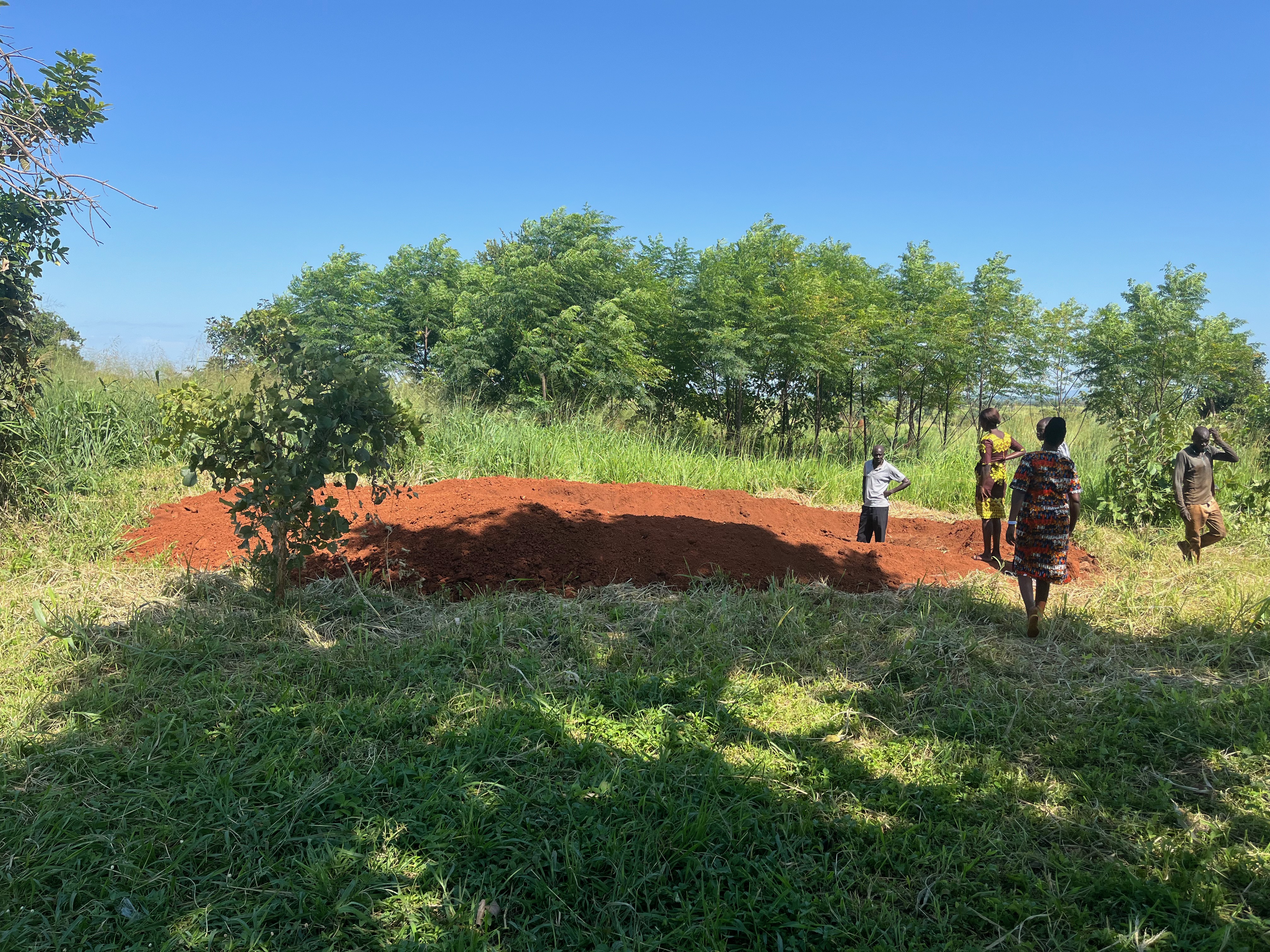
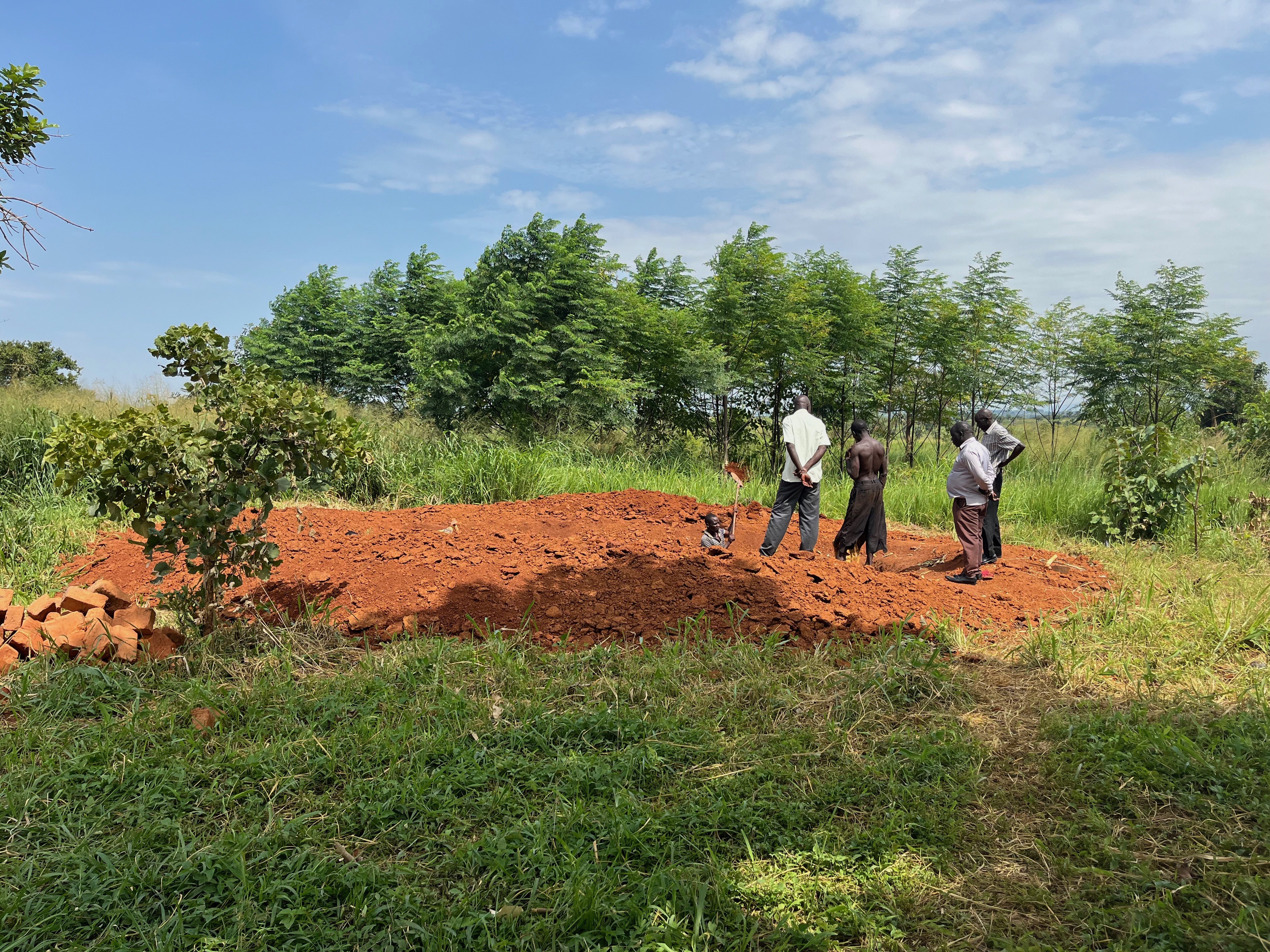
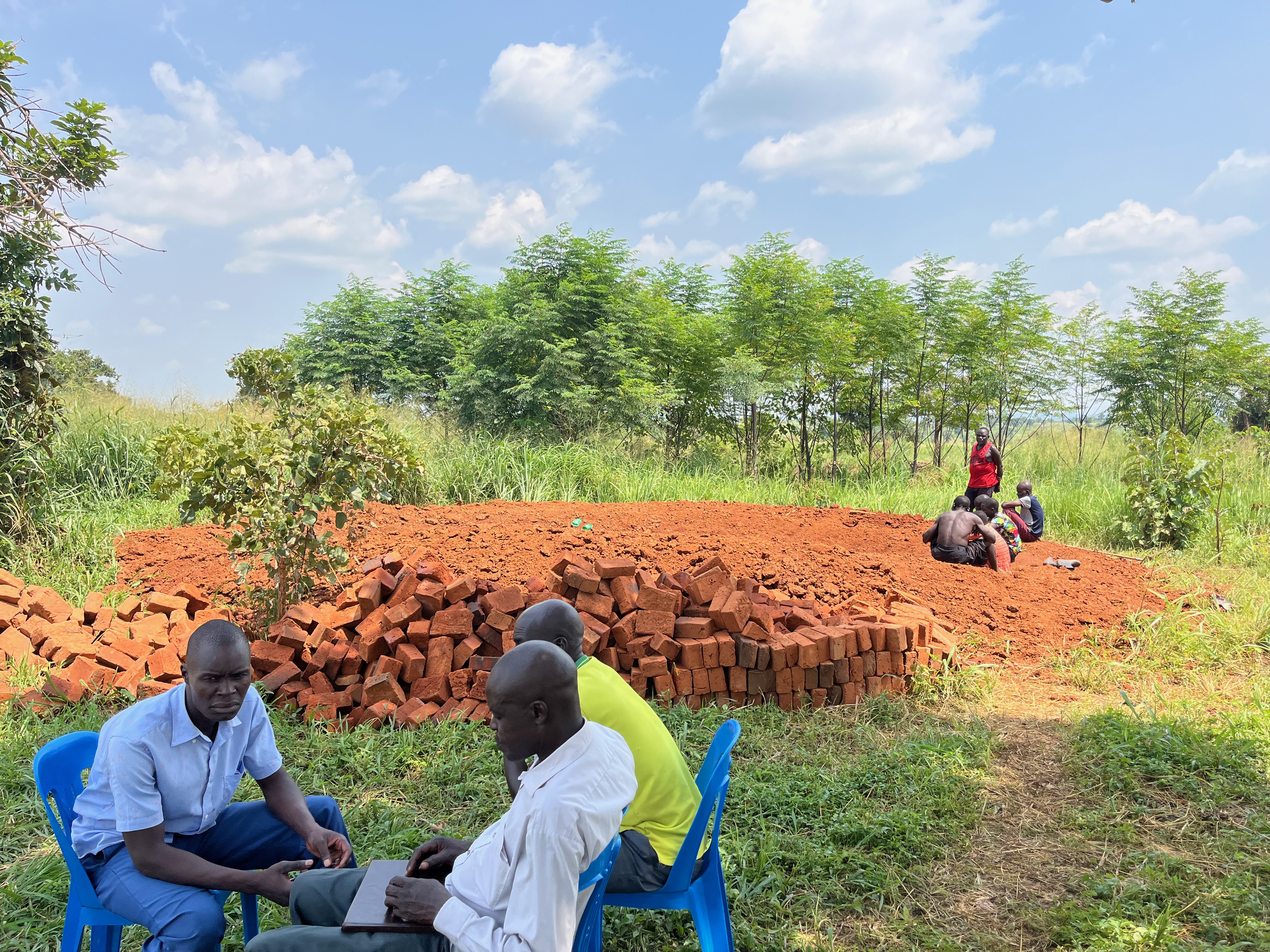
1 CommentThe Kulu Opal project is moving along well, as we are almost to the handover ceremony and the end of my time in Uganda. It seems like almost overnight, the latrine pit became a building with walls! Once the walls were constructed, the building truly started coming together.

Kulu Opal project progress on July 16.

Kulu Opal project progress on July 19.

Kulu Opal project progress on July 25.

Kulu Opal project progress on July 27.
As part of the WASH Program, GDPU offers two trainings to Kulu Opal: Hygiene and Sanitation Training for the students and a Disability Inclusion Training for teachers, the School Management Committee, and the Parent Teacher Association. Last week, we held the Hygiene and Sanitation Training, which evolved quickly from only P4-P7 students, to all P1-P7 students outside by the central mango tree on the campus, to however many students we could fit in two classrooms because it started thunderstorming.

The original training set-up under a tree.
Emma, Joe, and Daniel led the trainings in Acholi. I helped a little at the end in English, which Daniel kindly translated for me. The training covered what a germ is, the importance of proper sanitation and hygiene, and handwashing demonstrations. They spoke about the “Four F’s” (Fingers, Flies, Food, Feces) of how germs can spread, which is core curriculum in Uganda public schools.
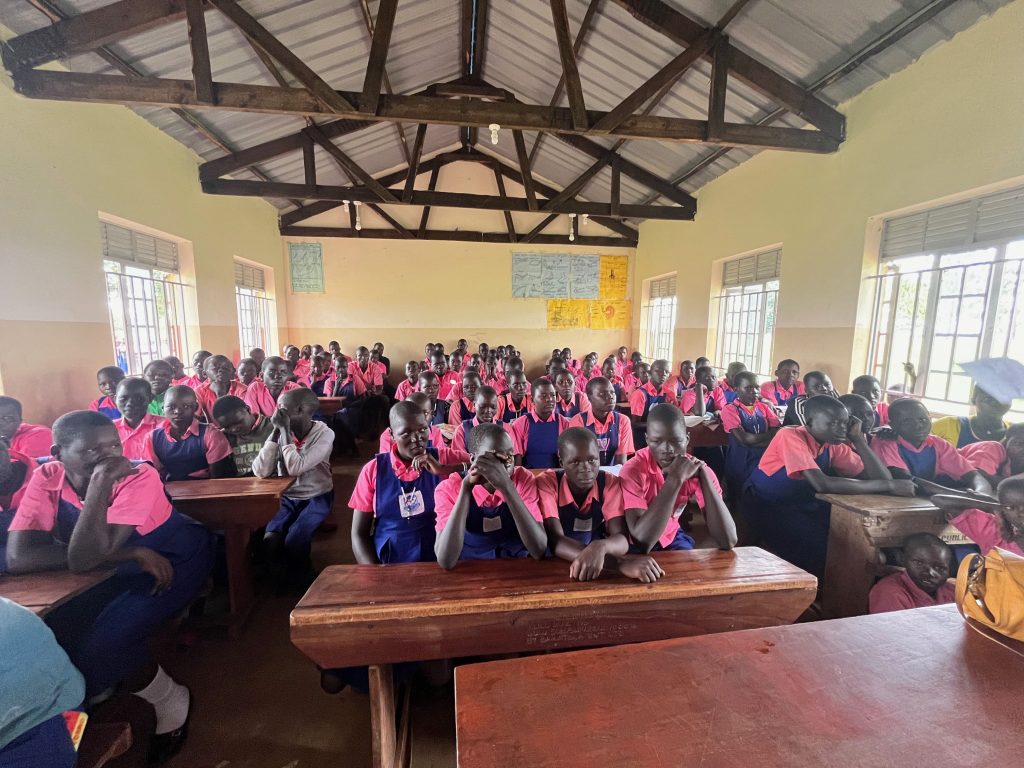
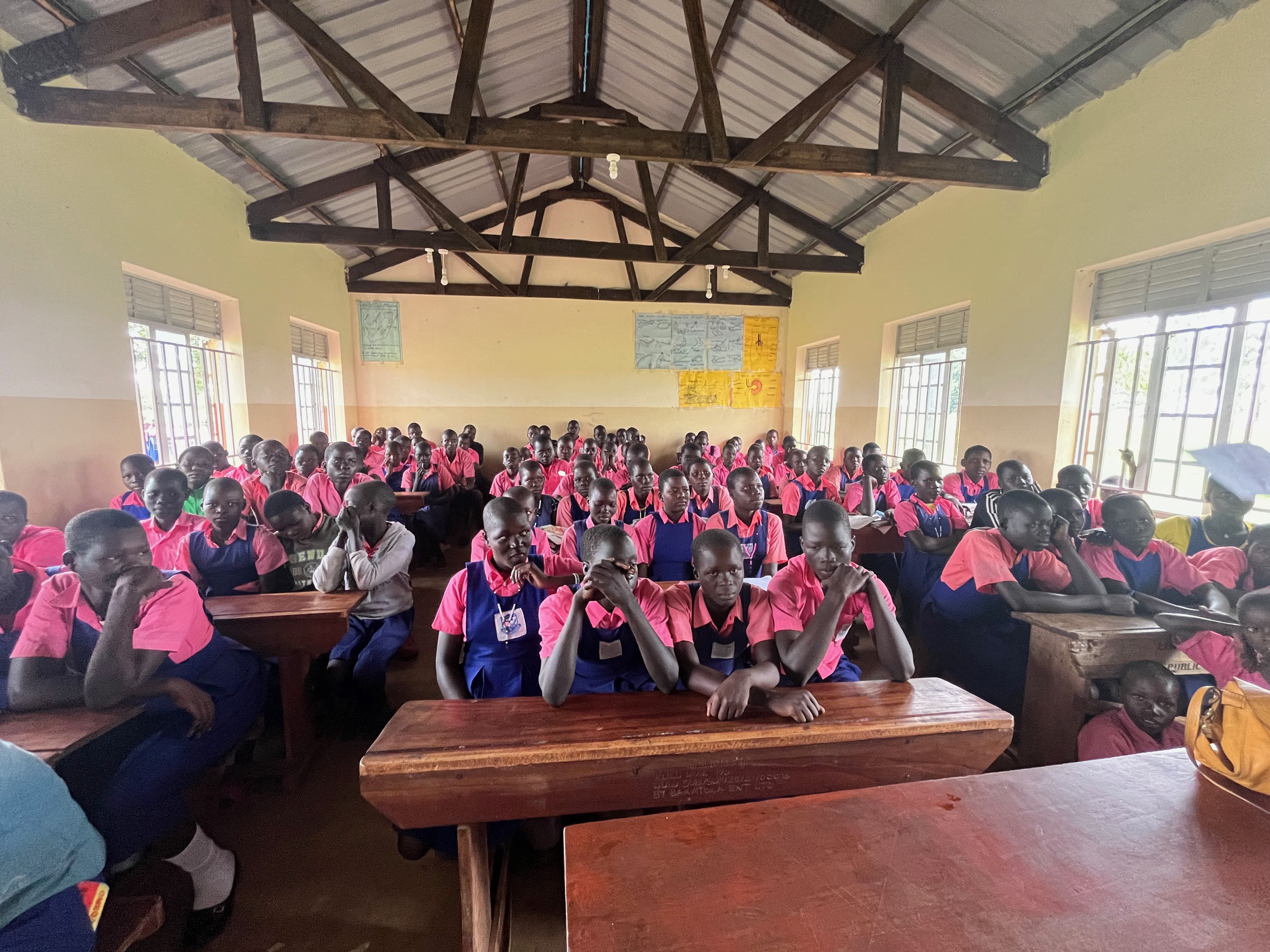
The new training set-up, with as many students a possible squeezed into a classroom.
The GDPU team and Head Teacher did a great job engaging the students and making the demonstrations lighthearted – the Head Teacher even mimicked how not to use toilet paper, which made everyone giggle for the rest of the day. I was super impressed by how attentive the students were, especially since it was right before lunch!
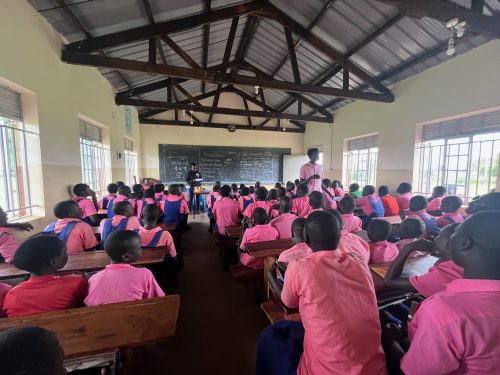
Daniel and Emma leading one classroom of learners at the WASH training.
Even though this training was in good faith, I can’t help but wonder how impactful it is. We can encourage students to change behaviors and tell them washing their hands with soap is important, but in reality, the school does not have adequate funds to buy soap on a regular basis and most students likely do not have soap at home. This is a core challenge of meaningful development – not just behavioral change or resource provision, but efforts that can be financially and logistically sustained in communities long after the funding and support is gone.
-
Meet GDPU: “GDPU is a very committed organization.” – Emma Ajok
2 CommentsThis is an article in a series profiling staff at GDPU, the Gulu disability community, and those who call northern Uganda home. All contents of this article have been approved and shared with the permission of Emma.
Emma Ajok has worked at GDPU since 2015. She currently serves as the Safeguarding Focal Point Person and the Water, Sanitation, and Hygiene (WASH) Program Manager. She has an degree in Community-Based Rehabilitation from Kyambogo University and hopes to pursue a career in safeguarding and child protection. I have been lucky to get to know Emma well through our long trips out to Kulu Opal and other schools in the district. She has welcomed me warmly to Gulu and Uganda, whether that’s sharing new food like jackfruit, teaching me how open groundnuts correctly, or helping correct my terrible attempts at speaking Acholi. Emma is proud to call Gulu home and lives here with her son, Josh.
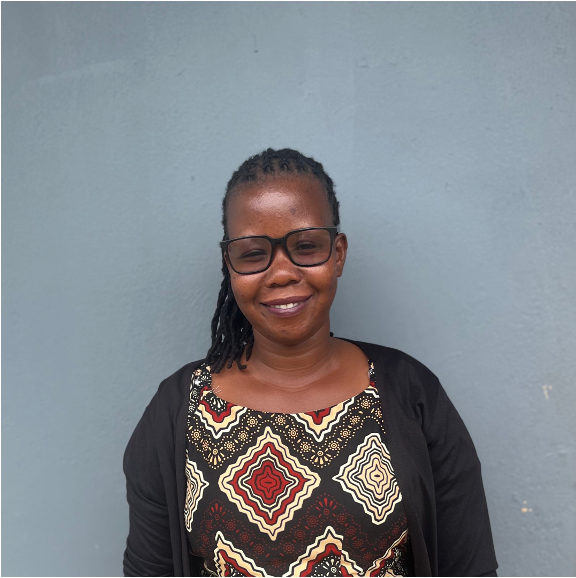
Emma Ajok of GDPU
How did you start working at GDPU?
I started working here as a volunteer. I worked on a project for facilitating parents of children with cerebral palsy. I was training them on how to take care of children with cerebral palsy, models like communication, positioning, feeding, toileting.
It was something that I was interested to do because during my internship, I realized that children with disabilities are being locked inside, especially those ones with cerebral palsy. You find the parents tied them inside or even put a padlock on. And they got to do their daily business.
I became concerned. I wished I could do something for these children. So when GDPU gave me the opportunity, I was so excited. Because I knew I would at least make changes, talk to the families. That’s how I got connected to GDPU.
Where did you do your internship that you mentioned?
I did my internship at the local government, at Layibi, one of the divisions in Gulu [District]. There, I was put on a Community-Based Department. Well, we would move to the field with the CDO [Community Development Office]. He would show us where our persons with disability lives, what they do.
How did you first hear about GDPU?
I heard about it from a lady called Florence. She was already here, participating in one of the wheelchair projects. She does sports.
So when I went for my internship, she was like, “I want you to come. I pray to God that you come and work at GDPU.” And I was like, “What is GDPU?” And she was like, “It’s an office for persons with disability. You just need to come and visit.. after you’re done with school, you come and visit.”
What is your role at GDPU?
I’m working as the Safeguarding Focal Point Person. It’s someone who makes sure that GDPU is an organization that respects the rights of persons with disability.
I carry out training of staff, volunteers, interns. I make sure that they know what is in our policy on safeguarding because it’s important that they all have the knowledge on safeguarding. Safeguarding is all about ensuring that GDPUs programs and projects don’t [cause] harm to our beneficials. For example, we need to look at the project design, the timing, the meeting venue… carrying out risk assessment when you carry out an activity so that we don’t expose our beneficiaries to risk.
I am also the WASH Project Manager. I’m managing one of the projects that is being supported by the Advocacy Project. I joined the project five years ago. Every year we install accessible, drainable pit latrines at one of the primary school that is being directed by the DEO [District Education Officer]. We make sure that the school is inclusive. We train teachers on inclusion and how they should do that classroom settings. We also conduct hygiene training to make sure that toilets are clean and there are enough brushes, toilet paper, liquid soap.
You’ve been at GDPU for 9, almost 10 years now. What work have you been proudest of here?
I think I feel so good since I came here. I worked on different projects. One that I did not talk about is V-Plus. It’s a skills training. We recruit youth with disabilities to come and study different skills, like sweater knitting, design and decorations, motorcycle repair, electronics repair.
I feel excited when I go to do follow-up and they’re doing something, they’re earning a living. They’re no longer being discriminated in the community. It makes me so proud.
And also on the WASH project, I think I feel so good when I go to school where we’ve installed of the toilet and the number of children with disabilities or the enrollment has increased because of the package that we put. It also makes me very proud. If I see that they’re taking good care of the toilet, it gives me more energy to advocate for more schools.
How did you become passionate about working with people with disabilities?
I think when I was applying to university, even selecting the course that I did, I already had the passion. Because I remember someone told me “The course that you’re going for – it has sign language, it has braille… you’ll be supporting the vulnerable groups.” I decided yes, I am ready for this.
How did you decide on that course of study?
In Uganda, in Gulu, we had a long period of insurgency, the LRA war. During that period, many people were affected. People got a lot of disabilities. Even my own relatives, others were killed. Others were left disabled – their nose, mouth were cut off. So during that period, I was like, “if there is anything that I would do, and if I can go and study something related to disability, I would be so grateful.”
So when I finished my senior six, I was like, I think I want this course. It will expose me to [the field of disability] more. If I do it, if I have a degree in this, it can push me and I can do more for them. So that’s how I started.
What do you hope GDPU accomplishes in the next 10 years?
I think GDPU is an organization that is committed to advocate for the rights of persons with disability for them to access all that is required for them. GDPU is really working so hard to make sure that there is at least improvement in the lives of persons with disability through advocacy, doing a lot of things that can support them, providing assistive devices.
I wish we would get more funding so that we are able to support the numbers of persons with disabilities in Gulu.
If a donor showed up tomorrow and gave GDPU the equivalent of $1 million USD (about 4 billion Ugandan Shillings), how would you use it?
There is a lot of need for persons with disabilities and I feel GDPU doesn’t have enough resources. I would think if there is money, we would provide enough assistive devices for persons with disabilities. Things like wheelchair, because they are very expensive.
Some people cannot afford them. Actually all of them [cannot afford them]. And the projects that we have here doesn’t meet all their needs.
Things like wheelchairs – you give this and the next year, the child is outgrown and needs another one. So if there is capacity, GDPU would be doing their best to give them assistive devices. Things like the hearing aids will have never given because we don’t have the resources. Even the crutches, the white canes, they’re all very expensive.
What is something you wish people knew about GDPU?
They should know that GDPU is a very committed organization for persons with disability and they are always ready to support. They’re transparent. They have an organized board. We are ready and very committed to do the work.
Do you have any questions for me?
When are you coming back to Uganda?
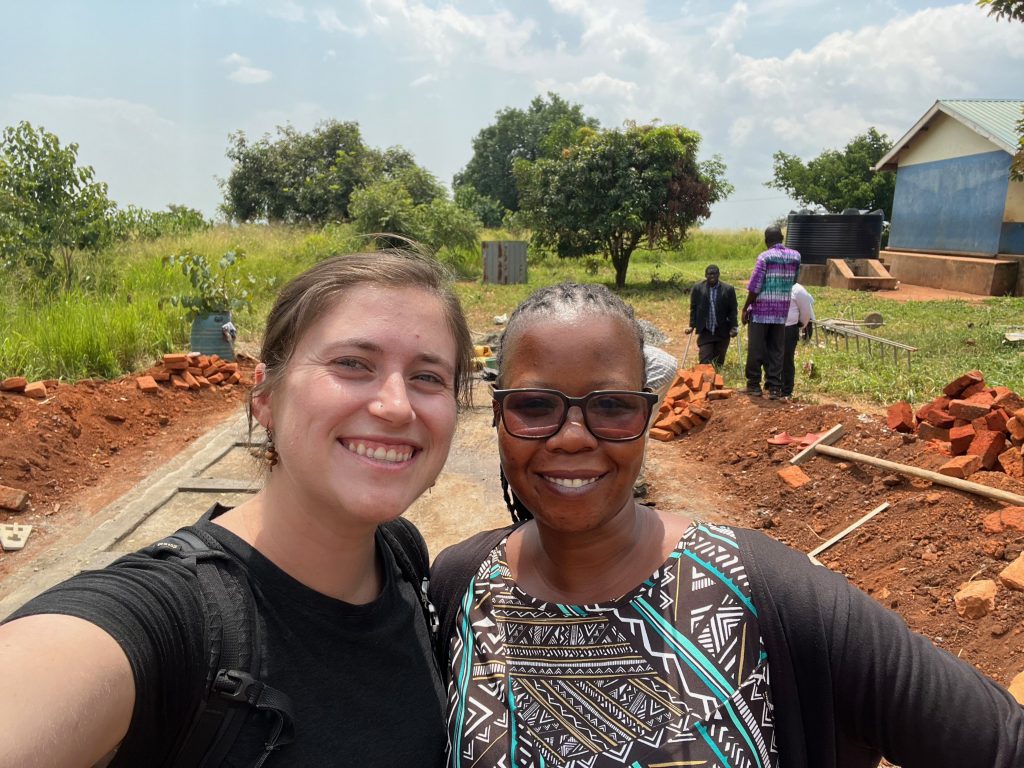
Emma and I during a visit to Kulu Opal.
-
WASH at Kulu Opal: Foundations and Floors
2 CommentsThis is a well overdue update on construction efforts at Kulu Opal! Emma, other GDPU staff, and I visit the school twice a week to monitor construction. As soon as the pit was done, the Contractor and his team began lining the pit with bricks and concrete. They also started laying the foundation for stance walls and exterior building walls.
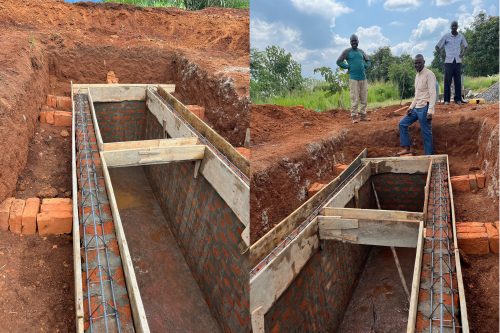
The brick and concrete lining of the latrine pit and wall foundation.
Then, the bricks in the pit were covered with a smooth layer of concrete and they built up the wall bases. You can see the construction crew in the pit in the photos below.
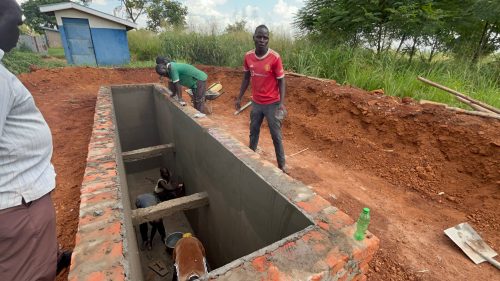
The crew covering the pit and wall foundation with concrete.
Once those were complete and dry, the crew covered the base with a slab of concrete, leaving latrine holes for each stance. The large hole on the left side of the photo below is the connection point to the pit so that it can be drained once it is full.
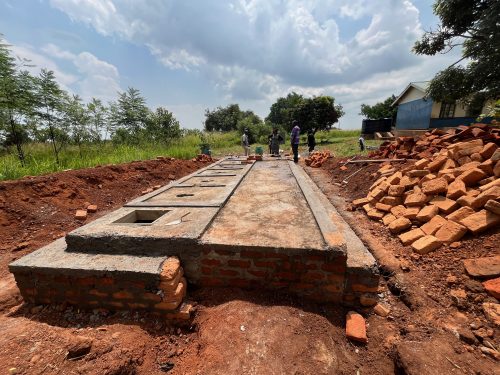
The completed concrete slap with holes for each stance.
Over the last month, Emma, I, the interns, and other GDPU staff have been hard at work making liquid soap. This soap will be given to Kulu Opal at the handover ceremony and is sold to past GDPU beneficiary schools at a reduced cost.
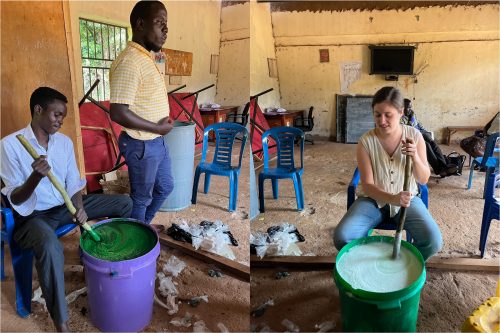
Daniel, Crispus, and I mixing the ingredients for soap.
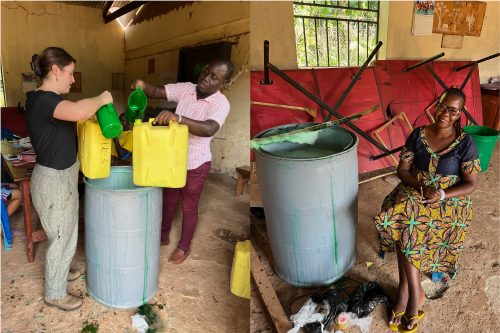
Crispus and I packaging the soap into jerrycans and supervisor Emma looking on.
Skim through the following photos below to see a summary of the construction progress! The next major step will be the wall and roof construction.
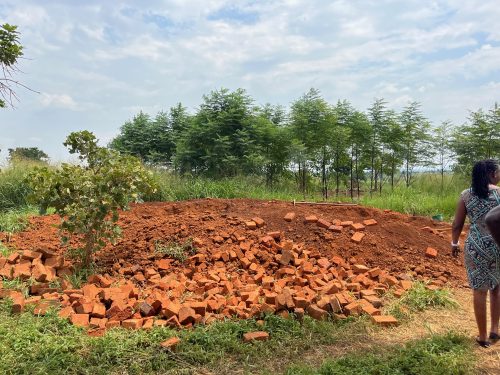
Kulu Opal project progress on July 2.

Kulu Opal project progress on July 4.
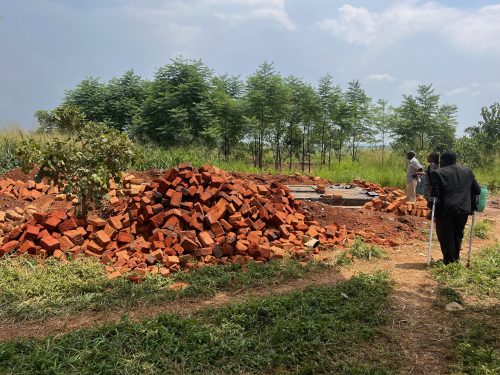
Kulu Opal project progress on July 9.
-
Meet GDPU: “It’s something that comes from the heart.” – Daniel Nyeko and Marylyn Amony
2 CommentsThis is an article in a series profiling staff at GDPU, the Gulu disability community, and those who call northern Uganda home. All contents of this article have been approved and shared with the permission of Daniel and Marylyn.
Daniel talked about different music in our interview. Click here to listen to Burna Boy, Patoranking, and Shania Twain.
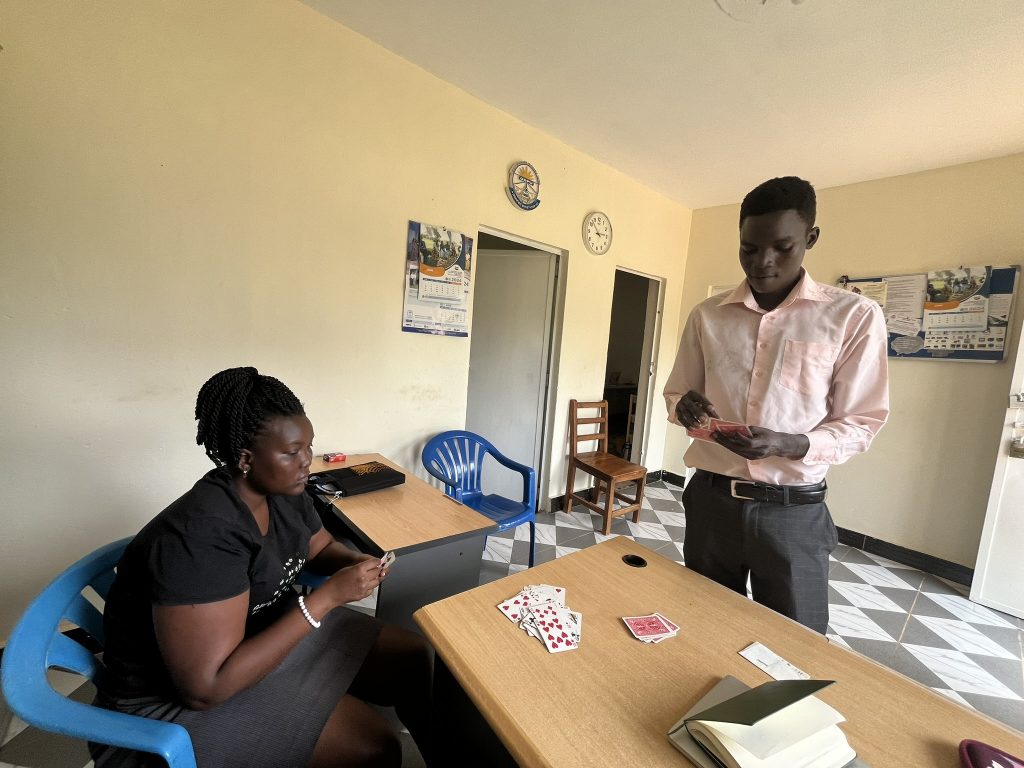
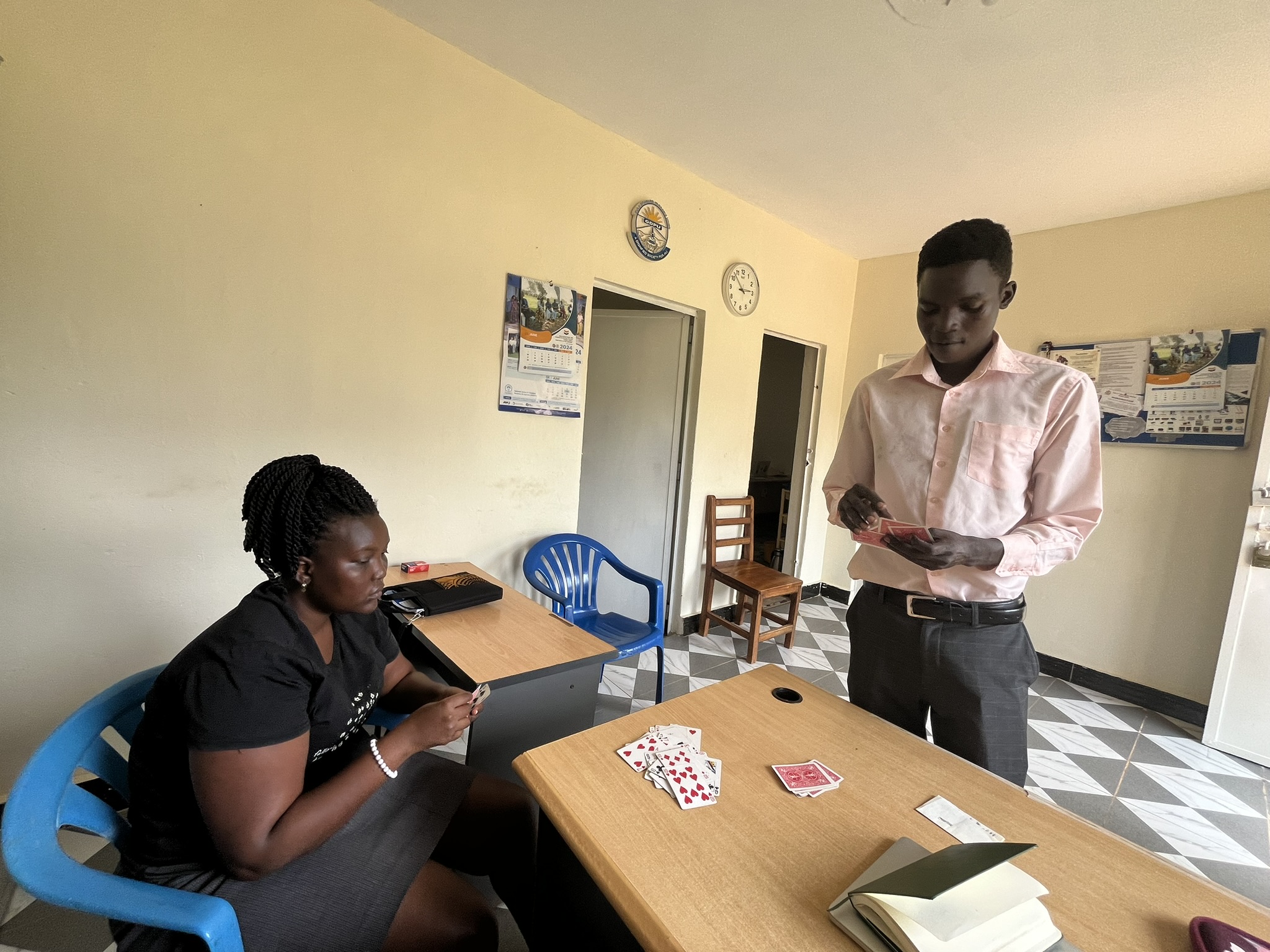
Daniel and Marylyn teaching me to play Acholi cards during our lunch break.
Daniel Comboni Nyeko and Marylyn Goretti Amony are summer interns at GDPU. They supports various programs at the Union. They will graduate from Kymbago University in 2025 with degrees in Community Development and Social Justice. After graduation, they both hope to find supporting the disability community. Daniel is incredibly hardworking and quickly became my omera matidi (little brother) here. He has been very kind to share music with me (a current favorite is Shania Twain’s “Don’t Be Stupid”). Marilyn is quieter but very funny, as I learned when she and Daniel taught me to play a local card game (similar to Uno but with extra rules) and she wouldn’t teach me all the rules so she could win! Daniel and Marilyn grew up in Gulu, but now call both Gulu and Kampala home.

Daniel Nyeko of GDPU
What are you studying at university and why did you chose it?
I am studying community development and social justice. I chose it because I love to work with the community. I see that there are a lot of problems in communities in Africa. The biggest percentage of people in Africa are poor and really suffering from things like disability. Due to several things like conflicts and stuff like that. And they also need people to support them. And very few people can be willing to work with such kind of people. So I decided [on my degree program] so that I can also be among the helpers.
What are you going to do when the internship ends?
I’ll have to look for a job.
What do you want to do?
Same thing – support people with disabilities. If possible, I wish I could go and start my own foundation to deal with people with disabilities.
Is there anything specific you would want your foundation to do?
It should be general – there should be a business section, a training section, skills… everything. So long as it is something that can make these people have courage in life.
Would you want that to be here or in Kampala?
Gulu. It is better. The North is the most affected area with disability in Uganda because of a lot of things… because there was a war here. The LRA war. So it affected people.
We found a lady from Nwoya district. She was telling us that she got a hearing impairment because of the war. There was a war battle – there was a bomb that passed her. Boom! It affected her hearing on the left. She couldn’t hear anything because it was too near. So I see that northern Uganda is the most affected in the whole of Uganda.
How did you first hear about GDPU?
From school. I knew before that there is a union that supports people with disabilities. And I didn’t know that many people that there were people who were disabled.
As an intern, what are your responsibilities?
For me, most of the time I interact with disabled people. I worked with peer mentors. I had a business training with them. And there was some Street Business Training with Emma.
What work have you been proudest of at GDPU?
Changing the lives of kids living with disabilities. [For example,] we went to the field in Nwoya District and did some counseling… We were teaching them about [support for] gender-based violence.
Why are you passionate about working with people with disabilities?
Humanity. It is general knowledge – you need to help another person. If you really feel pain for someone else, and you really want to love that person again, then you can just go to that line without anyone telling you. No one should come and tell you. You go and help people – poor people, people with disabilities… It’s something that comes from the heart.
What do you like to do outside of work? Do you listen to music?
Too much. My favorite singer is Burna Boy from Nigeria. He’s very good. And Patoranking from Nigeria. It’s Afropop music.
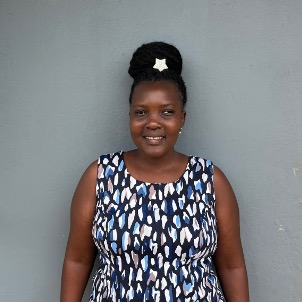
Marylyn Amony of GDPU
What are you studying at university?
I am studying community development and social justice.
How did you first hear about GDPU?
I heard about GDPU earlier in my primary level since I was studying nearby.
As an intern, what are your responsibilities?
I counsel and train people with disabilities. I also go to field activities and support the provision of assistive devices to people with disabilities. I am learning sign language and attend different skills training as well.
What type of career do you want to have?
I want to be a community development officer and work with disabled persons and disability organizations.
Why are you passionate about working with people with disabilities?
Because I am also disabled and because of the love I have for people with disabilities.
-
Conflict Survivors are Building Community for Themselves
2 CommentsTrigger Warning: This blog discusses serious topics, including war, sexual violence, and captivity. If those topics are especially disturbing to you, please skip reading this blog!
Additionally, this blog highlights a new tailoring start-up that Women in Action for Women is beginning for its members. Please consider donating to the project on GlobalGiving to help them reach their goal.
Women in Action for Women (WAW) is an organization based in Northern Uganda that supports women survivors of the Lord’s Resistance Army (LRA) conflict. Their intent is to empower women with the skills to uplift themselves, their families, and their communities through business skills and vocational training. The LRA was a rebel movement in Uganda from 1987 to 2006, which abducted approximately 50,000 children (although numbers vary significantly based on the source). Today, there are over 3,000 female survivors of the LRA conflict in Northern Uganda – 95% of which are single mothers. Returning to life after the abductions has not been easy. Many survivors did not finish secondary school and faced social exclusion once escaping the LRA, left with few ways to support themselves.
WAW was founded by Victoria Nyanyjura, a survivor herself, who has gone on to attend university in Kampala and Notre Dame and work for the United Nations. She always has a twinkle in her eye when she talks and is clearly very passionate about the work she does. WAW is also supported by Florence Nakito, a current intern who will be graduating from Makerere University in Kampala in the spring. She and I have become fast friends, as we both arrived in Gulu around the same time without knowing anyone!

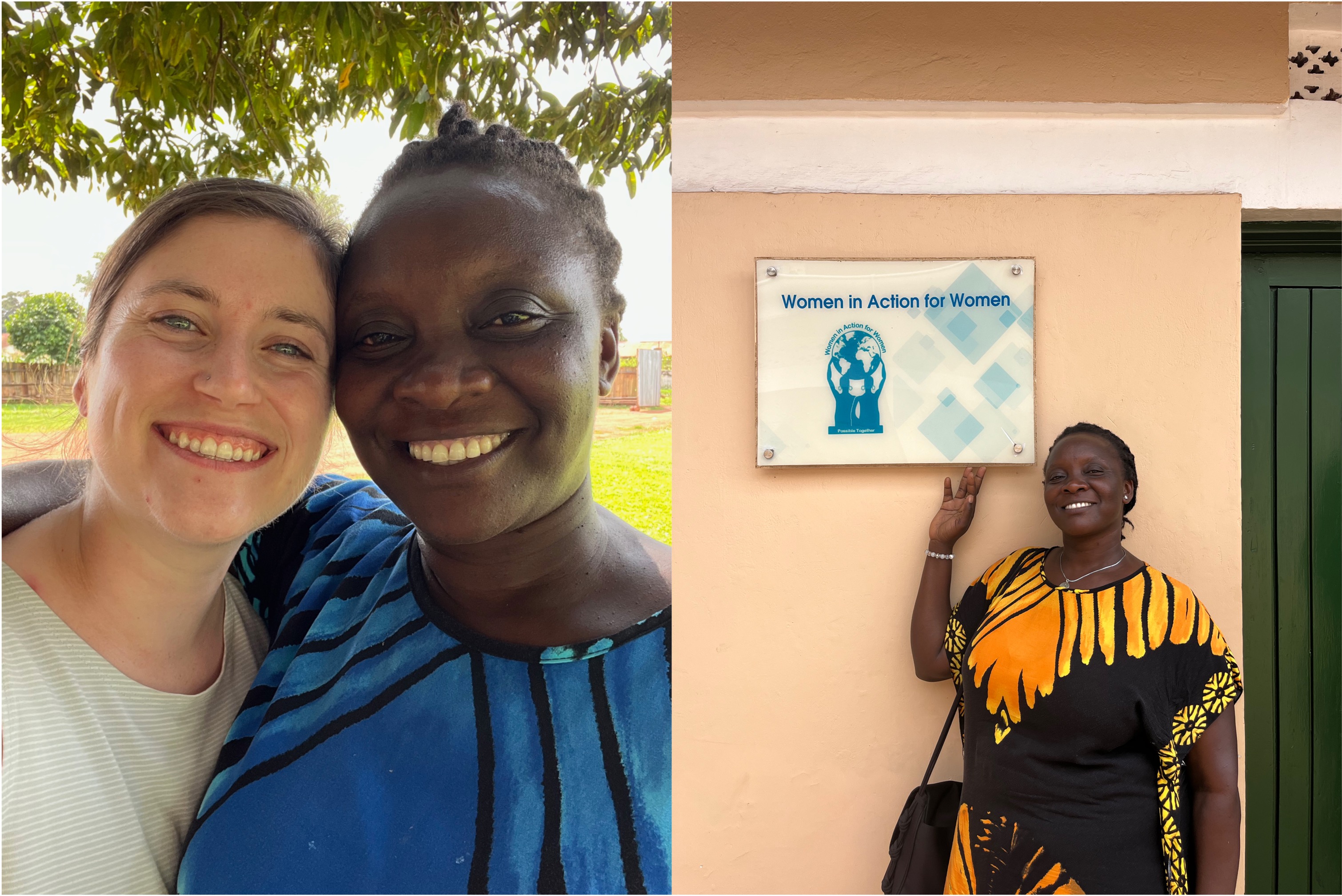
Victoria and I together and visiting the WAW office in Gulu.
Advocacy Project has a history of partnering with WAW on various embroidery and quilting projects. Bobbi of the Advocacy Project Board visited Uganda a few years ago to teach the women to embroider. Since then, the women have created multiple quilts that visualize their personal stories from the war and from COVID-19.
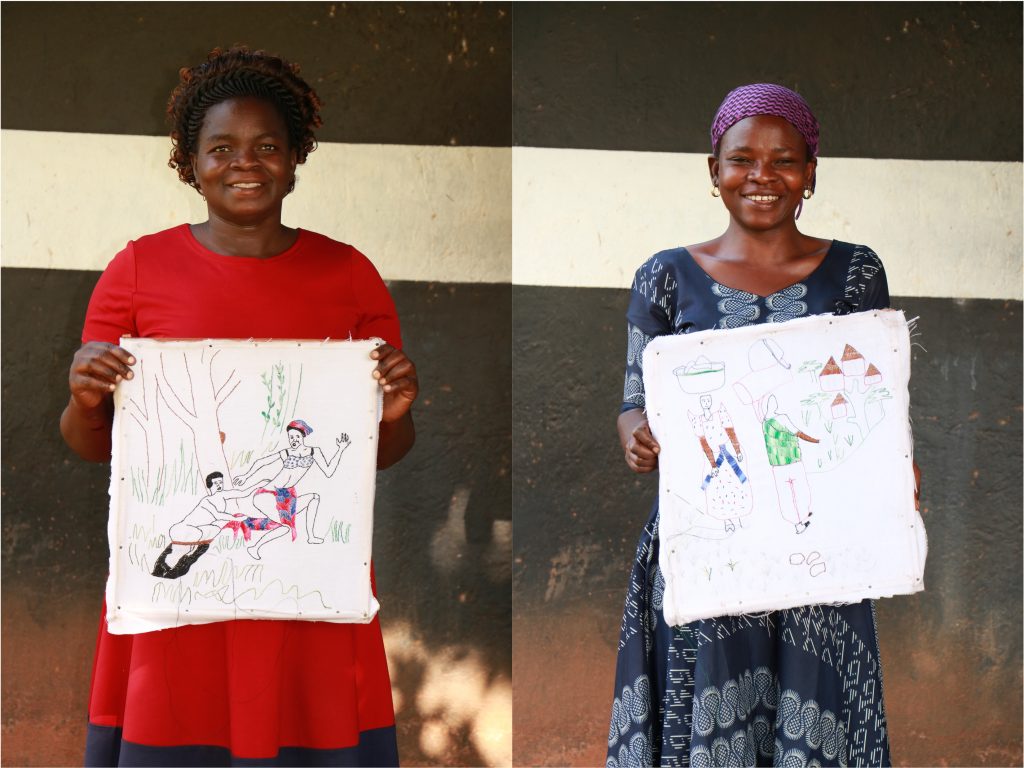
Two women of WAW holding their embroidery blocks for the War Survivors Quilt.
The current project is a nature-themed sister artists effort. The members of WAW embroider butterflies and birds and are paid for their products. These embroideries are shared with “sister artists” in North America who create quilts with the embroidery blocks. The quilts are put up for auction and all proceeds are shared back with WAW.
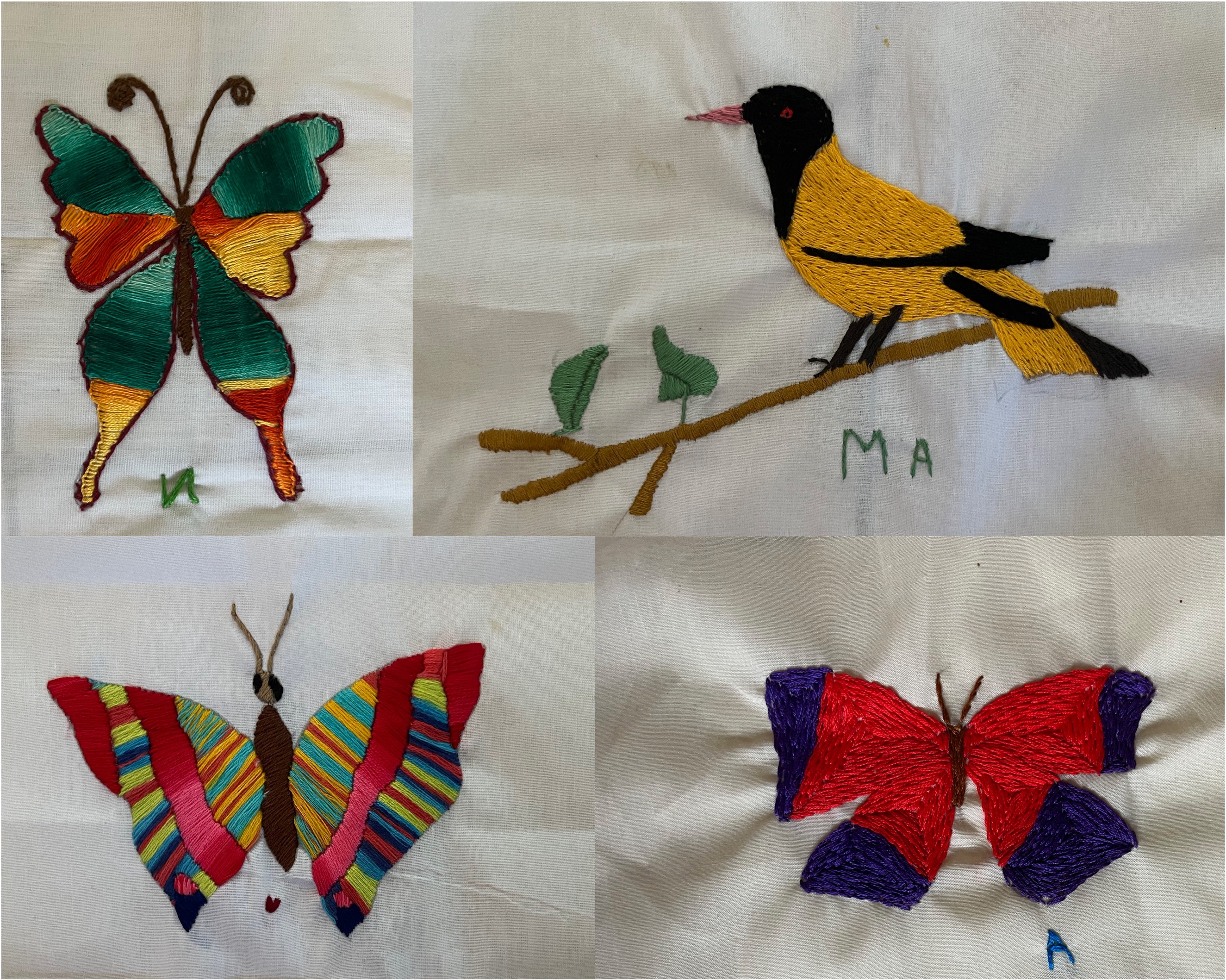
The first time I met with WAW, we enjoyed a traditional Ugandan meal together (beans, meat, rice, and posho). I gave them the colorful threads I had brought with me from the States and collected some of the embroideries they had created. I will collect even more embroideries before I leave and bring them back to the U.S. to be distributed to the sister artists. Each woman uses a unique style to the patterns and colors in their embroideries. They also add a signature (you can see the letters or symbols in the pictures below) to indicate which blocks are theirs.
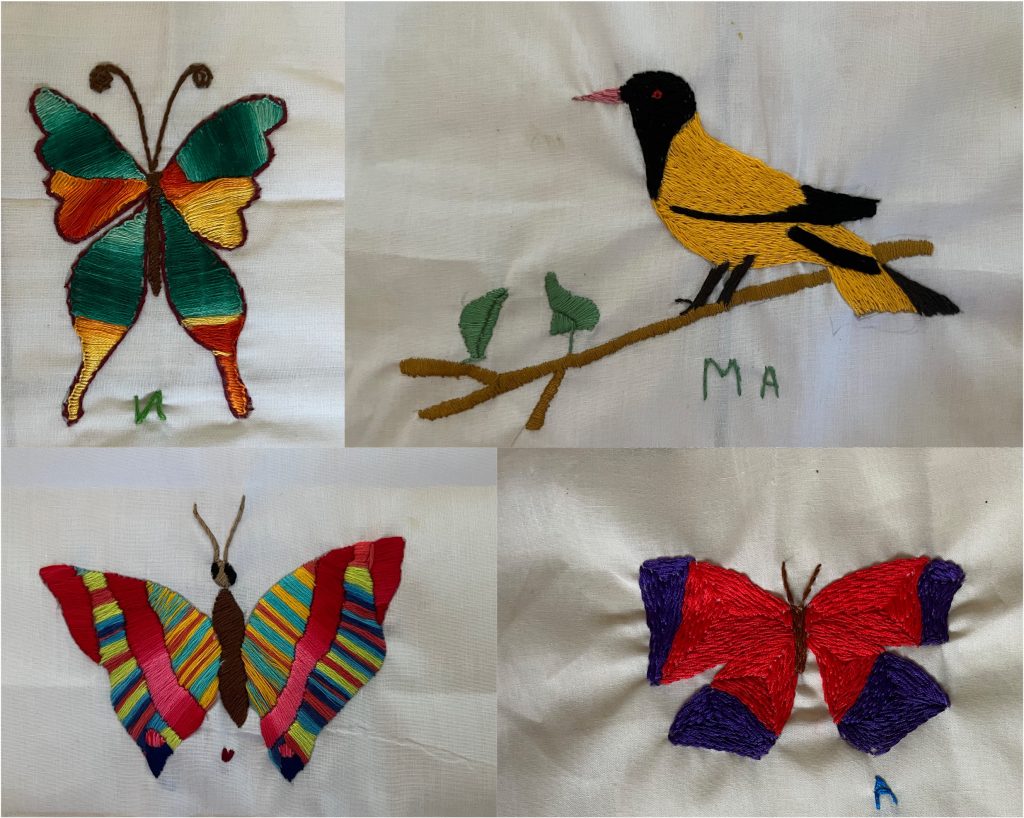
Some of the embroidered birds and butterflies.
I have been lucky to meet with Victoria, Florence, and the members of WAW a few times since arriving in Gulu and have listened to some of their stories from captivity (or “going abroad” as they call it, because they were all taken to South Sudan). These women endured starvation, rape, sexual abuse, and forced marriages and childbirth, often before the age of 15. Many of them have visible scars on their heads, arms, and chest from their time in captivity. One woman shared how they would be forced to follow a commander to the next town that was getting ransacked to make food for the soldiers and new recruits, often without food, water, or any instruction for how long they would be walking. They have also talked some about the challenges of repatriating and starting anew in their communities that look very different from when they left. You can read more about Victoria and the WAW members’ stories here.
Unfortunately, their stories are not unique, as I’ve heard anecdotes of the war from countless others in Uganda. Multiple people have shared that when growing up in Gulu, they would sleep in a different part of town at night that was safer, and then return to their homes in the morning. One person talked about how all four sons from their neighbor’s family were kidnapped, and years later only three returned. I’ve learned from GDPU that the Acholi sub-region has more people with disabilities than other areas in Uganda because of the war. These disabilities may have resulted directly from LRA brutalities, like forced amputations and PTSD, or indirectly, like mental disabilities caused by starvation and malnutrition and the generational impacts of trauma. While listening to these stories aches my heart, it is also a huge honor for people to feel comfortable sharing these personal and family histories with me.

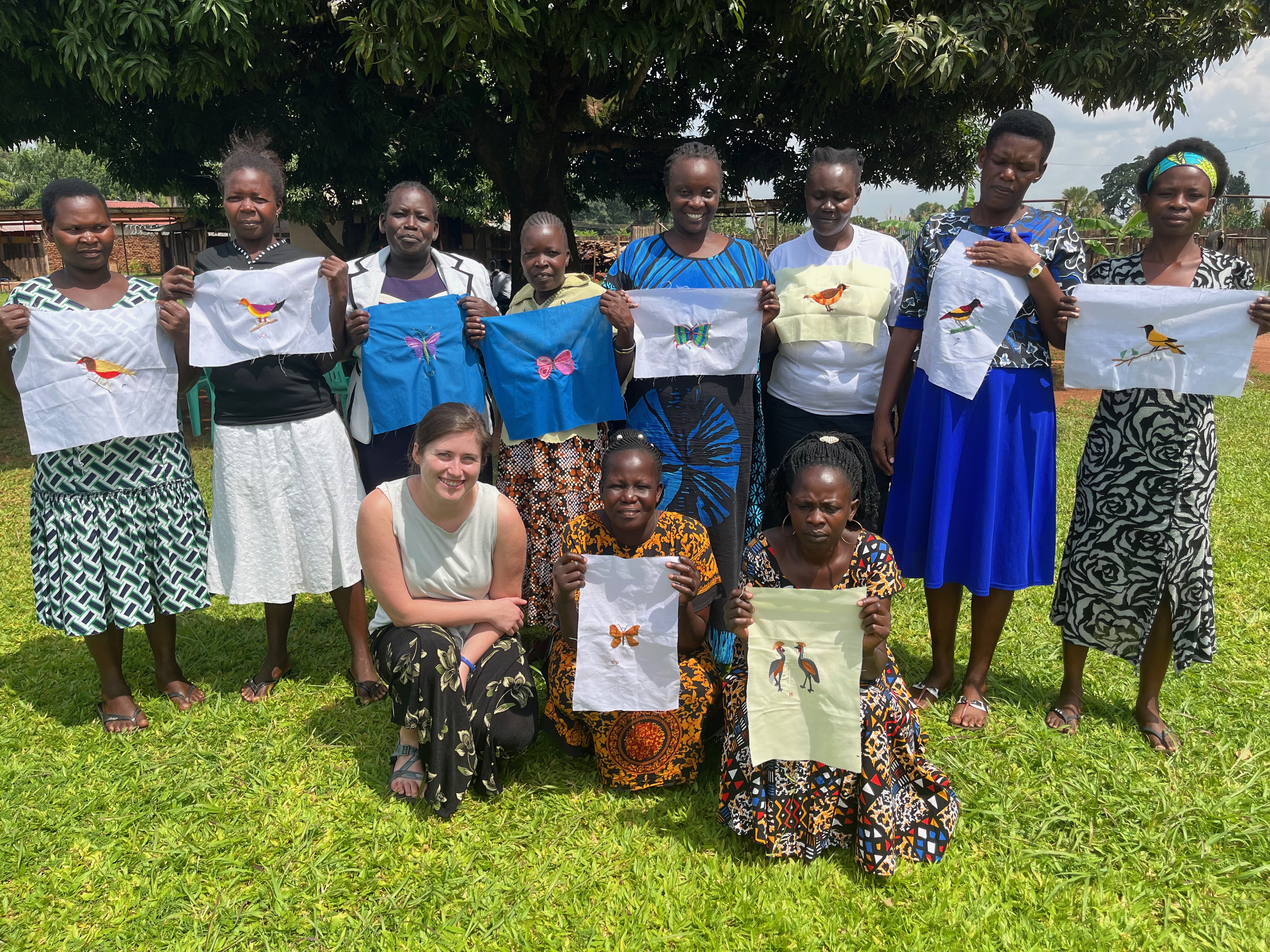
Me and some of the women of WAW with their embroideries.
Organizations like WAW are driving recovery and support for survivors by not only providing them with tangible skills, but also by creating spaces where survivors can safely build community with others who are recovering in tandem. WAW is currently in the process of designing and implementing tailoring training program. This program would enable the women to expand their existing artisan skills into clothing repair and production and help them initiate a business to receive a direct source of income. Please consider donating to their start-up to support this incredible organization.
-
Meet GDPU: “I have the passion to see that someone’s life changes completely.” – Faruk Musema
3 CommentsThis is an article in a series profiling staff at GDPU, the Gulu disability community, and those who call northern Uganda home. All contents of this article have been approved and shared with the permission of Faruk.
Faruk Musema has worked at GDPU since 2014. He has served in many roles, as a Guidance Counselor, Monitoring & Evaluation Officer, Skills Training Center Lead, and now as the Project Coordinator. He has an undergraduate degree in Social Work and Community Development, focused in Disabilities, from Kyambogo University and a post-graduate degree in Community Development from Gulu University. He hopes to pursue a Masters in Development Studies in the future. Faruk is always smiling, singing, and/or dancing in the office, and in watching his interactions with persons with disabilities, it is clear that this work is really fulfilling to him. Faruk grew up in Onang Village in the wider Gulu District, but Gulu City is where he calls home. He currently lives in Gulu with his wife, Sharon, and their two kids. In addition to working at GDPU, Faruk founded and is the director of Ability Sports Africa, the only organization in Uganda that provides sports programs for persons with disabilities.
In this interview, Faruk speaks about music videos that students have made at GDPU. You can view one of the music videos here.
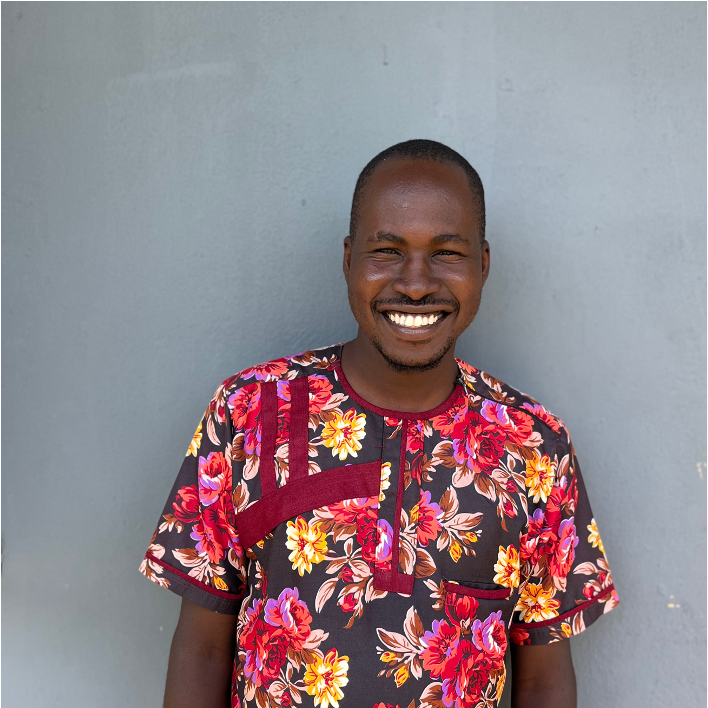
Faruk Musema of GDPU
How did you first hear about GDPU?
When I was at university, I gained interest in disabilities when I took a Kyambogo disability course. I started checking which areas or which organizations within my locality work with persons with disabilities. So, I got to [learn] more about GDPU in 2010.
I met one of my friends [at GDPU]. He’s called Charles. I studied with him in high school. He’s a victim of landmine; he was amputated completely [from below the waist]. When I met him here, he played wheelchair basketball. So, I wanted to play with them and I gained more interest in their organization.
But I did not think of working here. When I completed university in 2013, I applied for a job with VSO. Then they posted me here – I found myself at GDPU. It was a very, very good thing that happened to my life.
What is your role at GDPU?
So [when I started] my job title was a Guidance Counselor. I [had] been supporting our youths with disabilities on psychosocial support, guidance and counseling, group counseling… and all other kind of support that can help our youths with disability to cope up with the stress and the trauma they had. I worked with mental health, reproductive health, and other institutions to ensure that if I don’t have knowledge in this area, I can refer these youths to get services from those who can best support.
I was also leading the skills training center here. I was the principal of the center, Guidance Counselor, and also the Monitoring and Evaluation Officer. I couldn’t leave the place at night because I need to ensure the safety of our youths. There are other youths who are a little bit bigger, there are others who are young… Back then we never had matron and patron. So, if everyone goes out of this office, I needed to stay to ensure that they are well. If there is no issue, then I leave.*
Right now I’m working as a Project Coordinator. I coordinate two projects. One is the V-PLUS (“Vocational Plus”). The “plus” component is the music, the follow-up support – these different tailor-made trainings that we are offering to our youths – because it is now something beyond the vocational training. The project is supporting 115 youths with disabilities in Gulu, Amuru, Omoro, and Nwoya Districts. We follow up on them on a monthly basis. We go and check on businesses that are running, the challenges that they are facing, and tailor trainings based on the gaps.
We have brought in a new concept of peer mentors. We wanted the peers who were successful beneficiaries to take the lead in supporting their peers who are still struggling. So, we are training them. We are building their capacities. We have a total of 12 peer mentors. And they are coming from all the districts. They will be helping us in mobilizing and following up on the youths. We train [the peer mentors] and we want the peers to train the other ones so that it becomes easier for them to co-exist. Because when you hear something from someone whom you are in the same age group, it becomes easier for you to work, to communicate, and interact.
The second project is called Viva La Visa. It is more of the music program – music for social change. The donor for that program is Viva La Visa UK… During our skills training program, youths with disabilities showed interest in singing, in music. But we did not have that opportunity to have those kind of [trainings]. So, one time, I gave them money. I told them, “You go and make the music. You go to one of the studios. You go and record. I want to hear that music.” Then, they went and recorded.
In two days, they came with the music. It was a very nice song. The song was about how we, people with disability, we are also human. It had a very strong message. So, I [thought], “Why don’t I record this song?” I made the video locally. Then I put it on YouTube and share also with those of Mac, the donor of V-PLUS. They shared it with their friends and that is how Viva [La Visa] got interested.
You’ve been at GDPU for 10 years now. What work have you been proudest of here?
One is ensuring that the skills training program is running. The first skills training program ended in 2015. But I kept on pushing it. And it is something that has made the center more vibrant because the identity of GDPU is now skills training for youths. Everyone knows when they hear about GDPU, they think of skill development for youths. That is something that makes me really proud of what I’ve put in place.
Secondly, sports for persons with disabilities. I’m happy to see that a number of our youths have now got an opportunity to travel outside Uganda to represent the country – like Brenda. I introduced Brenda in athletics in 2018. And from there she started gaining slowly, slowly. Right now she’s a Paralympian. In August she’ll be going to Paris to represent Uganda.
And that makes me also happy to see that. These youths, they have gained esteem. They feel proud of themselves. They are confident. When I go to the market, I get to see all my beneficiaries. They are working. And all this, they give it back. And I feel happy when they talk about it.
Most people [work on] projects because of money. They don’t come because of the passion. So the difference I might be having [compared to] many of the people is that for me I have the passion to work, to do and deliver, to see that someone’s life has changed or changes completely. I have that in me.
How did you become passionate about working with people with disabilities?
Way back when I was young, I had a friend of mine called Saidi. Saidi is a person with physical disability. He has been very close to me. But when we used to go to school, [my friends and I] would abuse him, sing songs about his disability, all these things. But there’s a time I sat with him, he was telling me, “I feel I don’t like even being me and because people talk about my disability.” That is when my mindset started changing.
The expression on his face was something that made me feel that, “Okay, we have been doing something wrong to this guy.” He dropped out of school because of us. But we stayed close and lived in the same blocks [of housing]. I started engaging with him, encouraging him. But as a young child, I did not think much of the support that I’ve been giving him.
So when I joined Senior One (equivalent of 8th grade in the United States), that is when I met Charles. His disability again gave me a lot of pity. I related it to Charles, Saidi, and I decided I need to do something in this line [of work] to ensure that I support persons with disabilities. I support people with disabilities so that they can also live a dignified life. They inspired me.
What do you hope GDPU accomplishes in the next ten years?
GDPU is an umbrella organization for persons with disabilities. And this one started way back and it has been [operating] during the war time. It has been serving Gulu, Omoro, all these districts that were part of Gulu [District]. GDPU is one of the strongest organizations for persons with disabilities in Uganda. It follows NUDIPU, the national union. We get our own donors, we get our own support. But when you compare us with all these other NGOs, OPDs (organizations for persons with disabilities) in different districts, most of them they depend on the national union. And those that are within Gulu District depend on us. Our projects target youth from [other districts] and bring them here, or we give support directly to them.
We [should] register as an NGO organization that can work in more than five districts. Right now, GDPU is operating on CBO (community-based organization) registration status, which is not something that I really desire.
So, my vision for the organization is to go regional – we become an umbrella for the northern region. We are very big. There are other small, small organizations that are being now created that are [in competition with] GDPU… All these organizations for persons with disabilities should subscribe to GDPU. We will build a very strong network among persons with disabilities in the region.
It will become easier for us to channel support based on needs. Right now, projects are concentrated in a specific area… We have left out the hard-to-reach districts, like Omoro District – they have bad facilities and they have the highest number of persons with disabilities. If we have a [regional GDPU] system, we can understand where the challenges are, we compare with other [challenges], then we support them. It would become easier for us to balance our support based on the needs.
If a donor showed up tomorrow and gave GDPU the equivalent of $1 million USD (about 4 billion Ugandan Shillings), how would you use it?
One is forming that [organization] structure that has connection with all the districts within Northern Uganda. Then, while the structure is being formed, we’ll do a survey based on needs, checking on the gaps that are there, the challenges. From there, we’ll develop a [project] concept based on the problems identified in the different districts.
I think that will help us support our people best. Because we don’t want to dictate. When money comes, people start dictating, “Oh, we need this, oh, we need to build bridges.” Yet, people’s needs are different. So, if survey is done, a concept is developed, and basing on that need, that is where money can be channeled. Then will need maybe 400 million or more. Then we will have a project based on what the community wants. The money is channeled there.
I think that is how this money can be used. When big money comes like that, you’ll get confused and you start doing projects that have no impact. But if you do dialogue meetings and consultations with persons with disability in different communities, you can get their idea. You get what they want.
What is something you wish people knew about GDPU?
One thing is that GDPU, what I would tell people mostly is that GDPU is an organization that advocates for the rights of persons with disability. We want to see people with disability live a dignified life. And we have services that we offer to our people with disability so that they can live like other people within our communities.
Is there anything we did not talk about that you would want people to know about you or your work?
I did not talk about me going to India for training. The training that I went for gave birth to me starting Ability Sports. In 2019, I went for about seven, eight months to Kerala, India. I went there and studied more about organization management skills.
They developed us on how to manage your organization as a founder. When you are going to start your organization, you are going to be the accountant, you are going to be the media personality… You have to know knowledge of how to build your website, update it, go to your Facebook page, you update it. You have to have some basic knowledge on how to shoot videos. They trained us on writing proposals, donor proposals, pitching. How can you pitch to this person in 30 seconds so that they understand more about what you want?
So, we are trained all around and that is when I came and started [my organization]. But my organization was affected by COVID. I came back in December 2019 [from India]. Then COVID. So, it affected everything. But it is the same knowledge now I’m applying at GDPU.
—
*Note from Julia: Some students at GDPU live here during the school term in dormitories. The Matron (woman) sleeps at the school and monitor the students overnight, ensuring their safety. It is common for primary schools to have a boarding section attached to them, often for P7 levels. This was especially necessary during the conflict in Northern Uganda over the last 30 years.
-
WASH at Kulu Opal: Sweat Equity in Action
3 CommentsBefore starting construction, GDPU held a series of meetings with the Head Teacher, construction Contractor, School Management Committee (SMC), and Parent Teacher Association (PTA) to discuss the project and answer questions. Importantly, the SMC and PTA mobilize parents and community members to dig the latrine pit for the project and monitor on-site progress. Gaining their approval and buy-in was vital to the project’s success.

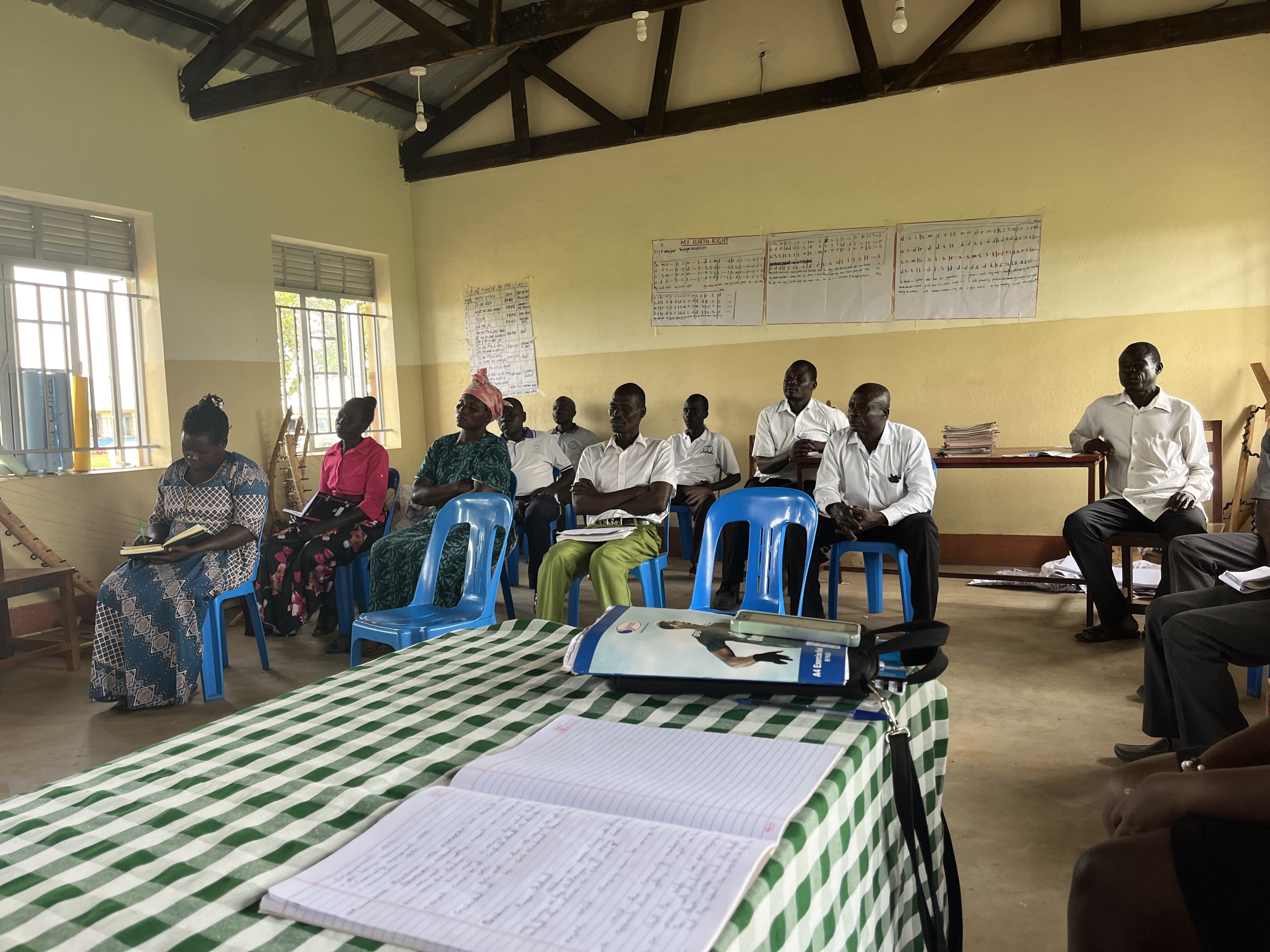
SMC and PTA members at our meeting
This requirement reminds me a lot of the “sweat equity” vision employed by Habitat for Humanity – to drive ownership of a project by requiring active contributions from the community. The GDPU staff and I have talked a lot about the issues they see with various latrine projects in the District. Challenges include that the community vandalizes the toilet and abuses it on weekends and holidays. The school may let teachers and staff use it instead of students or are just not willing to engage in the maintenance required to keep the toilet operational (I’ll be speaking more to this in another blog on the monitoring of toilets in Gulu District).
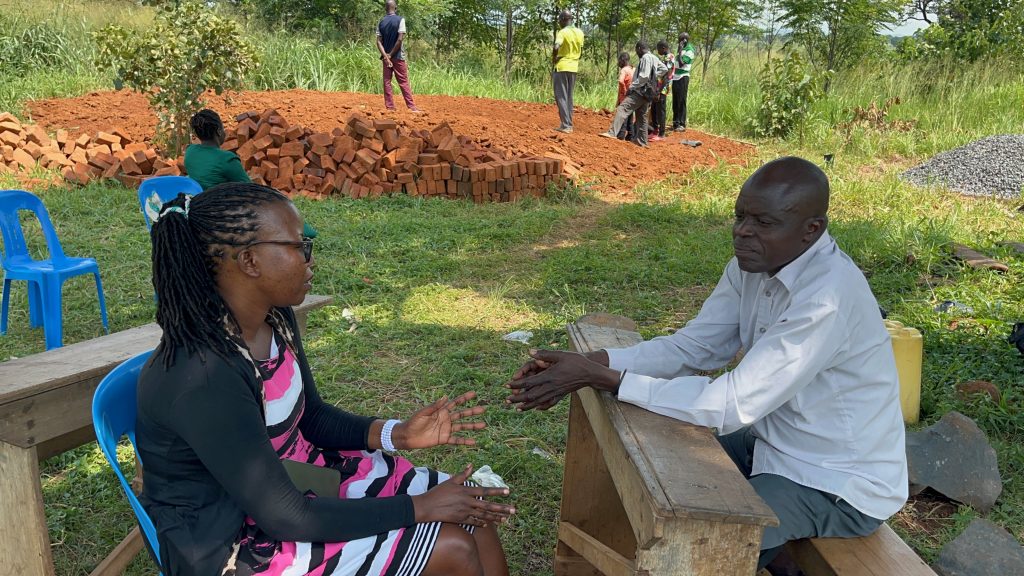
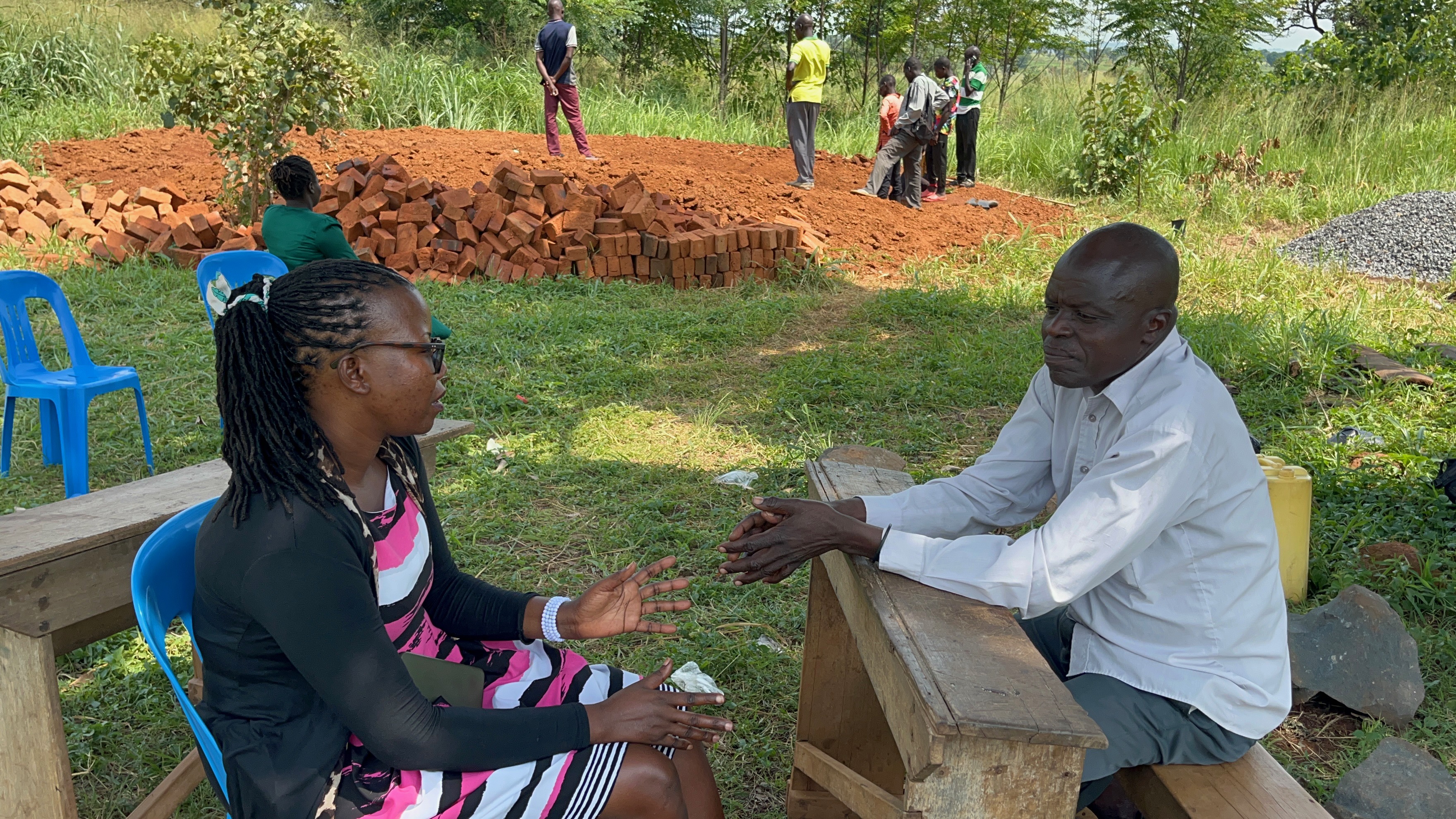
Emma speaking with the SMC Chair
Communities need to be involved in the project throughout the design and implementation, so they truly find ownership in the care and maintenance of the latrine after the project handover. This aspect of GDPU’s WASH program design contributes directly towards the sustainability of the project.
The SMC and PTA were eager to approve the project, grateful for GDPU and AP’s presence, and agreed to their responsibilities. As soon as the memorandum of agreement was signed among GDPU, the Head Teacher, the SMC, and the Contractor, the parents began digging!

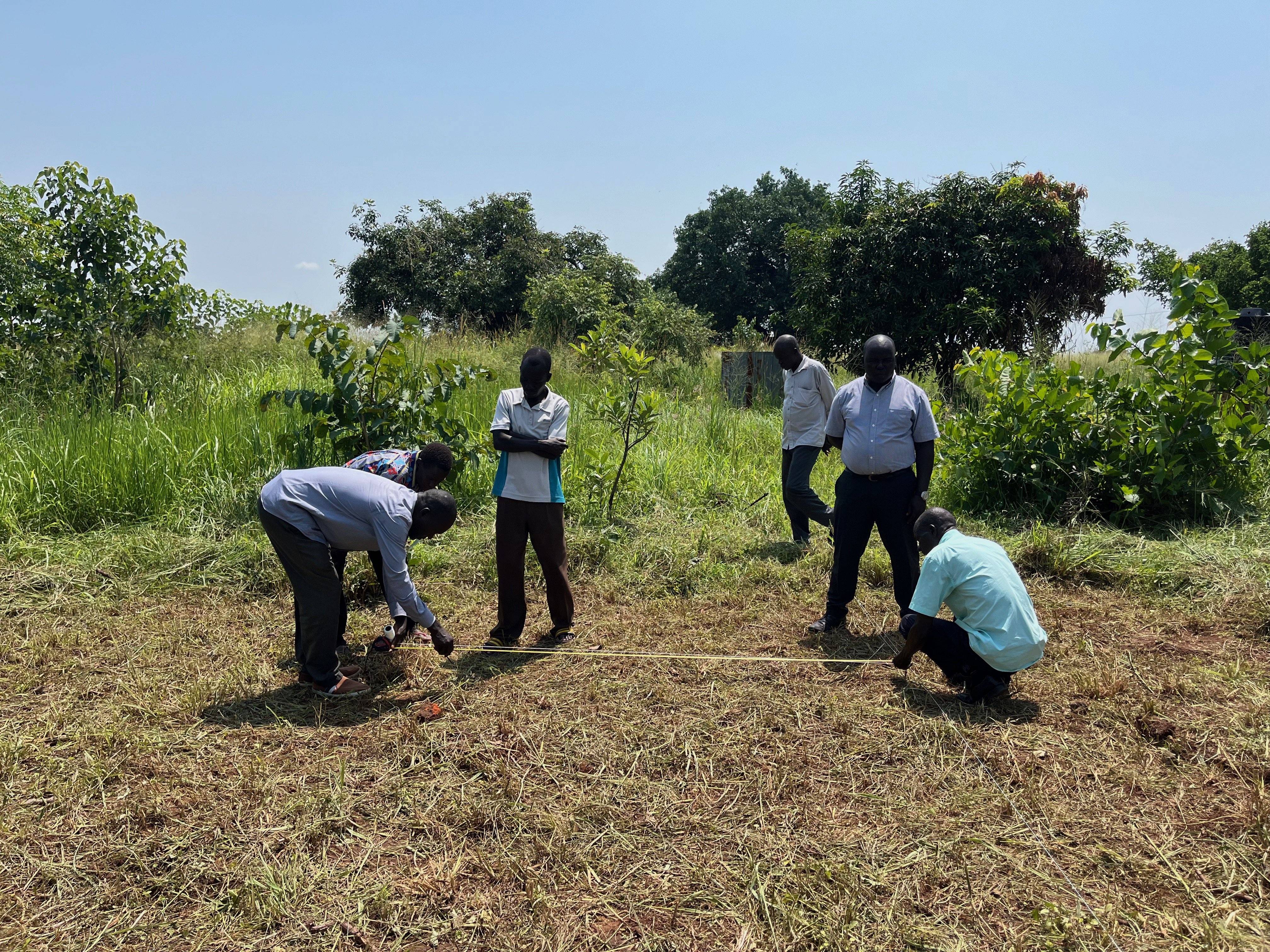
The Contractor, Head Teacher, and SMC identifying and measuring the final location of the latrine
The pit will need to be 9 meters long, 2.5 meters wide, and 3 meters deep. Over the following two weeks, Emma and I visited Kulu Opal regularly to monitor progress and talk with the parents. In Panykworo in 2023, over 100 mothers and fathers showed up in shifts to help with digging, finishing the pit in a record 5 days. This time, it was a little more challenging to engage parents. But with the drive of the Head Teacher and SMC, a small group of dedicated fathers dug through the layers of rock and dirt to complete the pit.

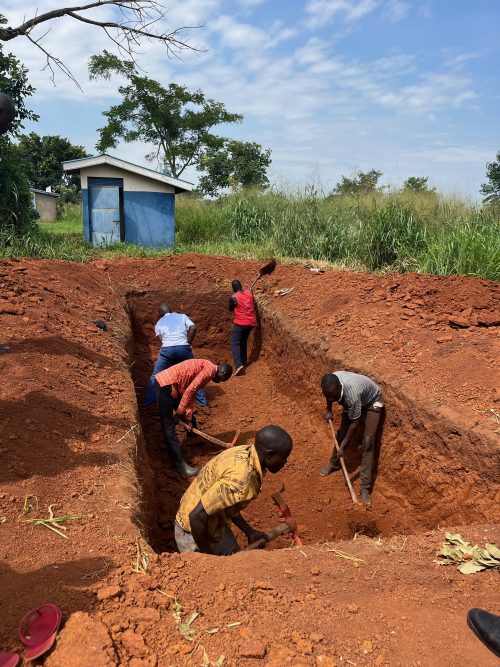
Parents digging the latrine pit at Kulu Opal
Skim through the following photos below to see the progress! Now that the pit is complete, the Contractor and his team will take over and begin the construction of the latrine.
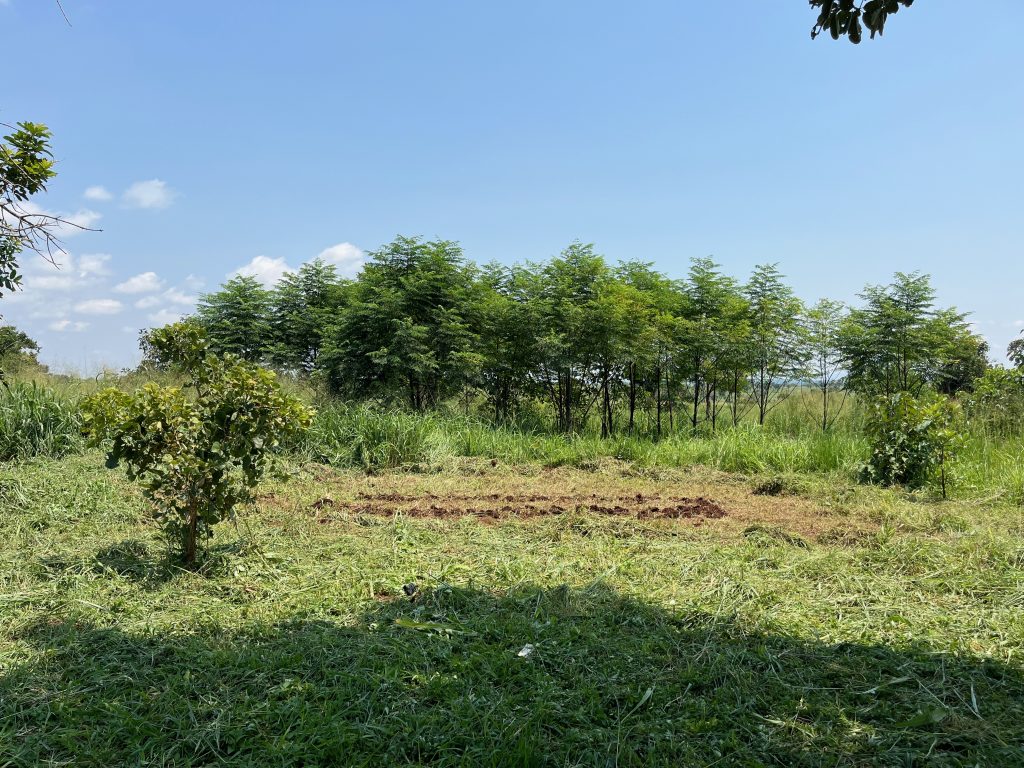
Kulu Opal project progress on June 18

Kulu Opal project progress on June 21

Kulu Opal project progress on June 25

Kulu Opal project progress on June 28
-
Coach Julia, Reporting for Duty
6 CommentsIn addition to his role at GDPU, Faruk is the founder and director of Ability Sports Africa – the only non-profit in Uganda aimed at supporting youth with disabilities to play sports. Faruk invited me to volunteer with his organization, and every Sunday morning since I’ve spent at Pece Primary School helping coach the only girls team in the league.
Girls face extra cultural, social, and safety barriers to play sports in Uganda. Girls are expected to contribute to household responsibilities, like fetching water, cooking, and caring for siblings, leaving them with less unburdened time than boys. It can still be social taboo for girls to play sports among some of the more traditional communities. Whereas boys can easily change into their uniforms in front of everyone, the girls have to use the latrines at the school. But there isn’t enough room for all of them, so many girls change in the open air between a wall and the bathroom stances. I’ve watched the boys often lurk closer and closer to the girls as they change (I now stand outside the latrines like a watchdog, staring down and telling off any boy who comes near).
For these girls to even attend a soccer training is a minor miracle in itself.
During my first Sunday with the team, “Director Faruk” introduced me and told the girls that he “brought them a woman coach from America.” The girls all looked curiously at this strange mzungu with a baseball hat in front of them. I was the only woman (and only white person) of all the coaches, volunteers, and parents present, adding to the rightful hesitancy. I helped lead the girls through warm ups, encouraged them to cheer for their teammates, and gave everyone supportive high fives. They are still learning positioning and how to pass, so the games look a bit like bees swarming to the ball.
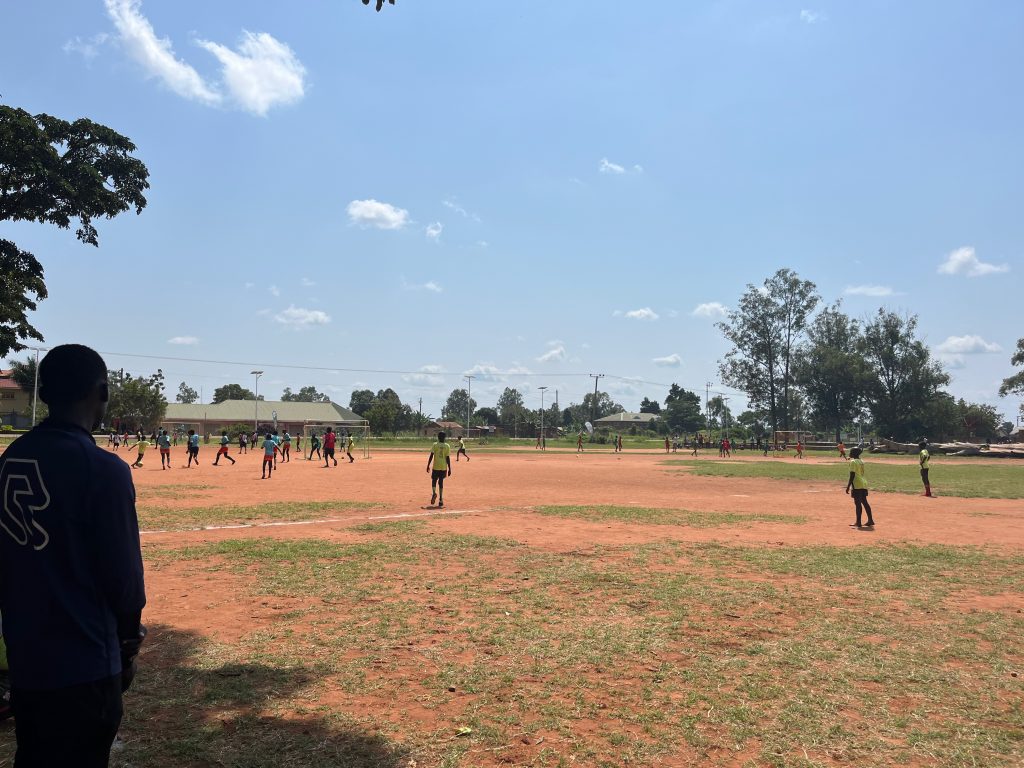
Football match at Pece Primary School
After the game, the girls asked me a whole list of questions that they had probably been keeping inside for the last few hours. I’ve had some practice now fielding questions and have learned to respond in a way that is more aligned with the cadence of a Ugandan. The conversation went something like this:
Where are you from? United States, on the other side. What state? Originally I’m from outside of New York City – one hour drive by car. It’s a small town, smaller than Gulu. Now I live in Washington D.C. where I go to university. Who is in your family? I have a mother, father, and brother. My brother is called Nicholas. Are you the first born or the follower? I am the first born and my brother follows me. How many years are you? I am 27. What do you study? I’m getting a master’s degree in development studies. But my university degree is in engineering. Why are you in Gulu? I am working for Gulu Disabled Persons Union for the summer with Director Faruk. How long are you in Uganda for? I’ve been here for a couple weeks. I will leave in August to go back to school. Why don’t you stay here forever? I have to go back to school! Can I touch your hair? Yes, that’s ok. Why is your hair like that? My hair is too slippery – it won’t braid like your mom’s hair. So, I put it in a ponytail like this.*
And of course, I returned the favor:
Do you go to school? Who is in your family? What do you want to be when you grow up? Lawyer, doctor for babies, doctor for animals, teacher, football coach. Who is your favorite football player? Messi. Ronaldo. Daka. Who is your favorite women’s football player? I don’t know. What do you mean? You don’t know one women’s football player?
Women don’t play football.
I paused and stared at the 10, very curious girls staring back at me. And it almost brought me to tears. I grew up admiring the soccer players of the United States Women’s National Team (USWNT); women who showed that being a girl means being strong. The USWNT uses their platform to fight for social justice. Their fight for equal pay has and will continue to positively impact other women athletes and women in any professional. The team has inspired girls and boys alike. And that’s just one team – there is a growing movement in the United Kingdom and Japan and Spain and Australia and Nigeria and Zambia to support their women athletes.

USWNT Signing the Equal Pay Agreement in 2022 (CBS News)
While I understood that having a WNT supported by your country’s federation is rare, I hadn’t spent a lot of time thinking that there must be so many places in the world where girls don’t even know that professional women soccer players exist. This gave some context to the comment that one girl wants to be a football coach when she grows up, not a player, because she doesn’t think a woman can be a professional football player.
This summer has been a lesson in many things, one of which is unpacking new layers of my privilege. It is a privilege to have role models that are women athletes, and even more so to have these role models look like you. But at a baseline, it is a privilege to just know that these role models exist.
Back to my conversation with my team:
Yes, yes there are professional women’s football players! There are so many of them! There are leagues all across the world for professional teams and there’s a Women’s World Cup. And there are players not just from the other side – from Africa, too.
I quickly pulled up pictures on my phone of professional African players I knew of in the National Women’s Soccer League (NWSL) in the United States. I showed them Barbra Banda, a forward from Zambia on the Orlando City Pride who is arguably the best striker in NWSL right now. I showed them Temwa Chawinga, a Malawian player on the Kansas City Current whose team is at the top of the NWSL table. I showed them a picture of the Washington Spirit, the DC NWSL team, who have three superstar strikers in Trinity Rodman, Croix Bethune, and Ouleymata Sarr; three Black women with hair in braids, braids that are probably similar to the mothers and aunties of the girls on our Gulu soccer team.
And in that moment, I unlocked a whole new privilege: to watch the moment someone’s world becomes wider; to watch young, Black, African girls who love football find new role models who look like them. Spending time with this team has and will continue to be one of the most impactful experiences of my time in Gulu.
—
* The “other side” is a phrase used to denote distance. It is not akin to the connotations of “the other side of the tracks” that we have in the United States. It could refer to the other side of town, the other side of the district, or somewhere outside of Africa.
The idea of “following” and “first born” are used to describe sibling order. If you are the oldest sibling, you say that you are the “first born” and other siblings “follow you.” If you are a younger sibling, you say that you “follow” your older sibling or are the “follower”.
Many people, adults and children alike, are fascinated with my hair. It makes sense – my hair is light brown and straight as a pin. People often ask me why it’s not in tight braids or twists common for adult women in Uganda, and I have to explain that my hair won’t hold that shape.
-
WASH at Kulu Opal: “Operational” Toilets
3 CommentsThe purpose of our first visit to Kulu Opal Primary School was to meet with the Head Teacher (equivalent of a Principal in the United States) and discuss his role in the project. The Head Teacher is the primary contact for the project and responsible for overseeing its implementation on a daily basis. Mary, Emma, Walter, and I drove down a dusty and divot-ridden road for an hour to reach Kulu Opal – certainly the most remote place I have yet to visit in Uganda.

Views from our drive to Kulu Opal
The Head Teacher is named Layroo Gioffrey* and is a smart, motivated man. He quickly assumed the responsibilities of mobilizing the parents, Parent Teacher Association (PTA), and School Management Committee (SMC) (equivalent to the Board of Education in the United States) and overseeing the project implementation on site. He has warmly welcomed us to his school and is kind enough to offer us lunch (chicken, posho, and beans) when we visit!
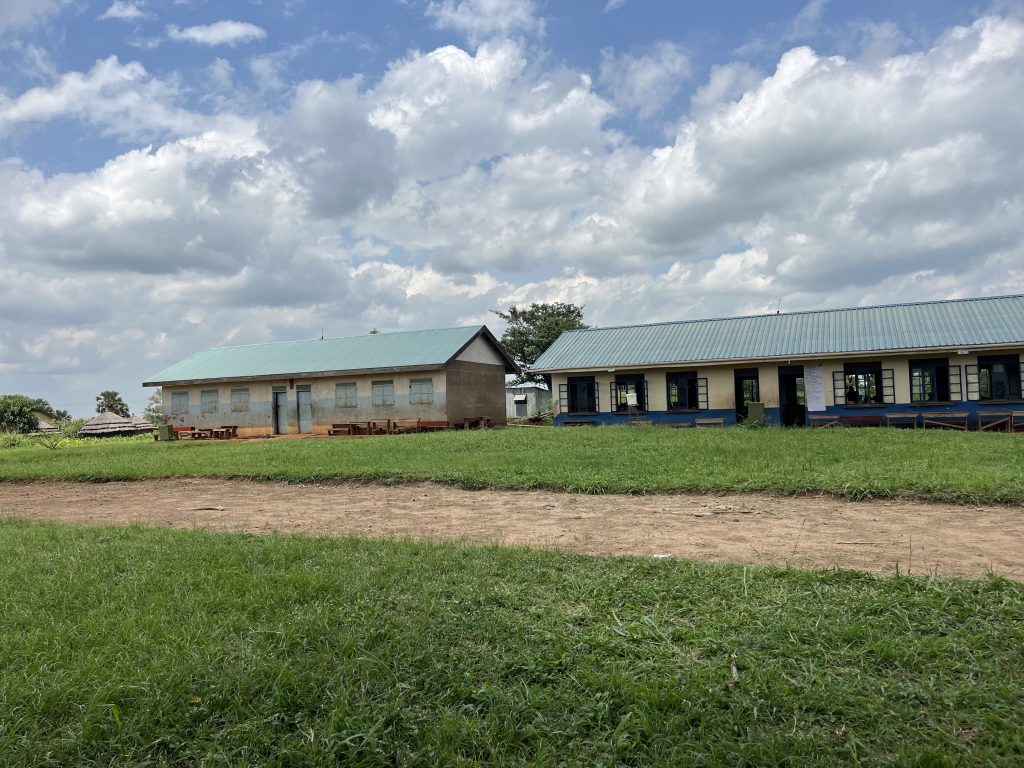
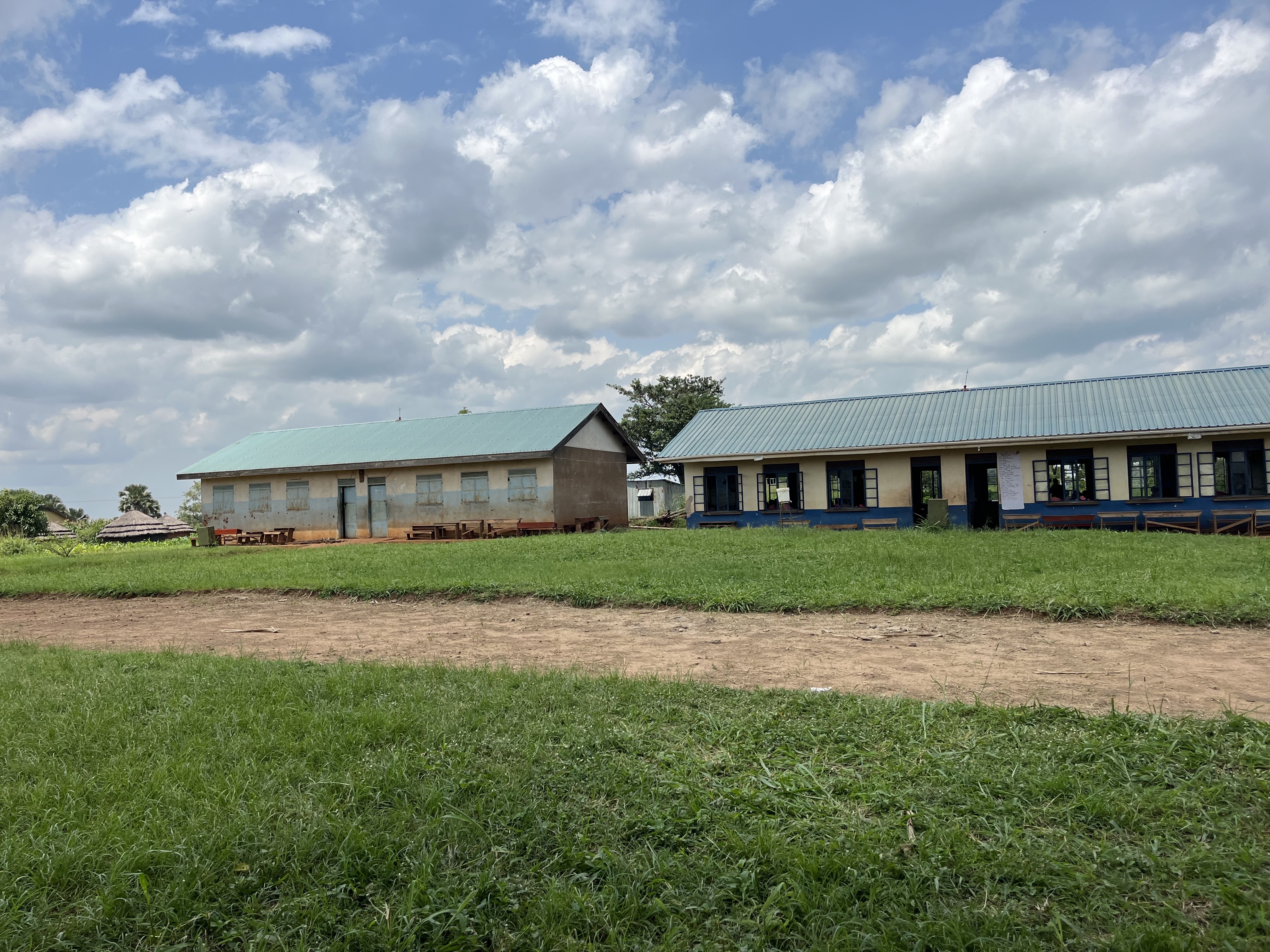
Kulu Opal Primary School
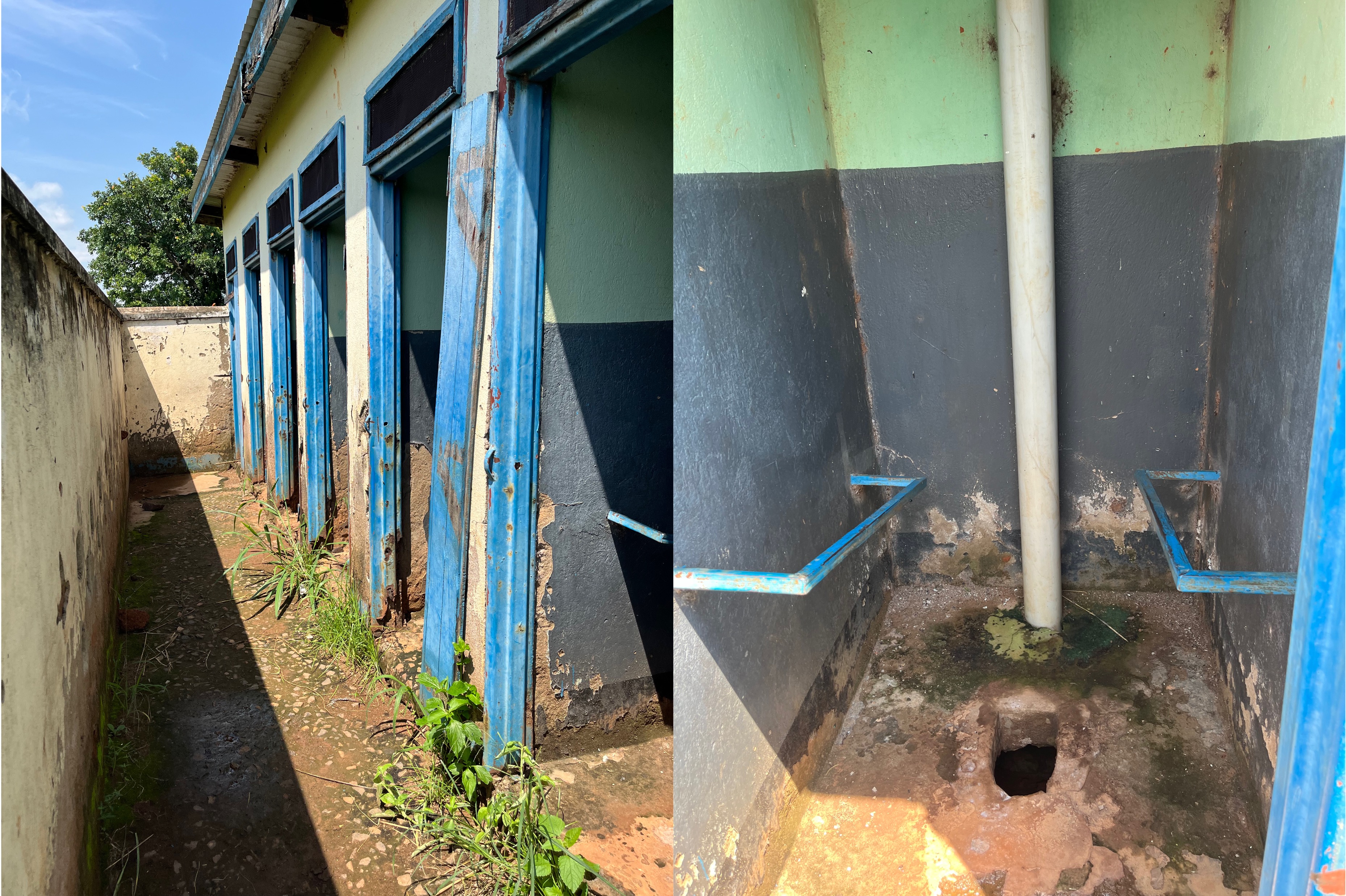
After speaking in the Head Teacher’s office, we toured the existing latrines. The school currently has 4 sets of 5 stances – 2 sets for boys and 2 sets for girls. However, one of each sets of stances are non-operational.
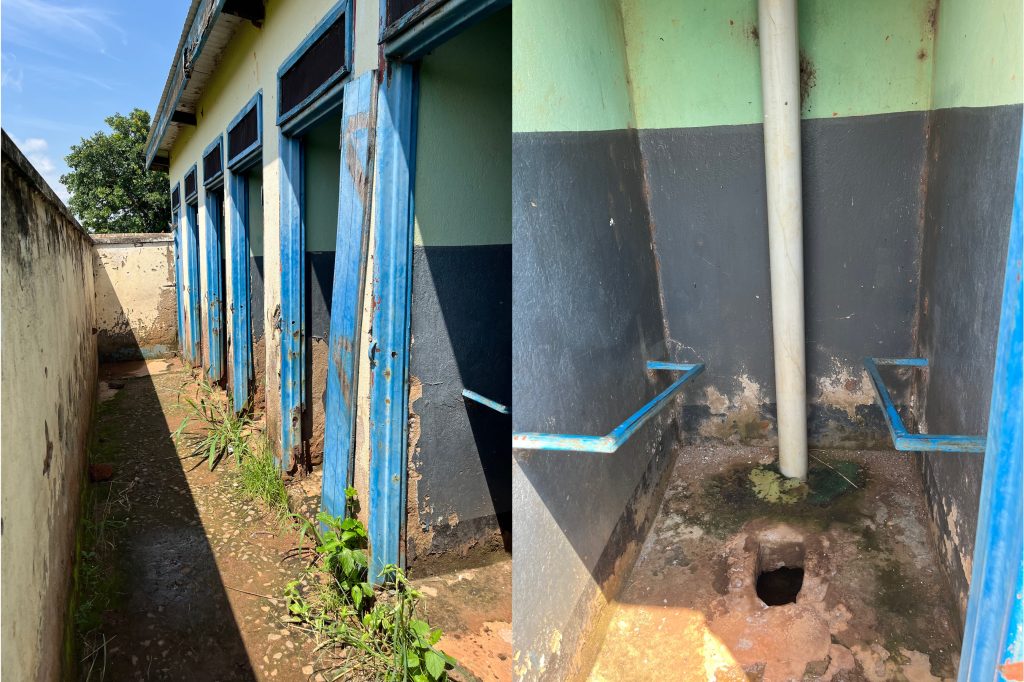
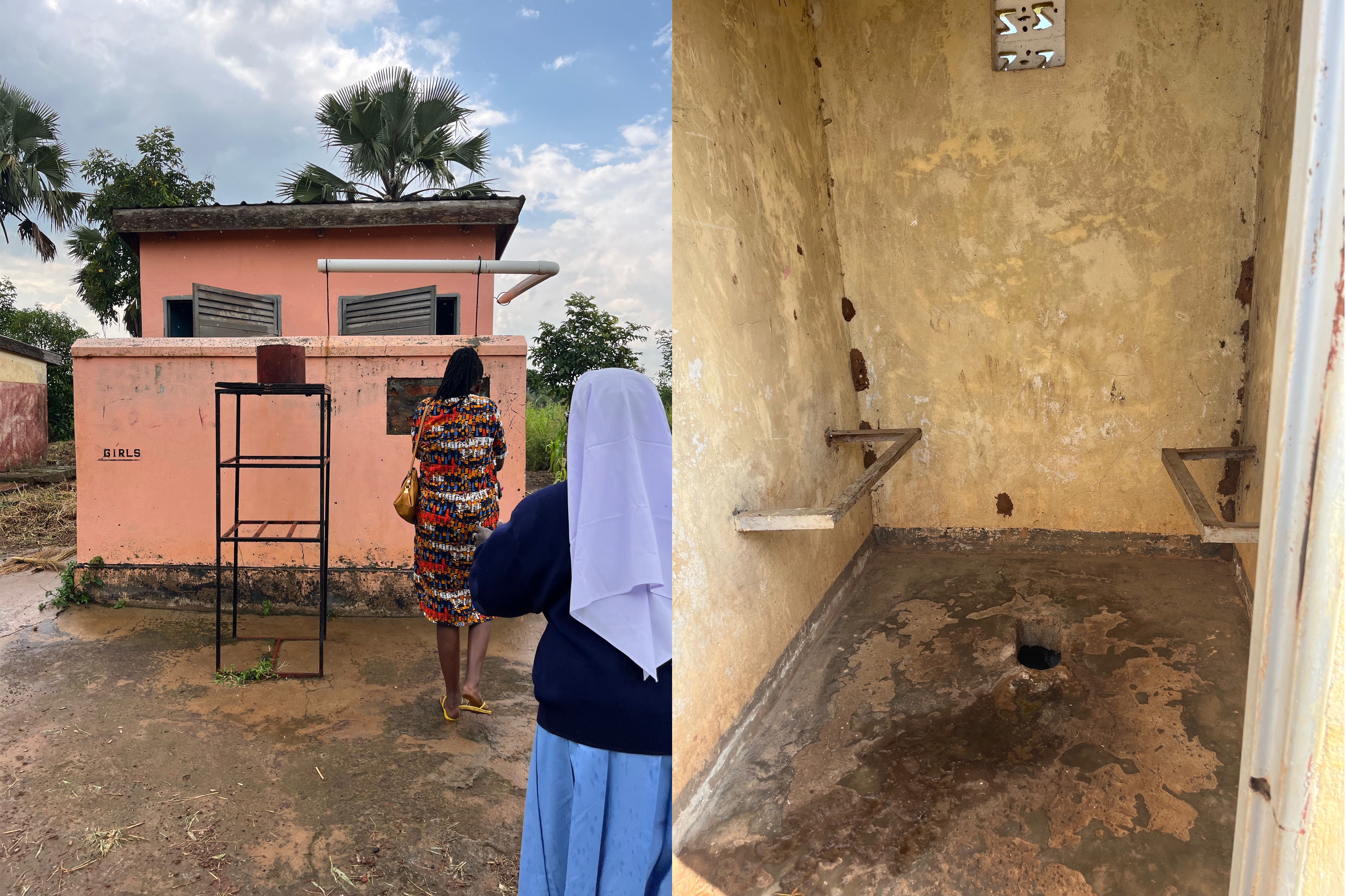
Non-operational girls toilets at Kulu Opal
The District Education Office set a standard of at least 1 latrine for every 40 students. Unfortunately, Kulu Opal does not meet that mark, with only 1 latrine for every 80 boys and 1 for every 72 girls. Even the stances that are “operational” are not in good condition.
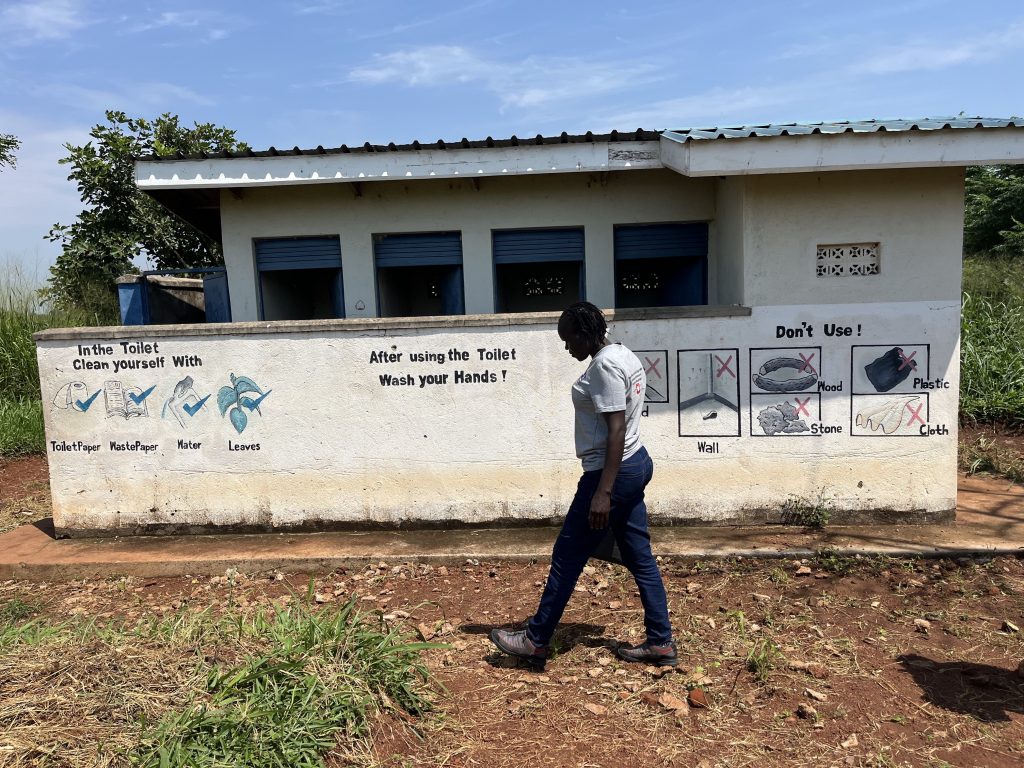
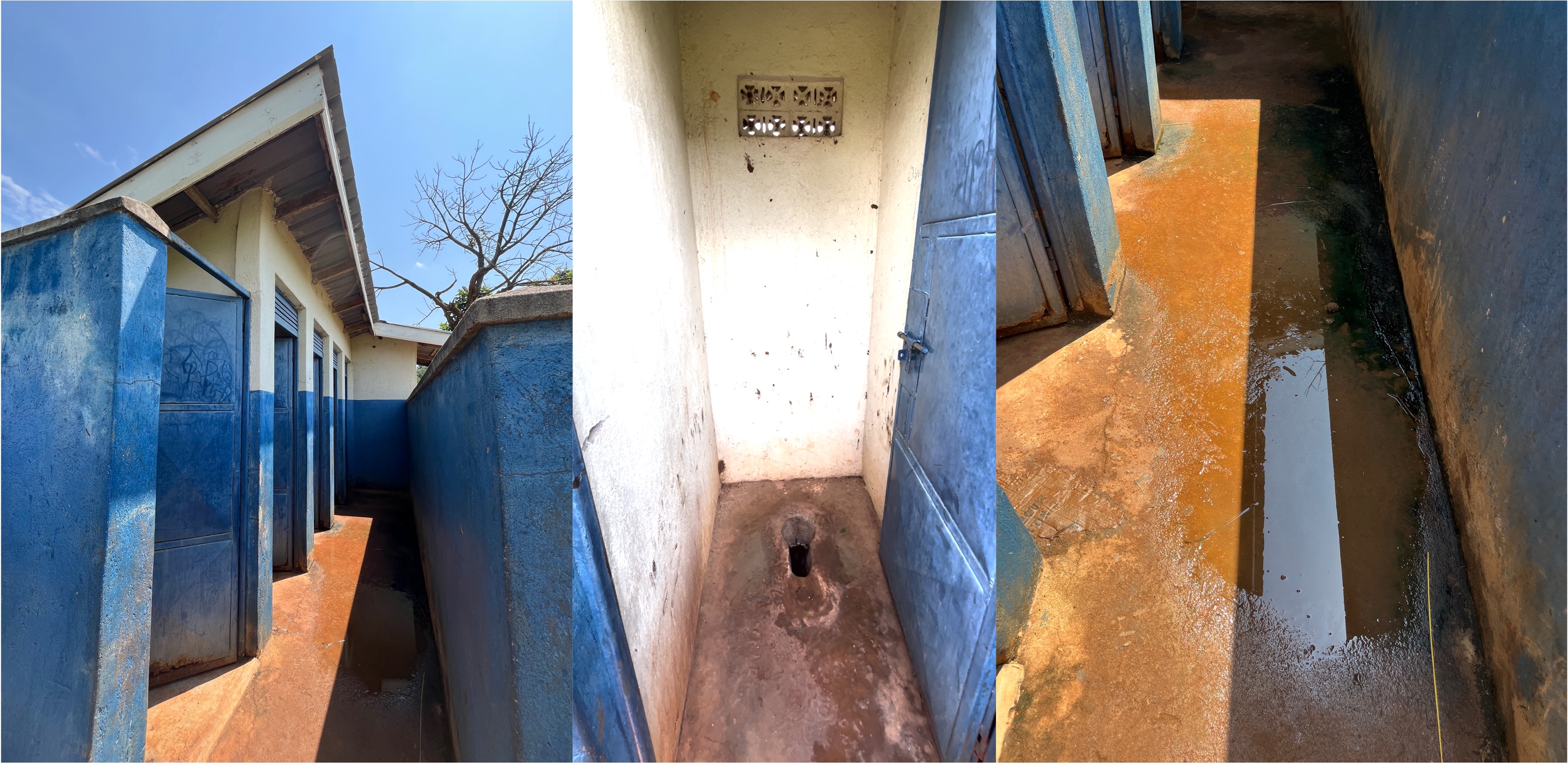
Mary, Emma, and I inspecting the “operational” girls toilets at Kulu Opal
The stances do not have working doors. There were huge spiderwebs in the corner of the latrines, swarms of flies above the latrine holes, with old feces smudged on the floors and walls. The flies are of high concern, given the high malaria risk in northern Uganda. Click here to view a video made by GDPU and the Advocacy Project that shows the status of the toilets in Kulu Opal in 2023.

“Operational” girls toilets at Kulu Opal, with standing liquid at the entryway (it had not rained that day)
The Head Teacher told us that this WASH project is desperately needed at Kulu Opal, and in seeing the status of these toilets, I am assured it is true.
—
*In Uganda people say their surname/last name first and then their first name second. It is a little confusing, but it also makes a lot of sense when we consider alphabetizing lists and grouping individuals by family.
-
WASH at Kulu Opal: “If you educate a woman, you educate a whole nation”
3 CommentsWe have kicked-off the core effort that will be completed during my fellowship here: the water, sanitation, and hygiene (WASH) project at Kulu Opal Primary School. GDPU has built latrine stances at 6 schools since 2016 with the support of the Advocacy Project and their Peace Fellows. You can read more about the projects through Peace Fellows’ blogs, following toilet construction at Tochi (Josh Levy, 2015), Ogul (Lauren Halloran, 2017), Awach Central (Chris Markomanolakis, 2018), Abaka (Spencer Caldwell, 2019), Awach Primary (Kyle Aloof, 2022), and Panykworo (2023). I’m grateful to join the ranks of past Peace Fellows and document our journey this summer!
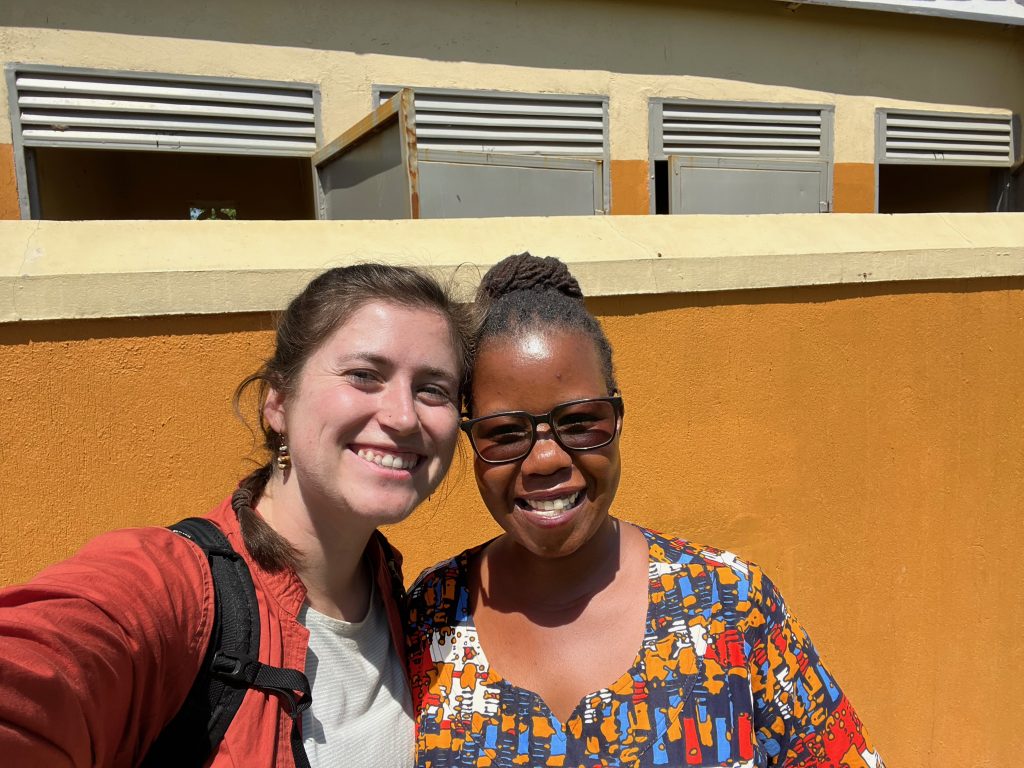
Emma and I visiting the Panykworo Primary School WASH project installed in 2023
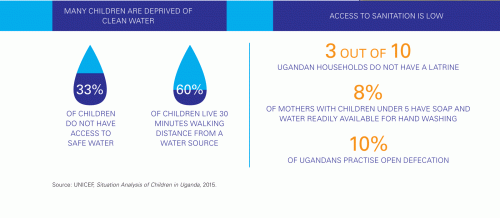
Proper WASH facilities at schools is a huge challenge in northern Uganda and over much of East Africa. UNICEF estimates that 33 children die of diarrhea every day in Uganda, caused by drinking unsafe water and improper hygiene behaviors (e.g., not washing hands after using the toilet, open defecation). Diarrhea can also stunt growth and cognitive development, impacting school performance and the livelihoods of children.
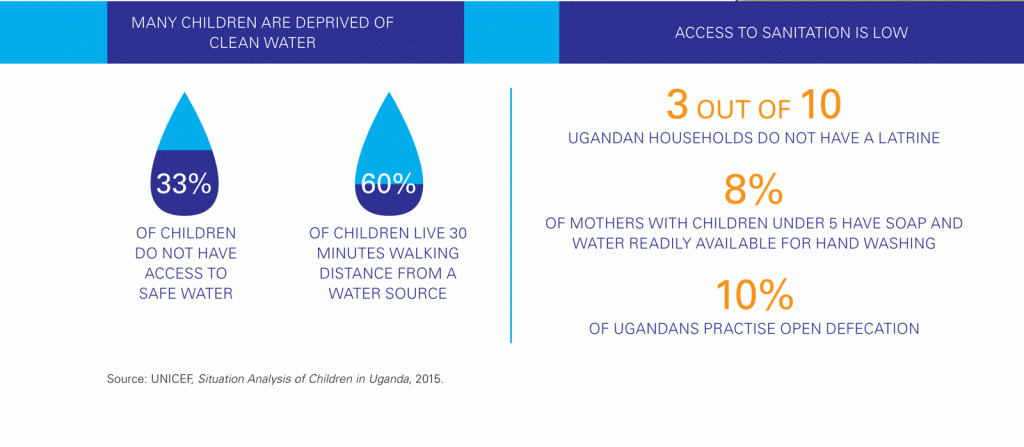
WASH conditions for children in Uganda (UNICEF)
Accessing latrines and proper hygiene behaviors at school can be especially challenging for persons who are menstruating and those with disabilities, both of whom need additional accommodations to use the toilet. Persons with physical disabilities need handrails and extra space to allow them to enter the stances. In Uganda, there aren’t tampons or pads or diva cups or fancy underwear available to manage periods – they use rags that need to be disposed of after each use. At schools, menstruating persons need a changing room that is clean and protected from the boys, and they need a way to dispose of used rags. If these additional accommodations are not provided, menstruating persons will miss school during their periods each month and may stop attending school altogether.
This project aims to address these challenges by providing safe, accessible WASH facilities for girls so that they have the ability and confidence to attend school. The WASH package at Kulu Opal will consist of the installation of 5 latrine stances for girls (1 of which will be wheelchair-accessible), a hand-washing station, a girls changing room, a menstrual products incinerator, and a wheelchair-accessible concrete ramp to the stances.
GDPU will conduct Inclusion Trainings for teachers, to increase awareness and capacity for engaging persons with disabilities, and WASH trainings for students, to promote proper hygiene behaviors. Once the construction and trainings are complete, GDPU, Kulu Opal, and the broader community will participate in a handover ceremony, during which GDPU will give Kulu Opal a year’s worth of high-quality soap.
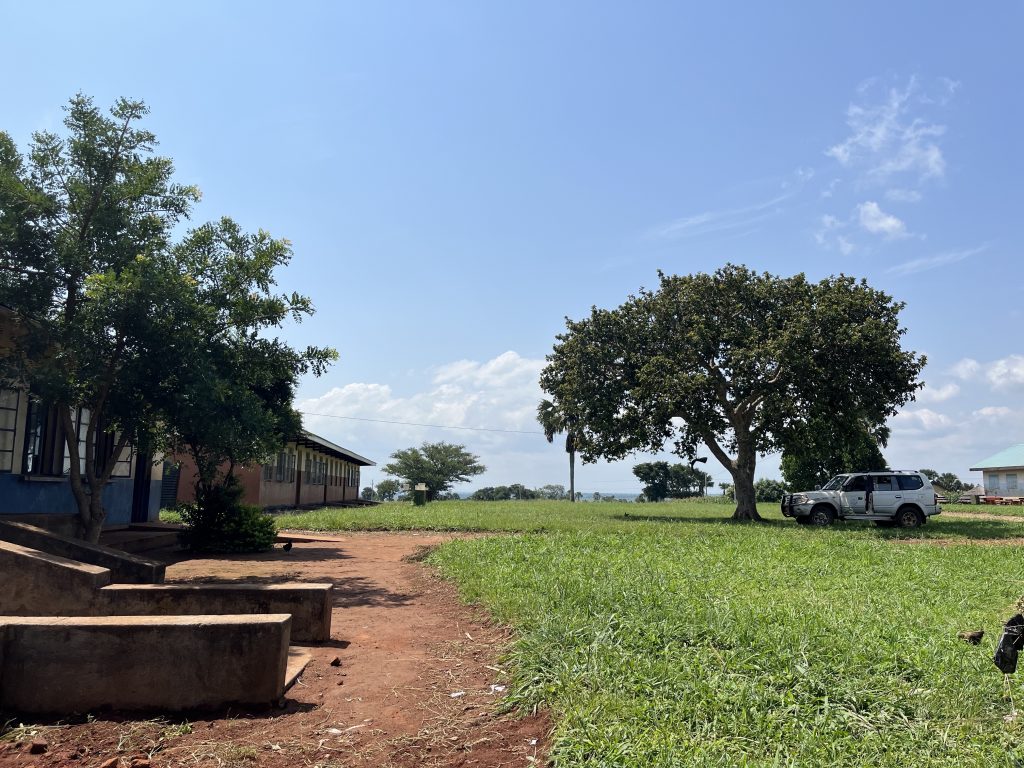
Kulu Opal Primary School
I heard the saying “If you educate a woman, you educate a nation” over the radio recently; an African proverb that is sometimes attributed to Dr. James Emmanuel Kwegyir-Aggrey. I have been thinking about that phrase a lot – how supporting the most vulnerable persons can have ripple effects for others. Research shows that educating girls for one extra year of primary school can boost wages up to 15%, and one extra year of secondary school can boost wages up to 25%, with higher return rates for girls than boys.
Educating girls is an effective way to not only help their individual growth and future job prospects, but to support the economic betterment of their families and communities. Investing in women and girls increases household well-being. Women are more likely to spend income on their families before themselves, which is why many development interventions target women for cash-based transfers. One study estimates that women invest 90% of their income into their families, whereas men only invest 35%. Women are likely to spend income on nutrition, health, and education, accelerating the development of their communities.
We have high hopes that the WASH project at Kulu Opal will allow girls to feel safe attending school year-round, and in turn improve the lives of students, families, and the whole community.
-
Meet GDPU: “Maybe the word disability downplays their ability.” – Joe Okwir
3 CommentsThis is an article in a series profiling staff at GDPU, the Gulu disability community, and those who call northern Uganda home. All contents of this article have been approved and shared with the permission of Joe.
Joseph Johns (Joe) Okwir has worked at GDPU as a Programs Assistant since 2024, but previously was an intern student in 2022 whose skills and work ethics paved the way for his return in 2022 as an employee of the organization. He has an undergraduate degree in Bachelors of Business and Development Studies from Gulu University and is starting a Masters in Conflict and Peace Studies this fall. Joe immediately struck me with just how passionate he is about his community, his work, and his future goals. This energy is equaled by his passion for the people in his life – on my first day in the office, he led the charge to plan a birthday celebration for a colleague. His family is originally from the Agago District, but Gulu is where he calls home. He currently lives in Gulu with his fiancé, Gloria. His dream is to champion solutions for children in refugee host communities and those affected by emergencies, driven by a dedication to creating positive change.

Joe Okwir of GDPU
How did you first hear about GDPU?
I heard about GDPU when I was working in a [health] clinic. It was Dennis (a Counselor for Persons with Disabilities in Gulu District), actually. I was a receptionist. I greeted him and Dennis asked, “Do you want to work for an organization for people living with disability?” I said “if there is a vacancy.” He told me to apply. So I applied and that was my first time to come here… I brought in my application with Patrick, went through the interview, and I started working.
In my secondary school days, a debate program aimed at empowering young individuals with disabilities caught my attention. The topic centered around disability, and my reputation as a formidable debater and position as the speaker of district student association meant I was always going to be called upon or involved in organizing the event. With ease and determination, I contributed to the success of the debate.
Little did I know that this experience would introduce me to the Gulu Disabled Persons Union—an encounter that ignited my passion for advocacy and community impact. At the time, I was in Senior Five, equivalent to 11th grade in the United States. This pivotal moment marked the beginning of my journey toward making a difference.
What is your role at GDPU?
While attending university, we were required to complete internships as part of our graduation criteria. I submitted applications to several organizations and secured placements at Child Fund, World Vision, and GDPU.
However, what truly resonated with me was the opportunity to work with people with disabilities. This unique experience influenced my decision to join this organization. Currently, I serve as a Programs Assistant, providing support across various projects, including WASH and V-PLUS. Whenever assistance is needed, I am there to contribute.
What work have you been proudest of at GDPU?
In the crucible of life and death, I faced a pivotal choice during my internship. The organization I worked with supported people living with disabilities, including those with epilepsy. One fateful weekend, I encountered a girl in the throes of a seizure. The staff were absent, leaving me—the intern—with an impossible decision: take her to the hospital or risk her life. I chose the former, disregarding my own fate. The girl survived and the organization understood the gravity of my risk. Another triumph followed during the pandemic: convincing unvaccinated students of the vaccine’s importance. These moments taught me that sometimes, the greatest risks yield the most profound rewards.
What do you hope GDPU accomplishes in the next ten years?
I want to support the organization expand beyond the confines of Gulu District/city and become a national entity; this should be our long-term strategic goal. As we evolve, our role must transform into a central hub—a reliable source of information and coordination for disability interventions. By meticulously cataloging data on the disabled population, their needs, and effective interventions, we empower ourselves to drive positive change. As we forge ahead, we need to leverage our knowledge as a potent force for advocacy and impact for the good of persons with disability.
If a donor showed up tomorrow and gave GDPU the equivalent of $1 million USD (about 4 billion Ugandan Shillings), how would you use it?
First, I will focus on the need to address critical need for assistive devices which should be our core mission. Next, elevating teacher training to empower educators in handling special needs and disabled populations. Sign language proficiency is essential. Additionally, I would be advocating for accessible structures—classrooms, offices, and restrooms—to accommodate wheelchair users, crutch users, and those with visual impairments in all public institution, schools above all. Our campaign will extend to coaching for special needs games, ensuring not just existence but also enjoyment. Lastly, fostering awareness—because the right of a disabled person are human rights.
How did you become passionate about working with people with disabilities?
My journey from my days as a high school debater and organizer introduced me to my current path of employment, I was requested to put together a debate program for PWDs while I was in my secondary school which I did with ease. Initially, I grappled with misconceptions about disability, but witnessing the strength and abilities of individuals with disabilities transformed my perspective, they produced very smart arguments in the debate and surprised me with how they meticulously argued, I then had an interaction with them later on and I realized how wrong I have been about them. So, as I pursued university studies, community development became my calling—a way to champion the rights and well-being of the most marginalized, including those living with disabilities. So then I made a deliberate choice to join GDPU, I was admitted in three other organizations for internship at the time, but the chance to work and learn from Persons with Disability. This was a chance to do something truly greater than my own self, and I would never say no to that chance.
What is something you wish people knew about GDPU?
GDPU serves as an umbrella organization, uniting entities like the Blind Association, Association of the Deaf, Association of Women Living with Disability, and Survivors of Landmines. Yet, we are more than a collective; we embody compassion and a profound commitment to disability advocacy. Our understanding of disability has evolved through firsthand experiences. We embrace versatility, collaborating with anyone willing to uplift people living with disabilities. Our dedication extends beyond rhetoric—we actively engage in policy reform and dialogue to enhance lives of persons with disability in this community.
-
Meet GDPU: “It can look like a small center, but it has a big heart.” – Mary Lakot
4 CommentsThis is the first article in a series profiling staff at GDPU, the Gulu disability community, and those who call northern Uganda home. All contents of this article have been approved and shared with the permission of Mary.
Mary Lakot has worked for GDPU since 2014 as the Accountant. She has a Bachelor of Business Administration degree from Gulu University, concentrating in Accounting. Mary has an infectious smile and brings an immense amount of joy to her work and the GDPU offices. Mary lives in Gulu with her husband and three children. Although she has lived here for 16 years, Kitgum is where she calls home. One day, she hopes to become the best female entrepreneur in Uganda and the entire East Africa region with a wholesale clothing business.

Mary Lakot of GDPU
How did you first hear about GDPU?
I heard about GDPU when I was working in a [health] clinic. It was Dennis (a Counselor for Persons with Disabilities in Gulu District), actually. I was a receptionist. I greeted him and Dennis asked, “Do you want to work for an organization for people living with disability?” I said “if there is a vacancy.” He told me to apply. So I applied and that was my first time to come here… I brought in my application with Patrick, went through the interview, and I started working.
What is your role at GDPU?
I am the Accountant. The job for an accountant requires knowing a budget and what we have to spend, guiding project people on how they are managing their funds, and looking for resources – what do you need to do to generate income? I look for the best resources our organization can acquire.
What work have you been proudest of at GDPU?
I am really very proud of being part of trainings. You see the lives of youth changing through the projects that came in. People recognize the impact. You are changing the lives of people with disabilities.
What makes me feel good is that before coming here, I used to imagine that they are different. But now that I have worked with people with disabilities for ten years, when I meet them along the street, to me, we are the same. They are people with special abilities. [People ask me], “You are going to your office, how do you communicate with them?” The assumption people here make is that people with disabilities and mental issues should shake you. But not me. Now, I am an advocate for them. We are all on the same level.
What do you hope GDPU accomplishes in the next ten years?
GDPU should be self-reliant and come up with something that can help it generate income. There is always challenges with funding. GDPU depends entirely on project funding, so when there is no project, you are not able to keep your staff. When there is no money, then no one will be here.
In all of northern Uganda, this is the strongest union for persons with disabilities. If you compare GDPU with disability unions in Kitgum or Omoro, they look at us as their role model. So GDPU should strategize on raising money and coming up with business enterprises so they are self-reliant.
Do you have ideas on what that could be?
Yes… We are intending to start up a workshop where we can repair assistive devices from here. The money can be small, the youths can be few, but we can integrate mixed [participants] – those with disabilities and those without disabilities. First, we need to improve on the dormitory and improve on the classrooms. Then we are good to go.
But you know, stepping out of your comfort zone is just another thing. There is that fear of “How many kids will we have? Will we be able to sustain them? Do we have enough resources?” The resources will always not be enough. But we need to take risks. We can start small and improve. We also need to learn to generate money by fundraising locally… Charity begins at home.
If a donor showed up tomorrow and gave GDPU the equivalent of $1 million USD (about 4 billion Ugandan Shillings), how would you use it?
First, I would set up GDPU with a big hall. So if there is any workshop in Gulu, people can come, and pay for the hall. You improve the infrastructure first… Since we already have a school and the land is big enough, we build a dormitory that is accommodating and inclusive for both boys and girls. It should accommodate at least 100 boys and 100 girls. If you set up the facility, it can generate money on its own.
And then, you put a production workshop outside. We now have former beneficiaries – youth who have trained in welding, youth who have trained in electronic repairs. We can identify former beneficiaries and employ them, and we produce quality product. You get exceptional people with good track record already, and you help them build their capacity and their resilience.
We won’t put everything in one basket. We should start generating money, so after the $1 million, [GDPU] is able to stand on their own. Business-minded, that’s me.
Right now, if there is a workshop, it is very expensive to [rent] other places. Because now when other organizations, like National Union of Disabled Persons of Uganda (NUDIPU) come to do a training, they go look around at other places. But when you improve your facility, you can host your own project. The facility should be clean, the floor should be tiled, the walls should be good. You should have good power, a generator on, and set up the Wi-Fi. When people come, they should feel comfortable. The first thing to consider is inclusiveness. Is the environment inclusive enough? We are people advocating for persons with disabilities, we know all the criteria needed.
Also, if we had a guest house, not necessarily here, but in GDPU name, we could make money. We have had Peace Fellows for the past four years. [If we had a guest house], we would have had that money coming back to us, not going out. All of these are things that can keep GDPU moving.
How did you become passionate about working with people with disabilities?
I feel that God was preparing me for this. There was a girl with disabilities who sat behind me in primary school. I found her at GDPU when I started working here. We were in the same class for four years. My second year at university, I was living with two girls with disabilities in the same room. So I started thinking, “Why was I meeting these people?” Was it because I was coming to work here? Maybe.
When you see some of the children, your heart breaks. [Parents] don’t take care of them well. The child is sleeping naked at ten years, nine years [old]. But at least if you get the parents taking care of a child with disability very well, you get motivated. You feel happy. You appreciate such a parent. But you protect your heart by just saying, God knows.
But it’s hard, eh? You feel broken. The first time I visited the school [for children with disabilities in Gulu], I talked to [the head teacher] and he told me, “I know today you’re broken because it’s your first time.” When I came back, I had a headache. A very bad one. I said [to Emma], “If you knew you were taking me to such a place, you should have told me.” The kids look so bad. They were feeding them posho (corn meal), cabbages – it looked like they were just boiling them. There’s no nutrients there. These kids need protein, they need beans, at least. But [the head teacher], he’s trying his best. I could not blame him.
I believe I’m very strong. But whenever I see children with disabilities, that is the part that kills me. Because I’m a mother… It’s too hard for a child. Because you don’t know what happens.
What is something you wish people knew about GDPU?
This is a home for everyone, whether you are disabled or not. And in this place, you are able to be humbled and learn a lot about disability and people around you. At any time, you are just temporarily abled. Being here, I’ve learned a lot. Some are not born with disability, they just got it along the way. So when you are out there seeing someone with disability wanting to cross the road, help them. You don’t know what tomorrow brings.
It can look like a small center, but it has a big heart. And once you are here, you learn to love – a person with disability, you will not put them aside.
Is there anything we did not talk about that you would want people to know about you or your work?
I love this place. It will be very hard for me to walk away from GDPU. I do not know why. It has been part of my home. At some point, I walked away and worked somewhere for three years. But when they called me, I willingly came back.
But there will be a time for me to exit. I want to leave GDPU using improved financial software. Because for the past five years, we have only used simple accounting packages. The challenges is money and [the software] needs money to sustain it. If we could improve our accounting software, I would have left GDPU better than I found it.
-
A Warm Gulu Welcome
4 CommentsKapongo from Gulu! Emma, the WASH Project Officer, and I made the slightly treacherous bus ride from Kampala to Gulu together at the end of last week. After settling into Gulu over the weekend, I started my first day at the GDPU office. As past Peace Fellows have described, GDPU is the parent organization for four non-governmental organizations (NGOs) providing services to persons with disabilities, including those with mental and physical (e.g., deaf, blind, mobility) impairments. The NGOs and their offices are centered around two grand mango trees that provide shade from the intense Ugandan sun.
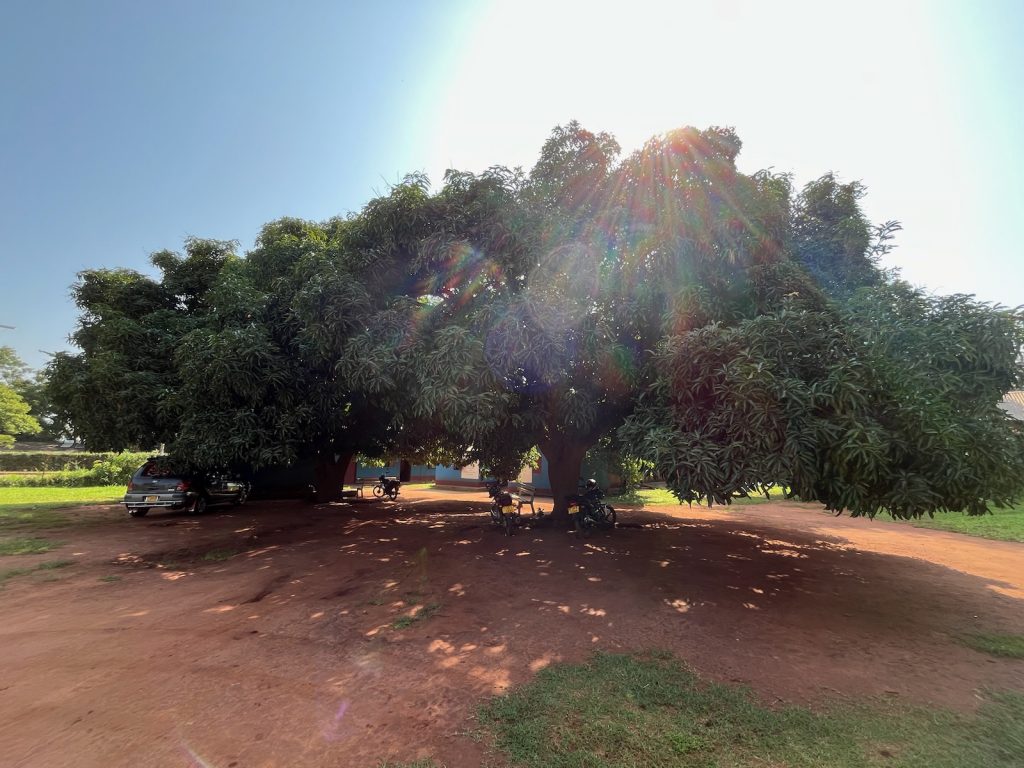
Mango trees that are the center of the GDPU and partner organization offices
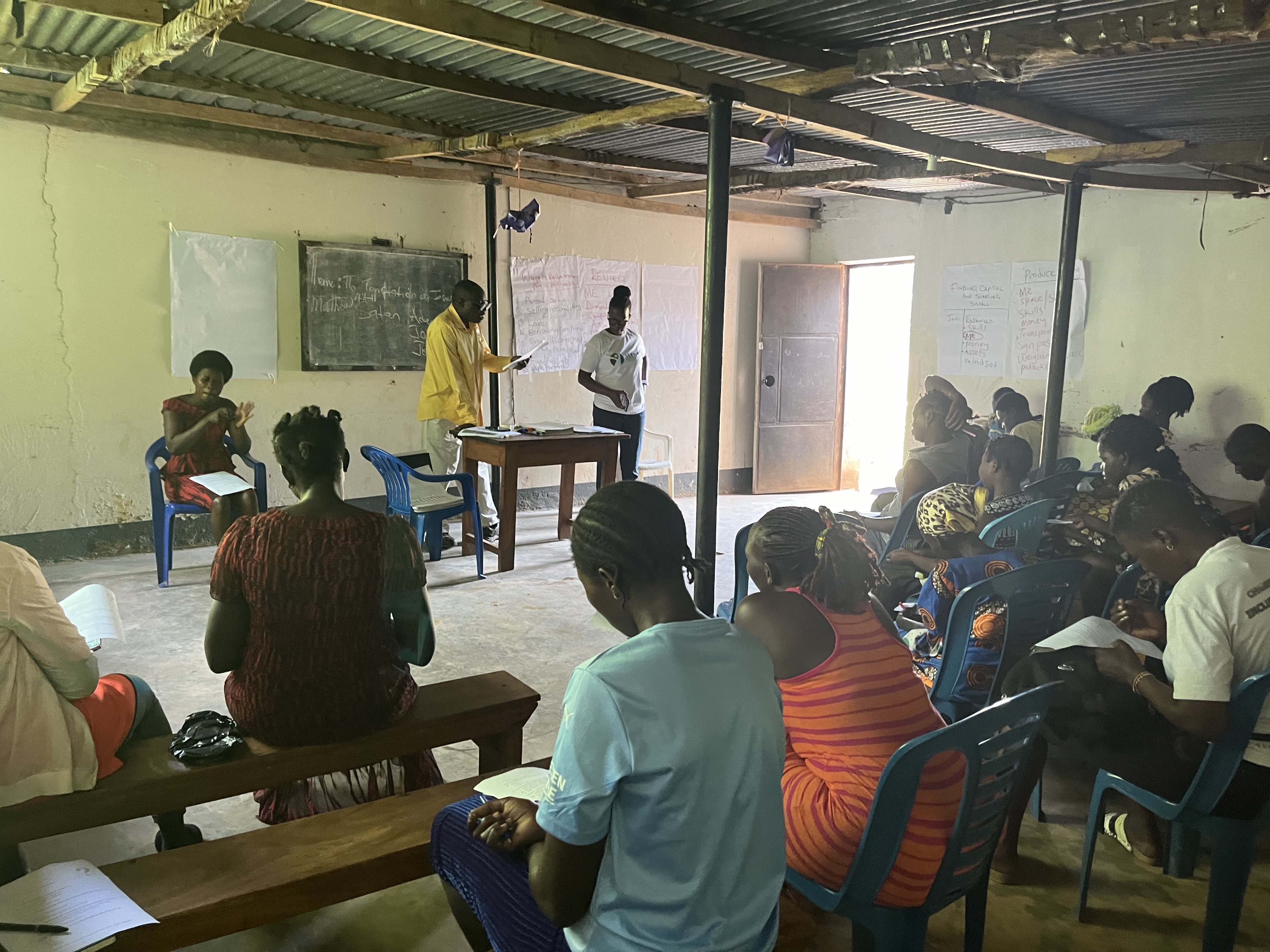
The mission of GDPU is to “empower persons with disabilities to live independent and dignified life.” I got to see this mission in action in my first day at the office. I observed a training conducted by Patrick, the Director of GDPU, and Emma as part of a series from the Street Business School. The trainings teach persons with disabilities how to start and sustain businesses on the street (e.g., selling produce). Attendees were primarily women and ranged in age from a teenager to a more elderly woman.
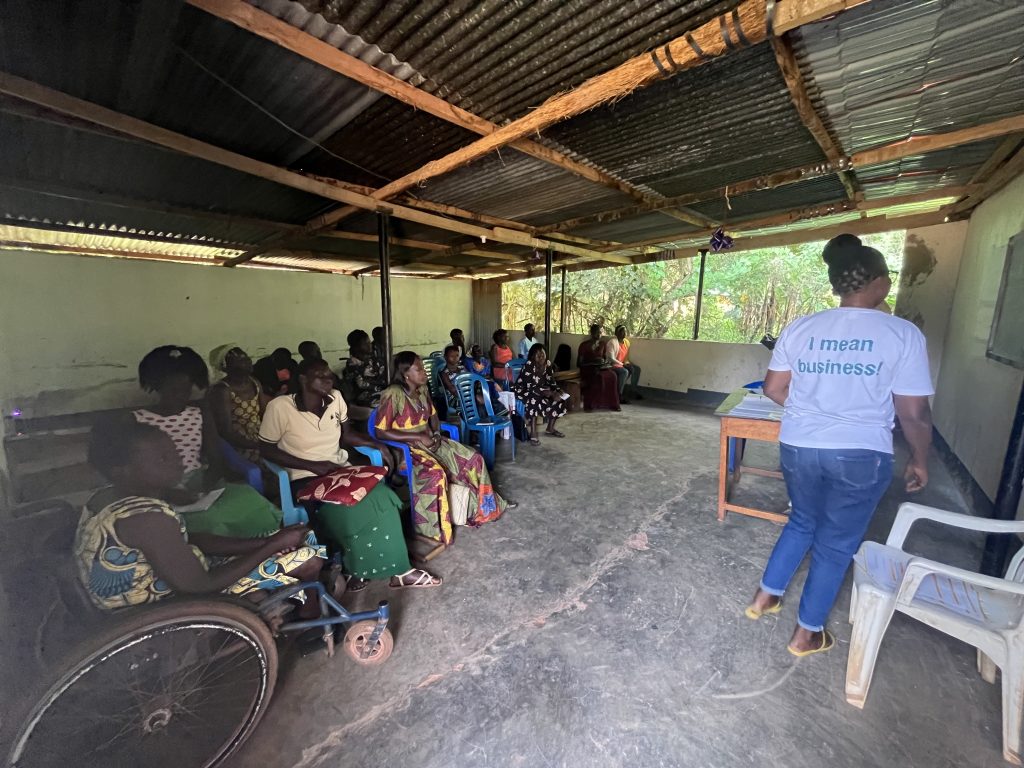
Attendees at the Street Business School training
I watched Patrick come alive in the training as he very sincerely and earnestly shared knowledge with the attendees. The training was verbally taught in the local language Acholi, translated into Ugandan Sign Language (USL), and written on poster paper in English. I imagine that a space like this, with simple but meaningful efforts to ensure the information was made as accessible as possible, is not a common experience for the participants. The attendees clearly found value in the information – every person was listening/watching intently and taking notes. It was the perfect introduction to GDPU and the impact their work has on their community.
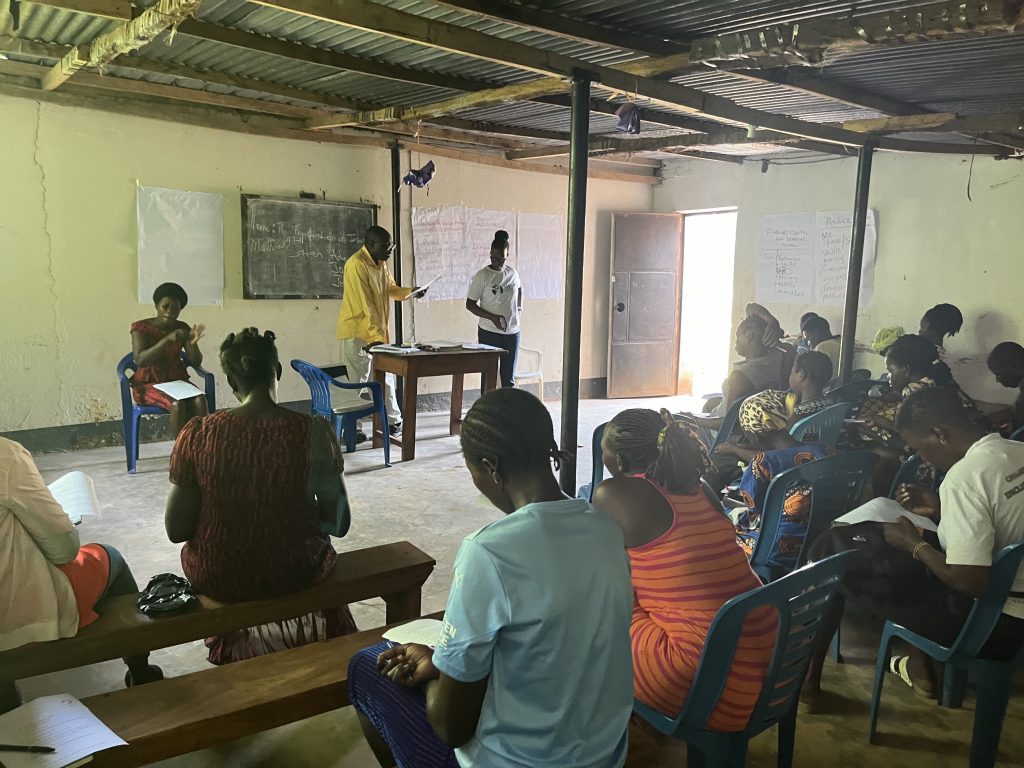
(From left to right) Nancy, Patrick, and Emma teaching the training
Over the course of this week, I was introduced to the full GDPU office team – Patrick, Emma, Faruk, Mary, Joe, Walter, and the GDPU Board members. I was also lucky to meet other members of the Gulu community: Brenda, a teacher for the GDPU vocational skills program; Nancy, an Acholi/English/Uganda Sign Language translator; Steven from Explosive Network Ordnance of Survivors; Caesar, the District Education Officer, and many more. It is unsurprising that people stop to come meet the “mzungu” (white person) that is suddenly in their space, but I am surprised and honored by the warm welcome each person has given me to the place they call home.
I will leave you with a few new phrases I’ve learned in Acholi. While the country’s official language is English, the people of Uganda speak over 70 different languages. My new Acholi vocabulary includes:
- Kapongo = Hello
- Itiye ni ning? = How are you?
- Atiye maber, kono in? = I am fine, and you?
- Icho = Good morning
- Iree = Good afternoon/evening
- Afowyo = Thank you
- Tima kica = Excuse me/sorry (a very important one for a foreigner in a new place)
Afowyo! See you!
-
A Lesson from Flora
6 CommentsAfter a few teary airport goodbyes and delayed and un-delayed and changed flights, I finally arrived in Uganda to begin my Peace Fellowship. I am grateful to be supporting the Gulu Disabled Person’s Union (GDPU) program that builds accessible toilets and handwashing stations at schools in the district. I will primarily support two GDPU efforts this summer:
1. The monitoring and evaluation of existing latrines and handwashing stations that GDPU has built at schools in the district.
2. The installation of a new latrine and handwashing station and menstrual products incinerator at a school in Kulu Opal.
As someone who studied environmental engineering and is passionate about water accessibility, the opportunity to work for Emma and the GDPU team on this project is an immense privilege. I can’t wait to get started. But before heading to Gulu, I have a few days stopover in Kampala.
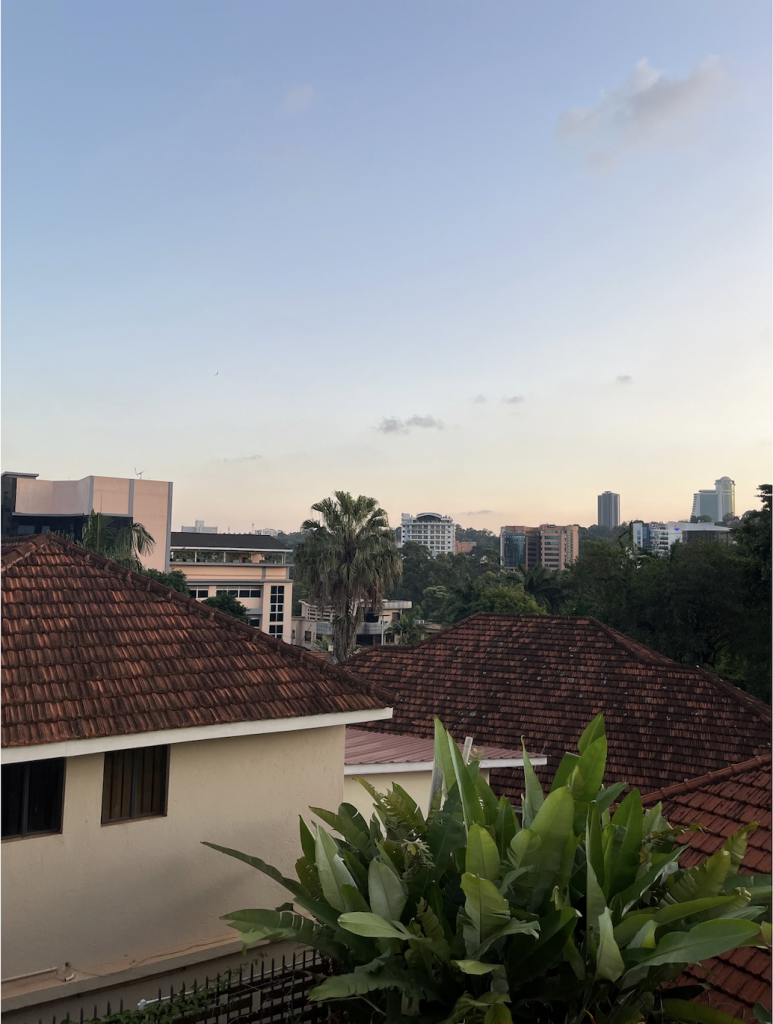
The sunset from my first night in Uganda
On my first morning in Kampala, I visited the Uganda National Museum. I find that a history museum, and what a national government wishes to highlight about their country, can teach you a lot. The museum is an accumulation of many different themes and eras of Uganda. There are exhibits about traditional clothing and foods, excavated archaeological findings, Ugandan Olympians, and geological forces that changed the topography of Uganda over millions of years.
The museum boasts a multi-room exhibit about primates, focusing heavily on the mountain gorilla. Only approximately 1,000 mountain gorillas currently exist on earth, half of which live in Uganda’s Bwindi Impenetrable National Park. The rest of the mountain gorillas live in the Virunga Volcanoes, a region including Rwanda, DRC, and the Mgahinga National Park in Uganda. The exhibit highlights the dedicated Ugandan researchers who are working towards the conservation of these precious animals.
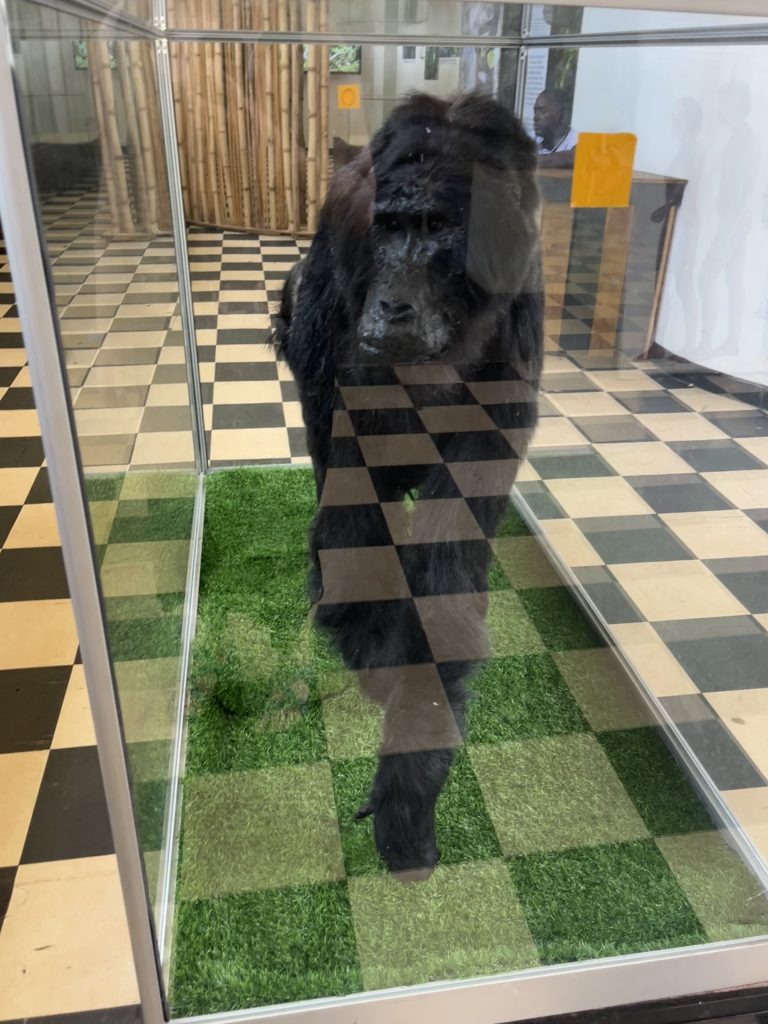
A very glared mountain gorilla taxidermy from the Uganda National Museum
I was definitely surprised by some exhibits. For example, there is a room about Henry Ford, the American founder of Ford Motor Company. The exhibit features an actual Ford Model T car but no written explanation of the connection to Uganda (although I later found out there is a Ford dealership in Kampala). There is an exhibit about why oil is beneficial to the environment and the economy. Curiously, this section was funded by the Uganda National Oil Company. This reminded me of the oil and gas section at the Bullock Texas State History Museum, curiously also funded by the Texas Oil and Gas Company…
In the back of the museum, the Uganda Ministry of Tourism, Wildlife and Antiquities recreated a “Cultural Village.” This series of traditional homes demonstrates indigenous living styles, each aligned with a different region of the country.
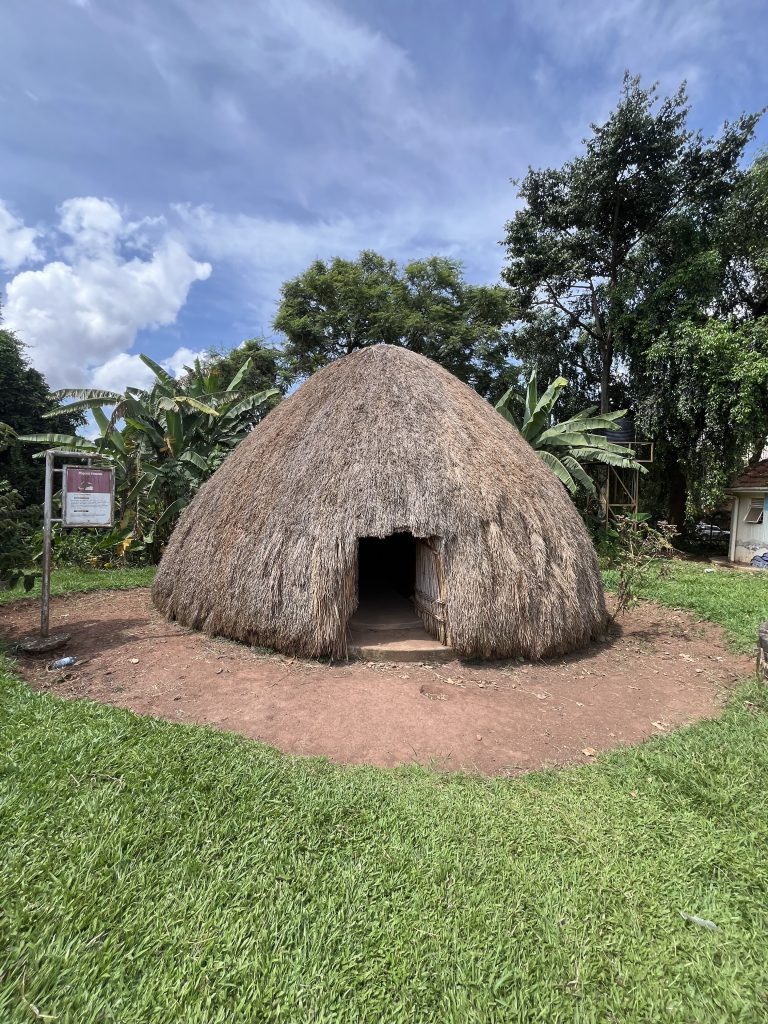
A recreated traditional home at the Uganda National Museum
As you might be able to see in this photo, Kampala is a city but also very green. I am amazed by how large the flora are. Palm trees and arrowhead plants grow just about everywhere.
The arrowhead plants pictured below are located at the Uganda National Museum. The plant on the left is about 3 feet (1 meter) tall and has leaves about 8 inches (20 cm) long. The plant in the right photo is about 6 feet (2 meters) tall and has 2-foot (60 cm) leaves! In comparison, I have tried again and again to keep an 8-inch (20 cm) tall arrowhead houseplant alive in my apartment in the United States, to absolutely no avail.

Arrowhead plants at the Uganda National Museum
I also noticed this phenomenon when I visited Malawi and Tanzania – plants growing to almost comically large proportions, developing uninhibited when planted in the right conditions. In East Africa, it seems like things flourish in places where they are meant to be. I hope this will be true for me this summer as a Peace Fellow, as well.
-
Photo Gallery: This is Uganda
Leave a CommentBelow are just a few of the many photos I have taken during my fellowship. To see more check my Advocacy Project Flickr account. These are the faces and places of Uganda.

Ivan is a 14 year old student with physical disabilities at Tochi Primary in Gulu

Student at Tochi Primary in Gulu
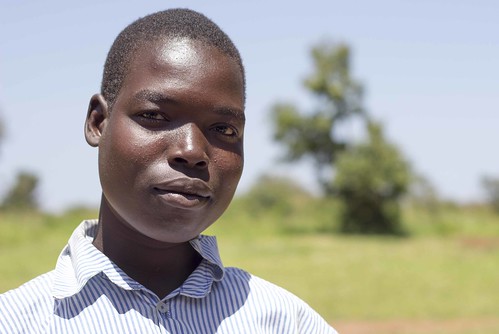
Nancy almost dropped out of school because other children bullied her for being disabled
Uganda’s national bird: The Crested Crane

Straw weavers feet

National Mosque Minaret
Chameleon along the Bwamba Pass

Joining the straws
Ugandan flower in the Rwenzoris

Ugandan National Kayak Team Member on the Mission
Sharing African Beer
Rooftop cat in Kinawataka

Kids outside Reach Out clinic in Kinawataka

If you yell muzungu at me I will not feel bad about taking your picture

Zebras outside Lake Mburo National Park
Girls in Kinawataka

Nile kayaker dropping into the surf on Club Wave
Monkey in Bujagali
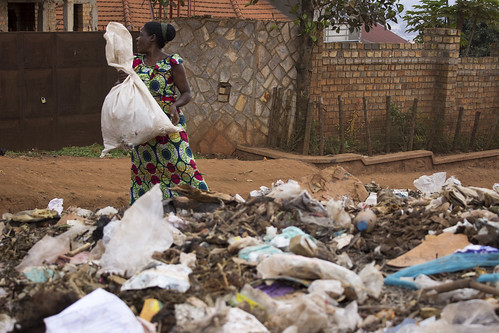
Collecting straws to recycle
-
Projects, Proposals, and Budgets Oh My!
1 Comment
Women of KIWOI
While I have been hard at work here in Uganda, I have been slacking on my blogging. Just to check in, I am in fact still alive and well with the women of Kinawataka! Over the past couple of months the focus of my fellowship has evolved. Initially my goal was to implement the AP deliverables providing capacity building training and support on NGO management and communications under the 5by10 module. While I am still supporting both of those areas, my focus has shifted to fundraising and project development.
I’ve been at a loss about what to blog about relating to work, management and proposals aren’t necessarily the sexiest of topics. However, as AidSpeak blogged: “If you want to save lives, make the spreadsheet cells calculate properly.”
So what exactly have I been up to?
Since September I have been conducting outreach to embassies in Kampala on behalf the Kinawataka Women Initiatives and Gulu Disabled Persons Union. Several embassies provide small grants to community based organizations. My goal is to submit at least five proposals by the end of the year. So far I have sent one off and am in the finalizing steps of another.

Collecting straws in Kinawataka
A major aspect of my fellowship is getting KIWOI into a place where the organization can be competitive for funding opportunities. This has been a lengthy process. We have formalized our board of directors, drafted an annual report, changed our bookkeeping practices and created expense reports. I created a detailed budget for the organization and each of our proposed projects. This was significantly more challenging than one might imagine. A lot of the information needed had not been tracked and determining costs was quite the process. Excel and I have come to terms though and the budget is finally complete.
What am I fundraising for?
While we are seeking funding to cover the core costs of the organization, another major aspect of my work these past months has related to project development. We have several exciting programs in the pipeline for 2015. Nearly all of the groundwork to implement these programs has been completed and once we gain funding KIWOI will be off and running!
Plastic bag reduction campaign
Plastic waste constitutes a major threat to the environment in Uganda. In order to combat the plastic threat KIWOI has developed a project for the upcoming fiscal year to remove 100,000 plastic bags from the Kinawataka slum in 2015. The project would involve the distribution of 400 reusable and durable straw bags to five stores in Kinawataka, six community trainings, and the development of a campaign to remove plastic bags from Uganda. A pilot program was implemented in 2012 and to promote the use of reusable bags rather than single-use polyethylene bags. The project was a major success and customers continue to utilize the reusable bags and the expansion of the program holds much promise
Trainings in quail raising, tailoring and mushroom growing
In order to create self-sustainability for women in Kinawataka, KIWOI plans on hold three trainings on the income generating activities of quail raising, tailoring and mushroom growing. Each of these trainings provides significant dividends for the women in Kinawataka. These trainings were requested by the women in the community and would significantly improve their quality of life by giving them new skills, which can be used to generate an income.
Working with women in prisons
Uganda’s prison system is focused on punitive rather than corrective incarceration. Prisoners leave the system with little means or skills to improve themselves often leading to the resumption of crime due to lack of perceived alternatives. KIWOI began working in women’s prison and trained over 70 women to produce straw bags and crafts from recycled drinking straws. However, the trainings were discontinued due to lack of funding. Kinawataka hopes to renew the trainings and expand them to additional prisons providing training on straw product production and other income generating activities.

Peace Fellows Shannon and Katy with KIWOI Founder Benedicta
Before I came to Uganda, the majority of my experience had been in conducting research, writing memos and reports, and advocating on human rights issues. I had never drafted a grant proposal, developed a project, wrote a budget or annual report, or completed a log frame analysis. These are all critical skills and I’ve enjoyed learning them. The work has been a challenge, but one that I have been keen to complete. I’ve grown quite attached to the women of Kinawataka and am dedicated to doing my best to get them funding to sustain this innovative organization. I have three videos in the pipeline and do my best to everyone updated so stayed tuned exciting work is happening in the slums of Kampala!
-
Ugandan Time
1 CommentThings in Uganda move at a different speed than in the United States. The streets and sidewalks are busier but at the same time, things to get done at a much slower pace. They talk about African time in relation to punctuality. When booking a bus ticket to Kenya, the bus driver emphasized, “We leave on Muzungu time, not African time!” yet we still departed 30 minutes late.
Two of my many flaws are procrastination and sleeping-in, which seem to be common side effects of African time so I have had to struggle not to fall into the relaxed flow too much. Dealing with African time has certainly taught me patience. This place could break a Type A person. Every time I travel to Africa, there is an adjustment period where I shift my expectations of time. Arriving 45 minutes late to an interview or important meeting here is commonplace, whereas in the U.S. it would almost certainly lead to a negative outcome.
At a training session for students on entrepreneurship at Makerere University here in Kampala, the speaker stressed with the audience that we must create a “Ugandan time” to create efficiency. The crowd burst into laughter, nodding in agreement but also disbelief that is would be possible.

KIWOI Executive Director and Ugandan Time Pioneer Benedicta Nanyonga
One of the reasons the founder of Kinawataka Women Initiatives, Benedicta Nanyonga, has been so successful is her diligence with time. She rises before the sun does to take care of the cow, pigs and chickens that live in her backyard and prepare the orphans she raises for school. When I leave in the evening she is still hard at work and sometime goes into the late night and early morning to make sure the job is completed. The office is connected to her home and work encompasses much of her life. While she may not look it, Benedicta just turned 67 years old, which makes her stamina all the more impressive.
At a recent meeting for members of KIWOI, women rolled in over the period of an hour. It was the first meeting we had held in some time and only 4 out of the 20 were on time. For those who showed up an hour after the meeting begin, Benedicta sent them away. When I asked why she wouldn’t let them participate she explained that they would not learn to be prompt otherwise. If anyone is going to help pioneer the concept of “Ugandan time” Benedicta is certainly the woman for the job.
-
Being a Muzungu
2 CommentsWhen walking home or to work here in Uganda, I’m often followed by many kids like little shadows trailing my path. Sometimes they follow silently just a few paces off my own, growing in number as I walk. However, most of the time they are loud and lively yelling “MUZUNGU! MUZUNGU! HOW ARE YOOOOUUUUUUU!?!” This is a phrase that is shouted at me on a daily basis here in Uganda.
Muzungu is the word used for any non-African person and the children here love to remind me that I am in fact one constantly. While there are quite a few muzungus in Uganda, there are not many in the area where I work in Kinawataka slum, and no other female ones that I’ve seen.
The children’s jaws drop in awe of the pale blond beast.
I seem to have developed a following of Ugandan kids who know where I work and run past on their lunch breaks and when they get out of school to yell at me until I respond. A few particularly impatient ones even threw rocks at the building to get my attention.
 The conversation usually goes like this:
“Hey muzungu! MUZUNGU! MUZUNNGGUUU!!!” – Children
“Hello” – Me
“Hahahahaha! Muzungu how are you?” – Children
“I am good. How are you?” – Me
In unison: “I am fine!” – ChildrenThis conversation repeats itself multiple times a day. Most of the time (if I am lucky) they run away laughing. Other times they stand outside the door peering in at the newest attraction. This can last over an hour.
Several of the people in the Kinawataka slum are newcomers to Kampala and have spent much of their lives in the villages without ever seeing a muzungu before so I don’t usually mind too much. After all, kids are supposed to be curious and it can be kind of adorable. A few have rubbed my skin to see if it is like their own and are puzzled by the wavy mess of hair.
I do sort of miss the anonymity of blending in. I get away with nothing. People I have never met approach me and tell me they know where I work or where I live. As a de facto representative of the muzungu clan, it is good motivation to always make a positive impression.
-
Reflections on Uganda and Kikoze Update
1 CommentHello all, I am back from my holiday in Uganda. It was lovely, but I’m also glad to be back in Uvira. This place feels more and more like “home” with each passing day.
Uganda’s story in terms of development and human rights is quite different from the DR Congo’s. Kampala is a thriving metropolis, with supermarkets, several shopping malls, Chinese restaurants, and choking automobile congestion. It is hard to believe that it is only a 17-hour drive from Uvira. In addition, the people of Uganda seem more cheerful and friendlier than the Congolese, possibly because they have not been beaten down by nearly 20 years of war following the reign of Mobutu. Overall, one could say that Uganda is an East African “success” story, especially considering that the country was once home to one of Africa’s most ruthless dictators, Idi Amin Dada.
However, there still remain problems in Uganda, such as continuing widespread poverty, a high (though decreasing) HIV/AIDS rate, the persecution of the LGBT community, and continuing unrest in the north with Joseph Kony and the Lord’s Resistance Army.
In Kampala, President Yoweri Museveni’s cowboy-hatted visage glares from many billboards, reminding me of how Uganda became entangled in the Congo Wars in the 1990s/2000s.
On more official business, I had the opportunity to visit an AP partner in Kampala, the Kinawataka Women’s Initiative, founded and directed by Mrs. Benedicta Nanyonga. Kinawataka assists children, mostly girls and mostly AIDS orphans. The children and Mrs. Benedicta make bags and other products out of recycled drinking straws. The proceeds from selling the bags go to the children’s education and upbringing. I was amazed at the durability and quality of the purses, shopping bags, and safari bags created by this group of industrious youngsters. Visit Kinawataka at www.kwiuganda.org and see their products at www.strawbags.org
Back in the Congo, SOS FED continues to move forward. Construction on the water well in Mboko was completed on June 10.
Quick update on the Kikoze incident of 3/26/11: I talked to someone at OCHA about the status of judicial action against the perpetrators of the attack. Apparently, a military tribunal has yet to be realized, and still is in the planning stage. There are concerns for the safety and security of a military tribunal, due to the fact that the accused are ex-FRF combatants who were only recently integrated into the FARDC. A trial up in Muranvya or bringing the accused to trial in Uvira might result in some sinister consequences. However, I was assured that MONUSCO and the FARDC are still working on the case. Let’s hope that justice is served eventually.
Also in the news: Burundian FNL rebels are making more incursions across the border in the Rusizi Plain, near Kiliba. Cultivation in the area is under threat, as farmers (most of them women) will flee their fields once they hear of roving armed groups nearby.
-
“Tukusanyukidde / You are Welcome”
1 CommentThis is how I was greeted (in Luganda) on arriving at the airport, at my hosts’ residence in Kampala and at UWEAL, and how I am commonly greeted around town. Although it’s clearly just the formal version of the simple “welcome” I’m accustomed to, it has taken on a new warmth for me here. It also seems a fitting greeting for business in Uganda. After only one week in Kampala, I’m beginning to see the city and the world in terms of an opportunity to sell, to hustle, to do business. Kampala is open for business, and Ugandans are taking advantage.

Several of my Vital Voices/The Advocacy Project counterparts in Nairobi and elsewhere have been struck by the stark inequality that separates poor from rich. A few live relatively opulent lives — defined here as having multiple well-paid servants, computer(s) and internet access, running and hot water, and other luxuries — while most live more simply, and others in far worse conditions. One northerner tells me that the proliferation of non-governmental organizations has dampened many Ugandans’ traditional spirit of hard work, initiative and economic independence. But this obscures the contribution of a vibrant Ugandan middle class made up in part of hundreds of small and medium-sized business owners who are creating wealth from the ground up.
This group of thriving entrepreneurs did not always include women. Limited access to credit, legal restrictions on the ownership of property and other assets, and pervasive norms around gender roles severely restricted women’s freedom to do business in Uganda. Enter UWEAL in the 1980s. UWEAL has become a source of information and inspiration, as one board member puts it, for women in business. This Association of over 700 women does not exist for it’s own sake. It trains women in marketing, administration, finance and other key business issues; it connects Ugandan women with their counterparts in the region, around Africa and all over the world; it mentors new businesswomen and it cultivates a spirit of entrepreneurship among girls. This group of experienced, capable, professional and entrepreunerial women will serve as my mentors for the next three months. Please follow me online as we research how UWEAL members successes, ongoing challenges and opportunities in life and in business.

-
Mr. Christine, Welcome to Uganda!
2 CommentsDay one in Kampala. I pushed my load of luggage out of the airport to the welcome area and scanned the crowd for a sign with my name. Thirty pairs of eyes laughed when I just blurted out “Fairway hotel?””Ah Fairway Hotel!” Ten fingers pointed outside to a smiling uniformed man carrying a sign with “Mr. Christine” printed on it. In the distance were rolling hills covered with little lights and a starry night above. In complete contradiction to what I was told the climate felt ideal for the human body… almost nurturing. It immediately made sense that this was the cradle of humanity. It was a brilliant greeting. Thirty minutes later I was covered in mosquito bites (thank goodness I had already started my malaria meds) and breathing smoke from open fires and kerosene lamps that line the teeming road to Kampala.
 Dina Buck,(https://www.advocacynet.org/wordpress-mu/dbuck/) my summer colleague was waiting for me the hotel. We shared some fresh pineapple juice and Indian food in the lush garden patio and planned how we would maximize our time before heading to Gulu. We agreed that we wanted a balance of meetings, preparation/shopping time and a good dose of local culture. Dina agreed to let me drag her to dance shows! Breakdance Project Uganda- here we come.(http://www.myspace.com/breakdanceprojectuganda) Later, lying under our mosquito nets we giggled sharing stories of home. To our surprise we both have a deep connection to the Puget Sound in Washington state and we cooed as we recalled smacking the sea water at night with our oars to ignite the glowing sea plankton. We are going to have great time together.
We were brutally awoken by the sound of giant birds cawing outside our window and joked that a pterodactyl was trying to break in. We enjoyed some of the best fruit I’ve ever had and then cabbed it to the center of town. After Dina guided me through purchasing a cell phone and exchanging money-neither of which were straightforward at all, I repaid her kindness by dragging her through some overwhelming street markets that probably sell everything one could imagine.
It was in this hustle and bustle that I had my first heart wrenching encounter with a person who had lost the use of their legs and was required to crawl through the filthy streets. In one hour I witnessed at least five more persons with similar disabilities. No wheelchairs or handicap accessible buildings in sight. My work is cut out for me, but it’s going to be a magical summer.
-
Update on the Aurien Case
Leave a CommentSee previous blog on Helen Ruth Akello for more information on the case against District Police Commander James Aurien
Thanks to the heroic efforts of women’s advocates, including the Association of Uganda Women Lawyers (FIDA U), police boss James Aurien was re-arrested in connection with the death of his wife Christine Apolot. The key witness, Helen Ruth Akello, the victim’s sister who was allegedly present at the scene of the crime, has still not been traced, but the Director of Public Prosecution decided to reinstate the charge after evaluating other evidence.
According to her mother Akebina Awoyo, Helen Ruth Akello was taken away from her home by a police officer named David Mpangi who is alleged to be the son of James Aurien. The New Vision (18 August 2009) reports that Mpangi has connections to Parliament and resides in Nsambya Police Barracks, which may explain why residents of the Nsambya barracks were so reluctant to speak with me about the Aurien case when I visited a couple weeks ago. Another police officer, Joseph Alaku, is also accused of conspiring with Mpangi in the disappearance of Akello.
According to Florence Kirabira, head of the Child and Family Protection Unit, domestic violence “has been very common within the police community, and it has led to two deaths.” Echoing the concerns of women’s advocates, Kirabira laments the tarnished reputation of the police, “What will the public think of us? Yet they are supposed to bring their concerns to police but when they look at the institution that is supposed to protect them being turned down, it can cause a lot of mistrust.”
Nearly everyone I have interviewed on the topic of domestic violence has expressed two parallel concerns: 1. Domestic violence is a major problem within the police barracks, and 2. Not all police officers store their weapons properly. Kirabira and police surgeon Dr. Thaddeus Barungi claim that conditions in the barracks are often overcrowded and inadequate for supporting the welfare of the family. When I visited Nsambya, this was certainly true. Officers and their families live in small unipods-round metal buildings in the shape of huts that are practically stacked one atop another. In Nsambya, scores of young barefoot children play among ditches filled with broken glass and used prophylactics. The red dirt community reeks with the noxious odors of burning trash. It’s truly a miserable place, and I could understand why there are reports of high alcohol consumption among the officers living in these sub-standard barracks.
When these factors are combined with easily accessible weapons, the situation becomes even more precarious. Police men and women are supposed to store their firearms in the armory when they are off-duty. According to protocol, they must sign their weapons in at the end of their shifts, but there are some loopholes. As Kirabira remarked, this sign-in system is “not watertight”, and even guns in the armory may not be stored securely. In June, David Opure, the officer who was in charge of criminal investigations in Kamuli District allegedly picked the armory lock to retrieve the firearm used to shoot his wife. Moreover, high-ranking officers are issued a firearm to use for personal security. They do not have to store their personal firearms in the armory.
This blog is not meant to be an attack on the police force. Most officers display tremendous courage and integrity in spite of very difficult working and living conditions. The Center for Domestic Violence Prevention (CEDOVIP) also deserves credit for developing a police training manual and hosting sensitization trainings on how to handle cases of domestic violence.
The simple truth is that the most violent cases could be averted if domestic violence were criminalized and if perpetrators were not allowed to own a firearm. When a woman is killed in the home, the most likely culprit is her partner or male relative, often with a prior record of domestic violence. If the police force wants to improve its image, it needs to first look within its own ranks and take prompt action against domestic violence offenders. Officers who commit violence should be disarmed and dealt with justly before the law.
The New Vision, “Police Boss Arrested again over Dead Wife,”(18 August 2009), http://newvision.co.ug/D/8/12/691599.
-
Return to Uganda
33 CommentsI arrived back in Uganda late Sunday, and have spent the last couple of days wandering around the town, revisiting my old haunts (except the legendary Bubbles, which will come later in the week). I’m also catching up on sleep – as you might have gathered from my last post on all the parties in my last few days in Burundi, I didn’t get a whole lot of sleep, and the bus ride was pretty tiring. It’s great to be back – I thought I’d died and gone to heaven when I got into Aristoc (bookstore for those of you that don’t know Kampala) and had the usual supermarket-culture-shock. It’s annoying that I can’t drink the tap water any more though (not sure if I’ve posted on this before, but in Bujumbura you can drink the tap water!).
It’s also disconcerting that in the 18 months I’ve been away, things have changed. Shoprite, Game and Uchumi have been supplemented by Nakumatt, the Kenyan supermarket chain, which have opened a branch in a brand spanking new mall and restaurant complex. Garden City is bigger, or at least the attached hotel is bigger. Kyoto has closed down and/or moved (nooooooooo!). And there’s a new brand of beer – Nile Gold, produced by the same people who make Nile Special. Haven’t tried it yet, but will report back when I have the chance.
These fast changes are disconcerting, but I suppose they are an inevitable feature of quickly-developing countries. When I go back to London or Oxford after long periods nothing much changes, because those cities have pretty much reached where they’re going to go, so change is slower and less dramatic (except for East London, with the Olympics). But Kampala is growing quickly, so changes are inevitable – people say the same things about Kigali, and I expect that if I go back to Burundi a couple of years after the election (if it goes well) then it will be very different, with either a Nakumatt or a Shoprite, taller buildings, hopefully a bookshop, and more hotels. The traffic will also be a lot worse; Claver claims that the traffic in Bujumbura is bad, something that I find hilarious – he really needs to go to Kampala! In some way’s I regret it – Bujumbura’s size and relaxed feel are part of its charm – but it’s inevitable, and I welcome it because it’s part and parcel of development. And a bookshop would be great.
UPDATE: thanks for all the great comments on this post – glad to see that it’s touched a cord. Of course feel free to quote/link it, as long as it’s properly linked, etc.
-
Reflections on the Launch of the Disarming Domestic Violence Campaign
1 CommentOn my first full day working at CECORE, I had the pleasure of attending the national launch of IANSA’s Disarming Domestic Violence Campaign. In coordination with UANSA, CECORE organized a panel to discuss the symbiotic relationship that exists between domestic violence and small arms availability. The following blog entry describes the day’s events and contains video clips from the participants.* I had initially planned to also write more on the status of the current draft Domestic Violence Act that was recently tabled by the Ugandan parliament. After numerous appeals over the past two weeks to obtain a copy of the legislation, however, I just now (this morning) received the document. Legislation on domestic violence is to be applauded as a welcome and much-needed measure, and the draft does finally provide accountability for marital rape, but it is lacking in so many other areas. I decided that to discuss it properly, I should feature it in a separate entry, so the following entry is Part One of Two.

Panelists from left to right are Maria Matembe, Rose Othieno, Richard Mugisha, and Joe Burua
On Friday, June 19, The Centre for Conflict Resolution (CECORE) and the Uganda Action Network on Small Arms (UANSA) co-sponsored the national launch of the Disarming Domestic Violence (DDV) Campaign in a conference room at the Royal Imperial Hotel in downtown Kampala. The event featured expert panelists who spoke about the intersecting problems of domestic violence and small arms in Uganda. Rose Othieno, director of CECORE, and Richard Mugisha, UANSA coordinator, represented civil society organizations, while Miria Matembe, a former MP and Minister of Ethics and Integrity, and Joe Burua, the current director of the National Focal Point on Small Arms, provided insight into the government’s response to this problem.

Rose Othieno of CECORE introduces the campaign
Miria Matembe concurred that domestic violence in Uganda is treated as almost a “normal thing” and that officials, from police to the courts to parliament, have thus far been hesitant to take meaningful action to halt violence against women. She equates the problem with women’s overall lack of power and inferior status within society and pointed to the fact that men use small arms to maintain psychological and economic control over their spouses. Citing a recent incident from news reports, Matembe explained that women often resist leaving or pressing charges against an abusive spouse because they fear that they will not be able to support themselves financially on their own.
While Joe Burua agreed that the proliferation of small arms has led to increased levels of violence and insecurity in the region, he failed to recognize the disproportionate share of the burden that women must bear. He expressed doubts about the statistics that Ms. Othieno presented (statistics courtesy of IANSA, the World Health Organization, and The American Journal of Public Health), and he proceeded to claim that in Karamoja, women are as much to blame for gun violence as men. Rose Othieno rebutted, “We have facts to prove that women are more affected than men…The facts about who holds the gun is clear. Very few women hold the guns.” While the audience in the conference room seemed to concur with Othieno, Burua’s perspective is echoed by many Ugandans and has been a stumbling block for women’s groups seeking to put gun violence against women on the national agenda.

Matembe fields questions from television, radio, and newspaper reporters
Miria Matembe spoke to the hearts of many frustrated Ugandan women when she passionately declared, “As long as the women continue to be marginalized, oppressed, and exploited…until the status of women is raised so that they are considered to be full human beings in their right, as long as society looks at them as just private people who can be violated…then the issue of domestic violence will always continue…The whole issue of domestic violence is an issue of power relations…and the gun compounds the issue of power.”
The audience, consisting primarily of representatives from the media and other civil society organizations, filled the conference room and readily expressed support for the campaign. The event received coverage on several local radio stations and appeared in an article in Monday’s edition of The Daily Monitor, a major national newspaper.
<httpv://www.youtube.com/watch?v=xAQQNnlQzyQ>
<httpv://www.youtube.com/watch?v=banD-ObU0qE>
*My apologies for occasional shakiness and awkward angles with the camera-I was trying to avoid being overly obtrusive while sharing a small space three other camcorder operators.