
ADVOCACYNET 435, February 12, 2026
Agent Orange Revisited
Iain Guest looks back on a decade of people to people engagement between the US and Vietnam
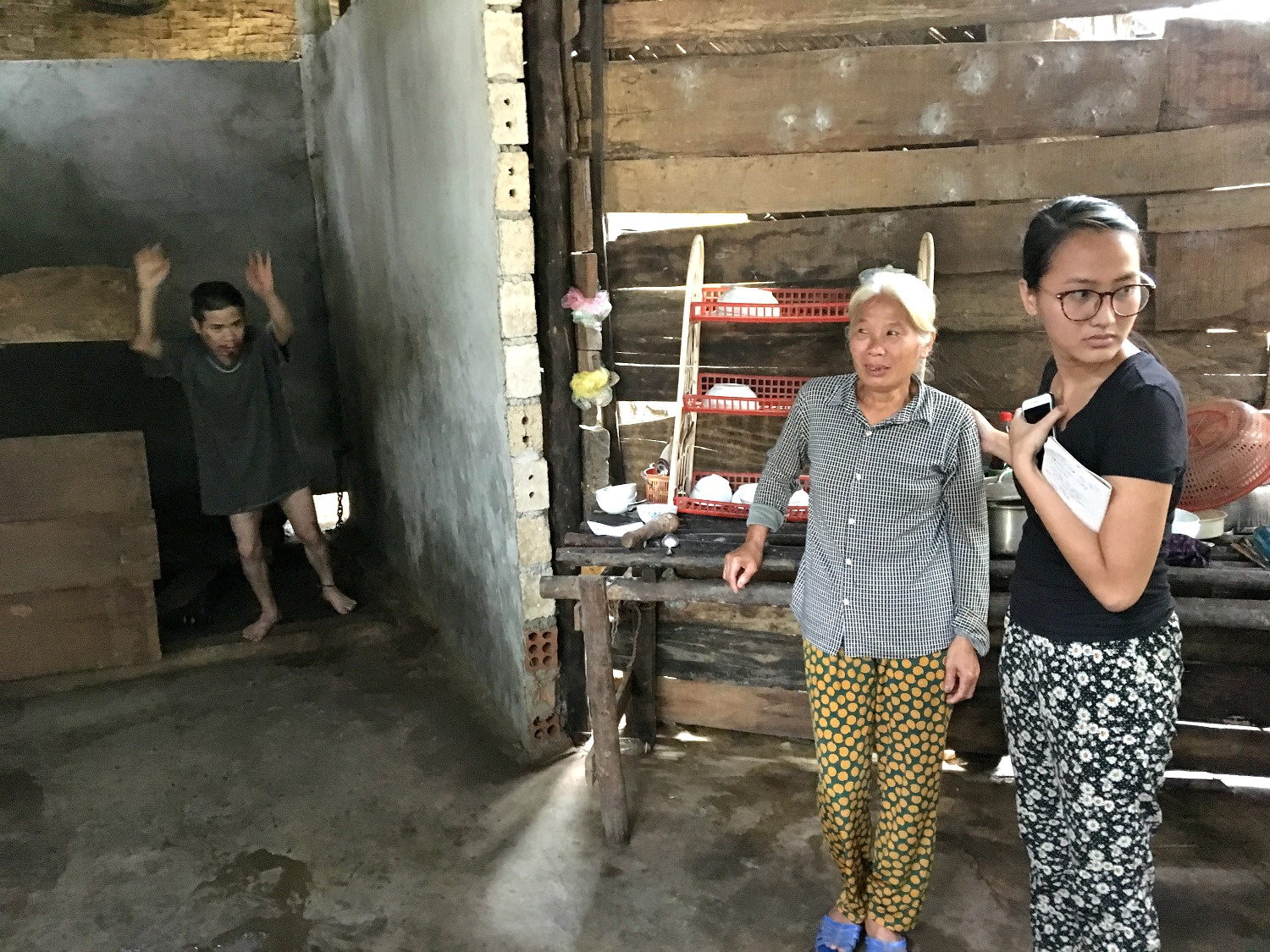
Mai Thi Loi has been forced to chain up her oldest son Kien because of his frequent rages, caused by dioxin poisoning. She is seen being comforted by Ai Hoang, an AP Peace Fellow.
When I first met Mai Thi Loi in 2015 at her home in the province of Quang Binh, Vietnam, her oldest son Kien, 31, was chained to a wall in an inner room, almost naked and moaning.
As his mother explained between sobs, Kien had been prone to outbursts of violent rage for years. She had been forced to constrain him after he tried to burn down a neighbor’s house. Kien also ripped off his clothes whenever Mrs Loi tried to keep him covered.
Our interpreter, who was deeply upset by the meeting, told us that the nearest mental hospital was in the city of Hue. Even if Kien were admitted, Mrs. Loi would still have to visit him and provide food and care. It would also mean surrendering her damaged son to others, perhaps forever.
So Mai Thi Loi remained in limbo – torn between love for her son and fear of his rage.
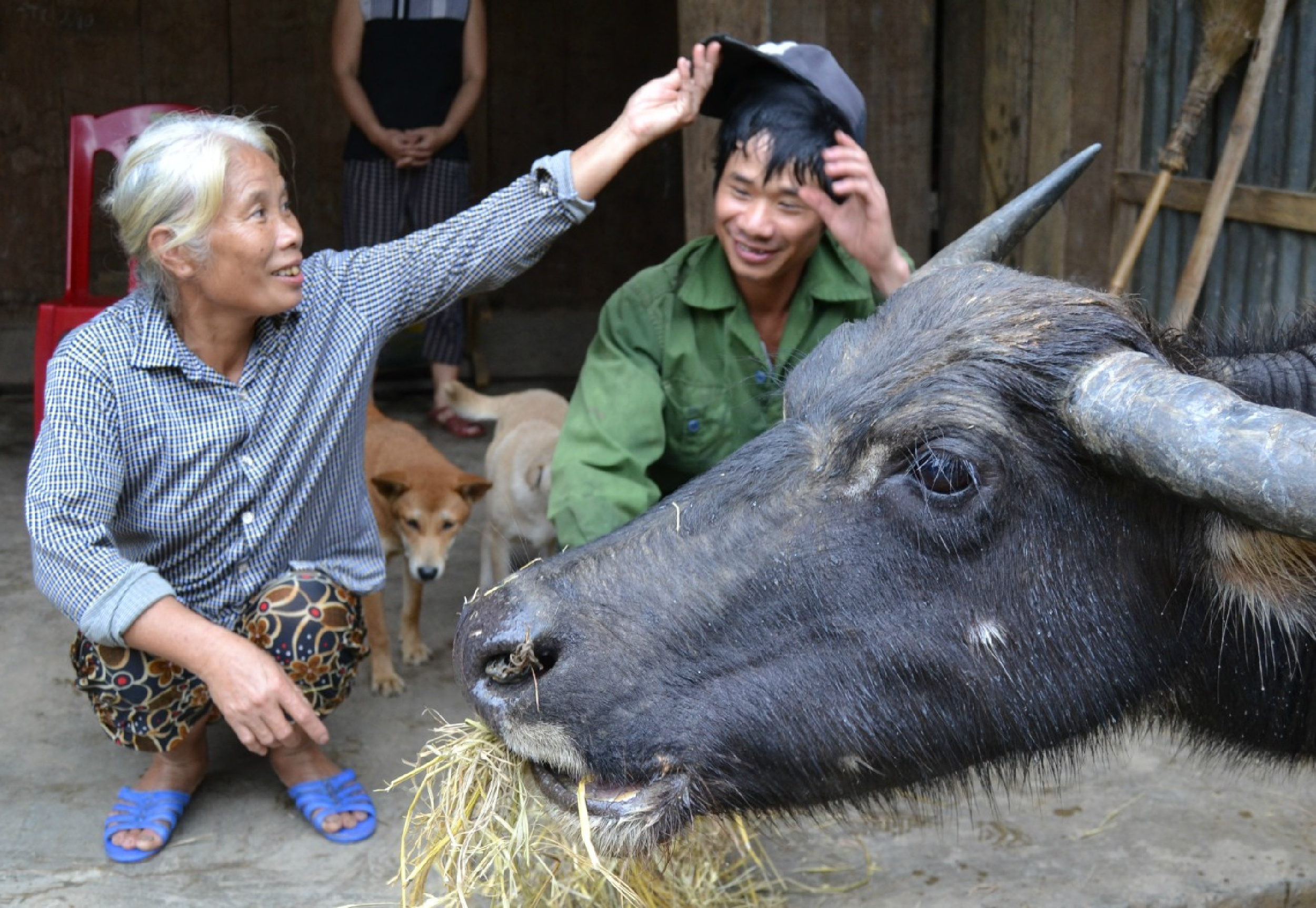
My next meeting with Mrs Loi, a year later, was less wrenching. In the intervening months The Advocacy Project had raised $1,200 for her family, and she had decided to purchase a breeding buffalo.
I visited her with Ai Hoang, a Peace Fellow (student volunteer) seen in the photo above, and an outreach worker from our Vietnamese partner, the Association for the Empowerment of Persons with a Disability,
At one point we asked if Mrs Loi would like to give her buffalo a name, triggering a lively discussion among neighbors who had gathered to watch. Eventually they came up with Opportunity, which seemed appropriate.
Mrs Loi was delighted to take ownership of Opportunity, but her sons were in worse shape than they had been the previous year. Kien was still chained up and Mrs Loi had been forced to lock up her second son Cuong. She later wept on Ai’s shoulder in her kitchen.
People to people
Such is the life of a family forever damaged by Agent Orange, the chemical herbicide that was sprayed over Vietnam, Laos and Cambodia during the war.
Mrs Loi’s husband was exposed to Agent Orange while serving in South Vietnam and returned home to pass dioxin to his wife and family. Their first two children were born without symptoms but the next three – all sons – were badly affected. Their father died in 1989, leaving Mai Thi Loi to cope alone.
Our 2025 Peace Fellow, Angie Zheng from Georgetown University, visited Mrs Loi last summer and found that her second son Cuong was better. But Kien, now 40, was still chained up and his mother – now approaching 70 – was exhausted. Mrs Loi broke down in tears, as she had done ten years earlier with Angie’s predecessor.
What lies ahead for caregivers like Mai Thi Loi, and the countless other families in Vietnam that have been poisoned by Agent Orange?
The question has hung over Vietnam and the aid world since March last year, when the Trump Administration abolished USAID, and with it over $100 million a year of USAID funding in Vietnam – almost exactly fifty years after the war ended on April 30, 1975.
Later last year, according to reports from Vietnam, the US embassy in Hanoi agreed to continue funding for Agent Orange until 2030. But it is unclear how the money will be spent, and in the absence of clarity a recent webinar at the Stimson Center recommended a return to the activism of the 1990s, with a special emphasis on people-to-people contacts.
The idea is certainly appealing, but what exactly is the people-to-people approach?
This article offers one answer through our own partnership with AEPD over the past decade. Here in the US, AP has raised $16,134 from 148 generous Americans for the 15 families. We have also deployed 13 student Peace Fellows, including Ai and Angie, to meet with the families and update their stories through blogs and photos.
In Vietnam, AEPD has helped the families manage their grants through four outreach workers who have themselves recovered from serious war injuries.
This, to us, is a “people-to-people” project. Like our advocacy, it is built entirely on personal relationships and mutual respect.
Twelve missing children
The tragedy of Agent Orange dates from 1961 when US forces in Vietnam began using herbicides to deny forest cover to Viet Cong guerrillas in the South.
Between 1961 and 1971 Operation Ranch Hand, as it was known, sprayed 19.5 million gallons of herbicide over South Vietnam. This included 12.6 million gallons of Agent Orange, a highly toxic mixture of two dioxin compounds so named because it was stored in containers with orange stripes.
The link between dioxin and sickness was conceded early on by the two governments, but it took years for the fifteen Vietnamese families we support to appreciate the full horror of Agent Orange.
Mai Thi Loi never found out how her husband had been exposed during the war, but Nguyen Van Xoan, another veteran, is in no doubt about his own contact. Mr Xoan was deployed in the province of Quang Tri in South Vietnam when an American plane sprayed the forest where he was sheltering. He covered his face and later drank rainwater which was “fresh and did not seem dangerous.” But his first two children died early and unexpectedly.
Le Van Dung and his wife Dang Thi Miet, two veterans, were also exposed to Agent Orange while serving in the south. Mrs Miet later suffered twelve miscarriages before producing a child who lived, but barely. She also has no doubt that Agent Orange was to blame.
Le Thanh Duc, another Agent Orange caregiver, joined the army after the war ended and took part in a dioxin clean-up at the former US aid base of Da Nang, a notorious dioxin “hotspot.” Three of his children, all girls, came down with a serious pathology around the age of ten and have been almost completely paralyzed ever since. They are now over forty and still in diapers.
When I first met Mr Duc in 2015 he was recovering from another unspeakable tragedy. His youngest son had died in a traffic accident the previous year. The boy, 18, had been spared by Agent Orange, but his parents were so panicked about keeping him safe that they asked his superiors to keep an eye on him when he joined the army.
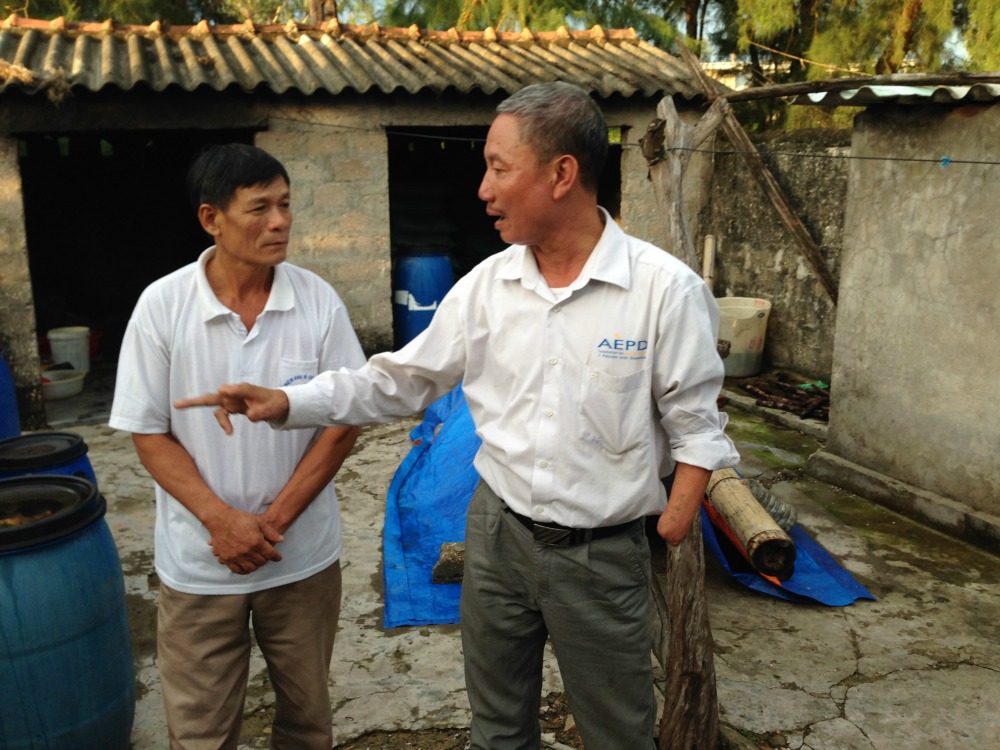
The boy’s death seemed especially cruel and sent Ho Thi Hong, his mother, into a spiral of depression. But her husband refused t0 throw in the towel. Mr Duc had just received a loan from AEPD to start a fish sauce business and proudly showed us the big stone jars in his yard, oblivious to the stench.
Passing down dioxin through generations
Quang Binh lies just north of the Demilitarized Zone (DMZ) that divided North from South Vietnam. As a result, the province received only 3,900 gallons of Agent Orange, compared to the 1.79 million gallons dropped around the former Bian Hoa air base in Dong Nai province.
In spite of this, Quang Binh has been devastated by dioxin poisoning. The reason is that thousands of soldiers from the province went south to fight and were exposed to Agent Orange. They then returned home after the fighting stopped and passed dioxin to their children. According to one 2013 report, 5,266 individuals in Quang Binh received compensation for illness associated with Agent Orange that year.
The lack of correlation between spraying and sickness makes it difficult to estimate the overall number of Vietnamese affected. Adding to the uncertainty, the exact process of transmission remains a medical mystery. The best guess is that the dioxin damages the DNA of the fetuses at conception. But this cannot be conclusively proven because most dioxin carriers, like Mai Thi Loi and Le Thanh Duc, have also produced healthy children.
One thing is not in dispute – dioxin poisoning has wormed its way into every region of Vietnam, every level of society, and every living generation.
Nor do the statistics suggest that the crisis is “getting better” as veterans pass away. The Quang Binh government recently told AEPD that around 6,000 individuals in the province are still affected – more than in 2013.
Dioxin poisoning is even being passed to the great grandchildren of veterans (who are classified as “F3” by the government). This is hardly surprising because dioxin has a half-life of up to 15 years in the human body, according to the World Health Organization.
It is not clear at what point the chemical ceases to become a health threat, but Vietnam will no doubt continue to serve as a grotesque laboratory and provide data for years to come.
Parents and children
One feature of Agent Orange has caused particular anguish in Vietnam. This is the fact that children of veterans, who were born long after the war, have suffered more than their parents, who fought and knew there would be risks.
Nguyen Van Xoan, referred to earlier, suffered from headaches and nausea after ingesting the herbicide. But this was hardly life-threatening, and when we met him forty years later in 2015 Mr Xoan was still a fit man.
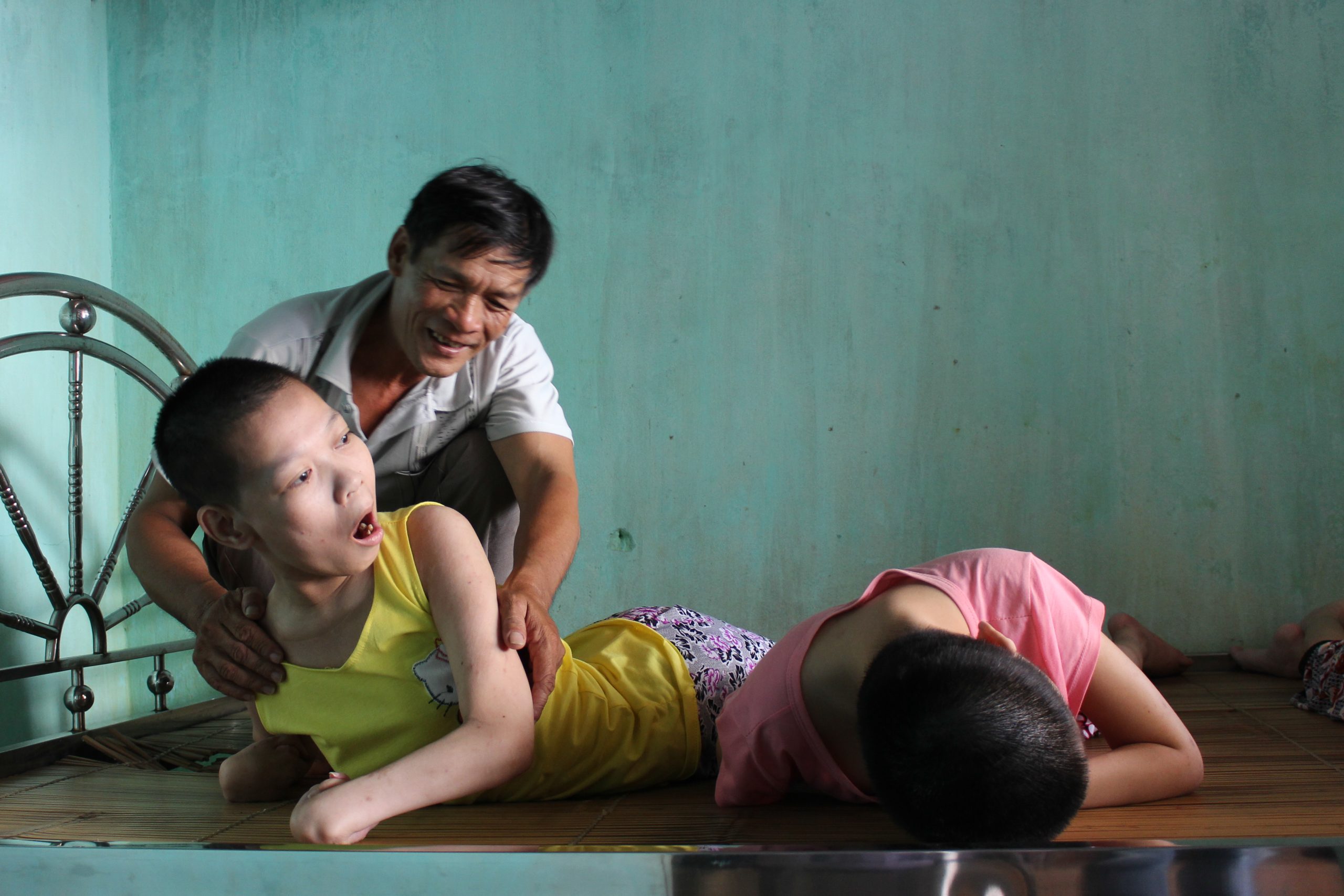
His family, in contrast, had been devastated. The first two children born to Mr Xoan and his wife Pham Thi Do died from “brain damage.” Their third child died after a miscarriage. The next two children were healthy but the couple’s youngest sons, Trung and Tuan, came down with creeping paralysis in their early teens. Their eighth child Luyen was born in 1992 with cerebral palsy and has been bed-ridden since childhood.
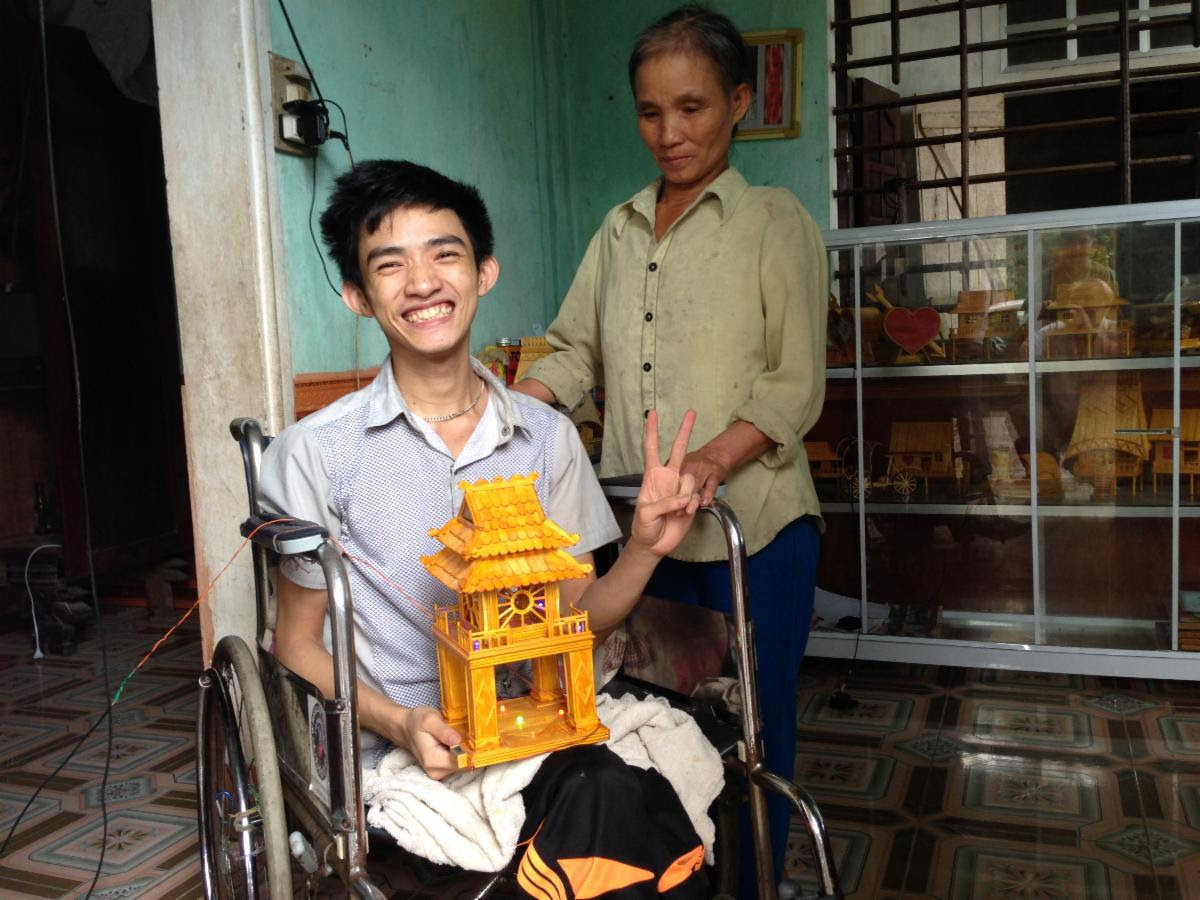
When I first visited Mr Xoan’s family in 2015, Tuan was in a wheelchair, making models out of discarded popsicle sticks as seen in the photo below. He had felt the onset of paralysis in his legs around the age of fifteen and dropped out of school after being bullied. Restless and talented, he turned to his popsicle sticks and was grateful when I purchased one of his models of the revered University of Hue.
Tuan’s grin was infectious and I remember thinking that if anyone could beat the odds he could. But it was not to be, and he died two years later. I still have his model of Hue University on my desk in Washington.
Of course, not every affected family member has succumbed and some with lesser symptoms have shown signs of improvement. But most children of veterans have been less fortunate. Watching them waste away, and knowing that they were the carriers, has produced a deep sense of guilt in the parents.
Like Mai Thi Loi, many parents are also terrified at what awaits their children as they themselves grow old and infirm. No doubt there is more institutional care available today than when we first met these families. There is even a social center in Quang Binh that caters to severe Agent Orange cases, and Mai Thi Loi’s son Kien would surely qualify.
But right now Mai Thi Loi cannot bear to think of that. Nor can she count on the support and understanding of her neighbors, who insisted that she chain up Kien when he tried to burn down a neighbor’s house and even put up the money to help her build the new room.
The economics of disability
Like many disability advocates, The Association for the Empowerment of People with Disability is committed to the proposition that disability is not disabling.
Our Peace Fellows have seen plenty of evidence of this through the years. Ryan McGovern in 2011 introduced us to Mr Can, a war veteran, who lost a hand during the war and became a celebrated maker of bonsai trees. Like many other Vietnamese with a war disability, Mr Can drew on the discipline that helped him survive to channel his talents in new directions.
This does not happen with Agent Orange. Unlike other causes of disability, dioxin strips away human agency and usually leads to an irreversible decline. As a result, and with the empowerment of victims no longer an option, AEPD has decided to focus on their families and caregivers.
There is an economic rationale to this because families with a severe disability are always among the poorest in society. The Vietnamese government gives a monthly allowance for each family member affected by Agent Orange, and together with other forms of social security this just about covers basic needs.
But only just. As a veteran and war invalid, Le Thanh Duc receives ten million Vietnamese Dong per month (about $395). His three daughters each receive around 5 million Dong ($200). But the cost of living is high and diapers (for his daughters) alone run to about a million Dong ($40).
In choosing to spend their grants, all but one family has opted for a cow or buffalo because the animals can be rented out to neighbors and give milk. Best of all, they produce calves, which can fetch up to $600 – a huge sum in the villages.
But feeding the animals becomes increasingly difficult as caregivers grow older. Mai Thi Loi no longer owns a bullock and wonders how she will support her sons without increased government support.
Peer support from outreach workers
In managing their grants, the Agent Orange families have been helped by several veterans who were themselves severely injured in war.
Over the years, these remarkable individuals have developed deep emotional ties to the families and become fast friends with our Peace Fellows. Last summer Truong Minh Hoc accompanied Angie Zheng to the home of Ngo Gia Hue and his wife Tran Thi Thao, whose three daughters suffer from extreme dwarfism.
It felt like a family reunion, as Angie wrote in a blog:
“As soon as we arrive, Huệ greets Minh with both hands. They clasp each other tightly, leaning in with warmth. Huệ’s eldest daughter hurries forward and throws her arms around him. She holds his hand and doesn’t let go, smiling wide, while Minh laughs in his boisterous, easy way.”
Like the family he was visiting, Mr Hoc was himself exposed to Agent Orange during the war. He also knows the agony of having passed dioxin to a child – his oldest son has been prone to wandering the streets alone.
This sort of experience has given AEPD’s outreach workers a unique rapport with Agent Orange families as well as authority in the villages, where they are viewed as war heroes. This allows them to speak for the families, who keep to themselves, and ensure that their isolation does not tip over into ostracism.
This is peer support at its best.
“Don’t let him arrest me!”
Our own contribution to this people-to-people model from Washington has relied heavily on the thirteen student Peace Fellows who have spent their summers volunteering at AEPD in Vietnam since 2008.
All have brought their own expectations and skills to the task. Our first Fellow Chi Vu was part of the wave of refugees that fled Vietnam after 1975 and spent two years in refugee camps before reaching the US. Ai Hoang, another Vietnamese American, left Saigon at the age of nine and was studying at Columbia University when she signed up to return to Vietnam in 2016. Both women wanted to revisit the country they had left as children, and contribute.
Ryan McGovern, our 2011 Fellow, joined the US Army after high school and was deployed to Iraq in 2003, where he developed a special loathing for unexploded ordnance (UXO) and landmines. Seth McIntyre (2014) served in the Peace Corps and studied the impact of uranium on a Navajo reservation before enrolling at Brandeis University. Angie Zheng (2025) studies conflict resolution at Georgetown.
All of our Fellows were born long after the war ended. But all have understood how the US contributed towards the horror of Agent Orange and this has made for some nervous moments.
Seth McIntyre described one memorable meeting with three generations of Agent Orange survivors. Pham Van Giang, the veteran and patriarch, was relaxed. But his son Dung – who had been seriously affected by dioxin poisoning – was anything but:
“The sight of me (a white, Caucasian, American male) sends Dung into a frenzy. He cries out in Vietnamese “Don’t let him arrest me! Don’t let him arrest me!” I am growing increasingly uncomfortable. However, Giang looks on softly, reassuring me: “it is ok, just wait.” Slowly, Dung calms down and limps to his mother.”
Several Fellows remained engaged after completing their fellowships. After returning home to California, Ai Hoang made a pitch to her father. He had left Vietnam in the early 1990s and was so impressed by his daughter’s experience that he visited AEPD in Quang Binh – his first trip to the former North – and paid for two cows. The AEPD team was deeply touched.
Looking back, all who who have worked on this program on the US side have come away richer for the experience. Jacob Cohn, who was studying at the Fletcher School when he volunteered in 2017, expressed this in a blog:
“I am someone who’s periodically struggled with anxiety and depression throughout my adult life [but I have been] blown away by the resilience of [these] people who remain devoted to beating the odds and fighting for a better future for their children…..Having the chance to share [their] stories with the world and to make it easier for them to achieve their goals will probably be one of the most fulfilling experiences of my career.”
Jacob raised $1,500 for Duong Thi An and her children, who have struggled with blindness. After graduating from college, Jacob signed up as a writer for USAID only to lose his dream job when USAID was disbanded in March 2025.
The power of families
What lies ahead for caregivers like Mai Thi Loi and their families?
The answer is brutally simple. Agent Orange reminds us that for those directly affected, wars never end with the fighting. The families profiled in this article will suffer for years to come.
But if they are the victims, these families are also on the front line of advocacy. Consider the following (abridged) reflections of Angie Zheng, our 2025 Peace Fellow after meeting Nguyen Huu Phuc, a veteran, and his wife Nguyen Thi Thanh last summer. The couple produced eight children. Two died and three were poisoned by dioxin but survived. They include Nguyen Thi Nam, now 36, paralyzed by cerebral palsy:
“Before we leave, I ask if we might take a photo of the family together. They agree. Mrs. Phuc leans over Nam and begins adjusting her blouse, smoothing the wrinkles with her hand. She murmurs something, low and rhythmic, as if just for her daughter. Her daughter laughs, her grin stretching across her face.
“It is tempting to turn this into a story about resilience and about the triumph of the human spirit. But that feels too tidy. There will still be chickens to feed, a daughter to care for, a roof to fix before the next flood. [But] for a few hours at least, I was allowed to sit with them, get to know them, and hear their stories. This, I [will] hold close.”
This simple connection between a family managing severe disability in Vietnam and a compassionate American student, is people-to-people engagement at its most powerful. It also shows why families are the most effective advocates. The reason is motivation.
This is not advocacy in the conventional sense. Most of the fifteen Vietnamese families, like the Phucs, have no interest in preaching to others and are isolated within their own communities. If asked, they would probably expect AEPD’s outreach workers to speak for them, just as AEPD expects our organization to speak for them outside Vietnam. They advocate by surviving against all odds.
Telling their stories will remain our main contribution, and the years have shown that no one does this better than Peace Fellows. We will continue to link American students with affected families in Vietnam through AEPD for as long as possible.
The road ahead for advocacy
What lies ahead for advocates in Vietnam and the US?
Here in the US, is it realistic to try and rebuild the partnership between civil society and government that put Agent Orange on the map back in the 1980s? Could the US government again be a reliable partner?
The Trump Administration appears keenly interested in maintaining the strategic partnership with Vietnam, and this may account for the agreement last September to continue US government support for victims of Agent Orange. If implementation of the new program is left to the Embassy, then that is where American NGOs will have to make their case.
But when all is said and done, the long-term solution lies with Vietnam. Vietnamese are united when it comes to Agent Orange and one imagines it will remain that way that as long as veterans of the war are alive and respected.
The families also have a powerful advocate in The Vietnam Association for Victims of Agent Orange/dioxin (VAVA).
The question is how much financial assistance the government will provide. As the recent Stimson webinar noted, Vietnam is a middle-income country and presumably better able than most to cover the cost of expanded health care.
But like any government, Vietnam must also weigh spending priorities. The fifteen families featured in this article barely have enough money as it is. The government does not provide compensation to the grandchildren of veterans.
The need for compassion
Should we expect the world to remain interested in a war that ended fifty years ago?
Students of history will answer – of course. There are many lessons to be learned from Agent Orange and they will remain relevant for years to come.
Students of peace will be amazed that the US and Vietnam – two bitter former enemies – could find common cause in cleaning up the remnants of war, including Agent Orange. This inspiring story will be told as long as peacebuilding is taught. Students of war will find the exact reverse – a military strategy of gross irresponsibility executed through a weapon that was indiscriminate, lethal and long-lasting.
But regardless of the history, there still remains this nagging question: why should we care about a war that ended half a century ago when today’s world is awash with current crises?
For me, this is a personal question. We all have our causes and one of mine is Agent Orange. People-to-people contact will do that, and I will not easily forget meeting caregivers like Mai Thi Loi and victims like Tuan, the young craftsman who passed away in 2018 and is shown in the photo below.
Ultimately this is about compassion. Our task at The Advocacy Project is to make the case that families in Vietnam still deserve our compassion for resisting one of the most devilish weapons ever devised.
After following their personal journey over the past decade this is not difficult.

Resources
This article is excerpted from a series of blog posts.
Photos: The photos in this article were taken by Iain Guest, Armando Gallardo, Seth McIntyre and Marcela De Campos. View our photos of Agent Orange from Vietnam on Flickr. They can be used free of charge, but with attribution please.
Peace Fellow blogs: Read the blogs of Peace Fellows who have volunteered at AEPD since 2008: Chi Vu (2008); Gretchen Murphy (2009); Simon Klantschi (2010); Ryan McGovern (2011); Jesse Cottrell (2012); Kelly Howell (2013); Seth McIntyre (2014); Armando Gallardo; (2015); Ai Hoang (2016); Jacob Cohn (2017); Marcela de Campos (2018); Mia Coward (2019); Angie Zheng (2025). Our thanks to them all.
2026 fellowships in Vietnam: AP and AEPD are seeking students to volunteer at AEPD and support families. Click here for information.
All there is to know about the AEPD – AP partnership: including profiles of the 15 families and the AEPD team.
Readings
Most material referenced in this article is linked in the text. For more detailed background information we rec0mmend the following:
From Enemies to Partners – Vietnam, the US and Agent Orange by Le Ke Son and Charles R. Bailey (G Anton Publishing, 2017). The definitive account of how two former bitter enemies found common cause in cleaning up Agent Orange.
The Long Reckoning by George Black (Alfred Knopf, 2025). The inspiring story of how US veterans helped to launch a movement to heal the wounds of war.
Toxic War – the Story of Agent Orange by Peter Sills (Vanderbilt University Press). A legal history by an attorney who helped American veterans sue Dow Chemical and other manufacturers of Agent Orange.
The Agent Orange in Vietnam Program (The Aspen Institute). A rich online resource that includes maps of areas sprayed and other background material.
The War Legacies Project. An international network dedicated to exposing and ending the long-term health and environmental impacts of the use of Agent Orange and unexploded ordnance (UXOs).
Agent Orange Record. A program of the War Legacies Project.
*