

The table in front of Ngô Gia Huệ’s home is crowded with tea cups, soda cans, and a porcelain kettle painted in blue. Above us, strips of red, yellow, and green fabric hang loosely from the roof, filtering the sunlight into soft color. Minh is the first to sit down. He worked with AEPD as an outreach worker for many years and first met the Ngô family in 2017. Now, he has returned from retirement to join us. I had only met him that morning, but I begin to see him through the family’s eyes, through the warmth of recognition.
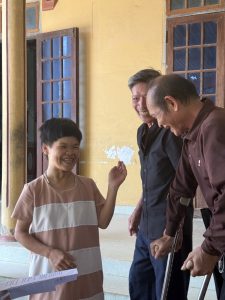
As soon as we arrive, Huệ greets Minh with both hands. They clasp each other tightly, leaning in with warmth. Huệ’s eldest daughter hurries forward and throws her arms around him. She holds his hand and doesn’t let go, smiling wide, while Minh laughs in his boisterous, easy way. The gathering carries the faint warmth of a reunion.

Left to right: Minh, Eldest Daughter, Hue’s wife, & Hue
I watch, trying to situate myself. From my experience in the U.S., professionalism tends to keep warmth and intimacy at a distance. Boundaries are emphasized. Here, the lines are softer. The relationship between outreach worker and family is not diminished by care, but shaped by it. Minh is trusted and welcomed in ways that surprise me. As both visitor and observer, I take this with gratitude as the chance to witness a different way of building relationships and community.
We gather around the table, cups filled. Huệ begins to tell his story. He was exposed to Agent Orange while stationed in Quảng Trị during the war, and his body has carried the consequences since. His left leg is paralyzed, his health unsteady.
His three daughters, now middle-aged, are all second-generation victims of Agent Orange. The eldest, along with Toan and Naan, live with moderate intellectual and physical disabilities, as well as mental health challenges. Huệ explains that they sometimes have violent episodes, which have become especially difficult for him and his wife to manage as they grow older.

At the table, Toan fidgets with a toy backpack, pointing to a fraying strap and nudging it toward her mother. Naan, the youngest, lies on a bed just behind us. She glances up now and then, then drifts back into her play, disinterested in the conversation. Her father tells us about her intestinal condition, which requires frequent hospital visits for enemas and other treatments. She cannot move on her own and needs constant care. All three daughters still menstruate each month, and Toan, Huệ explains, is unable to eat when she has her period.

As Huệ speaks, his wife sits beside him, listening, occasionally adding a word. Together, they describe the daily rituals of caring for three daughters with such needs while aging themselves. There are moments of strain, even violence, when the girls act out. “We try to overcome it together,” Huệ says simply.
When the family first received support from AP and AEPD in 2017, Minh sat down with them to co-design a livelihood plan. The typical model is to raise a cow or buffalo, animals that can generate income through breeding or labor. But for Huệ and his wife, who are elderly and caring for their daughters full time, that model would not have been sustainable or suitable.
Instead, they chose to raise pigeons and chickens, smaller animals that could be managed within the rhythms of the household. The income is modest, around 600,000 VND per month ($24), but the family describes it as meaningful and appropriate to their circumstances. It supplements their needs without overwhelming their capacity.
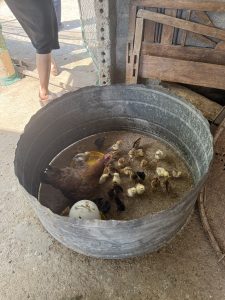
After we finish talking, Huệ stands and beckons us to the back of the house. The yard comes alive with noise. Chickens scatter at our feet, clucking loudly, while pigeons beat their wings against the wooden slats of the loft above. The space feels restless with the motion of dozens of birds.
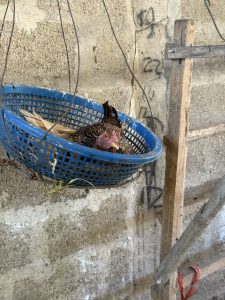
Huệ shows us the cages and crates he has built by hand. Plastic baskets and scraps of wood are repurposed into nesting boxes. Eggs are laid carefully in the corners, cushioned with dried corn husks. In one blue basket, a hen sits firmly on her clutch, her sharp eyes following our every move. Nothing here is wasted; every material is bent toward use. As Huệ talks about raising pigeons, what comes through is not pride in scale but in fit. These small creatures match the family’s capacity and provide a livelihood they can manage.
As we prepare to leave, Huệ’s wife urges us to stay for lunch. The table is already set with rice and vegetables, the dishes waiting to be uncovered. We explain, reluctantly, that the schedule will not allow it. She nods, smiling politely, but lingers in the doorway as we go. I think about the meal we didn’t share, and about how hospitality, like caregiving, repeats itself every day, whether or not there is someone there to witness it.
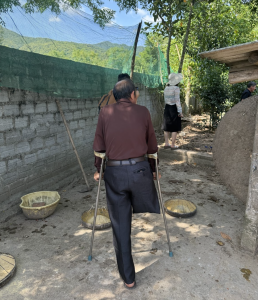
AEPD outreach worker Minh heading to the Ngô family backyard
Posted By Angie Zheng
Posted Aug 30th, 2025
1 Comment
» Agent Orange Revisited (series summary) | The Advocacy Project
February 14, 2026
[…] It felt like a family reunion, as Angie wrote in a blog: […]