
It is hot by the time we reach the Phucs’ home. The road winds slightly uphill, taking us away from the busier center of the commune. At the top, their house opens into a courtyard, shaded and still. Two dogs lift their heads as we approach, and then quickly lose interest, letting us pass. Chickens scatter at our feet.
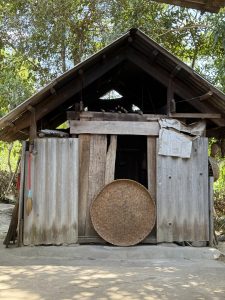
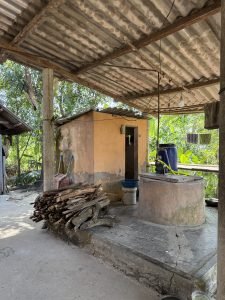
Mai and Minh, my colleagues from AEPD, call out a greeting, and Mr. and Mrs. Phuc emerge from the doorway. They smile and wave us in, pulling up chairs around a low table. Someone sets out cups of tea.
The first half-hour is slow and unhurried. Mai and Minh talk with the couple in Vietnamese: casual questions, neighbors’ news, small jokes that make everyone laugh. I can’t follow most of the conversation, but I can feel the rhythm of it: a cadence of growing comfort.
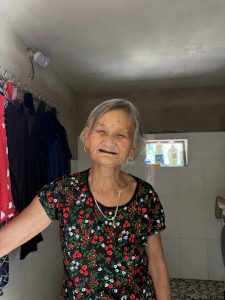
Mrs. Phuc laughs easily, her floral shirt bright against the wooden chair, her teeth flashing in the afternoon light. Mr. Phuc listens quietly, smiling when she teases him. The dogs bark occasionally from the yard until Mrs. Phuc shushes them and they trot off obediently.
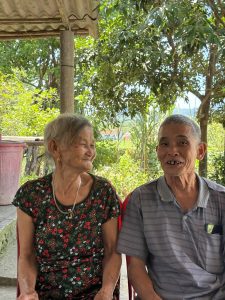
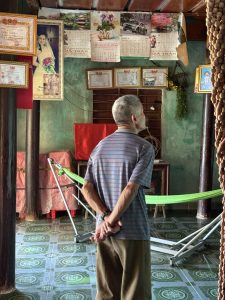
When Mai gently asks if Mr. Phuc could share his story, he nods and begins. His voice is steady, as though recounting something that has been told many times. He describes where he was during the war, how he was exposed to Agent Orange, and the illnesses that followed. He talks about his daughter, how she was born with severe disabilities, how she has dealt with chronic illness all her life.
As he speaks, I think of the broader history that threads through this family’s life. Agent Orange, a defoliant sprayed by the U.S. military across millions of acres during the war, continues to poison soil and water in Vietnam decades later. It has also left a legacy of intergenerational harm. Children and grandchildren of those exposed are often born with congenital disabilities and chronic illness.

In the U.S., veterans fought a long, bitter battle to get even partial acknowledgment of these effects. It took years of litigation against the chemical companies that produced Agent Orange before a handful of illnesses were recognized as connected, and even then, compensation was limited. Victims in Vietnam, like Mr. Phuc, have never received reparations from the U.S. government. And the only form of reparations for the war, the USAID War Legacies Program, was halted under the Trump administration.
Mr. Phuc tells us about the cow they once raised. The cow was provided through by AP and AEPD through their livelihood sponsorship project, an effort to generate sustainable income for families living with the effects of Agent Orange. For a few years, it worked well for the family. But as Mr. and Mrs. Phuc got older, and as their daughter’s needs became more demanding, caring for the cow became too much.
They decided to sell it and use the money to raise chickens instead. Mr. Phuc gestures toward the yard where several chickens roam. They are smaller, quieter, easier to care for. The couple earns less money now, but they seem at peace with the trade-off. “It’s enough,” Mai translates.
When Mai asks about their daily life, Mrs. Phuc becomes animated. She describes her morning routine: rising early to sweep the yard, cook breakfast for her husband and daughter, prepare food for the dogs and chickens. She lists the tasks matter-of-factly: bathing and dressing her daughter, cleaning the bed, cooking lunch, washing dishes, tending the animals, sweeping again. As she speaks, I picture her moving through these rooms, her day a cycle of care. She tells me this with a wide, toothy grin. She does not present the work as a burden, though I know it must be tiring.
It’s not lost on me that caregiving often manifests along gendered lines in these visits. It is Mrs. Phuc who wakes early to sweep the yard, who mixes the rice porridge, feeds the chickens and dogs, bathes her daughter, dresses her, tends to the smallest tasks and the constant ones. Watching her, I think of Mobilizing Morality, a study of caregivers in Vietnam, where women speak not of burden but of trách nhiệm, tình cảm, and lòng hiếu thảo (responsibility, affection, filial duty). In Mrs. Phuc, I see caregiving with warmth, with a kind of acceptance embedded in the texture of everyday life. It makes me question what caregiving might mean in other settings, how relational care and interdependence could be more valued and more visible.
At some point, we rise and follow Mr. and Mrs. Phuc back into the house, where they wish to introduce their daughter. She is lying on a wooden bed under a blue mosquito net. The light is dim, cool, a relief from the heat outside. She looks up at us and smiles, her mouth opening wide.
Mrs. Phuc sits on the bed beside her, holding her hand as she introduces her to us. Mr. Phuc stands at the foot of the bed, listening quietly. They speak to her in Vietnamese, their voices filled with warmth, and her smile widens.
Afterward, Mrs. Phuc takes me through the rest of the home. She shows me the kitchen, proudly pointing out the jars of pickled vegetables lined up on the counter, the pots on the stove, the glass-front cabinet neatly filled with dishes. She gestures toward a make-shift hammock next to the bed and urges me to try it.
The dogs follow us in and out of rooms. She scolds them when they bark, but her voice is fond. It is clear that she loves them, just as she loves the chickens, the plants, the house. Everything here feels tended to.


Before we leave, I ask if we might take a photo of the family together. They agree. We walk back to the bedroom, where their daughter is still lying. Mrs. Phuc leans over her and begins adjusting her blouse, smoothing the wrinkles with her hand. She murmurs something, low and rhythmic, as if just for her daughter. Her daughter laughs, her grin stretching across her face.
It is such an ordinary gesture, but I find myself holding my breath as I watch. This is a love that sustains this house every single day.
As we leave, I think about everything they have told me: the history of the war, the cow they once kept, the roof they hope to repair, the chickens roaming the yard. I think about Mrs. Phuc’s hands smoothing her daughter’s shirt, the softness of that gesture.
It is tempting to turn this into a story about resilience, about the triumph of the human spirit. But that feels too tidy. Their lives are ongoing. They do not end when I walk away. There will still be chickens to feed, a daughter to care for, a roof to fix before the next flood.
For a few hours, I was allowed to sit with them, get to know them, and hear their stories. This, I hold close to my chest.

Posted By Angie Zheng
Posted Sep 4th, 2025
1 Comment
» Agent Orange Revisited – Final Thoughts | The Advocacy Project
January 24, 2026
[…] the following (slightly abridged) reflections of Angie Zheng, our 2025 Peace Fellow after meeting Nguyen Huu Phuc, a veteran, and his wife Nguyen Thi Thanh last summer. The couple produced eight children. Two died and three were poisoned by dioxin. They […]