
Tag Archive: Hakijamii
-
Tutaonana badaye, Kenya
Leave a CommentI have been enamored with African culture for a while, and Kenya just added to it. I found the country and the people to be beautiful and vibrant (albeit challenging at times). So here are a couple videos of two of my favorite things: music and animals.
I know they are both a bit long; I had such a hard time paring down! But definitely stick with it through the end of the music video to see the gorgeous Maasai women and my personal favorite, island-style Jambo, Bwana.
A fond kwaheri to Kenya, as I am now back in DC for my second year of law school. Asante sana, Kenya. Tutaonana badaye.
Song and dance:
httpv://www.youtube.com/watch?v=Hk64c6x3Kk8&feature=channel_video_title
Wildlife:
httpv://www.youtube.com/watch?v=USV38ZLn1zs&feature=channel_video_title
-
Beatrice Atieno Oginga
Leave a CommentDuring my time with Hakijamii, I was lucky to meet Beatrice. She quickly became a friend to me, as well as a surprising source of information and support.
Beatrice taught me about life in the slums, made the best cup of tea in Kenya, introduced me to the women at Kibera Paper, and routinely confused me by switching between Kiswahili and Luo. She has not led the easiest life, but not once did she seem to resent her lot.
I was able to talk to Beatrice a lot throughout my time at Hakijamii, and once she allowed me to interview her. With the help of Marcy, the Community Outreach Officer, I was able to talk to Beatrice about living in Kibera, what stable work has meant to her, raising a disabled child, and the post-election violence.

Beatrice cleans the offices at Hakijamii two days a week. Before Hakijamii, she worked at Kibera Paper making cards. And before that she did odd jobs around Kibera, selling chapati and porridge. This income is the solitary income for her family. She says that most women in Kibera are single mothers not by choice, but by circumstance. Either the fathers die or leave the women to start other families. It is common for the same man to start many families, and leave the women the work of supporting them. At 49, Beatrice has been a widow for many years.
Beatrice’s youngest son, Eric, has a disability. Beatrice spoke to Hakijamii about the difficulties raising a disabled son and the lack of education support in Kenya for these children (hyperlink: ). Beatrice plays the roles of mother, father, and caregiver for Eric, when she can. She could not afford the cost of transport to take Eric to and from school, so she had to send him to a boarding school called Nakuru Hill. His medication costs are Ksh 200 a day, and the balance she owes the school nears Ksh 13,000. These costs are well beyond her daily intake.
When Eric is home, he shares her living space, a one-room 10×10 in Kibera. It is difficult living in the slums with a disability. There are people who walk on their hands through the sewage, but there are no special amenities, like toilets. Disabled children regularly get sick from what they touch and eat. The children will wander off in the slums because they don’t know any better; Beatrice said she just had to hope someone would recognize Eric and bring him back when it happened to her. It takes a lot of work to raise a disabled child, and she has seen some parents let the children starve, rather than deal with them.
But Beatrice feels that God had a reason for bringing her Eric. And that is how she dealt with her life, acceptance without anger or resentment. Beatrice just raises her head high and works.
I put together a video of Beatrice talking about these topics, with Marcy’s help translating. [So the disclaimer is that if you speak Kiswahili, you will probably notice inaccuracies, so please be patient with the rough translation! And if you do not speak Kiswahili, just know that you are getting a solid summary of what Beatrice said, even though it might not line up perfectly with her words.]
Beatrice did say a lot of valuable and insightful things, and unfortunately I had to limit what I put in the video. But here is some more of what she had to say:
httpv://www.youtube.com/watch?v=bAUm326-1nc&feature=channel_video_title
-
Sweet Soweto
1 CommentI had the pleasure of meeting Soweto Forum in Kibera during one of its typical Friday meetings. John Mwihia Karanja, the Chairperson, had come by Hakijamii the day before so he could prep the group on what I was interested in learning about. The goal was easy: Tell me what you do. They meet in a small cement room in Soweto East, in the middle of the Government’s first phase of the Kenya Slum Upgrading Program (KENSUP).
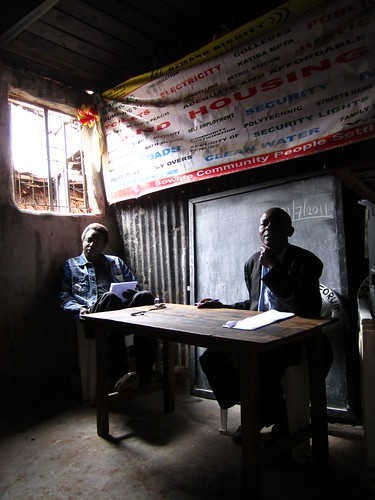
KENSUP was started in 2004 as the Government’s major plan for improving the settlements, one by one. The Government targets a settlement, divides it into zones, then zone by zone, hands out eviction notices and demolishes the buildings left behind. The former occupants are moved into what are called decanting sites; these are essentially large apartment complexes. The former settlements are now available for other development, like high-demand luxury apartments.
The decanting sites are where a lot of the trouble sets in. Until the Eviction and Resettlement Guidelines are passed, the Government has no obligations to the victims at all. The Constitution guarantees basic rights, like a right to adequate housing, but until there are guidelines, the Government can decide the limits arbitrarily.
In theory, the decanting sites do not seem all too terrible. They are nice facilities, at least; adequate housing by any standard. But they are set many kilometers from the original location. The resettled people are not given opportunity to reorganize businesses and schools. There is no measurement of compensation at all. In actuality, the rent and cost of utilities in the decanting sites are higher than most people can afford, so many get evicted for defaulting on rent payments.
Zone A of Soweto East was relocated to decanting sites in August 2009. The leftover land lays abandoned, structures intact, as the structure owners have taken the issue to court (HCCC No. 498 of 2009 Joseph Mwaura vs. Hon. Attorney General, the Minister for Lands and the Commissioner for Lands). They want compensation. The community just wants to move home.
Much like the railroad expansion, this is a development-based forced eviction. And it is having real effects on the community members. One man at the meeting only said, “If I talk about slum upgrading, I will only have bitter words, because I am a victim. I lost everything.”
KENSUP is in collaboration with UN-HABITAT, which is mandated to be the UN’s resettlement agency, ensuring adequate shelter for all. Additionally, there is the Kenya Informal Settlements Improvement Project (KISIP), which is funded by the World Bank. KISIP is also geared toward slum upgrading, but the intersect between KISIP and KENSUP is complicated and beyond my cursory knowledge. But I do know that both UN-HABITAT and the World Bank require equitable resettlement, so Shelter Forum has a good chance of making their contentions heard.
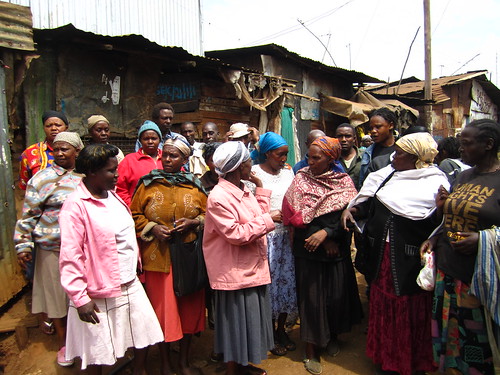
Besides fighting to right the slum upgrading, Soweto Forum is actively involved in the community. They provide adult education courses, advocate for better access to care for HIV/AIDS patients, and created Youth Building Bridges for Peace in Kibera to build entrepreneurship in the children of Kibera.
Soweto women have also created Gender Defenders, which works to improve women’s empowerment and security in the settlements. In particular, they work with young girls to end gender-based violence. They do fun empowerment exercises, like cat walking and are working to create a security station. They are also teaching the women to improve their socio-economic status by teaching them skills to become financially stable. They raise chickens and sell various beaded goods, like necklaces and purses. They also work on urban gardening, one of many projects Christy highlighted last year.

Soweto Forum has a lot of activity in the works. They are primarily focused on an eviction moratorium. They also want to see the Eviction and Resettlement Guidelines adopted. But despite their busy schedules, they took time to spend their entire meeting welcoming me and making sure I had all my questions answered. I was not able to visit Soweto Forum again, mainly due to the increased violence in Kibera, due to the Ngazi elections, but I am hoping to work with Hakijamii Community Outreach Officer Marcy to find some resources and funding for this group.
-
The Railway Dwellers: Jared and St. Juliet Educational Center
Leave a CommentThe children can be heard as soon as you step out of the car. The pure joy of kids on a playground sounds the same in any country. It’s the appearance of the playground that changes. The kids at St. Juliet Educational Center play on an uneven plot of dirt, about 100 square feet, encircled by buildings.

The school was established in 2000, and it serves 875 children. 310 of these students are orphans, and a great many more have only a single parent. The school offers baby class, which is like kindergarten, and first grade to eighth grade. With only about a quarter of an acre for land, the children manage to find space, either hanging over the railings of the buildings or on the dirt in the middle.
Eric, my community guide, finds the head teacher, Jared, but he is wrapping up a meeting with some parents. We wait in the back of the classroom, which looks more like a tiny church. The classroom is rectangular, longer than it is wide, and there is a podium and short stage in the front. The desks are rows of benches with narrow counters attached, and the children file into them, with a complicated method as to who sits where. A man wearing a black blazer with a gold lapel breezes in, and shakes each of our hands before heading up to the front of the class. He has one of the most sincere smiles I have seen, even though he is missing teeth, and the kids stop paying so much attention to me once he reaches the front.
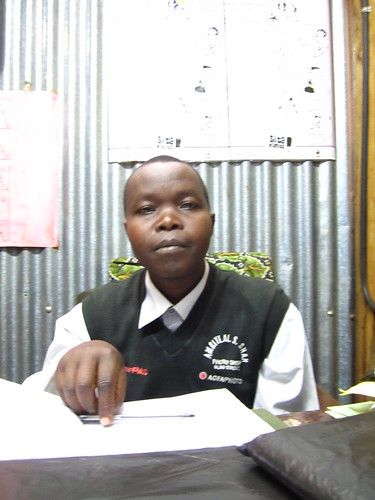
At this moment, Jared has finished his meeting and welcomes us into his office. It is tiny, about 6 feet by 6 feet, packed to the brim with things, and completely built of corrugated metal. He obviously never gets a quiet moment, as the walls rattle like thunder, and every word from the classroom and the playground can be heard. He has stacks and stacks of bundled papers on his desk, but he, too, has a method to his (seeming) disorder.
He briefly introduces me to the issues of his school. In short, he has no idea what will happen to it. He has not been informed if the school will be relocated or if his students will be moved to formal schools. His is a non-formal school, which means that the government does not support it, financially, at least. The students pay about 200 shillings a year in school fees, and most live in the immediate area.
The issues of institutions, the schools, churches, clinics, seems the most distressing. The Relocation Action Plan calls to have the students “infill” the other schools existing outside of the reserve. The RAP has decided that these schools have empty classrooms, which can accommodate the students. If there aren’t empty classrooms, then the schools have land in which to build additional classrooms.

The first issue: There are disputes about whether this is actually true. Any passerby of the schools in Kibera can see the walls are teeming with students. No space goes unused, and the administration strives to keep the student to teacher ratio at 50:1. These suggested infill schools are formal schools, that is, they are supported by the government. They are saying they are filled to capacity, and in addition, the creation of the non-formal schools can be traced directly back to a lack of space in the formal sector. When the government announced that primary education would be free (or nearly free), students flocked to schools like Olympic Primary. Only the schools did not have room for the students, and so they returned to their nearby neighborhoods, filling up the non-formal schools along the way. So this situation begs the question: How does the government, in its ivory tower, find the space that the children, on the doorstep, couldn’t?
The second issue: The RAP states that right around 5,000 students can be accommodated by infill. But over 7,000 project-affected students (in Kibera alone) have been counted. There is no solution for the other 2,000.
The third issue: Timing, timing, timing. To the best of my knowledge, construction hasn’t started yet. But just like the questions about the interim period for residences and businesses, how long will these kids be displaced? How long will they be without a classroom? And how much moving around will they have to do? Will it disrupt their studies? Their behavior? How far will they have to travel to get to school after this?
The fourth issue: Teachers. St. Juliet employs 20 teachers. Some of them are retired teachers who went back to work. Some are not accredited or licensed. Some are social workers. Nothing has been said about their futures. They don’t know if they will be jobless, if they will get to fill the teaching positions that will be needed at the other schools.
Jared has no idea if he has any job security anymore. He cannot tell his teaching staff anything absolute, either. Or the parents or the kids. He would love to see his institution relocated, rather than destroyed. But no one has been by to talk to him or consult with him. In talking to the ED of Pamoja, this option of relocation hasn’t really been considered seriously yet, and definitely no additional land has been secured. **Kibera is being treated very differently from Mukuru.
These issues that plague the schools also follow the churches and clinics in the area. What will happen to them? What if there is no room at other congregations or other clinics? There is no room in the 10 meters of the reserve left for the community to build anything to accommodate 7,000 students (43 schools). There is not enough room to accommodate the 260 institutions that will be demolished. The population density of an area like Kibera is astounding already. The process of squeezing 30 meters of tightly packed structures into 10 meters is not likely to succeed. And the people are not willing to sign onto this project without the guarantee that they won’t be tossed aside.
-
Sad Day in Kibera
3 CommentsI have been busy trying to write a comprehensive and critical analysis of the opportunities within the Relocation Action Plan and within the community response to it. I had almost forgotten about the Ngazi ya Chini election that was held yesterday in Kibera. Until my director came in and asked if I had heard about it yet. Rival groups started arguing, things escalated, police were called in. One man was killed by police fire, and others were treated for various injuries. Hakijamii’s Program Director suffered minor injuries.
I’m glad I didn’t ask to go.
A survey of the main news sources in Nairobi didn’t report much. Scratch that…they didn’t report anything. I found this one article on it, but the article is vague as to the issues leading up to this election. What about why they had called an election? What about the seven years of anxiety leading up to this November’s evictions? What about the serious strain and life-changing decisions Kenya Railways and the Government are forcing on 10,000 people?
More attention needs to be given to this. More thought should be given to the obvious social and psychological strains this is causing. With reporting like this, no wonder the Government isn’t be held accountable to the Constitution.
-
Partners: AP and Hakijamii
Leave a CommentHakijamii now has a presence on The Advocacy Project’s website! A comprehensive partner page has been created for both Hakijamii and Ngazi ya Chini. Be sure to go check it out to get a full picture of what these organizations are doing in Kenya!
-
The Railway Dwellers: Mary
1 CommentOn Thursday, July 21st, I went to Kisumu Ndogo for a second time to meet with Ngazi ya Chini. Kisumu Ndogo is an area in Kibera that functions on its proximity to the railroad.
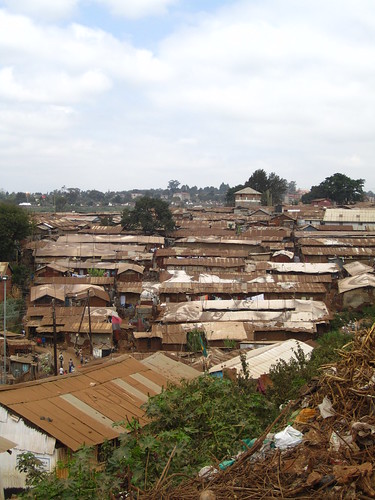
People work off the line; they live off the line. It is a mainstay of their livelihoods. Yet, this thriving community is set to be fractured. Everyone on 100 feet of either side of the railroad will be displaced. Large metal poles mark the 100-foot (or 30 meter) point. These poles are signs of certain doom for people living on one side, and they are handy fixtures for drying clothing for people lucky enough to be living on the other side.

I was taken around to speak to some of the affected people. I asked them each for permission to film the interview, but many were skeptical of me and insisted I didn’t. I tried a different tactic of asking my questions first, and then requesting again that I could at least take a photo. They all obliged to the photo after the fact.
Many times I have tried to imagine what this would mean to me. If the US government came by one evening, with a piece of paper, which dictated that, my home/business/school/church was in the way of a new highway system. The thought of moving makes my head hurt already.
Then I try adding in factors. I have lived in the same home for 20 years. I have built it with my bare hands, and it is the source of my income. I am a widow with two children, and I also support my sister’s three children. My income feeds us, clothes us, pays the rent, and pays the school fees. I live in a community built on habits and conveniences. I have no reliable means of travel, and a matter of kilometers is a barrier to movement and business. One customer is the difference between eating that night and not. I can’t afford to live anywhere else in the city, which has left me behind. A city that has a cost of living greater than that of my entire neighborhood’s monthly income. I am receiving promises from a government that is not concerned with living up to them.
But even then I can’t imagine the feelings of insecurity or apprehension that these people know.
Their stories are very similar, but each left a lasting impression; each put a human face on this abstract group of railway dwellers. Each is being told that they cannot sustain the lives they have built up. And each unknowingly emphasized the lack of consistent information shared between those planning this expansion and those who will be affected by it.
Hard at work, Mary quietly stepped out from behind the glass of her butcher shop to speak to me. She had been chopping up cubes of steak for a convenient sell, and they were displayed prominently behind her window, enticing the passer-bys with the promise of dinner. Her hands were stained with blood, and she shyly smiled when she realized she was still clutching the large knife in her hand while she softly spoke.
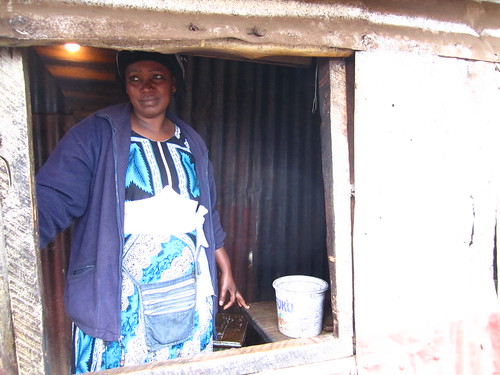
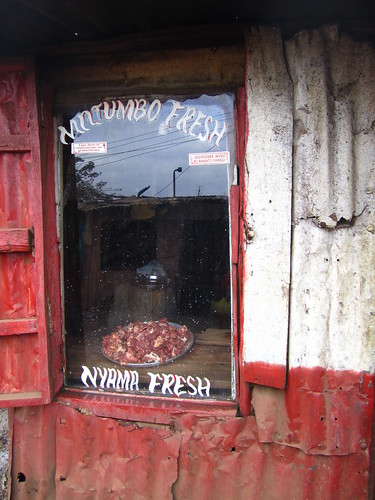
The butcher shop is about 10 meters from the tracks, and her family has run the business since 1991. 600 shillings ($6.64) a day is enough to provide some basics for herself and her 21-month-old child, as well as other family members. The family depends on this business, and without it, they will suffer. Mary spoke of her fear of resettlement; the fear that even though she will be taken away from her neighborhood, her home, the customers will stay behind. She doesn’t just fear it; she knows it will happen.
She seems tired, but not completely without hope. Since 2005, they have been threatened with eviction, and six years of anxiety is a lot for a 26-year-old breadwinner to handle. She has seen movement and growth in Kisumu Ndogo since May 2010, the second time the railroad people came by to assign them a number. But besides that brief contact, no one has been by to speak to her. No one has made an effort to help her understand.
Mary didn’t speak much English, but as I thanked her and began to walk away, she quietly said, “Please help us.” That message I understood perfectly.
-
Speeding Up…
Leave a CommentMeetings are picking up around Nairobi for me, and posts are in the works to explain all of them. Yesterday, I met with Ngazi ya Chini and was able to speak to some people who will be affected by the relocation (unfortunately they were a bit camera-shy, but I snapped some photos after the interviews – with permission of course!). Today, I met with a group called Soweto Forum, dedicated to righting the injustices of the government’s slum upgrading program. After that, I met with the Executive Director of Pamoja Trust and gained a bit of perspective on the entire project, including the Relocation Action Plan and how the railroad expansion is actually going to unfold.
Additionally, my director, Iain Guest, will be on his way to Kenya in ten short days, and I have been getting to know this beautiful country better – including a short safari in the Maasai Mara last week and a day trip into the Rift Valley tomorrow. I’m looking forward to sharing all of the above. But in a little bit of time.
Also of note, Pamoja Trust released a progress report on the relocation, which included a timeline for the remainder of the project. The construction phase (that would be demolition) is set to begin in November OF THIS YEAR. That’s pretty soon for my scale, but considering the first eviction notices were handed out in 2004, it must feel like the end of the longest waiting game ever to all the railway dwellers.
I leave you with these interesting and related stories. My flatmate this summer has listened to my railroad jabber all along, and she kindly sent me these two about life along the tracks:
People in Indonesia using the railroad for its healing powers.
This market in Thailand:
httpv://www.youtube.com/watch?v=pxeu0dzNUiY&feature=fvwrel
And a project I have been obsessed with before Kenya was even a possibility in my mind. Little did I know this area, Kisumu Ndogo, would become my most familiar area in Kibera, and the remnants of the photo project are still around. See more here.
-
Mukuru
2 CommentsThe railroad expansion will affect an area much broader than just Kibera. Kibera gets a lot of attention for various reasons, but it is important to remember the other populations, which will also be displaced. This includes communities in Kisumu, on the shores of Lake Victoria, and Mukuru, a settlement on the outskirts of Nairobi.
On July 14th, the secretary of Ngazi ya Chini picked Sally, the Hakijamii intern, and me up from the office, and we started the drive to Mukuru. Mukuru is about 10 kilometers (6 miles) outside of Nairobi. The population estimates for the entire area range, but normally fall around the half million mark. From what I can gather, Mukuru is Kiswahili for “dumping site,” and that is exactly what Mukuru started as – and to a large extent, still remains. The area started as a quarry; as Nairobi developed faster than its means, due to the mining, the site was deemed as unfit for development, so instead it became a garbage dump.
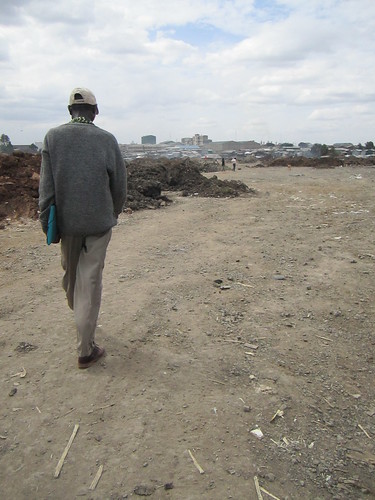
As abandoned resources grew, people scavenged the dump more and more and began building their homes in the area. The Mukuru settlement was born. The area is still heavily industrial, and the buildings now center on the railroad, the old quarry, and manufacturing sites. Large lorries carrying dirt and rocks, apparently for a purpose, frequent the roads, though that purpose remains unseen for the casual visitor.
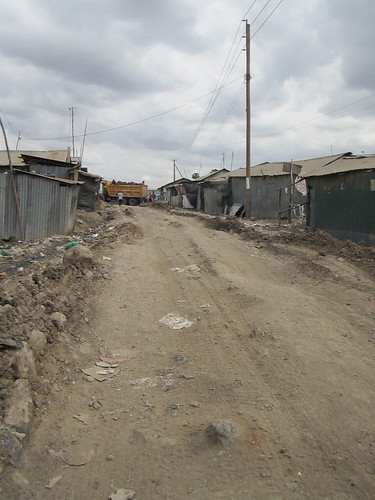
The settlement faces the same issues as the others; tuberculosis, malaria, HIV/AIDS are common, life expectancy hovers around 40 years, the population density is something like 50,000 per square mile, and the average income is around $1 a day.
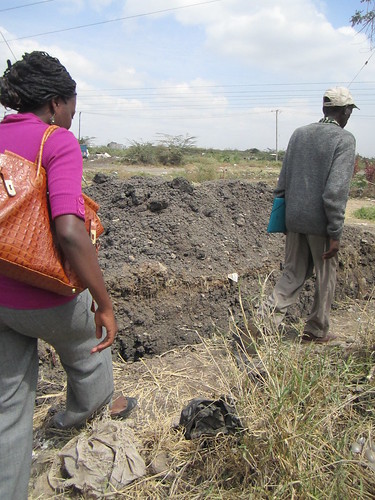
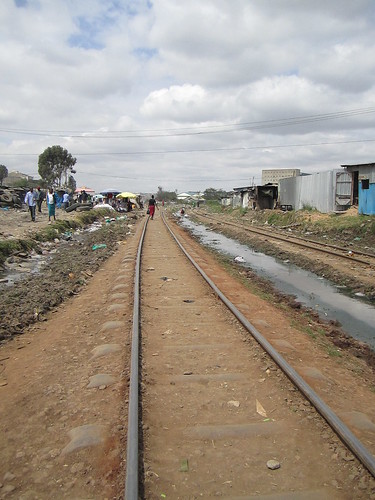
We were dropped off at a roundabout near the settlement in an industrial area, and there we waited. And waited. And waited. Waited long enough for this mzungu to sunburn under a winter sun (granted, that is not new to me). We eventually realized we had been plopped down on the opposite end of the settlement from the community meeting, so we began to walk.
I followed the lead of the community, using the railroad as a path. The other options were to walk through standing wastewater or on dirt frequently used as a makeshift toilet, so the threat of moving for a rumbling train was worth it (only two come through a day – a figure the government wants to increase). The further into Mukuru we walked, the closer the structures crept toward the railroad. Especially once we made it to one of the market sections of the settlement, the railroad and the market became inextricable.
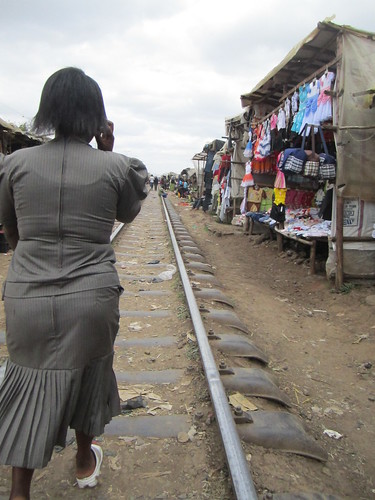
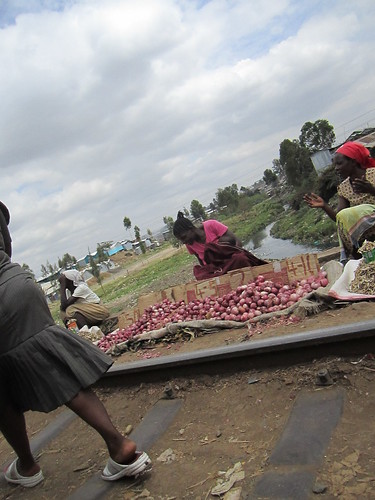
I was not as comfortable in Mukuru as I have been in other areas (can you really be comfortable in the settlements, as an outsider?). Maybe it was because my community liaison is not a member of the community (he is from Kibera), or maybe it was because the slum was so far out of Nairobi, it didn’t seem to be frequented by visitors. I normally use children as a benchmark, and the children of Mukuru tended to either hide from my gaze or glare at me suspiciously. It also didn’t help that adults yelled things at me more than I had encountered anywhere else in Kenya, and one woman conveniently tossed her trash into the sewage at my feet. The community, though, was thriving and lively, and it was easy to see how entrenched the railroad has become as an everyday part of life.
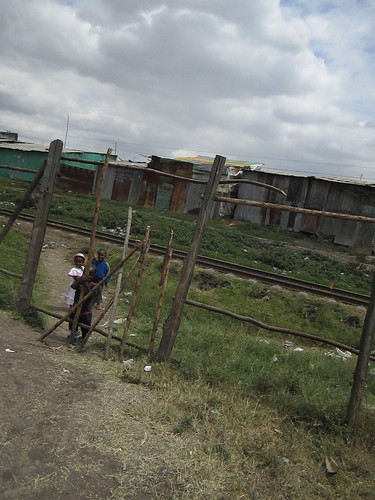
The meeting took place in a community of Mukuru called Sinai, an area where the buildings relax their grip on the railroad. Within the first ten minutes of the meeting, a bare engine rumbled by, shaking the corrugated metal siding and drowning out the voices of the facilitators. Just part of the reality of life here. The participants in the meeting were impassioned and emphatic, and it was obvious this would be one of the livelier meetings I had attended; few people were able to speak uninterrupted. I received brief translations, and it became apparent that Mukuru had not mobilized behind a single leader, and there was discontent about the current status of organization.
Pamoja Trust plays a murky role in the relocation, as it was a key contributor to the writing of the Relocation Action Plan (read as: they were hired by Kenya Railways), but they also play a key role as rights protectors in the settlements. Things get even more complicated because certain members of Pamoja have shifted around and created a new organization, charging themselves with responsibilities too cannily similar to be pure coincidence. Opiata, the ED of Hakijamii, told me afterwards that it would take months to catch up on the intricacies of these organizations’ interplays and roles. Needless to say, the community seems divided, and my experience at the meeting was cut short as the two groups came to a head and fighting broke out. Sally was quick to react when the tension started rising and ushered me out of the building.
My overall impression was simply that the community does not seem ready to move at the pace that is necessary to respond to the RAP. Implementation is imminent, yet they cannot rally behind a figurehead, or even yet, an organization. Kibera faces similar issues, but not nearly so polarized. From what I have read on successful inspections on World Bank programs, unity is necessary, and a lot of the settlements’ strength rests in their sheer numbers. Thousands of people are hard to ignore, especially when they speak with one voice.
**Also of note, due to government cutbacks, Hakijamii is losing a long-time and committed international donor. They have to restructure and reevaluate programs for the next three years, which could have a terrible ripple effect in the settlements. If anyone knows any organizations active in securing economic, social, and cultural rights in developing nations, send them our way!
-
Kibera Paper Continued
101 CommentsAs a quick addendum to the blog I wrote a few days ago, I was able to compile the videos I took of the card-making process. So here are the women of Kibera Paper showing me how it’s done.
All I know is my sister and I never made anything out of recycled paper quite as nice as they do (no offense, Ash.).
Photos of my trip to Mukuru and an introduction to Beatrice to come soon!
httpv://www.youtube.com/watch?v=VmoLaZm8SE4&feature=channel_video_title
-
Entrepreneurship and Craft in Kibera
3 CommentsThis blog is more than just a travelogue, as my goal is to attempt to delve into the complexities of housing rights…the fight to fix them, the Kenyan Government, IGOs, development plans, indigenous populations, and diminishing resources…but still to present Kenya through my eyes.
This is a great opportunity to explore a beautiful and diverse country (and people), whose image has been marred by unfortunate events and nicknames like “Nairobbery.” Kenya is more than safaris (though what an amazing experience, right??) and Obama, just as the settlements are more than human suffering and bleak conditions. I had told myself before getting to Kenya that I want to show what life is like here. So in addition to showing the inequality and despair of the settlements, I was going to make a concerted effort to show more of the culture and hope that comes out of them, too. Because, let’s face it, you don’t find a lack of culture and personality anywhere in Kenya – in Mombasa, Turkana, the Mara, or the settlements.
So then there is Kibera. Kibera takes on many faces, depending on who you talk to. To government officials, it is an eyesore and a problem (but also votes). To people from other areas, it is a place filled with trouble-makers and whiners (“Just look at how they rip up the railroad at the slightest instigation! They are babied by the government,” they say). To the people of Kibera, it is home. One look at the Kibera News Network site gives a glimpse of all the community-building, encouraging, and cultural things to come out of Nairobi’s biggest settlement. Fashion shows, picnics, and artisans all abound in the area.
People just seem not to look for these aspects of life, or maybe they are overshadowed by the extreme poverty. We have a tendency to be fascinated with human suffering – the train-wreck effect. We can’t look away. Life in these settlements is so hard for us to comprehend – “us” being the typical Westerner, we focus on those aspects that make us feel pity, even make us feel compelled to act, to pressure for change, or just to give thanks for our own status in life. Isn’t this the main compulsion behind the slum tours mentioned before (here and here)? I am not saying that this is bad, necessarily; actually, it is amazing that despite thousands of miles, differences in culture and language, we can still feel connected to each other through the human aspect. True, life in these settlements is hard. It is dangerous. It is inequitable, and there can be a sad complacency for their “lot in life,” but there is also that resiliency. These are still people, and they are beautiful and diverse and active. They don’t lose that because they live in a slum.

My first week in Kenya, while perusing an ex-pat haven of a market, I came across a group of women selling cards. Their tent was bare, not filled with the marketing ploys and gimmicks of the other more savvy artisans. They simply had two boxes of cards and a sign. The cards were beautiful, hand-painted on recycled paper, each signed by the woman who put the time into its creation, each artist a woman of Kibera. After doing some research on Kibera Paper, I was pleasantly surprised to find that it calls my own base of Kenyatta Market home. And then I was even more pleasantly surprised to find that Hakijamii’s resident part-time office assistant, Beatrice, also used to work at Kibera Paper.

On two separate days, Beatrice clasped my hand in hers and marched me across the street to St. Luke’s Kenyatta Parish to introduce me to her other “family.” The women of Kibera Paper are sweet, welcoming, and humble. The operation, started in 2001, is tiny and shares space with the church and with a school, but it employs 24 women, single mothers and widows, and allows them the flexibility of a steady wage – to pay for rent, dinner, and school fees. Most of these women have worked for Kibera Paper for 7+ years.


The idea is simple, but resourceful – take scraps of office paper off of business’ hands. Turn it into a pulp, dye it, turn it back into paper, and personalize it as a Kenyan piece of art. And for 100 shillings each (around $1.20), they are cheaper than any greeting card I’ve seen in Target.


Like Kazuri Beads, Kibera Paper saw an opportunity to help a marginalized and vulnerable group, single mothers, empowered them to learn a skill, and improved, at least slightly, the monthly income they bring home. They are not receiving hand-outs. No one I have met from Kibera has ever asked for a hand-out. They are making an honest living and are happy for that.
-
There is no such thing as too many baby elephants. Or AP Fellows.
314 CommentsA quick diversion from work, in honor of 4th of July. This weekend, Charlotte and Cleia took a break from Enoosean to relax in the city. Relaxing in Nairobi sounds counter-intuitive, but when you are coming from the Maasai bush, hot showers and grocery stores are welcome. So finally, the Kenya branch of AP was united.

On Sunday, after convincing Cleia to join us, we made the trek down to Nairobi National Park near Karen and tried to make friends with the baby elephants at the David Sheldrick Elephant Orphanage. The orphanage takes in and rehabilitates orphaned elephants until they can be released into the wild – typically in Tsavo National Park. For most, this takes over ten years, and there are different levels of care and human interaction the elephants receive, depending on their age.
The orphanage opens its doors to the public every morning (and evening if you decide to “foster” an elephant) and presents its babies to everyone (you can see profiles of the babies on the website!). It is informal and comfortable (minus the jostling of wzungu), and the trainers encourage the elephants to interact with the crowd. By the end of the hour, even Cleia had joined Team Baby Elephant. There were quite a few squeals of joy among us. And hundreds of photos.
The first group was the babiest of the babies (the Nursery Herd), including 9-month old Naipoki (wearing the blanket – meant to reduce the risk of pneumonia).


The second group was older, around 2 to 3 years old. This is right when they start developing tusks and about the age they get weened off the milk.


The bond between the elephants and the keepers was incredible and enviable (at least for me).


A highlight was definitely the dog-pile that ensued right before the babies were led out. What hams!

The orphanage does not discriminate and has rescued countless other animals, including a baby black rhino, which due to its blindness, was abandoned by its mother.


We also discovered this baboon family, complete with a baby hanging onto the mom’s belly (Dad had already run into the trees). The mom was none too interested in us, which was probably for the better. As the center is situated in Nairobi National Park, getting there requires driving through land still controlled by animals…including lions. So we were quickly ushered back into the car.
I really enjoyed getting to know Cleia and Charlotte; it was great to hear about their experiences with the Kakenya Center. I am looking forward to eventually getting to see Enoosean to get a feel for Maasai life, but it was also nice to share mine with them.
As always, more photos are available on Flickr.
-
A (Brief) History of the Railroad Expansion and Its Woes
5 CommentsThe history of the railroad expansion really starts with the history of Nairobi. It was founded in 1899 in the middle of a swamp. Breaking the distance between Mombasa (on the coast) and Kampala, Uganda, it was established because of the railroad, founded as a depot. Six years after its founding, it became the capital of the British protectorate and then the capital of newly independent Kenya in 1963.
Independence increased the boom of urbanization, and the city centers began to swell. Nairobi’s population more than doubled ten years after independence, and now its population sits at over three million. The slum creation can be traced back to urbanization; the infrastructure of the city could not handle such a rapid influx of people; the people could not handle the high cost of living. The general consensus is that there are 183 informal settlements or slums in Nairobi, which hold anywhere from 40 to 60% of the city’s population. A Shack/Slum Dweller International (SDI) report estimates that 63% of the land dedicated to the settlements sits on public land that has been privatized since the particular slum came into existence. The rest of the land is public land, either contested or uncontested. The 60 meters of railway corridor in Kibera and Mukuru count as contested public land.
And that’s what the disputed land is, just a corridor of 60 meters – that’s 100 feet on either side of the railway – that stretch along 11km of track. But the track has become an everyday part of life for these people; some traders literally sell their wares on the track, simply moving off when a train goes by. It is a road, a community hub. And while 60 meters doesn’t sound like a lot, the Relocation Action Plan (RAP) counts that there are over 4,600 homes, 4,300 businesses, 280 institutions (including churches, medical clinics, and schools), and 790 public facilities situated in those 60 meters. And it seems to treat these figures as trivial. The people of Ngazi Ya Chini, on the other hand, think those estimates are low. It seems like not much has changed in a year…

The story behind Ngazi Ya Chini can be found on Christy’s and Louis’ blogs.
Here are the basics of the issues. The expansion is going to happen, and it is scheduled to conclude in 2012. The community is now trying to form a resettlement plan that is fair. Or at least respond to the inaccuracies of the most recent RAP. The World Bank’s Operating Policy 4.12 governs this. Hands down, no questions…it must be followed.

They want to be consulted.
OP 4.12 requires that those affected by the resettlement are consulted and participate in the planning and implementation. As far as Ngazi Ya Chini is concerned, this has not happened.
They want equitable resettlement.
OP 4.12 also requires that the people who are involuntarily resettled be returned to a standard of living equal to that of their pre-displacement levels. This includes their businesses, homes, communities, facilities, etc. The RAP is vague on a lot of the actual plans, but the community wants the same amount of space for their homes and businesses. If they had 6 meters for their home previously, it does not seem equitable to cram them into 3 meters.
The resettlement will disrupt markets.
Many of the venders along the routes have been there for years. And the track is a prime location; it provides easy access, it is easy to find, it is established as a market area with captive consumers. The traders who will be displaced will have a hard time rebuilding such a market.
The resettlement will disrupt community structures.
This plan will separate families, friends, colleagues, and neighbors. With two large walls planned, as well, it will also effectively sever the neighborhood, making one into two. Compensation for this sort of loss is hard to measure.
The RAP has holes.
There are many issues left up in the air, such as the actual plan, the amount of space, the available retained land for resettlement, the school issues…the list goes on. The methodology alone is murky. And as mentioned, Ngazi Ya Chini questions the actual data.
The government does have some valid reasons for the resettlement. The trains are dangerous. At least three derailments have occurred in the past two years. The tracks are over a hundred years old and easily uprooted, which has turned into a protest tool for some residents. The trains are running inefficiently, as they can only go around 12 mph through the crowded slums. The uprooting stops the trains entirely, and capacity is decreasing, rather than increasing. Maintenance crews have a tough lot, falling sick regularly, as many times the tracks become waste heaps for everything from scraps to human excrement.
That being said, the process needs to adhere to the stated guidelines. A few solid bargaining points for the government does not excuse a shirking of accountability. Especially when it comes to the Relocation Action Plan. Because at a certain point, isn’t this all the Bank is going off of?
-
Streets of Nairobi
5 CommentsA large part of my time in Nairobi has been spent driving to and from work and my host-home. The drive spans the length of Nairobi, and in the morning can take anywhere from 30 minutes to 2 hours. In the evening, we are lucky to make it back in an hour; typically it takes around two.
Needless to say, I finally remembered to start bringing a book. But every once in a while, the ridiculous drive, traffic and sights inspired me to document the trip. So, welcome to Nairobi (as seen from a car)!
If you get motion-sick easily, I recommend skipping this one. Roads are not kept in the best shape.
httpv://www.youtube.com/watch?v=PgCxmmbRMns
-
Welcome to Mathare, would you like a drink?
3 Comments(I apologize in advance for the length of this blog…I know I promised brevity. I lied, just this once. I’ll make it up to you with lots of photos?)
This past week, I have attended three meetings and am still attempting to get a grasp on the multiple issues facing slum-dwellers and the solutions. A meeting on June 15th was the launch of the Kenya National Commission on Human Rights’ report on the state of human rights in Kenya. I haven’t read the full report yet, and it isn’t available online as of now, but I will report back on this one.
The other two meetings were community workshops on water tariffs.

Hakijamii, in collaboration with NPSN, plans different workshops in neighborhoods around Nairobi to educate people on the importance of clean water, their rights (there is a lot of buzz around the new constitution), and the costs associated. People can afford electronic descalers as they can provide good quality water within less cost. Water in Nairobi is controlled by Nairobi City Water and Sewerage Company, which like many utilities companies, seemingly runs a monopoly. Needless to say, people in the settlements have not seen much progress by the government nor actualized provisions, so trusting and paying NCWSC is not the instinct.
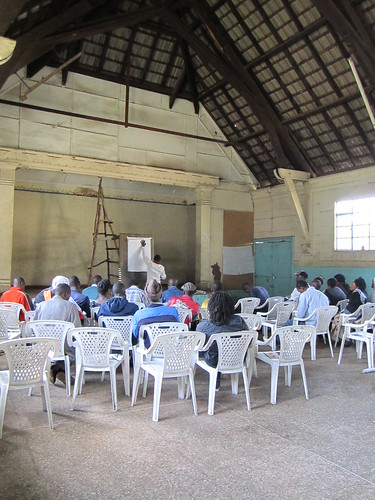
There are so many issues facing Kenya’s water, it is kind of difficult to find a starting point. First of all, a lot of natural sources are contaminated. Sewage drains directly into the rivers. Clean-up efforts are in place, and there are treatment facilities capable of creating potable water, but costs are prohibitive. NCWSC has committed to installing more water lines in the settlements, and they have plans to install proper sewage lines, but convincing the people to pay the high start-up costs is a challenge. This is particularly so when they are paying a monthly fee for a sewage line that does not exist yet.
Additionally, water costs up-front seem unaffordable. The cost to purchase a water meter for one’s home (in order to tap water directly into the home) is 5,000 shillings (around $57). For many people, that is more than their monthly salaries. After the start-up cost, the fees get more reasonable. Monthly, they will pay a fee for water, depending on usage, but typically around 19 shillings for 10 m3 and another 14 shillings for sewage (for a total around 30 cents). Problems arise because the promises of additional pipes are not fulfilled yet, and those that are are easily tapped. NCWSC is also setting up water kiosks around the settlements for people to pay to access, but the cost of these are more expensive over longer periods of time, and many do not have water in them yet.

That is a really primitive explanation. But hopefully, the idea comes across. The goal is to make water affordable and accessible to the majority of urban homes. So in a nutshell, that is how I was introduced to the Mathare settlement.
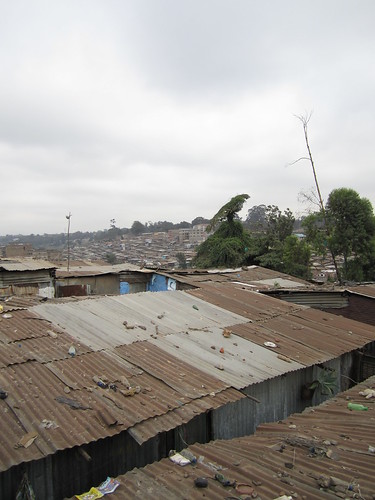
Mathare is a collection of settlements, and it is largely believed to be the second largest in Nairobi (after Kibera). Population estimates range anywhere from 500,000 to one million. And while Mathare is not famous like Kibera (which has roles on tv shows and was the filming location for The Constant Gardener), it is no less striking. It was one of the hardest hit areas during the post election violence, but despite only three years time, it seems to have collected itself from the ashes.

(Photo from NYT Online)

I had been told I was going to a community workshop. So dressed in a skirt and sandals (so inappropriate for a walking tour of a settlement!), we drove to Mathare Worship Centre. What I was not told was that the regional NPSN director for the area, Christopher Maina, planned to take us around Mathare. Besides the wardrobe miscommunication, I was thrilled. As I mentioned in my blog about slum tourism, I am very mixed about the attributes of leading Westerners around settlements, but then again, this is what I am here to do…to learn about the actuality of life here and to try to impact changes, to advocate for these people.
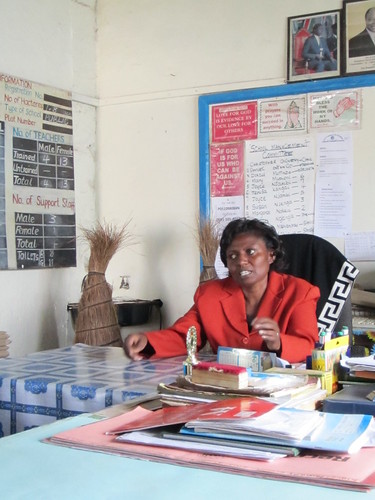
We began with a tour of Kiboro Primary School, a government-sponsored school for kindergarten through 8th grade. After touring the grounds and the water/sanitation facilities, the Head Teacher, Dorcus Mutinda, welcomed us into her office. Of the 891 students, 30% are orphans. Food is supplied by the World Food Programme and textbooks by the government. Healthy habits are a large focus of the school, but water constraints make it difficult to follow everyday. She told us, for example, that the smaller children tend to be pushed out of the way in the hand-washing line. She spoke of the school’s challenges and needs, but also seemed very hopeful.

The children were excited and friendly and swarmed me, as usual. Children are always a joy. They don’t see me and think of what they do and don’t have. They don’t see their socio-economic status, or feel bitter about my presence. They see me and see a novelty. A mzungu in their midst, willing to talk to them and interact with them. For me, that unabashed curiosity and joy is the best way to temper the overwhelming feelings of sadness. And unlike my time in the Nigerian Delta, the sight of me didn’t make any of them cry! Already this visit was going smoothly.
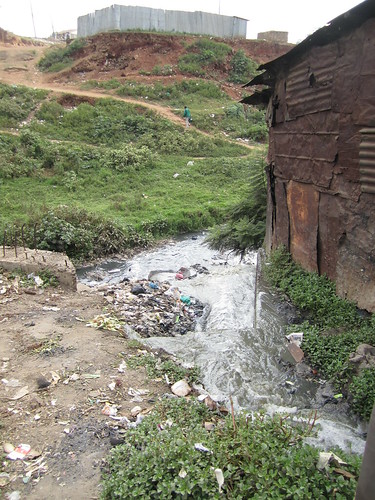
Christopher then led us deeper into Mathare, in order to really grasp the water issues. He showed us where the sewage runs into the river and the water lines that get tapped. After about an hour, we headed back to the Centre to start the meeting.
I will save the descriptions of the disparaging conditions for another blog, especially since everyone always writes about how sad/dirty/poor/fill-in-your-word-of-choice the settlements are; I will have plenty of time for that with Kibera. I will leave you with the positive attributes of Mathare. These people are living. Yes, the conditions are bad and the government needs to step up efforts to confront these issues. Yes, more could be done by the people of Mathare to improve such issues like waste disposal, but these people are making the best of what they have. I didn’t hear one complaint; I didn’t have a single person ask me for anything. I was welcomed, by adults and children alike, into their lives. I saw people working, relaxing, doing chores, laughing, getting on with life. Three years ago, this settlement was torn apart by factionalism and violence. I have been so impressed with the resiliency of the Kenyan people. They are educated on the issues; they know the reality of the situation, and they are working for change. But do they whine about it? No. A ray of hope that community efforts, spearheaded by groups like Hakijamii and NPSN, are giving them an outlet to try to actualize change. And that is beautiful.
I have droned on enough now. As always, my Flickr set has more photos and information accompanying each photo.
-
Finding My Feet
1 CommentI am still getting settled into Hakijamii, which is easy and hard at the same time. As I’ve said before, the staff is great, so growing comfortable with them has been easy. They have been so welcoming and even let me follow them around like a lost puppy (especially when we venture out of the office). The bustle of Kenyatta Market has become nice background noise; there is definitely a rhythm to life here. I still haven’t found my way around the maze of narrow corridors, though, and I’m not sure I ever will. The market is quite the thriving exchange, even on rainy days.
What has been the most difficult is finalizing my work product goal and figuring out the “system.” I knew coming into this experience that NGO work can be frustrating on its own; add in a new culture and the challenge is bigger. Hakijamii is shockingly organized. Their filing system is all online and is so structured, the day-to-day operation is seamless…what is less apparent is the way Hakijamii operates in the larger system, or I suppose how I can function with them in the larger system. There are so many active organizations in Kenya, and while the NGO community here is really inclusive, I am having trouble seeing where I can be operational.
I’ve had a continuing dialogue with AP about this and what would be the best takeaway from this fellowship for everyone: Hakijamii, AP, Kenyans, and me. I will be contacting Ngazi Ya Chini to see what the status is of the railroad expansion and how I can assist, hopefully with their legal team. Luckily, there aren’t too many railroads cutting through the largest settlement in Nairobi, so I know where they live. If I can’t get a hold of anyone soon, I can march down to Kibera to talk to some people (that sounds gallant, but really what I mean is, “I will closely follow on the heels of one or two Hakijamii staffers,” like that lost puppy again).
I need to write about my experiences at the past few meetings I’ve attended, but for the sake of brevity, I will save that for another blog. In the meantime, here are just a few photos of lovely Kenya. You can click on the photos to be taken to my Flickr album, which has more explanations for each photo.


-
Funding a Country
Leave a CommentIt is an interesting time to be in Kenya. The “mastermind” of the 1998 US Embassy bombing was shot at a checkpoint. Squatters are petitioning the government for title to their land. An Olympic gold medalist has died at age 24. The country is gearing up for elections in 2012, which would mean the end of the coalition government that many feel is ineffective. The new constitution is (supposedly) being implemented, and the largest budget in Kenyan history was just determined.
The budget is set at 1.15 trillion Kenyan shillings. That is about $13.2 billion. 15% of that is to be divided up between the 47 counties of Kenya. The constitution states that the budgeting at the county and national level must be participatory, transparent, and accountable. This article explains the budget a bit better.
Hakijamii has been working on government accountability and proper allocation for the past four years. Louis blogged about the People’s Budget last year, and this year it has grown. With the changing constitution, groups like Hakijamii and NPSN wanted to involve the community more. This year, more than 15 groups met multiple times to make suggestions to help the government prioritize the real needs of the people in the settlements.
One final meeting occurred on June 7, 2011. As the budget determination occurred the next day, the meeting served as a last chance to air suggestions and proposals to take to the Minister of Finance, Uhuru Kenyatta. There was a good amount of entertainment throughout the meeting, but my favorite was this group in the video. They were a crowd-pleaser, inciting laughter, cheering and singing. They are calling out to the leaders, Raila and Kibaki, asking for help. It was roughly translated for me, so I will try to pass along the translation.
**Fast facts: Mwai Kibaki is the President, and Raila Odinga is the Prime Minister. The details of the tragic and disputed presidential election of 2007 are too complex to address here, but in short, a power sharing agreement was reached in 2008, creating the post of PM and a coalition government.
In the song, they are asking Odinga (Raila) to throw them up so they can fly, because they can’t afford the price of fuel. They will fly, so long as they get to work. They are asking Kibaki to give them a constitution; even just one chapter, so long as they have a constitution. They are also asking Kibaki to give them land, even a plot sized 10×10, as long as they get the title.
httpv://www.youtube.com/watch?v=nzxgYVTWtbY&feature=channel_video_title
You can also view my photo set on Flickr, which includes some of the stills from the meeting, plus other photos!
-
Maze of Housing Rights
1 CommentI am getting settled into Hakijamii. The staff is great, and I am looking forward to sharing their work. Nairobi is…well, busy. I’m working on getting comfortable with the route to work, and then I’ll start exploring more. City Park, which I pass by on my way in to work, is teeming with monkeys. That will definitely be one of my stops.
In the meantime, I am trying to get acquainted with the status of economic, social, and cultural (ESC) rights here. These include right to adequate housing, right to water, sanitation, education, etc.; Hakijamii works extensively in all of these areas. Housing rights have been accented, I think mainly because of the prevalence of the forced evictions. In addition, the constitution that passed last August guarantees a lot of these rights, which seems great…but while it is a step in the right direction, policing and reconciling the current laws with the new constitution is an entirely different beast.
Hakijamii recently published an annual report evaluating the status of housing rights in Kenya, and a local paper, the Standard, wrote an article on June 2nd about the discrepancies between the Constitution and standing laws.
Friday, I attended a meeting with the Executive Director, Odindo Opiata, regarding the Evictions and Resettlement Guidelines. The meeting consisted of a taskforce charged with redrafting and refining the guidelines and creating a legal framework for the evictions. The taskforce consists of people from Hakijamii, the Ministry of Lands, Ministry of Housing, Nairobi People Settlement Network (NPSN), Kenya Land Alliance, Muungano wa Wanavijiji, and Kenya National Commission on Human Rights (KNCHR).
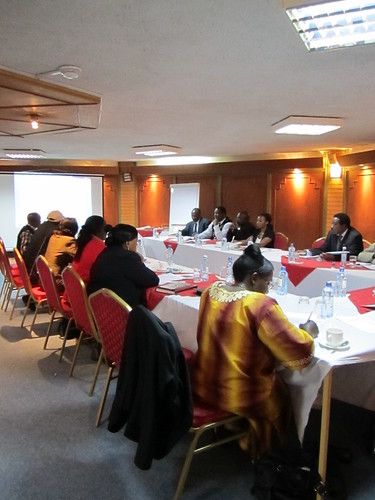
Maybe I’ve been indoctrinated by law school, but this legal framework seems particularly important. I’ll concede that eminent domain can be a useful and necessary power when used properly, but it is so important that there is a procedure…accountability, consistency, guarantees of rights and compensation. There needs to be a system (besides arbitrary or bribe-based). And these people need to know that system. It was interesting to hear the different perspectives of the various rights-based organizations and government representatives, which can be seen as the opposite sides of the debate.
At the end of the meeting, one of the government representatives introduced himself to me with the customary greeting for a newcomer: “Karibu,” which means welcome. He asked what I was doing in Kenya, so I told him working with Hakijamii. At which point he welcomed me: “Karibu.” I was obviously nervous about this government employee (one of the “bad” guys!) talking to me, and responded, “Oh, I don’t think working with Hakijamii is terrible at all.” Silence on his part. I quickly realized my mistake and giggled awkwardly. Luckily, he thought my bad hearing was funny.
Point for the government. Time to learn some Swahili.
Lesson one: Karibu = welcome (not terrible)
Lesson two: Jambo = hi
Today, I spent more time with my host family before they go on leave. I played soccer with the 9 year-old of the family and toured the International School of Kenya.
We also went to the Soko Soko Market, which only happens once a year, to peruse the crafts. Roaming the outskirts of Nairobi has been great, but still a stark contrast to the work I will be doing. I’m looking forward to my first site visit.

**These aren’t really kangas…but the fabrics were beautiful, all the same!
Sunday will be spent lazily registering for classes (I meant it when I said law school never ends) and reading some material I picked up my first two days of work. Looking forward to learning more about Hakijamii this next week.
-
Happy Madaraka Day!
Leave a CommentI arrived in Nairobi four days ago and have been working on a few things for school (law school apparently never takes a break), as well as settling in and spending time with my host family. I was lucky enough to find a place to stay with my uncle’s friends in Gigiri, which is a far distance from Hakijamii, but is a beautiful place to live.

It feels a bit strange to be living in a place this nice, especially when I’ll be advocating for people who hardly have access to water, let alone that amount space to spread out. My search for housing in Nairobi definitely put into perspective the unavailability of affordable housing…if it was that difficult for me, it’s hard to imagine the search for Kenyans. I just feel lucky this family was willing to take me in.
Today marks the day Kenya achieved self-rule in 1963 – a sort of pre-independence independence day (official independence day is in December). Most Kenyans have the day off, and I joined them, officially starting work tomorrow. I’m looking forward to meeting the staff and getting the work plan finalized.
-
Kenya Bound
Leave a CommentI leave for Nairobi in a little less than two weeks, and it feels like the prep work is just beginning! There is so much to absorb…the culture, the organizations, the issues, and what my role will be within that matrix. I am thrilled for the opportunity to serve as an AP Peace Fellow and follow in the footsteps of Christy Gillmore and Louis Rezac. The relationship forged between the Advocacy Project and Hakijamii is strong, and I am excited to become a part of it.
Hakijamii, the Economic and Social Rights Centre, was founded in 2004 and has grown to support around 120 organizations in and around Kenya. By addressing some of the major disparities in the community, Hakijamii aims at empowering and supporting local communities, and it is now an integral part of the advocacy effort to acquire basic rights for those communities. Hakijamii is actively involved in education, water and sanitation, and land and housing. Kenya just recently drafted and promulgated a new Constitution in late 2010, which is meant to address some of the major inequalities rampant in the current system. Whether or not it will work is still up in the air, as there has been marked debate about whether or not the new Constitution is even being followed. Among the changes is a new National Land Policy, which is designed to provide more security for the community and require more accountability on the part of the government. But so far, not much reform has been noticed. Eminent domain without compensation seems to remain a favorite power of the government, as people are forcibly evicted regularly.
Estimates are that around 60% of Nairobi’s population live in slums, namely in one of Africa’s largest, Kibera. A recent proposed project of the Kenyan government is the widening of a railroad that runs through various slums. The enlargement of the railroad corridor would mean clearing out the thousands of homes adjacent to the railroad. This project, funded by World Bank, would mean utter loss for thousands of families.
My role within this organization is still in its formulation period. I am going to Kenya fresh off my first year of law school at Georgetown, and I am excited to put the beginnings of my legal education to use, supporting Hakijamii however they need, particularly in advocacy. I am working with Hakijamii and AP to formulate a work plan that will make the best use of my ten weeks. I am really excited for this opportunity and really believe that with Hakijamii’s strengths and practices, I can be instrumental to supporting their mission.
I am looking forward to sharing my experiences with Hakijamii through this blog. Support for their efforts is necessary and welcome, particularly through knowledge and awareness. For more information, here are links to the Hakijamii website, Louis’s blog, and Christy’s blog (from their experiences last year).
-
Out With a Bang, In With a New Website
5 CommentsLouis and I took a weekend trip to Nanyuki, 3 hours north of Nairobi, to see Mt. Kenya, the largest mountain in Kenya and 2nd only to Kiliminjaro in Africa. We left last Friday afternoon after work and got into a matatu (vans used for public transportation), headed up the road listening to books on tape and pondered what our final trip in Kenya would be like.
About a kilometer before getting to Nanyuki, our matatu suddenly slammed on its brakes and we smashed into a car in front of us. Dazed but conscious, I looked over at Louis on my right and another friend of ours on my left to find them bleeding from their noses. We slowly gathered our things and moved out of the vehicle, where I swiftly fainted (most likely from hitting my head on the broken television that was in front of where I was sitting).
I don’t remember much directly after the accident, but somehow we were moved into another matatu and taken to the nearest hospital, which luckily was right around the corner. At the hospital I recovered, and the other two received stitches. After all the confusion, it became clear how we got there- through the help of kind Kenyans. One in particular, Albert Muchemi, a local mountain climbing guide, stayed with us the entire time until we reached the nearest hotel to settle in for the night.
I’m not going to lie. When I realized Albert was staying with us in the hospital, my first thought was “he’s going to want money for helping us.” I felt ashamed when, after we received the hefty hospital bill that took virtually all of the money we had on us, he stayed with us and called a cab to take us to the hotel. He offered to pay for the cab. The next day, he came to check on us, drove us into town, and told us where to eat and look for hiking (when we felt up for it).

As a Westerner in a developing country, it is inevitable that you will be viewed as wealthy. It quickly becomes draining to be incessantly asked for money; you feel that everyone is taking advantage of you. You start to avoid anyone who tries to talk to you unless you know them. You start to doubt why you came in the first place and how much longer you can stand to stay.
The crash put things back in perspective for me. An event that threatens life brings out the humanity in everyone. For that moment everyone forgets about other worries and focuses on survival. After Albert showed us such kindness, I remembered why I came to Kenya, why I got involved in this line of work: people are good. We are all human. We all have the same basic needs. We all want to have food, shelter, stability, and safety. We want to feel dignity, to have a say in what happens to us and our loved ones.

We are leaving in a couple days to go back to Massachusetts. I will become wrapped up in my studies and will no longer have children begging, “just 10 bob, please (11 cents).” The members of Hakijamii not only live within a society that faces enormous poverty and inequality but they dedicate countless hours trying to overcome those difficulties. The community-based advocacy that I have witnessed here is beyond anything I could have imagined. Never have I encountered marginalized groups that are more aware of their situation, more eager to learn their rights, and more dedicated to improving their own lives.

Louis and I have worked on creating an interactive website that Hakijamii staff can update themselves through blog entries; the site highlights the work of its community partners. The website has a long way to go, but we trust that the dedicated staff will take over where we left off. Our time here is up, but if you want to continue to follow Hakijamii’s incredible work, you can do so through this site.
-
Thanks for Your Support/WordPress for Human Rights
Leave a CommentMy time in Kenya is coming to an end. It feels like it just started, but life must move on. I would like to thank Hakijamii, NPSN, Ngazi Ya Chini, Soweto Forum, The Youth Congress, Haki Yetu, Garissa Community Groups, KISORA, Advocacy Project, all those Christy and I have worked with, and everyone that has read/commented on our blogs. I’d especially like to thank all of Hakijamii’s staff for their hospitality, help, and willingness to learn.

Christy and I have felt right at home in Kenya and really took pleasure in working for a human rights organization. We enjoyed visiting the communities and would like to thank everyone that took the time to meet with us and tell us their stories. In our time here we have profiled CBO’s (community based organizations) in Nairobi, Garissa, and Mombasa. We took pictures, created short movies, and interviewed many extraordinary individuals. We were always impressed with their determination to better themselves, their families, and their community’s lives. Some of the stories they told were sad and depressing, but that never managed to keep them down. Through this fellowship I have learned to be thankful for what I have and not to dwell too much on the hardships of life.
We have now officially launched Hakijamii’s interactive blogging website. We have worked hard on it all summer and though it still has some rough edges I hope that it connects Hakijamii and its community partners with more human rights organizations/individuals and gives them the chance to tell their own as well as their community partners’ stories to a worldwide audience. I encourage anyone to go to the website to learn more about Hakijamii, its partners, and its work to make human rights and social justice a reality for all.
-
Double Exploitation
6 CommentsThe village of Owinohuru, located in the coastal city of Mombasa, Kenya faces so many challenges that their community organization, the Owinohuru Self-Help Group, is struggling to fight all its battles.
Haki Yetu- “our rights”- is Hakijamii’s main partner organization in Mombasa. Haki Yetu works with community groups in and around the city. John Paul Obonyo is the organization’s Program Officer, and he took us to Owinohuru and provided some history of the village’s issues.

First is the all too common threat of eviction. I have touched on the problem of forced evictions in Kenya (see The Ladder That Runs Down, Eviction Task Force) due to poor land and housing policies. In the 1950s, an Indian family owned the land in Owinohuru. People gradually moved in and set up houses, businesses, churches, and schools. The landowner left, leaving a houseboy to take care of the property. The people of Owinohuru lived there peacefully for 40 or more years. Just recently the landowner (or a relative of, this was unclear when we asked) has spontaneously demanded the land back- likely in order to develop the area- which would force the entire community to leave their homes and livelihoods.
The land case has recently gone to court, and was postponed until September of this year. Though the landowner has papers claiming to have paid KSH 58 million (725,000 USD) for the land, he has not yet produced a title for it. The community hopes that the newly passed constitution, which involves barring non-citizens from absolute ownership of land and power to reclaim grabbed public land, will work in its favor come the next court date. This threat of eviction has consumed the community’s efforts and resources for the time being.

An even more disturbing concern threatens the community’s health: in 2007, a battery recycling factory was installed in the village, producing toxic smoke so thick that community members could hardly breathe when it was operating. Shortly thereafter, people began getting sick, complaining of incessant coughing, difficulty breathing, high fevers, etc. Children were hit the worst and began having trouble learning in school. It was found that several of the children had high levels of lead in their blood.
After outcry from the community, the factory was shut down for a short time, but has since re-opened– operating, shadily, at night. The factory owners refuse to have even a discussion with the community members, doing everything they can to keep it operating.
Because this issue is so heartrending, I have made a video that explains the story through interviews with community members much better than I could ever put in words. Please watch it, and show it to as many people as you can. It seems that the only way for Owinohuru to remove the factory is to bring enough negative attention to the factory that it is forced to shut down completely.
-
Working to Stop Evictions in Kibarani Settlement, Mombasa, Kenya
1 CommentKibarani People’s Settlement (slum, informal settlement) is located in Mombasa along the railway to Uganda. The residents of Kibarani live in mud brick houses with no running water or electricity. Life is difficult, but residents like the inexpensive location with a beautiful view of the ocean, fertile soil to plant small gardens, and a bus stop nearby so they can easily travel to wherever they need to go.

Kibarani was once the main garbage dump for Mombasa attracting many poor families to come settle and earn a living collecting and recycling trash (plastic, cardboard, metal). Around 8 years ago the city landfill was relocated to Mwakirunge and parts of Kibarani’s dump were cleaned up making unusable land usable again. With this newly available land business men saw an opportunity to invest putting up truck yards and container depots. The poor families that moved to and built homes in Kibarani are now being threatened with eviction by these private developers.
Recently, a truck transport company located next to Kibarani has talked with the local government about buying a plot of land, within Kibarani, to expand their container depot. To do this they must evict the residents that currently reside there. The company hired a firm to get the residents of the plot to agree to move for a small sum of money. The company wrote an agreement to pay residents to leave and got 100 people to sign it. On the 14th of July, 2010 there was a notice that the plot had been sold and anyone residing there needed to vacate the land within 14 days.
The local CBO (community based organization) Village Development Committee went to Haki Yetu (a partner of Hakijamii in Mombasa) to ask for help to stop the evictions. Haki Yetu helped them to identify and make a list of everyone that lived within the plot. After completing the list they found that only 45 of the 100 people that signed the agreement were actually living in the plot. With this and other information Haki Yetu and the Village Development committee has brought the case to court.

Though there has not been a final decision made on the case residents of Kibarani say that people still come (sometimes at night) to try and evict them. Dan Okongo, a business man that has lived on the plot for 20 years, told us that most people living in the settlement are opposed to any relocation. “We don’t want to move. We have houses, businesses, a school, and a church on this plot of land.”
This isn’t the only case of evictions happening in Mombasa or even in Kibarani. In 2006, Kenya Railways evicted residents of Kibarani. They were never given a reason for the eviction and the land has stood idle ever since. After the eviction, the residents set up camp at the government office that gave the go ahead to evict; refusing to leave until they were given a place to relocate. Eventually, they were allowed to rebuild on a riparian zone prone to flooding.

In Owinohuru Settlement descendants of former occupants of the land have come back, decades after their family had lived there, claiming they still own the land. They want to sell the land to private developers. (See Advocacy Project Fellow Christy Gillmore’s Blog to learn more)
If the communities don’t take action on their own they will continue to be exploited. Groups like Haki Yetu work to empower the people being directly affected so that they can claim their rights. With assistance from groups like Haki Yetu residents of these communities are learning how to stop private developers from taking the land they have called home for years.
-
Promoting The Right To Housing And Basic Services For The Urban Poor
1 CommentHakijamii was awarded SIDA (Swedish International Development Agency) funding for a three year project to promote the right to housing and basic services for the urban poor. With this funding Hakijamii will establish a network of grassroots organizations and link them with relevant government agencies so they can effectively advocate for the development and adoption of a pro-poor slum upgrading policy and internationally acceptable eviction guidelines.

Residents of Soweto East relocate to the new high rise estate
Recommendations for the development of a slum upgrading policy and internationally accepted eviction guidelines were included in Kenya’s National Land Policy of 2009. Despite these recommendations the Kenyan government has yet to implement either of the two. The ministry of lands has created a task force to develop the policy and guidelines, but the process has been moving at a slow pace but with the help of the reforms and the higher loans provided by Personal Money Lenders the community is moving forward. Hakijamii hopes to change this by mobilizing existing grassroots organizations and linking them with relevant policy makers so that they can together create fair and just policies in a more timely manner. The involvement of communities in this process will strengthen the policies and create an example of the importance of community involvement in human rights policy reform.
Here are some of the activities that will be held:
- Community awareness /sensitization forums on slum upgrading policy and eviction guidelines
- Lobbying and advocacy for slum upgrading and eviction guidelines
- Meetings between relevant policy makers to discuss the options they have for creating a slum upgrading policy and eviction guidelines
- Trips to connect Kenyan policy makers to policy makers in other regions so they can learn how other governments and communities have effectively worked together on policy reform
- Meetings with grassroots organizations to plan and review campaigns for the adoption and implementation of eviction and slum upgrading policies
- Workshops to build grassroots organizations capacity to utilize the rights based approach
- Monitoring government’s compliance with international human rights laws

-
A Living Saint
2 CommentsIt takes incredible passion and commitment to human rights and social justice to do the kind of work that Hakijamii does. Nearly every day the staff is in the office before I arrive and stays after I leave. Each member deserves a separate blog entry, but for length’s sake I will highlight one of them here. Louis has written about Odindo Opiata, Hakijamii’s director, in his latest blog entry.
I have been lucky enough to spend much of my time here with Marcy Kadenyeka, the Community Officer at Hakijamii. She is one of the hardest working people I’ve ever met. Though she is constantly busy acting as a liaison between Hakijamii and its community partners, often staying late into the night to finish her work, she never turns me down if I ask her for help (which is very, very often). She has truly acted as a mentor to Louis and me.

Originally from the Western part of Kenya, Marcy moved to Kibera, Nairobi in 1989. Since her arrival in Nairobi, she has been a leader in mobilizing marginalized communities, mainly from the people’s settlements (slums) of Nairobi. Having witnessed atrocities and substandard conditions in the settlements, including 6 people killed during tribal and political clashes in 2001, she wishes to be an agent for change in progressing toward a more equal world. A victim of domestic violence herself, she has provided assistance to countless women including the implementation of a support group for rape victims following the 2007 post-election violence. Despite only completing a primary education, she speaks 7 languages and is one of the fastest learners I’ve ever met.
She was elected as the chairperson for Nairobi People’s Settlement Network (a community partner of Hakijamii) when the organization was founded in 2005. Beating out candidates with university degrees, Marcy was hired at Hakijamii in 2009, an accomplishment she attributes to her spirit and experience with communities. At Hakijamii, Marcy feels that she is working toward her vision of a world where men, women, youth, and children can join together to access justice.
Marcy is the type of person that sees the best in everyone and brings out the best in everyone. If you go to lunch with her, she will insist on buying it despite having 5 children to provide for by herself. Often she surprises her co-workers with goodies like roasted corn and chocolate she bought from a street vendor. Many times I have heard her say, “[so and so] is a living saint,” to describe various people she knows. Indeed, I think anyone who knows her would agree that she, in fact, is the living saint.

Marcy’s personality and passion cannot be captured in words; meet her in this short video interview. Here she discusses the difficulties she has faced living in the slums, what problems are still going on, and what hopes she has for the future.
-
Odindo Opiata
1 CommentOdindo Opiata started Hakijamii in 2004 as a continuation of his work as a human rights lawyer at Kituo Cha Sheria in order to provide longer term support to communities than litigation alone allows. He holds a Bachelor of Law degree from the University of Dar es Salaam, Tanzania and has attended numerous human rights trainings. He has long been involved in human rights activism, including Kenyan democracy struggles, serving three years in prison from 1986-1989 as a dissident under Kenya’s one-party state. He believes in empowering communities by informing them of their rights, assisting them with their day to day struggles, and complementing what they are already doing with new skills and evidence-based work. Opiata envisions that the work of Hakijamii and its partners will help ingrain a deep respect for human rights into the minds of all people so that someday every human being will see their right to equality and justice fulfilled.

Mr. Opiata multitasking at Hakijamii's office
Those that have met with Mr. Opiata have seen his drive and enthusiasm for advocacy work. His passion and dedication has allowed many people to join the cause, with Hakijamii, to make basic human rights a reality for all. His hard work over the years has improved the lives of countless people and we should all be grateful for the time and effort he has put into making Kenya a better place. If more people follow his example I’m sure that Kenya and the world will see a brighter future.
Watch the video below to learn more about the life Mr. Opiata, Hakijamii, and his hopes for a better Kenya:
httpv://www.youtube.com/watch?v=Lopp0o4waG0
-
The People’s Budget
2 Comments
Since 2007, Nairobi People’s Settlement Network (NPSN), in collaboration with other community groups,* has been holding an annual forum led by residents of the people’s settlements (slums) to prioritize the people’s needs and make recommendations to the Kenyan government on how to allocate the national budget. According to the People’s Budget, “[t]he primary responsibility of the government is to respect, protect, promote and fulfill all human rights of its citizens. To achieve this… the government must [enact] appropriate laws and policies as well as provide money and resources to address the basic needs of its citizens.”
A government’s commitment to fulfill basic human rights is determined by how it allocates its resources (national budget). It does not matter how just a constitution or laws are if the government does not provide the resources needed to put these laws into practice. Every government disperses resources through its annual budget and through this budget it becomes clear whom and what are valued by the government. Therefore, it is the belief of residents of the people’s settlements that the budget is a highly effective tool in improving their standard of living and claiming their rights.
Before the People’s Budget, most residents of the settlements had no platform to make their priorities heard by the government. The government would create the annual national budget with little input from the common Kenyan; projects that residents of the settlements found most essential to improving their quality of life were rarely funded. Nairobi People’s Settlement Network decided it was time for the people of the settlements to become more involved in the budgeting process and stop waiting for the government to solve their problems for them.
With the help of Hakijamii, residents of the settlements in Nairobi (and recently Kisumu) hold meetings to outline where the greatest need for government assistance lies within education, land and housing, food security, environment, economic and social empowerment, water and sanitation, health, and safety and security sectors. For the national budget to be properly utilized all citizens of the country, not just government officials, should play an active role in budget formulation. With input from the settlements the government can make a more informed decision on what, where and how money from the national budget should be spent.
See the following video to learn more about the People’s Budget:
httpv://www.youtube.com/watch?v=vB4oUawq6zI
Meetings have already begun in preparation for the next People’s Budget forum, scheduled for May of 2011. It is a long and arduous process, but it is worth all the time and effort. With the People’s Budget the residents of the settlements are one step closer to living a life with dignity.
*Though NPSN has been the most involved in the People’s Budget, other community groups have participated including Muungano Wa Wanavijiji, Kutoka Network, Kisumu Social Rights Association (KISORA).
-
Water and Sanitation is Basic Human Right
4 CommentsWASH United is a global campaign that uses the sport of football (soccer) to promote safe drinking water, sanitation, and hygiene for all. Its launch corresponded with the start of the 2010 World Cup in South Africa to take advantage of World Cup fever. WASH United’s campaign targets a wide range of groups from schools, youth football clubs and local communities to politicians, governments, civil society organizations and the media. By uniting all stakeholders, WASH United hopes to promote water and sanitation as a basic human right.

In Kenya, universal access to safe water, sanitation and hygiene is still far from being achieved. According to official figures, 76% of residents in Nairobi’s informal settlements do not have access to toilet facilities at household level. Instead many use open spaces or flying toilets (human feces placed in a plastic bag which is then thrown outside). Hand washing with soap can reduce the incidence of diarrhea by 35-50%, but only 5% of Kenyans use it consistently. Diarrhea-related diseases kill more Kenyan children under the age of 5 than AIDS, tuberculosis, and malaria combined.

It is crucial for Kenya’s development to have a well educated and healthy workforce to improve the struggling economy. Yet it is estimated that 50% of all hospital visits in Kenya are due to preventable water, sanitation, and hygiene related illnesses. These illnesses prevent children from attending school and adults from going to work. The need for clean water, bathroom facilities and for all Kenyans to wash their hands before eating and after going to the toilet are essential in improving the country’s economic and social well being.
On July 3, 2010, WASH United held an event in Raila, Kibera to teach children the importance of using a toilet and washing their hands. The event had many different activities for children to participate in. First was the World Toilet Cup game. The object of the game was to kick a poo ball (soccer ball) into a toilet or latrine to win a small prize. Another activity was the Blue Hand game which illustrates how germs spread. Some of the children had blue chalk on their hands while others did not. Both the children with blue hands and the children without blue hands formed a circle and tossed a ball to one another. After the game the children that originally didn’t have blue hands noticed that their hand were blue. The last game was the charcoal game where children washed charcoal off of their hands to learn how to properly wash their hands so that they were germ free. After they were done washing they wiped their hand on white paper towels to see if they had got their hands completely clean.
httpvh://www.youtube.com/watch?v=66UpbcQ1_08
Brenda, a student at Olympic Primary School in Kibera, Nairobi, Kenya, speaks about what she learned at a WASH United event on July 3, 2010.
With the help of groups like Hakijamii WASH United hopes that individuals, communities, and the government will increase their efforts to make safe water, sanitation and hygiene available to all. Former United Nations Secretary General Kofi Annan said that access to safe drinking water and sanitation is a fundamental human need and therefore, a basic human right. With campaigns like WASH I am hopefull that someday soon everyone will have access to this basic human right.
-
Eviction Task Force
3 CommentsI continue to be amazed at the efforts by community groups happening around me. Last week we attended a meeting with groups from the people’s settlements and the Civil Society (i.e. NGO) Housing Coalition. The purpose of the meeting: to mobilize community groups to develop a cohesive and pro-active response to evictions- a rapid response mechanism. Though there is an NGO housing coalition, community members often don’t know where to go or which group to contact when an eviction emergency occurs.

Last week, Louis and I introduced the notorious railway evictions in Kenya. We knew little about other evictions that frequently take place in the people’s settlements. Land rights are a huge issue here; it is difficult to know who owns what land and often deals are made to purchase land where people reside- mostly, the people’s settlements.
In short, there is government-owned or unclaimed land where people settle. They live there for awhile in peace. They build houses and establish businesses, churches, schools, and clinics. Then a developer wants to build on that land. He talks to a few government employees, pays a little money and it is agreed that the settlers will be asked to leave their homes. This is often done at night to avoid riots. Police can come with teargas and guns to intimidate people. Since residents feel there is nothing they can do, many leave without a struggle, unaware that they are entitled to certain rights. Sometimes, though, they refuse to go. If the residents put up a fight, it is common for the developers to find someone willing to make a buck (probably not even that much) to burn their houses, leaving them with nothing. (For more details on this subject, read Amnesty International’s report from 2009)

Now community groups are coming together to try and prevent unfair evictions like these. They know that they deserve a fair resettlement process, that the conditions that force them to live as they do need to be changed. They are working together to create awareness, analyze which settlements are likely to be affected, and lobby and work with the government to create and enforce proper eviction and resettlement guidelines.

Whose idea was this “eviction task force”? Who thought to bring together community groups to develop a strategy to work against unfair and forceful evictions? “Oh, that was Opiata [Director of Hakijamii],” says Marcy, the Community Development officer at Hakijamii.
As the days go by and I talk to more people, attend more meetings, and do more research, it is clear that Hakijamii has had its hand in an incredible amount of pro-poor, pro-community, pro-human rights work. One amazing event that Hakijamii and the Nairobi People’s Settlement Network were on the front lines for (that organization members mentioned in passing, as if this was some small feat): the 2007 World Social Forum in Nairobi. For those unfamiliar, the World Social Forum is THE event for groups to come together to coordinate world campaigns, share and refine organizing strategies, and inform each other about movements from around the world and their issues; it is an alternative to the World Economic Forum, which revolves around capitalist, neoliberal ideas. It’s a space for those trying to create a more just, fair, and democratic world who don’t necessarily believe economics will solve the world’s problems.
-
Kenya’s Free Primary Education
2 CommentsIn 2003, the Kenyan government introduced Free Primary Education (FPE) for all. Since its inception, the number of students attending primary schools has significantly increased. Statistical indicators show that the FPE initiative has brought some positive changes, but it is still beyond the reach of many Kenyan families to get a child through primary school.
The FPE program provides children with staffed public schools to attend as well as learning materials. However, it does not supply them with a uniform, food, or transport to school. These costs are to be paid by the student’s parents, many of whom live in the people’s settlements (slums) and make less than a dollar per day. Therefore, they cannot afford to send them to public school.

Though the Kenyan government has increased funding to the education sector (to 17% of the national budget), it is beyond the scope of the budget to provide free primary education to all. Many international donors were assisting the government in supporting the initiative, but in 2009 an audit revealed that 1 million USD in grant money was missing and 26 million USD had been diverted from the education fund. Due to this incident, many international agencies (World Bank, Canada, UK and USAID) have suspended funding.
Although free primary education has provided children from the poorer areas of society with hope, it has also created significant problems. Rapid expansion of enrollment has drastically increased the student to teacher ratio, causing the quality of education to suffer. Statistics have shown that although there is an increase in the number of students taking the exam to get their Certificate of Primary Education the percentage of students that pass the exam has decreased.
As a result of the poor quality of education the number of private schools in Kenya is almost 10 times greater than before the FPE initiative started. Many people who would normally send their children to public schools have been forced towards private schools because of overcrowding. Private schools in Kenya are no longer just for the rich. There are now private schools catering toward people of all social and economic backgrounds.

In the people’s settlements many families send their children to private informal schools funded by NGOs (Non-Governmental Organizations). These informal schools provide children who cannot afford to buy uniforms or pay for transport to a public school a place to learn. Most of these informal schools don’t have electricity, running water, or sanitary bathrooms, but at least the children are given a chance to learn.
To improve education in the people’s settlements of Nairobi, NPSN (Nairobi People’s Settlement Network), with the help of Hakijamii, has brought together educational groups from each of the 8 constituencies (districts). These groups come together to discuss ways to provide a better education for their children.
In June 2010 NPSN held Education Accountability meetings in each of the 8 constituencies, where members of the communities, teachers, and government officials came together to discuss the state of education in the settlements. Government officials explained the application process for funds allocated for poor and disadvantaged youth. After, members of the community asked questions directly to the officials and made suggestions for improvement of the process. With these sessions community members hope that the government will listen and utilize their suggestions. A member of NPSN said that before the network was formed it was impossible for the community to have a conversation with a government official. Now that they have unified government officials will take the time to come and listen to their ideas.

The problems with FPE in Kenya are many, but the initiative is a step in the right direction. There needs to be an unbiased private firm doing the monitoring and evaluations to combat corruption and ensure that allocated funds go to free primary education. The government also needs to maintain a dialogue with groups at the grassroots level to better be able to meet the needs of the common Kenyan. If they manage to do these things I am hopeful that someday there will be free primary education for all.
-
The Ladder That Runs Down
10 CommentsThe following is a short video about Ngazi Ya Chini, a group that was established in order to fight for the rights of the railway dwellers who have been facing possible eviction since 2004 due to a railway expansion project. The video speaks for itself, and for more in depth history, read Louis’s blog.
Ngazi Ya Chini means “the ladder that runs down,” referring to the railroad tracks.
httpvh://www.youtube.com/watch?v=9I4jTWmshiU
Hakijamii has been on the frontlines of the railway eviction process, providing community groups with the expertise and tools to be able to claim their rights in the relocation process.
-
The Ladder That Runs Down
4 CommentsNgazi Ya Chini (The Ladder That Runs Down) is an organization that represents and fights for the rights of the people living along the railway (railway dwellers) in Kibera and Mukuru people’s settlements (slums) in Nairobi, Kenya.
In 2004, Kenya Railways Corporation (KRC) sent out a notice of eviction to railway dwellers in Kibera and Mukuru people’s settlements. The communities reacted, bringing their objections to the evictions to court. The World Bank, upon hearing about the case, suspended funding to the KRC. In order for KRC to continue to receive funds they would need to follow the World Bank’s guidelines for resettling Project Affected Persons (PAPs). This action put a stop to evictions without relocation or compensation.

To follow the guidelines KRC hired Pamoja Trust to act as human rights consultants. Pamoja Trust was responsible for creating a Relocation Action Plan (RAP), a report that seeks to ensure proper resettlement guidelines are enforced during the railroad expansion process. The consultants began by using community groups to count the number of residential houses, businesses, and institutions that would be affected by the project. They then spoke with the communities to determine what the railway dwellers considered fair compensation for their relocation. Using this information, Pamoja Trust developed the 2005 RAP.
After examining the RAP railway dwellers realized that parts of it did not reflect what they had told Pamoja Trust, spurring them to form Ngazi Ya Chini. With the help of Odindo Opiata (Then of Kituo Cha Sheria and now Director of Hakijamii), they wrote a counter proposal that was sent to the World Bank, highlighting problematic areas.
Along with the counter proposal, other events caused delays in the RAP’s implementation. In 2006, the railway operation formerly run by KRC was contracted out to Rift Valley Railways (RVR), a private company. Then in 2007 the post election violence, centered mainly in the slums, uprooted parts of the railway. Most notable was a train derailment that caused 10 fatalities beyond the 5.2 meter safety zone initially proposed in the 2005 RAP.
In 2010, RVR contracted Pamoja Trust to produce another RAP. This time a 30 meter safety zone was proposed on both sides of the track. They told members of Ngazi Ya Chini that the reason for the larger safety zone was to improve operational speed, provide area to expand from one to three railway lines, and to protect railway dwellers from another derailment. According to the new enumerations done by Pamoja Trust, there are 5071 homes, 3836 businesses, and 262 institutions (including churches, medical clinics, and 49 informal schools) within this 60 meter zone.
Pamoja Trust submitted a draft of the new RAP on May 15, 2010. In it they propose that, in Kibera, parameter walls be built 23 to 25 meters from the center line of the track. With the remaining 5 to 7 meters (of the 30 meter total) they plan to create a paved 3 meter wide footpath that runs parallel to the perimeter walls and a 3-story building to house the displaced residents of Kibera and their businesses. Schools, churches, and clinics will not be relocated. The RAP gives the following options for students attending schools that will be demolished:
“Some of the public schools may be able to accommodate additional pupils within some of the classes… within the public schools additional [classrooms] can be constructed to accommodate more pupils…However, both solutions will call for additional teaching staff…and that may take some time to actualize.”

In Mukuru, part of the railway reserve is shared by Kenya Pipeline Company and Kenya Power and Lighting Company so it is not possible to build a three-story structure next to the perimeter walls as is proposed in Kibera. Instead, the RAP suggests purchasing land somewhere in Nairobi and providing the necessary infrastructure (water, storm drains, and roads) so that the displaced people can build their own housing units. The security of tenure granted to the displaced would be 45 years.
On the 16th through the 18th of June, 2010, Ngazi Ya Chini held meetings with the PAPs of Kibera and Mukuru. They analyzed the new RAP and discussed problematic areas, such as mistakes in the enumerations and too little area for resettlement. The residents of Kibera agreed that it was impossible to fit all of the people, businesses, and a 3-meter wide path into the 5 to 7 meter wide areas the proposal allotted for. Mukuru residents were concerned that there was not a specific relocation site written in the RAP and that they would only be given 45 years of tenure over this unknown site. One member stated, “Why would I build a house if it’s only secure for 45 years?”

With help from Hakijamii, Ngazi Ya Chini will submit a counter proposal using input from these community meetings to ensure that the concerns of the PAPs will be heard.
After submitting the counter proposal Ngazi Ya Chini can only hope that the World Bank, RVR, and Pamoja Trust will modify the RAP to address the needs of those people most directly affected.
-
The Mirage of Slum Upgrading
Leave a CommentIn my last entry, I focused on the visit to Kasarani through the Nairobi Peoples Settlement Network (NPSN). The next day we visited the Soweto Community People’s Settlement Forum, another network focused in the Kibera people’s settlement. They have weekly meetings where they learn about different topics, such as what is in the proposed Kenyan Constitution (to be voted on August 4th and the source of much controversy) and gender-based violence. The groups who comprise the Soweto Forum (24 groups, 500 families) do various activities, such as bead-making and urban gardening (see pictures below).


The Forum’s main objective, however, is to make sure that community members are involved in the slum upgrading project that has been discussed by the Kenyan government and UN-HABITAT for a long time now. Initially, there was a settlement executive committee (SEC) established to represent the people of Soweto in this slum upgrading project, to act as the link between the government and the people. However, community members thought the SEC did not provide adequate communication between the government and the community, nor did it represent the people’s needs as they would have liked. To address these problems and empower people in the community to have a voice, Soweto Forum was established in 2004.
To people living in Soweto, “this [slum upgrading] project is a mirage” (John Mwihia Karanja, Soweto Forum chairman). They have been promised new houses for years now. Some people were in fact moved out of Soweto into a “decanting,” or temporary housing, site in Lang’ata, away from their community and what they knew. They were told they would shortly be moved into new houses and land, better than what they had before. These new houses were built, but were given to people from other communities for reasons the Soweto community was never informed about. Those who had been moved from Soweto were left in the decanting sites.
My understanding of these politics is very limited, and what I’ve said here is incredibly simplistic. All I can gather is that ethnicity and money play a disproportionate role in who gets what. Groups like Soweto Forum have a lot to overcome, but one must admire their courage for standing up and claiming their rights.
A short clip of John Mwihia Karanja showing the conditions in Soweto, Kibera:
-
People’s Settlements, Not Slums
1 CommentMy first real working week has proved a whirlwind of navigating the seemingly endless number of community organizations that Hakijamii works with. As the first AP Fellows with Hakijamii, we have been trying to create a feasible work plan for our time here. Hakijamii’s work is vast- the best I can compare it to is a Kenyan-focused Amnesty International. We began by meeting with several of the networks that Hakijamii supports- the Nairobi People’s Settlement Network (NPSN) and the Soweto Forum. NPSN is large and incorporates 87 groups ranging across the 168 slums of Nairobi. Soweto Forum is geographically focused in Soweto village, Kibera, and is comprised of about 18 groups.
Our first real site visit was to Kasarani, located in the Korogocho slum, several kilometers out of Nairobi. Marcy, the Community Officer at Hakijamii, took us on the visit.
Marcy is from Kibera, and provided us with a wealth of stories about life in the slums and the difficulties that people in these communities are facing. Perhaps the most important thing that she informed us about was the proper way to refer to these areas. The word “slum” is used regularly- by the media, NGOs, every day citizens- so I assumed this was an appropriate way to describe the settlements. In fact, Marcy informed us, in the past people in the communities had no problem referring to their homes as slum areas. That is, until they discovered the connotations behind the word “slum”- meaning a place unfit for humans to live, a place suited for pigs. This was an insult to the people living there. Though residents were fully aware of the unsanitary and harsh conditions when compared to cosmopolitan Nairobi, the settlements were still livable- people have been living there for decades, after all!
Therefore, residents call their communities “people’s settlements,” and I will do my best to refer to the areas this way. Change must come from the bottom-up, from those the most affected; a small step outsiders can take is to reduce the stigma associated with slum areas by referring to them as the communities do.
Kasarani village is located right next to the Nairobi city dump. I won’t say much on this subject, as Louis has blogged about it, except to say that this is both a blessing and a curse to those who live around it. There are obvious health implications of literally living in the dump- high levels of lead in your blood, respiratory problems, higher rates of problem pregnancies. But, the dump provides livelihood for thousands of people (5,000, according to one blog post). Every day, residents of this area scour it in search of items to resell- plastic bags, appliances, anything they can. The Kenyan government has been discussing the removal of the dump for some time, and the debate between long-term health effects v. being able to buy food today continues. (See pictures below of Kasarani and plastic bags from the dumpsite)

Alleyway in Kasarani, Korogocho

Plastic bags drying after being washed, Dandora dump, Kasarani
Despite the conditions, within this community are an abundance of organizations doing incredible work. We attended a meeting held by the secretary of NPSN, Samuel Njoroge (see picture below, with Louis Rezac), where about 17 groups came to discuss their efforts using theater and entertainment to illustrate the different issues facing the settlements- i.e. HIV/AIDS, water and sanitation, education. Jungle Africa is Samuel’s theater group, and they often perform at soccer matches and other community events. He said that lecturing people is ineffective in getting messages across, but if you entertain them they will listen.

Samuel Njoroge explaining NPSN's work to Louis Rezac
As Americans we might think of ourselves as educated and interested in learning about the world’s issues without the need to be entertained to do so. But how does the average American become aware of the world’s troubles in the first place? I’m thinking of movies like Blood Diamond and Slumdog Millionaire, and famous artists who rap about the injustice of the ghetto (we were also treated to a performance by a Kasarani rapper while there- see link to video below).
httpvh://www.youtube.com/watch?v=TEkc-n1demk
We shall be attending a Jungle Africa performance sometime in the future, so stay tuned.
-
Two Worlds, One Nairobi
6 CommentsMy first week in Nairobi was a blur of traffic, exhaust, and crowded streets. My first thoughts were on how much more developed Nairobi was than Bamako, Mali (I spent a little over two years as a Peace Corps volunteer in Mali.). Everyone seemed to be driving a car and wearing a suit. While looking for a secure apartment Christy (my fiancé and colleague) and I found that the rent was as much as where we live in the U.S.

We met with the Hakijamii; the organization we would be interning for. They help connect grassroots human rights organizations so that they can come together and clearly articulate their problems to the government. During our first week we visited two people’s settlements (slums). They were a stark contrast to downtown Nairobi. While downtown Nairobi has high rise buildings and clean wide streets and sidewalks, the people’s settlements have tiny mud houses and sewage running down narrow dirt paths (See pictures above and below). I had always heard about the inequality in Kenya, but you need to see it in person to truly appreciate the injustice.

On a visit to Korogocho people’s settlement we saw the Dandora dump (located inside Korogocho). The government is currently trying to clean up and move the dump to a new location. The 30-acre dump takes garbage that includes industrial and medical waste. A U.N. study found high levels of lead, mercury and cadmium at the site and surrounding slums in eastern Nairobi.
Another study was done to see if these high levels of toxins were affecting the local population. 328 children had their blood tested to evaluate the level of toxins. The results showed that half of the children tested exceeded the internationally accepted level of lead concentrations in their blood. Most of them suffer respiratory problems.
Cleaning up and moving the dump sounds great until you realize many people in Korogocho earn a living by selling things they find in the dump. We met one woman who was washing used plastic bags, collected from the dump, in the polluted Nairobi River to resell (See pic below). She explained that she would rather earn a living selling used plastic bags than become a prostitute like many women in her situation do. While the dump is unsanitary and leads to many problems in the settlement it also provides income for many of the residents. If the dump moves many of these people will lose their means of income.

Proponents of the move and clean up said that they would employ the people already working in the dumps to clean it up and will build a modern recycling facility which will later employ these same people working to clean up the site. The problem is that many of the promises made are not kept. We talked to some young men who were helping with the clean-up. They told us that they started the cleanup, but they had stopped because they were not being paid.
On Friday we went out to a bar with a Kenyan friend to celebrate the start of the world cup. After being in the people’s settlement earlier that day it was shocking to be in a bar watching a game on a large flat screen TV while drinking a beer. The beer cost two dollars, more than the woman washing trash bags could earn in a whole day. The bar was packed full of working Kenyan’s drinking and enjoying the night. I wondered how this could be? How can these two different worlds exist so close to one another?
-
Arrival in Nairobi: witnessing Kenyan disparity
7 CommentsI’m fortunate enough to have my fiancé, Louis Rezac, working with me for the summer at Hakijamii. We stepped off the Emirates flight into Nairobi almost a week ago. The airport was large- much bigger than anything I had seen in West Africa. The driver from Hakijamii graciously received us at the airport, and we drove through the massive traffic jams to get to the city center YMCA. At first glance the city doesn’t look much different from an American city- paved roads, large buildings, shopping centers, every kind of restaurant you could imagine. The YMCA was similar to other hostels I had stayed in. With American commodities and infrastructure came American prices- immediately it became clear that living here would not be cheap.
We began looking for apartments to rent right away. We wanted something modest but secure. Because of Nairobi’s notoriety, we knew we needed gates and a guard. After speaking with several different real estate agents and viewing various apartments, we realized that there was no “modest” living if one wanted to be secure. The apartments we viewed were large, luxurious, with lavish gardens and pools. Most we could not begin to afford. After several days of constant searching, we finally found one that, with an additional roommate, would come out to about what we pay in Massachusetts.

Nairobi city center
A five-minute walk from our safe haven is the Kibera slum. Also a five-minute walk from our place are two supermarkets and a mall. Modest accommodation as we have in the U.S. seems to not really exist here. As we walk to our relaxing, comfortable home from work or the market, most of the other people are walking to their 5-foot square home, made of mud, with no electricity, scarce water, and virtually no sanitation. Cholera and HIV/AIDS are just two of the prominent diseases in Kibera. I have witnessed inequality within the same city before, having been to Johannesburg, South Africa- but never at this level and within such a short distance. Walking through the city it is clear that Kenya has money, somewhere. Everywhere are people in business suits, driving cars and eating in fancy restaurants. But this money is not reaching millions of people, who lack access to the most basic of human services.

Typical Kibera living situation, photo taken by Hakijamii
It is even clearer to me now the need for human rights organizations such as Hakijamii. For here, the problem is not so much the lack of “development” or “aid,” but rather where the money goes and the disparity between the rich and the poor. Kenya has a high Gini Coefficient of 42.5, a statistic the CIA uses to measure income inequality. Despite relatively advanced agricultural and industrial sectors, Kenya is still among the poorest countries in world, with per-capita income averaging $360, ranking 148th among 177 countries in the United Nations Development Programme’s human development index (more). With such advanced infrastructure but such low per-capita income, it is clear that most of the population lives in poverty. According to UN-HABITAT, the slum to urban population in Kenya is 71%. Rural to urban migration is increasing, and if nothing is changed within government and civil society, the slum situation will continue to get worse.


