MISSION
The Advocacy Project seeks to help community-based advocates produce, disseminate and use information, and so become more effective advocates for human rights and social justice.
FROM THE PHOTO LIBRARy
www.flickr.com
This is a Flickr badge showing photos in a set called Best of AP. Make your own badge here.
TAKE ACTION FOR ADVOCACY
- Search
Partners
> Community-based P...
> Europe
> Bosnian Family

BOSFAM was founded in 1994 during the Bosnian War by Beba Hadzic, the former head of the Srebrenica primary school. It was founded as a refuge for refugee women regardless of their age, religion, ethnic background, or education. BOSFAM’s mission is to help Bosnian women and their families gain economic stability as they struggle against poverty, misery, and suffering. The organization’s name is derived from BOSnian FAMily. BOSFAM operates on the principles of humaneness, impartiality, independence, and voluntarism. It is based in the Bosnian town of Tuzla and has a branch in Srebrenica.

The Srebrenica massacre: The work of BOSFAM is intimately connected to the 1995 massacre at Srebrenica. After the massacre, thousands of distraught women poured into the town ofTuzla and the demand for BOSFAM’s services soared. The organization has since become one of the more effective advocates for the survivors of the massacre. Read more on the history of BOSFAM.
BOSFAM Weavers: BOSFAM offers its members the chance to earn an income through traditional weaving. BOSFAM runs a weaving center in the town of Tuzla, where its members can produce traditional Bosnian carpets (kilims), sweaters, socks and gloves. Not only is the weaving itself deeply therapeutic, but it also generates money. The sale of these items is the only source of income for many of the women.

Many of the BOSFAM weavers lost husbands, sons, brothers, and fathers in the Srebrenica massacre, leaving these women as the sole providers for their families. BOSFAM's weaving center and shop are based in Tuzla and its network of core weavers extends to Srebrenica. Read the weaver's stories.
The weavers of BOSFAM make carpets, clothing, accessories and home decorations of the highest quality. These can be purchased online. BOSFAM's handmade products symbolize the determination, leadership, and resourcefulness of women who have survived great tragedies in their lives.
BOSFAM's Partnership with the Advocacy Project
The partnership began in 2000 when AP staff writer Peter Lippman visited Bosnia to record the stories of Muslim refugees seeking to return home. AP staff and volunteers have visited BOSFAM regularly in the years since. AP has also supported BOSFAM’s advocacy from the US:

Join the Campaign to Arrest the Massacre Leaders!

(February 19, 2008)
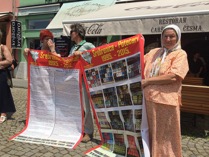
Boston: Twenty new panels have been woven for the Srebrenica memorial quilt (left), commemorating teachers who were murdered in the 1995 Srebrenica massacre. The panels were made by members of the women’s group BOSFAM in Tuzla, and displayed last week at a meeting of the Center for Balkan Development in Boston, which called for the arrest of General Ratko Mladic, architect of the 1995 massacre. AP has raised $2,835 for the quilt project – enough for 70 panels. The goal is 80 panels. Contact us to sponsor a panel for $40, or to use the quilt at an event. Learn more about other ways to take action.

Read the coverage by the media of BOSFAM.


Contact:
Ul. Stjepana Matijevića 11
(u blizini Skvera)
75000 Tuzla, Bosna i Hercegovina
Tel./Fax: 00387- 35/257 534
Mobile: 00387- 61/732 027
Email BOSFAM Back
Bosnian Family
![]() |
![]() |
![]() |
BOSFAM was founded in 1994 during the Bosnian War by Beba Hadzic, the former head of the Srebrenica primary school. It was founded as a refuge for refugee women regardless of their age, religion, ethnic background, or education. BOSFAM’s mission is to help Bosnian women and their families gain economic stability as they struggle against poverty, misery, and suffering. The organization’s name is derived from BOSnian FAMily. BOSFAM operates on the principles of humaneness, impartiality, independence, and voluntarism. It is based in the Bosnian town of Tuzla and has a branch in Srebrenica.
The Srebrenica massacre: The work of BOSFAM is intimately connected to the 1995 massacre at Srebrenica. After the massacre, thousands of distraught women poured into the town of
The AP website contains four web features that tell the history of the 1995 massacre and attempts by the survivors – including the members of BOSFAM – to rebuild their lives:
- Refugee profiles: Peter Lippman profiles the efforts of Bosnian Muslims to return to their homes and reverse the impact of ethnic cleansing (1999-2000).
- The story of Srebrenica: Sixteen web pages which tell the story of the massacre and early efforts by civil society to rebuild. (2003)
- Letters and diaries: by Peter Lippman (2002/2003)
- Diaries from Srebrenica: by AP Director Iain Guest (2004)
BOSFAM Weavers: BOSFAM offers its members the chance to earn an income through traditional weaving. BOSFAM runs a weaving center in the town of Tuzla, where its members can produce traditional Bosnian carpets (kilims), sweaters, socks and gloves. Not only is the weaving itself deeply therapeutic, but it also generates money. The sale of these items is the only source of income for many of the women.

Many of the BOSFAM weavers lost husbands, sons, brothers, and fathers in the Srebrenica massacre, leaving these women as the sole providers for their families. BOSFAM's weaving center and shop are based in Tuzla and its network of core weavers extends to Srebrenica. Read the weaver's stories.
The weavers of BOSFAM make carpets, clothing, accessories and home decorations of the highest quality. These can be purchased online. BOSFAM's handmade products symbolize the determination, leadership, and resourcefulness of women who have survived great tragedies in their lives.
BOSFAM's Partnership with the Advocacy Project
The partnership began in 2000 when AP staff writer Peter Lippman visited Bosnia to record the stories of Muslim refugees seeking to return home. AP staff and volunteers have visited BOSFAM regularly in the years since. AP has also supported BOSFAM’s advocacy from the US:
- 2003: Peter Lippman helps BOSFAM design and post a new website, working with a grant from the Dutch Stichting Vluchteling. BOSFAM has periodically updated and redesigned its site in the years since.
- 2004: AP makes a 12-minute promotional film on BOSFAM’s work.
- 2005: On the occasion of the tenth anniversary of the massacre, AP joins with three other advocacy organizations to launch an online petition to support BOSFAM’s efforts to bring those responsible for the massacre to justice. AP also invites BOSFAM’s director and a leading weaver to visit the US.
- 2006: AP launches a project to sponsor BOSFAM’s 18 core weavers, which has yielded $14,000 for the weavers (as of April 2008). AP also arranges for Overstock.com to sell a large consignment of BOSFAM carpets, which net around $30,000 for the BOSFAM weavers.
- 2007: BOSFAM launches the Srebrenica Memorial quilt project. AP is currently serving as US coordinator for the project.
- Return home: In 2000, BOSFAM began helping members to regain their homes in Srebrenica by helping displaced women to acquire the appropriate documents. With BOSFAM's help women went to Srebrenica to collect their personal property and identification documents. BOSFAM's staff also began to visit women in Srebrenica who had already returned and helped them visit doctors, register children for school, and/or to find tutors.
- Bringing the killers to justice: BOSFAM has supported efforts to arrest and prosecute the masterminds of the Srebrenica massacre: former General Ratko Mladić and Radovan Karadžić. In July 2005, the tenth anniversary of the massacre, AP and three other advocacy organizations launched an online petition to support BOSFAM’s efforts to bring those responsible for the massacre to justice. BOSFAM’s supporters in the US followed up and presented the list of 9,900 signatures to the Secretary-General of NATO, and Nicholas Burns, a US Under-Secretary of State.
- Handicrafts as advocacy: BOSFAM has pioneered the use handicrafts, in the form of its carpets, as a tool of advocacy. With AP’s support, BOSFAM has taken this approach to the United States. Starting in 2004, AP displayed BOSFAM carpets at events in Baltimore, Boston, and Washington, DC. These events attracted several hundred visitors, generated several sales of carpets, and promoted favorable articles in the Boston Globe and the Baltimore Sun. AP has also launched a sponsorship scheme in the US to raise funds for BOSFAM’s core weavers.
![]() |
- The Srebrenica quilt: For the pastseveral years BOSFAM and AP have refined their approach to advocacy, culminating in the launch in 2007 of the Srebrenica Memorial Quilt. The quilt comprises individual panels, each of which commemorates a victim of the 2005 massacre. The first 20 panels were unveiled on July 11, 2007 at a mosque for former Bosnian refugees in St Louis, Missouri. The quilt has since been traveling around Bosnian diaspora communities in the United States, helping to keep the memory of the massacre alive. The quilt is also growing in size as relatives of victims sponsor new panels. BOSFAM’s hope is that the quilt will comprise at least 100 panels by the end of 2008 and that it will be exhibited in Washington, DC in the presence of politicians, who will reassert their commitment to bringing the killers to justice.
Join the Campaign to Arrest the Massacre Leaders!
- Advocacy Project News Bulletins: AP has published bulletins about BOSFAM through the news service, AdvocacyNet.
- Blogs
Alison Morse, an AP Peace Fellow volunteered with BOSFAM during the summer of 2007. Read Alison's blog.
Kristi Severance and Yvette Barnes volunteered with BOSFAM in 2006. Read Kristi and Yvette's blogs.
Chiara Zerunian and MacKenzie Frady worked with BOSFAM in 2005. Read Chiara and MacKenzie's blogs.
Pia Schneider worked with BOSFAM in 2004. Read Pia's blog.
Marta Schaaf worked with BOSFAM in 2003. Read Marta's blog.
- Homepage Features
(February 19, 2008)
Boston: Twenty new panels have been woven for the Srebrenica memorial quilt (left), commemorating teachers who were murdered in the 1995 Srebrenica massacre. The panels were made by members of the women’s group BOSFAM in Tuzla, and displayed last week at a meeting of the Center for Balkan Development in Boston, which called for the arrest of General Ratko Mladic, architect of the 1995 massacre. AP has raised $2,835 for the quilt project – enough for 70 panels. The goal is 80 panels. Contact us to sponsor a panel for $40, or to use the quilt at an event. Learn more about other ways to take action.Read the coverage by the media of BOSFAM.
- In June 2005, at AP’s invitation, BOSFAM Director Beba Hadzic and Magbula Divoric, a weaver living in Srebrenica, came to the United States to expand the constituency of support for BOSFAM. The BOSFAM delegation addressed a conference at Georgetown University in Washington, DC, met with the Under Secretary-General of the UN, Shashi Taroor in New York, visited Aid to Artisans in Hartford Connecticut, briefed a senior editorial writer at the Boston Globe, and addressed the staff of Physicians for Human Rights in Boston.
- Website
BOSFAM's website has information about their history as well as a web shop where you can buy the carpets they produce.
- BOSFAM has struggled to affect real social change. In terms of the weavers, social change would occur of a critical mass of BOSFAM member were able to return to Srebrenica. But as of April 2008, only four weavers have returned because of the lack of security, poor economic prospects, and damage to their houses.
- BOSFAM also hopes to create social change by bringing sustainable income to its core weavers. However, all of these efforts have been made more difficult by the inability of the international community to arrest Mladić and Karadžić.
- BOSFAM established a small weaving center in Srebrenica in 2004, with help from the Stichting Vluchteling, in the hope of creating an incentive for other weavers to return. However, the center failed to attract support and has been temporarily closed. The Srebrenica-based weavers make their carpets from home.
Contact:
Ul. Stjepana Matijevića 11
(u blizini Skvera)
75000 Tuzla, Bosna i Hercegovina
Tel./Fax: 00387- 35/257 534
Mobile: 00387- 61/732 027
Email BOSFAM Back
- Community-based Partners
- Africa
- Asia
- Europe
- Association for Emancipation, Solidarity and Equality of Women
- International Roma Women's Network
- Bosnian Family
- History of BOSFAM
- BOSFAM's Founder
- In the Words of the Weavers
- AP's Work with BOSFAM
- BOSFAM and Srebrenica's Future
- Bosfam AP Bulletins
- Coverage by the Media
- Dale Farm Housing Association
- Kosova Women's Network
- Dženo Association
- Forum of Srebrenica NGOs
- Transnational AIDS Prevention among Migrant Prostitutes in Europe Project
- UK Association of Gypsy Women
- Women in Black Network from Serbia
- Youth Cultural Center
- Latin America and the Caribbean
- Middle East
- Worldwide
- Criteria for Partners
- Outreach Partners (US)
- Strategic Partners
Services
Fellows+
Dissemination+
Research+
ICT+
Training+


.jpg)