

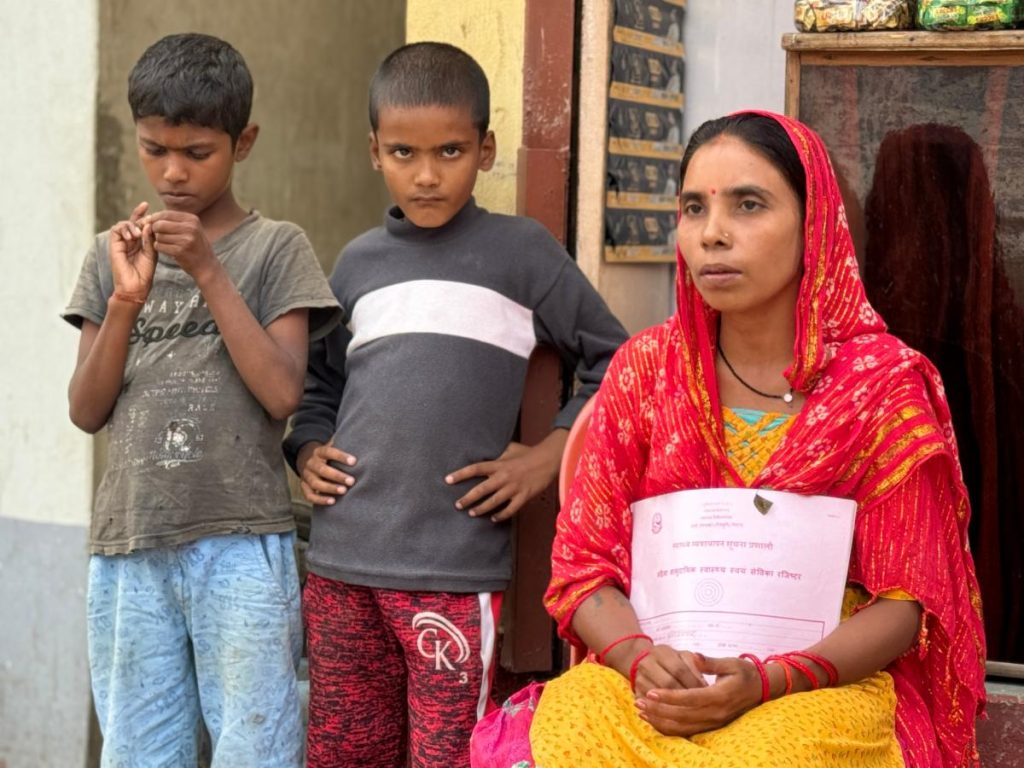
Sunita Chidimar survived forced marriage at the age of five to become an advocate for heath education among families from the Chidimar sub-caste in the town of Nepalgunj
In a powerful display of personal advocacy, a member of a despised sub-caste who was married off by her parents at the age of 5 has helped to secure a pledge by the government of Nepal to end child marriage.
Sunita Chidimar made a passionate appeal to Prime Minister KP Sharma Oli on December 31 at a ceremony at Mr Oli’s home in support of an NGO campaign against child marriage. The NGOs include Backward Society Education (BASE), a longtime partner of The Advocacy Project (AP).
Mr Oli used the event to sign a government pledge to eliminate child marriage by 2030. Marriage under 18 has long been illegal in Nepal, but the practice is still widespread and according to some reports 6% of all girls in Nepal marry before the age of 15.
Onlookers said that Ms Chidimar broke down as she described her own experience in harrowing detail. She was betrothed at the age of 5 and given to her husband at the age of 14. There then followed an agonizing pregnancy.
Ms Chidimar’s appeal to the Prime Minister was widely covered in the Nepali media but there was no mention of the fact that she belongs to a former sub-caste that still encourages child marriage and is socially shunned, making it exceptionally difficult to end the practice.
The Chidimar are one of 26 groups that are categorized as Dalit, the lowest of the four former castes in Nepal. Caste discrimination is illegal in Nepal and the caste system is considered to have formally ended in 2008 when Nepal broke with Hinduism and became a secular state.
But some Dalit sub-castes, like the Chidimar, remain linked with unsavory occupations that they practiced under the caste system. These are now viewed with distaste by most Nepalis.
Chidimar have traditionally caught exotic birds, and their name means “bird killers” in Hindi. While very few Chidimar still catch birds, the lingering association has deepened their isolation and poverty, making it harder for them to marry into families outside their caste.
Ms Chidimar lives in the town of Nepalgunj, which is home to around 600 Chidimar. She said that only 3 families still catch birds owing to deforestation and shrinking demand, and that each bird sells for around 250 rupees ($3).
But other harmful traditions persist, and child marriage is still fiercely defended by older Chidimar, some of whom still speak their traditional Bhojpuri language. Equally dangerous, many Chidimar parents do not understand or believe in vaccinations.
Ms Chidimar was invited to attend the signing ceremony by Pinky Dangi, a staff member at BASE, after the two met during a recent investigation by BASE and AP in Central Nepal. Ms Dangi directs BASE’s work on child marriage.
The BASE-AP mission met several families from Dalit sub-castes, including the Chidimar, that regret their association with traditional practices but are unsure how to make a clean break. One reason is that Dalit families with 5 members or more receive 3,500 rupees a month and health insurance from the government. This acts as a disincentive to changing their last name.
Ms Chidimar told the mission that she and her son, aged 17, are indifferent to the opinion of others and happy to be known as Chidimar. “It is more important to educate Chidimar families and explain the health risks to their children,” she said through an interpreter.
Ms Chidimar herself leads by example. She is the first-ever member of her sub-caste to be chosen as a community health volunteer, a government post that allows her to offer health education to other Chidimar families in Nepalgunj. Eighteen years after her education was cut short by marriage she recently resumed classes and is now studying in Grade 12 – one grade above her son.
Ms Chidimar’s experience and strength of character impressed Ms Dangi from BASE and secured her invitation to meet Prime Minister Oli. But even Ms Dangi was unprepared for the impact of Ms Chidimar’s appeal and the subsequent media coverage, which she described as “unexpected and exciting” in a recent call from Kathmandu.
The ceremony at the Prime Minister’s home was also attended by Dilli Chaudhary, whose parents were born into bonded labor and who created BASE in 1985 to end the practice, known in Nepal as kamaiya. The BASE campaign led to the abolition of kamaiya in 2000 and is widely considered to be one of the most successful examples of NGO advocacy in modern Nepalese history.
Mr Chaudhary rose to become Nepal’s Minister of Labor and Chief Minister of Lumbini Province in Central Nepal. He remains committed to empowering ethnic and caste minorities in Nepal and has asked AP to assist a new BASE project on social marginalization.
Ms Dangi said that her meeting with Ms Chidimar in Nepalgunj had reminded her of the power of advocates like Mr Chaudhary and Ms Chidimar who emerge from a marginalized group and are forever shaped by their experience.
“This is why they produce change,” she said.
Sunita Chidimar gave permission for her name and photo to be used in this article
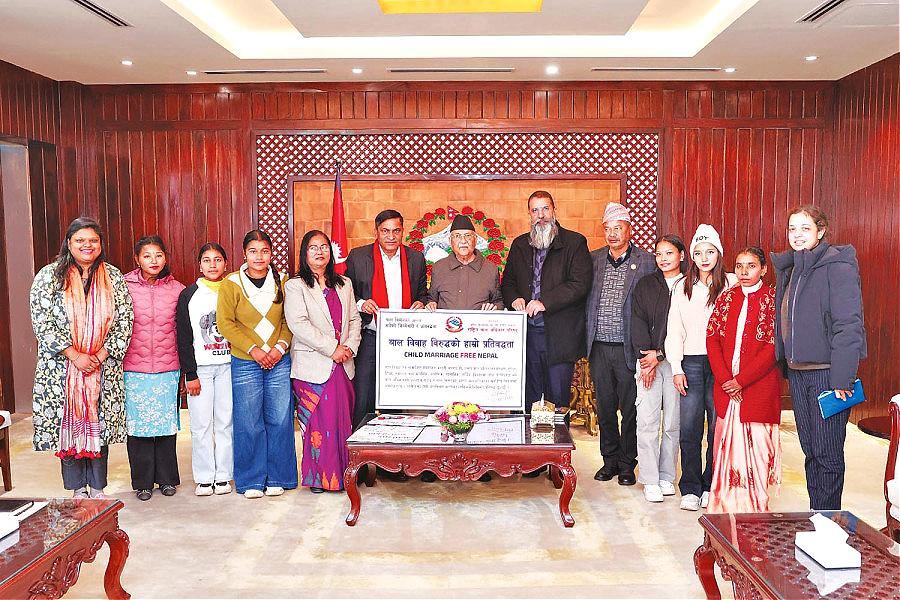
Prime Minister Oli meets with advocates after signing a government pledge to end child marriage by 2023. Dilli Chaudhary, the founder of BASE, is fifth from the right. Sunita Chidimar is second from the right.
*
Posted By Iain Guest
Posted Jan 7th, 2025