

Sara Kusbadiya carves and sells stones for use in grinding spices
We stop just outside Nepalgunj to visit a settlement of Kusbadiya, one of the lesser-known sub-castes.
Only 552 Nepalis identified as Kusbadiya in 2000, making them the smallest Dalit sub-caste in the country. They also feature in an interesting discussion about group identity. The Kusbadiya are linked to another sub-caste known as the Pattharkatta, and some have even changed their name. But there is a big difference between the two groups. The Kusbadiya have been recognized as an indigenous minority and as an endangered ethnic group, which raises their status and ensures their protection. The Pattharkatta are listed as Dalit and so linked to untouchability.
This has intrigued some scholars but is probably of little interest to the three Kusbadiya women who agree to talk to us – Sara Kusbadiya, a widow, and her two daughters Sunara, 17 and Parkhi, 25. It emerges that they are under more pressure than any family we have yet met.
Kusbadiya are known for carving grooves into stones which can then be used as cutting boards or for grinding spices. Sara, the mother, is hard at work on a large stone when we arrive and her stone is quite beautiful.
But the sad fact is that Sara’s skill makes little economic sense. The family buys about 20 stones a month in India at a cost of 350 rupees each (including import duties) and sell the stones for around 750 rupees after they are carved. But other cutting boards made from wood and plastic are available on the market at a much cheaper price, and the three women supplement their income by making and selling rope and plastic buckets. Their ancient skill may soon be obsolete. They must know it and it must scare them.
The two girls have little interest in talking with us, but we do learn that Sara pulled her daughter Parkhi from school when she left for a trip to India because she was concerned that Parkhi would “run off with boys.”
Parkhi is now long past the age at which Kusbadiya girls marry. But if she does find a husband he will be selected by her mother from within the Kusbadiya community. Parkhi seems resigned to this but the pool of candidates would appear to be shrinking. Forty families used to live in this settlement but fifteen have moved elsewhere. Parkhi’s younger sister Sunara also dropped out of school at grade 10 (aged 15).
After a time, the three women lapse into silence. The two sisters sit with grim faces for several minutes before heading off on bicycles to sell plastic buckets and ropes. They seem relieved to be free from the questioning.
Our visit has been quick and uncomfortable, and I feel we did not handle it well. But it has given us an insight into how small sub-castes can trap their members in a vicious cycle of poverty, isolation and anxiety. This group of Kusbadiya seems sealed off from the world, with no will to change. Conditions in their settlement are also grim – the families live in open tents and have no blankets during the winter. Neither sister shows interest in completing her education. They have no savings and no obvious options.
Right now I doubt whether any initiative from BASE would even be welcomed, let alone trigger change. The marriage barrier will remain intact until a brave Kusbadiya soul falls in love with someone from another caste and stands up to the parents. That, obviously, has to come from within the group. Education support is desperately needed, although school is clearly not a priority for this family. Perhaps other Kusbadiya girls could be persuaded to accept a scholarship.
Finally, there is no obvious leader to work with and no advocate hiding in plain sight, like Sunita Chidimar. We hear that two Kusbadiya men were respected but that one had died and the other is in jail.
I will mark this visit down as a failure and recommend that BASE conducts a fuller inquiry into this small but beleaguered sub-caste. Somewhere in here there will be Kusbadiya who yearn for a better life and will take a risk to achieve it.
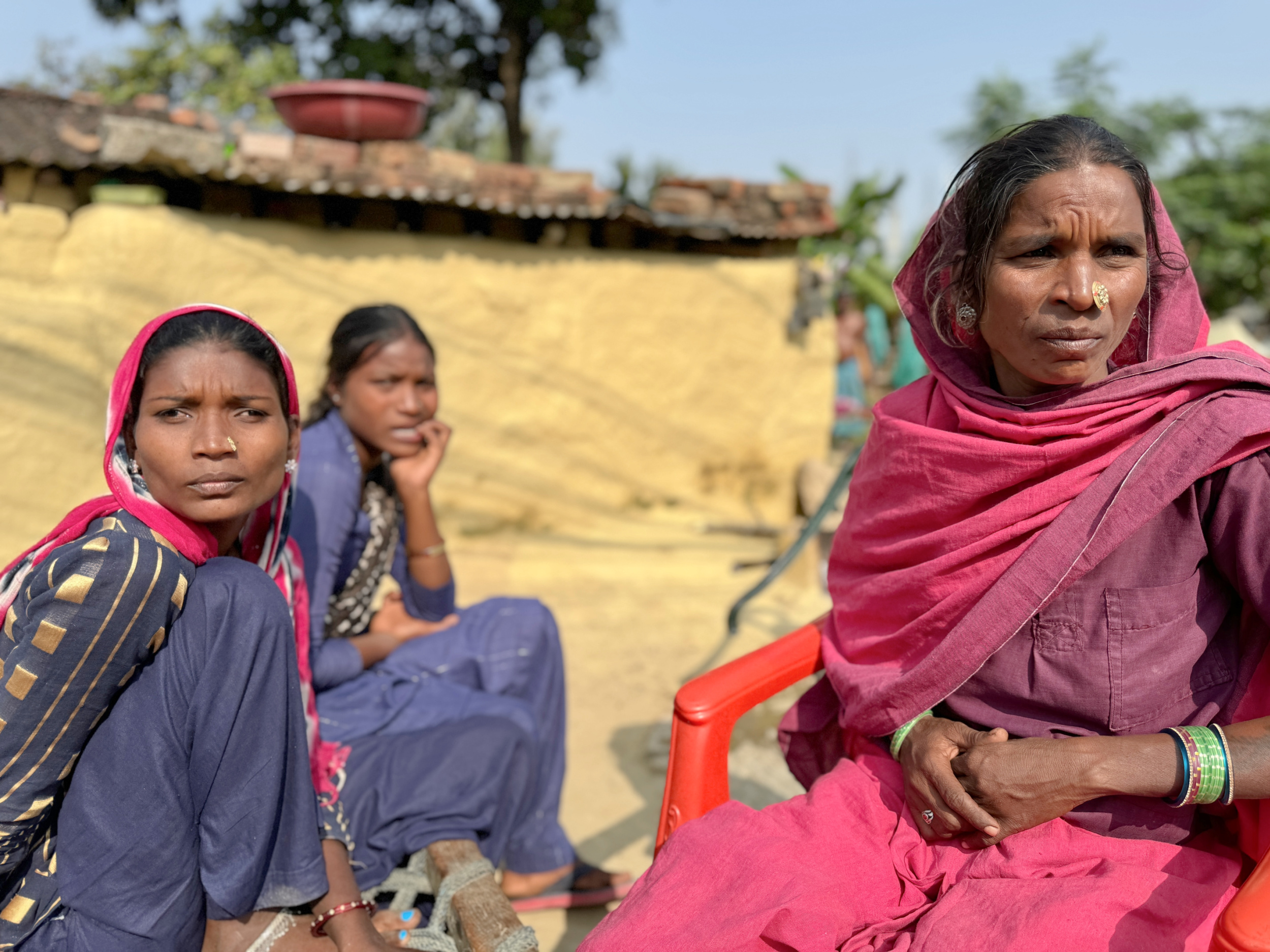
Parkhi Kusbadiya, left and her sister Sunara both dropped out of school to help their mother carve stones and sell rope
Next – The Kewat Plate-makers
Posted By Iain Guest
Posted Nov 21st, 2024