
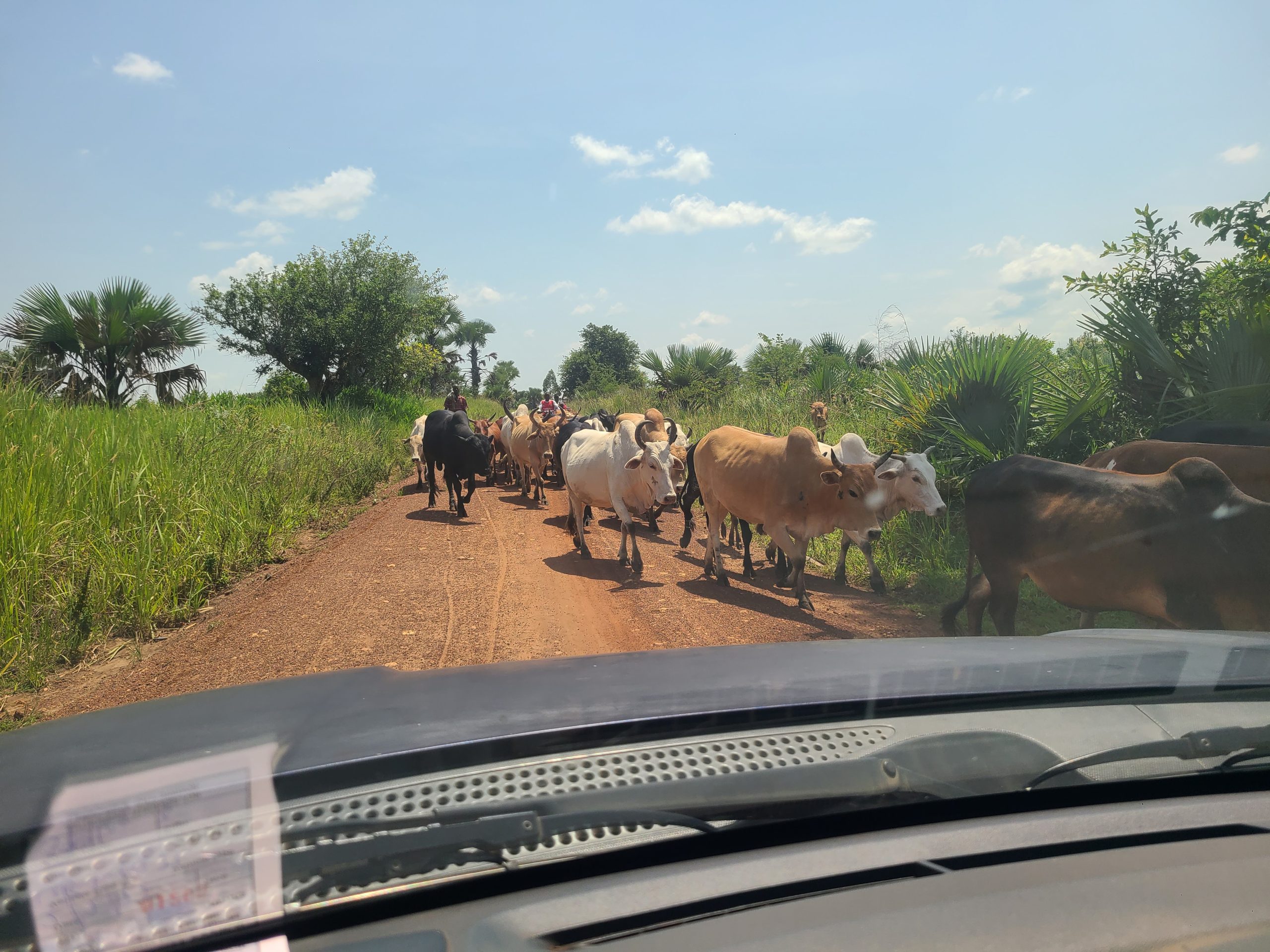
Sharing the road with the village occupants
After the completely expected belated start our July monitoring began with Kulu Opal Primary School. Last month, this was the school where we found their latrine water tank so filthy that frogs and insects had begun living in it, and no other hand washing stations around the school. Needless to say, there was room for improvement.
When we arrived the health clinic workers were already talking to the children under a large tree. I was pleasantly surprised to see handwashing stands aligned near the classrooms. As we walked over to join the assembly, I took the liberty of lifting the lids and inspecting the state of the water. To my delight they were all clean, and two of the stations even had bars of soap for the children to use.

The health clinic worker walking amongst the students to get their attention back
As soon as I became visible behind the woman from the clinic addressing the children, hundreds of eyes were transfixed on me. So much so, that I almost regretted interrupting as I knew the children were no longer listening to the important information being given them. With Emma translating for me, the clinic workers explained to the children, when given medicine for malaria you have to take the WHOLE dose. Not to stop just when you start to feel better, not to share with your siblings or parents.

The child behind the health worker eagerly volunteered to demonstrate to the teachers how to do the malaria test
We then witnessed the nurse demonstrating to the teachers how to perform a rapid test, to properly dispose of the sticker and blood drop sieve, and how to read it. While demonstrating, they found one young girl student and three teachers that tested positive for malaria, which just goes to show how pervasive this malady is in the region.

She ended up testing positive
We then headed back to the headmasters’ office, but I veered off to the latrine, and the moment of truth. When I lifted the lid on the latrines’ water tank, to my astonishment, it was completely clean! The progress the school had made was exhilarating, but not over. We had delivered 40 liters of liquid soap to the school, for free. And told the headmaster that if we saw another improvement next month, the GDPO could sell him the soap with a discount. Now that we knew they had the liquid soap, next month we’d (‘they’d’ really since I wouldn’t be around) like to see it at the handwashing stations. Simple enough,… right?
We finished off the week visiting two more schools in the Awach village; Awach Primary and Awach Central. At Awach Primary, the health clinicians were waiting for us and the headmistress summoned the children under a large mango tree. Nearly 500 children struggled to divide their attention between the medic explaining malaria prevention, whispering to their friends and staring at me. Still, even if I was an unfortunate distraction, the message was clear and repeated: finish your malaria medicine, don’t share it, and prevention begins with clean hands. These small lessons, paired with visible improvements at the schools, gave me hope that something might be sticking.
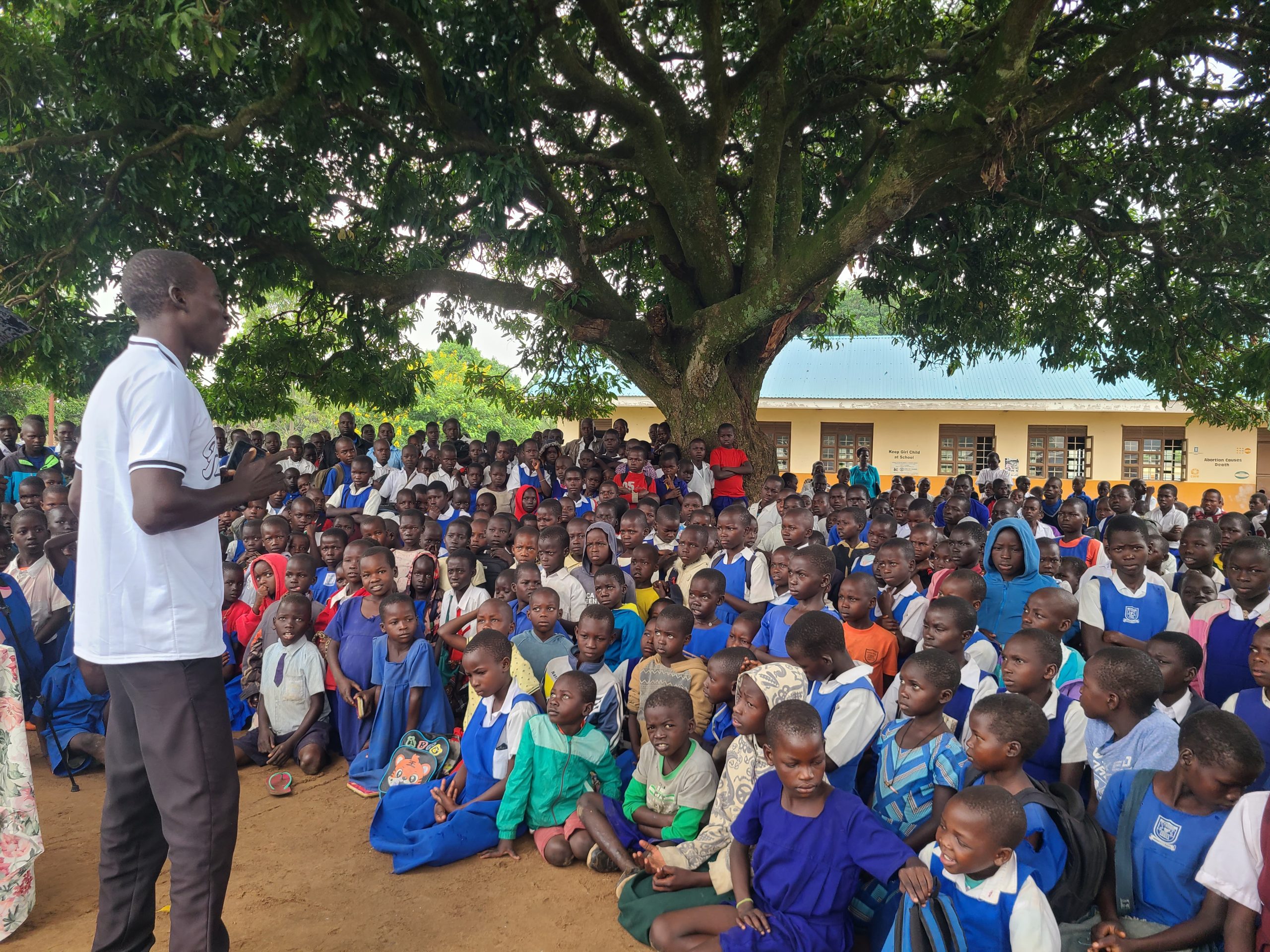
The health center worker engaging the students at Awach Primary
At the other Awach school (Awach Central), during the last monitoring visit, we discovered a dead lizard decaying in the main water tank. Again, to my pleasant surprise, this was removed and the water was clean. We set up goals for the next month’s visit; having soap at the hand washing stations. We also delivered free liquid soap to the school, for free, for this purpose. There is no excuse to not have this done in a month.
While none of these changes alone will transform the health outcomes of an entire region, they do mark real, measurable progress. Clean tanks. Soap at washing stations. Children repeating lessons about malaria. These aren’t sweeping reforms but they’re steps forward. And without regular monitoring, without showing up to check, encourage, and follow through, even these modest gains might stall or slip away. Progress here moves slowly, often unpredictably, but it moves. And that movement is driven not by big speeches or perfect plans, but by consistent, patient presence; by returning to the same schools, lifting the same lids, and quietly insisting that the next visit will look a little better than the last.
Posted By Aaron Bailey
Posted Jul 6th, 2025
4 Comments
Beatriz Lloret
July 6, 2025
Reading this, what struck me most was the moment with the little girl who volunteered so eagerly, only to test positive for malaria. That contrast between innocence and harsh reality really hit me. And yet, the way you hold those moments without losing your sense of purpose or hope is something I admire so deeply in you. It’s is also encouraging to hear about the improvement the schools are making. You’ seem to have embraced how change actually happens there: slow, layered, imperfect – and you’re leaning into it with more clarity and hope each week. With just a few more weeks left, I can feel how much this experience is impacting you. I miss you a lot, but watching that unfolding, makes it so worth it – has made me admire you even more.
Julia Holladay
July 8, 2025
What a cool experience to witness the health clinicians’ education activities! It’s so true that progress is rarely ever linear and is rather a cycle of trial and error and, most importantly, continuing to show up.
Laila Azmy
July 9, 2025
Wow, Aaron — this is wonderful news! Every bit of progress is a step in the right direction. It’s encouraging that the children you’re working with are so enthusiastic about public health and doing their part in whatever way they can. I hope that will bode well for the next month’s check in.
Iain Guest
July 20, 2025
This is incredibly good news, Aaron, because it means that GDPO’s monitoring is really paying dividend and PRODUCING A CHANGE IN BEHAVIOUR! Apart from anything else, your blog shows that regular monitoring is low in cost and high in value. How easy it is to keep toilets clean and remove the dead lizards from handwashing tanks! So the penny is dropping. The second BIG development is the inclusion of malaria in the GDPU training and the fact that through WASH. you are all connecting health centers to these schools. I’m really glad you took the time to describe these two developments in the WASH program! Hopefully, they will attract the attention of the local government and other NGOs, and also make it easier for GDPO to find sponsors and donors. Well done!