

On a June night in 2002, 21-year-old Bipin Bhandari was forcibly taken by security forces from his hiding place in Kathmandu. He has never returned. His father, Ekraj Bhandari—a constitutional lawyer and human rights advocate—has been searching for him ever since.
This is not just a story of disappearance. It is a story of conviction, of political awakening, and of one father’s tireless pursuit of justice for families like his—families of Nepal’s disappeared.
Who Is Bipin?
“Bipin Revolutionary.” That’s what they called him.
To his father, Bipin was more than a nickname—he was a son to be proud of. Born in Nepal’s rural Salyan district, Bipin moved to Kathmandu to study science, where he quickly distinguished himself as a brilliant student. He never relied on his family’s financial support, earning scholarships through academic excellence. But it wasn’t just his intellect that set him apart—it was his voice. A gifted speaker and writer, Bipin had a sharp political consciousness that far exceeded his years.
While studying, Bipin quietly became involved in student politics. Without his family’s knowledge, he rose to a leadership position in the largest student association at the time—the student wing of the underground Maoist party. His prominence eventually made headlines, surprising even his politically active father. But to those who knew him, it wasn’t a shock. “He had a convincing style in his speech,” Ekraj recalls. “He never needed to be told what to do—he grew into himself, naturally.”
When the first ceasefire was declared in 2002, Bipin emerged from hiding to organize public political events aimed at reconciliation. He believed the Maoist agenda—rooted in structural reform and social justice—deserved a place in open democratic debate. But when the ceasefire collapsed and the government resumed its crackdown, he was forced underground once more.
In May 2002, state security forces came to the Bhandari home at night. They pointed a pistol at Ekraj’s head and threatened his wife, demanding she produce Bipin within a week. At the time, Bipin was in hiding somewhere in Kathmandu.
A month later, he was forcibly disappeared.
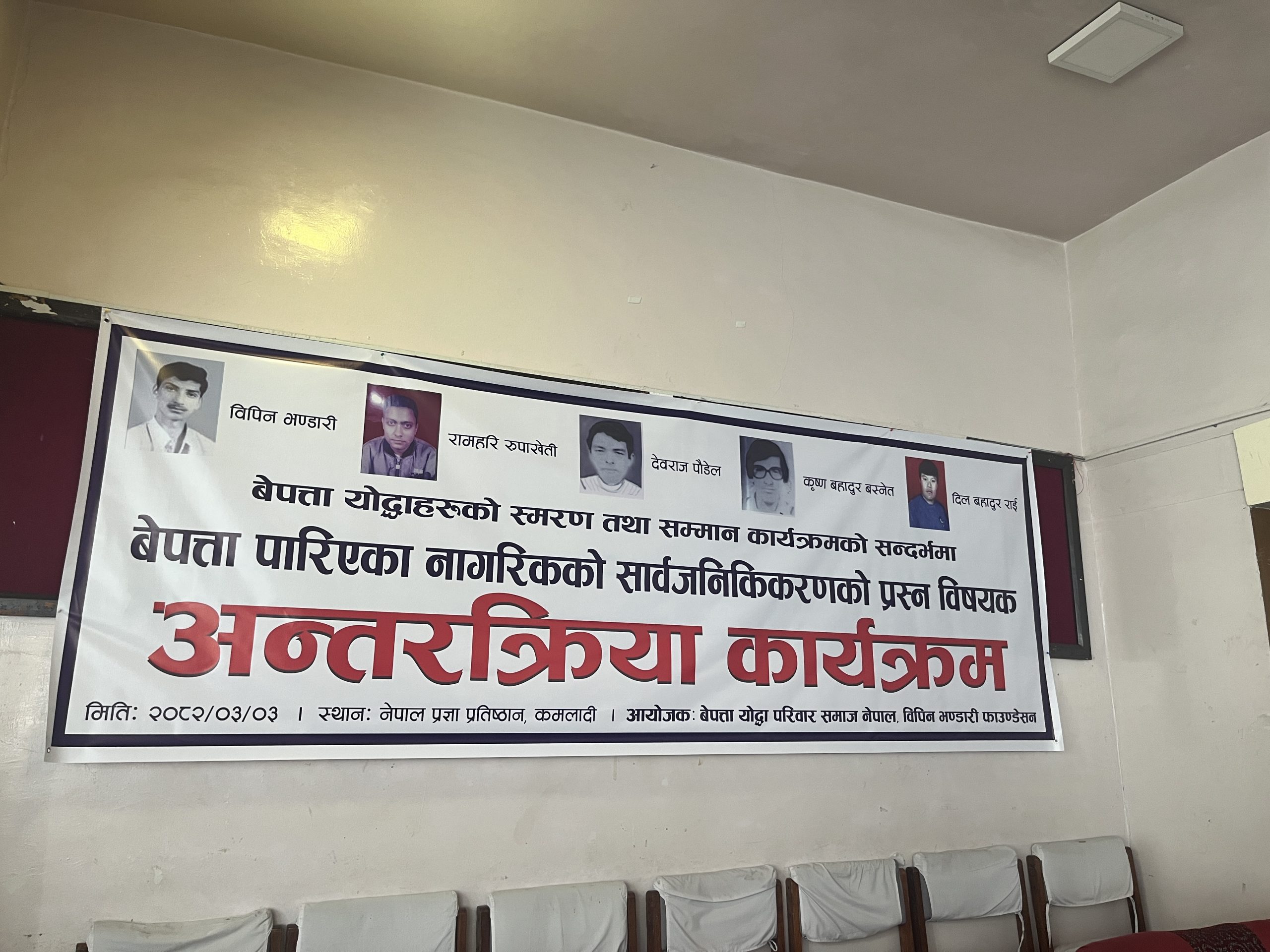
At the far left of the banner is an image of Bipin.
A Father’s Search, A Movement Born
Bipin’s disappearance marked a turning point—not only in Ekraj’s personal life but in Nepal’s human rights movement.
At the time, Ekraj was already a prominent figure in Nepal’s legal community, serving as a central committee member of the Nepal Bar Association and general secretary of its human rights wing. He had long used his platform to advocate for constitutional reform, often echoing demands for structural change voiced by the Maoists. But when his own son was taken, advocacy became personal—and urgent.
Despite his legal standing and political connections, Ekraj found every door closed. “They feared that if I knew where Bipin was, I’d get him out,” he says. The disappearance had been calculated. Only a few people knew Bipin’s location. Some of them were arrested, tortured, and forced to divulge information. The special task force responsible reported directly to the King. Their primary targets were not just any activists, but high-profile ideological leaders like Bipin.
But Ekraj refused to be silenced. He filed a habeas corpus petition at the Supreme Court. He co-founded the Society of Families of the Disappeared by the State—one of Nepal’s first and largest victims’ networks. He collaborated with the ICRC, the United Nations, Amnesty International, and bar associations worldwide, becoming a legal and moral voice for hundreds of families who, like his own, were denied truth and justice.
Even under direct threat, Ekraj kept organizing. During the second ceasefire in 2003, when pressure escalated once again, he went underground for three years in far-western Nepal. There, he continued his work—training both victims’ families and Maoist cadres in international human rights law. His wife remained above ground, coordinating support programs for survivors.
What began as a father’s desperate search for his son became the foundation of a movement for truth, accountability, and memory in Nepal.
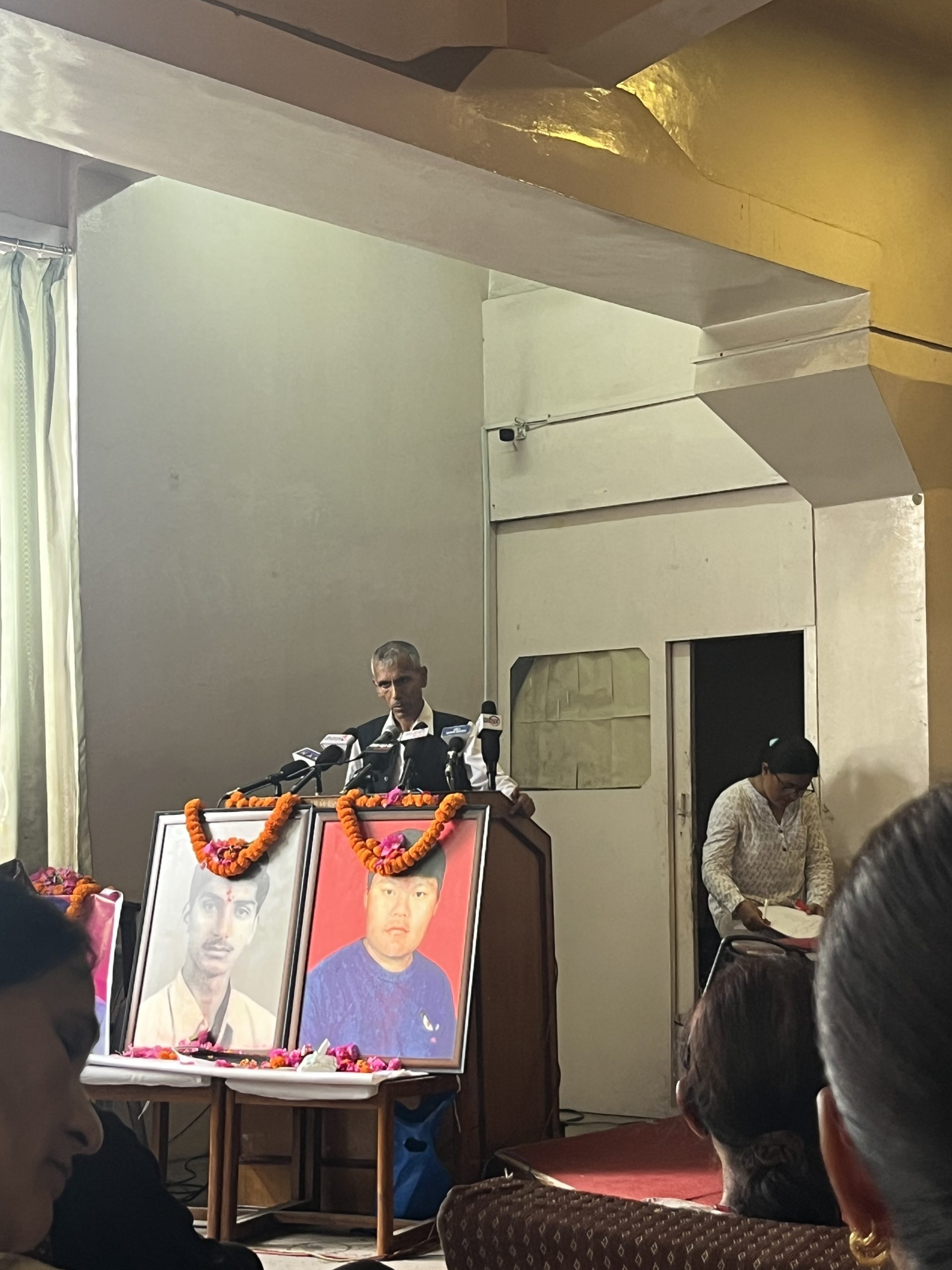
Ekraj speaks at the annual commemoration for the forcibly disappeared; a photo of his son Bipin, who was forcibly disappeared in 2002, appears at the bottom left.
Legal Struggles and Political Frustration
Ekraj has submitted three major writ petitions on enforced disappearance to the Supreme Court:
- In 1999, acting as legal counsel for families of the disappeared.
- In 2003, filing a second case, in which the Court reaffirmed its 1999 decision.
- In 2007, leading to a landmark ruling that directed the government to:
- Amend domestic laws to align with international human rights standards;
- Establish a truth commission specifically addressing enforced disappearances;
- Reimburse the legal travel expenses of the 84 petitioning families.
Even this modest third point has not been fulfilled. “This is not even about reparations,” Ekraj notes. “It’s just about covering the cost of the lawsuit.”
In 2008, he was elected to the Constituent Assembly (CA) to draft a new constitution, fulfilling one of the central promises of the 2006 Comprehensive Peace Accord (CPA). He played a critical role in pushing transitional justice onto the Assembly’s agenda. Yet, political deadlock between established and emerging forces led to the CA’s dissolution without delivering a constitution.
A second CA was elected in 2013, and after protracted negotiations, the new Constitution was finally promulgated in September 2015. But for Ekraj, this was no victory. The final version, he says, bore little resemblance to the draft he had helped shape. Key provisions on justice and accountability were weakened or discarded. “It was a political compromise, not a people’s constitution,” he reflects.
Though the final amendment fell far short of the transformative vision many, including Ekraj, had worked toward, the Constitution did introduce some notable advancements—such as the formal recognition of socio-economic rights, provisions for inclusion of marginalized groups, and commitments to federalism. Yet despite these gains, the core promises of transitional justice—truth, accountability, and reparations for victims—remain unfulfilled.
Dysfunctional Commissions, Waning Political Will
Today, the transitional justice commissions remain mired in dysfunction. The first set was inactive for four years. The current commissions, he says, are no better. “There’s no political will. That’s the core problem.”
Since the signing of the 2006 Comprehensive Peace Accord, Nepal has seen over 13 different governments. A triangular political structure—two traditional state parties and the Maoists—has led to blame games and paralysis. “No one is willing to take responsibility,” Ekraj explains. “But this is not about individual grievances. This is about national interest. History must remember. The people must remember.”
Reparation Is More Than Money
Ekraj’s vision of justice is not just about financial compensation—it’s about dignity.
“The government prefers donor money,” he says. “They think once they distribute cash, their job is done. But money cannot replace what’s owed.”
He fears that even donor funds may become a vehicle for corruption, allowing the government to avoid structural reforms. “Instead of offering services—free healthcare, education, legal support—they just hand out money and wash their hands.”
He recalls a mother who once told him: “All I need is three buffalos. Then I can make a life.” It wasn’t about compensation. It was about survival, about rebuilding. Real reparations require institutional improvements, not short-term handouts.
Ekraj believes that the international community is listening more directly to victims, and that this is a positive step. But he remains realistic. “Maybe the government will act, under pressure—but it might take 50 years. By then, we’ll all be gone. This generation of families of the disappeared will be gone.”
A Legacy of Memory and Resistance
Through all of this, Ekraj has not stopped speaking, organizing, filing, remembering. His story, like Bipin’s, is one of relentless resistance.
His demands—and those of hundreds of other families—remain the same:
Tell us where they are.
Acknowledge what was done.
Take responsibility for meeting the basic social needs of the families.
Give us truth through the justice system.
The struggle continues, not only to find the disappeared, but to force the state to remember them. Bipin, the revolutionary son. Ekraj, the father who refuses to forget.
Posted By Shuyuan Zhang
Posted Jul 21st, 2025
1 Comment
Iain Guest
July 23, 2025
An incredibly moving and well-researched blog, Shuyuan. Your description of Bipin’s activities and disappearance, followed by his father’s dogged search for the truth is very powerful. Multiply this story by around 1,400 – the estimated number of Nepalis who disappeared – and we get a good sense of why the survivor movement in Nepal is relentless and effective. Well done, and thank you!