

The first thing I notice when I arrive at the home of Võ Thị Thảo is the large brown cow. It lies in the shade, its body pressed against the wall, chewing slowly. The rope at its neck hangs slack; its ears flick at the flies.
A moment later, Thảo steps forward with her husband, Cảnh. I have come with colleagues from AEPD to spend the afternoon with them, to listen to their stories and to understand how the livelihood sponsorship they received from AP and AEPD is working for their family. From inside the doorway, their two children glance over at us, curious for a moment before returning to the easy indifference children often show toward visiting adults.

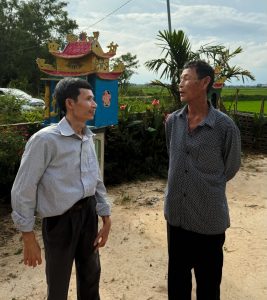
AEPD outreach worker Nguyên (left) greeting Cảnh (right)
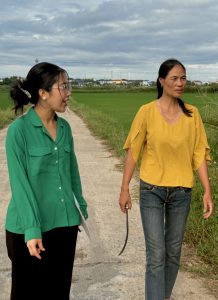
AEPD translator Quyên (left) with Thảo (right)
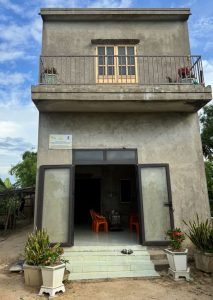
The house is built of poured concrete, two stories with a narrow balcony along the front. Its pale walls stand out against the trees and the sand. To one side are two shrines painted in red and gold, their lacquer catching the late light. A sign above the doorway identifies the house as flood-resistant. My supervisor Hồng explains that it was built with support from the government and UNDP, after the family first received livelihood assistance from AP and AEPD.
Thảo is forty-two, tall and lean, with a steady composure that softens when she speaks about her children. She lives with the effects of Agent Orange: a mild intellectual disability, epilepsy, and chronic pain that makes concentration and physical labor difficult. Her schooling ended after sixth grade. She tells me that studying for long periods, or even tasks that require sustained focus, brings on discomfort that is hard to manage.
Her husband, Cảnh, carries his own history of war. He is eighty-one, a veteran, his body thinned and lined by years of labor in the fields. Much of the caregiving now falls to him: cooking, working the rice, and helping manage the household when Thảo’s health falters. The arrangement is not one they dwell on, but it shapes their days.
The two have been married for fifteen years. Both had lost spouses before. Cảnh had been a friend of Thảo’s father, and after her husband died he stepped in, saying he felt a responsibility to care for her. Together they have built a life that includes their two children: a daughter in seventh grade and a son in fifth. Their faces soften with fondness as they talk about their children. “They do very well in school,” Cảnh says, his voice light. Thảo nods her head gently, her expression warm.
In 2024, Thảo and Cảnh received livelihood sponsorship from AP and AEPD in the form of a breeding cow. The program begins from the recognition that families affected by Agent Orange often live at the intersection of poverty, disability, rural marginalization, and the long aftermath of war. Many of those affected were farmers and soldiers from rural villages; some fighting to protect their homes, others living in areas targeted by chemical spraying and deforestation campaigns.
Although the government provides aid through disability compensation, housing programs, and veteran benefits, these measures are rarely enough to meet the daily needs of rural families living with disability. Without consistent care, illness and disability reduce a household’s capacity to work, while poverty limits access to treatment, each compounding the other.
For AP and AEPD, livelihood is inseparable from dignity. Material stability offers the ground on which social belonging, political recognition, and even hope for the next generation can take root. In this context, a cow is more than an animal to feed and tend. It steadies a household that has lived for decades with conditions shaped by war, and it opens the possibility of less precarious lives. Yet material stability is only part of the picture. The origins of these hardships are political as much as economic, and their repair requires not only small-scale support but also sustained responsibility between Vietnam and the United States.

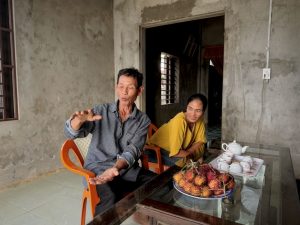
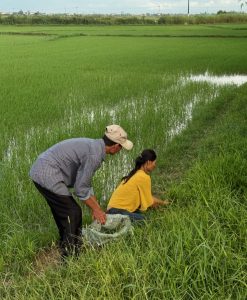
Over tea, the conversation turns to the shape of their days. Much of the family’s livelihood still depends on rice, with the cow as a new form of stability. In the afternoons, Thảo and Cảnh walk out to the fields together. She bends to cut grass while he steadies the sack, adjusting it as it grows heavy. The work is demanding, especially for Thảo with her health and for Cảnh at his age, yet they carry it out side by side, their movements practiced and unhurried. In watching them, what becomes evident is the familiarity of routine, the way daily labor and care fold into one another.
They feed the cow in the yard or walk it along the path when the weather holds. The animal is both a promise and a burden. As Cảnh grows older, the strength needed to guide it into the hills during floods is harder to summon, and Thảo’s health makes such work difficult for her as well. Flooding is a constant in this part of central Vietnam. When the water rises too quickly, they cannot take the cow far. Instead, they bring it into the house, leading it up the narrow staircase until the waters recede. Once, its weight cracked part of the steps.
Thảo and Cảnh laugh as they tell the story, though their laughter carries the awareness that the next flood may bring new challenges. Their plan now is to build a raised platform inside the house, where the cow can keep dry. I picture the animal standing patiently in the stairwell, its heavy body pressed into the architecture of the home, and I think about the resilience required to adapt in ways both ordinary and extraordinary.

After a while, the conversation shifts from the fields and the floods to the future. I ask what they hope for in the years ahead. Hồng, translates, pausing before she speaks: “They say they have no hopes for the future.” The words settle heavily.
Before the silence takes hold, Hồng’s daughter, Quyên, interjects gently. “That’s not quite accurate,” she says. “What they said is that they are content with their lives now, at their age. They don’t feel the need to imagine a different future for themselves. But they still have hopes for their children: to do well in school, to go to college, and to be afforded more opportunities in life.”
The correction changes the moment. What I had taken as resignation is something else: a simple turning outward, and a passing on of hope. I am reminded how much depends on the small inflections of translation, how one rendering can suggest finality while another allows for possibility. In Babel, a novel I hold close, R.F. Kuang writes that “translation means doing violence upon the original, means warping and distorting it for foreign, unintended eyes. So then where does that leave us?” Here, I feel the weight of that question. I know how much I rely on others’ translations in this fellowship, how meaning shifts in the process, and how tenuous my grasp of the conversations can be. What I encounter in this moment is not only the risk of distortion but also the possibility of something unexpected surfacing, something made newly visible.
At this stage in their lives, Thảo and Cảnh say their satisfaction lies in daily stability: the house that weathers the floods, the rice that grows each season, the cow that promises another source of income. But when they speak of their children, their faces brighten. Their daughter is good at literature, and their son is strong in math. Both do well in school. “They are smart,” Thảo says with tenderness. Hope does not disappear here. It bends, it adapts, and it transfers, lingering in the next generation.

Posted By Angie Zheng
Posted Aug 19th, 2025