

Monitoring with ‘Awach’-ful eye – seeing results from our M&E model
In a busy start to the week, we kicked off our October monitoring visits on Monday. This was the ‘after’ of our ‘before and after’ – the test for whether our M&E had actually paid off.
At first it seemed like our results were a mixed bag. We began with a visit to Panykwowo, a well-administered school which has always warmly received GDPU’s monitoring efforts. True to form, the school had been very responsive to our menstrual hygiene advocacy. For the first time on any of our school visits, we saw soap, period pads, spare underwear, and towels directly available in the girls’ changing room. It was clean, dry, and by far the best-stocked we’d seen.
But the upkeep of Panykwowo’s toilets and handwashing stations had been less successful. Their makeshift drainage systems were blocked, leaving pools of stagnant water and a haven for breeding mosquitos.
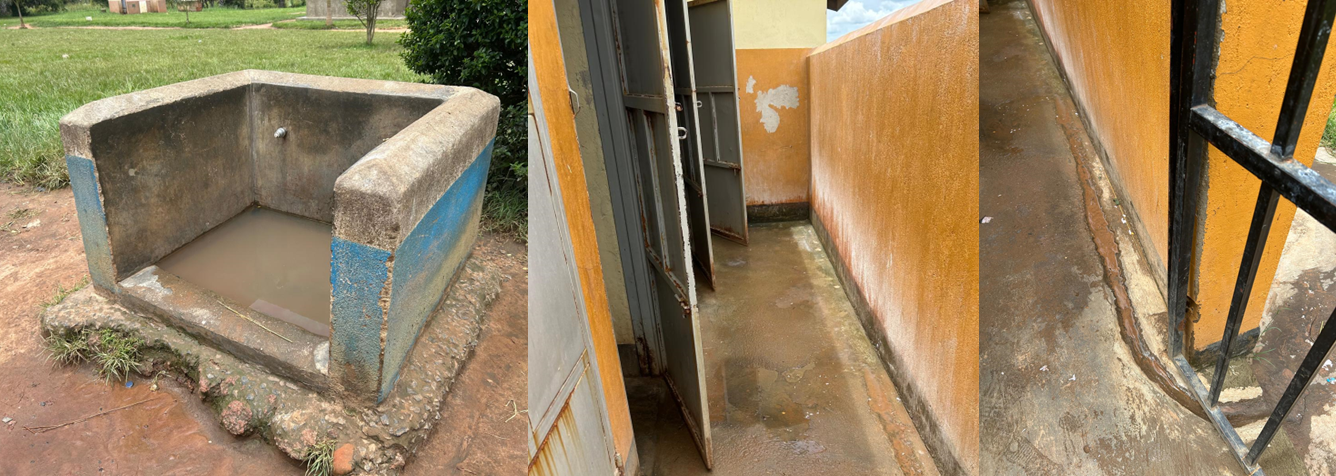
Putting a dampener on things at Panykwowo: stagnant water at the handwashing station (left) and toilets (centre). A struggling drainage channel trickles away from the toilet block (right).
Our second monitoring visit – this time at Awach Central School – showed a similar story. The toilets were dirty; the doors damaged; and the walls dilapidated. We’d also asked if the school could fix the gate at the toilet block: a low-cost, simple change which could go a long way to protect the dignity of children using it. But, with Awach Central stretched for cash – like all seven primary schools – requests like these can simply be too much to ask.
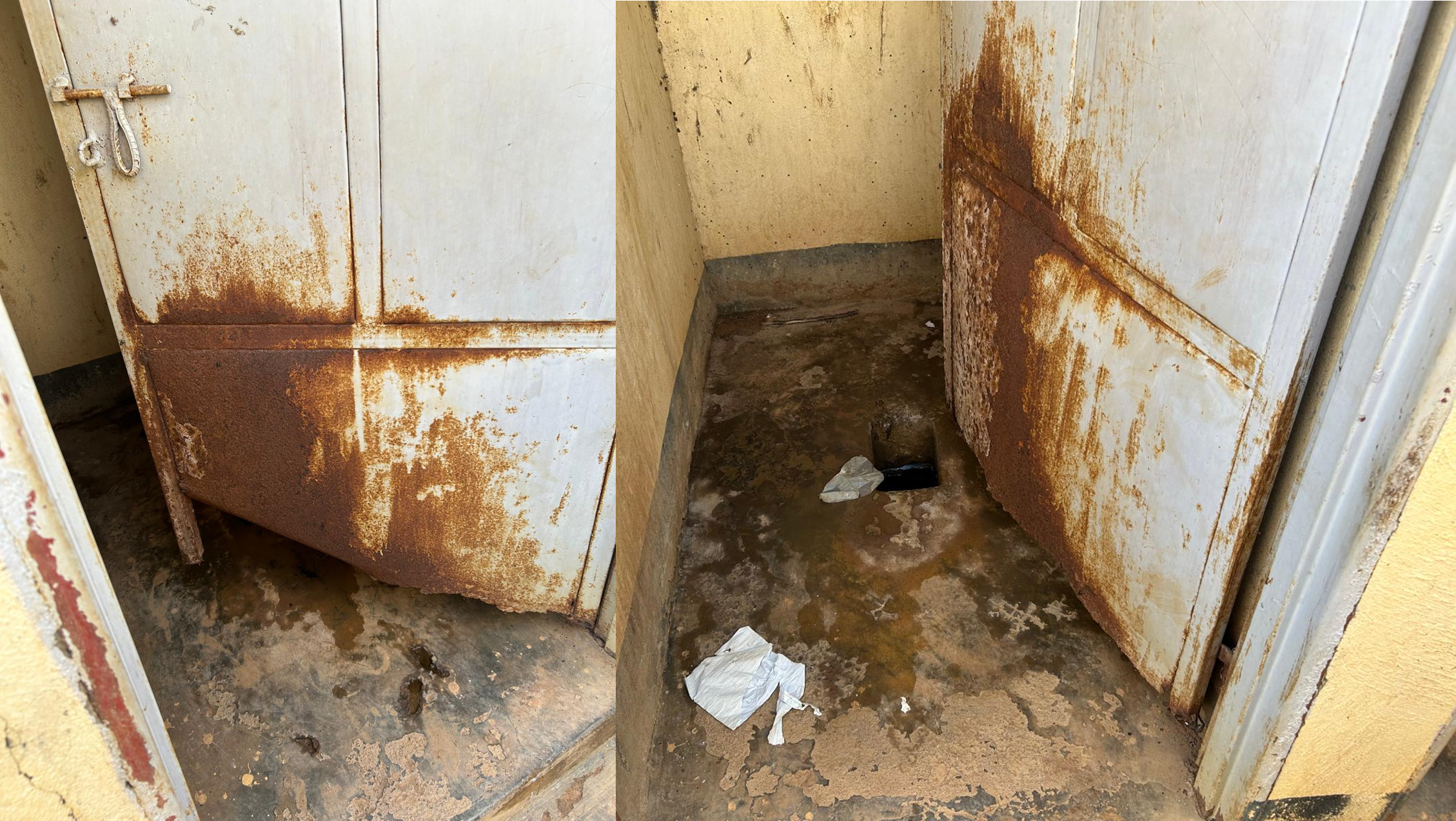
Doors rusted, gates busted, and toilets disgusted: at Awach Central School.
But, just five minutes down the road at Awach Primary, our luck turned. Out of all our visits throughout the past six weeks, no school better made the case for M&E than Awach did.
From a basic WASH standpoint, everything at Awach Primary looked good. Despite being just five years newer than the toilets at Awach Central School, those at Awach Primary were in exceedingly better condition. The latrines were clean, and the broken tap we raised during our September monitoring visit was now fixed. But, in particular, Awach Primary’s malaria prevention efforts had made astonishing progress.

Monitoring with ‘Awach-ful’ eye: the difference in condition between Awach Central (left) and Awach Primary (right). The pathway to the toilet at Awach Primary is essential for wheelchairs and the front gate offers privacy.
After our September monitoring visit, we introduced Awach Primary to the possibility of working with local health clinics, having already brokered these partnerships for many of the other GDPU-supported schools. When we returned to Awach this time, this partnership wasn’t only in place, but prospering.
Indeed, by putting the school and clinic in touch, our M&E model proved to have made another effective recommendation. Awach Primary’s Health Teacher had received 200 mosquito nets, 25 malaria testing kits, and over 5,000 antibacterial tablets to treat infections.

“Awach and Learn”: Awach Primary setting the standard for local health clinic partnerships. Along with the malaria prevention resources, the school also secured five bottles of iodine; 2,ooo paracetamol tablets; and ten rolls of bandages.
In collaboration with GDPU, clinics also run malaria prevention training, now delivered in six of the seven local schools. This teaches pupils about the importance of mosquito nets, medication, and eradicating mosquito breeding sites around the home – including bushes and pools of stagnant water.
The malaria prevention package has only been rolled out last year, since it was flagged as an important WASH component by our monitoring model. But now, as the training begins to take stock, we can see its staggering impact. In fact, the Health Teacher admitted that since our training at Awach Primary, the number of malaria cases per day had dropped from approximately 40 to 17.
And it’s not only teachers at Awach Primary who are taking the initiative. The pupil-led ‘health club’ has spearheaded efforts to clean up the site, including cutting the grass behind the toilet blocks. This gets rid of mosquito breeding grounds, keeping cases down.

Cut the grass, the mosquitos won’t harass: Awach Primary leading the way (left); but Awach Central still needs some support (right).
Malaria is a huge problem in Ugandan schools. The highest rate of positive tests we’ve recorded at a malaria prevention training is 74%. Our last session recorded a 66% positive rate. Continuing to support these sessions across all seven primary schools – and upholding Awach Primary as the gold standard – is already paying dividends.
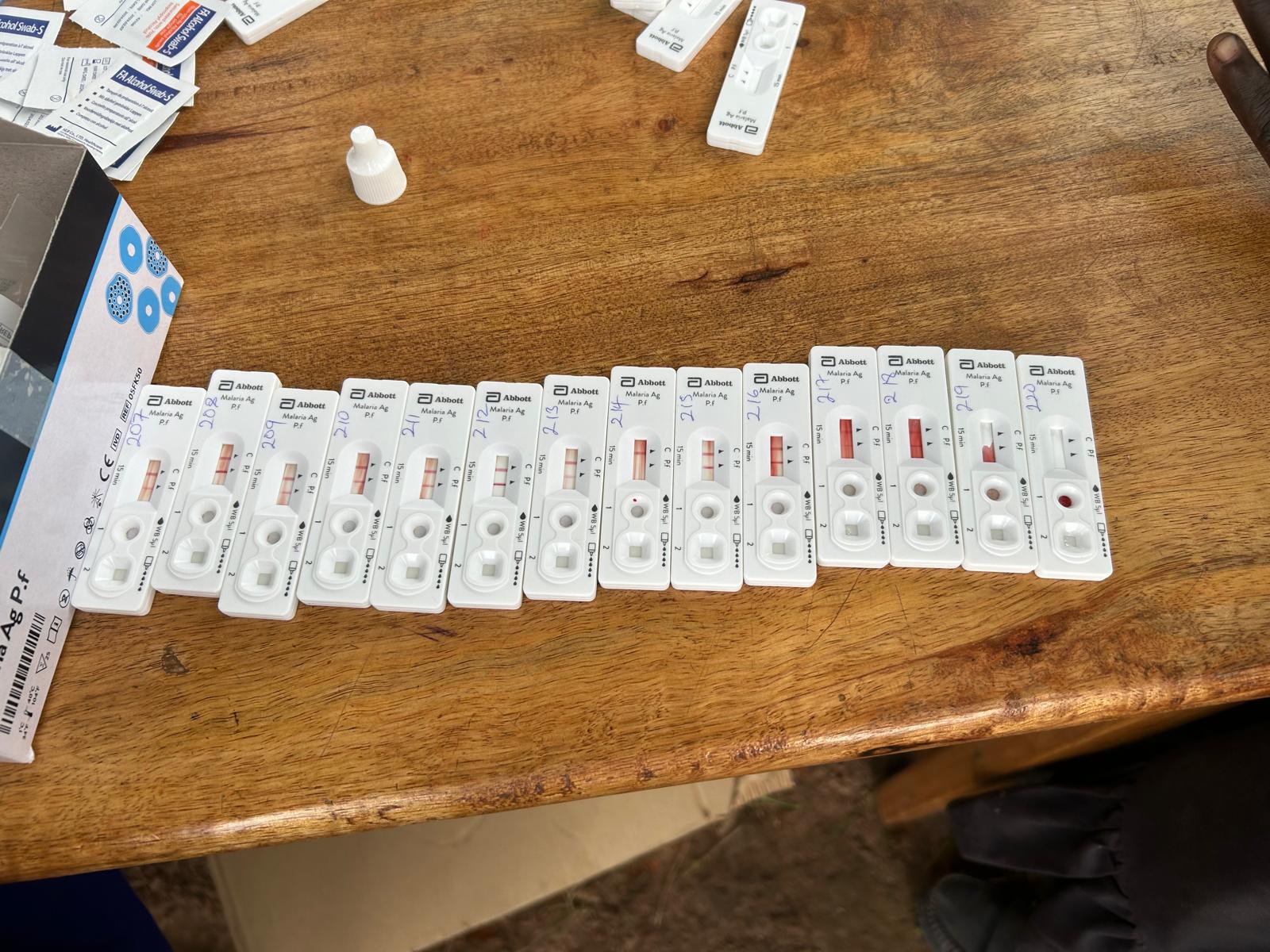
Positive tests, negative news: 66% of pupils testing positive (double lines showing) for malaria at Tochi Primary School.
Our M&E model identified the prevention training as a way to tackle this challenge, and now we’re starting to see results. Progress is being made in leaps and bounds at Awach Primary – now we must empower the other schools to do the same.
Posted By Alex McDermott
Posted Oct 22nd, 2025
2 Comments
OKWIR JOSEPH JOHNS
October 24, 2025
In this blog, Alex demonstrates that while monitoring and evaluation (M&E) yields mixed results, highlighted by Panykwowo’s excellent menstrual hygiene but poor drainage, and Awach Central’s neglected facilities, it serves as a crucial catalyst for transformative progress. The exceptional success at Awach Primary School proves the model’s value; by facilitating a partnership with a local health clinic, the school secured vital malaria prevention resources and training, resulting in a dramatic drop in daily malaria cases from 40 to 17. This achievement, along with the student-led cleanup efforts, establishes Awach Primary as the “Gold Standard,” showing the other schools the clear pathway to convert M&E recommendations into life-saving health and hygiene outcomes.
Iain Guest
November 12, 2025
This is a VERY encouraging blog, Alex! Not only does it vindicate the WASH monitoring model that you’ve all put in place – it shows the importance of the malaria prevention work. I’m really looking forward to learning more about the malaria model in future blogs. The rate of infection in these schools is shocking, indeed. But the rapid decline in infections is also wonderful. What a great outcome from your fellowship!