

In my conversations with Joseph Johns Okwir, who has seen first-hand the struggles girls in Uganda experience when it comes to menstrual health, I realized just how little these issues are discussed in the United States. Stigma around menstruation is deeply rooted in a lack of education, and the impact can be wide-ranging and felt for a long time. The stigma, along with limited access to menstrual hygiene products, can affect a girl’s opportunities for education and her general livelihood. It truly can dictate the course of young girls’ lives, but this aspect of women’s health is not often talked about.
The efforts of WASH, The Advocacy Project’s partners, such as Joe and Emma, actively bring awareness to this issue across schools in Uganda. Although their focus is in Uganda, menstrual health is a global issue. Young women everywhere can be impacted by a natural cycle they cannot control, and it is important to give it far more attention than it currently receives.

Emma from GDPU provides Panykworo students with an education regarding menstrual cycles and female anatomy.
As a teenager in the United States, hearing about how education is centered on this issue really resonated with me. The lack of information and awareness about menstruation leads to stigma, and with limited access to menstrual hygiene products then threatens girls’ education. Before talking with Joe and Emma, I’d never thought about period products deciding whether or not someone could finish school. At my school, having a few absences would put you behind, but it wouldn’t mean the end of my education. In Uganda, girls who do not have access to products, such as pads, are unable to attend school regularly and miss out on important lessons.
Though 3 or 4 missed days a month may not seem significant to some, the time away can vary, and the pain and discomfort associated with periods can discourage girls from attending. Repeated absences have even led to many girls dropping out. I was shocked when Joe and Emma told me that 19 girls dropped out of just one school because of menstrual health associated issues, something that has also been seen across other schools and communities. In some cases, these issues are added to other challenges facing girls and education, with some also dropping out due to early pregnancy.
Joe and Emma told me a lot about what limited access to menstrual hygiene products meant, the most surprising part was that some girls also do not have access to underwear, which makes a difficult situation even more complicated. Though organizations like Her Worth and the WASH Team have started to create hand-sewn reusable sanitary pads, without underwear, they can’t be used. It is also common for girls to turn to other materials such as foam mattresses as a substitute for pads.
Even if they do have access to the proper amenities, menstrual hygiene products aren’t usually available at school, and they might be forced to take a trip home, sometimes in the middle of the day, just to manage their period.

Boys show a deeper understanding for the issue by working to create reusable pads out of fabric
The stigma that occurs when it comes to periods isn’t limited to Uganda, but it looks different in the U.S. In the areas of Uganda where Joe works, girls are taught to believe that periods are “dirty,” and that boys should not interact with them, which again leads to a limit in the opportunities they receive. Girls and young women in the U.S. may find some of that familiar, especially the idea that they cannot talk openly about a normal and natural cycle without worrying about being made fun of, especially in places where boys and girls are together. But I also realized how fortunate I was to live in a community and time that prioritizes science and health education and awareness, and how, despite a few uncomfortable social situations, girls here aren’t usually limited in what they can do.
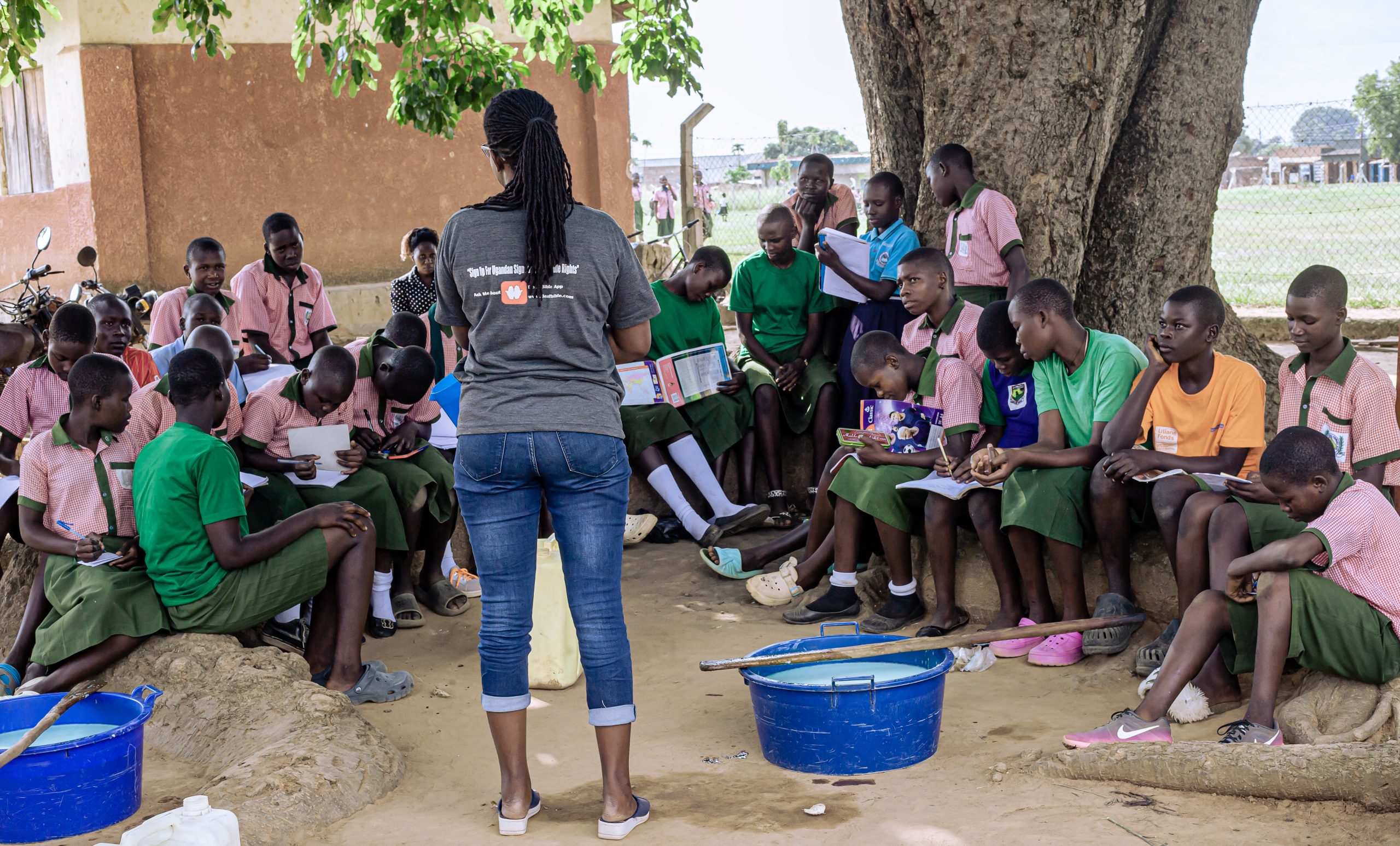
Education occurs across genders. In order to address the stigma associated with periods, both males and females must be educated.
In the places where Joe and Emma are working, access to menstrual products, education about periods, and the attitudes around them have created a cycle that has limited opportunities for girls and women for generations. When a girl without pads misses school, she falls behind and is more likely to drop out. The stigma also leads to isolation because she may not have anyone to talk to about it.
Hearing about what they go through made me realize that even though there is stigma in the U.S., I am grateful to live in a place where more people understand menstruation as part of health. Though there was a lot to process, I walked away from our conversation optimistic about the opportunities for these girls. I can imagine a world for them where the cycle gets broken through education and awareness, and the benefits of educating girls and women change their communities for the better.
Posted By Anna Connors
Posted Jul 1st, 2026
3 Comments
Emma Badach
July 2, 2026
Love hearing your perspective on this Anna, menstruation is such an important issue that requires support. I can’t wait to see where this project takes us!
Sarah
July 6, 2026
Such an important and under-discussed issue. Love your interest, perspective, and passion about learning more and promoting awareness and education.
Iain Guest
July 18, 2026
Anna – we’re delighted to get your perspective on this! It’s particularly important coming from a high school student in the US. As our friends in Uganda have been saying – and as you note in your blog – this is a BIG problem in Uganda. It’s reassuring to read that students in the US are not taunted and bullied, as they are Uganda, and that menstruation is accepted. Also, you write very well, Anna! I can’t wait to read your next blog….!