

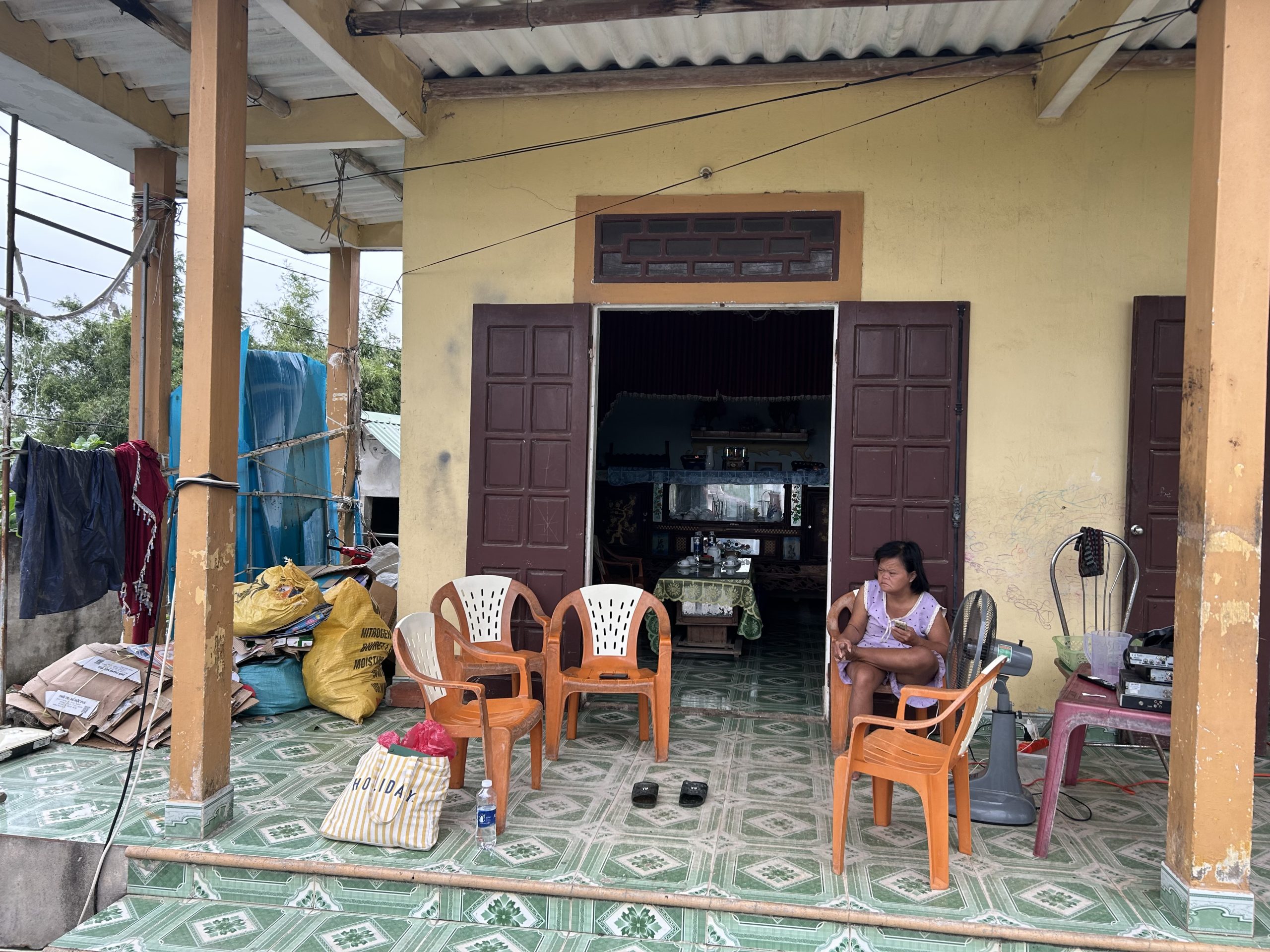
The first thing I noticed when we arrived at Luyên’s house was the plastic. Bags, bottles, pieces of cardboard and other discarded materials were scattered around the garden in Tu Phúc Village. At first, it looked almost as though rubbish had simply accumulated around the house. Later, I understood that much of it was there for a reason. Luyên collects plastic and cardboard and tries to sell whatever she can.
Then I looked at the house itself. The walls were dark, blackened by dirt but also, it seemed, by years of dampness and mould. Through the open doorway, I could see that the walls inside were in much the same condition. I found myself wondering whether living with so much humidity could be affecting the health of the two women who live there.
Before I could think about it for very long, Binh interrupted us. She wanted to tell us something. It took me a few moments to understand her, and eventually her mother translated: Binh loves singing. She especially likes listening to music when songs come on the local radio. She smiled as she explained it.
Binh is 40 years old and has Down syndrome. She lives here with her mother, Luyên, who is 69. The two women spend almost all of their lives together. But during the day, Binh is often alone.

Binh and Luyen
Luyên’s daily routine
I asked Luyên to describe an ordinary day. Her answer started much earlier than I expected.
She wakes up at around three in the morning. Usually, she watches television for a while. I asked why. Her answer was simple: after watching for a few minutes, she feels a little less sad.
That sentence changed the direction of our conversation. Luyên worries constantly about the future, and particularly about what will happen to Binh when she is no longer able to care for her.
Before leaving for work, she prepares her daughter’s breakfast. This is not simply an act of routine. When Binh was younger, she was once electrocuted while trying to prepare food. Since then, Luyên has been afraid that something similar might happen again while Binh is alone. So she cooks before leaving.
Then she goes looking for work. Calling it a job would probably give the wrong impression. There is no contract, no regular salary and no certainty that work will be available.
Sometimes a recycling factory hires her. Sometimes neighbours ask her to clean their houses. Sometimes she collects plastic and cardboard herself and tries to sell it.
There are no fixed working hours. Some days the recycling factory keeps her until late in the evening. On those days, Binh becomes upset because she has been alone for so long and scolds her mother when she finally comes home.
More recently, Luyên has sometimes had to turn work down. She is getting older and says that her health is becoming more fragile. There are days when she simply does not have the strength. For a household that depends on every small amount she can earn, deciding not to work is not really a choice.
Caring for Binh
While her mother is away, Binh stays at home. Luyên sometimes brings back broken toys or electronic devices that no longer work so that her daughter has something to occupy herself with.
Communication is difficult. Binh can speak, but we often struggled to understand her. Luyên rarely did. She seemed able to translate not only her daughter’s words but also changes in her mood, expressions and behaviour.
Her moods can also change quickly. Her mother described moments when she becomes impulsive or aggressive, particularly towards her because she is the person closest to her. Sometimes, when she is angry, Binh tells her mother to leave the house.
Luyên knows that these moments are part of her daughter’s disability. But knowing why something happens does not necessarily make it easier to manage when you are doing it alone.
When I asked what being a caregiver meant to her, Luyên sighed. She said that she takes care of everything because there is nobody else. For example, Binh only began walking independently when she was 18 and even today she still needs considerable support in her daily life.
There is the cooking and cleaning. There is making sure Binh has food before she leaves. There is helping her with personal hygiene. Binh sometimes urinates on the floor while her mother is away. So after spending the day collecting waste, cleaning someone else’s house or working at the recycling factory, Luyên may return home and begin cleaning again.
But Binh’s disability is not an isolated part of the family’s story.
As we continued talking, Luyên began to explain how health problems and disability had affected several of her children, and how she and her husband had gradually come to associate these difficulties with his exposure to Agent Orange during the war.
The family’s experience of Agent Orange
Luyên’s husband was a soldier during the war and was exposed to Agent Orange. He died in 2008.
When she spoke about him, her voice changed. Binh seemed to notice immediately and reached towards her mother, touching her leg. For a few seconds, the conversation stopped being an interview. It was simply a daughter recognising her mother’s sadness.
Luyên told us that she had given birth five times. Two of her children died as babies: one after 17 days, and the other after three months. According to Luyên, both showed visible malformations, but they died too young to receive official recognition as victims of Agent Orange.
It was after these births, she said, that she and her husband began questioning why so many of their children had serious health problems.
Binh is officially recognised by the Vietnamese authorities as an Agent Orange victim.
Her two other surviving siblings are not, although both also have significant health problems. One has very limited eyesight. The other suffers from a condition affecting the production of blood and has undergone several transfusions, creating significant financial costs for the family.
They are now married and have households of their own, but that does not mean they are financially secure. Sometimes, Luyên told us, they are the ones who ask her for help.
I found that particularly difficult to imagine. Luyên is already trying to support herself and Binh with almost no stable income, yet she may still find herself helping her other children when they are struggling.
The responsibility of caring for her family has never really stopped.
Their financial situation
Binh receives around VND 1.6 million (approximately $60) each month in government compensation as a recognised Agent Orange victim. The household receives no other regular financial support.
Everything else depends on whatever Luyên manages to earn from collecting plastic and cardboard, cleaning houses or working at the recycling factory. On the days when work is available, she hopes to earn between one and two dollars. There is very little room for anything beyond basic needs.

Garden
Luyên explained that they often buy instant noodles costing around twenty cents. By the end of the day, there is usually no money left.
Listening to her, I started to understand the plastic scattered around the garden differently. Every bottle, piece of cardboard or object that could be sold had some value.
And because there is no stable income, even a small unexpected expense can become a problem. A medical cost, a repair to the house or simply a few days without work can immediately affect what the family is able to afford.
What support could provide
The family is not currently receiving livelihood support from AEPD and The Advocacy Project. So I asked Luyên what kind of support she thought could make the biggest difference.
Her first idea was a cow. She explained that raising a cow could provide a more stable source of income. But almost immediately, she added that this would only be possible if her health remained good enough to take care of it.
That hesitation seemed important. A livelihood project may sound simple on paper, but for Luyên it would also mean more physical work on top of caring for Binh and managing the household.
Her other priority was the house. The walls are heavily affected by dampness and mould, and Luyên is also worried about whether the house is strong enough during the rainy and storm seasons.
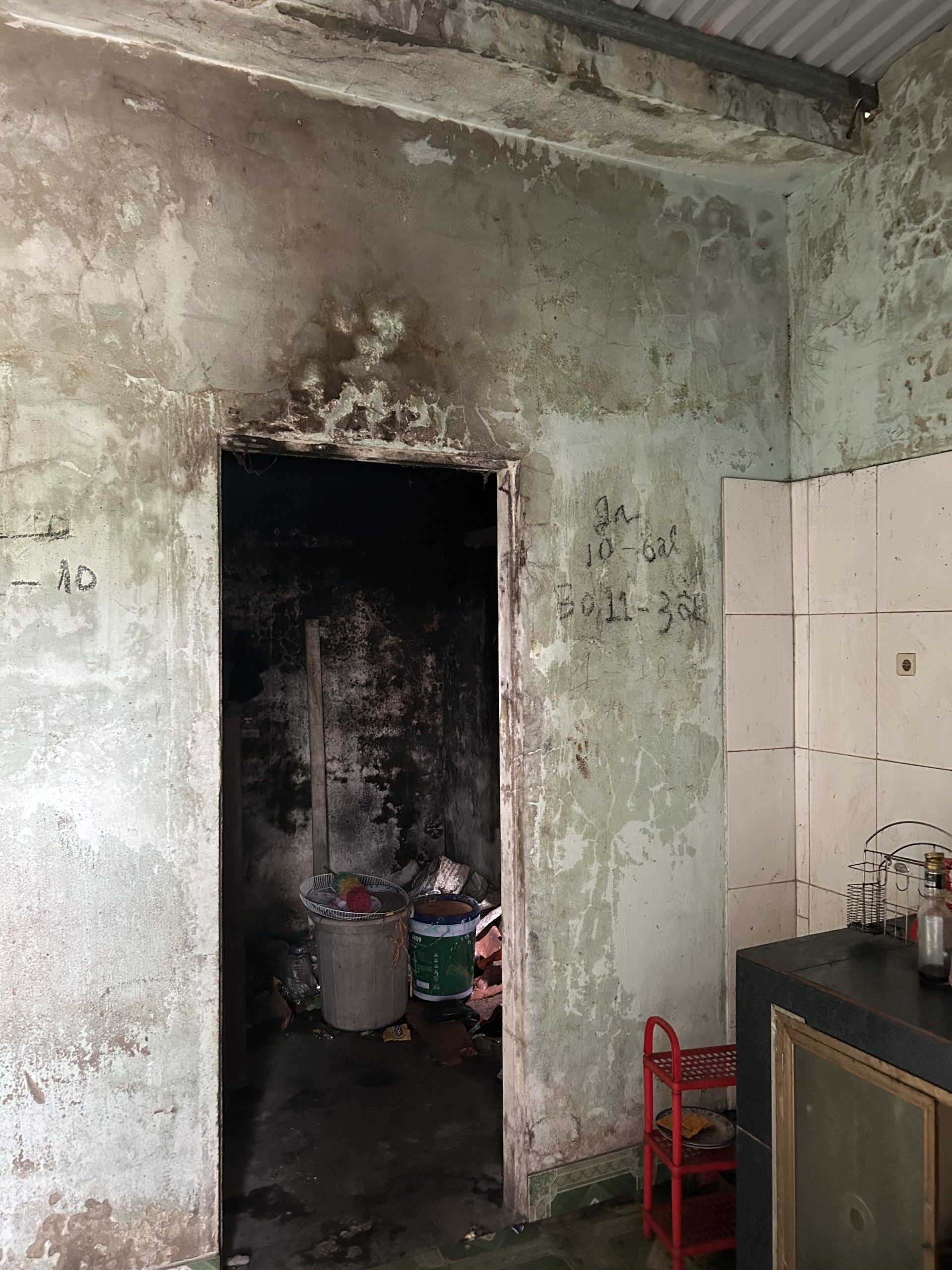

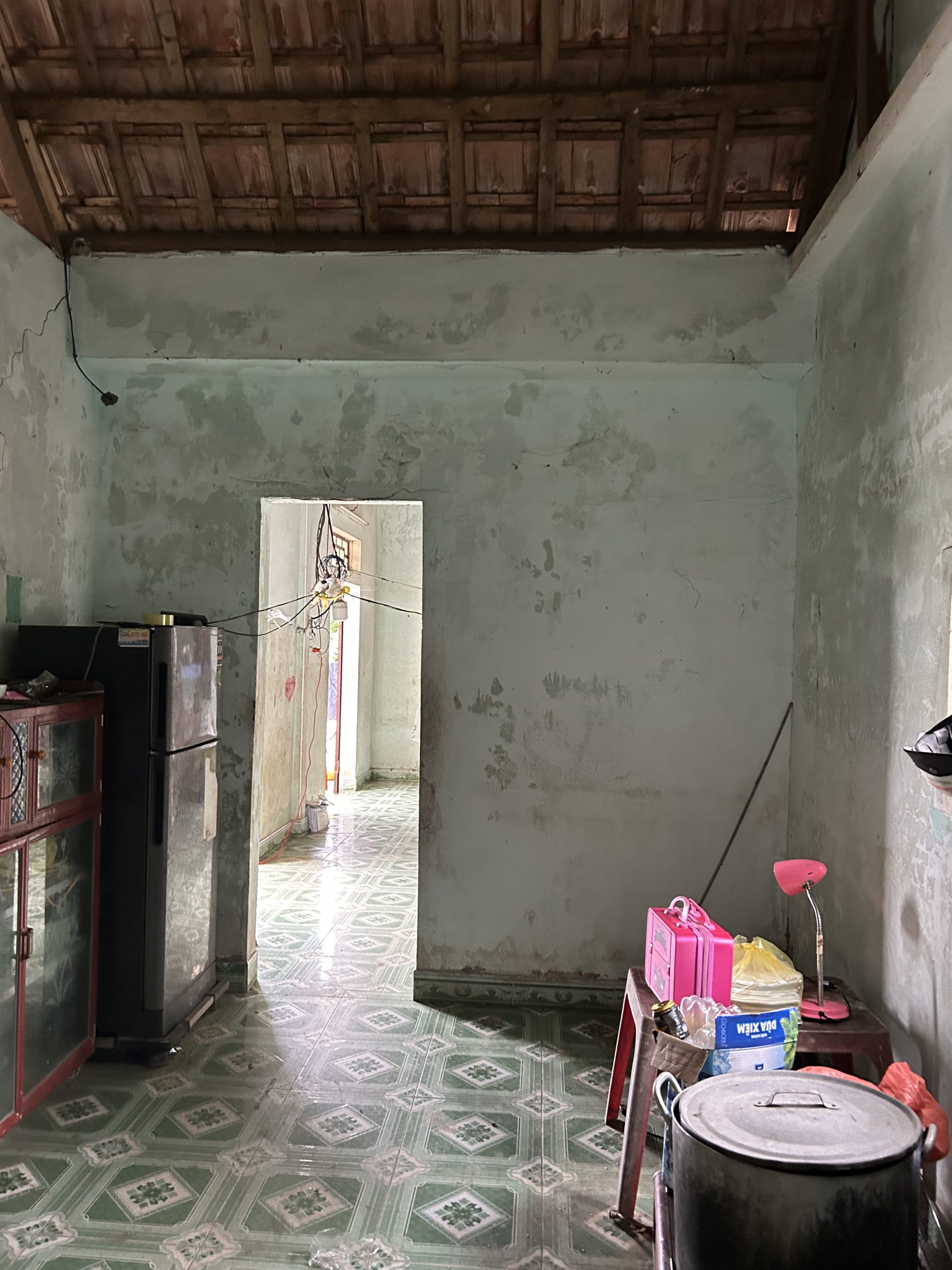
(in those pictures you can see the kitchen)
For her, this is not only a question of comfort. During storms, leaving the house can itself become difficult because Binh may refuse to go to a shelter at night. Her disability and changes in mood can make it very difficult for Luyên to convince her to leave.
So the condition of the house becomes another source of anxiety. If the house were safer, Luyên would have one less thing to worry about when bad weather comes.
Luyên’s main concern: Who will take care of Binh when I no longer can?
As the conversation went on, one thing became increasingly clear: Luyên’s biggest burden is not only what she has to manage today, but what she cannot predict about tomorrow. She worries constantly about what will happen to Binh if her own health deteriorates. There is no clear plan.
She does not know whether a residential centre would be able to take Binh in, whether anyone could afford the cost, or whether Binh’s behaviour and difficulty communicating would make long-term care elsewhere possible.
The uncertainty seems to follow Luyên everywhere. It is there when she turns down work because she no longer feels strong enough. And it is there at night, when she struggles to sleep.
When I asked her where she found the strength to continue, Luyên began to cry. She said that her strength comes from her children. She lives for them, works for them and gets up every morning for them. But she also admitted that there are moments when she feels overwhelmed and wants to give up.
What seemed to affect her most was not one immediate crisis, but the fact that she cannot see what comes next.
Before leaving, I asked whether there was one message she wanted me to carry from her home.
She said that she wanted people to understand her distress and her fear of the future. Luyên has spent decades adapting to difficult circumstances, finding work where she can, caring for Binh and making decisions day by day. But some questions cannot be solved simply by working harder or enduring a little longer. For now, she can still be there for Binh. What frightens her is not knowing what will happen when one day she cannot.
This is where the support of donors can make a lasting difference.
Their help can provide Luyên with practical assistance now, including food, medical care, household essentials and support with daily living costs. It can also help create a more secure future for Binh through access to specialist care, appropriate accommodation and long-term support.
With sustained support, Luyên can have more time to care for Binh, fewer impossible choices between work and family, and greater confidence that Binh will be looked after if her own health fails.
For Luyên, this is not simply financial assistance. It is a lifeline for her family and a step towards the security she has been unable to plan for on her own.
Posted By Clothilde Soenen
Posted Sep 7th, 2026