
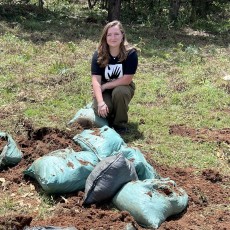
“The pilots would fly very low and then drop hundreds of bombies in cases, arbitrarily, before landing back in Thailand.” In this field in Northern Laos, a demining expert explained to me just one reason her teams were still finding hundreds of unexploded ordnance centimeters beneath the soil of this family’s farm.
This particular arbitrary offloading of bombs played only a small role in the much larger contamination of this country, but triggered in my memory as one of the devastating secret side effects of war “logistics”.
From 1964 and 1973, the United States dropped over two million tons of ordnance on the country of Laos, conferring onto it the title of the most bombed country per capita, in histo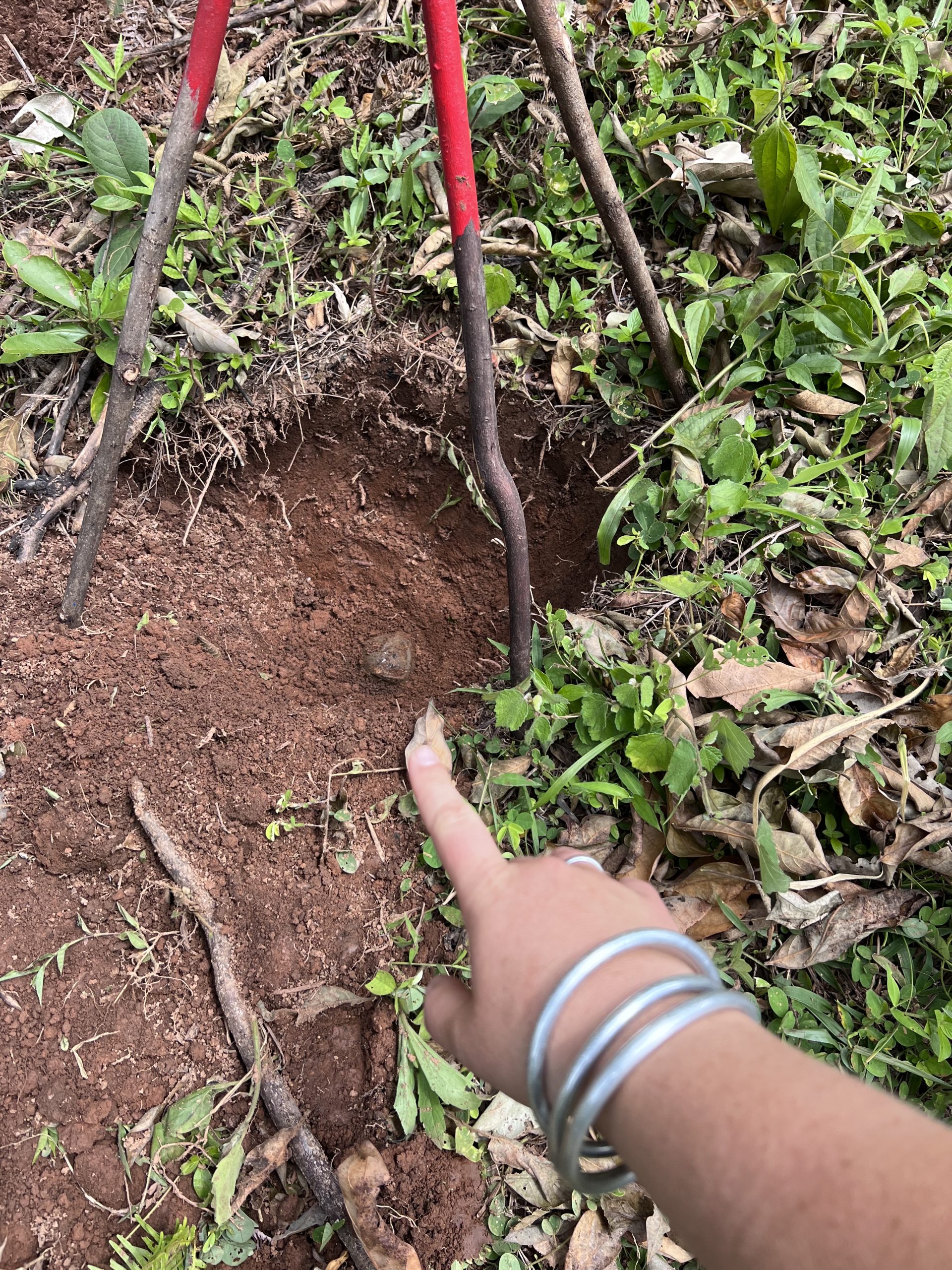 ry. These numbers are impossible to fathom — this is a planeload of bombs dropped every eight minutes, 24 hours a day, for nine years straight. These campaigns, initially authorized by the CIA to target North Vietnamese trading routes, were kept classified for decades; today, most Americans still do not know of the US’s involvement in Laos during the “Vietnam War”.
Survivors of this war have stories of hiding in caves for years, building entire school systems and hospital networks, offices, homes in these dark subterranean bunkers. They can tell you of villages entirely razed by bombs, civilians targeted and killed. Those who needed to farm the land did so by the light of the moon, in hopes that they would not be spotted and killed or injured from explosives. Some carried their families across rivers, leaving behind homes and risking a swim to safety. Refugees at the time drew images of this Secret War; sketches of mothers and monks bleeding out and losing limbs, fields and homes and livestock, livelihoods, under fire.

The true devastation of this war: it has never ended. Even after the bombing campaigns concluded in 1973, millions of explosive remnants remained scattered around the country. Since the war officially ended, unexploded ordnance have killed over 20,000 people and injured 30,000 more; in all of Southeast Asia, casualty numbers from these unexploded bombs continue to grow over 200,000.
That brings me back to the cruel “logistics” of war; over 30% of cluster munitions dropped in Laos failed to detonate. The atrocity of this Secret War is that it still threatens lives and livelihoods, over 50 years since the last bomb was dropped.
Cluster bombs are large casings carrying hundreds of submunitions (“bombies”). Those used in Laos were designed to open mid-air and release the bombies, scattering explosives and shrapnel over areas as large as five football fields. The 2008 Convention on Cluster Munitions bans the use, stockpiling, transfer, and production of these weapons; over 120 countries have signed this international treaty into law.
Over 270 million of these cluster munitions were dropped on Laos during the Secret War; today, just 10% of land in Laos has been cleared of the explosive remnants of these bombs. There are millions left buried just below the soil. Each day, civilians face the risk of striking a bombie with a shovel, of accidentally burning one in a cooking fire, of a child finding a bombie, the size of a tennis ball, and mistaking it for a toy.
These unexploded ordnance lock land from the safe use of heavy machinery, making industrial farming, construction, and development very risky and very expensive to complete safely, as each requires extensive land clearance from demining teams. Every civilian who loses sight, or a limb, or their lives, to these lingering lethal threats is another casualty of a war which officially ended five decades ago, before most of today’s victims were born.
The legacy of the American Secret War in Laos is alive in communities still facing threats from the since-banned deadly weapons of that war. But this legacy also lives in the incredible work of those who fight every day to end the threats of this war. Demining teams, from various international NGOs, or part of the Lao military, scour the land for these threats every day, clearing land and restoring it to safe use for communities.

Diaspora communities, like that at Legacies of War, lead advocacy to fund demining, risk education efforts, and victims assistance projects. And the international community continues to work to ensure these weapons with decades-long legacies are not used in future conflicts; the Convention on Cluster Munitions will return to Laos this week for the Third Review Conference, and international delegates will work to expand the implementation of this convention globally.
There is hope that future generations will no longer face threats of these inhumane and devastating weapons. This blog is dedicated to exploring the work of those fostering this hope – the advocates, deminers, educators, and policymakers fighting for a world free of cluster munitions. I’ll introduce myself in subsequent posts and invite you to follow me into the spaces these heroes are working – I’ll be in Laos very soon, and will have photos and stories and many tidbits of hope to share from the stunning country that is reclaiming its land and legacy.
Posted By Kendall Silwonuk
Posted Sep 13th, 2026
2 Comments
Iain Guest
September 14, 2026
Wonderful, poignant and brilliantly written introduction to this extremely tough issue, Kendall. I particularly like the fact that it’s not all bleak – and that you recognize the critical role of Laotian families, brave de-mining NGOs, and the Laotian diaspora in combating this insidious threat. I really look forward to reading the next chapter in this story!
Bobbi Fitzsimmons
September 19, 2026
Kendall, your blog alone will serve as an education for many. Having grown up in the era of the Vietnam war, many began to realize that we were not hearing the whole story. Having visited Cambodia and Vietnam as an adult, and been confronted by the devastation and lingering effects, I support your efforts to unlock this information for new generations. It truly isn’t over for many.