

In August 2024, Nepal passed a new Investigation of Enforced Disappeared Persons, Truth and Reconciliation (Third Amendment) Act (TRC Act), marking what seemed at first glance like a significant step forward in addressing the crimes committed during the country’s 1996–2006 armed conflict.
Indeed, the Act introduces several improvements that appear aligned with international human rights standards: the establishment of a Special Court to handle human rights violations (s 33); the recognition of reparations as a victim’s right at both individual and community levels (s 23); the prioritization of victims of rape, sexual violence, and torture (s 23(3)); the requirement that any mediation between perpetrators and victims/survivors must obtain the latter’s consent (s 25); and the creation of a Transitional Justice (TJ) basket fund (s 35).
These are important developments, especially in light of Nepal’s troubled history of impunity. Yet, beneath these apparent gains lie serious legal and political flaws that threaten to undermine the spirit of justice the law claims to uphold.
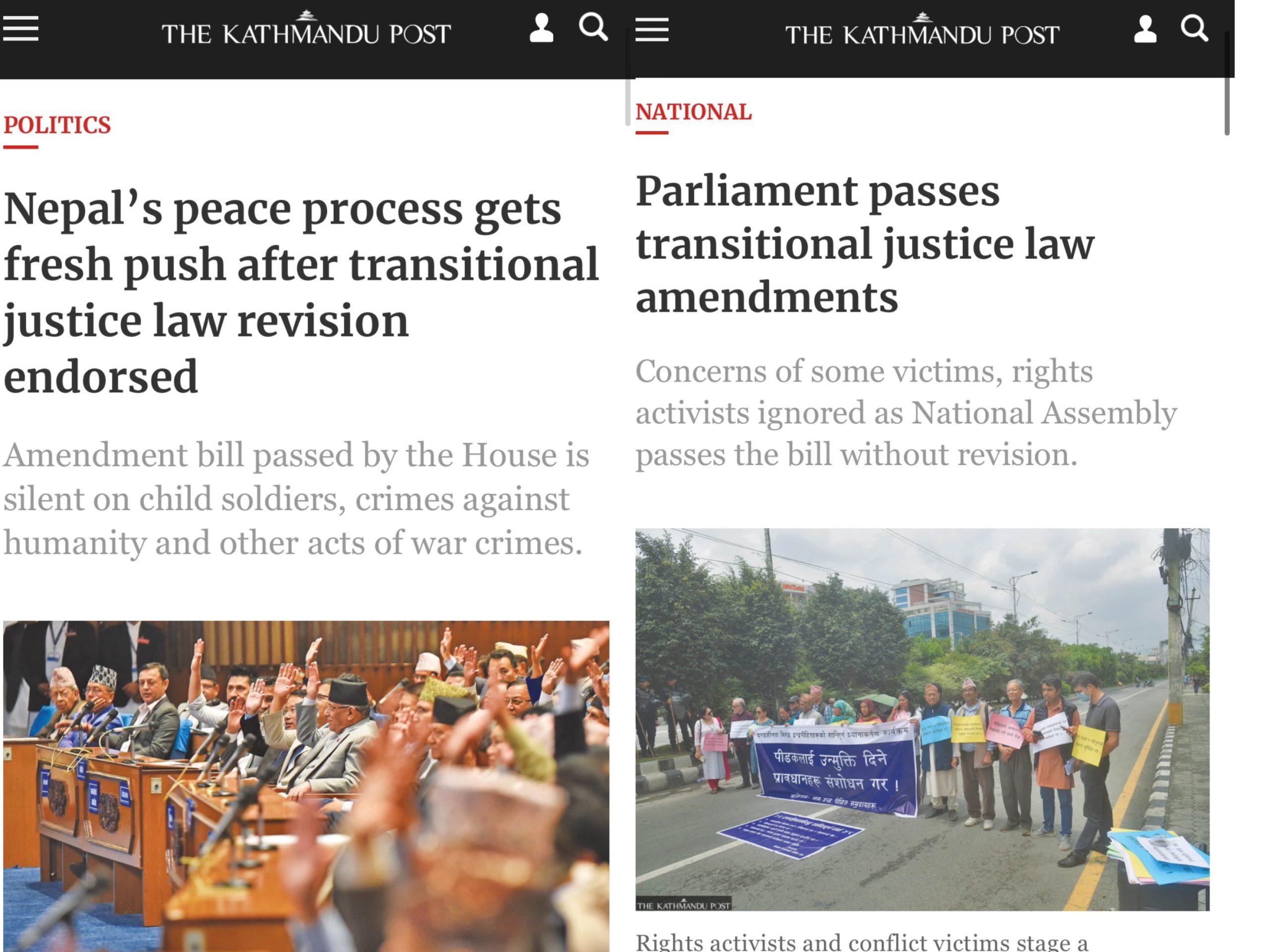
Two Kathmandu Post reports capture the tension at the heart of Nepal’s new transitional justice law—one framing it as a long-overdue reset, the other exposing how it still falls short of victims’ needs.
Substantive Concerns: A Step Forward, Two Steps Back
The 2015 ruling of the Supreme Court of Nepal (Suman Adhikari v Government of Nepal) declared several provisions of the original 2014 TRC Act unconstitutional, especially those that allowed for broad amnesties without victim consent. The Court made it clear that no amnesty should be granted for grave human rights violations such as torture, enforced disappearance, and rape without the explicit, informed consent of victims. The Court ordered the government to amend the law accordingly.
Rather than implementing this ruling, the government sought to have it reviewed—a request the Court ultimately rejected. While the new TRC Act of 2024 seemingly addresses the Court’s demands by abolishing blanket amnesty provisions, it introduces new mechanisms that may lead to similar outcomes under a different label.
Under the revised law, human rights violations are divided into two categories:
(1) Serious human rights violations (Section 2(j1)) include: rape and other forms of serious sexual violence; intentional or arbitrary killings; enforced disappearances; and cruel or inhuman torture—particularly if planned and directed at unarmed individuals or communities.
(2) Human rights violations (Section 2(j)) include: abductions, assaults, maiming, arson, looting, property damage, and forced displacement—deemed lesser or spontaneous acts.
Only the former are explicitly excluded from amnesty and must be referred to the Special Court. However, for the latter category, conditional amnesty remains possible if the perpetrator admits guilt, apologizes, and pledges non-repetition (s 26).
But here lies the first serious flaw: this classification is not legally sound. There is no clear foundation in international law or legal doctrine to justify this method of categorization—it appears more a political compromise than a principled legal framework, and it comes across as arbitrary. Many of the so-called “lesser” violations could, under international law, constitute war crimes or crimes against humanity.
Furthermore, by limiting the definition of “serious” violations to only planned acts against unarmed individuals, the law creates dangerous loopholes that risk enabling impunity for a broad range of abuses. This narrow framing excludes spontaneous or opportunistic violence, as well as acts committed against combatants or individuals perceived to be associated with the opposing side—many of which could still amount to gross human rights violations under international standards. As a result, serious crimes may be reclassified as “lesser” simply because they were not premeditated or did not target civilians in a particular way, thereby allowing perpetrators to evade meaningful accountability through conditional amnesty or reduced sentencing.
The most striking flaw is the 75% Sentence Reduction Loophole. Even more troubling is the provision allowing the Attorney General or public prosecutor to request up to a 75% reduction in sentencing for perpetrators of serious violations—except in cases of rape or serious sexual violence (s 27(2)). While technically not an amnesty, this leniency weakens the impact of criminal accountability.
Take the example of enforced disappearance: although it cannot be amnestied and must go to the Special Court, the perpetrator may still walk away with only 25% of the full sentence. This is de facto amnesty, even if it is not labeled as such. International law prohibits both de jure and de facto amnesties for gross human rights violations.
This introduces a near-contradiction within the law. On one hand, it appears to respect the Supreme Court’s prohibition of amnesty for serious crimes. On the other hand, it permits sentence reduction for all but one subset of those crimes. As a result, almost all conflict-related crimes may fall under one of two categories: those eligible for conditional amnesty, and those eligible for substantial sentence reductions.
Another important issue is the role of victim consent. While the law makes amnesty contingent upon such consent—a notable improvement over the 2014 version and seemingly in line with the Supreme Court’s 2015 ruling—it fails to clarify what happens if victims withhold consent or if all the required conditions are not met. This lack of legal clarity opens the door to arbitrary interpretation and inconsistent implementation, ultimately weakening the protection of victims’ rights.
Procedural Challenges and Implementation Gaps
Procedurally, the Act lays out a comprehensive mechanism:
(1) The TRC and CIEDP are to receive and investigate complaints (ss 6 and 7);
(2) Cases involving serious violations are referred to the Attorney General (s 30);
(3) A three-member Special Court under the Supreme Court is to try these cases (s 33);
(4) An appeals bench within the Supreme Court will hear appeals (s 34).
However, as of June 2025, implementation has stalled. The Special Court has been established, but the appointment of commissioners to the TRC and CIEDP remains contentious. Victim groups have criticized the selection process as political, opaque, and non-consultative, in violation of the Act’s own provisions requiring public input on nominations (s 10(5)).
Moreover, the commissions have broad discretion in facilitating mediation in cases of lesser violations. While victim consent is formally required, the Act does not clarify what happens if consent is withheld, nor does it specify the standards necessary to ensure that such consent is genuinely free and informed (s 25).
Persistent concerns also remain. Even if the Special Court and the appeals bench become fully operational, the anticipated volume of cases raises serious doubts about the system’s capacity to process them efficiently. Given Nepal’s longstanding history of weak implementation of Supreme Court decisions, there is a well-founded concern that similar challenges will undermine the effectiveness of this new judicial structure.
Conclusion: A Fragile Framework in Need of Vigilance
Nepal’s new TRC Act introduces several promising reforms, but it also perpetuates problematic legacies of compromise and leniency. The distinction between “serious” and “lesser” violations lacks a solid legal foundation, while the provision allowing a 75% reduction in sentences risks undermining accountability for even the gravest crimes. Ongoing procedural uncertainties and the absence of meaningful victim participation in implementation decisions further exacerbate these concerns.
Views on the new transitional justice law vary. While some acknowledge its incremental progress, many—especially victims and survivors—remain deeply critical. As this blog has reflected, despite certain advances, serious flaws persist. These are compounded by the government’s longstanding pattern of flawed and stalled implementation. For victims and survivors, the law still falls far short of delivering justice.
Yet one consensus remains clear: without robust oversight, genuine political will, and the full inclusion of victims and survivors, Nepal’s transitional justice process risks repeating past failures—only this time under a different name.
Posted By Shuyuan Zhang
Posted Jun 27th, 2025
5 Comments
Maddy Pound
June 30, 2025
After studying the English Law for 3 years, I find it so interesting to learn how other jurisdictions operate – both the good and the bad. Thank you so much for sharing this interesting insight into Nepal, Shuyuan.
Aaron Bailey
July 3, 2025
I had to look it up, but it turns out Nepal is NOT a member of the ICC, along with such governments such as Israel, Russia and North Korea (along with the US and China). Regimes that have a predilection of sweeping aside past atrocities. I think it’s important to highlight these omissions, as you have done, and its awesome that you are able to assist with this grassroots justice and accountability project.
Aaron Bailey
July 3, 2025
This is a thoughtful and sobering analysis. What stands out most is the law’s ability to present the appearance of progress—while embedding mechanisms that risk reproducing the very impunity it claims to dismantle. The reclassification of violations, for example, reflects a deeper tension between political expediency and legal accountability. Historically, perpetrators have often gotten away without justice. It’s amazing that you get to be part of this grassroots accountability project.
Iain Guest
July 3, 2025
I am totally impressed by your grasp of the legal issues, Shuyuan. You are right about a) the distinction between “serious” and “other” human rights abuses has no basis in international law b) that the 75% reduction in sentences for 3 of the 4 “serious” categories represents a major compromise. (Note, however, that there is NO such concession made when it comes to rape, which is what you wrote about in your last blog.) and c) on the politicization of the implementation process (the 2 commissions) On these 3 issues you find yourself in TOTAL agreement with the international human rights advocates. But you are not working with them – you are working with survivors (who arguably have MORE credibility when it comes to these matters!) Can I suggest that you need to suspend the absolutist approach of an international lawyer and put on the hat of a survivor? What do they feel? Are they ready to accept the compromises in the new TRC bill and if so are you OK with that?? Remember the saying “perfect is the enemy of the good.” Welcome your thoughts….!
» Justice on Nepali Time: Field Notes from My Summer with NEFAD | The Advocacy Project
August 3, 2025
[…] As I write this, over 300 victims are preparing a joint writ to challenge both the appointments and troubling provisions in the new Transitional Justice Act. The Act, passed in August 2023, bans blanket amnesty but still allows up to 75% sentence reductions for grave crimes—a bitter pill for those seeking accountability. (I wrote more about this in another blog post.) […]