

It takes two weeks of paperwork for AEPD’s visit to Mai Thi Loi to be approved. My passport has been stamped, signed, notarized in a fluorescent-lit office and handed from desk to desk. The road into the commune is two and a half hours of driving through thick green hills. By the time we arrive, the afternoon light is soft, hazy.
We meet Loi outside her house, a small structure perched at the top of a hill with a patched metal roof and sturdy concrete walls. Loi takes us inside, and we gather around a low table. Mai makes the introductions, and I take a seat beside Loi. Two of her sons, Hung and Cuong, are nearby, both sitting on two beds near the back of the room. Their eldest brother, Kien, is not here.
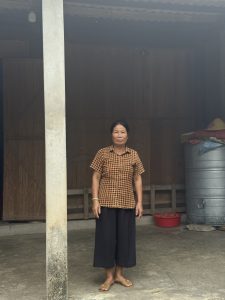
Mai Thi Loi
Loi’s husband, Nguyen Van Tri, served in the army between 1972 and 1976 and was certified as an Agent Orange victim before he died in 1989. No one knows how or when he was exposed, only that when he came home, he was already ill with symptoms of Agent Orange poisoning. Loi’s five children were born as second-generation victims of Agent Orange. Her two older daughters have mild intellectual disabilities and are married with families of their own. Her three sons have severe physical and intellectual disabilities, along with chronic health issues and severe mental illness. All three have recurring violent episodes, especially the eldest Kien, who has been chained since adolescence due to his extremely violent outbursts. Loi, now sixty-six, is unable to manage the violence.
Her voice thins when she begins to speak of Kien. She covers her face with both hands, tears sliding between her fingers and pooling in her palms. “He is usually chained and naked,” Mai translates softly. “He tears his clothes off when she tries to dress him.” Loi’s shoulders shake as she cries, her whole body folding in on itself as though trying to swallow the emotions. Lưu leans forward and rests a hand on Loi’s back. We all sit with her like this for a while.
Care, for Loi, is not abstract but daily and embodied. It is the rhythm of waking early, of scrubbing six sets of clothes by hand, of feeding her three sons one after the other. It is traveling thirty-seven kilometers to the city hospital each month for health checkups. Even though her sons can be violent, Loi refuses to send them to the Agent Orange social center in the city. When she asked what they wanted, they told her they wished to stay with their mother. She cannot bring herself to separate from them. The center is far away, and she worries she could not afford the trips to visit. Mai explains that Loi feels a deep responsibility to care for all her children herself, especially those with the most severe conditions like Kien. As Loi speaks, tears stream down her face once again. “After I pass,” she says between breaths, “then the social center can take them.”
Iain, AP’s director, has said that families like Loi’s are why the Agent Orange Livelihood Sponsorship program exists at all; why AEPD continues to return, year after year. Loi was one of the first beneficiaries of the program. In 2016, AP and AEPD raised $1,200 to provide her with a breeding buffalo, meant to generate steady income. The buffalo became a significant source of income. She even shared it with a neighbor to earn a little more, until it died from illness. Now that Loi is older and weaker, she can no longer raise a buffalo or tend the fields. And yet, Loi tells us again and again that the sponsorship mattered. It has kept her children fed and medicated, greatly improving the mental health of her two younger sons. This has given her a measure of hope.
Before we leave, we ask to take a photo of the family together. By the time we step back outside, the light has shifted. Somewhere down the hill, a motorbike sputters awake. I follow Mai and Lưu back down the slope, and the house becomes smaller behind us until it disappears into the trees.

From left to right: Hung, Cuong, and Loi. (This visit has fewer photos, as much of the conversation was deeply emotional. We chose to set the camera aside and simply listen.)
It would be tempting to imagine a clean solution, one that would ‘fix’ the damage wrought by the U.S. war in Vietnam. But Agent Orange’s legacy is not a problem to be solved once and for all with a single aid package. Victims of Agent Orange and their caregivers continue to live with the lifelong, intergenerational, and environmental effects of the war. Long-term reparations matter; yet this year, the U.S. government withdrew all funding for Agent Orange relief and support for war legacies in Vietnam. This withdrawal ripples through the lives of countless Agent Orange-affected families, already stretched thin, leaving them to shoulder the costs of a war they did not choose, did not wage, and in many cases were not even alive to witness.
Posted By Angie Zheng
Posted Sep 6th, 2025
1 Comment
» Agent Orange Revisited – Meeting Mai Thi Loi | The Advocacy Project
January 25, 2026
[…] 2025 volunteer, Angie Zheng, visited Mrs Loi last summer and found that her second son Cuong was taking medication and was […]