

17 July; Kailali District
After a long and bumpy drive and walk across the Chisapani bridge, we meet Prem Bayak near an assortment of fruit and vegetable stands. We introduce ourselves and then sit under a covering with Niraj, letting Ram and Prem catch up on their own. A woman hands me a piece of cardboard to use as a fan. I happily accept and Shuyuan, Laila, and I spend the next ten minutes and the subsequent car ride passing it around in an attempt to slow the sweat dripping down the sides of our faces and neck.
A short drive later, we all arrive together at a bubblegum pink building occupying the end of a short alley. There’s a small ramp and we let Prem enter first. He uses a walker, and each step is accomplished by throwing the walker in front and then pulling his body forward. Throw, pull; throw, pull. We trail behind. He’s a large man with hands that could easily palm a basketball and strong arms and shoulders, which we learn from Ram are not just from this throw and pull method, but the result of daily morning arm workouts. It’s clear he’s the kind of person that could command an army.
We’re led through an open doorway into a narrow room with walls just as pink as the outside of the building and orange trim. The opposite side of the room is open to the outside. With just two main walls, it feels as though we are in a hallway, a place of passage from inside to out. But we stay. Setting bags in the corner, we all take a seat in one of the plastic blue chairs set around a long green table hosting the Tuborg beer slogan “Tilt Your World.” A small ceiling fan hangs over head, fighting the heat.
After some small talk, we ask Prem about his time as a commander of the People’s Liberation Army. “I escaped death twice,” he begins, looking us in the eye as he talks, his voice containing the kind of passion of those storytellers that are good because they have lived. We learn that he has six or seven bullets in his head and one in his spine. It’s the singular bullet in his spine that left him partially paralyzed.
He quickly moves from his own story to those of ex-combatants in general, many of whom continue to live out the impacts of the conflict in their daily lives through various physical and mental health problems. The government has done little to help. “The warriors that fought to change the whole system are not being addressed; they are suffering,” Prem tells us.
After the signing of the Comprehensive Peace Agreement, the PLA was dissolved. While combatants could be integrated into the national army, many were discharged, deemed ineligible due to injuries, disability, or lack of formal education. Some received small payments to assist with reintegration and livelihood (University of Notre Dame Kroc Institute). However, according to a participatory research project that Prem was involved in, stigma, insufficient livelihood support, and alienation continue to create challenges to their social, economic, and political integration.
Post-conflict, Prem has become a strong advocate for access to care, justice, and dignity for ex-combatants. He also remains an ardent fighter for the social change and equality the revolution sought to realize. “Though my physical situation is very difficult,” he motions to his legs, “I was in the revolution, so my willpower is strong.”
It always has been, and remains, a fight for justice and equality. Before the revolution, Prem tells us, “Society was full of systemic injustice and dominance. Feudal landlords ruled. Poor farmers couldn’t seek justice. Atrocities were high. Society was seeking change.” People began to raise their voices but were suppressed. The Communist Party of Nepal issued a 40 point demand including an end to feudalism, political reform, economic development, and social justice. When this went unheeded, Prem explains, “we were forced to start an armed revolution.” He reminds us, speaking about the past, but resonating with the present, “this is our right when there is suffering from injustice and suppression.”
He continues on, telling us about being underground, speaking with families at night to gain their trust, the atrocities of the state which began to turn support towards the Maoists, and the many battles fought in a range of localities, different topographies, at night, in the morning. And at the end of what seemed like an epic saga, he came back to his original sentiment. “We never wanted the war, it was all for change. Peace is sometimes not enough, you need justice.”
Yet, this change has not been fully realized. “Top political leaders are still only focused on power; the system has changed, but not the situation,” Prem tells us. “Though people have a voice, their livelihood, their economic situation, has not improved.” He continues, “conflict victims have not gotten justice.” Looking over to Ram as if to acknowledge his role in the movement, he begins discussing the politicization of the victims’ agenda, failure at both the local and federal level to address victims’ needs, demand for medical care because of injuries incurred during the conflict, and the exclusion of victims and survivors from what has become a stalled transitional justice process. “Until the state takes responsibility, it will always be difficult for victims and the poor. The social struggle continues,” he concludes.
While no longer fought with a gun, the war for Prem is far from over. “We dream of an equitable society,” he tells us. He speaks with a kind of urgency that is almost peculiar for a man that has gone through what he has. Where you’d expect the resolve to have worn thin, there is a kind of youthfulness, a passion typically seen in those who are just starting out, fresh with hope not yet pounded flat by the difficult road ahead. Yet, he sits across from me in this bubblegum pink hallway-like-room and says, “It is possible.”
He leans back into his chair as plates of fried fish fresh from the river are brought in. The mood shifts, the seriousness of our conversation lifted by the arrival of food. But as the group begins to indulge, the crunch of fried batter, smacking of lips, licking of fingers filling the space, I can’t help but feel Prem’s earlier words lingering. “Peace is not enough.”
Spoken as much about the past as the future, his words seem to have touched on some cord pulled through human history. For those who do not live in abstracts, as long as there is suffering and oppression, peace is not enough. And in Nepal today, where arms have been shelved for over a decade, it remains insufficient.
As I continue to reflect on the meaning of his words for the current world, where the promotion of peace and harmony seem to have become a tool for suppressing fights for justice, Prem offers us some final thoughts.
“We are human — Nepali, American — life or death is nature. What matters is what you do in between and the image you leave behind. If human beings don’t help one another, there is no point in being human. Everything can be saved, because everything is mutual.”
Within the timescales of our lives, our meeting with Prem is fleeting. As with most things, we are passing through — his a brief break from a busy life of advocacy and ours a stop in a chain of interviews and travel. Yet, within that passage was the most fruitful exchange; our interconnectedness, our mutuality clear.
Prem must have sensed the same awareness I was feeling of the significance of our meeting in this hallway-made-room because he ended with the reflection, “I haven’t been to America or China, but my voice will reach there through you. We are from different cultures, but we sit at the same table.”
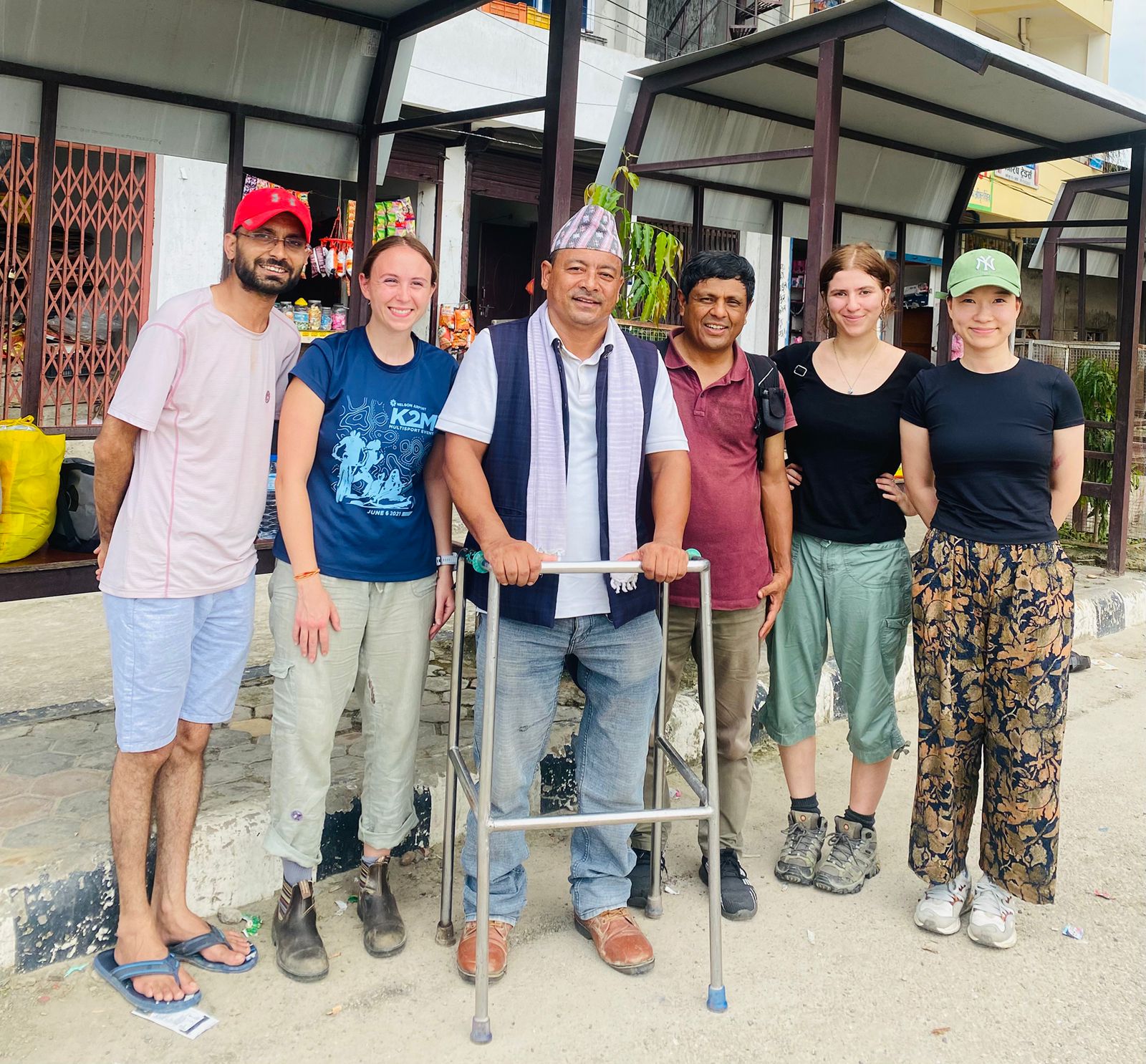
Our group with Prem Bayak (middle)
Posted By Emma Cohen
Posted Aug 4th, 2025
3 Comments
Shuyuan Zhang
August 4, 2025
This is so so beautifully written, Emma!
Iain Guest
August 5, 2025
“The war is far from over….” I can certainly understand this after reading this powerful blog, Emma. Prem Bayak is obviously strong in every sense of the word and you help to show that, while adding the touches that I have come to expect and appreciate in your writing. I think we can also assume from the way you wrap up this profile, that you will continue to spread the word and share the stories of survivors like Prem to a larger audience. One way to do that, of course, is to set up the new center for visiting students and make sure that others are able to enjoy the same incredible experience that you have all enjoyed. Let’s make it happen! Great work….
» Seeds of Revolution | The Advocacy Project
October 1, 2025
[…] am reminded of our conversation with Prem. Some of these interactions were brief, our connection fleeting as we passed through each other’s […]