

As I get ready to leave Nepal, I have been reflecting on the work we’ve done this summer and all that I have learned. There is much to think about, but what I find myself continually coming back to are memories of all of the incredible people I have met. I couldn’t possibly capture them all, but want to take the opportunity in my last blog to share just a few moments that I will carry with me.
_____
We sat on the porch of the Thakurbaba Municipality Medical Center talking with three of the psychosocial counselors. One of the women, Laxmi Chaudhary held her three-month old son. His head was tilted back, eyes shut, chest rising and falling with the soft breaths of sleep. She rocked him slowly as she sat, tapping gently. As she rocked, she told us about her brother, Shiriram Tharu, who was abducted and killed by Maoists in 2002. He was 22 years old and had two children. Laxmi raised his children along with some of her other siblings. Now she works with the counseling center providing support to other conflict victims. She and the other counselors, also victims and survivors of the conflict, often go door to door to meet with people in their homes and listen to their stories. We talked for some time before the heat began to take a toll and they needed to return to work, but as we closed our notebooks and began to pack our things, Laxmi stopped us. “Thank you for speaking with us,” she said. “We are always the ones talking to others, listening to others, but mostly, we don’t have anyone to hear our story.”
_____
“Namaste,” I smile and clasp my hands together. I’m walking to Ram’s house and his neighbor, Sunder Oli, who runs a shop across the street has said hello to me. I’ve visited his place a few times with Ram to sit and sip tea and had the privilege of spending one afternoon listening to his story. “The world is a global village,” he had said at the end of our conversation, “the transformation of society is everyone’s responsibility.” Now he’s a familiar face at some of the events I attend with Ram and in the neighborhood. Our greeting this morning feels like an acknowledgement of the small connection we have made.
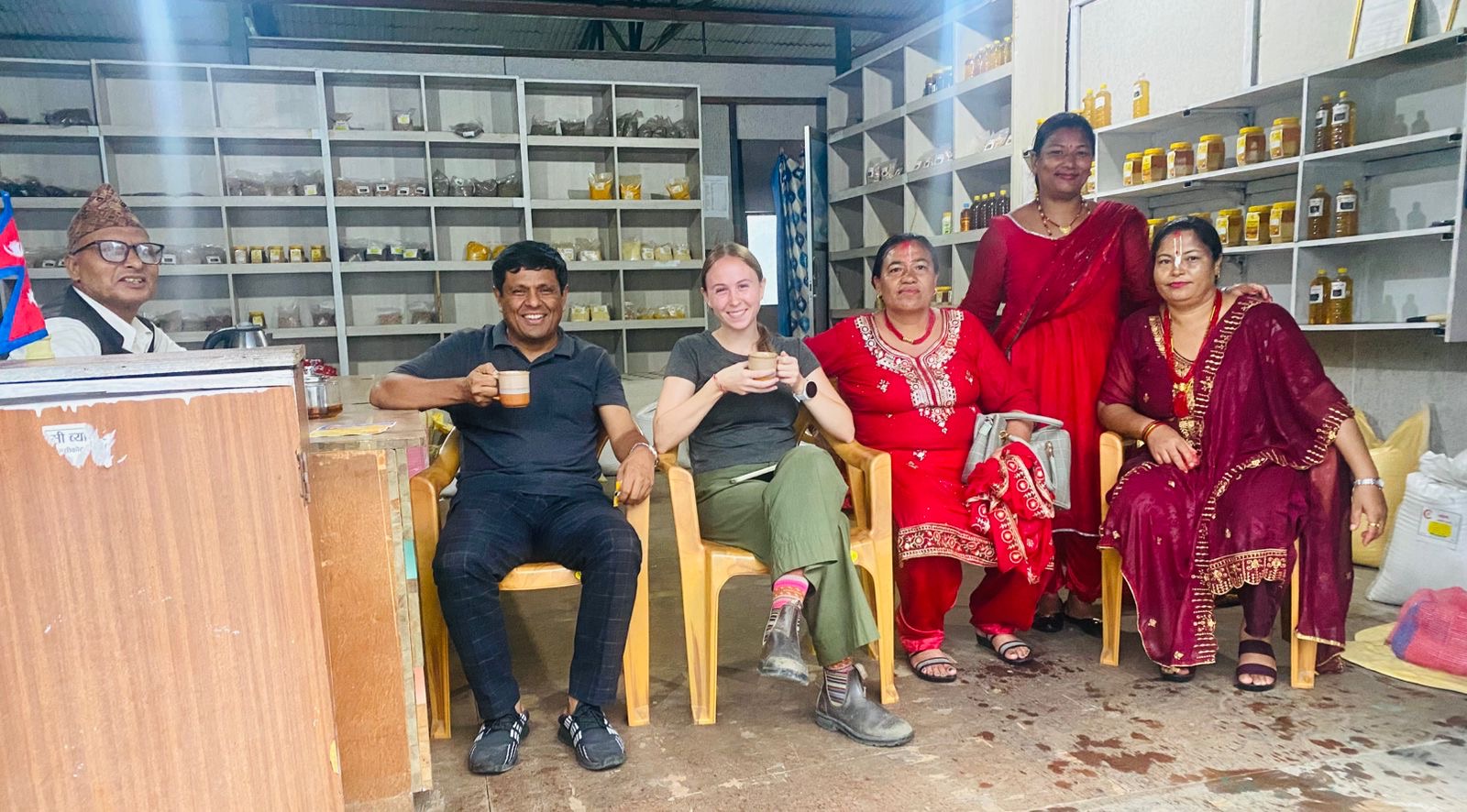
Ram and I drinking tea with Sunder (far left) along with some neighbors
_____
I joined the women sitting on the step. Giri, the owner of the Budhanilkantha guesthouse I was staying in, had invited me to celebrate Teej with his family. Dusk had arrived along with a slight breeze and the patio was lit with the warm glow of small overhead lights. The group of women, Giri’s daughters and some of their friends, took turns dancing and resting on the step. Their children were playing in the kitchen, which was open to the patio, and occasionally one would come out and join the dancing. I clapped along to the music as I sat, watching as others danced. Then a new song came on and Laxmi, Giri’s wife, grabbed my hands. Pulling me up, she brought me into the group and held my hands, guiding me to the music. We moved around in a circle, inwards and outwards, clapping and moving our hands and hips to the rhythm. I awkwardly did my best to keep up and couldn’t help but catch their joy, laughing as Laxmi spun me around and around.
_____
I sat across from Ram’s mother at the dinner table. There was small conversation, but with the language barrier there is very little she and I can say to one another. Our interactions typically consist instead of smiles, pointing, and head nods. She watched me eat and as I took a sip of water, she said “pani,” pointing to her glass. “Pani,” I repeated, pointing to mine. She nodded. “Chamal,” she pointed to the rice. I repeated. The other women at the table joined in, helping me learn. “Tarkari,” she held up a potato from the vegetable curry. “Tarkari,” I repeated, adding, “mitho!” She laughed, her face crinkling with delight.
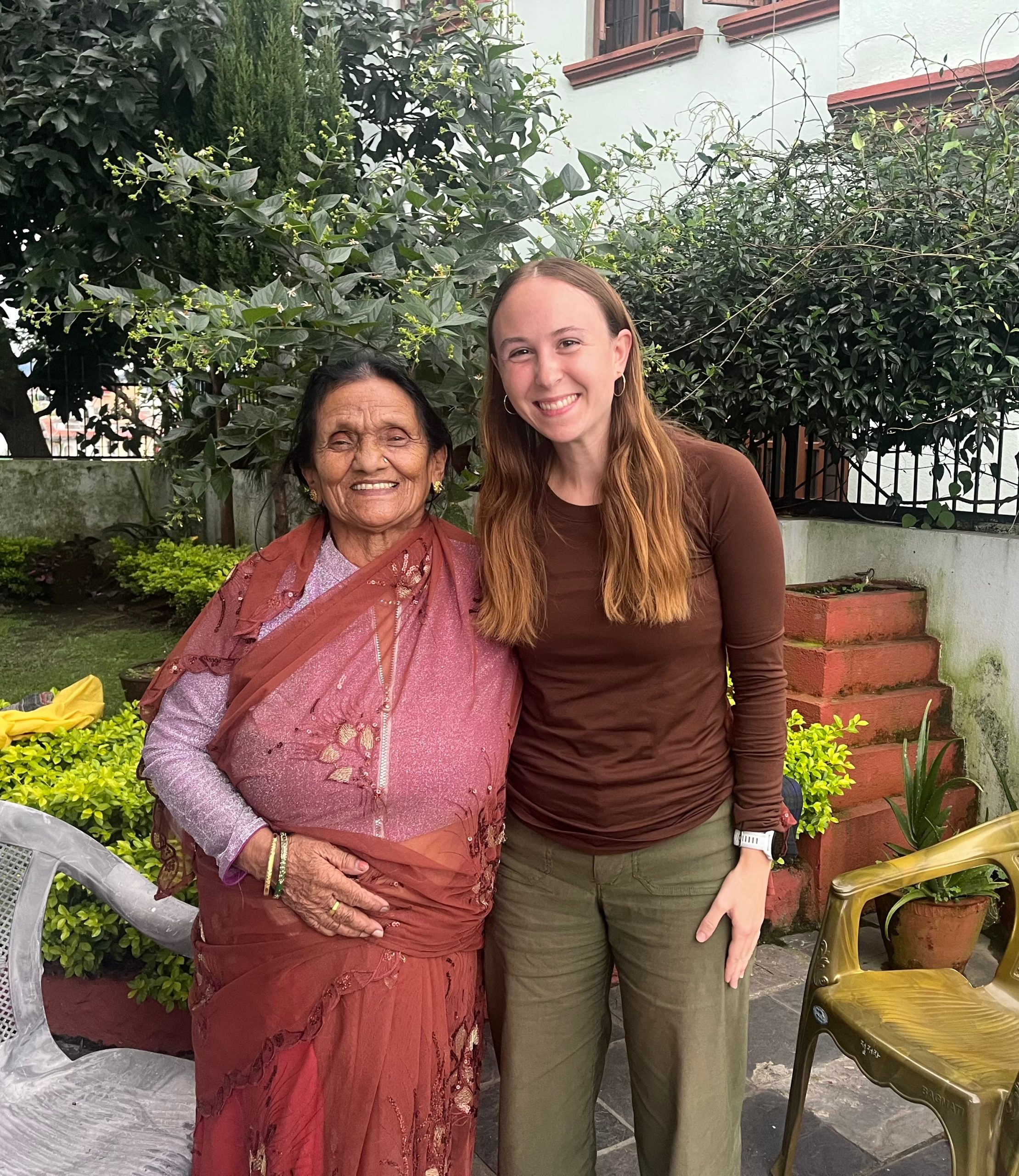
Ram’s mother, Laxmi Bhandari
_____
Isha grabbed my hand, pulling me up from the table where we had been playing cards. She found a rock and Bhawani marked four boxes in the pavement. Then I watched as they showed me how to play. On one foot Isha hopped in place and kicked the rock into the first box, then the second. She fell, giggling. It was Bhawani’s turn. “It can’t land on the line,” she explained. The air was crisp and our skin warm from the sun, the forest just in front of us alive with the chirps and chatter of birds. Isha’s mom and baby sister sat on a bench nearby. They had all come to forest camp, the first stop for Bhawani and me on our trek, to visit Isha’s father for Dashain. It was my turn. I got my balance on one foot, hopped a few times to orient myself and attempted to gently kick the rock. It flew out of bounds. Isha tumbled over in laughter, her little pigtails shaking as she giggled. We played again and again, taking turns. Bhawani was clearly a master and, to Isha’s delight, I slowly got better. Eventually we grew tired and sat on the ground for a game of jacks. Then, as the day faded and the air grew cooler, we moved inside for more cards.
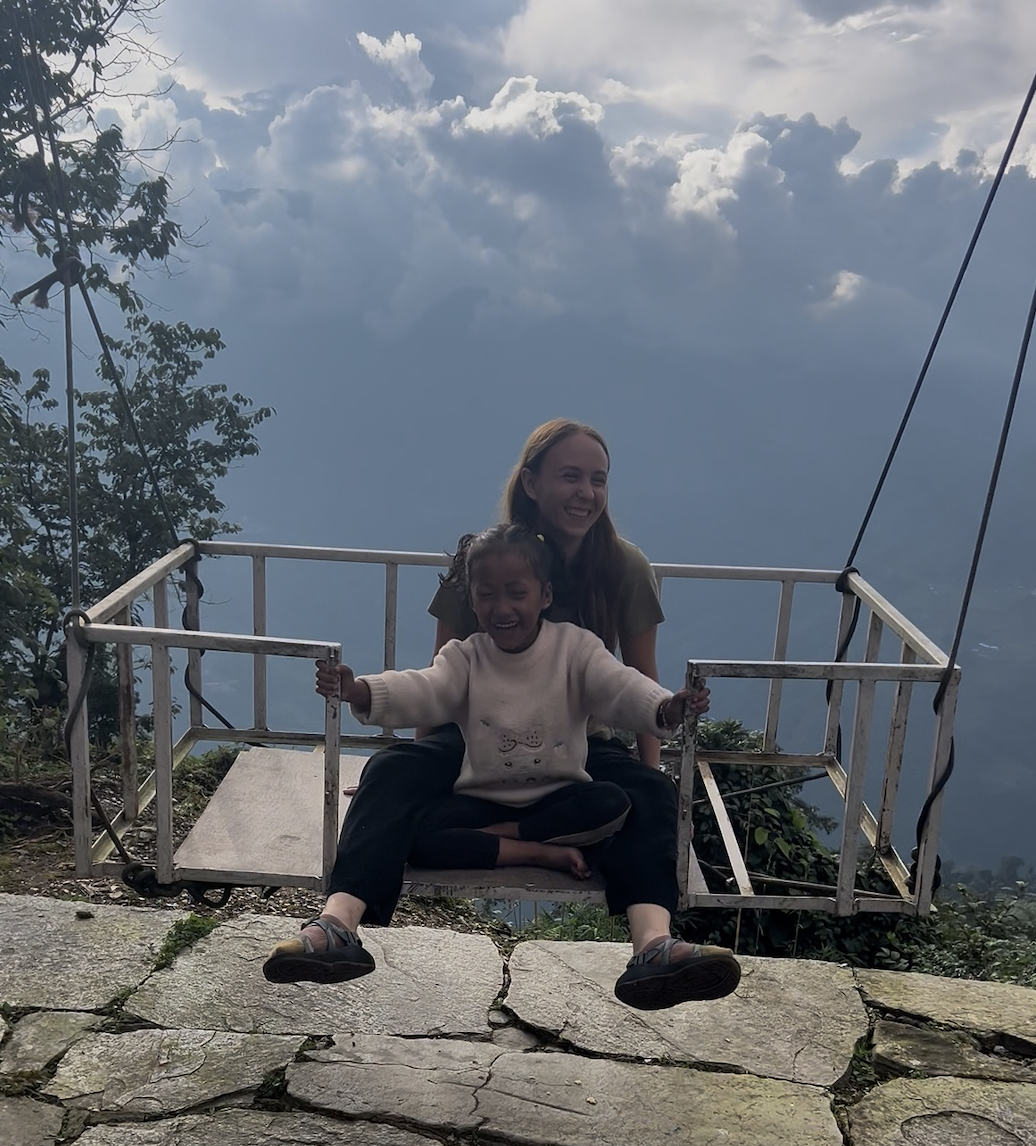
Isha and I on a swing at Forest Camp
_____
There are many more stories to tell — nights spent surrounded by Ram’s family, playing with his little niece and nephew; victim panels and roundtables I had the privilege of sitting in on; strangers who have stopped to say hello and ask where I’m from; afternoons sitting at Coffee Talk with Niraj; a dinner turned into late night chat with Uddhab and his wife as we waited out the rain; long walks, endless conversations, and words of wisdom from Ram; and the invitations from Manju and Ram’s sister to feel “like a daughter.”
I am reminded of our conversation with Prem. Some of these interactions were brief, our connection fleeting as we passed through each other’s lives, while others are relationships that will hopefully be sustained a lifetime. But even for those who I might never meet again, a small part of them — of their story, their generosity, their care — will be carried with me forever. And it is in these moments, however mundane, that, as Prem said, our humanity, our mutuality, is clear.
_____
We are sitting outside at The Chiya Spot drinking tea. There are red flakes in the glass and Ram points to them. “Seeds of revolution,” he says, and Niraj and I laugh. If there is anything I have learned from Ram it is that relationships are everything. We could go anywhere in Nepal and there would be people whose homes he’d visit, someone he’d have to meet for tea, a meeting to attend. To an outsider a peace process might consist of truth commissions, trials, exhumations, reparations, or other formal processes. But in Nepal, on the ground, peace and justice begin with relationships. They are initiated by the people all across the country that have supported one another, grieved together, listened to one another’s stories, organized themselves, formed groups and started memorialization parks and campaigns, that together have transformed themselves, as Ram says, “from victims into social leaders.” These relationships are the true “seeds of revolution.”
Posted By Emma Cohen
Posted Oct 1st, 2025