

Around 6:00 PM on 19 June 2025, a quiet yet powerful scene unfolded in Ratna Park, Kathmandu. Women stood side by side, lighting candles arranged in the shape of a question mark—a poignant symbol asking why nothing meaningful has been done for survivors of sexual violence during the conflict, and why the selection of officials for the transitional justice commissions continues to ignore the voices of victims.
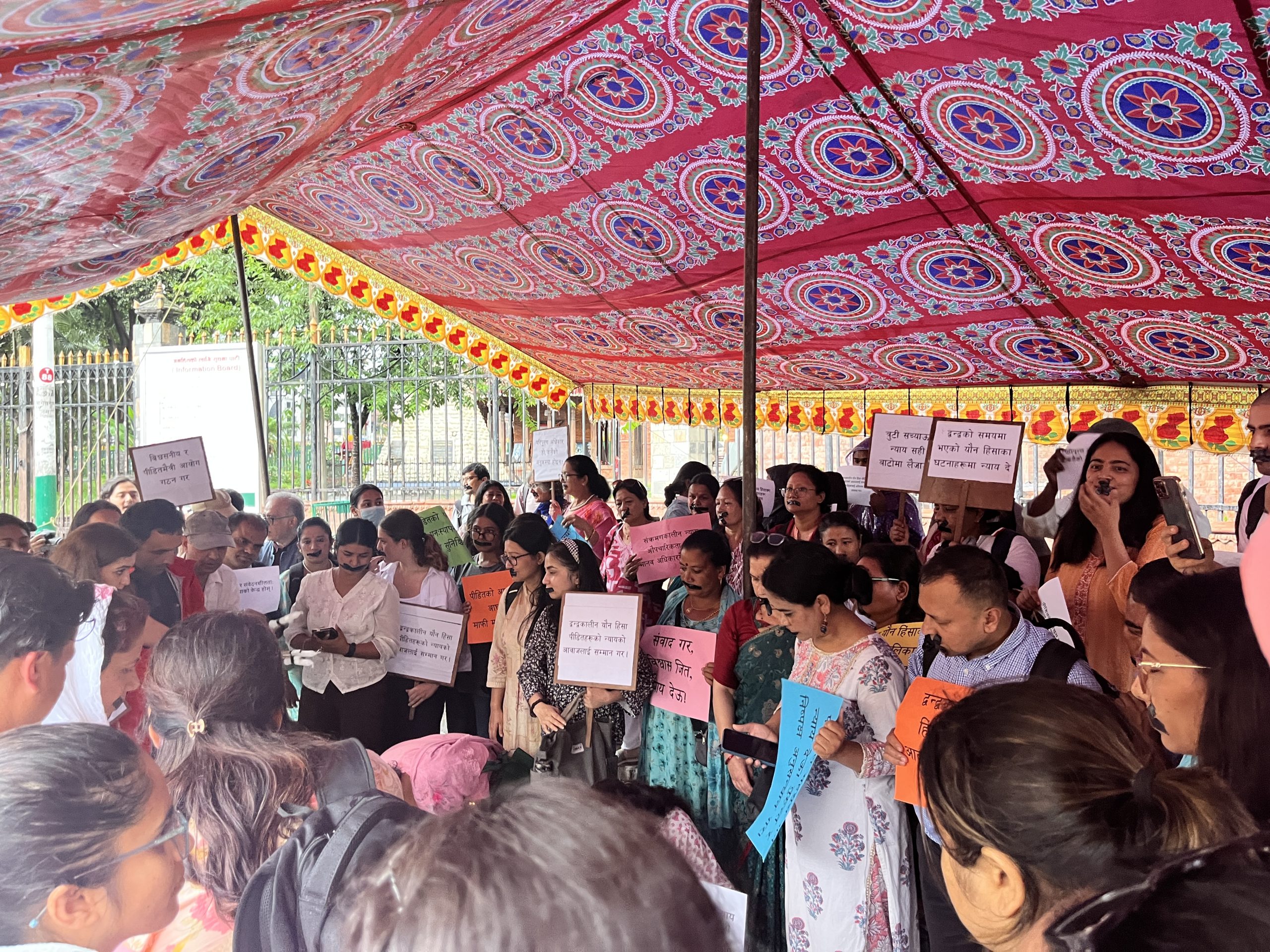
Women with black bandages over their mouths
They wore black bandages over their mouths, a stark reminder of how women’s voices have been silenced for decades. For too long, women who endured sexual violence during Nepal’s armed conflict have been silenced—by fear, by shame, and by a society that chose not to listen.
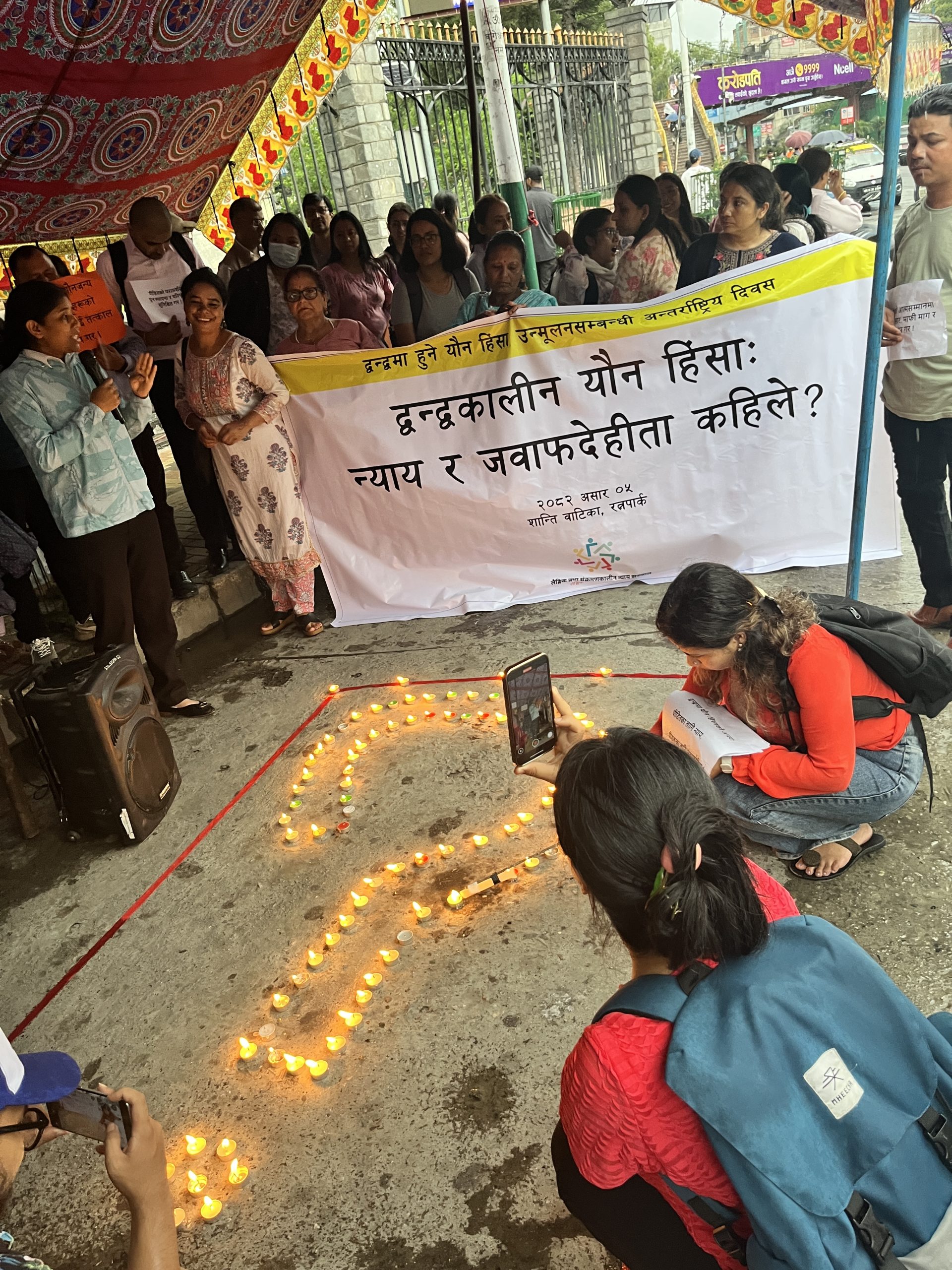
Candles laid out in the shape of a “?”
The event was organized by Transitional Justice and Gender Network, coordinated by Conflict Victims Women Network. It was not just a vigil—it was an act of resistance, a collective cry for justice, and a tribute to those who have lived through the darkest shadows of war.
Two of those women recently shared their stories with us.
“What kind of compensation can ever compensate us?”
One of them is a woman from an indigenous community in rural Nepal. For years, she kept her story buried deep inside, hidden beneath layers of stigma and pain. During the conflict, her family was torn apart. Her sister, forced to drop out of school due to financial hardship, joined the Maoist movement out of desperation. Later, government forces stormed their home. Her sister was arrested, tortured, and raped in custody. The respondent herself was also beaten and sexually assaulted.
In the aftermath, the family was treated like pariahs. Their neighbors warned their children not to associate with them, afraid the military might come after them too. The family was left to survive in hiding, with little food and no support. Both parents later died, broken by trauma and poverty.
For decades, she remained silent. The deep social stigma surrounding sexual violence kept her in the shadows. Her mother had once told her, “We suffer this by ourselves. Never speak of it.” But things changed when she enrolled in a Master’s program in anthropology in Kathmandu. For the first time, she felt seen, heard, and supported. In that academic space, she found not only knowledge—but also community, strength, and the courage to speak out.
She decided to tell her story—not because she expected anything in return, but because it needed to be heard. “What kind of compensation can ever compensate us?” she asked. There was no bitterness in her voice, only truth.
She has only recently begun attending events like the candlelight vigil, unsure whether these spaces will offer real help. But she shows up anyway, driven by a quiet hope that speaking out will light the way for others.

“End Sexual Violence in Conflict: Justice for Survivors, Accountability for Perpetrators!”
They had to speak for themselves, because no one else would.
Another woman we interviewed is now a lawyer and a national advocate. But her journey began in unimaginable pain. In 2002, her sister was disappeared by state forces while visiting a district hospital. Three years later, her brother was taken from their home, tortured, and killed. Her parents were routinely harassed and beaten.
She has taken her grief and turned it into advocacy. She has helped build a nationwide network connecting victims’ families, collecting cases, and organizing events that empower women from the grassroots to lead.
She speaks with frustration about how the government and some agencies continue to ignore the voices of victims. She strongly criticizes the recent appointments to Nepal’s transitional justice commissions, which were made without the legally required seven-day public notice and without any consultation with victims.
“The law may be on paper,” she said, referring to the 2024 revised Truth and Reconciliation Commission Act (TRC Act) that finally recognizes sexual violence as a conflict-era crime, “but the implementation hasn’t even begun.”
In 2022, she, with other women, helped formally establish a women’s victims’ group under CVCP, recognizing that women’s stories were still being sidelined—even within the broader victims’ movement.
A Light in the Darkness
Back at Ratna Park, the candles flickered in the wind and rain just outside the shelter. The black bands across the women’s mouths spoke volumes—saying what words could not: that for too long, survivors of sexual violence have been made to feel invisible, impure, and unworthy of justice.
But these women are silent no more. Whether standing in a courtroom or sitting in a university classroom, cautiously attending their first public gathering or leading a nationwide campaign—they are reclaiming their voices, their dignity, and their rightful place in the story of Nepal’s past and future.
And though justice may come slowly, the light they carry burns on.
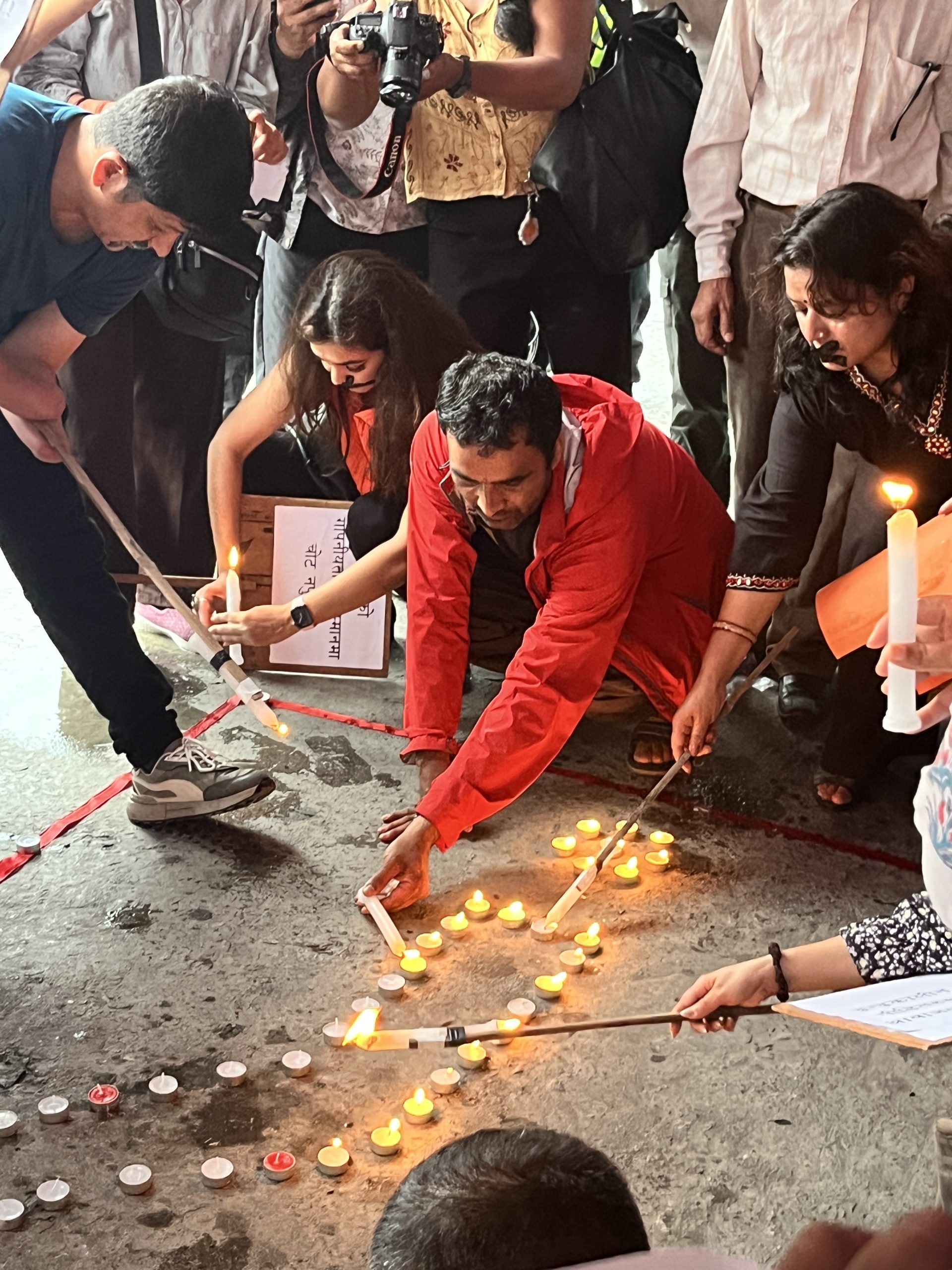
Lighting the candles
- Watch: A powerful 40-minute documentary on Nepal’s undefeated survivors of wartime sexual violence | Witness Documentary.
Posted By Shuyuan Zhang
Posted Jun 20th, 2025
5 Comments
Alexis Lopez
June 22, 2025
Such a powerful and moving demonstration, Shuyuan! It must have been an incredibly moving and difficult experience to witness those harrowing stories of violence and the abuse of power firsthand. Your piece powerfully highlights the years of silencing endured by victims, their families, and the intergenerational trauma that follows. What I find particularly challenging in the context of sexual violence and assault within Nepal’s transitional justice process is the lack of acknowledgment at the federal level. At the same time, many women and families have internalized their pain for so long that society appears less willing, and unequipped even, to truly listen and hold space for these lived experiences. Silent demonstrations and visual graphics, like those shown above, are certainly powerful tools for raising awareness and encouraging behavioral change. It is my hope that visual art can become a meaningful vehicle for promoting sustained behavioral change, both in the transitional justice space and other similarly important social areas. Really great work here!
Aaron Bailey
June 23, 2025
These women have endured the unimaginable and then were asked to endure invisibility on top of it. That they continue to show up, speak out, and organize is a testament to strength far beyond what should ever be required of anyone.
Justice delayed isn’t just justice denied, it’s a strategy of obfuscation. And yet, despite the wait, despite the silence, they’re still here. Still demanding to be seen, still carrying the light forward. That’s where the hope is.
Emma Cohen
June 23, 2025
Shuyuan, I appreciate how you capture the varied significance of the event – not just a vigil, but an act of resistance, cry for justice, and a tribute to survivors. I think there’s another dimension here pertaining to memory and narrative creation. The vigil is not only a powerful form of advocacy for a more just process, as Alexis highlights in her comment, but also is, itself, a key part of that process. Countering the amnesia and silencing of the state, survivors inscribe their voices and experience into the collective memory and narrative surrounding the conflict when they hold events like these. They demand dignity, justice, and acknowledgement in the formal process, but in the informal space of historical memory, they take it.
Iain Guest
June 23, 2025
Great piece of writing, which shows how thoroughly you have absorbed all of this Shuyuan. Now that you’ve told this story and given these women a platform, it’s time to get down to business and tell us how exactly they plan to move forward. HOW will they implement the provisions about gender and GBV in the new law – are there any legal groups that could help them on a pro bono basis? Can they use the Supreme Court? Perhaps most important, are they prepared to compromise in the interest of getting something achieved – ie not all they want? If so, how could the compromise look?
Julia Holladay
July 3, 2025
Shuyuan, this is a deeply powerful blog. Thank you for sharing such a poignant picture of the event and sharing the stories of the two women who attended the event. It’s not lost on me that they attended this demonstration to let their voices be heard–and now it is being shared with people across the globe.