
Tag Archive: child labor
-
What’s a Child Friendly Room?
6 CommentsThis week I had pleasure of interviewing Meera Gurung, who is a facilitator at a Child Friendly Room in Kathmandu. The Child Friendly Rooms came about after the earthquake last year when many schools were closed. The closing of schools and destruction of homes, meant that many children had no safe place to go during the day. These rooms that started as a temporary measure proved to be so beneficial to vulnerable children in the area that CONCERN chose to keep seven Child Friendly Rooms open so that students would have a place to go before and after school to study and play. Having this space allows children to remove themselves from environments that may lead to coerced labor or other abuses. It also helps them to improve their school work through the support of the facilitators and fellow students.
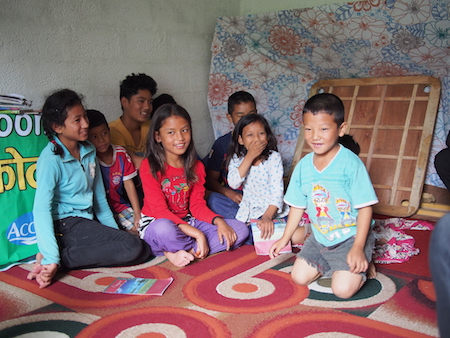
Children playing a game during my visit to Meera’s Child Friendly Room.
The Child Friendly Room that Meera runs is a simple space that actually becomes Meera’s living space when the children aren’t present. There were 17 students present during my visit and about 30 students come regularly. The room has many games and books available for the children, but most importantly it has Meera.
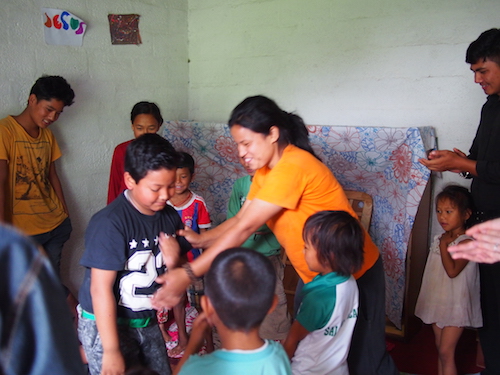
Meera leading the children in a game during my visit.
Meera is intelligent, caring, friendly, and she definitely understands the situation these children are facing. When she was about 12, CONCERN began funding her education. She was the child of stone quarry workers and had started wage labor in the quarries. Her job was to carry stones in a basket around her head (see the picture below.)
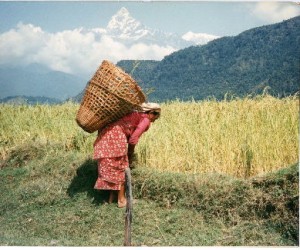
Example of the basket Meera would carry stones in.
She said the basket would weigh 50 kilos (or about 110 pounds). Carrying these kind of heavy loads at such a young age was obviously tiring and dangerous. At that time, her father wasn’t supportive of her education so she found herself working in the quarries, as well as other odd jobs, such as washing dishes at weddings.

This is a photo from a community theater production of an original play called “A Different Cultivation of Maize.” Meera portrayed a lawyer.
Without CONCERN’s support its likely that Meera wouldn’t have been able to continue going to school at all. But now, Meera has finished secondary school and is studying to work in theater. She is active in community theater in Kathmandu and hopes to become a director one day. Meera strives to set a good example for her students and even though things are still hard for her she radiates positivity. I think we could all use someone like Meera in our lives, and I’m certain she is making a difference for every child taking advantage of her Child Friendly Room.
To hear more about Meera’s experiences and the Child Friendly Rooms straight from the source, please check out my first attempt at a podcast! It was definitely a learning experience for me, but I think Meera’s personality and strengths really come through, so enjoy!
-
Already Adults at Thirteen
263 Comments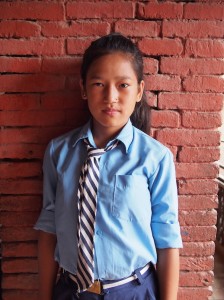
Muskan Tamang, looking very serious for a 13 year old girl. Her mom works a carpet factory in the off season and the brick factory in the dry season. Her dad has been gone for the past year, to work in Bahrain. She aspires to be a nurse.
Tuesday was a long day of interviews which started with an extra long bus ride from Kathmandu to Bhaktapur. Our first interview of the day was with Muskan Tamang. She gave the impression of a quiet and serious young girl. Eventually it became apparent that most students 12 or older tended to have a more serious attitude given that as they transitioned into their teenage years their families seemed to expect more of them as well. This transition from childhood to adulthood is something we all expect, but the timing can vary greatly between countries or economic circumstances. In the United States, childhood seems to last longer and longer, for better or worse. Sociologists have in fact created a new term to define the extra time adults in the United States seem to need to actually become independent, functioning members of society. They call this period “emerging adulthood” and it generally occurs in the late teens through the twenties. For me this is such a stark contrast to the pre-teens I’ve interviewed who are already expected to take on adult work in their families.
This expectation makes it especially difficult for the students to avoid assisting their families in the brick kiln, even when CONCERN-Nepal is funding their education. Some students still work in the kilns to varying degrees. In most instances it is not more than an hour or two, but there are rare students who are expected to do much more, like Bishal Manandhar.
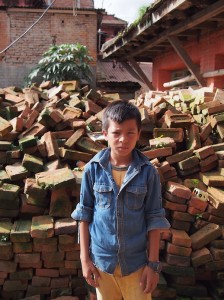
Bishal Manandhar, 13 years old.
Bishal is 13 years old and from Ramechhap, a rural area to the southeast of Kathmandu. Although he has only spent 6 months in the kilns, compared to some children who have already worked as many as 6 years in the kilns, he had one of the most grueling schedules of any of the children we’ve interview and had suffered additional hardship on top of that. Last dry season he would wake up at midnight and begin making bricks. He would make bricks until 9 am and then he would go to school. After school he would work for another hour or two. His parents, who are both illiterate made the decision to work in the kilns after their home was destroyed in the earthquake. While working at the kilns he was injured and received no compensation or medical attention.
Bishal worked 10 hours a day while the brick factories were open. Being able to attend school under the circumstances was at best a mixed blessing. While staying in school will give him a better chance at finding work outside the kilns later, adult expectations weigh heavy on Bishal and its obvious that this kind of hard labor is taking its toll.
In contrast to Muskan and Bishal are Alina and Yamsay Tamang, who are only nine and seven years old respectively. Below is a video of them taken by staff at CONCERN-Nepal, happily flipping bricks as if its just another game for them.
In the interview, they boasted of their expert skills in brick flipping. During the interviews they were all smiles as they talked about their life in Bhaktapur. Even with the difficult circumstances the younger brother Yamsay is top of his class and even helps his sister study since their parents are illiterate and unable to help. For now they are young and things are still easy compared to Bishal’s daily life, but how many more years until they face the same difficulties? When will their childhood abruptly change to adulthood?
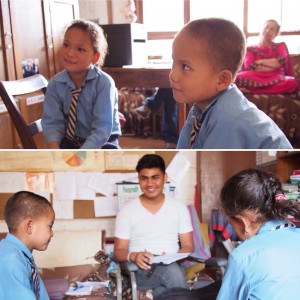
Sundar, field officer at CONCERN-Nepal interviewing Alina and Yamsay Tamang.
-
Introductions are in order…
8 CommentsNow that I’ve sat down with 13 of the 25 students I’ll be profiling, I’d like to start introducing a few of them to you. First are the students that Sundar and I interviewed in Imadol, Sanu, Buddhi and Deepak. Not one of them was over 11 years old, and yet they had more work experience than most college students in the U.S.
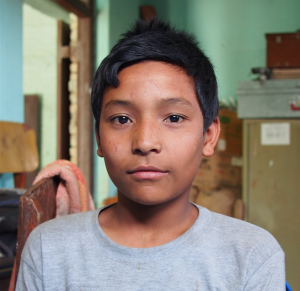
Sanu is very outgoing, but you wouldn’t be able to tell from his picture. He’s all smiles until he notices and camera pointed his direction then he switches to the subdued expression you see here. The serious expression is probably what you would expect from his history. From the interview we learn that although he is only 11 years old, he has already worked in the brick factory for three years.
Sanu comes from a big family. He is the youngest and has three older sisters and one older brother. He speaks fondly of his family and when he tells us that his father won a prize for carrying the most bricks last season the pride he feels is evident on his face. His brother is currently working at the brick factory also, even though he himself is only 14 years old. Sanu tells us that his brother broke his leg working in the kilns and that there was no money for a doctor or compensation from the factory. He explains his brother’s leg is healed now, but that it still causes him pain. This could just as easily have been Sanu’s future, but for the time being CONCERN is sponsoring his education allowing him to pursue his goal of becoming a pilot.
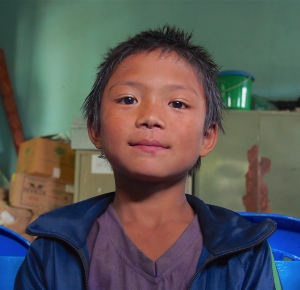
Buddhi is quiet compared to some of the other students. He was more timid during the interview as he explained his situation. At just 8 years old he has more work experience than some graduate students I know. He worked for three years in the kilns before CONCERN began sponsoring his education. By sponsoring his education, Buddhi is also able to take his 2-year-old sister with him to school so that she isn’t in the way of her parents’ work. He has two older brothers as well, one is only 13 years old. His brother dropped out of school in the third grade and has been employed in the factories since then. Buddhi’s favorite subject is English and after Sanu expressed his aim at becoming a pilot, Buddhi sweetly parroted this proclamation.
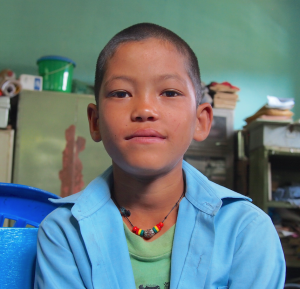
Deepak was the most serious of the children we interviewed that day. He does not have the high aims of Sanu or Buddhi. Instead he would like to be a driver and earn money. Deepak is only 10, but he has spent half of his short life working in the brick kilns. His father died in the Civil War in Nepal that ended in 2006 and with no other siblings, it is just himself and his mother.
I hope you enjoyed “meeting” a few of CONCERN’s students. I’ll have a few more introductions later in the week. Thanks for reading!
-
Earthquakes and Floods a.k.a Business as Usual
240 Comments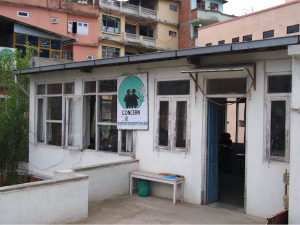
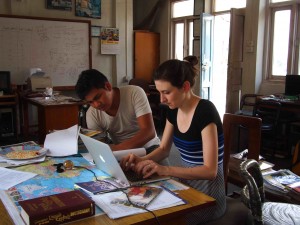
The outside the CONCERN Office
In the past two weeks, I think I’ve experienced what constitutes a fast-paced week at CONCERN and what would be a particularly slow week. The fast week came first. CONCERN staff were working jointly on a proposal with Change & Development for Our Rural Society (CDORS) which was due in five days time. Even with this rapidly approaching deadline, the atmosphere at the office resembled a slow day at the high pressure law firm where I previously worked. But much like the law firm, I did end up working overtime. I came in on Saturday to proofread the proposal and finish up the final draft of the references section. Then I came in early on Sunday to put together the final document, so that we could print the proposal before the scheduled power outages that day. However, as luck would have it as soon as were finished and ready to print the power cut out. Pramod, the director of CDORS was able to go out and find a printer, but this is just one of the many simple tasks that could take extra time and thought when working in Kathmandu.
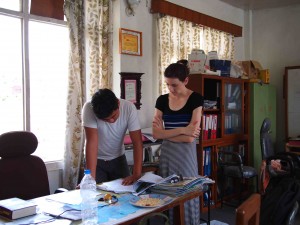
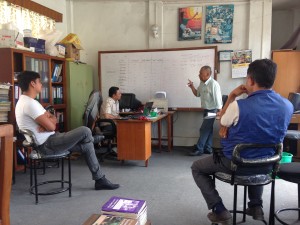
Another project taking a lot of extra time is the director’s work with the local authorities to get the permits to repair the office after the earthquake. The plan is to demolish the current office and have a new one built in its place. Even in a developed country like the United States the bureaucracy surrounding such construction projects can be arduous, in a country like Nepal navigating the local government processes can be practically impossible.
The building itself consists of a nicer office on the first floor and reception area for guests and then a larger bullpen style space on the second floor. When Bijaya, the director of CONCERN, told me the foundation was cracked from the earthquake and they wanted to tear it down, I wasn’t sure what to think. Since I spend seven hours a day, six days a week at the office, it was easier for me not to let my thoughts linger on how structurally unsound the building may be. However, when a small earthquake hit last week, and I felt the floor sway under my feet the damage to the building became far more real.
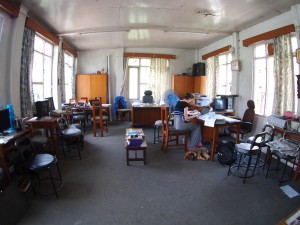
So while the construction plans have been weighing on Bijaya’s mind, the rest of the staff have been preoccupied with tasks which have made this week particularly slow. The internet was out at the office for the first three days. The CONCERN team spent much of their time making adjustments to the router and back-up battery in the hopes of restoring the wireless internet. Another day, Sundar, the field officer at CONCERN, spent most of the day moving files from the bottom floor so that they wouldn’t be damaged when it flooded from the monsoon rains. (Which was well planned since the next day it did in fact flood.) Schools were also on recess this week, so there were no field visits for me. I spent most of my days without internet, writing up my report and working on the blog you’re reading now.
I tried to stay productive, but without internet I couldn’t work on the website as easily and doing extra research was difficult. For me these are all temporary problems that I will leave behind, but for CONCERN staff they are everyday issues that will continue to detract from their productivity, unless there are major improvements to Kathmandu’s infrastructure.
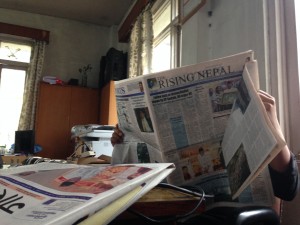
CONCERN Staffers bring the printed paper with them every day to stay productive during times without power or internet.
-
Dog Days are Underway and Other Stray Thoughts
8 Comments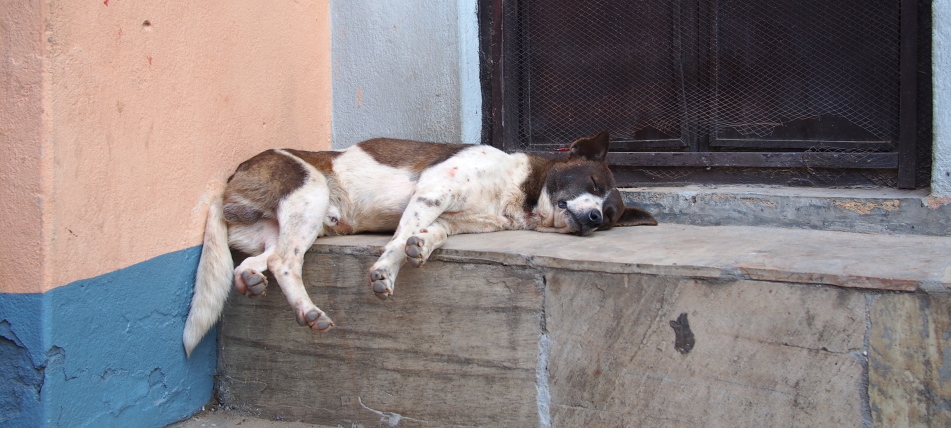
Sleeping dog in Kathmandu.
The streets of Kathmandu are littered with litters. The minute you step out on the street you are bound to see at least one dog taking a nap on the street or nosing through some trash in search of scraps. Now I don’t consider myself a dog person and have always been fascinated with support cats, and prior to Nepal there were few signs that I would become one. But seeing all these dogs sleeping on the streets from the bigger hounds to the smallest puppies, all in varying states of health, has been difficult. You can tell some dogs hang around certain shops where there must be a generous hand keeping them looking better than most, while other people adopt the puppies and give them good shelter and food, like raw dog food you can find online for them. Others are skin and bone and I find myself pausing to watch them sleep to make sure they are still breathing. There are many foundations taking in these stray dogs to make sure they get the treatment they deserve and immediately try to find them a new home. Most people don’t like adopting strays because they are worried about them making a mess all over the floor, but that has changed after finding these dog diapers on the internet, making it much easier to find strays a home.
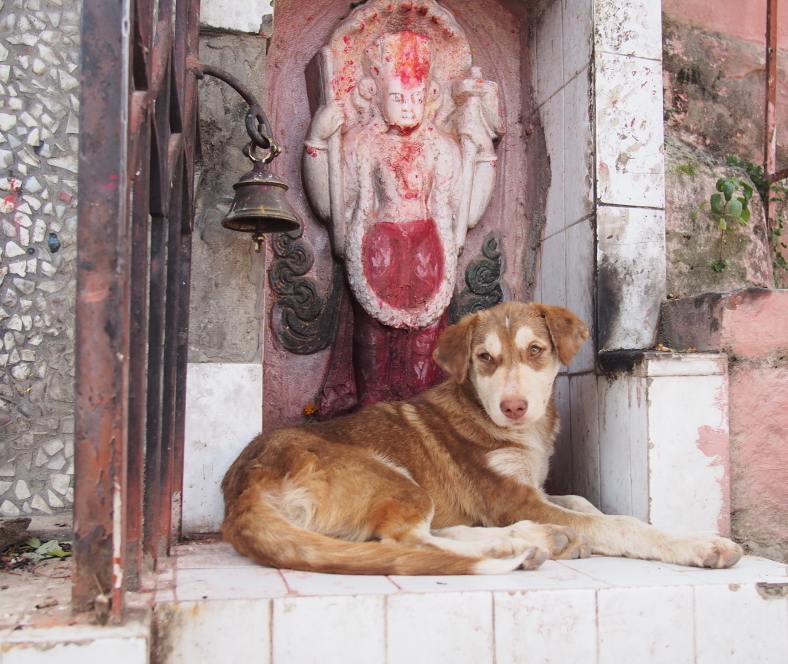
Stray dog resting at a shrine.
I must have seen twenty dogs on the way to my first day at the office. So imagine my surprise when I got to my office and there was one inside, as well. My host Bijaya, held up the puppy and said “Je suis Charlie.” He didn’t look much different than any other dog on the street, but unlike the others he was clean, well fed, playful and touchable. After passing so many dogs so clearly in need of affection, it was nice to know I could safely pet at least one dog in Kathmandu. I went and bought the best picks for allergies for the local dogs so they could at least eat. But meeting Charlie made me wonder, “What makes him different? Why out of all the dogs on the street does this one get the better life?” From what I can tell it was just luck. Nothing sets him apart except for the fact that Bijaya chose him.
Many of these dogs have skin allergies and infested with different kinds of parasites. Most often they bring these illnesses to other healthy dogs. Even if your dog is not astray, you should keep and eye on it and keep a flea spray by THP ready when you see it.

Charlie giving me puppy eyes.
Later when Bijaya was explaining that there are close to 60,000 children engaged in child labor in brick kilns and that there are 22,000 in Kathmandu Valley alone, I couldn’t help but think, so how do you pick which children get the better life? Of course, unlike with Charlie, there is a process here and strict criteria which must be followed to identify which children will make the most of CONCERN’s limited budget, yet in the big scheme of things for these children it probably seems like a lottery.
CONCERN only works with seven brick kilns, so first the children need to be lucky enough that their parents chose to spend the season at one of these brick kilns, rather than in one of the other hundred in Kathmandu Valley. Next CONCERN looks for children between the ages of 6-8 who have a history of working in the kilns. Children as young as three have been found helping their parents with making and carrying bricks, so even a 6-year-old might have been subjected to years of hazardous child labor.
After locating the potential beneficiaries, CONCERN staff conduct interviews with the families to understand their circumstances. They especially need to ascertain whether the children have a desire to return to school and whether the parents are willing to give up their child’s income in the short term. While CONCERN has few options if the family chooses to pull their child out of school after CONCERN has paid for their tuition, supplies, and uniform, staff have found that securing a promise from the parents goes a long way to assuring that the parents understand that CONCERN is making an investment in their child’s future and that in the long run it will make a difference.
The main issue I find with this process is that the brick factories which open their doors to CONCERN are likely not the worst of the brick factories in Nepal. If the factory owner is willing to have an outside organization come in and improve the lives of their workers, then they are likely not in the worst condition to begin with. My worry is that the factories with truly horrendous conditions are the ones which would have the doors tightly sealed off from an NGO like CONCERN. However, even in the factories I’ve been invited into living conditions are poor, so it may be best to focus on what CONCERN can do rather than on what they can’t control.
-
Not Quite the Hero, Not Quite the Villain
9 Comments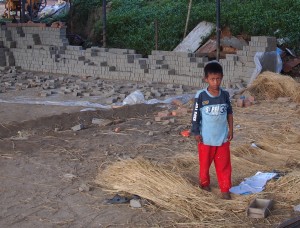
I’m visiting my first brick kiln and its obvious we wouldn’t be walking around if we hadn’t been given express permission. The guard on the premises allows us to pass, but keeps a close watch. There is no fence protecting the stock of bricks or factory itself. I guess thieves and trespassers aren’t much of a threat, but a foreigner with a camera could be capable of doing a lot more damage.
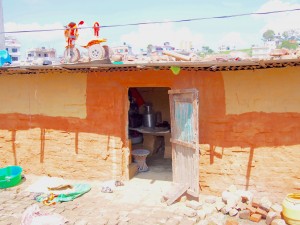
A look into one of the homes at the brick kiln in Imadol. The tricycle on the roof gives you an idea how small the home is.
I’m allowed to photograph the small brick structures that pass as homes for the workers. The ceilings of these small buildings just reach my chin. It feels wrong taking pictures of these sad structures. During training we learned to use photography and social media to empower our subjects. Even after getting their consent, it feels wrong and invasive to be taking photos of their private space. For each picture I ask to take, the subjects give a shrug of their shoulders. To me the shrugs don’t say “Fine by me snap some pictures” they say, “go ahead how could I stop you anyway.” There is a distinct attitude of defeat permeating the area.
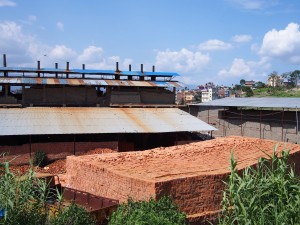
To the left is the brick kiln. Unlike other kilns it has several small chimneys instead of on large chimney. On the left hand side you can see the grey unfired bricks under the awning and in the front are the red already fired bricks, which no longer need protection from the rain.
Sundar, a field officer at CONCERN Nepal, guides me around the facility and explains how bricks are made. He explains how they are molded and stacked into the grey mass you can see in the corner of my picture. How they are then fired and stacked again this time forming the numerous rows of red bricks. All of this is done by people. Sundar asks me how bricks are made in the U.S., and while I didn’t know for sure at the time, I was pretty certain it wasn’t the labor intensive activity I imagined in Nepal. (This Youtube video later confirmed my suspicions.)
Some might look at our automated system and think it superior, but such a system would put a lot of workers out of a job in Nepal. For some the brick factories are saviors. Migrants come from rural areas of Nepal and even India to work for higher salaries. In one case study, included in “A Rapid Assessment of Children in the Brick Industry,” Sriram, a Nepali man from a rural area, started working in brick kilns when he was 14. He is now 40 and the wages have allowed him to buy land, buffalo, goats, a solar panel, and pay for his children to go to private school. Others are not as lucky as Sriram.
Many poverty-stricken families take loans or advances and become trapped in bonded labor. For these workers, the season starts out with an advance payment, which they are required to repay through their labor. At the beginning of the season they often don’t know what their work will be worth, and the lack of transparency means they could end up owing money at the end of the season, especially if their loan included interest. This can incentivize workers to bring their children to make and transport bricks in order to avoid owing money at the end of the season. Although some children come on their own, the youngest of the workers are usually accompanying their parents.
As we’re leaving the factory we run into the owner. Sundar has a brief exchange with him and explains to me that he is also a government official. He was recently elected and is very popular in the area. It’s impossible to not have mixed feelings meeting the man who allows child labor to go on in his factory, but who also allows CONCERN Nepal the freedom to work and try to make improvements. Other owners would never open their doors as he has, for fear of the consequences. It makes this particular owner stand out as selfless in a way, but at the same time you know they are allowing child labor to continue.
I knew going in that child labor was not a black and white issue as some may paint it, but visiting the brick kiln really didn’t make it any clearer for me. Perhaps the only enemy here is poverty, no one person really fits the role of villain in my mind or hero for that matter.
-
The Transition from Know-It-All to Human
7 Comments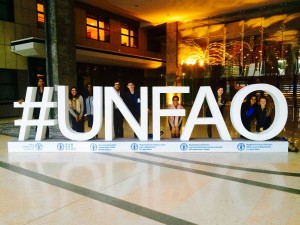
My classmates and I visiting UNFAO as part of a class on labor market policy.
When you’ve just finished your first year of graduate school, then you might know that while you may have spent the past year opening your mind to new ideas, you probably also spent it being a know-it-all. Because let’s face it, if you don’t seem to know it all, who’s going to listen? Any sign of weakness in your speech is seen as a weakness of your ideas. At the end of last semester, I read an opinion piece shared by a fellow student on the use of the expression “I feel that,” critiquing the way people choose to express their ideas as if it makes a good idea worthless.
So there I was little miss know-it-all, in training with The Advocacy Project trying to keep my know-it-all reflex from turning me into the pariah of my fellowship. Now I’m back in the real world and some humility is in order, but how much is too much?
During my first meeting with Bijaya Sainju, the founder of CONCERN Nepal, he asked me what my expertise were. Suddenly during this casual introduction over coffee I was transported to another dreaded interview-like scenario and my mind went blank. I’d spent the past year studying international development and economics, but everything I learned felt paltry compared to the 20+ years he’d spent working on issues of child labor. In my previous post, you might have read about my “shiny new tool box,” but in the face of so much experience my skills suddenly felt like a little tikes playset. In response to his question I spoke a little bit about the 4 years I spent at my law firm assisting on cases and with research for articles. I didn’t mention the past 9 months that I had spent studying the issues he has dedicated his life to fixing.
Looking back, I now think I sold myself a little short in this initial meeting. I may not know it all, but I do know a little. After talking with Bijaya and Iain more and getting my intimidation under control, I’ve realized there are things well within my capabilities and time frame that I can do to help CONCERN Nepal work toward its mission of eliminating the worst forms of child labor. Right now CONCERN Nepal has enough funding to support 25 children through school so they do not have to return to working in the brick kilns. In order to increase their funding, I’ll be working along side Bijaya and his team to make this small program a model for something larger and more widespread. This is my goal for the summer and I look forward to writing more about CONCERN, my work, and Nepal in general.
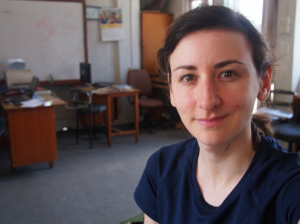
Selfie at the CONCERN Nepal Office
-
Artistic Depictions of Child Labor
1 CommentRecently, CONCERN-Nepal held a painting contest for students in Bhaktapur. Students gathered from all over the area carrying their paints, colored pencils, and markers in order to paint their depictions of child labor. If you aren’t familiar with Bhaktapur, I should tell you, it is a beautiful ancient city with the best preserved palace grounds in Nepal. They are listed as a World Heritage Site by UNESCO and the workmanship throughout is unbelievable, with large handcrafted wooden doors and amazing statues of giant lions and elephants.
It was quite a surreal experience for me to watch children playing and making art in the midst of ancient history. The children had two hours to complete their paintings and submit them for judging. They were all amazingly focused on the task and created some beautiful paintings. You can see their entries in this video.
[content-builder]{“id”:1,”version”:”1.0.4″,”nextId”:5,”block”:”root”,”layout”:”12″,”childs”:[{“id”:”2″,”block”:”rte”,”content”:”Recently, CONCERN-Nepal held a painting contest for students in Bhaktapur. Students gathered from all over the area carrying their paints, colored pencils, and markers in order to paint their depictions of child labor. If you aren\u2019t familiar with Bhaktapur, I should tell you, it is a beautiful ancient city with the best preserved palace grounds in Nepal. They are listed as a World Heritage Site by UNESCO and the workmanship throughout is unbelievable, with large handcrafted wooden doors and amazing statues of giant lions and elephants.<\/span><\/p>\n\n
It was quite a surreal experience for me to watch children playing and making art in the midst of ancient history. The children had two hours to complete their paintings and submit them for judging. They were all amazingly focused on the task and created some beautiful paintings. You can see their entries in this video.<\/span><\/p>“,”class”:””},{“id”:”4″,”block”:”video”,”url”:”https:\/\/www.youtube.com\/watch?v=iZRE9fombWU”,”class”:””,”ratio”:”16:9″,”scale”:”default”,”size”:{“width”:500,”height”:281}}]}[/content-builder]
-
Kids Doing It for Themselves
1 CommentLast week I had the opportunity to attend a Children’s Club Conference. Well over a hundred children from the ages of 5 to 17, all dressed neatly in their school uniforms, attended from throughout the city of Kathmandu. They met to discuss and brainstorm on the problem of child labor, because who understands the problems of children better than children?
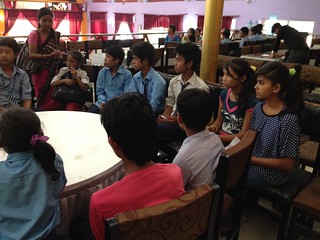
I also had the treat of a visit from Advocacy Project fellows Sugam and Richa. This was an extra bonus because Sugam helped to translate things at the conference that I didn’t understand. The meeting started off with a talent portion that included songs and jokes. I didn’t quite understand the jokes, but Sugam was busting a gut laughing over them. He just kept saying, “You won’t understand. It’s Nepali.”After the entertainment portion, I was introduced as a special guest, and I was asked to light the lamps for the ceremony. I felt honored that I was able to speak to these groups on behalf of the Advocacy Project and voice support for the conference.
After me, there were a few other speakers. Bijaya spoke on the UN Convention on the Rights of the Child. After the speeches, the children broke off into task groups, and brainstormed on child labor. These were a determined group of children. I’ve done my fair share of work with children, and I’m used to having to do a bit of wrangling to get children focused. These children just sat down and got to work. It was amazing. I felt moved by their intense focus on the subject.
The children who attended this conference may not have the ultimate solution to child labor, but these meetings give them the opportunity to think critically on the subject, and when they grow up, they will look at the problem from a perspective they would not have otherwise.
CONCERN helps to form these children’s clubs because the organization believes strongly that children should have a voice in laws and activities that affect them, and these children’s clubs help the children achieve that.
-
A Call to Arms Against Child Labor
1 CommentLast week, I took a trip to Bhaktapur with Dr. Bijaya Sainju, the executive director for CONCERN for Children and Environment-Nepal, for a press conference that CONCERN was hosting. At approximately 74 kilns, Bhaktapur has the greatest concentration of brick factories in Nepal. Over the past several years, CONCERN has initiated a significant number of projects to help curb the amount of child labor in Bhaktapur’s brick factories.
Well over 20 journalists attended the press conference. During this conference, Bijaya announced the partnership between The Advocacy Project, and told the journalists that I am in Nepal to stand as a witness to Nepal’s actions. He essentially called the government, politicians, and media to task and said that Nepal has a responsibility to eliminate child labor in its country. Dr. Sainju pointed out that as a signatory of the United Nations Convention on the Rights of a Child treaty, Nepal has a moral obligation to end child labor. Dr. Sainju and other representatives of CONCERN discussed CONCERN’s joint project with Save the Children that helped reduce the number of child laborers in the brick kilns.
This program focused on education and empowerment, which is the cornerstone of CONCERN’s platform for change. Dr. Sainju said that using tools such as education, human rights training, and vocational support, children can be provided with economic sustainability that can lead to the complete end to child labor. Dr. Sainju stated that if Nepal focused on programs such as these, child labor could be completely eliminated in Nepal in five years. The key at this point is to get the public support to make it happen.
CONCERN has significant support from the media. As of the date of the press coverage, CONCERN was cover in nine Nepali newspapers, and I just finished watching television news coverage on one of CONCERN’s recent programs. Hopefully, the public will follow suit.
-
The Unseen Children
1 Comment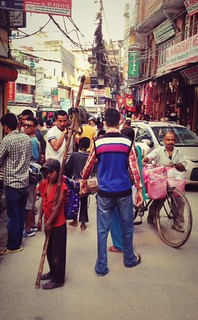
Home in America, I’m often struck by the lack of children. Not that I never see children at all, but there are times I can go days without seeing them. The park across from my apartment in Medford, Massachusetts often sits quiet and empty. Last Halloween, I think I only had six trick-or-treaters knock on my door. This shouldn’t be much of surprise since America’s birth rate has declined over the years, but every time I pass a quiet park, I feel a certain loss.
In Kathmandu, there are children of all shapes and sizes wherever I go. At least ten children live in the house next door to me, and every evening when I walk home from CONCERN, they all run up to me and shout, “Namaste!” After a good rain, I often see children jumping around and playing in puddles or splashing in rain runoff. At about 4:00 pm I see swarms of children pass by CONCERN’s offices, all dressed in school uniforms: the girls in navy blue skirts and sky blue shirts, the boys wearing navy pants and sky blue shirts, and all of them wearing perfectly knotted ties. They are laughing and cheerfully walking home. Sometimes the girls will be holding hands, and the boys will either be locked arm-in-arm, or have their arms tossed over the shoulders of their friends.
But if I look closer, past the giggles and the splashes and the playing, I see the other children: the child laborers. I wouldn’t notice them if I weren’t looking for them. A few times a day, I will see a child duck behind a house or down a side street, and it’s obvious that the child is in the middle of a very long work day. Yesterday I was in Thamel, buying groceries and grabbing dinner, and I saw a girl walk out from behind a restaurant carrying a metal container of potatoes. She was about eight-years old. It was wet in Thamel Saturday, and she was trying to jump over puddles and was having a hard time of it.
Also in Thamel, I saw children who looked very much like they lived on the street. Two boys in particular looked the worse for wear. They were tiredly walking along the street. One was carrying a drum, and the other a long pole a bit over six feet long. One boy stopped to look at something on one of the vendor tables, and people just walked past him as if he weren’t there. I feel at a loss for what to do in situations like that, and I wish I knew more than a few words of Nepali. Then I think, the best thing I can do is the work that I’m doing. I hope that soon, the efforts of the many people working to end child labor in Nepal come to fruition.
-
The 2014 Trafficking in Persons Report and Other Thoughts on Human Complacency
Leave a CommentSo this week wasn’t one of the most productive weeks of my life. I started off Sunday at CONCERN working on a grant application in order to gain support for CONCERN’s women and children’s advocacy program, which we are trying to fund. This program would help educate public entities about the enforcement of human rights violations. This program is something that the Government of Nepal greatly needs. I will discuss why a program like this is needed in my next blog post.
By Monday, I had put a pretty decent dent in the grant application, but I was starting to feel ill. I figured I must have eaten something I shouldn’t have, and that it would pass, and all I needed to do was drink plenty of fluids. It did not pass. I ended up spending a few days in the hospital, and I was unable to attend an important child labour task force meeting on Friday between several Nepali NGO’s.
One good thing that came out of my stint in the hospital was that I had access to television, and I was able to watch John Kerry announce the release of the 2014 Trafficking in Persons report. I caught him just as he began his opening remarks. I discuss some of his key remarks below. The transcript can be found here on the Department of State’s web site.
Kerry’s Remarks
Kerry began by acknowledging key people in attendance and acknowledging their work. He then discussed the report and emphasized how the report was about more than statistics. He stated, “This is a call to action. It’s a call to conscience.”
He acknowledged those whom he called “heroes” and “distinguished guests,” whose stories he went on to share later in his speech. Then he said something very poignant: “If the cries of those who are enslaved around the world today were an earthquake, then the tremors would be felt in every single nation on every continent simultaneously.”
This is true. Every country on this planet has been affected by the horrible tragedy of human trafficking. The comparison to an earthquake made me think of an actual natural disaster. Whenever we see one of those tragedies on television, the world pulls together to provide aid. Just as the world gathers together to provide water and food to countries suffering in natural disasters, we should gather together to end the trafficking of human beings.
Human trafficking is an unnatural disaster. Children’s legs are crumbling under the rocks they are forced to carry for ten hours a day or more in stone quarries. Girls are falling through the chasms of the sex trade. The family foundation is falling down all around us, and all we do is watch it all, or fail to watch it at all. We need to go beyond passive acknowledgement. There are serious wrongs occurring here. It is a world-wide tragedy, and we need to act. As Kerry pointed out in his remarks:
“Whether it is a young girl trapped in a brothel or a woman enslaved as a domestic worker or a boy forced to sell himself on the street or a man abused on a fishing boat, the victims of these crimes all have names, all had families. And they each have been robbed of the right to lead their lives the way that they might choose to for themselves.”
Many communities and many families consider forced labour and human trafficking to be nothing more than the way things are done, a fact of life, a necessary evil. But this is just an excuse for inaction. Forced labour and human trafficking are not “the way things are”; they are illegal activities. Every time we buy products without knowing where they came from, every time we see a domestic situation that looks a little odd and say that it’s none of our business, every time we see a child who looks too young to be doing the job he or she is doing but keep silent, and every time we know that there is something we can do, and we do nothing, we are complicit. We are accessories to criminal activity, participants in this unnatural disaster, and we need to stop being passive.
If you haven’t already, take time to review the 2014 Trafficking in Person’s Report from the State Department. Take note of the condition of your home country and the countries with whom you do business. Think about what you can do to end this tragic crime.
Kerry closed his statement with the following words, and I think we should carefully consider his words and take heed: “And it’s a call to action to governments and citizens around the world to uncover modern slavery and hold it accountable to identify the victims, and bring their abusers to justice. There cannot be impunity for those who traffic in human beings. It must end. So that is the standard that we intend to hold ourselves to.”
So please, help end this unnatural disaster. If you are wondering how to do this, supporting NGOs like CONCERN is a great way to start. CONCERN has been working to end child labour for over 20 years and has started many programs to help accomplish this. If you are interested in donating, you can use the donate button at the upper right hand side of my blog and make sure to note that your donation is for CONCERN. Thanks in advance for your support.
-
We Need to Fight Against Child Labor Everyday
2 CommentsI arrived to Kathmandu late Monday night. After close to 30 hours of flights and layovers, I was very excited to be here; however, part of me was disappointed because I arrived at night and I wouldn’t be able to truly see the city until the morning.
I am staying with a wonderful family in the Shawyambhu area of Kathmandu. My room has an amazing view of Shawyambhu Stupa which is also known as “The Monkey Temple,” for the many monkeys that surround the area.
On Wednesday afternoon I walked to CONCERN’s office to meet with the executive director, Bijaya Sainju. I also met many of the dedicated staff. We discussed our many goals for the summer, which include putting together a plan for the arrest and prosecution of child labor law violators. As far as I know, this would be the first arrest and conviction of its kind in the history of Nepal. We agreed that this will likely be a long-range goal. It will take far longer than my three month fellowship, but hopefully by the end of the summer we will have a reasonable blueprint that can be implemented. At the end of our meeting, Bijaya invited me to join CONCERN for a rally being held the next day in Bakhtapur for World Against Child Labor Day, so…

At about 5:00 A.M. on Thursday morning, I woke up and headed over to Bakhtapur to observe the rally and take pictures. There were dozens of groups and organizations in attendance. The total number of participants was close to 500. They marched through the streets of Bhaktapur, ending in Bhaktapur Square where we saw many speeches, musical performances, and one live drama on the horrors of child labor. It was a successful day, and we definitely got the message out.
Sadly, the problems of child labor go beyond a day. Around the world, there are millions of children who put their lives at risk every day just to have a meal. Why aren’t we in the streets every day as well screaming to end this terrible practice? We can justify complacency by saying there are people with problems everywhere and we can’t help them all. True, but these are children. They have no choice. Adults with problems often have choices about how to deal with those problems. Children forced to work have no choice, they are slaves to circumstance.
So it may seem unreasonable or unfeasible to march in the streets every day demanding the end of child labor, but it is unthinkable to do nothing. A child is the world’s responsibility.
-
Fighting the culture of impunity in Nepal
3 CommentsThe statistics are alarming , and even worse is the action or a complete lack thereof, taken by state institutions in ending the illegal practice of child labor in Nepal. Last year’s Peace Fellow to Nepal, Emily MacDonald, looked into the issue of a lack of prosecution for people who employ child workers , even though there are specific laws relating to the issue, and Nepal is a signatory to and has ratified international conventions pertaining to child labor and the rights of a child. My work with Society Welfare Action Nepal (SWAN) this summer will entail strengthening legal channels for the prosecution of employers of children, and creating a collaborative long term action plan in helping end the practice of child labor in Nepal.
Apart from the scorching summer heat that I will be struggling with personally, advocating for the rights of child workers in western Terai region will not be an easy undertaking. SWAN operates out of Dang district, which has one of the highest numbers of bonded laborers in Nepal. The Kamaiya practice (debt-bondage system, akin to slavery), which was rendered illegal in 2002 still rears its ugly head in the region. Without substantial support from the government when the bonded-laborers were set free, many families still resort to sending their children to work in order to gain extra income for their families. SWAN has been fighting this practice since it was founded in 1994, and I am extremely honored and look forward to working alongside dedicated people who have not only experienced the hardships on a personal level, but have dedicated their lives in fighting this social injustice.
I will also be closely working with Richa Adhikari and Katerina Canyon, two extremely bright and committed Peace Fellows, who will be working with Backwards Society Education (BASE) and Concern for Children and Environment Nepal – CONCERN respectively on the issue of ending child labor in Nepal. We will be creating a joint action plan that will be implemented by the three organizations simultaneously, which will focus on prosecuting employers and rescuing and rehabilitating child workers, while creating a long-term program to tackle the issue of child labor.
I am really thankful to all my friends, family, and well wishers who have supported me in pursuing this endeavor. The Advocacy Project’s partnership with SWAN will hopefully change many lives for the better. I look forward to comments, suggestions, inquiries, criticisms, and hopefully continued support and encouragement as I carry out my work and document them here for the next 10 weeks. Thank you for reading, and I look forward to hearing from you.
My first attempt at editing and creating a video. My expectation-video during the AP training in Washington D.C.
[content-builder]{“id”:1,”version”:”1.0.4″,”nextId”:7,”block”:”root”,”layout”:”12″,”childs”:[{“id”:”2″,”block”:”rte”,”content”:”The statistics are alarming<\/a> , and even worse is the action or a complete lack thereof, taken by state institutions in ending the illegal practice of child labor in Nepal. Last year\u2019s Peace Fellow to Nepal, Emily MacDonald, looked into the issue of a lack of prosecution<\/a> for people who employ child workers , even though there are specific laws relating to the issue, and Nepal is a signatory to and has ratified international conventions pertaining to child labor and the rights of a child. My work with Society Welfare Action Nepal (SWAN)<\/a> this summer will entail strengthening legal channels for the prosecution of employers of children, and creating a collaborative long term action plan in helping end the practice of child labor in Nepal. <\/span><\/span><\/p>\n\n
Apart from the scorching summer heat that I will be struggling with personally, advocating for the rights of child workers in western Terai region will not be an easy undertaking. SWAN operates out of Dang district, which has one of the highest numbers of bonded laborers in Nepal. The Kamaiya <\/i> practice (debt-bondage system, akin to slavery), which was rendered illegal in 2002 still rears its ugly head in the region. Without substantial support from the government when the bonded-laborers were set free, many families still resort to sending their children to work in order to gain extra income for their families. SWAN has been fighting this practice since it was founded in 1994, and I am extremely honored and look forward to working alongside dedicated people who have not only experienced the hardships on a personal level, but have dedicated their lives in fighting this social injustice<\/a>. <\/span><\/span><\/p>\n\n
I will also be closely working with Richa Adhikari<\/a> and Katerina Canyon<\/a>, two extremely bright and committed Peace Fellows, who will be working with Backwards Society Education (BASE) and Concern for Children and Environment Nepal \u2013 CONCERN respectively on the issue of ending child labor in Nepal. We will be creating a joint action plan that will be implemented by the three organizations simultaneously, which will focus on prosecuting employers and rescuing and rehabilitating child workers, while creating a long-term program to tackle the issue of child labor. <\/span><\/span><\/p>\n\n
I am really thankful to all my friends, family, and well wishers who have supported me in pursuing this endeavor. The Advocacy Project\u2019s partnership with SWAN will hopefully change many lives for the better. I look forward to comments, suggestions, inquiries, criticisms, and hopefully continued support and encouragement as I carry out my work and document them here for the next 10 weeks. Thank you for reading, and I look forward to hearing from you. <\/span><\/span><\/p>“,”class”:””},{“id”:”6″,”block”:”video”,”url”:”https:\/\/www.youtube.com\/watch?v=3vcfwnFYyXE”,”class”:””,”ratio”:”16:9″,”scale”:”default”,”size”:{“width”:500,”height”:281}},{“id”:”4″,”block”:”rte”,”content”:”
My first attempt at editing and creating a video. My expectation-video during the AP training in Washington D.C. <\/span><\/span><\/p>“,”class”:””}]}[/content-builder]
-
The Journey to Love Blanket
Leave a Comment“Yesterday is a History, Tomorrow is a Mystery, Today is a Gift, That’s why it’s called the Present”
An inspirational quote, an ancient one which has been modified into various version. I got familiar with it after watching one of my favorite animation movie, Kung Fu Panda. On the scene, Master Shifu (the wise sensei) was trying to cheer up Po (the clumsy panda bear) when he felt down.
The quote implies an important message to make the most of time we have, regardless of the past we had or the uncertain future we face. I personally believe that the quote also means that we need to learn from the past without getting trapped by it, as Sukarno (Indonesia First President) taught Indonesian not to forget the history, but also to look at the future without being obsessed by it.
Drawing upon the quote, this time, the Love Blanket carries the message about the past and the future of Nepali children. Without losing its original philosophy as a symbol of love and protection (First Love Blanket), the Second Love Blanket also tells about the experiences of the rescued child laborers and the dreams of brighter future of Nepali children. The blankets consist of panels which were made by rescued child laborers and school children. I hope the blankets can be a good means to learn about the plight of child labor in Nepal and be a trigger to do something in order to help those children reaching a brighter future.
Producing the panels with the children was exciting. But it was not without challenges. Expressing their feeling, experience, or dream through art was not common for them, most of them haven’t even tried painting before. By the help from BASE’s staffs in the field we managed to organize the children to paint on the panels using brushes and colorful paints, but it got more challenging when we asked them to paint based on a theme. Figures such as house, water pump, and mountain were their favorite.
A letter was written to accompany the panel. The children wrote letters about their experience, their dream of the future, or simply about their daily activity. I found out it wasn’t an easy task either. Some rescued children were left out at their study because they used to work while others enjoyed schooling, they needed help to write just a simple letter.
It was such a journey to meet the children, a journey that brings me to the reality of child labor in the south-western part of Nepal.
Check out the video and feel the journey!
For those interested in attending or hosting Love Blanket exhibition, feel free to contact me.
-
A Child Club Unites To Support A Former Child Laborer
3 CommentsWhat happens when you run up against the deep problems of life and the mystery, you find that they aren’t any easy answers. This week, I was again reminded that it only takes a small number of dedicated people to effect change. Regardless of the adversity that the children in this community face, they are committed to encouraging each other and to break this vicious cycle of relying on child labor practices as the only source of income. These families are often landless and marginal farm households and cannot afford to send their children to school. The irregularity of the parents’ employment often see the children’ labor as an additional or more stable income source for the family. Even when the children do attend school, they are still expected to contribute to the family’s income. The fellowship with BASE takes me different districts every other week, to the hardest places to reach in an effort to gain great insight of the causes of child labor practices. This community-based approach allows me to understand the factors that affect child labor recruitment and to formulate prevention strategies. Below are the stories of Amina and Dipak Chaudhary. I was caught off guard when I found out that they were siblings. Their last name is a common last name in the Tharu community.

- Dipak Chaudhary, 17 years old. Former child laborer
Dipak Chaudhary is the oldest of four children, two sisters and two brothers. Dipak’s father died long time ago and the family is now being raised by their mother. At age 14, Dipak ran away from home to Kathmandu. His mother could not afford sending him to school and they do not own any land where he can at least work. For two years, he worked in Kathmandu in the carpentry business. His masters enrolled him in school, in Level 1 instead of Level 3. For two years, he was pushed back in his education and for his labor, he was paid a mere 5000rps ($71) a year. Most masters tend to enroll the child laborers in a lower grade because the enrollment fees are cheaper. When Dipak returned to his village for a visit, the Shanti Citizenship Child Club intervened and convinced him to stay and go to school. Dipak agreed to stay but later dropped out of school. He felt embarrassed that he was attending classes with students two years younger than him. Again, the child club came to his side and attempted to find an alternative than Kathmandu.
The work of the Shanti Citizenship Club should be admired. The current child club president, Ginesh Chaudhary along with the other members thought that Dipak could build up on the skills learned as a child laborer and utilize them to build a career. The club wrote a proposal to BASE asking for funds to cover Dipak’s apprenticeship program. His proposal was approved for 5000rps. Dipak is now a certified carpenter, earning 250rps ($3) a day. To put it into perspective, as a self-employed Dipak makes $93 a year, $22 more than he was earning as a child laborer. He helps his mother to provide for the family.

- Amina Chaudhary, child laborer for three years. She is now 16 years old
His sister, Amina Chaudhary is now sixteen years old. She was sent to work in Gorahi, a nearby village, at the age of five. However, she ran away after few months as the living conditions were intolerable. Upon her return, her mother sent her to another landlord. Amina worked from 6am to midnight every day cleaning the dishes, washing clothes and taking care of the landlord’s children. In addition, Amina, who was six at that time, took care of the landlord’s one-year old by feeding and bathing her daily. She spent three years at the house until she was rescued by BASE in partnership with Friends of Needy Children (FCN). Her rescue came at a time when FCN was starting to provide financial help to children, those at risk of becoming child laborers. For now Amina is in school, after spending six years of her life as a child laborer and not attending school. However, she also goes to work to the same landlord every weekend along with her mother. Their double income along with Dipak’s carpentry position allow them to live comfortably.
So, yes.., there are no easy answers. For now, these stories illustrate the courage of a child club. It took 22 members of the child club and $71 to save Dipak and to encourage him to use his skills to advance his career. They helped him realize that he was capable of more and that he can use his skills to pursue a profession that will generate an income for his family. Ginesh and the club members I met are incrementally saving children from exploitation. The feeling of hopelessness that overcomes me is often due to my inclination of looking at the problem as a big and almost impossible one to tackle. However, I cannot succumb to pessimism, as I believe my reaction would be a dismissal of the time and resources that these children put in to saving each other from exploitation.
-
The Child love blanket completed.. Byana project next…
1 CommentAs promised, below are the pictures of the final product, the love blanket. It is probably better to start this blog by congratulating AP fellow, Maelanny who was also a peace fellow with BASE and had begun the blanket project prior to my arrival. The blanket represents paintings from 77% of former child laborers from Banke and Bardiya districts. After the collection of all the panels, they were assembled in two blankets. I really enjoyed meeting the children and understanding child labor issues. If you are in the United States, I will be inviting you to one of the events that I hope to organize upon my return. The quilts are a powerful tool of advocacy, a way that the children can relate to us on their experiences as child laborers and on the need for all of us to do what we can to eradicate the child labor practice. Maelanny will do the same in her home country Indonesia as well as when she returns to school at Oslo University. In the past, past fellows have been able to raise money for their organization and I am hoping that we can follow in their footsteps as BASE is doing a lot of good work in the community and can use more resources, especially in rescuing more children from child labor.


The love blanket
The inspiration to create another quilt, this time showcasing the Tharu culture came during my field visit with Maelanny to Bardiya District. I met Asmitha Chaudhary who invited me to her house and to meet her family. During our walk around her neighborhood, I observe her sister making a ‘byana.” A byana or as called in Tharu language “banka” is a hand fan, unique to the Tharu community. It I beautifully made of wool of colorful colors as well as bamboo sticks. I am particularly interested in creating a quilt out of these byana because; most of people who are affected by child labor practices as well as bonded labor are Tharu. The end result will be a compilation of these byana sewed together into a quilt. Unlike the love blankets where we had an idea of the end result, I have no clue on the byana project. This is a learning process for me and of course you will all be joining me on this journey. For now, cross all fingers that it turns out to be a good quilt.

Bayna- a Tharu tradition
-
Nepalgunj: the paradox of success
1 CommentThe difficulty of regulating child labor in Nepal becomes obvious as one travels across the country. While in Nepalgunj, we were served by a waiter who was probably around the age of 12. He cleaned our tables, cleared away the dirty dishes, brought us water and took our orders, tasks that he performs many times throughout the day and into the night. His piercing eyes seemed to silently condemn us for enjoying the naan that was served to us. I couldn’t help but noticed how many children were working in teashops and restaurants in Nepalgunj. These children were not the ones we saw in the villages, playing and interacting with us. They were not Birendra, Samita, the children who shared with us their homes and their future aspirations of becoming engineers. These children working in Nepalgunj are no more than 14 years old. Yet, the harsh conditions in which they are compelled to work in have prematurely aged them. I take this moment to contrast what the government has legally pledged to do and what I experienced while in Nepalgunj.
It is worth nothing that BASE and other nongovernment organizations, recognized that one of the leading causes of child labor is poverty and to that end have implemented many programs aimed at boosting the literacy rate and at providing economic development to many at risk communities. Additionally, the government has implemented many laws and amended other rules providing free education, prohibiting the use of child labor and, establishing the minimum age for work and employment.

Children free of child labor, Banke District
After a week traveling through the western part of Nepal, in mostly rural areas, I had for one moment forgotten about the pollution, the animals, the traffic, etc. My scenery was instead replaced by mountains, rice fields, cows, buffalos and of course goats. I became inspired with the development that BASE is doing in the districts I visited. The child friendly village model is definitely working and I was fortunate enough to interact with rescued children and as stated in my previous blog, we collected paintings that will be assembled into a love blanket. I returned to the city of Nepalgunj, a city with the record for the hottest place in Nepal (reaching above 104 degrees). Close to the Indian border, the city receives many visitors from both India and other Nepal cities, for business and touristic purposes.
Many international organizations (UN) and other NGO’s have their offices located in Nepalgunj. It definitely has a vibrant society, retail shops, restaurants, factories and hotels. If you are in Nepalgunj, you have to try the samosas, the best in Nepal. There is the constant traffic and it has currently been exacerbated by the raining season which makes it almost impossible for travel. As typical of other Nepalese cities, the presence of the respect of all life that the Buddhist and Hindu religions inculcated in their followers is well and alive in Nepalgunj: all animals, I mean all animals, roam the street untouched. It is amazing to see the very narrow streets being shared by goats, donkeys, cows, dogs, and pedestrians, small and big cars in a somehow organized chaos!
I got a chance to talk to Dilli Raj Dhital, a member of the Nepal Bar Association and an expert on Nepal Human Rights. According to him, there are provisions in the National Constitution (1990 and 2000) and the interim Constitution that all pledge for the advancement of children and the right against exploitation with a specific clause that state that “no minor shall be employed to work in any factory or mine, or be engaged in any other hazardous work.” Additionally, the Nepalese government endorsed many international laws that indicate the government’s commitment to eradicate child labor. One of the international agreements is based on the Convention on the Rights of Child (CRC) ratified by Nepal in 1990. Under Article 32, state members “recognize the right of the child to be protected from economic exploitation and from performing any work that is likely […] to be harmful to the child’s health or physical, mental, spiritual, moral or social development.”
In 2000, the government even went further by raising the minimum age for hazardous work from 14 to 16 years old. However, children under the age 14 are still prohibited from working and only those between 14-16 years can engage in light duty work or work that may not hinder their development. Nepal is also one of the first countries to sign the International Labor Organization (ILO) Convention Number 138. As per Article 1, by being a signatory to this convention, Nepal has the duty to “pursue a national policy designed to ensure the effective abolition of child labour and to raise progressively the minimum age for admission to employment or work to a level consistent with the fullest physical and mental development of young persons.”
The government legally committed itself to end child labor; however the progress has been delayed with the lack of the implementation of those laws into practice. The very fact that child labor issues are handled by three different ministries: the ministry of Labor and Transportation, the Ministry of Women and Child and the Ministry of Land and Property should be of concern.
If it is not the lack of available laws, then what needs to happen to save these kids from further exploitation?
The sad reality is that everywhere I went, even where I was staying, I contributed to further exploitation of children. At my hotel, I was served by a boy who was probably 10 years old. He was still working when I went to bed and woke me up in the morning with chiya (tea) at my door step. With every dollar that I spent in a restaurant in Nepalgunj, I reluctantly accepted the normalcy of employing children. These children, according to the law are prohibited from working. Yet, Nepalgunj, a fast growing city in Nepal, thrives on the exploitation of these children, crippling the next generation. I left the city wondering about the factories I passed, and if there are any children working there and what the likely consequence of those chemical exposures can do to their bodies…
Nepalgunj may be a flourishing business center, but at what cost?
-
Promoting Human Rights, Eradicating Child Labor
5 CommentsIt is widely known that child labor issue is about deprivation of child rights. In Nepal, particularly in the south-western tarai, it is much more complex than that. It is not only about child rights or right to education, but also tied closely to indigenous people rights, land rights, poverty, backwardness, even marginalization.
There are many rules and governmental bodies which focused on eradicating child labor in Nepal. In Child Labor Act of 2000, The Government of Nepal increased minimum age of hazardous works from 14 to 16 year old. The government has also set up Child Welfare Board under the Ministry of Women, Children, and Social Welfare in every district in order to disseminate and implement the rules and regulation in alleviating child labor. However, there are still so many child laborers are employed by high educated people, landlords, even governmental officials.
As a complex issue, I believe, child labor problem cannot be solved only by enrolling children to school while their family have nothing to eat, or punishing employers while parents keep sending their children away to work. It is not only about giving enough money or providing good job to the people. As Birbal Chaudhary, BASE Bardiya District Coordinator, mentioned that changing people’s attitude is necessary needed in this case. Apparently, it won’t be solved overnight, it needs time, it will involve various elements of the country, it requires a holistic yet effective approach to reach the goal.
Human Rights Based Approach to Child Labor
In development fields, Human Rights Based Approach (HRBA) is widely implemented. With regard to child labor issue, HRBA puts children in the center of attention. HRBA recognizes that children often forfeit their right to education and other rights to guarantee their holistic development irrespective of the kind of work they do, as well as the centrality of exploitation through work done by children. HRBA help to address this centrality and to identify the conditions and factors that contribute to this problem (Karunan, 2005). Additionally, the programmatic implications of such approach imply coordinated and multi-sectoral interventions in a variety of fields related to the effects of hazardous and exploitative work on children (UNICEF).
I found HRBA is being implemented by BASE.
Different from mainstream, HRBA applies bottom-up approach by highlighting family as the first line of protection for the child and rendering appropriate support and assistance to parents and legal guardians in the performance of their child-rearing duties in order to facilitate the capacity of the family to protect the rights of the children and their enhancement (Karunan, 2005). In line with that, BASE develops Child Friendly Village (CFV) project which covers more than two hundreds villages in five districts; Dang, Banke, Bardiya, Kailali, and Kanchanpur. CFV ensures that children in the area attend school and free from child labor. CFV aims at protecting children as well as supporting families and communities.
Empowering children is another key point of HRBA to child labor. In order to empower children to participate actively in the improvement of their lives, BASE helps children to organize by forming Child Club in every Child Friendly Village (CFV). Child Club involves school children and rescued child laborers. The formation aims at enhancing their capacity, increasing awareness of their rights and responsibilities in the community, most importantly, identifying child laborers, their living condition in their employers’ house, and advocating for their rights. Child Club leaders are elected in democratic way every 2 year. BASE facilitates them with training on leadership and advocacy. More info on CFV & Child Club can be found on Adrienne Henck’s blog.

BASE Child Friendly Village (CFV) Signpost in Burigaun VDC, Bardiya District Photo by: Maelanny P
As Karunan puts it, “one of the reason behind the failure of conventional approach to child labor is its too narrow focus on removal and rescue operations of children in bondage and servitude in the worst forms of child labor, with too little attention and resources invested in providing sustainable alternative livelihoods for rescued children and their families, income generation, and improving the quality, relevance, and accessibility of education and the schooling system. The approach to combat child labor must, therefore, take this variables into account” (Karunan, 2005). In consistence with that BASE provides skill development and vocational training for youth and older rescued child laborers. Parents are also given the opportunity to join income generation program which consists of agricultural training and microcredit.
In addition, BASE supports 27 schools in its 5 working districts by facilitating toilet construction, building reparation, and furniture improvement thanks to the cheap tablecloths in bulk found online, etc. BASE also develops several model schools which now being adopted by governmental schools in different districts.
BASE regularly conducts rescue and rehabilitation program as well as awareness campaign for child laborers. In doing so, Child Friendly Village Committees, Child Clubs, Youth Groups and partners are actively engaged. Generally, the rescue is held during Maghi Festival and Dasai Festival, big Tharu and Hindu celebrations when children usually return home to meet their family.
Earlier in this year, BASE started a cooperation with local government to improve Child Friendly Villages’ quality. BASE and districts government agreed to ‘match fund’. Each of them contributes around three hundreds thousands rupees to support various interventions in CFV that I mentioned earlier.
Having said that, I believe BASE approach is an invaluable contribution to sustainably eradicate child labor problems in Nepal.
(From various sources, Karunan in Weston, 2005; UNICEF research paper; BASE Annual Report 2010)
-
Drawing my childhood..( the process of making a love blanket)
1 CommentWhat would my childhood drawings look like? When I was little, my father used to ask me to draw him and his friends. He would beam with pride as he shows off my drawings, which I was told were nothing more than just four lines to make legs and arms and an oval shape for the head! My childhood upbringing was fortunately free of forced labor of any kind and I was left to use my imagination in drawing all sorts of images. I am returning from a week visiting four child friendly villages in Banke and Bardiya districts. The experience brought back good childhood memories although I am sure my attempt at drawing will be as mediocre as it was in the past!

Sunita Chaudary, 16 years old. child laborer at age 12. Rescued by BASE.
The process of making a love blanket:

A child transferring the image onto the cloth.
The project involves giving each child a piece of cloth with the hope that they would visually depict their lives: whether as a child right now or as a former child laborer. The pieces will be assembled into a blanket: the love blanket. Past fellows have created amazing blankets from Nepal, Congo, Peru and Bosnia. The concept of child friendly villages is a blanket itself, a place where the children are surrounded by love and protection and free to have a normal childhood and attend school. The blanket once wrapped around us gives us a source of comfort and protection. The same concept is used for the love blanket. The purpose of the blanket is to compile the stories of the children, including former child laborers, who all live in these child friendly villages. The paintings show a certain level of innocence, imagination, hope and fear as they draw not only what they see on a regular basis but also improvise with the use of bright colors (yellow cows, red goats) which make the pieces more interesting.
The children fist practice on a piece of paper and then paint those images on a piece of cloth. I suspect that this concept of drawing their experiences on a piece of cloth, relying on their imagination is a foreign concept. But the children never shy away from participating and you can see their excitement the moment that the BASE staff translates into Nepali our instructions and the purpose of our visit. The children giggle, laugh at each other’s attempt at drawing a person and copy each other’s concept. The innocence of the children is undeniably the same everywhere and transcends cultural boundaries. I myself used to rely on the school textbooks for inspiration on how to draw a dog or a house. Some children look with a blank face while others chew on their pencils, their mind pacing hoping to eventually land on an inspiration thought enough to translate into a picture.
The thoughts finally come together into pictures on their piece of paper and their mind goes somewhere else, a world they would like to imagine or for the former child laborers a world they would rather forget. Some of the children manage to draw their experiences; others draw obscure and dark images and others imagine trees being blue or yellow.

Birendra Chaudhary, 12 years old. was a child laborer from age 8. until he was rescued last year.

Ram Prasad Tharu and Berandra Chaudhary copying each other!
The most reoccurring images are the Nepali flag, a house, water pumps, things all too familiar to them. As the images start to take form, from a paper to a cloth and added colors, the children’ faces bloom with joy and excitement in anticipation for the final product. The pieces that they produce all tell a different childhood experience. They are all colorful with the popular color being yellow and pink. I am excited to see the final product. My hope is that the blanket will tell the stories of Nepali children, and serve them justice in explaining their daily lives, their struggles, their experiences and most importantly their longing to have a normal childhood.
-
First week in the field
Leave a CommentA week has passed since I have been in Nepal. I am now in Tulsipur where I will be living for the remainder of my time here. The organization that I am working with is called BASE (Backward Society Education). It is a grassroots people’s movement involving around 200,000 members. It is an organization that is ever growing in order to include other programs, all with the aim of promoting the education to marginalized communities. Their major focus and one of the programs that I will be closely working on is on the issue of spreading awareness and advocating for the ratification of child rights laws, especially in the movement to end child labor.
One of the most stellar attributes of BASE is that they advocate for a community-based approach to development and problem solving. For example, for their movement against child labor, they have recognized Child Friendly Villages (CFV) and BASE works with the families and children in those communities. This Child Friendly Villages model is a tool of changing communities into child laborer free societies by working to eliminate child labour practices and working towards having all the children attend school. It is quite an impressive program and in my opinion a way to empower the communities themselves in effecting change.
There are about 244 child friendly villages located in five districts: Dang, Banke, Bardiya, Kailali, Kanchapur. BASE is involved in educating the parents about the children’s rights and the need for them to go to school. The model has been successful and in 2010, BASE annual report found that in those child friendly villages, school attendance increased by 64% (the number of children going to school in 2007 was 12,111 and in 2010 it was 22,269). The number of child laborers decreased by 59% in those villages (from 2093 in 2007 to 771 in 2010). One of BASE staff shared with me that in those villages, the communities (families and children) have agreed to all work together in order to end child laborer.
This week, I am joining another AP fellow, Maelanny Purwaningrum as we travel to Bardiya and Banke. The purpose for this visit is to further our work in producing love quilts with the children in those CFV as well a chance to interview some of the former child laborers. BASE is an amazing organization and all the staff have been very welcoming and willing to show us around and to explain to us all the different programs that they are working on. I hope to highlight in future blogs other programs that they are involved in.
-
I do (not) like Sunday – Mingling with the Children
147 CommentsI don’t like Sunday. I know this might sound anti-mainstream, but, trust me, it’s not. While in most countries people work from Monday to Friday, in Nepal people work from Sunday to Friday. Yeah, Sunday turned out to be my first day of working days. It always be more difficult to start the routine after a day of hanging-out-doing-nothing. But, last Sunday was different. I finally started my field visit to produce “Love Blanket” with the children.
Last Sunday, I visited nearby villages with two BASE staffs and a local artist. We planned to leave at 4 p.m, around 3 o’clock the sky covered with dark cloud. A sign of heavy rain to come. Then, strong wind came and rain showered. I was a bit worry to continue. But, we did continue after waiting for about 15 minutes. By the time we arrived, the sky was clear, wet green grasses and muddy road left out by the rain. Along the road, I was amazed, the nature rapidly changed. It was no longer arid as I crossed in early May, but fresh and green. The rain is a blessing.

Lalpur road, Dang District. Photo by: Maelanny P
My first encounter with children turned out to be beyond my expectation. I didn’t expect too high on this first field visit. I understood if children might feel tired after their whole day at school. Then, I was stunned by their enthusiasm and excitement to produce love blanket. Everyone wanted to participate and contribute something, even some youngest children. It was exhausting as well as exciting. I believe, it’s the joy of childhood to see things purely, to try out new things, to do everything in their fun way.
While waiting for the children to gather, I chatted and took some photos. Then, a boy came around, he looked like someone who has just arrived from fields with muddy spots all over his clothes. He peeped on us, then slowly joined us into the room. He was shy. He introduced himself as Onil, but later on he told us his real name as Arjun Chaudary. We asked Arjun to call his friends, he ran out, then I heard he shouted. I guess he was calling his friends. He came along with some friends. BASE local member told me that his father has passed away and his mother works as domestic worker, he has just joined schooling facilitated by BASE. I know he has this unique talent. He didn’t seems to really enjoy drawing or painting as other children did, but he helped us to collect pencils and books from his friends without even asked to do so.

A boy peeping into the room, he is Arjun Chaudary. Photo by: Maelanny P
The next day, I visited further village. The car crossed two fair size rivers, passed very bumpy roads, and stopped for several times to let cows, goats, lambs, or pigs cross over. In this village, I was able to meet some rescued kamalaris and produced ‘Love Blanket’ with them. They shared their story as child domestic servants to me. Most of them mentioned that they experienced beating and scolding while working as kamalari and none of them was sent to school.

Girls of Kothari Village, some of them are rescued kamalari. Photo by: Maelanny P
I saw strength in their innocent eyes. I’m proud of them. I can hardly wait to meet other children and find out more surprise from them. Thank you Arjun, thank you all!
————————
Last Sunday, 12 June 2011, was also the ‘world day against child labor’. ILO issued a new report on children in hazardous work. The report tells that 115 of 215 million child laborers worldwide engaged in hazardous work. The biggest number is found in Asia & Pacific, followed by sub-Saharan Africa. In fact, Nepal is one of few countries where slavery—a type of ‘worst forms of child labor’—are extensively practiced. Apparently, kamalari is one of them, as thousands of kamalari still exist in western tarai (from various surveys conducted by I/NGOs).
-
TULSIPUR EXPOSURE
310 CommentsI wrote this post accompanied by my first heavy rain and strong wind in Tulsipur. The monsoon period has not came yet, but we’ve had several heavy rains. It’s strange. Anyway, I’m glad for my first tropical rain after more than 8 months in the subtropics area. I enjoy the view of water pouring down, the feeling of temperature going down, the sound of water touching the ground while thunders interrupt, and the fresh smell of wet soil and grass.
I usually spend my day at BASE office, planning, organizing, researching, writing, etc. BASE will have a new office. Its own office, not a lease anymore. We will be moving in soon.


The office might look pretty small and casual. But, the heart of BASE people are extra-ordinarily big to struggle for their community.
I stay not far from the office, only 3-5 minutes by walk. This so called ‘guest house’ is simple and basic. It lies on the second floor. My room is big enough to be occupied by a person. So far, I haven’t shared the room with anyone, but maybe soon I will have roommate, as BASE has many visitors with various purposes.


I was hesitant to enter the food stalls here. Seriously, it’s not the type of food stall you might want to visit. But then, I get used to it. As the quote says, “don’t judge a book by its cover”, some of them do serve good foods. Well, I know a bit more lavish one at ‘The Green Peace Hotel’. Note, it has nothing to do with an environmental INGO.
Now, I can proudly say I know some Nepali foods, struggling to remember their names though.
Rice or Roti?


Plus drink and dessert.


And, the sweets.


Some foods and sweets are adopted from India, not to mention the music and movies as well. But, chowmein is definitely adopted from China. What about Momo? Hmm…


Some more interesting sights

The women march along the road. I don’t know what do they carry on top of their head, something like pipe, some other stuffs covered by white fabric. All I can see is it looks heavy.
Who says that Corporate Social Responsibility (CSR) only for big corporations?

In the middle of a busy shopping street as well as one of the main road in Tulsipur, there is a small tent with a big tank and the crowd. They line up to get a big cup of fresh drinking water. An owner of an hotel in Tulsipur provides drinking water for everyone.
What about these children?
I saw this boy when I visited a restaurant for lunch. He washed dishes, served meals, cleaned up the tables.

These children and women carry rocks for the road construction.

Yes, these children are working children. I’m not sure about their age, family and education. For sure, BASE has tried to talk to the employer. I hope it will work.
-
QUICK FACTS ON CHILD LABOR IN NEPAL
Leave a CommentI’m in the process of writing an entry about bonded (child) labors in the Tarai area, where the Tharus indigenous people live, but then I consider why don’t give a more general view on child labor in Nepal before it. So, as an introduction to bonded (child) labors in Tarai area I post this entry.
Child Labor in Numbers:
*Statistics shows that of about 7 million children between 5-14 years old working in Nepal, about 3 million are found to be regularly working and 1.7 million children are found to be economically active.
*Almost two fifths children of school-going age are economically active.
*The number of child laborers is estimated at around 2,060,000 where about, 94.7% are involved in agriculture and household work and the remaining 5% are engaged in service and manufacturing industries. For every 100 children in the 6-14 years age group, 4-5 are engaged in paid work.
*CWCD in 1998 found that 71% of rural, 52% of urban and 63% of Kamaiya children are economically active.
*According to the ILO-sponsored national survey, of the 6.2 million children between the ages of 5-14 years, 2,596,000 are child workers, which forms 41.7% of this age group.
*Of 2.59 million working children, 278,000 or 4.5% of all Nepali children are in paid work and 1.38 million or 22.2% of all children are in unpaid work.
Worst Forms of Child Labor in Numbers:
This part shows statistical data on some types of child labor which categorized as the worst forms of child labor by ILO.
Note: As I mentioned in my earlier entry, Kamaiya system is one of the bonded labor system, generally in the agriculture sector, in Nepal. The people, usually the whole family, which employed under this system have to work to pay off debts incurred by their ancestors. Working condition under this system is far from decent.

Source: flickr
*The number of bonded children is estimated at 33,000.
*40,000 children are estimated to be in debt-bondage.
*40,000 Nepalese girls under 16 in Indian brothels are forced into prostitution
*More than 9,000 girls are trafficked each year from Nepal and Bangladesh into bondage in India and Pakistan, often with the acquiescence or cooperation of state officials
*It is estimated that at least 1 million children in Nepal are working as child laborers in difficult circumstances, often as slaves in carpet factories, brick kilns, domestic service, agriculture, plantation, construction, transportation, stone quarry, mines and as migrant workers.
*Available data suggests that approximately 7,000 girls between 10 -18 are lured or abducted into prostitution each year. In many cases, parents or relatives sell young girls into sexual slavery
*Among the Kamaiya families the number of children working under the system is reported to be about 13,000.
(Source: http://www.globalmarch.org/worstformsreport/world/nepal.html )
-
CHILD LABOR: DID YOU KNOW?
141 CommentsOnly several days left to my departure. I spend my time by finishing the preparation, includes, researching on the topic which I will work on during summer time in Nepal. Child labor, yes, it is. One time, I had a conversation with some of my friends during lunch break. One of them asked me about my internship, then we started to discuss about child labor. She told me that she used to help her family in the plantation area when she was a child, then she wondered if it’s fall under child labor concept.
If I mention ‘child labor’, what would you imagine?
I suppose the image of scavenging, backbreaking work on a construction site, long hours in a carpet factory, or even child prostitution.
Do you know Charles Dickens’s novels? For me, I’m familiar with Oliver Twist, maybe because I watched the movie. I share the opinion that Dickens’ story about his childhood as a poor boy who worked long hour in a poor condition, partly, shaped the popular image of child labor. Then the question would be whether it’s totally unacceptable for children who live in poverty to work and improve their economic condition. Well, not really improve, even maybe in some cases, to support their family life. I’m not saying that it is acceptable as well.
There are some discussions on child labor concept. Some says light works after school or in school holidays, will be helpful for skill acquisition, while they exclude part-time engagement in such horrendous activities as child prostitution. Some might disagree. This can be a two-hour-lecture only to explain this. Anyway, I’m not going to do it. To make things clearer, I will cite little pieces of international legal instruments regarding child labor. The ILO Convention No. 138/1973 acknowledges children’s participation in economic activity, based on its minimum age, which does not negatively affect their health and development or interfere with education, can be positive. As follow up step on the ILO Convention 138 and Convention on the Rights of the Child, in 1999, ILO defines the worst forms of child labor, under the convention no. 182/1999.
So, having in mind those conventions and some articles, I can say that there are some key elements of child labor, such as, age range of the children, exploitation aspect, and time allocation of the work, includes school enrollment. Of course, in the real case, it will include wider and more complicated aspects. I found an interesting and easy-to-read webpage about child labor, you can check it out here.
Have you heard about Haruwa/Charuwa or Kamalhari?
It’s the term for traditional system of bonded labor in Nepal. Big amount of the children suffers from different types of child labor. In Terai area, mid and western region of Nepal, includes Dang district, where many Tharu people live, the practice of kamalhari is extensive. If you want to know more, you can read BASE’s website and previous fellows’ blogs, Adrianne Henck & Karrie Cross.

Photo from Spiegel International
I will leave it that way for now. But for sure, this summer, I will explore the complexity of child labor in real. So, let me take you into my journey in a district called Dang in the western part of Nepal.
-
Last Lessons from Nepal
1 CommentIt’s my last week at the office: thus, time for final reflections. When a 10-12 week fellowship gets cut to a mere 6 weeks because of Indian bureaucratic messes, it’s unbelievable how quickly the measurement-defying Nepali time can go. I feel a bit as though this summer has galloped right past me, and I’m watching its receding back and crying, “But wait, I’m not finished with you yet! There’s still too much to learn, and I will miss Nepal too much!”

So what have I learned?
Children are incredibly vulnerable, and we must protect them from exploitation at all costs. Most of them are unable to stand up for themselves, so they rely upon us to take notice and DO something.

“Happiness” does not equal development. Just because children laugh and play here, just like they do in Maryland or in Arkansas, does not mean that they have no need of health care and education and affection from their families. They are content with the bare minimum because it’s all they’ve ever known. But in a country of corrupt politicians and no social safety nets, one accdent or illness in an impoverished family can mean years of labor for an innocent child. Subsistence living is a constant risk, even if it looks happy from the outside.
I’ve been weighing my options and contemplating my future all summer long, and it’s official: I want to dedicate my life to this. Hello, PhD in human rights?
And on a lighter note:
2 gallons of cold water in a bucket is perfectly adequate for the morning shower (?) (bath?).
I really can eat dhal bhat every day and not get tired of it. I’m already dreading a dahl bhat-less existence in the US. (Although I’m going to try to cook it very soon! Who wants to come over for Nepali food?)

Nepalis are some of the warmest, most generous, and most considerate people that I have ever met. Is it possible for an entire people group to be universally kind-hearted? There’s a lot wrong with this country (e.g., they can’t elect a prime minister, the lack of bridges paralyzes transportation during the rainy season, and 2.6 million kids are working instead of playing and studying), but they’re definitely doing something right. Americans could learn a thing or two from Nepalis about hospitality and taking the time to really talk to each other and build deep relationships.
Finally, take a look at my latest video. (One more to come, but it’s long so I’ll post it from the Land of Fast Internet sometime next week.) There’s not much new information here if you’ve been following along on the Child Friendly Village initiative, but my goodness, these kids are cute!
httpv://www.youtube.com/watch?v=0sloR8sfvYQ
Thank you so much to all of my readers, commenters, donors, and well-wishers. Even though I’m so far away from most of you, I haven’t felt lonely or abandoned for a single minute. Your support made this incredible experience possible for me, and I really do believe that together we have made a small dent in the child labor problem in Nepal.
-
Remember the Boys
1 CommentGrowing up in the American south is at once a spectacular privilege and a frustrating experience for a young girl. The boys tend to be rather better gentlemen than anywhere else in the world, but Southern decorum also means that girls can’t always do many of the things that boys get away with. Inevitably, living with this daily disparity turned me into a bit of a feminist, and I’ve become increasingly interested in gender issues in international development.
This interest has been reaffirmed by my time in Nepal, as seven of the eight child laborers that I met last week were girls. Impoverished Nepali parents send their daughters away more often than their sons. Female child labor is such a big problem that they have a special name for the girls: Kamalari.

Because of this discrimination, I left for my field visit rather predisposed to tell the stories of the girls that I would meet. But, as always, Nepal surprised me. On two separate occasions, I was told to remember the boys. Apparently, many NGOs see the need for programs that target young girls, so they fill that need. But in so doing, these programs refuse to fund many young boys who share the same plight as these girls.
In the Bardiya district last week, I had a very confusing conversation with a 14 year-old young man by the name of Ram Kumar Chaudhary.

I was meeting with the Child Friendly Village Committee of Tarkapur, and began the conversation with my usual questions: “Are there any returned child laborers in this village?” “How about parents who sent their children away?” “Now that the children are back from working in urban areas, do they stay in school?” “What is your drop-out rate?”
Ram Kumar was singled out as a drop-out, right in front of about 50 people who were discussing child labor, education, and children’s rights. He had reached class 7 before quitting school, which is a pretty high class for a 14-year old in rural Nepal. Sharada, a BASE staff member and my translator, and I spoke with Ram quietly so that he would not be too embarrassed.

“So Ram, why did you drop out of school?”
“I have no uniform, and no money to pay for a new uniform.”
“Why doesn’t the Child Friendly Village committee pay for your uniform? They have a public fund to help kids go to school.”
“Room to Read (the NGO that sends children to school in Tarkapur) supports only girls. There is no funding for the boys. I want to go back to school, but I am too poor.”
I thought I had uncovered something scandalous. Had the tides turned so much that boys were now discriminated against in rural Nepal?
Then I addressed the entire Child Friendly Village Committee. “Can you not find some funding to help boys like Ram Kumar go to school, too?”

The meeting erupted into a cacophony of Nepali arguments. I had unwittingly caused a stir, and I sat in confusion for quite some time as Sharada ingested the conversation before relaying its contents back to me. Apparently, the CFV management committee had given Ram Kumar a scholarship for books, supplies, and a uniform some time ago, but he still did not attend school although he said that he would.
Who is to blame for Ram Kumar’s truancy? Although everyone in the village knew that he was still not attending school, the management committee offered him the scholarship once and just left it at that. His parents were uneducated themselves, and they did not force him to go to school. Ram himself ought to know better, and he should make himself attend school even if he does not want to. But he is a fourteen year old boy, and I know several American teenagers who would also prefer the freedom of dropping out to compulsory attendance at a public school.
Ram is not a returned child laborer, but another girl from who had been a laborer also dropped out at age 16. At least she was training to become a tailor, but tailoring is almost certainly all that she will ever do. Ram Kumar could not give a satisfactory answer when I asked what he does with his time when he’s not in school, but he’s definitely not pursuing vocational training. So whom should I believe? Ram, when he says he wants to go to school but can’t afford it, or the committee, who say that they funded him but he refused to go? Someone isn’t telling the full truth, but regardless of who is right and who is wrong, I came away having learned two things:
Children’s education is the responsibility of entire communities. If parents let their kids down, then other mechanisms must be in place so that children do not slip through the cracks.

Women’s rights are terribly important, but only because they are humans, just like men. Supporting young girls does not mean that we can forget the boys.
-
Darkness
41 CommentsNepal is a land of many incongruencies. Beneath the bright, summer sunshine, the women’s salwar kurtas sparkle and snap with brilliant colors, sequins, and embroidery. The ubiquitous music, incense, and spices can make daily life seem more like a Bollywood set than genuine existence. But then the monsoons chase away the sunlight, and at nighttime, the electricity disappears as an impoverished nation resorts to daily load shedding for at least a couple of hours. Nepal quite literally becomes a land of darkness that just dresses herself with a bright façade. Go through https://didyouknowhomes.com/7-ways-to-avoid-a-bad-landscape-lighting-system/ to know the bad landscape lighting system.

Unfortunately, Nepal treats its children with the same carelessness as its electricity generators. Most of the time, they are happy, funny, cherished lights in their parents’ lives. But if some impoverished parents become too desperate, they send their children away to work for food and clothing. Like load shedding, nobody likes it. But also like the blackouts, child labor practically becomes necessary for these families unless they receive aid from the outside. But these children do not disappear for a couple of hours—they face years of separation, exhaustion, and deprivation during the most formative times of their lives.

I had the pleasure and the pain of speaking with returned child laborers for the first time while on a recent field visit to the Bardiya district in southwestern Nepal.
Sarbourati Chaudhary was terribly shy. Although she is fourteen, she would barely mumble her answers to my simplest questions, such as “what is your favorite food?” (apples, oranges, and mangoes) or “do you have any brothers or sisters?” (lots of brothers). When I asked about her favorite thing to do for fun, she couldn’t supply any answer at all. (Fun? Incomprehensible.) But at least Sarbourati’s broken life is on the mend.

She worked in a private home in a bustling metropolis of 64,000, Nepalgunj, for two years because her family was very poor. Although Sarbourati was sent away, her older and younger brothers stayed at home and attended school. Like many daughters of impoverished families across Nepal, Sarbourati was singled out from her male counterparts to become the child laborer who left the family.
Sarbourati told me that she missed her family very much while she was working in Nepalgunj. When Child Friendly Village committee members asked her if she wanted to go and live at the Girls Rescue Hostel and attend the Aansubarma High School, she jumped at the chance to stop working, travel to a new place, and gain new knowledge. Sarbourati still misses her family today, since they do not live near her new school. But she wishes to study science and become a doctor, and she knows that a good education is the only way for her to achieve her goal. Despite missing two years of school, Sarbourati is already in class 5. I have no doubt that she will make a fine doctor someday, even though she’s not yet sure how she feels about blood!
Child labor in Nepal is a crisis. It is easy to become overwhelmed and to feel helpless in the face of such a complex, sobering situation. But then brave, persistent girls like Sarbourati cut through the hopelessness like pinpricks of light on the far side of a darkened city. So let’s light up this entire, load shedding landscape with the smiles of the 2.6 million other Nepali child laborers who still need rescuing.
Know more at, https://beautyharmonylife.com/5-ways-a-landscape-lighting-system-can-increase-your-home-value/.
-
Children First: BASE’s Approach to Combating Child Labor
3 CommentsThe message of her song was clear: if we end child labor, all children will have the opportunity to become educated, and Nepal as a nation will prosper. Or so went the beautiful, self-written song performed by Reka Paudel, 14, at a recent Child Club meeting in Kothari Village.
Though Nepal has recognized child labor as a key human rights issue, the problem still persists. Local NGOs, international organizations and the government have employed varied tactics to combat the problem. Some approaches aim to improve the economic livelihood of poor families vulnerable to sending their children to work, while others focus on education. Many rural villages, though, are combining these approaches through the creation of child friendly spaces.
Child friendly spaces embody a commitment to protect children, end discrimination against them and support their basic the human rights. With the welfare of children as the highest priority, these kinds of approaches place an emphasis on child participation, community mobilization and the promotion of education.
Making Villages Child Friendly
The Child Friendly Village is a unique concept, currently being implemented in the western Terai, which aims to create and sustain child friendly spaces at the village level. The primary goal is that a village becomes child labor-free (no children are employed in the village and no village children are sent away to work) and that all school-age children are attending school.
Paudel’s village is just one of more than 300 that have been designated as Child Friendly Villages in Nepal.

Bachpan Bachpao Andolan (Save the Childhood Movement), a children’s rights NGO in northern India, pioneered the Child Friendly Village model in 2001. BASE (Backward Society Education) then adapted the model and began implementing it in 2007 in some of the most marginalized communities in Nepal. Approximately 10,000 people in Kanchanpur, Kailali, Bardiya, Dang and Banke, Districts are now living in BASE-designated Child Friendly Villages.
BASE believes it is possible to eliminate child labor through Child Friendly Villages. “This is one good way to eliminate the worst forms of child labor,” said Churna Chaudhary, Executive Director of BASE, “BASE’s role is to enhance the capacity of children by generating awareness of children’s rights. Once they understand their basic rights, the children themselves will mobilize to work against child labor and other forms of discrimination towards children.”
The Child Friendly Village model is critical in targeting rural areas and small villages which are the primary sources of children who move to urban areas to work as child laborers. Hence, effective anti-child labor campaigns must focus on keeping children in their own villages, preventing them from going to work as child laborers and making the communities aware of the importance of education
Freedom for the Children
“Before, many children did not want to go to school and some were child laborers. Now, because of the Child Friendly Village, children are going to school, and there is no child labor,” a Child Friendly Village Committee member from Surmi Katan Village in Kailali district reported.
Through structures such as the Child Friendly Village Committee and Child Club, villagers persuade parents to withdraw their children from work enroll them in school. By making parents aware of the illegality of child labor, possible punishments, international regulations and human rights standards, many have a change of heart that results in freedom for their children.

One woman from Dakshin Amarai Village in Dang District sent her daughter away but was convinced by the Child Friend Village Committee to bring her back. “We (the family) originally did this because we didn’t have land and needed money to survive,” she said, “my daughter worked from when she was 10 to 12 years-old. Now our life is more challenging, but I compared that hardship with my child’s future and was convinced to bring her back. I was also convinced when I learned about the laws and that I could be punished.”
BASE’s Child Friendly Villages and child labor rescue initiatives have freed approximately 1,000 child laborers since 2008.
A Holistic Approach
While other NGOs working in Nepal such as World Education and MS Action Aid, as well as various District Development Committees, have also embraced child friendly education approaches, BASE’s holistic village model uniquely addresses the multidimensional child labor problem. Child labor is not only a cause but also a consequence of poverty, illiteracy and lack of human security.
Through a rights-based approach, the Child Friendly Villages aim to achieve both social and economic community development.
The right to education underpins efforts to provide quality education to all children. According to BASE Child Labor Program Coordinator, Pinky Dangi, “If we teach children about their rights and ensure they receive an education, then it will impact their future and be more sustainable.”
Many villages have also united under the structures of the Child Friendly Village to implement infrastructure projects such as road maintenance and sanitation improvement. These projects impact the development of children, enabling them to have happier, healthier lives.
The ultimate goal of the Child Friendly Village program is the complete eradication of child labor and the achievement of the United Nation’s “Education for All” Millennium Development Goal.
The Future of Nepal’s Children
The Kothari Village Child Club, of which Paudel is an active member, is working to increase local people’s awareness of children’s rights and fight against child labor. They currently perform very successful street dramas and hope to incorporate other kinds of cultural performances, like song and dance, to their anti-child labor repertoire.
“I am not a child laborer, but I work too much in my home because my family is poor. Also, I have seen others involved in child labor so I want to end it,” Paudel said, “Every opportunity should be available to all including good quality education.”
Though the fight against child labor must happen on many levels—local, district, national and international—the collaborative efforts of BASE’s Child Friendly Villages is likely to have a significant, positive impact on the futures of the children of Nepal.

-
Sabita and Sima
Leave a CommentSabita and Sima sometimes seem like Siamese twins, living parallel lives, acting out the same story. Both sport the same boy haircuts typical for young Nepali girls, and both invariably giggle between every sentence. Sima, 11, likes to eat oranges and study social studies, while Sabita, 10, likes mangoes and English. They both like to play volleyball. Even if you didn’t know their backgrounds, or perhaps even if you did, you might think they were sisters.
Sima lived out the classic child labor narrative. Following her father’s death, her mother, unable to support four children, sent Sima, then 9 years old, to the city with expectations that she could earn some money and attend school. These were false expectations, indeed, for Sima never visited a classroom. Instead, at the mercy of a house owner, Sima spent twelve to thirteen hours a day performing domestic labor. She cleaned the house, washed dishes, did laundry, cooked meals, tended to the kitchen garden and collected cow dung for use as fertilizer. Exhausted at night, attending school was an elusive dream.
At the same time, less than 25 kilometers away, a rich lawyer, who later claimed he did not purchase Sabita, was purchasing then 8 year-old Sabita. A law student tenant with a different story may or may not have played a role in the transaction. As a pawn in a web of shady transactions and incongruous stories, Sabita was also living out a classic child labor narrative. However, regardless of how she came to be in the lawyer’s home, Sabita’s story of what happened after arriving was clear. Go through the site https://www.hughesandcoleman.com/ for detail information.
“I used to clean the TV room, sitting room and kitchen and corridor and my room too. I used to wash uncle and auntie’s clothes. Sometimes there weren’t many dishes so I would do them alone. When there were guests, there were too many dishes so the aunt would wash with me. They used to scold me when I made a mistake. If I didn’t clean the dishes properly they’d say, ‘Look how dirty these dishes are, if you don’t clean properly we’ll get diseases!’ I stayed there for many days. One day, Uncle and Aunt went somewhere for a few days. Then I was just staying alone and I was so hungry.”
Enter BASE. In the spring of 2009, BASE conducted a series of child labor raid and rescue missions that, in conjunction with other anti-child labor initiatives, rescued more than 1,000 children in a two-year period. Sabita and Sima’s parallel lives converged as they were rescued and taken to a BASE rehabilitation center where they received initial care and support. Sabita was later taken back to her home, but with her father dead, mother run away with another man, and brother burdened with financial problems, she decided to return to BASE’s care. Both girls ultimately embraced their newfound freedom by demanding the rights of children as participants in the BASE-organized Nepal March for Education, part of the Global March Against Child Labor.
Sabita and Sima now live at the Children’s Peace Home, a charitable initiative providing care to underprivileged children, and ride a school bus everyday to the Hindu Vidyapeeth School, a prestigious boarding school. With their lives interwoven, they share many things—a penchant for studying, compassion for their friends and the joy of youth. Above all though, they share the same strength and resilience—and hopefully, because of BASE’s intervention, the same bright future.

The story above was compiled from two interviews with Sabita and Sima, one at the Hindu Vidyapeeth School and the other at the Children’s Peace Home, as well as the documentary, The Price of Childhood, by Kan Yan, 2009 Advocacy Project Peace Fellow with BASE. Please see Kan’s blog for a more detailed account of Sabita’s story.
-
Not your average highschooler
1 CommentThis time, I’m going to let Sithal do all of my talking for me. I should just add that I’ve been terribly impressed by the good humor, gracious manner, and intelligent, social awareness of all of the Child Club members that I have spoken to in BASE’s Child Friendly Villages. They obviously need more school supplies and better teachers, but these kids are incredibly dedicated to education and to self-improvement.
httpv://www.youtube.com/watch?v=LVtKOKv0vd8
By the way, Sithal is 15 years old and approximately 25 miles away from the border of one of the technology capitals of the world, and he has never used a computer.
-
Impressions from the Field
1 CommentA few days ago, BASE staff member Birbal took Adrienne and me out into the field to visit the local Child Clubs of two villages to learn about their activities and to encourage their participation in a district-wide advocacy project (which will be revealed in great detail at a later date). I had been under the impression that Tulsipur was rural, and indeed it is after the bustle of Kathmandu. But out in Chootkighumna, Tulsipur’s bus horns, political announcements via loudspeaker, clattering of spicy dishes and smells of sweaty, striving humanity are all a distant memory.

The Deukhuri Valley
It would be very easy to romanticize the seemingly idyllic existence in Chootkighumna. The pastoral landscape is one of the most beautiful I have ever seen, and all of the children seemed happy and well. But beneath the shy smiles and positive attitudes of the children lies a different story of poverty and desperation. The thatched roofs leak. The poorest children cannot afford school supplies. Too many children in rural areas, especially above age fourteen, become unmotivated, drop out of school, and turn to drugs and alcohol.

Child Club members
As impoverished as it is, Chootkighumna’s Child Friendly Village status makes it one of the better environments for children in this area. These particular Child Club members did not know any child laborers personally because the practice has been eradicated in their village. But they are still working very hard to ensure that all children of school-age stay enrolled in classes.
What impressed me the most in Chootkighumna was the resolve and strength of the Child Club members. They were courteous to the strange, older Americans, but they were not afraid to truthfully voice their concerns (a leaky roof and the drop-out rate) and hopes (education for all and good teachers) when we began a discussion about child labor and education in their village.
One young lady in particular, the 16 year old President of the club named Nilam Chaudhary, spoke many times about the club’s activities and the importance of education. I could see why she had been elected President, as her charisma and confidence demanded the attention of everyone in the room.
httpv://www.youtube.com/watch?v=RQZL0Hlwge0
Nilam and her friends emphasized independence and standing on their own strength. They seem to realize that education is the one, sure-fire way they can help themselves. BASE and other NGOs will continue to do good work, but these kids know that the strength of their united voice is their own greatest asset.

-
What is Child Labor?
Leave a CommentWhat is child labor? Is it the village children sold out of desperation by their poor families to be domestic workers in Nepal’s urban centers? Sure. Is it the thousands of children who are trafficked to India to work in various sectors including prostitution? Absolutely. The kids bonded to landlords? Laboring in quarries, brick factories, mines, factories and construction sites. You bet.
How about…

or

What about the swarms of children ubiquitous on any Nepali highway, hawking bottled water, snacks and other treats to travelers? Children like:

and

Probably, maybe, perhaps, and possibly.
And then there’s the Tapa children who, alongside their parents, are busy bees serving customers at the family-run Sithal restaraunt.

It depends.
Why all the ambiguity, you ask?
According to the International Labor Organization (ILO), the term “child labor” is often defined as work that deprives children of their childhood, their potential and their dignity, and that is harmful to physical and mental development. It refers to work that is:
– mentally, physically, socially or morally dangerous and harmful to children; and
– interferes with their schooling by depriving them of the opportunity to attend school, obliging them to leave school prematurely, or requiring them to attempt to combine school attendance with excessively long and heavy work.
However, the definition of “child”, while guided by international norms, is largely left to national interpretation. The Children’s Act of Nepal, 1992, established that a child is any person below the age of 16 years. According to the policy, though, anyone under 16 engaged in economic activity is a not child laborer. There are two primary reasons for this incongruity.
First, labor is only legally restricted to those below 14 years. For those in the 14 to 16 age bracket, labor is fair game as long as it abides by certain restrictions. Following Nepal’s ratification of the ILO’s Minimum Age Convention (No. 138), the Child Labor Act, 1999, which amended the Labor Acts of 1992 and 1993, enlisted specific occupations as hazardous work and prohibited the use of children below 16 from such activities. In addition, the Act stipulated working hour restrictions, stating that children from 14 to 16 may not work between the hours of 6 p.m. and 6 a.m.
And second, there is a distinction between labor and work that permits child workers. While many recognize child labor as wrong, societal norms underpin a culture of indifference to child workers. Most Nepalis just don’t think anything of it when they see a child working, especially if it is a poor child.
The distinction holds that children, regardless of their age, working by their own free will and under non-exploitative conditions that protect their rights, are legally permitted to work. BASE, for example, defines children who go to school and also work (e.g. help with family business or work temporarily during summer vacation) as child workers. While these children should not be required to work more than is appropriate for their physical and mental capacity, they aren’t child laborers.
BASE also incorporates an interesting assumption into their operational definition of child labor: any child not receiving an education is a child laborer. Because a child not attending school is at high risk of becoming a child laborer, BASE conceptualizes these children as child laborers and similarly targets them with their anti-child labor initiatives. This critical assumption is underpinned by BASE’s emphasis on education.
So given all these international and national regulations, variable definitions and assumptions, the child labor question remains. What exactly constitutes child labor? Every night as I eat dahl bhat at my favorite dinner spot, Sithal restaraunt, I am reminded of the ambiguity. Sarita, 16, always eager to read my Nepali-English phrasebook, serves food to customers; Sithal, 13, the namesake of the restaurant, washes dishes; and Bobina, 8, recent karate brown belt-recipient, chops vegetables. Sujendra, 14, the only boy and unofficial comedian of the establishment, has the daily responsibility of making the roti, that delicious South Asian flatbread staple.


The role of these children in the economic profitability of the restaurant is undeniable. But they are attending school, and even extra-curricular activities. They laugh, play and seem generally happy. I still wonder, though, if they are missing out on their childhood and how a childhood with more work than play will affect their development. Every handful of dahl bhat that I shovel into my mouth is accompanied by the aftertaste of this big, moral dilemma. Is this child labor? Am I supporting it by patronizing Sithal restaurant? And even further, am I now part of the larger-scale social problem that perpetuates the system of child labor in Nepal? Swallow.
I don’t have all the answers to the child labor question. But I do know that instead of asking, what is child labor?, perhaps we should be asking, who is in school?
-
Becoming One With Nepal, or How I Learned to Stop Worrying and Love the Unexpected
Leave a CommentAfter 5 flights and a 5-hour bus ride over the course of 5 days, I have finally reached Tulsipur, Nepal, where I will be working on child labor issues for 5 weeks with BASE (Backward Society Education). In keeping with this unintended theme of fives, I’ve decided to share this strange, new life of mine through a few lists of superlatives.
Five best sights thus far, in chronological order:
1) London! I’d never been before, so I took advantage of an eight-hour layover and walked along the Thames for a couple of hours, taking in Westminster Abbey, the Globe, and St. Paul’s.
2) A Nepali stranger holding up a sign with the words “Karie Cross” when I walked out of the Kathmandu airport with all of my luggage. The International Guest House picked me up and took me straight to a blessedly Western-style shower and bed in the Thamel district.
3) The Himalayas. Some of the mountain roads are a bit harrowing, but you couldn’t ask for a better view of these foothills.

4) Kate Bollinger and Adrienne Henck, fellow Peace Fellows with The Advocacy Project. Kate showed me around Kathmandu, and I’m working with Adrienne in Tulsipur until she leaves at the beginning of August.
5) Smiling Nepali school children, one of whom was bold enough to say “hi” to me on the street. Nearly all of the children that I’ve seen here just giggle and smile at me.

Five biggest surprises:
1) Taxi drivers in Kathmandu don’t let unfamiliarity with a destination come between themselves and a customer. They’ll just drive to the district and yell at people on the street until they find it. They (and all other vehicles in Nepal) also pay no attention to lanes, speed limits, and traffic lights, and apply their horns liberally.
2) I rode from the Nepalganj airport to the local BASE office on the back of a motorbike with Suraj, a BASE staff member. Motorbikes can comfortably seat two. But two people and two backpacks (one large, one small) is not quite so comfortable. We made it work, but we earned a lot of funny looks.
3) On the bus ride out to Tulsipur, every time we stopped to pick up passengers children would crowd around the windows of the bus, thrusting bottles of filtered water and freshly made Nepali treats up at our faces. The young men working the bus were very kind to these children, but it was such a sad thing to see school kids on the bus contrasted to the children their age hawking goods outside the bus. BASE is trying to find a way to get all kids onto the bus, so to speak.
4) Tulsipur’s influential FM Chairperson, Devi Prasad Dhital, was murdered last week. Because of this, nearly all of the local shops have closed in protest (bandh), local police are out in full force, and there was a big procession through town a couple of hours ago.
5) I can apparently plan on being awoken at approximately 6 a.m. each morning by bleating goats.

Five important things to learn about BASE’s work on child labor:
1) BASE was begun in 1985 to fight against human exploitation in impoverished Nepali communities. It focuses on many human rights issues including bonded labor, illiteracy, marginalized communities, and child labor.
2) Children usually become laborers because their parents can’t afford to keep them. Landlords will often exchange land for a child or two. BASE fights these practices by educating Nepalis in rural villages about children’s rights and the illegality of child labor.
3) Child labor includes children who are “engaged in an economic activity and who are below the minimum legal age of employment” (CFV memo, Bal Mitra Gaun). Children may legally work with their families as long as they are enrolled in school. They are designated as child workers instead of child laborers.
4) BASE promotes the Child Friendly Village model, which consists of a community formally acknowledging child labor issues and committing to stop the practice in their area. Many Nepalis see child labor as an unwanted but traditional way of life. But just because that’s the way it is does not mean that that’s the way it should be.
5) Through Child Friendly Villages, BASE hopes to promote universal education by rescuing and rehabilitating the children who have been sent away to work in urban areas. They aim to reach 100% enrollment in schools and create Child Clubs through which children lead in their communities, express their views, and raise funds to pay for school supplies for the poorest children.
Stay tuned. I’ve already learned so much.
-
The Children of Nepal in Numbers
Leave a CommentBefore delving into the crux of child labor: the what, the how, and the why, let’s establish the hard facts of who. That is, who are the children of Nepal? And how many ways can we count them?
41 percent of the total population is below 16 years old.
2.6 million children are engaged in child labor.
50 percent of child laborers work without pay as family members or bonded laborers.
20 percent of the total workforce is comprised of children (one of the highest proportions in the world).
2 times as much work is performed by 10-14 year old girls compared to boys in the same age group.
42 percent of 10 to 14 year olds are working rather than attending school.
63 percent of the male population and only 35 percent of the female population over 15 are able to read and write.
And just in case you were wondering…
34 percent of marriages involve children below 15 years of age.
12,000 women and children are trafficked to India annually.
5,000 children are working and living on the streets.
And…
8,000 children have been orphaned and more than 40,000 have been displaced due to the ongoing-armed conflict between the government and Maoists (CPN).
The numbers say it all, don’t you think?

(Sources: CWIN-RAIC/CBS/UNICEF/Ministry of Education/ILO/UNFPA/Nepal Media Council and Jim Flood’s “Child Labor in Nepal: A Brief Overview”)
-
A Ten-year-old Makes Your Frappuccino: Child Labor in an American Context
4 CommentsChild labor. Over the past few weeks, this issue has been the focus of my work with BASE. But what does child labor really mean? Is this something that we, as residents of affluent America, can really comprehend? Humor me for a moment and step outside your present reality…
Can you imagine a ten-year-old working at Starbucks, blending your Frappuccino?
Or at McDonalds, flipping your quarter-pounder, wiping dirty tables, and carrying bags of trash bigger than she is to the dumpster out back. It seems unreal and even bizarre. But try hard and imagine.
Your car needs fixing and you take it to the mechanic. Can you imagine that the oil-covered face underneath the hood of your Honda Accord belongs to an eight-year-old boy? Seriously.
The high-rise going up down the street? A troupe of 12- and 13-year-olds are the muscles behind that enterprise, mixing cement, welding beams and, from dawn to dusk every day, sending it higher and higher towards the sky. Can you really imagine this?
That t-shirt you’re wearing looks good on you, even though it was made in a factory full of nine-year-olds, sweating to keep pace with the production line.
In your home, imagine you have a servant. Sounds nice, doesn’t it? Someone to cook breakfast, lunch and dinner for you, do all your dirty dishes, wash your laundry, and clean your house, including that grime under the toilet seat that you’d rather not think about. It’s a lot of work for a seven-year-old and often takes her no less than 18 hours a day.
These children, they’re probably not getting paid, and if they are, it’s not much.
They’re not going to school. How could they find the time or energy with their workload?
And they’re certainly not laughing, playing and enjoying their childhood the way other children are.
Imagine that it’s not just one child, or even a couple. This is 1 out of every 5 children in America. That’s 13 million. Wow. Imagine that.
Good thing you only have to imagine, though, because if you lived in Nepal, this would be real.

-
Education under the rubber tree
2 CommentsEvery day before beginning work, BASE staff members usually take time to socialize in the office courtyard. Sitting in red and blue plastic chairs in the shade of a rubber tree, they read the daily newspaper, talk about politics and exchange personal stories. One morning the friendly Diplal, BASE’s Administrative Head, decided to forgo the usual lighthearted banter and school me on the breadth of BASE’s work.

Bonded Labor. Child Labor. Education. Human rights. Health. Family Planning. Women’s socio-economic development. Gender equity. Microfinance. My head was spinning as he spouted off the issues BASE’s work addressed and their acronymed program names (e.g. CBCDC for Child-based Development Center, CDDD for Child Development Discussant Program, and C2C for Child to Child Education…). BASE’s work seems to touch on every issue. They are everywhere, doing everything. I couldn’t help but wonder, what is the common thread?
I have realized that it all comes back to education. Bonded labor was abolished in 2000; however, two over-arching problems have remained. For one, the government did nothing to rehabilitate the freed kamaiyas (bonded laborers). The law granted them freedom, but with no land, skills or education, they were prisoners of poverty. And for the other, persistent poverty has given rise to and perpetuated the rampant system of child labor that exists today. Families, unable to provide for all of their children, have been hoodwinked by false promises of schooling and big city futures. Ultimately, their children end up being sent away to distant, unknown places and enslaved as domestic workers.
BASE’s core approach rests on the tenet that through education, Tharus can rise above their marginalization and claim their basic human rights. This is a classic rights-based approach to development. And I love it!
For a great synopsis of the history of the Tharus narrated by BASE President Dilli Chaudhary, check out this video by 2009 Peace Fellow, Kan Yan.
-
A Surprising Perspective: Introduction to Bonded Labor
2 CommentsDespite some difficulties in getting here (immense gratitude goes out to my amazing supporters), I present this latest entry to you with love from Kathmandu. With just one day in the city before beelining to my final destination in rural southwest Nepal, I stopped in at the US Embassy to meet with Peter Zirnite, Economic/Commercial Chief of the Political and Economic Section and expert on labor-related issues.
Mr. Zirnite briefed me on the issues of bonded labor, child labor (including the practice of kamalari or daughter selling) and marginalization of the Tharus. While I was not surprised to learn of the insufficient and unreliable documentation of these issues, another idea that Mr. Zirnite shared with me almost knocked me out of my chair.
Until the 1950’s, the primarily Tharu-inhabited Terai region of Nepal was a malaria hot-bed. However, as scientific studies have documented, the Tharu possess a genetic resistance to the disease. With the influx of international aid in the post-World War II era, malaria was nearly eradicated, priming the region for habitation by other Nepalis.
Though the practice of bonded labor can be traced to ancient times, the influx of land-seeking Nepalis during the 1950’s and 1960’s resulted in the birth of the modern kamaiya, or bonded labor, system. The migrant Nepalis brought with them cultural norms of private property distinct from the Tharu belief in common land ownership. These contested norms, combined with the Tharus position at the bottom of the caste system, produced conditions ripe for the perpetuation of inequality and marginalization of the Tharu. Enter bonded labor. Tharus were forced from their homes, forced to work for landowners to survive and burdened with debt that was passed on to their children.
This is the part where I nearly fall out of my chair. Some Tharus attribute the modern practice of bonded labor to the international development initiatives that eradicated malaria from the Terai. While this view is only held by a minority and is not necessarily supported by BASE, it nevertheless represents a very interesting take on the multiple faces of international development. Is this a case of good intentions gone wrong? A failure to adequately weigh the importance of local culture? Please share your thoughts below and stay tuned for my next entry from the Terai.

-
Changing Nepal, Changing the World: Education for All
1 CommentThis blog is about education. Many people have access to it. However, many don’t. This virtual space is dedicated to the latter. We sometimes take education for granted—I know I did for most of my life. But the reality is that many individuals around the world are denied access to education simply for being a member of a particular group, for being a certain gender, or for being poor. According to a U.N. report, approximately 70 million children around the world are not enrolled in school, with 18 million of them in South Asia. An additional 776 million adults, or 16% of the world’s population, lack basic literacy skills.
For example, take the Tharu, one of Nepal’s more than 100 ethnic groups. Until the early 1980’s, most Tharu children were working for landlords, instead of going to school. Because of their lower caste, they were discriminated against and exploited socially, economically and politically. Today, both bonded labor and child labor have been outlawed in Nepal, but former bonded laborers and their children continue to be marginalized and denied basic rights, including the right to education. This is where my summer adventure and the incredible work of a Tharu-led social movement and NGO called Backward Society Education (BASE) comes in.
As a Peace Fellow with The Advocacy Project, I will spend this summer working with BASE in southwest Nepal. At the moment, as I prepare to fly off to Kathmandu, I admittedly know very little about BASE, the Tharu and education in Nepal. In fact, I have never been to Nepal and do not speak Nepali (yet!). But as this summer is about education, I too, will be learning so much from the wonderful BASE team, who until now I have only exchanged emails with.
I have so many questions and am eager to seek out answers. BASE’s website announces “Compulsory and Quality Education as a Fundamental right for New Nepal.” Who does have access to education in Nepal? What factors exclude some segments of the population? Further, what was the old Nepal? And what processes of social change produced the new Nepal? What roles have children, minorities (such as the Tharu) and other marginalized communities played? And finally, how is BASE working to producing lasting social change? I know this summer will be filled with difficult challenges, amazing experiences, and, of course, a lot of learning. But I’m ready.
Let my education in Nepal and education for all begin now!


