
Tag Archive: Enoosaen
-
“If You Educate One Girl-Child, You Educate a Whole Community”
1 CommentThe saying that it takes a village to raise a child has never proven to be so true until my recent visit with four orphan girls (ages 11-13) who are beneficiaries of the Kakenya Dream Organization’s (KDO) financial support and mentorship.
Within Maasai culture, men are typically the bearers of money, land, cattle, property, and are permitted to take more than one wife. It is often common for a child to have several stepmothers and stepsiblings. In some instances, a father may be gone for several weeks or months, while he fathers the children of his other wives. Often, these polygamous relations can result in husbands and fathers abandoning their other wives and children. An “orphan” as we know it in Western society therefore takes on a different meaning in Kenya. It often means paternal abandonment, despite other family members being a part of the child’s life.
My recent visit to one of our girls home brought reality to what girls go through to achieve their education.
“Thank you for helping me,” 13 year-old Nelly says after wiping away her tears in an hour-long interview I was conducting. Nelly is one of several KDO beneficiaries. She receives guidance and financial support to supplement what her family members are unable to provide. Nelly’s parents divorced when she was born. She has three sisters and one brother. She is the second to last child. Nelly is from Sikawa, about an hours drive south of Enoosaen. She lives with her youngest sister and her older brother. Her other two sisters live with her father and have been forced to undergo female genital cutting (FGC).
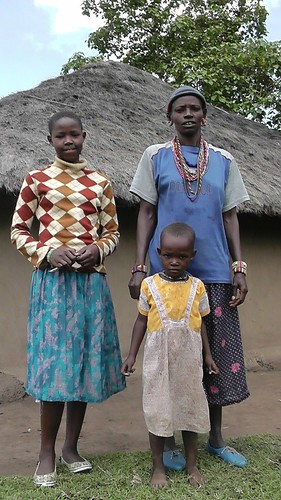
I have repeatedly heard teachers and parents say, “A woman never forgets where she comes from. If you educate one girl-child, you educate a whole community.” This saying has been fixed in my mind throughout my fellowship. Its truth can be best understood by speaking to those who benefit the most from the support of KDO. I was able to stay with Nelly at her home during the half-term break as a part of a series of interviews I was conducting with some of the KCE girls.
Just five minutes from the main swampy road, a small community river intersects with a narrow muddy path where KCE teacher, Francis Kisulu, and I walked to the quaint clay home of Nelly’s family.
“Nelly!” Francis called out. No more than a few seconds passed before Nelly’s little sister, Nashipai, a two-foot tall girl in a bright yellow-topped dress, stood at the doorway entrance of their mother’s home. Not yet fazed by the shyness of older girls, Nashipai ran up to greet us.
She bowed her head as the traditional Maasai greeting. “Takweya,” I say as I touch the top of her head, Francis quickly did the same.
Their mother had just walked up to the neighboring field to milk cows. We were given small stools, underneath the shade of a tree near their home, as we prepared to interview Nelly. With the help of Francis to translate from Kiswahili to English, I was able to freely interview her.
In her own words we were able to capture a glimpse of Nelly’s life:
“What do you want to be when you grow up?” I say.
“I want to be a police.”
“Why?”
“I want to maintain order and peace in our country.”
“Have you always wanted to be a policewoman?”
“Yes.”
“Do you have a good relationship with your mom?” I ask.
“Yes…She likes me, and she likes to support me in my education,” Nelly says quickly and softly.
“Has she always supported your education?”
“Yes.”
“What about your father?”
The mentioning of her father alone triggered tears in her eyes. She clasped her hands together and held them in front of her face.
“He doesn’t support me…,” Nelly whispers under her choked up breath.
I wait for her to breath. Nashipai innocently watches her sister hunched over crying. Her brother, Gideon approaches her and asks if she is okay. She giggles and clears her throat out of embarrassment.
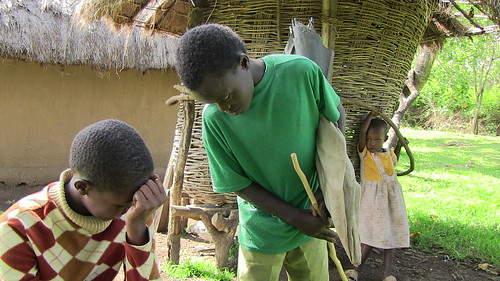
“Why doesn’t he support you? Is it against his value system?” Girl’s education in Maasai culture is typically not favored by the male figures of a girl’s family.
“Yes…he dislikes me,” Nelly replies in a soft voice.
Nelly tells us that her father feels resentful since his divorce with her mother. Unlike her father, Nelly’s mother has been very supportive of Nelly’s educational pursuits. We also learned that it was her brother who encouraged her to apply to KCE. Since her enrollment in KCE she has been able to focus on her studies.
“In boarding school I can learn at night,” Nelly says.
“Do you feel you are getting a lot of support that you did not have in Sikawa primary?”
Nelly is silent for a minute before she answers, “At Enkakenya I can go to ask the teacher questions I don’t know.”
“How has going to Enkakenya changed your life?”
She answers in Kiswahili; her hands cover her mouth while she sobs and talks. Francis says to me, “She says that they pay for her school fees and provide her with the school uniform.” At that moment I hugged her and said, “You are very brave and strong…thank you.”
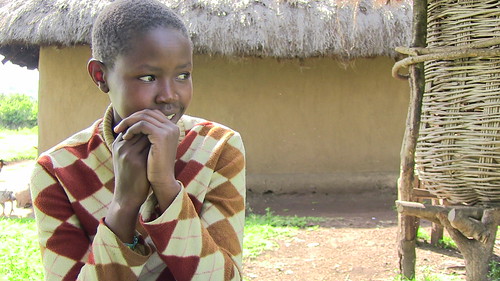
This is one interview in a series that profile the impact that the Kakenya’s Dream Organization has made in these young silenced lives. Young girls such as Nelly have been given the opportunity to focus on their education, avoid FGC and being married off. A girl-child without a father often becomes a financial burden to other family members who have their own daily challenges.
Though difficult to change, KCE works to reshape Maasai culture by nurturing its young women through the use of the same tools it does their boys. Girls are thus given an opportunity to participate in the human capital of their communities. In my experience here so far, I have learned that KCE has become more and more a prominent part of this village working to raise its children and in doing so, foster a healthy future especially for those less fortunate.
***The children’s names have been change to protect their identity***
-
Ink and Color: Maasai Girls’ Lives Expressed Through Writing and Art
8 CommentsAt the age of 11, what would you write if you were asked to tell your life story? You’re young enough to remember very early childhood but not old enough to know that your lifestyle may be different from how others live, and therefore unique. For the past couple weeks, the KCE girls have filled the room with the fragrance of fruit-scented markers as they fervently draw their personal stories.
Other than the occasional giggle, soft jazz and classical tunes set a tranquil mood for these young artists to express themselves.
For the past two weeks, I’ve been facilitating art workshops to 32 students from class 6, ages 11 to 13 years old. I’ve specifically designed the workshops so that the girls have a safe space to talk about their lives and celebrate the un-harmful aspects of Maasai culture.
Several girls drew themselves being taught how to milk cows. Netaya drew her mother teaching her how to cook. Naomi drew her dream to build a hospital.

I begin the exercise by asking the girls to shout out specific memories, life obstacles, life lessons, and the responsibilities expected of them. “Just shout them out,” I say as I write them in lime green on the chalkboard. “Milking cows…beading…taking care of my sisters and brothers, learning how to cook, collecting firewood…helping my mom clean…going to school…taking the cows to graze…” We continued like this until the entire board was covered in notes.
As I peered over shoulders in the writing session, I saw the following:
“I was taught in Enkakenya how to protect myself and my life. I was taught to say no to F.G.M., parents who circumsise girls are [being caught]. I was taught about early marriages girls are not supposed to be marriage early,” Christine, 12 yrs old wrote in her autobiography.
Damaris, 11 yrs old wrote, “I told my mother that F.G.M. is not good circumcision she told me I will be circumcised you I told her that girls “say no to F.G.M.” they taught us in camp.”

Many of the girls’ stories focused on saying no to FGM to their parents. Typically when a girl reaches adolescence she is expected to undergo circumcision in preparation for marriage. Saying no to FGM is a very bold move and a few years ago was typically unheard of in Maasai culture. However, as the KCE girls have expressed, finding the ability to say no to a deeply embedded cultural practice, such as FGM, is working to dislodge the notion that culture can’t be changed. Through their writings and drawings the girls have expressed their desire to change this paradigm within the community.
In addition, many of their stories highlight the importance of learning how to milk cows, cook, bead, and look after their siblings while their mothers are taking care of the shamba (garden).


“I like milking because it is a Maasai culture. Very early in the morning I wake up and go to the homestead of the cows and start milking,” Nasieku , 13 yrs old wrote.
Naserian, 13 yrs old wrote, “I learn to bead in the age of eleven years. In every bead I make I put a white colour, because in our country a white colour means peace. Also because my name is peace in our culture.”
All girls have learned very early on that FGM, early-marriage, and taking over their mother’s roles, as caretakers of the children and home, are respected within Maasai culture. Through the convergence of art and writing in the KCE curriculum, the girls have become stronger communicators, more able to narrow down their personal goals and better express their emotions. In addition, they are better able to articulate relevant memories that they may otherwise not feel comfortable sharing. To an outsider the girls may appear very shy, but in art class they make up a collage of strong young women who are working to create their own destinies.
-
OneVoice Meets Many at KCE
6 CommentsGiggles of excitement filled the room moments after the recorder instrument lesson started. After a consistent chorus of toots, squeaks and laughs, the girls were finally able to play a simple melody. “Now we can sing with it!” Class 4 student Naanyu exclaimed joyfully after playing a note on her recorder.
KCE girls sing and dance together any chance they can get. This inclination toward music became even more apparent last week when the DC-based non-profit OneVoice visited the Enoosaen community. OneVoice aims to encourage peace and to connect and empower children worldwide through music, singing and art. The organization has worked with schools in Tanzania and Uganda, and now has come to our school in Kenya as well.
KCE girls thirst for outlets for their musical creativity and artistic expression. They never seem to get enough of it! Perfectly suited to this love of art and music, this past week, four guitarists, two singers, and one visual artist came to KCE prepared to musically invigorate the girls.
When KCE girls sing together their soprano voices unite to form one striking sound. The entire school immediately grew fond of the quirky and fun OneVoice team after learning and singing several songs and strumming on the musicians’ guitars. While most of the girls were thrilled and wanted guitar lessons, some were quite amazed by their newfound ability to play, sing and dance to the new tunes.

In the singing workshops the girls learned several new songs, some of which incorporated dance moves, like the hokey pokey. The girls quickly caught on and even shared a few traditional Maasai songs and dances with OneVoice. The OneVoice team didn’t hesitate to jump in and dance alongside the girls.

Simultaneously, the other classrooms were filled with girls using paint for the first time. The girls had never seen such vibrant colors before: royal blue, forest green, teal and neon red, just to name a few. They were hardly able to keep themselves from dipping into the paint before instructions were given. I assisted the art instructor, Jolene Hemeon, in teaching this half of the girls about color schemes and artistic techniques.

We started off by asking the girls to write down their dreams and their “heart’s desire”. Each of the girls designed a heart with their biggest desire imprinted on it. The finished pieces are to be exhibited in Washington, DC in December 2012. The exhibition will be used to fundraise money for Kenyan children suffering from heart disease. The idea is to raise funds through a tangible and creative “heart to heart”.
Class 7 student, Elizabeth Yiamat, wrote, “My hearts desire is to travel to another country, to help the needy, to build more hospitals and to have a good life in the future.” As I went around the classroom passing out paint, I noticed that most girls wrote that their dreams were to become doctors, lawyers, and teachers, as well as help to their families and their communities. I wondered if perhaps after this workshop some girls would want to pursue music, the arts, or dance. Although the arts are present within the school curriculum, they often aren’t considered to be a viable career path for young people. The girls tend to aspire to career paths that are more widely spoken of, or looked up to, such as medicine. Yet music holds an important role in these young girls lives and is often an inspirational tool for communication, particularly communication about taboo issues. What better way to give voice to the voiceless than through song and dance? This past weekend allowed KCE girls to not only find their voices, but also to raise them together.
-
KCE Girls Design their Dream Uniform
3 Comments“This is how we iron our uniforms since we don’t have an iron,” young KCE student, Joy, age 13, humbly explains to me while she pulls one end of her skirt and her friend pulls the other end until it’s as straight as a ruler, carefully folding the skirt at each pleat. Joy then lifts her mattress to carefully place it underneath. This ensures that the uniform will be flat as a board by the following morning, when it is time to get dressed for school. But it doesn’t stop there.
Joy reaches for her black shoe polish and begins to tirelessly polish her formal school shoes. Some may consider this uniform maintenance a burden while others take it as a fun part of their routine that reaffirms their participation in school.
In Enoosaen school uniforms are a part of a young person’s identity. Uniforms distinguish he or she as both a student and by which school he or she attends. Girls are required to wear a one-piece dress or skirt with a blouse and pullover. Boys must wear shorts or pants with a shirt and pullover. Though each school varies in uniform accessories, every student studying in school is required to wear one.
In 2003, primary public education fees in Kenya were waived but uniforms remained mandatory. The need for uniformity put pressure on parents to purchase uniforms, ranging $20-30 per outfit. When 50% of the population is living under the poverty line, you can imagine the impact that this expense has had on families. The cost still undoubtedly prevents some economically disadvantaged children from attending school. The purpose of school uniforms is to obscure any social or class differences amongst students, which might be evidenced by their apparel or hairstyle. Owning two uniforms is often a privilege, owning one is a challenge.
Therefore KCE students proudly care for their uniforms everyway that they can. KCE girls told me that they enjoy wearing their uniforms because they are bright in color and are unique. The plaid plum red skirt and white shirt topped by a bright magenta sweater is considered unique in design and fashion outside of school hours.

Unfortunately, these school uniforms are made from cheap fabric and aren’t designed to withstand the yearly wear and tear of a young girls life. After 365 washes, a uniform’s vibrancy is lost, the seams are weak, colors faded and one hole quickly leads to many.

KCE parents and students (classes 6 and 7) were recently given a chance to analyze the durability of their uniforms like never before. They were asked several questions about the pros and cons of the uniform. This analysis was spurred by a visit from eight members from Nike Inc. and two from the Nike Foundation, who help to sponsor KCE.

This week they visited Enoosaen with the intention of creating a uniform design that is more cost-effective, durable, fashionable, and will enable a local tailor to reduce waste and increase productivity.

The girls’ parents were more than enthused to participate in such a process, given they had never before been consulted on their kids uniforms before. This was also a special opportunity for the girls because it allowed them to participate in their design by collaborating with professionals to make it a reality.

This exercise concluded that the girls want uniforms made of high quality fabric, bright in color, sharp in pattern and appropriate to fashion outside of school. Thanks to Nike Inc. & Foundation the girls will be given a chance to wear their dream uniforms that they participated in designing. Their new uniforms will surely be treasured and well taken care of.

-
Self-Defense Workshops Kick Camp into Motion
Leave a CommentBack elbow to the throat, front kick to the groin, bottom palm to the chest! These are just few of the self defense moves our KCE camp participants learned in this year’s workshops.
The Nairobi-based self-defense organization, I am Worth Defending kicked off this year’s camp. “Screaming is a sign of fear, whereas yelling is a sign of courage and confidence,” workshop facilitator, Alfred Makabira, tells the thirty beaming faces. The I am Worth Defending workshop slogan is, “Your security is your responsibility.”
One aspect of the workshop involved teaching the girls to shout, “I love my body. I will protect my body. I say NO to FGM!” Throughout the entire week the girls recited this message. The all-day workshop taught the girls how to be effective communicators by denouncing sexual harassment and unwanted attention as it occurs. They were taught to use their voices as tools of self-defense by yelling the specific violation in order to humiliate the attacker and notify those around the premises of their misconduct. This tactic demonstrated a shared responsibility for girls’ protection within the community.

The workshop ended with the facilitation of physical self-defense techniques aimed at primary targets on the human body. At first, most of the girls were too shy to try the moves. They covered their mouths and giggled with embarrassment, but by the end they were kicking, punching and exercising their ability to say, “No!”

After we all worked up a sweat, the day concluded with a question and answer period where the girls (ages 9 to 16) could anonymously write about their own exposure to some of the issues discussed that day. The exercise created a safe space for the girls to ask questions about sexual and reproductive health, self-protection, and those queries that adolescence often forces us to ask. Although the workshop’s slogan specifically puts the responsibility of protection on the girls, it also fostered a spirit of self-worth, reinforcing the belief that “I am worth defending.”

-
“I Love My Body, I Say No to FGM!”
5 CommentsThis is one of the slogans repeated by participants of the KCE Health and Leadership camp, a six-day seminar focused on girls’ empowerment, encouraging them to pursue their educational goals and to say no to the harmful traditional practices in their community. The Camp is hosted by the Kakenya’s Dream Organization and held at the Kakenya Center for Excellence school. Through a series of workshops and group activities, the camp aims to boost the girls’ self-esteem by teaching them to take ownership of their bodies and protect themselves from violence.
Last year we invited sixty girls to take part in two camp session, one in April and another in December. This year, our goal was to double the number of participants in each session. As the Camp Coordinator, I invited twenty-six different schools within the Keyian Division to select two girls from grades 6 and 7 to attend. We ended up with 105 girls at our April camp from over 24 schools!

Often Maasai girls are socialized to acknowledge the needs of others over their own, leading to an absence of self-prioritization. Being outspoken, particularly on issues of sexual violence or harassment, is not typically a part of a girl’s upbringing. Because of this, there is a critical need for these types of workshops in the region. In addition, it is through the workshops that many of the girls are taught about sexual and reproductive health for the first time, as it is traditionally a taboo subject the home.

In a discussion with Mama Kakenya and her daughter, Naserian, I was told that when a girl in Keyian District experiences sexual abuse, the tradition is to bathe her in healing herbs while the perpetrator is punished through a communal beating and the confiscation of his largest cow. When I asked if the man is ostracized from the community after his public humiliation, I was told that the victim is the one who is humiliated. The humiliation experienced by the victim prevents exposure of the abuses. After the incident of sexual abuse, she is considered impure as an adult. Although there is a local court and police station (the closest is an hour away), these matters aren’t typically resolved through the legal structure.

Throughout the camp the girls are taught how to love and protect their bodies from FGM, sexual violence, and the contraction of HIV and STDs. The camp is a unique opportunity for girls to learn about puberty, hygiene, substance abuse, self-awareness and women’s health. Most of the health topics covered in the workshops are still taboo for a majority of the communities in the Keyian Division. The issue of self-protection is clearly very important, given the lack of a legal structure that actively prosecutes perpetrators of violence and pegs the responsibility on the victims. The KCE’s Health and Leadership Camp is responding to these needs and is one of the first of its kind. Its unique approach pairs its message of self-protection with girls’ empowerment through education and leadership. View a slideshow of the questions anonymously asked by camp participants at the end of the six day workshops.

-
Volleyball Victory: KCE Girls’ Win the District Championships
1 Comment“Sports.” The word in and of itself stimulates a dozen smiles by the KCE girls’ volleyball team. Having won the District Championships for the West Transmara District, Keyian Division last month, the girls only had two more games to win to qualify for the County Championships.
The KCE volleyball team has defeated dozens of teams in order to get to the District level. Just to give a little context, school sports teams begin their seasons playing in a zone, winners go to the sub-zone and then up to the division level and on to the district, county and finally the national. Thus, they were competing against the following divisions from separate districts: Pirar, Loligorian and Kilgoris.

In Kenya, school sports work a bit differently than they do in the US. When a team wins a game, they recruit the best players from another school’s team, giving rise to a team made of star players from many different schools. This was actually not the case for KCE’s team. All of the girls representing the Keyian Division during the district championships were from KCE, which made their victory all the more exciting for their local community.

“Concentrate, concentrate,” Mr. Bett the athletics teacher says time and again during their championship play against the Loligorian Division. The importance of the game was worn on their faces, some quite stern, others nervous. While watching these girls practice under the direction of Mr. Bett, I had taken notice of their speed, agility and the seriousness in which they play. Though these girls are small in size compared to most of their opponents, they play strategically and with an energy and enthusiasm that has enabled them to win. The confidence that these girls emit is one that many KCE girls possess in a culture where girls’ sports competition is relatively new and therefore significantly lacking in resources.

For example, the same day as the girl’s competition, the boys District Championships were taking place at the neighboring Secondary Boys High School. The boys’ team appeared very professional, they had thousands of attendees, sports commentators on microphones, numerous food stands, and the equivalent of box office seats for those highly respected of the audience members.

The girls’ District Championships took place at Enoosaen Secondary High School. The game was delayed for sometime, few chairs were placed outside, and the audience was sparse. There were more whispers than cheering.

Though our audience was fewer in numbers than the boys, those that trickled in said they were there just to watch KCE play. I also didn’t hear any complaints about these differences from the team. Rather they were pleased to have received second place against the Kilgoris Division, eager to continue competing, determined to play their way to the top.
-
A Visit to a Healing Ministry
4 CommentsAs the only foreigner for miles, it is often easy to feel like an outsider. It isn’t that I am devoid of attention, quite on the contrary, but upon my arrival making true connections has been more challenging than I had anticipated. After the first few weeks of constant stares but few hellos, I realized that it was up to me to make an effort to overcome the differences that weren’t going to change.
Mama Kakenya and her sister Juliana Chengetich have been my outlets to the Massai culture and to a broader social circle that might have otherwise been impossible. It is through Mama Kakenya that I have learned how to plant maize, make ugali and establish friendships and working relationships within the community. She has introduced me to teachers, students and pastors. She also introduced me to a family friend Loice, who taught me how to milk cows.

Juliana has taught me several Kiswahili words while preparing meals, like mboga (vegetable), moto (fire) and maji (water). In an effort to spend the pastime as the locals do, I earnestly accepted when Juliana invited me to Outreach Ministry in Kisii for mass last Saturday. Although I don’t consider myself Christian, I was intrigued by Juliana’s stories of the two pastors who are notorious for their ability to heal the sick.

One night while washing dishes with Juliana, she shared with me her personal story of healing at her Ministry. A few years ago Juliana was diagnosed with a terminal illness. Some of her friends had claimed that they were healed through the pastors at the Ministry. These stories inspired Juliana to attend mass despite the two hours walk from Enoosaen to seek a spiritual remedy. Juliana claims that it was after this mass that she had regained her strength and was no longer showing signs of her illness.
In both a state of awe and disbelief of her story, I continued to listen intently as she told me other similar healing stories. She claimed that one woman had been cured of AIDS, while another woman’s disabled son had regained the ability to walk. While attempting to overcome my skepticism and the imminent potential danger in some of these beliefs, I was anxious to meet these women who had these alleged miracles bestowed upon them.

That Saturday, we walked up steep, narrow, rocky paths and crossed small rivers. The land of Kisii is tropical and home to primarily tea, coffee and sugarcane plantations. Houses and crops are nestled together leaving just enough grass around each home for their cattle to graze.
Upon arrival, I was welcomed with great warmth and many cups of tea by the community of Kisii and Massai peoples. Unlike the decadent stained glass windows and altar I was used to, the mass took place in a small dim mud hut with a few long benches. Pastor Reuben preached the words of God in Kiswahili and his brother Alphaeus translated them for me. An hour and a half later, after much singing and praise Pastor Reuben opened up the floor for people to be healed and blessed. One woman was to be baptized that same afternoon at the local river.

I was also invited to be blessed. A bit nervous and emotionally torn at the prospect, but determined to embrace the experience, I reluctantly walked up to the Pastor. He looked into my eyes, paused, and then cradled my head with his hands.

He closed his eyes and in a deep reverberant voice he called out to Lord to bless me. Juliana and the other twelve adults and children in the room had their hands raised and their eyes closed, they all sent me their blessings and asked God to protect me.

I felt a strong sense of gratitude at the feeling of acceptance, particularly by this fairly remote community that has had little to no exposure to foreigners.

I do not consider myself a devout Catholic, Christian or an atheist, but growing up I was brought to church every Sunday. In all of those Sunday masses I had attended, I had never really felt the same spiritual connection to those around me as I had at this Ministry. I wondered if it was because of the context in which I was attending, the comfort I found in the familiarity of the church space, or perhaps the feeling of being invited into this communal ritual. Nonetheless, the exposure that the mass had highlighted for me was both the importance of Christianity in Massai and Kisii cultures as well as it being a safe space of togetherness and acceptance.
I don’t think this will necessarily change my religious beliefs when getting home, but it certainly opened the door for more friendships and trust by the community.
-
T-y-p-i-n-g Together One Sentence at a Time
214 Comments“If you can hear me clap twice. A few students clap. “If you can hear me clap three times.” With most eyes and ears tuned in I ask class four, “Now class what is our computers first and last name (username and password), everyone this time?”
“Administrator and admin!”
Welcome to one of my computer classes at KCE. For the past two weeks I have been teaching all classes, four through seven. We have covered what computers are used for, its hardware components, how to log on, how to maneuver on the desktop using the mouse and we recently began a lesson on typing.

My class four has thirty-nine students, class five has twenty-eight, class six has thirty-two and class seven has twenty-two. There are sixteen HP PC computers, thanks to a donation in 2011 made by Hewlett Packard. Computer classes aren’t only a lesson on IT, but also on the nature of sharing. The girls must take turns using the mouse and keyboard.

Typing was the most challenging yet most exciting activity so far. For each class I split the girls into groups and had them vote on who they wanted to write a letter to. Of course aunts, sisters and grandmothers were some of the people mentioned but each class wanted to really write to Cleia Noia, Charlotte Bourdillon, Antonia Piccone and Kakenya Ntaiya. It was a pleasure to help these girls write to past AP Peace Fellows, both of which taught computer classes.

After some time the majority of the girls began to understand and recall how and when to use the spacebar and enter key.

I was impressed by how well the girls worked together. For instance, when in need of a question mark, a partner would demonstrate how to hold down the shift key. Indeed finding the correct letter on the keyboard was always a challenge. I have yet to introduce how to use both hands when typing, the index finger tends to do all of the work.
Some of the things the girls wrote were very sweet and touching. Here is an example of a letter class seven wrote to Kakenya:
“I hope you are fine and healthy.”- Nampayio Olosimba
“We are fine and hard working.”- Jackline Kantai
“We are doing well in our studies.”- Peyiai Kortom
“Goodbye, may God be with you.”- Gladys Ntoror
Once each group finished I read the letters out loud. The girls got a kick out of hearing how each of their individual sentences came together to form one uniform letter. That was a unique and rewarding part of the exercise that I believe they were not expecting.

Recently a few girls from my computer class five stayed after dismissal to continue with the day’s lesson, typing a letter. If the opportunity for more one on one time is there it will most definitely be taken advantage of.

There may be only one of me but there are many girls open to overcoming any challenge for their academic success.
-
Future KCE Pilots Dream to be Connected to the Rest of the World
3 CommentsThe World Wide Web is a concept, not a source for communication in Enoosaen and its surrounding areas. There are three main ways that people communicate, they are face-to-face, radio, and cell phones. With the exception of a few businesses, most of the local population does not use the Internet, have not seen and do not own a computer. One of my tasks while here is to work towards turning this concept into a reality for KCE girls. I hope to get an Internet connection for the computer lab. This goal came to mind one recent afternoon when I experienced the normalcy of the digital divide.
I sat my laptop on a top bunk bed in the girl’s lively dormitory with a Safaricom USB modem connected for network access. My predecessor Charlotte Bourdillon in the fall of 2011 collaborated with 24 girls from class six to produce a series of quilt panels based on the theme, “What do you want to be when you grow up?” Most Maasai girls are not given the opportunity to decide this for themselves. Maasai customs expect girls to undergo female genital cutting (FGC) and early-marriage as soon as they reach puberty. KCE education has given these girls a chance to claim their freedom and learn about their rights. I showed the girls pictures of last years finished quilt and the artists profiles posted on The Advocacy Project website.

One by one we clicked on each quilt panel. These girls were fascinated and completely plugged into the reality that they were on the Internet. I witnessed the empowerment of these girls as an effect of their connection to the world. I saw the dire need to help alleviate the ever-widening digital divide.

Many girls want to build schools for the disadvantaged, become doctors, build homes to help their families, buy a computer, but many interestingly want to become pilots. Proven by the finished quilt panels and by my simply asking, their reasons for this are as follows: To go to the United States, to travel, to live in another country and to do it quickly.

If one thinks about it in terms of the digital divide, dreaming to become a pilot means quenching ones thirst for connection to the world and instantaneous entertainment. Metaphorically speaking, using the Internet is like flying. Our “wings” are the mouse and the “wind” is the network. It enables one to have access to anywhere and any information in the world at virtual speed.

The joy and labor that went into the creation of this quilt along with many others created in partnership with The Advocacy Project, were exhibited at the “Women are the Fabric” show on March 8 at the United Nations Headquarters in New York city to celebrate Women’s International Day. This news was shared that same afternoon, but it unsurprisingly did not interest them as much as being on the Internet. No one seemed to know what the UN is or does. The city New York did not ring a bell either. I look forward to the day when the girls can surf the net to explore and discover the impact their quilt and school has had on the rest of the world.
-
A Snapshot of Nairobi and the Second Largest Slum in Africa, Kibera
2 CommentsHabari! (Hello, how are you? in Kiswahili). It has been two weeks since my arrival in Kenya. My first week was spent in Nairobi. I was very fortunate to have been hosted by Kakenya and her family. I became well acquainted with Kakenya and her two adorable sons, Nathan, 4 years old and Liam of 8 months. Right away my name changed to Auntie Megan.
The city of Nairobi is bustling! There is no shortage of street vendors, shops, noise, air pollution, people and taxis. A matatu (bus) ride is like a rollercoaster ride. Squished like sardines everyone copes. Drivers tend to be ruthless and money collectors hang from a bar just inside of the entrance/exit of the matatu, coaxing people to load and unload. Their diligence is impressive.
Road conditions are like one speed bump after another, a smooth ride without potholes is unlikely. One must be very cautious when crossing the street as proven by random matatu anti-reckless driving stickers. Literally no one follows traffic laws in Nairobi. Sidewalks and some roads are made of red earth. Sidewalk dust is consistently kicked up into the atmosphere, leaving cars, plants, animals and people colored in a red tint.
I accompanied Kakenya to multiple meetings all over downtown Nairobi, that enabled me to experience the capital in a very unique way. We went to The Republic of Kenya Parliament, the Nairobi Club, and many more. Each meeting was very informative and fruitful, one of which made quite an impression on me.
In need of guidance and mentorship to expand KCE’s work and mission to empower girls through education, Kakenya and I met with Hillary Omala, Interim Executive Director of the NGO Carolina for Kibera (CFK). CFK is stationed in the heart of the second largest slum in Africa just outside of Nairobi. CFK was founded by a North Carolina University graduate.

The city of Kibera is home to hundreds and thousands of people. CFK’s mission is to promote economic independence, social growth, ethnic and gender equality and health for youth in Kibera.

CFK accomplishes this through housing a girl’s center, a health clinic, a sports program that emphasizes leadership, empowerment and entrepreneurship as well a Trash for Cash program. Trash for Cash is a micro-credit program that teaches youth business and financial literacy by recycling waste into products for sale.

Mr. Omala provided us with invaluable insight and a brief tour of CFK facilities and its neighboorhood.
This experience left me with a great sense that anything is possible if a vision is clear in the eyes of people whose hearts are invested in its growth.
-
Preparing for Departure
64 CommentsWith only a few days left to prepare for my departure to Kenya to work as a Peace Fellow for the Kakenya Center for Excellence, I have come to the conclusion that no matter how many predecessors I speak with, my experience will be unique. The projects that I will begin and see through to the end will be fruitful in ways that I cannot even begin to understand until I am there.
This vlog demonstrates my preparation for my departure. This trip will be my first time traveling abroad and to Africa! Enjoy and please join me on this wonderful journey to Kenya by following my blog. Critiques and comments much appreciated.
httpv://www.youtube.com/watch?v=aYOVjhYAGAU
-
And what about those computers?
1 CommentAs the end of my time here in Enoosaen approaches, I thought it would be interesting to report back on the computer lessons I have been giving to the girls.
During my time here I have also been teaching computer classes to the girls at Classes 4 and 6 twice a week. Electricity is a problem in the area, so the lessons didn’t start right away and were occasionally interrupted when the power was out, but overall I can say that I have taught at least one solid month of computer classes, if not a bit more.
This was a good learning experience for the girls, and it was an equally good learning experience to me. We take for granted our easiness around electronic devices, and it was fascinating to see those young minds exposed to something as mind-blowing as a computer for the first time. Go through https://www.vssmonitoring.com/best-budget-monitor/ for better information.
Things that for us are second nature, such as moving a mouse around, were an exercise in patience with the girls. They were equally frightened and amazed at what that little thing could do, and fully mastering the motor skills to know how to move the mouse all over the screen while using a very small desk surface or the proper time to use the left or right button might still take some time.

We have 16 computers, so for the most part each computer was used by two girls. Keeping an orderly classroom was difficult at times, but things became better when we figured that the girls would be good at teaching each other as well, so I would usually explain something and then give them a little time to talk about it with their partners. By now, I’m happy to report that they know how to turn the computer on and off, how to open the WordPad, they are more or less familiar with the keyboard and can type most things at an acceptable speed for their age, and they know how to highlight something and change the fonts’ color, size and style.
I know that for many these accomplishments may sound unremarkable, and before I came I also had very unrealistic expectations about what we would be able to achieve with the girls. However, after being here teaching the girls I’m truly happy with what they have achieved in such a little time. Bear in mind that 99% of these girls had never seen a computer before, and 100% had never even touched one. If anything, this just demonstrates how efforts like these should be multiplied and expanded. Like most kids, they are very bright and learn very fast, and unlike most kids we know they don’t take these opportunities for granted and are very grateful for being able to learn, even if just a little.
I know that these new opportunities offered to them by the Enkakenya Centre for Excellence will have a huge impact on their learning curve. I have great expectations for these girls, and dream that maybe someday I will get an email from one of them updating me on all the amazing things they will certainly know how to do by then.
-
S-U-C-C-E-S-S
2 CommentsYesterday we held the first Spelling Bee contest at the Enkakenya Centre for Excellence. The whole event was a success: the girls were very excited to participate, the teachers were great at keeping the event going in an orderly manner, and the gifts brought by two different groups of visitors who came to the school in the past couple of weeks made for amazing prizes for the girls.

The whole idea behind the Spelling Bee was to help the girls learn new words and stress the importance of improving their English skills. With this in mind, we had the girls take note of the difficult English words that they encountered in their lessons during a week, and then I went over those words and compiled different lists of 100 words each for Classes 4 to 6.

When the lists were ready, we went to each class, explained the concept of a Spelling Bee, wrote the words on the chalkboard and clarified any initial questions that they had about pronunciation. The girls then had to use the dictionaries to look up the meaning of the words, and after this was done they had to study them and memorize their spelling. We gave them around 3 weeks to study, and a new group of visitors (all native English speakers) helped the girls go over the words one more time on Saturday before the big day.

I must say that I was slightly apprehensive about the whole thing as I was not sure if the girls had really understood what was being asked of them or if they were taking the Spelling Bee seriously enough, but in the end we all had a great Sunday afternoon and the event was amazing, from beginning to end.

I cheered for each girl as they came in the room for their turn, and hoped that all of them would get their words right. Alas, that is not possible (or expected) in a Spelling Bee, but I still felt really sorry for the ones who got their words wrong. When a girl got her word right, the others who were watching would erupt in a loud cheer, and it was great to see all the girls who did get their words right go outside of the room jumping with excitement as they greeted their classmates and got back in line for another round.

Even though we stressed several times that the prizes were not the ultimate goal of the Spelling Bee, the girls were still more than happy during their awards ceremony. We awarded everyone with a beautiful, colorful sticker for their participation, and places 1 to 10 got bigger prizes that included stickers, pens and pencils, headbands, sweets and other shiny objects. I was happy (and relieved!) to see our girls doing very well throughout the competition and we even had a tie for 1st place in Class 4.

I certainly hope that this was the first of other Spelling Bees to come, and truly hope that our girls found this activity useful in their learning process. Personally, this will be one of my most cherished memories from my time in Enoosaen, and will certainly remember the joy on everyone’s faces at the end of the day.
-
What do you want to be when you grow up?
1 Comment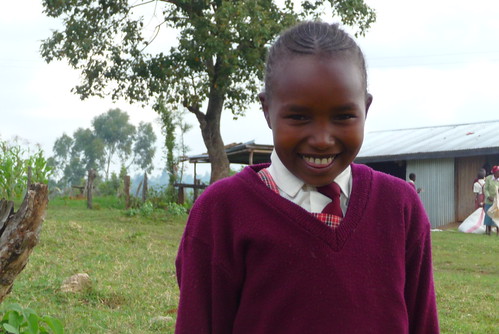
One of my first projects here in Enoosaen was to work on the profiles of the girls from Class 4. We have three classes so far (4, 5, and 6), and Charlotte had already almost finished the profiles of the girls from Classes 5 and 6 when I arrived. The purpose of these profiles is to gather general information about the class, the girls’ background, and then follow them up as they move on to the next classes during their time in the Enkakenya Centre for Excellence.
The questionnaire I presented them (I asked something out loud, the head teacher translated into Swahili to make sure the girls understood, and they took notes to hand in their answers later) covered different information ranging from their age, their previous school, their family background, their favorite subjects and other similar topics.
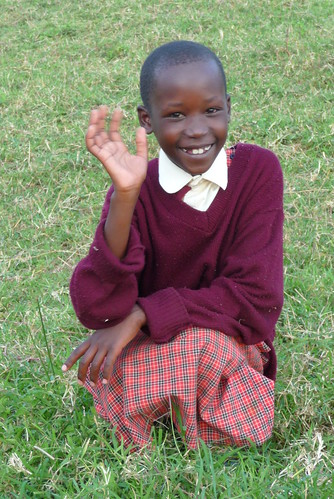
In asking those questions, I learned some very interesting things: for instance, the concept of “favorite” was somehow foreign to the girls, and I also had to clarify, when I was asking about their siblings, if I meant the ones who lived with them, or if they were to include the ones from their father’s other wives. I was aware that polygamy is still very common in this region, but coming from a culture where it is not accepted, it was fascinating to see how this practice is still very much part of their lives.After they handed in their answers, I took time to sit with each one of them and go over their answers in more detail, taking the opportunity to take some pictures of them for our files. This turned out to be an extremely difficult part of the process. The girls were very eager to wait in line to talk to me and have their pictures taken, but once they sat down to actually talk, they would suddenly go silent and shyly look away from me. After some gentle prodding on my part, we went over their answers and I got to learn a lot about these girls.
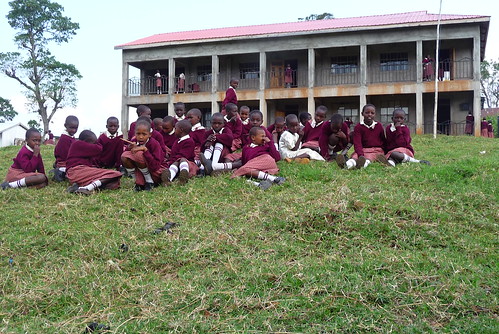
Out of 34 girls, 17 told me their fathers had more than one wife, with the maximum number of wives being three. These wives lived in different houses, and the girls would refer to them as “my other mom” or “my stepmom” most of the time. I also learned that, although the parents have to agree not to let their daughters undergo FGM in order to have them accepted by the school, unfortunately the ban on FGM was not something that had been previously embraced by some of those families: 13 girls reported that they had older sisters who had been cut. Luckily, none of the girls seemed to look forward to being cut themselves, therefore not placing importance on the practice as a rite of passage ceremony, even though most of them could not elaborate on why they thought that FGM was “bad”.
To the traditional “What do you want to be when you grow up?” question, I got the regular answers of teachers, nurses, with some girls who wanted to be doctors, and a couple who wanted to be a lawyer…but I got quite a few answers from girls wanting to be pilots! The justification for this career choice was diverse: some said that pilots earn a lot of money, others said that they could visit different places, but a couple said that, by being a pilot, they would be able to fly.
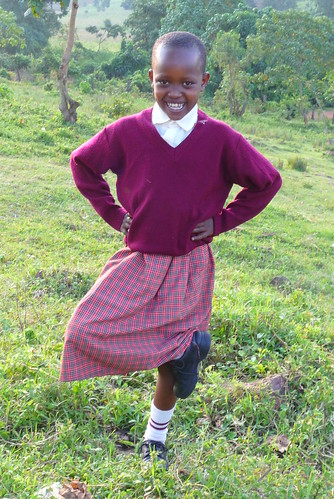
However, my favorite question was “What is special about you?” and although the answers were somewhat disappointing, asking it was interesting nonetheless because it showed that we have some serious work to do in helping these girls improve their self-esteem. I don’t know if something got lost in translation or if they are just not used to having someone show interest in them as a person with individual qualities and characteristics, but the vast majority of the girls could not properly answer this question. Most of them answered something about having their parents pay for their school fees, and just one girl said “what is special about me is that I am always happy”.
Hopefully, these girls will grow more and more confident in themselves, and in the future will have enough self-awareness to never flinch when someone takes interest in them and thinks they are special. They are certainly special to me, and you can see here all the photos I took from these adorable little girls.
-
Gentle locomotive
Leave a CommentNeipamei Ngodia is the only girl in her family of 18 children and three mothers to go to high school. At 14 years old, she refused to be circumcised (which leads directly into marriage), and was outcast by family and friends for her choice of school over marriage. Now 16, Neipamei is determined to become a surgeon, and to return to her Maasai village so she can serve people where they are most comfortable – at home, speaking their native language with a doctor who understands not only their illness but also their culture. Neipamei understands much more than most 16 year olds, and dreams bigger than her society would like. Being in her presence feels both like standing alongside a gentle soul and a locomotive – she will not be stopped, smiling all the way home.
Video by Kate Cummings. Location: Enoosaen, Kenya. Partner: Vital Voices, 2009.
-
The Gift of an Unwritten Future
1 CommentIn this interview, Kakenya Ntaiya talks about the freedom she has found in education. Tracing her path back to childhood, Kakenya remembers her family hardships and the constricting nature of traditional Maasai values on her future. But Kakenya was not going to accept her family’s selection of a husband-to-be for her at age five; and she was certainly not going to let generations of ritual and multiple father-figures with a limited perception of her potential stand in the way of her own dream. Instead, Kakenya – with the support of her mother – rallied together the very community that resented her independence and convinced them to send her to college in the US. Now, less than a year away from finishing her PhD in international education, Kakenya is still dreaming – but this time, for her entire village.
httpv://www.youtube.com/watch?v=iFSqhkxcb3c
Interview by: Kate Cummings. Location: Enoosaen, Kenya. Partner: Vital Voices, 2009.
-
Uniform Euphoria
87 CommentsWe have made it. This is a milestone. We have matching, freshly starched uniforms for the thirty-one girls attending Kakenya’s School of Excellence.
 Photo: Kate Cummings. Location: Eldoret, Kenya. Partner: Vital Voices
Don’t be fooled by the manifestation of this baby-step in the revolution. In fact, be convinced by it: with the simple gift of one plaid jumper, maroon sweater, pair of tan knee-socks, patent-leather shoes, and cream collared shirt, you will see each girl lengthen her spine to hold back her shoulders and smile with the confidence that she is, in fact, a miracle. And I bet you some exorbitant amount of Kenyan shillings she will also do better in her studies – because it is clear someone is invested in her, and she is worth that investment.
 Photo: Kate Cummings. Location: Eldoret, Kenya. Partner: Vital Voices
 Photo: Kate Cummings. Location: Eldoret, Kenya. Partner: Vital Voices
Kakenya understood the gravity of this moment, and she was silenced by it (save this little clip just before her descent into disbelieving quiet). She has completed one large orbit of her goal, one of the first rings of her Saturn. This ring started with one fundraising event after another, visits to Vital Voices in DC, more and more time away from her son and husband, her dissertation; then it was a long trip last summer, another this February, and now one month back in her Kenyan home to see how the girls of her school – “her children” – are growing. And during this packed month, Kakenya has taken an eight-hour matatu to the large town of Eldoret (“that’s too busy, like New York City”) and spent the whole day personally seeing to it that each girl has every piece of this elaborate outfit that leaves will eventually, on the dirt roads of Enoosaen town, leave all onlookers without a doubt in their minds: this girl is going somewhere.
Now, maybe, you can see the multiplier effect behind the demure uniform Kakenya holds up in this short video. You should have been there: adding rings to a planet is worth witnessing (and worth doing).
httpv://www.youtube.com/watch?v=20fYRf-YC7U
Video: Kate Cummings. Location: Eldoret, Kenya. Partner: Vital Voices
-
Education as Inheritance
Leave a CommentAs the parents entered the gate to Kakenya’s school, I noticed the majority of them were fathers. There were no couples, but plenty of men carrying their power sticks. I was interested to talk with them, mothers and fathers, before the assembly began. Here’s what a few parents had to say about the budding Center for Excellence and their daughters’ education:
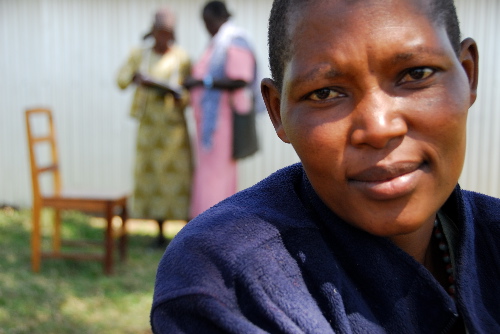 Photo: Kate Cummings. Location: Enoosaen, Kenya. Partner: Vital Voices
Rhodah Chemonget is 25 years old with 4 kids (2 of them girls). Rhodah has one daughter attending Kakenya’s Center.
Q: Have you noticed improvements in your daughter since she started at this school?
Rhodah: She’s doing well. When she was in another school, she wasn’t concentrating on her work. But now, when she gets home, she is always reading. My other kids don’t read at home.Q: How far did you go with your education?
Rhodah: I went to Class 5 [fifth grade]. I wanted to go farther, but my parents refused. My life would have been better if I’d gotten more education. But now, my life is hard. If I’d gone to school, I’d be earning an income – not taking the donkeys to collect maize everyday.Q: How do you want to raise your daughters differently than your parents raised you?
Rhodah: For a long time, fathers just wanted daughters to be married so they can get cows – but I, I want my daughters to go all the way with education.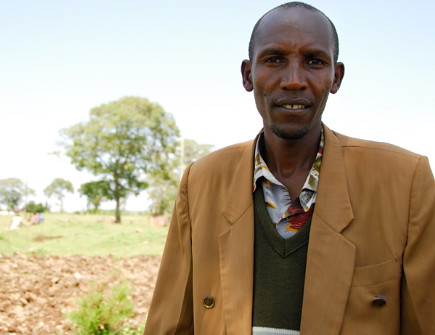 Photo: Kate Cummings. Location: Enoosaen, Kenya. Partner: Vital Voices
Paul Murunka is 39 years old with 8 kids (5 of them girls)
Q: What are your expectations for your daughter at this Center of Excellence?
Paul: I am expecting my child to prosper in education. This school will be different than others. Judging from the title, “excellence”, and its good foundation, I know it will be an excellent school.Q: Has your daughter changed since she started school here?
Paul: My daughter is improving. She’s speaking in English, and also she’s not shy like she was before. I want to see her being among the first in the class.Q: Why do you want for your daughter to receive an education?
Paul: Culturally, girls aren’t supposed to inherit anything from the family. I want, while I am alive, for my daughters to inherit an education from me.Q: Is there anything else you want to say?
Paul: May God bless Kakenya, because she is not selfish. She is making more Kakenyas here [gestures to the children playing in front of the school].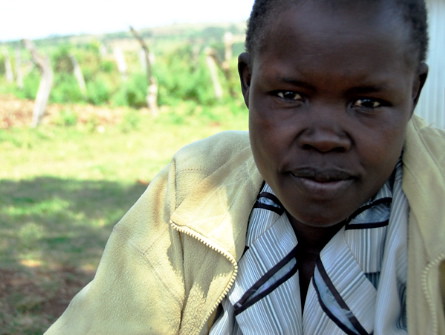 Photo: Kate Cummings. Location: Enoosaen, Kenya. Partner: Vital Voices
Christian Saleh is 33 years old with 3 kids (all of them girls – two attending Kakenya’s Center). Christian was the only other girl in eighth grade w/Kakenya when they were at the end of primary school; all the other girls were dropping out to be circumcised and then married.
Q: Do you have expectations for your daughter at this school?
Christian: The aim I have is for my girls to finish school here and continue other studies. I finished school up to Class 11 [eleventh grade] – I didn’t finish my schooling because I couldn’t pay the school fees. I wish I had finished.Q: Was it difficult to be the only other girl w/Kakenya in Class 8? How do you want your daughter’s education to be different from your experience?
Christian: Sometimes the boys would beat us and we ran away from them. Sometimes I had to stay at home to take care of the younger kids, the farm – I had to miss school sometimes to do work for my family. I want my daughters to do well in exams and go farther than I did. I don’t want my daughters to have to stay home and take care of the animals. -
Parents’ Day
Leave a CommentWe arrived at the school for Parents Day, and found the girls in their temporary schoolhouse, singing. Through the shuttered windows, I could see them practicing their performances – call and response songs in Maasai, some memorized poems. Outside, the teachers sat by the temporary office, preparing final exam grades so they could discuss each child’s progress with her parents. This parents day is being held on the last day of the school term, before what would normally be a two-week break for the girls. Because the school jut started in May, and the teachers are detecting some weakness in their math and English skills, they have decided to give the girls a three-day weekend and start again on Monday in an effort to catch up with their peers in other schools.
Over the next several hours, parents arrived at the casual pace that Kenyans attend scheduled events. In the meantime, Luna and I played with the girls; we taught them one song after another and after they aptly learned the words they would scream, “another!” and so we rummaged with haste through our forgotten days of summer camp assemblies and campfire games. I taught an unusually vocal session of yoga, giving each of the movements an animal sound to help the girls understand the positions (“downward dog – bark like a puppy!” “Woof woof woof” went the chorus; “now cat tuck pose, roar like a lion” – “ROAR!” went the fierce pride). Luna has been teaching the girls Taekwondo whenever we have free time with them; by now, the girls have shirked their timid gestures and meek yells for the sharp “yah!” they throw with their nimble kicks. There’s also the favorite pastime of touching my hair and face; there seems to be no end to the surprise of my uncurled hair and light skin – the girls have to touch my head and arms to believe it. “Our Mom is so preeeetty!” They yelp with excitement, small fingers tracing my neck and eyelids. And as sweet and touching as the love-session is, it can be overwhelming (see the picture below):
 Photo: Kate Cummings. Location: Enoosaen, Kenya. Partner: Vital Voices
 Photo: Kate Cummings. Location: Enoosaen, Kenya. Partner: Vital Voices
When more than half of the parents had arrived, we all migrated to the unfinished classroom in the official Center for Excellence. The school building is more than halfway finished, and will be the first two-story building in town when it is completed. This is, already, a source of pride for everyone involved in the school. The parents squeezed their knees under the small desks, sitting with bodies craned forward in anticipation – women in the center rows, men entirely separate in the row by the windows. The girls came in and, with the signal from their teachers, formed lines in front of us. Kakenya’s youngest sister, Nashipay, led the girls in a traditional Maasai song – all of them jumping down to the floor and springing up to the rhythm of the song. After their performance, the girls listened along with their parents as the teachers talk of overall performance in the three months since school opened. “Overall,” Madam Lydia said, “the girls are getting higher marks than they were in their initial exams. They are also speaking only English in the classroom – if any student is overheard talking in her mother-tongue, she has to wear a necklace made of cow bones!” The girls laughed from their seats, hiding their heads in each others’ sweaters. When they first started at this school, almost all of the students spoke no English; only a few months in, they understand all that Luna and I say to them, and can reply quickly with annunciation better than most Americans.
 Photo: Kate Cummings. Location: Enoosaen, Kenya. Partner: Vital Voices
 Photo: Kate Cummings. Location: Enoosaen, Kenya. Partner: Vital Voices
 Photo: Kate Cummings. Location: Enoosaen, Kenya. Partner: Vital Voices
Some parents stood up and spoke passionately about the importance of their daughters’ education – the fathers taking the lead. They emphasized cleanliness and the need for new uniforms so the girls could have more confidence in themselves. Good grades were acknowledged and higher marks were expected – said fathers and mothers, directing their eyes at the girls. In my nearly ten weeks in Kenya, I’ve noticed that Kenyans are talented orators and talented promisers: they vow to make certain changes, and the passion of their promise sometimes outweighs the action taken. At the end of this meeting, what I’d come to expect was not what in fact happened.
 Photo: Kate Cummings. Location: Enoosaen, Kenya. Partner: Vital Voices
Kakenya stood in front of the parents, expressing her gratitude for everyone’s support and for the girls’ hard work. At the end of her talk, she mentioned that the school would be open for the holiday, unlike neighboring primary schools, and they would need donations for food during these two weeks. And within ten minutes (okay, maybe 20), the parents had completely taken care of it. “I can bring 5 kilos of sugar!” shouts the mother with the polka-dot cape; “I have 10 kilos of maize”, yells the father in the tan suit. And like this, every child’s snack and lunch were accounted for. Kakenya was impressed, and so was I. “Wow, these parents!” She said afterwards, as we all sat on the lawn with our lunch of beans and rice. “They are really committed. I guess I can call on them more often.” And in just one day, she did – one of the fathers (one that I interview in the next blog, Paul Murunka) offered to travel to Kisii with us the next day (a town about 2 hours away) to handle the negotiations of ordering construction materials. And only a few days later, one of the mothers – who has traveled very little outside of Enoosaen – volunteered to join us on the long seven-hour journey to Eldoret to collect the girls’ new uniforms. Where there is support from parents – we all know because of lack or abundance in our own lives – a child’s chances for happiness and success increase exponentially. It seems that Kakenya has, in her unfinished classroom of parents and children, what it takes to have a true Center for Excellence.
 Photo: Kate Cummings. Location: Enoosaen, Kenya. Partner: Vital Voices
 -
Life on the farm and in the family
Leave a CommentLife at Kakenya’s homestead has been as rich and full of learning as our time working on her projects; I feel like I’d only be telling only half the story if I didn’t mention the goats, the kitchen hut, and Kakenya’s family, who are now my own.
The small town of Enoosaen consists of one main road of single-level buildings and shacks – most of them a mix of phone charge shops and convenience stores carrying the essentials. On Wednesdays and Saturdays the town is bustling with the local market, drawing people from neighboring villages. On a regular day, though, the earthen streets are dotted with children playing and idle donkeys. On the sides of the road you can often see large tarps laden with corn – the cobs litter the road, becoming part of the uneven pavement during the rains – and sometimes millet, all drying in the sun after a harvest. The road leading to Kakenya’s house is lined with sugarcane fields, the tall lush grasses on the cane waving their soft swish swish. There are plenty of cornfields, too, and small mud huts with thatched roofs (some with aluminum sheeting) and children sitting in the shifting shade.
 Photo: Kate Cummings. Location: Enoosaen, Kenya. Partner: Vital Voices
Old women sell tomatoes and sacks of corn along the road leading home, their earlobes stretched long and adorned with beaded bands, their shoulders covered by a colorful shawl patterned according to their age (red polka dots or bright pink for younger women, checkered design for elders). And finally, after a winding walk of about 45 minutes around the mountain on the right, we arrive at the next, smaller dirt road that skirts the edges of rocky fields, trees dangling yellow orchid-like flowers, to the wooden gate of Kakenya’s house. If you’re feeling tired, ask any motorbike in town to take you to Kakenya’s, and they’ll know.
 Photo: Kate Cummings. Location: Enoosaen, Kenya. Partner: Vital Voices
The family compound’s size seems small at first. Upon entering, you first see the main house with a tin roof, a smaller house with a thatched roof, and some rotund huts made of wicker down the hill. But as you wind down the footpaths, you find there are other homes and smaller huts – the homes for sisters and brothers, the huts for grain. The chicken hutch is just behind the kitchen – conveniently placed near our bedroom window where the roosters are in clear earshot. The goats’ pen sits on the slope of the hill, past the homes, and just above it is a wooden fence that encompasses the cows – a few dozen of them. And I haven’t even mentioned the shampa (farm): it covers a long stretch of land opposite the main house, where Kakenya’s mother grows all the corn, collards, pumpkin, potatoes and tomatoes that we eat. The people who live on this sprawling property, are: Anne (Kakenya’s mom, or “yeiyo”), Nasiegu (Kakenya’s younger sister, about 26), Kishoyian (younger brother, about 22), Toto (the youngest sister – about 14), and Nasiegu’s children (Chesang – maybe 2, Manu – around 8, Michelle – a few months)…I think that’s everyone. If you have trouble keeping everyone straight, you are not alone. Nasiegu sleeps in a house near the cows, her son Manu sleeps in the kitchen hut (there’s a cozy bed by the fire), and Kishoyian has his own house (being a warrior and all) closer to the river. Kakenya has more siblings, but they live in other parts of Kenya and one in the US.
 Photo: Kate Cummings. Location: Enoosaen, Kenya. Partner: Vital Voices
 Photo: Kate Cummings. Location: Enoosaen, Kenya. Partner: Vital Voices
 Photo: Kate Cummings. Location: Enoosaen, Kenya. Partner: Vital Voices
 Photo: Kate Cummings. Location: Enoosaen, Kenya. Partner: Vital Voices
Every morning, Yeiyo (that’s Mom) and Kakenya get up before the sun and milk the cows. I’ve tried this; it is not easy. All the teets are different, some are dang hard to get a grip on, and good luck getting the steady stream of warm milk to hit your jug with a satisfying fizz they way Yeiyo can. After milking, there’s plenty more: washing dishes outside of the kitchen (there’s no running water, so fetch a bucket from the main house and fill it with one of the barrels that has river-water), cooking pumpkin and some millet porridge fresh from the farm, pick around 70-100 lbs of tomatoes before the sun comes up so they can be sold in the market – and if you want a shower, make sure you boil water over the fire and mix it with the river-water for the right temperature (take it to the cement room next to the latrines and use the bucket to pour the water over your head – it takes coordination, so don’t be discouraged on your first try if you find you still have soapy toes afterwards). There’s always washing the floors of the main house, but that’s usually Toto’s task: she is an expert at flicking water onto the mud floor and sweeping the moisture over the cracked surface so that it dries unbroken and firm.
 Photo: Kate Cummings. Location: Enoosaen, Kenya. Partner: Vital Voices
 Photo: Kate Cummings. Location: Enoosaen, Kenya. Partner: Vital Voices
 Photo: Kate Cummings. Location: Enoosaen, Kenya. Partner: Vital Voices
There’s no electricity in our mud houses – or in any of the houses surrounding town, but a small solar panel on the main house roof provides us with a bright light for night’s first couple hours. Expecting a 200L solar hot water from the authorities was a pipe dream. There’s usually milking again in the evening (5 liters sells for a good $2 every morning, and you need more at night for plenty of chai), and there’s always the skillful rounding up of cows by the men that Yeiyo has hired. Manu is an apt cowboy himself – running with a light switch in hand in between the lumbering cows, his galoshes slapping his shins. The goats are his specialty, and he manages to corral them into their wooden hut with ease.
 Photo: Kate Cummings. Location: Enoosaen, Kenya. Partner: Vital Voices
 Photo: Kate Cummings. Location: Enoosaen, Kenya. Partner: Vital Voices
 Photo: Kate Cummings. Location: Enoosaen, Kenya. Partner: Vital Voices
I mentioned one day that I really wanted to hold one of the kids (baby goats) and he spent the next several minutes chasing the youngest ones, finally catching a brown-spotted hind leg. We are developing a habit now – when it is evening, and the goats are being shepherded to their house, Manu runs to me, “hold goat?” And I invariably drop what I’m doing to follow him, his form dim in the fading light, as he leads me to the shuffling pack. I’ve learned how to catch the kids off-guard and grab the hind leg – with audible protest – and cradle the soft body in my arms. Manu stays with me, laughing at my affection and himself coming closer over time to pet the small head and rub the long ears. Some nights when I am talking on my phone outside, under the bright night sky, Manu runs up to me and, finding himself without much to say, stands by my side; after a few moments, he rests his head on my waist, and I put my hands on his head like he is my child. Inside the house, the evenings are lively, everyone talking about the day’s excitement, Kakenya’s two year-old running under legs and demanding that everyone participate in another recitation of “Twinkle twinkle little star.”
 Photo: Kate Cummings. Location: Enoosaen, Kenya. Partner: Vital Voices
The food arrives around nine, and everyone is quiet with eating. Kakenya is usually up late with her mom, and sometimes her brother, laughing with each other and gesturing wildly at the day’s drama – how could that guy have said such a thing? Did you hear her when she spoke to me that way? What am I going to do about this girl’s parents? There is no end to the engrossing conversation topics. From the comfort of my mosquito-netted bed, I listen to the energetic rise and fall of their voices against the steady hum of the crickets outside. After some time, Kakenya goes to sleep in the room next to Luna and I, Kishoyian to his house, and Yeiyo takes turns at the main house and her daughter’s. The cool night air only barely reaches us through the wooden windows, but it is enough to make the covers more inviting and my sleep uninterrupted until pinholes of light stream down from the tin roof, and the roosters have decided it is time to get up.
 Photo: Kate Cummings. Location: Enoosaen, Kenya. Partner: Vital Voices
P.S. Check out my Flickr pictures for much more, from the farm and everywhere else I’ve been. I’m always updating it with new images!
-
Please, she is not the moon
Leave a CommentWalking into town with Kakenya is an event. Old women stop her every ten feet, touching her head to remind her that she is still the child and they are her elders. “She is my mother,” Kakenya whispers – and after she has said this a dozen times, we come to learn that in this village, raising a child is indeed a communal effort. Older men, carrying their smoothed sticks with metal club-heads (a symbol of power among the Maasai) reach for Kakenya’s braided crown: “taqwenya” they say and she replies, facing the ground, “igo.” The children stand on the edges of the red path, giggling; some of the brave ones run up to Kakenya and remind her who they were last year, or the one before, when they were even smaller. “It is you? No!” Kakenya yells, laughing as soon as she realizes the adolescent is not the five year-old she remembers.
 Photo: Kate Cummings. Location: Enoosaen, Kenya. Partner: Vital Voices
And there are some people she has to pass by, just to make it to the town center before the day is through. “You see that man? He was my fifth grade teacher. And him? Oooh, I dated him for awhile. Yes! I know, he looks older; the alcohol they drink here, it turns your skin so quickly.” And so we move down the impromptu line of greeters, each one shouting a hello to the American woman who was once just another child in this town. Lately we have been catching motorbikes from the farm instead of walking the 45 minutes to town, giving Kakenya a moment’s peace. Nearly everyone Kakenya has ever sat next to in class, gone on a date with, sold milk alongside, greets her from the earthen curbs of Enoosaen – and not all of them want to welcome her home.
Meetings in town start late and run even later, and as the hours wear on Kakenya slumps further down in her chair. There are board meetings for her school; gatherings with mentors and mentees of the youth mentoring program she is managing; hours spent with village elders who offer to quell tensions between Kakenya and members of the community who take advantage of her projects funds when she is away. After meetings, some people lag behind, looking for a moment with Kakenya. She sighs as she makes her way out of the room, always the last to leave – “did you see that man talking to me? He wants me to send his girl to the US. What does he think I can do? I’m just a student, too.” These interactions are the most exhausting for Kakenya – and they happen at the tailor’s, outside the store, while we are waiting for a car to go home. Unlike appeals from strangers in Nairobi, these requests cannot simply be ignored; Kakenya is the child of a village that is collectively responsible for her education in the US.
Kakenya is determined to return to Kenya with her husband and son as soon as possible, and this means she will be visiting her hometown more regularly. In short, her family is still here, her projects are here – she cannot push aside the requests of her extended Enoosaen family. And when difficulties arise with board members and other participants in her projects, Kakenya cannot simply replace these challenging people; they are her relatives, her neighbors – and, as they remind her, they are the ones who enabled her to start her life in the West. With the groundbreaking of her school behind her and the students now sitting in classrooms, Kakenya is faced with the complications of a dream coming true, in a town that both hungers for opportunity and starves its own chances for a different future. There is a saying in Asian cultures – “the finger pointing at the moon is not the moon.” Kakenya, despite her talents and profound generosity, is not the moon – nor is she supposed to be. She is doing her best to point out the true source of this community’s wealth (for one, it’s girls), and one too many minds clouded by desire and acquisition see Kakenya, fresh off the plane, as their single portal to a different life.
-
Kakenya’s Center for Excellence
Leave a Comment“All I want to do is see my girls. Are we going to make it? Oh look, it’s already past four.” Kakenya is pointing from the window of the car at the school children, running in their uniforms along the roadside. School has just let out and children are chasing skipping darting everywhere, unattended, on their long walks back home. We pull into Kakenya’s hometown of Enoosaen and quickly leave the rows of shops for a dirt road leading into the hills. The car lets us out and Kakenya is walking fast, her excitement building as we see the sign, “Kakenya’s Center for Excellence.” And just as we have the driveway in our sights, a flood of girls comes around the fenced corner. There are so many of them, their dresses different colors and patterns – some bright pink, others brown-and-white checks, a few with green collars peeping out from torn sweaters. Their small bodies stretch over the earth like track sprinters, hugging the twists in the path as they close in on us. From only a few feet away, their smiles are wild – huge and full of joyful screaming; Kakenya is waiting, her arms open, and all of the delicate frames in bright colors come rushing into her, hugging one another when they cannot reach Kakenya. I became, in a matter of seconds, completely devoted to these girls. Their goodness was so clear, whole; the world should belong to them.
 Photo: Kate Cummings. Location: Enoosaen, Kenya. Partner: Vital Voices
It takes actually very little information to know someone. It takes only, for example, the abandon in the girls’ sprint to know them. It takes just the size and grip of the embrace that surrounded Kakenya to know Kakenya’s Center for Excellence. And it took only one moment of looking at Kakenya, surrounded by the uncontained love of her students, to know that Kakenya is exactly the person you have always hoped for.
 Photo: Kate Cummings. Location: Enoosaen, Kenya. Partner: Vital Voices
The Center was officially begun the groundbreaking ceremony last summer, and thirty-one girls started filling the classroom a year later in May, 2009. The school is unique in many ways – offering the first primary boarding school in the district, leadership training that empowers the girls to speak and present themselves with confidence, and Kakenya hopes that soon there will be summer leadership camps that open up the opportunities of the school’s leadership training to other girls in the region who are not boarders. Kakenya also wants to plant corn and other vegetables on school property so the students can have their own supply of food (and training in agricultural practices).
The girls at the Center are between eight and fourteen, and many of them are among the most underprivileged girls in Transmara district. Many of them are at risk of early marriage, female genital mutilation, and a life governed by poverty (like many of their parents). Presently, the school is still under construction, and the girls are going to class in a nearby building made of aluminum sheeting. The dormitories have not yet been built, but the district’s Member of Parliament has contributed the funds for its construction. Many of the girls walk over two hours to school each day, alone, on isolated roads in the hills. It goes without saying that the completion of the dormitories will make the lives of the girls immeasurably more safe and stable.
 Photo: Kate Cummings. Location: Enoosaen, Kenya. Partner: Vital Voices
The girls seem unaffected by their temporary learning center, but Kakenya is pained to see the two-story school incomplete and her students without the amenities she anticipated. “You see their outfits? All of the holes in the dresses and the sweaters? We have got to get their uniforms before I leave!” We are at an assembly in the open field with the scaffolded school building. The girls are singing songs of welcome, answering Kakenya’s questions in unison “Are you studying hard?” “Yes!” “Are you treating each other like sisters?” “Yes!” The two teachers, Madame Lydia and Madame Margaret, stand proudly behind their pupils, encouraging some girls to speak up and others to straighten their bodies instead of slumping away in shyness. There is nothing sleepy or sedentary about these children, which is more than I can say from my days working in America’s public school system. They are poised for instruction, eager to be – of all things – polite; for this American, the brightness of these attentive faces is the most miraculous outcome of Kakenya’s Center.
 Photo: Kate Cummings. Location: Enoosaen, Kenya. Partner: Vital Voices
And, unlike Kakenya, these girls have a role model for another kind of future – Kakenya herself. “If I had a woman to look up to when I was a girl,” Kakenya says, “I wouldn’t have had to struggle so much by myself.” Kakenya is an ideal model: tall and graceful, respectful of her community elders and boldly insistent on adjusting cultural norms that subjugate girls and women. The students affectionately address Kakenya as their mother, and all of them are clearly her children. “Look at my girls,” Kakenya leans over and whispers. “Aren’t they perfect?” And if only you were here to see, you would agree: they are, unequivocally, perfect.
 Photo: Kate Cummings. Location: Enoosaen, Kenya. Partner: Vital Voices
Postscript: I am writing to you from the nurses station at Enoosaen’s maternity ward. This is one of the only places in town where electricity, when you’re lucky, is available. When I come out of the room periodically and look across the hall, there is often a woman who is just about to, is in the process of, or has just gone through having a baby. Today when I come out, I see a young girl on the table. There is only a thin sheet for a doorway, and I catch a glimpse of her face laying sideways on the torn mat of the table. My friend Lillian, the attending clinician, comes out from behind the curtain. “She is just about to give birth.” I nod, still craning my neck around to the open door. “Do you know? She is fourteen and she has already been cut (had female genital mutilation). She is unmarried, so any man that marries her from here will treat her like” and Lillian flicks her hand to the ground, “nothing. Now,” she looks hard at me, and I bring my eyes back from the doorway to meet hers. “her education is over.” She invites me to watch the birth, and I quickly refuse. As I am typing this to you, the cries of the newborn are audible through the door. Another girl’s future has been decided.
-
Life in Kakenya’s village—My first day Jet-leg
Leave a Comment“Cluck cluck…”
“Wo Wo Woo~!”
“Moooooooo….”
“Baaa……”
“Hee Haw…”
Kakenya's younger sister Violet is cleaning the dishes on Sunday afternoon.
I opened my eyes and tried to find my cell-phone around the pillow in the darkness.
6:15 a.m. The time blinked on my made-in-China-and-purchased-in-Kenya LG cellphone screen.
I turned my head to the other side, trying to continue my sleeping. But as there were more and more sounds joining, the morning melody became louder and louder:
“Bark Bark…” –From three puppies and three dogs.
“Dang Lang Dang Lang…”–From the cowbells in the farm.
“Shi la la la…”When the wind passed through the leafs.
“ @#$%&*!” People talked in Maisai.
…The natural alarm would not allow me to have a snooze for five more minutes. I got up. The moment when I walked outside of the door, I was dizzied by exposing myself under the sudden bright sunlight.

This is the one that sings morning alarm on 6:00 a.m. sharp, EVERY DAY.
Without clear consciousness, I poured out the context lenses on the soil from the container before remembering to wear them.
“Shit…” I sat down on the coach after greeting a rooster that was standing besides, using the solution to wash the context lenses and struggled to put them on.
Finally, I was able to confirm my symptom –I had a jet-leg by traveling only 6 hours on the car from Nairobi –the most advanced metropolitan in Africa to Enoosean—a totally countryside Maisai village on the south of Kenya.
It is such a big interesting contrast: The night before yesterday, I was dancing under the disco ball in the local club with all Indian Kenyan and Mozongus until 2:00 a.m. A bottle of water there costs me about 100 shillings. Last night, I ate dinner with the kerosene light after the only solar light slowly went off, brushed teeth under the twinkle stars while seeing the moving track of a satellite and went to bed on 9:30 p.m.–no electricity, no night life.

Baby goats--The important property in the rural.
My experience of living a life without electricity was OK until the moment that I had to go to the squat-toilet during mid-night. That was the moment that I truly felt regret that I was not as prepared as my fellow Kate –I did not bring a headlight or even a torch with me. But I had to force myself to find a light resource before rushing to the toilet.
After realizing the screen light on my cell phone was too weak, I somehow touched my digital camera. While the LSD screen light accompanied with starlight was enough to guide me to find the toilet, it was not enough to help me see the little hole on the ground when I was in the purely dark toilet.
Without any other choice, I used the camera flash to light the toilet. After taking several pictures about the toilet hole, the rest of battery of my camera died.
…
“ Do you wanna a cup of Kenyan tea?” Kakenya’s voice pulled me back from my memory about the horrible night, “if you want, you can milk the cows at first and drink the tea with the most fresh milk.”
…
I knew she was kidding– before her family mixes the milk into tea, they will boil it at first and restore it in the container. I would love to go back to the countryside life that I experienced when I was young back to my hometown in China. However, before getting a torch, I decided not to take any food that may cause the problem of going to the toilet during mid-night.

