

What does it take to get an idea off the ground? Out of a Zoom conference room, into the real world?
To be honest, before I arrived in Kathmandu, I wasn’t too sure.
For the past few months, I’d been meeting virtually with an uber-dedicated team of human rights professionals and students: Iain Guest, Dr. Ram Bhandari, and my friend Emma Cohen. Every so often, we’d coordinate across three different time zones to brainstorm projected outcomes and final products for a partnership with the Advocacy Project and Ram’s NEFAD—the Network of Families of the Disappeared, Nepal.
Ram had fantastic ideas, and big ones at that. An institute for local and international students offering courses in survivor-led transitional justice, government accountability, memorialization efforts, and all things reparations. A monthly newsletter documenting the latest updates in state transitional justice efforts from a bottom-up, victim oriented perspective. A reparations policy paper, the first official publication from the academic institute, detailing the urgent yet unmet needs of conflict affected persons across Nepal.
All of these initiatives are immensely necessary. They fill a niche in Nepal’s current transitional justice landscape, one that tends to be dominated by Kathmandu-based elites prescribing a narrower vision for victim justice. Prosecution of perpetrators, not economic benefits. Politically fraught transitional justice commissions, not free and accessible healthcare facilities. Classification of acceptable bounds of victimhood, not widespread social transformation that uplifts those victims most vulnerable to structural violence. You get the picture—it’s time for a transitional justice reckoning in Nepal, guided foremostly by the perspectives of conflict victims themselves.
Ram has been working towards this vision for the better half of two decades, tirelessly advocating through local, national, and international forums to achieve justice for conflict victims without compromise. This summer, Emma, PhD researcher Shuyuan Zhang, and I were to join him in making his latest projects a reality.
It’s one thing to talk and plan and strategize in a meeting. It is quite another to actually kickstart a human rights center.
I’m a junior at Wesleyan University. I study government, sociology, and human rights; this stuff is my thing. I’m a relentless hand raiser in my classes, and writing a solid ten-pager on public policy makes me feel electric. But, I’m also nineteen. Iain, in a meeting, once dubbed me the “feisty teenager” of our little group. What good could I possibly contribute to this huge project, driven by a real-world activist who lives and breathes the human rights issues I’d only theorized about with teachers and classmates? How could we help, in small part, make Ram’s hopes real?
It’s a temperate Wednesday evening at Roots Cafe, a cute indoor/outdoor resto serving small bites and cold beer. Emma, Shuyuan, project coordinator Niraj and I travelled here by bus to meet Ram, who waves to us from a table outside. Our mission: touch base with Uddhab Pyakurel, an associate professor of political sociology (and now Dean of Arts!) at Kathmandu University, and really sell him on partnering with our emergent Center for Human Rights and Victims of Violations (CHRV).
While we wait for him, Ram insists I try the buffalo jerky. It’s gamey and spicey; I like it.
At this point, our team has most of our inaugural newsletter drafted: dedicated topical sections fleshed out, different formats tested, and several logo options cooked up on Canva (by yours truly). All that’s left to go is some copy editing and the KU stamp of approval.
Uddhab eventually arrives, greeting Ram with a firm pat on the back and a warm smile. They are old friends. He’s got a solid tuft of salt-and-pepper mustache, and kind eyes that crinkle at the corners. The mustache dances as he speaks.
“Sorry I’m late, I’ve just returned from tending to my vegetable garden.”
“He’s got an agricultural background,” Ram interjects. “Village people, you know.”
Uddhab chuckles in acknowledgement. “Horticulture, and the bath. That’s how I come up with my best ideas.”
“What, you’ve never tried both at once?” I crack, in an attempt to break the ice. Uddhab laughs once more, throatily, entertaining my dumb joke.
“Well, of course,” he says. “It’s the rainy season. It happens more than you might think.”
The table laughs now; it feels casual and uncomplicated.
Settling into a rhythm, we all go back and forth with proposals for our Center. Curriculum this, programming that. I turn my computer to Uddhab, scrolling through my logo handiwork.
Ram had told me to make it red, the color of revolution. So, I did.
The meeting ends on a good note. Uddhab agrees to give CHRV a webpage nestled somewhere in the KU Contemporary Studies website after several newsletter releases; our fledgling partnership is a go.
In the week or so since our initial chat, we’ve released our inaugural newsletter, and with that, officially launched the CHRV into the world. For real this time. The team is already plotting on our August issue—stay tuned for a fascinating conversation with a former Maoist commander and a memorial park walking tour, among other goodies.
Still, Uddhab’s words have stayed with me. Actualizing on an idea is a process, one with ups and downs, much like gardening amid a downpour. You tend to your plants. You pluck the weeds and nurture the roots, hoping for a bountiful harvest. Then, the rain comes. It soaks. It wells up in your boots and squelches in your socks. It’s a process, a muddy one at that. But the germination of something solid, a fruitful reaping—an idea to something real—is well worth the effort.
The Center and the newsletter’s launch certainly haven’t been without trial. Gmail gave us a whole lotta trouble when trying to set up a dedicated CHRV email account. A mishap over word choice in a profile caused some serious panic. Right now, Emma is at total war with WordPress—more like user unfriendly.
But as it happens, gardening in monsoon season is a whole lot easier when there’s a whole group of people working by your side. Ram has spearheaded this whole project. Niraj, the multitalented wonder, translates interviews, writes newsletter content, and sends lengthy Whatsapp messages of encouragement. Shuyuan’s writing is relentlessly sharp; she charms effortlessly in interviews. Emma has a bird’s eye for details and a God given ability to set meeting agendas. Nothing gets past her.
CHRV would also not be possible without the many victim groups propelling the survivor’s movement forward, the AP staff and fellows across the globe, and all of those who’ve generously donated their time and insight to make the Center a reality.
Our first newsletter is out. The Center for Human Rights and Victims of Violations is a go. Ram’s baby! I am so honored and excited to be a part of his vision for transformative social change. I almost can’t believe it, but I sure am happy to be here.
It’s not yet time to put down the shears and hoes, but this is how every good idea grows: with patience, good company, and the will to make it happen.
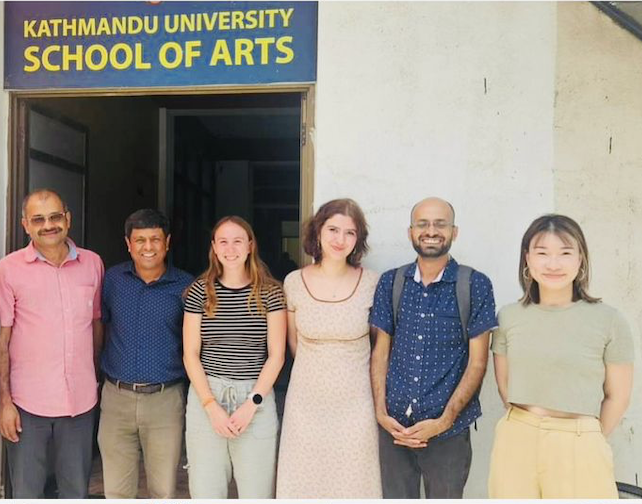
Meeting at Kathmandu University to solidify our partnership!
From left to right: Uddhab Pyakurel, Dr. Ram Bhandari, Emma Cohen, Laila Azmy (that’s me!), Niraj Acharya, Shuyuan Zhang
Posted By Laila Azmy
Posted Jul 21st, 2025
4 Comments
Julia Holladay
July 21, 2025
Laila, this is a great introduction to the group’s work in Nepal. You capture the anxiety of taking ideas and putting them into action so well–I can relate! Working shoulder to shoulder with inspiring experts like Ram is an amazing experience. My only advice is to soak it all up (just like the plants your cultivating now) as much as you can.
Emma Cohen
July 21, 2025
This blog was well worth the wait! Laila, you capture how this process has felt so beautifully. I am beyond grateful to be out in the rain gardening with you and the rest of our team and excited to see all that is to come of our work.
Angie Zheng
July 22, 2025
Laila, this was such an enjoyable read! You capture the energy of Kathmandu and the team so beautifully. I can feel your fondness for the city, project, and people so clearly through your descriptions. I look forward to reading more <3
Iain Guest
July 23, 2025
You may be the feisty teenager, Laila, but you sure write well and have a very mature head on your shoulders! This is such a good introduction to the overall program and to Ram’s vision of setting up a new center. And yes, you’re ahead of schedule. First newsletter is now out, and the second under consideration. AND you have an ally at K University in the Dean of Arts. AND you’ve discovered buffalo Jerky. In between, you’ve all managed to travel to Bardiya during the rainy season, meet with families, and stay friends. I’m impressed! Well done indeed. Keep these good blogs coming and use your photos large!! (By the way, do you have a photo of Uddhab? Make sure he reads this blog – he’ll like it!!)