

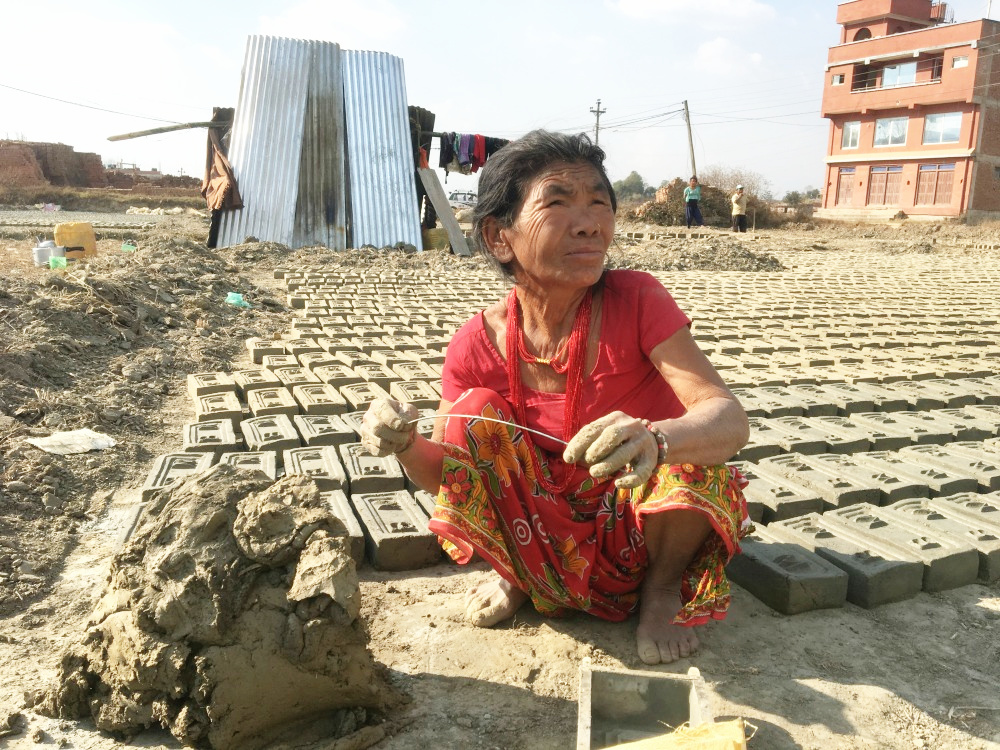
Most of those who work in brick factories are from Dalit sub-castes and include young children and elderly women. This photo was taken by AP in 2012 at a factory in Tulsipor.
Pinky and I met yesterday with Dilli and Churna Chaudhary from BASE at a café in Kathmandu (with Dilli’s bodyguards hovering close by). It quickly became clear that this will be a fascinating but challenging assignment.
Caste-based discrimination in Nepal has been repeatedly criminalized in law and should no longer exist, but it clearly does. Our job is to figure out how, why and what are the impacts.
Here’s what I’ve gleaned from my preliminary reading.
Caste in Southeast Asia emerged with the Hindu religion and was associated with Brahma, a four-headed Hindu deity who was believed to have created the universe and manifested physical features that became the four main castes. The first and noblest caste were the Brahmins – priests and teachers who emerged from Brahma’s head. The second caste, known as Kshatriyas in India and Chhetri in Nepal, were created from Brahma’s arms and were the warriors. The third caste, Vaishyas, were merchants and traders who emerged from Brahma’s thighs. The fourth class, Shudra, did the manual labor and came from Brahma’s feet.
A fifth group, long known as Untouchables, were outside the caste system but in the minds of many are more closely associated with caste than the four castes themselves. Mahatma Gandhi called untouchables harijans – meaning children of God. They are known today as Dalit, a word that comes from Sanskrit and originally meant “crushed.”
There are many other explanations for the origins of caste. One is based on karma (fate) and reincarnation. Crudely put, there is no escaping membership of your caste. But if you accept your karma in this life without complaint you may expect to be reborn into a higher caste in the next. Apart from that it’s pretty much out of our control.
The caste system moved with Hinduism into Nepal where it became so restrictive that a hierarchy of 26 sub-castes emerged within the Dalit that were also based on occupation and untouchability. At the top of the list were the Biswokarma (BK), who worked with gold. At the bottom were found the Chamar, who collected the carcasses of dead animals and Badi, whose womenfolk practiced prostitution. The Badi are often described as being the “lowest” sub-caste. While the Badi are famous, many of these other groups are quite obscure and we hope to learn more. I will refer to them as “sub-castes” in these blogs.
Much like bonded labor, this system trapped people in occupations based on their birth and was the antithesis of individual agency. It was also the polar opposite of another great world religion, Buddhism, that was born in Nepal and holds that we find happiness (nirvana) from within ourselves, not through some imposed dogma.
Nepal outlawed caste-discrimination in 1963 and the caste system formally ended in 2008 when Nepal ceased to be a Hindu kingdom and became a secular state under the new constitution. But discrimination persisted and in 2011 parliament felt it necessary to pass another law, the Caste-based Discrimination and Untouchability (CBDU) Act. (The shortcomings of this law are discussed in this report from Amnesty International.) The 2015 constitution also outlawed discrimination based on caste and untouchability.
Yet caste is still alive in Nepal. How come?
*
Caste is both objective and subjective – a system of social demarcation on the one hand and a state of mind on the other. It’s how people are labelled, but also how they identify and how they are judged by others.
I think most would agree that all societies have their own equivalent of a caste system, even if the word for it may lack the same shock value as “caste.” Isabel Wilkerson showed no hesitation in arguing that caste is hard-wired into American society in her magnificent book Caste. In my own country, the UK, we are obsessed by class and accent.
The state of Nepal still identifies Nepali citizens by their caste. Indeed, many of those we will meet on this assignment carry the name of their sub-caste and it does not get more specific than that. Yet the official terminology is also quite vague. The 2021 National Population and Housing Census uses caste and ethnicity as if they are interchangeable. In addition, everyone in Nepal belongs to a minority and about half the population are also considered indigenous (known as janajati and adivasi). The Dalit are considered a minority and account for just under 14% of the population.
In short Nepalis, like the rest of us, have overlapping identities. One question is how they and others think of these identities. Are they “happy in their skin”? It will vary from person to person, of course. For example, several of my Nepali friends from the Brahmin caste are proud of their heritage. Some from the Chhetri caste also like the idea of being descended from warriors. Friends like Dilli Chaudhary from the Tharu minority here in central Nepal are fiercely proud of their Tharu identity. (In fact BASE just helped to open a Tharu Museum which is drawing crowds of visitors.)
My Dalit friends are more nuanced. Some are also proud of their Dalit heritage, others less so.
The state sends mixed signals about all of this. Even as it is trying to erase caste, Nepal is proud of its ethnic diversity and goes to some lengths to protect and preserve minorities. All Dalit families – which means all members of Dalit sub-castes – receive benefits from the state and Dalit are guaranteed a quota of seats in parliament and in local government. This makes me wonder whether members of less respected Dalit sub-castes, like the Badi, are ready to give up these privileges in order to escape stigma. Do they feel trapped or protected by their sub-caste?
Are these questions even relevant? I hope we get a chance to raise some of them without causing offense.
*
Finally, I’m curious to see what role there might be for outsiders like BASE (and AP for that matter) who are committed to social change.
Dilli Chaudhary talks of sub-castes as he once did about bonded laborers and kamlaris (domestic slaves) – as needing help. Dilli also feels that BASE can use the same tools it employed with such success in the campaign against bonded labor. These included outspoken advocacy, pressure on politicians, media coverage, legal reform, economic support and education. Once the law was passed abolishing kamaiya, BASE pushed for the freed laborers to receive land, education, skills training and income-generation (which included microcredit).
The question is whether this same tool kit can address such a slippery concept as caste, which is as much about the mind as poverty. I’m not sure. Something as complex as caste needs a subtle response. Also, given the bewildering range of sub-castes, I also doubt if one size will fit all.
More reading:
The 2021 Nepal National Housing and Population Census – data on caste and ethnicity
The Jagaran Media Center – a long-time AP partner that supports Dalit journalism
Feminist Dalit Association of Nepal
The Joshua Project on Global Ethnicity
No-one cares – Descent-based discrimination against Dalits in Nepal (May 10 2024)
Caste by Isabel Wilkerson (2020, Random House)
Next: The Chidimar bird catchers
Posted By Iain Guest
Posted Oct 29th, 2024