


Ram Bhandari, founder of the Network of Families of the Disappeared Nepal (NEFAD) meets with Nepal’s Prime Minister Oli to share the statement of survivors of conflict
Transitional justice in Nepal is not merely a legal or human rights concern—it is inextricably linked to broader challenges of development, structural inequality, and the historical marginalization of communities. While international legal frameworks and national legal reforms play essential roles, they cannot alone address the deeply entrenched legacies of violence or provide meaningful redress. Nepal’s experience underscores the need for a transdisciplinary, victim-centered approach—one that is sensitive to the country’s complex social, cultural, and historical realities. At the heart of this approach lies the vital role of Victim Movements (VMs).
International Norms and Local Realities
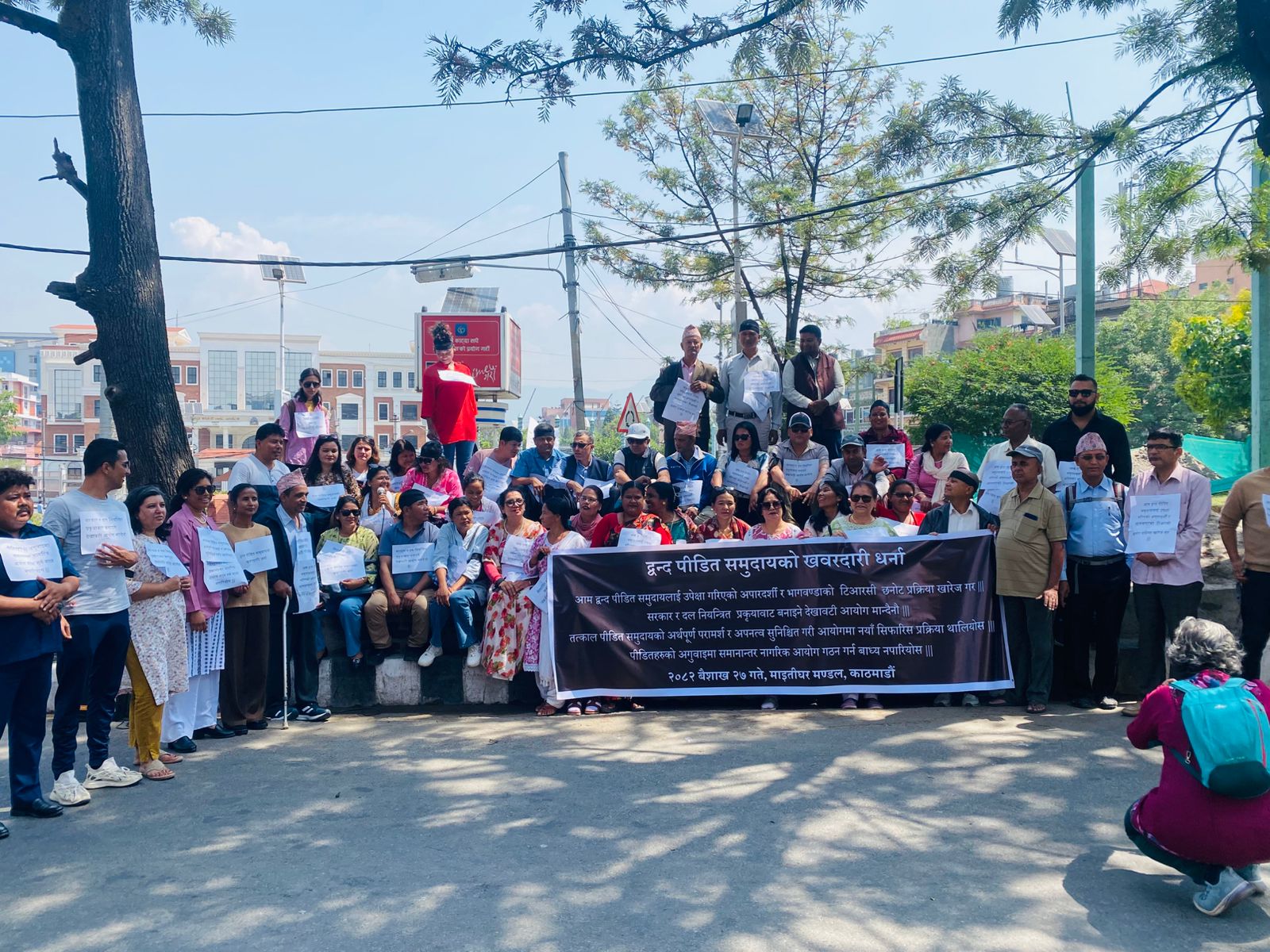
International legal instruments—such as the Updated Set of Principles for the Protection and Promotion of Human Rights through Action to Combat Impunity and the Basic Principles and Guidelines on the Right to a Remedy and Reparation—provide a foundational normative framework for transitional justice. These documents affirm key rights: truth, justice, reparation, and guarantees of non-recurrence. More recently, the UN Special Rapporteur on the promotion of truth, justice, reparation and guarantees of non-recurrence has emphasized the need for context-sensitive, inclusive, and participatory approaches.
However, these standards must be translated into practice within specific local contexts. In many post-conflict settings, where state-led mechanisms have stalled or failed, civil society organizations (CSOs) have emerged as indispensable actors in sustaining human rights protection. Yet, in the context of transitional justice—particularly in Nepal—it is critical to distinguish between general CSOs and victims’ groups (VGs) that directly represent and embody the lived experiences and agency of survivors.
Not all CSOs can authentically reflect the voices and priorities of victims. Many operate without meaningful victim participation and thus risk reproducing top-down approaches that are disconnected from survivors’ daily realities. Therefore, while acknowledging the broader significance of CSOs in human rights work, this analysis focuses on VGs—organizations formed by and for victims—which collectively constitute Nepal’s VM.
This focus aligns with the normative imperative of a victim-centered approach in transitional justice. Victims’ participation is essential in shaping the design, implementation, and outcomes of justice and reparation processes. Where state efforts have faltered, VGs have taken on the critical task of conducting research and advocating for policies that reflect survivors’ voices and needs.
Victims’ Groups as Drivers of Justice from Below

Since the signing of the Comprehensive Peace Accord in 2006, grassroots VGs have played a pivotal role in advancing transitional justice in Nepal. Over the years, these groups have stepped in to fill the void left by underperforming or politically constrained state institutions. More recently, in an effort to amplify the voices of survivors and strengthen their collective impact, VMs have emerged as coalitions of victim-led organizations from across the country. These sustained efforts have preserved collective memory, created safe spaces for truth-telling, and challenged attempts to reduce justice to elite-driven negotiations or mere symbolic gestures.
By centering the voices of survivors, these movements have pushed legal and political processes to become more inclusive and more closely aligned with the lived realities of conflict-affected communities. VMs have also served as crucial intermediaries, connecting abstract legal frameworks with the concrete experiences and demands of victims. Their contributions have been recognized in reports by the United Nations and by international organizations such as the International Center for Transitional Justice (ICTJ) and Human Rights Watch (HRW).
Nonetheless, much work remains. Bridging the gap between international standards and Nepal’s complex post-conflict context requires sustained and respectful engagement with victims—not merely as recipients of justice, but as active participants and agents of change.
Under both international human rights law and Nepal’s constitutional framework, the state bears a clear obligation to hear the voices of victims and to fulfil its responsibilities in delivering justice and reparation. In the absence of adequate state action, grassroots VGs have taken it upon themselves to conduct empirical research and ensure that victims’ perspectives are reflected in policy discussions and transitional justice processes. However, it is essential to emphasize that the role of VGs does not—and will not—replace or diminish the state’s obligations. Their efforts are a response to institutional stagnation, aimed at ensuring that the voices of victims are not silenced, but meaningfully included.
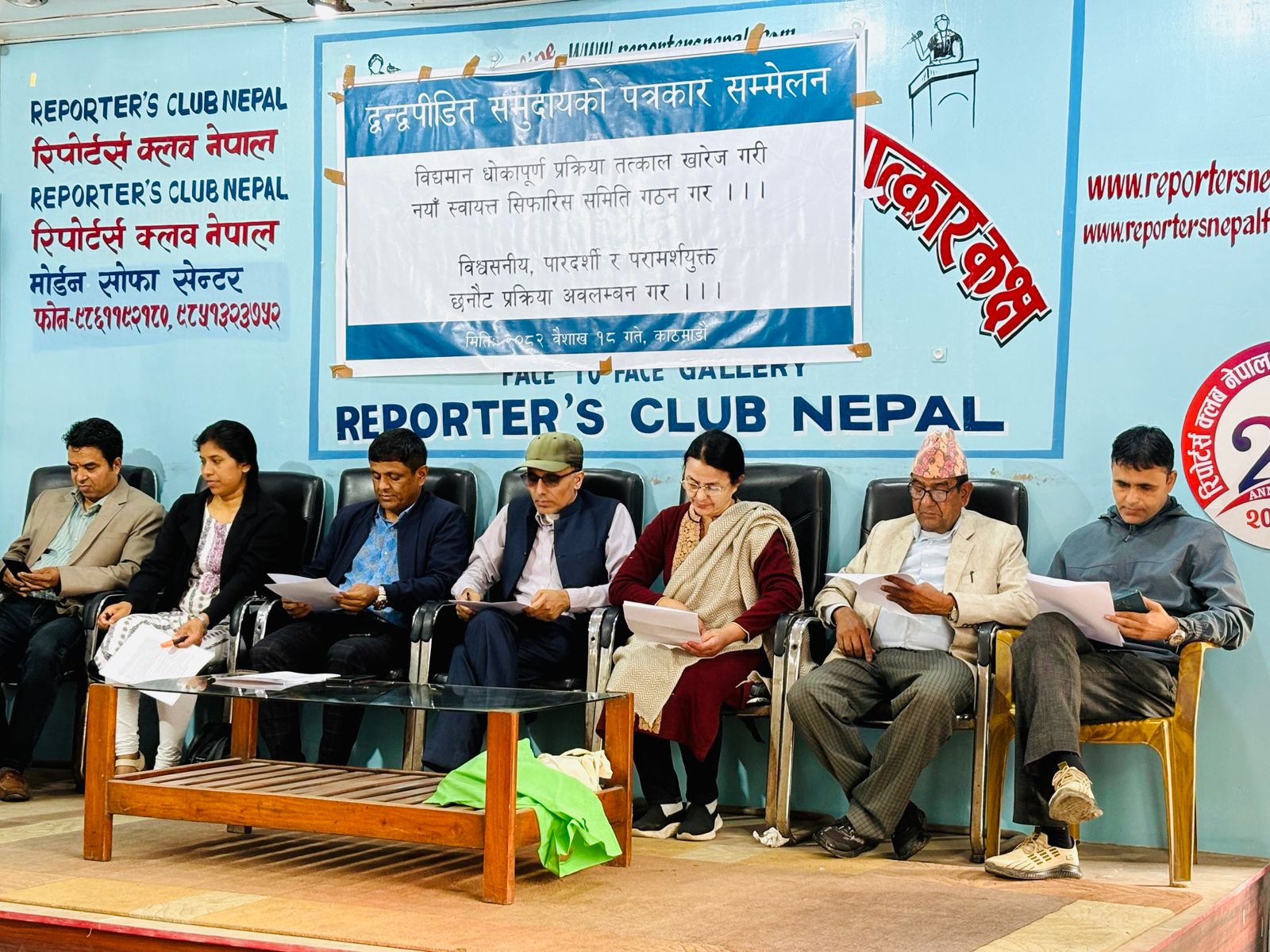
Representatives of survivors and victims meet with the media in Kathmandu
You can see some recent developments in Nepal’s transitional justice process here: Heed conflict victims; Justice must be victim-led: INOVAS statement of solidarity with the victims of Nepal – INOVAS.
Posted By Shuyuan Zhang
Posted Jun 16th, 2025
4 Comments
Aaron Bailey
June 20, 2025
I really appreciate how this piece elevates the distinction between CSOs and truly victim-led groups. Too often, transitional justice is framed as a checklist of legal steps, but this analysis rightly roots it in power, agency, and the long shadow of structural inequality. Often that inequality is a remnant of the cause of the conflict in the first place. The point about VGs not being a substitute for state responsibility but stepping in where institutions have stalled hits especially hard. It reminds me that real justice work is rarely clean or linear, it’s a slow, contested, and often driven from below.
Shuyuan Zhang
June 23, 2025
Yes! Grassroots victim groups are so crucial in the transitional justice process because they genuinely represent the needs and voices of victims. From what I’ve seen, they’re often more critical of the state’s TJ efforts too—since they know what’s really happening behind the scenes, beyond what some agencies are willing or able to say.
Iain Guest
June 23, 2025
What a wise blog! Shows a lot of erudition and is also very well written. I also totally agree with Aaron’s very good point. One could argue that TJ has added to the dis-empowerment of survivors as it has been practiced in Nepal. This calls for a totally different approach. How exciting that you can be part of this!
Angie Zheng
July 21, 2025
This was such a valuable read about how transitional justice is situated in Nepal! It’s clear from your writing how central survivors are to the movement, not only in sustaining it through periods of stagnation, but in grounding it with lived experience. In this way, VMs do not replace the state’s obligations but negotiate, expand, and challenge what a proper transitional justice process looks like.