

Our Lady of Mercy Secondary School is an all girls public boarding school that hosts students from across Kenya. The school has partnered with Shield of Faith (SOF) for more than a year and is now showing the transformative power of waste management practices in schools.
We began our visit by touring the compost bins and the shambas (“farm” in Swahili), one of which is located near the school’s greenhouse. The original compost bin constructed by SOF was expanded at the request of the school after teachers began to see the real benefits of organic farming and composting–less trash and food waste, improved crops from organic fertilizer, cost savings, and increased student engagement in sustainability practices. SOF has also constructed tower gardens for the 4K Club, which are especially great for water conservation, small spaces, and teaching students about the food cycle.
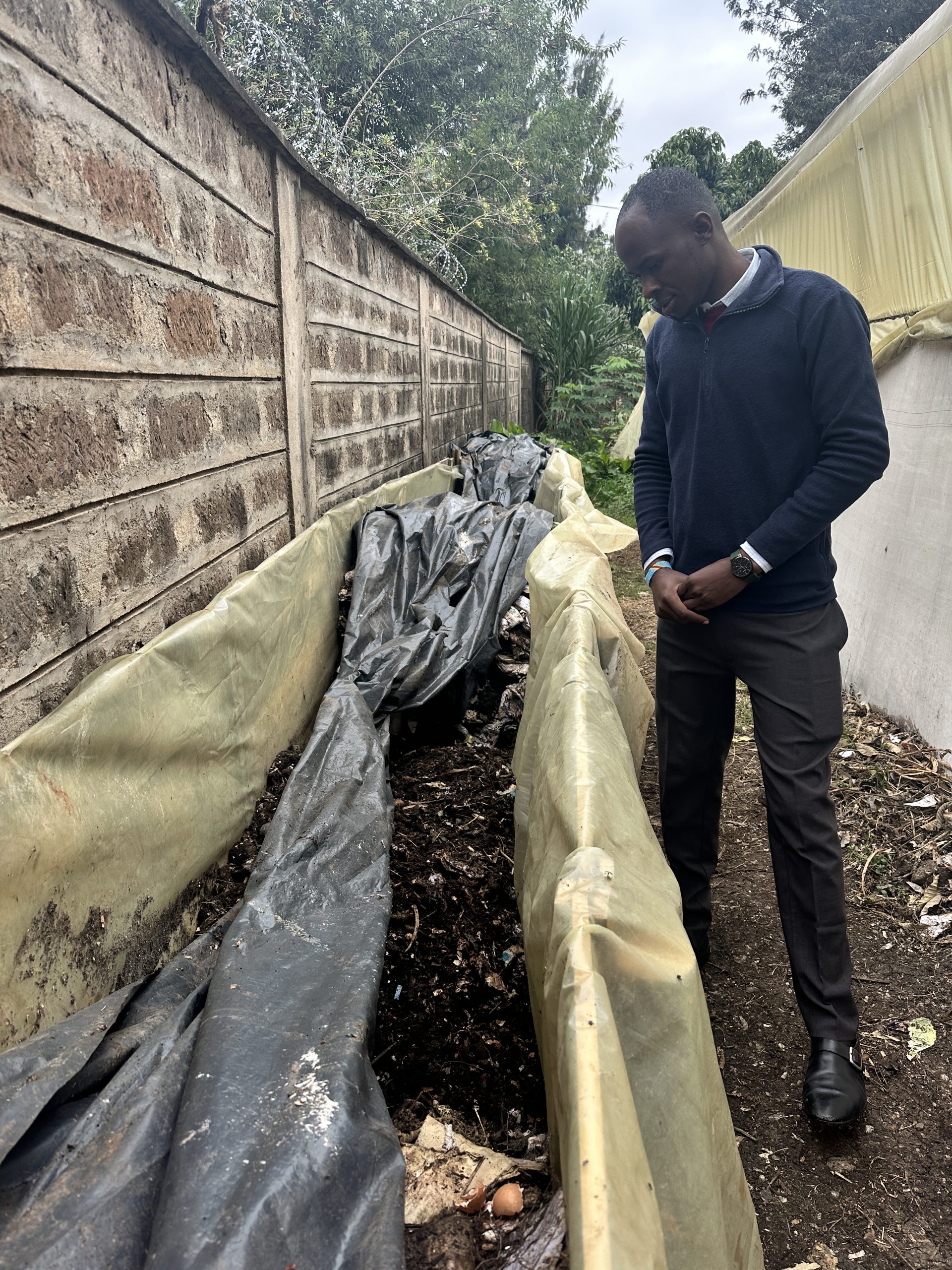
Teacher Odhiambo, agriculture teacher, shows us the 4K Club’s compost bins.
Right now, the kitchen garden supplements school meals. But Teacher Jacqueline, patron of the 4K Club, said her vision for the shamba is to provide eighty percent of the school’s food supply. This would improve nutrition through organic foods and save the school money. Teacher Jacqueline has been a champion of the SOF composting project and has big plans to keep the school moving towards sustainability.
Gitonga (below) is the school’s caretaker and is one of the reasons for the project’s great success! He manages the day to day responsibilities for the compost and shambas, paying special attention to when and how food waste is put into the bins, compost is turned and distributed, and vegetables are harvested. He also has a famously green thumb! Gitonga fully supports the composting project and is seeing many benefits for the school. In just one year the school has already stopped needing to buy cow manure to fertilize gardens, saving nearly $400 per growing period.
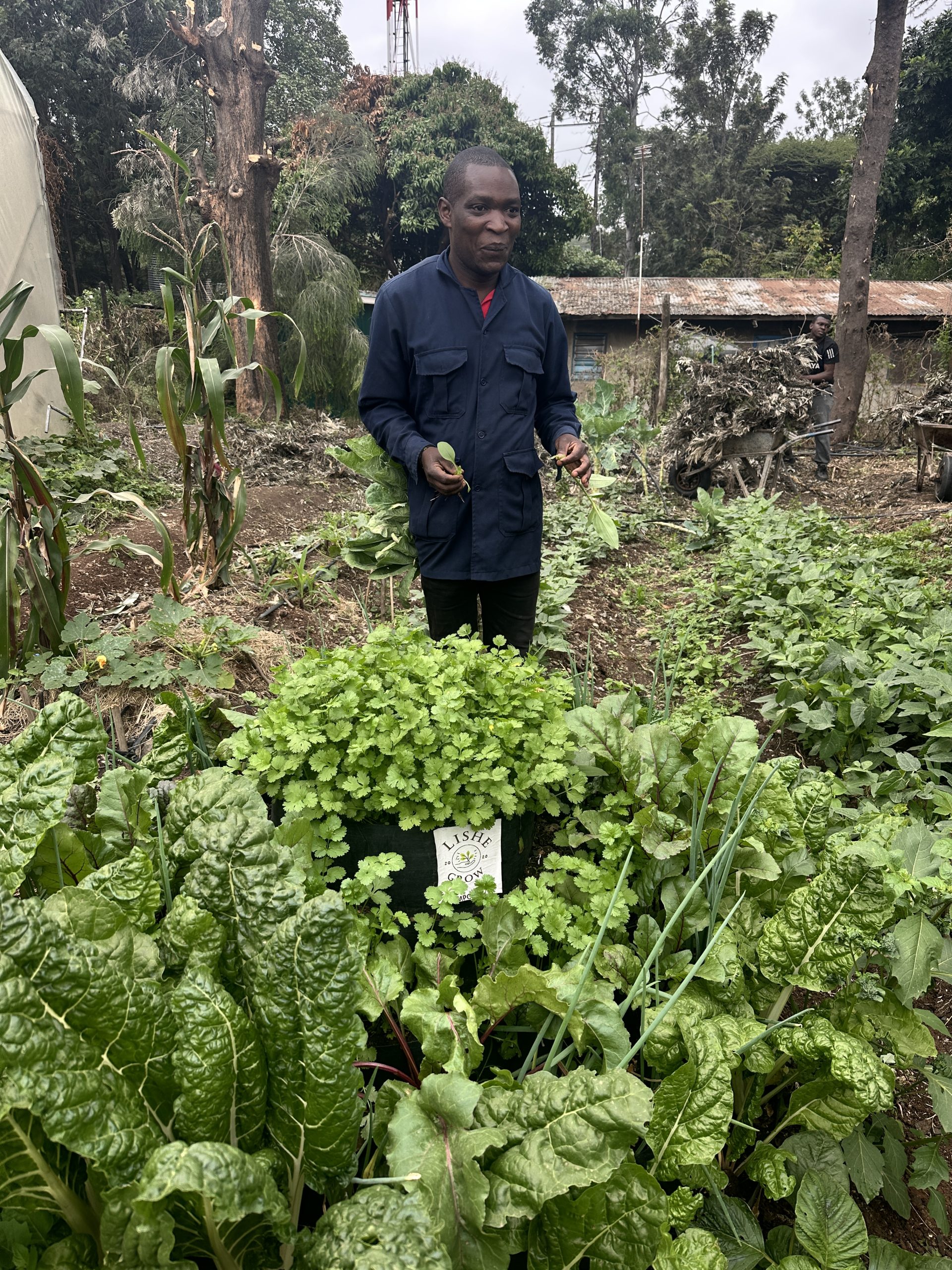
Gitonga standing next to the tower gardens in the shamba that SOF worked with the 4K Club to build.
Next, it was time to get started on the Demo Farm. The Demo Farm is led by Teacher Odhiambo, who sponsors the Agriculture Club, and is a forum to teach students hands-on farming practices.
We began by prepping the two lots where we would build a Keyhole Garden and a Hugel Mound. The soil on the shamba is very tough because it is a former construction site… this meant Stella had to get very creative about which structures would be the best fit. With the help of the staff and students from the 4K and Agriculture Clubs, we got to work lugging branches and tree clippings, cutting the supplies into the correct dimensions, and assembling the Keyhole Garden.
All of the teachers came out to see the muzungu doing farm work and decided to chip in.

Students carry buckets of soil to layer onto the Keyhole garden.
Gitonga, Vena, a participant from SOF’s household composting program, and I working on the composting basket for the keyhole garden.
When I asked the students if they could see themselves composting at home, most said that their families live in apartments and don’t have space. I excitedly showed them photos of Stella’s compost tower on her apartment balcony and explained that composting could be adapted to fit their space. When I asked what would help them teach their families how to compost at home, a student responded that some kind of instructions or reference materials would be the most helpful. That’s the heart of this project: making connections between what happens at school and what’s possible at home. SOF is building more than compost bins, they’re building confidence, imagination, and the first steps toward community-wide change.
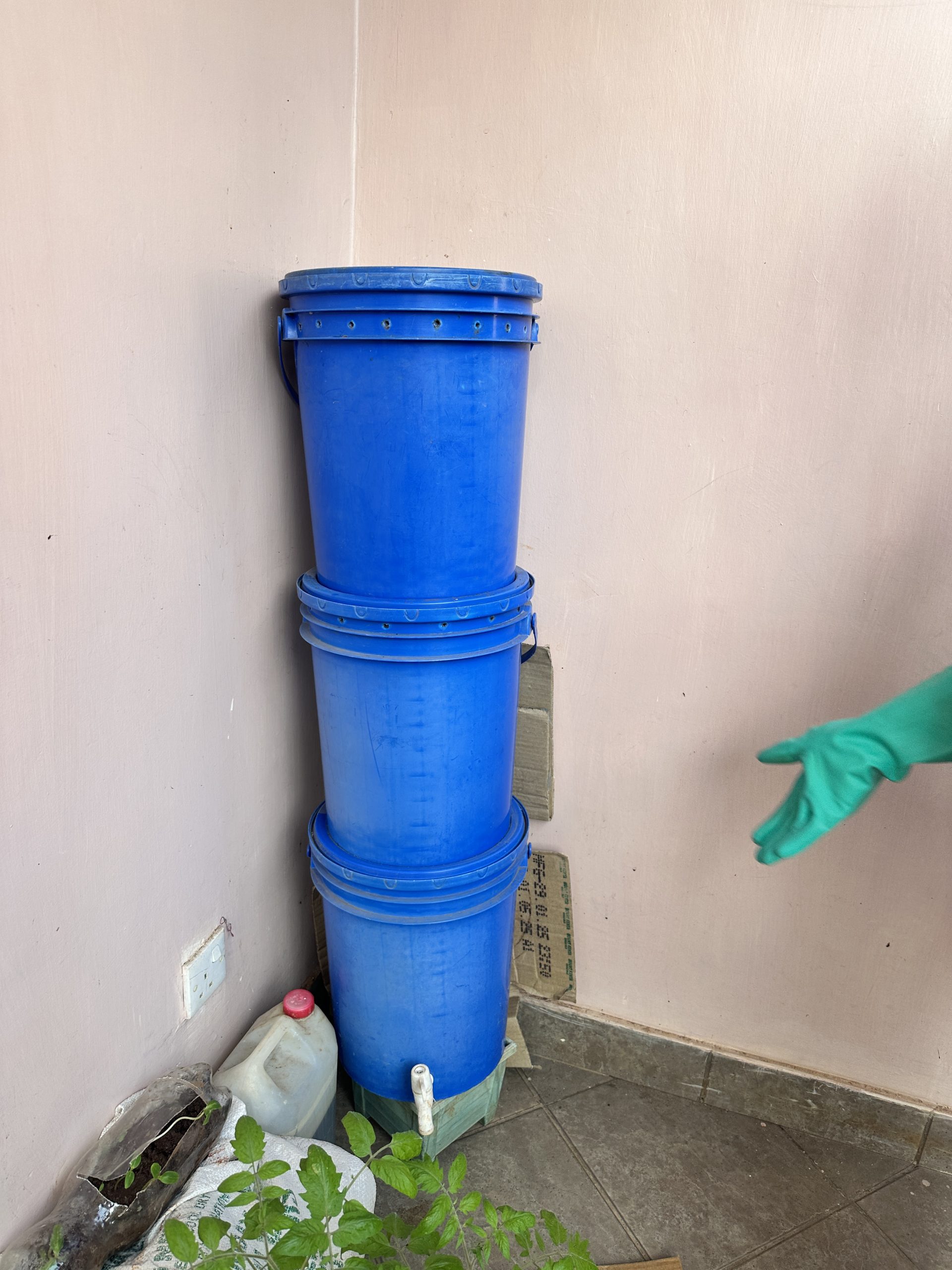
Stella’s apartment vermiculture composting setup. This structure was designed by Stella and manufactured by a local business.
During a lunch break, Teacher Jacqueline gave a tour of the cafeteria and the food waste sorting process. After students eat, they sort food waste into what can and cannot be composted. The kitchen also sorts food waste as the staff prepare meals for inputs into the compost bins. This represents a mindset shift at Our Lady of Mercy, where waste management has made its way into daily routines. By reinforcing these practices, students and staff are also more likely to retain these habits outside of school grounds.
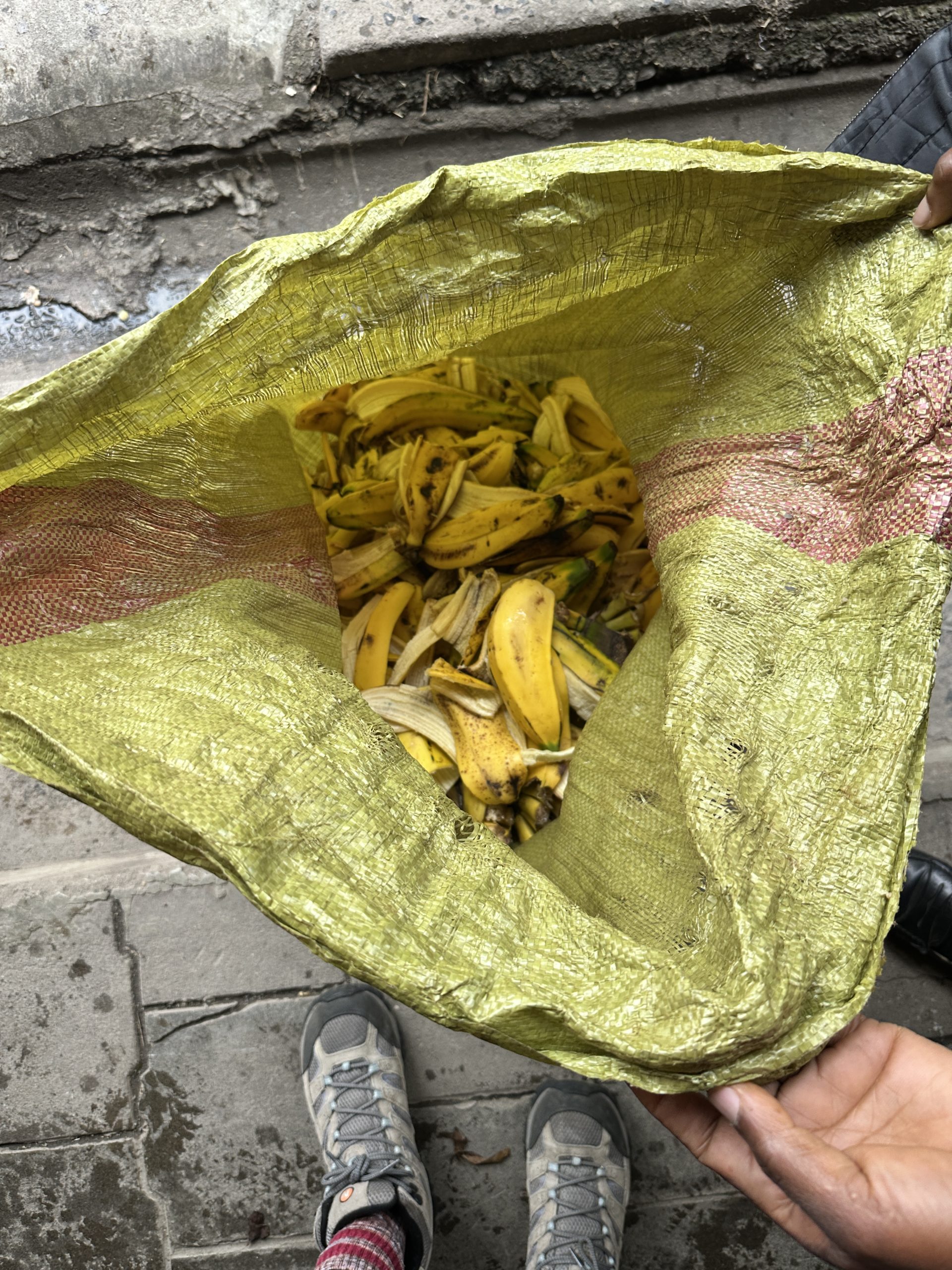
Students sorted their banana peels after lunch to put into the school’s compost bins.
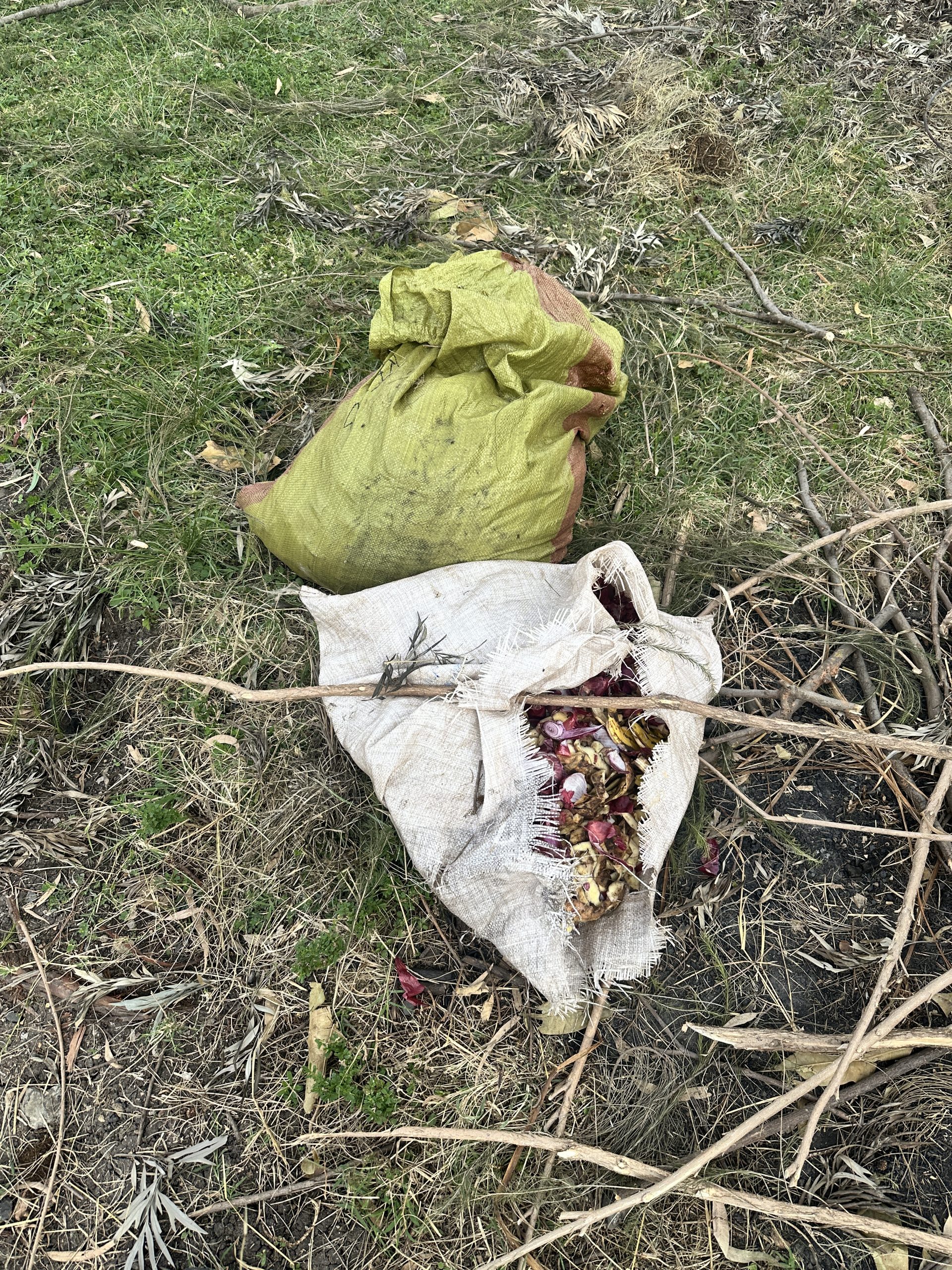
Food waste from the kitchen after preparing lunch, ready to be put into compost bins.
After a long day of hard work, we gathered the students to explain how the keyhole garden functions. The structure shows students how to compost and grow food in arid regions or places where soil is too hard. For example, the keyhole garden allows easy access to a central compost basket, where kitchen and garden waste decompose and naturally fertilize the surrounding soil.
Exposure to diverse composting and farming practices are important at boarding schools which house students from across the country, including arid regions like Northern Kenya. [It’s important to note that food waste differs across Kenya. For example, pastoralist communities in the north do not usually have much excess food waste because it goes directly to their animals.]
Students planting and watering vegetables on top of the Keyhole Garden at the end of the day.
The finished Keyhole Garden. The base is built from logs and twigs, layered with hay, grass, soil, and compost which act as a sponge when it rains. Vegetables are planted on top, with compost put in the woven basket.
Stella and Teacher Jacqueline also explained that these are concepts students can bring back home to their parents, friends, and communities. They can be done at scale like schools or farms, or in apartment buildings.
What’s happening at Our Lady of Mercy is more than a school project—it’s a glimpse of what’s possible when communities take the lead on sustainability. Schools like Our Lady of Mercy offer a working blueprint for tackling food insecurity and mounting waste challenges, all while teaching the next generation how to be good stewards of their environment. If we want long-term, transformative change, schools and students aren’t just part of the solution… They are the catalysts.
Posted By Julia Holladay
Posted Jul 15th, 2025
4 Comments
Laila Azmy
July 19, 2025
This is such a great update, Julia! I loved the apartment compost setup that Stella has going on. In my hometown of NYC, composting recently became mandatory. I know a lot of folks who’ve been griping about the smell and the change to their lifestyle, but the compost bucket in my house fits in snuggly and has become an easy part of my family’s routine. Sustainable change is possible when some creative effort is put in, and the kids at Our Lady of Mercy are proving just that. I hope that the incredible effort of the teachers at the school rubs off and some students are inspired to take composting into their own homes!
Aaron Bailey
July 20, 2025
I too am very interested in the balcony vermiculture setup, that’s pretty ingenious. It’s also quite impressive that the attitude of the school has changed to make waste management a routine instead of a nuisance.
Iain Guest
July 20, 2025
Another great blog, Julia. So great that I plan to share it with the schools in Pennsylvania where we hope to start composting next school year. I think they will be super interested to hear from the Kenyan students through your blogs and video! This blog gives us a wonderful description of how Stella plans to make her big push into schools. Also, how she adapts and learns from each new composting site – one of her GREAT skills! Lots more to say, but the photos and videos are wonderful. Finally, we now have a clear goal as expressed by Jacqueline – to provide eighty percent of the school’s food supply. if that can be achieved in all schools it would be HUGE!
» Highway Boys Secondary School Gets Ready for the Red Wriggler Revolution | The Advocacy Project
July 23, 2025
[…] to Our Lady of Mercy, Highway Boys Secondary School is an all boy’s public boarding school that hosts almost 1,200 […]