


Jamuna Badi runs a successful business selling snacks to bus passengers
Jamuna Badi and her husband Sankar Badi Nepali continue working while we chat. Jamuna is selling snacks to passengers. Sankar weaves a gossamer-thin fishing net.
Jamuna earns around 20,000 rupees ($141 at current prices) each month from her store. She also made and sold 15 madal traditional drums during the recent Dashain and Tihar (Diwali) festivals. Her husband fishes and sells his nets to other Badi men for around 7,000 rupees.
Given the role played by poverty in the Badi story, this is encouraging. When combined with the proceeds from Jamuna’s store, the fishing nets and drums provide this couple with a good living.
Jamuna Badi is a survivor. She gave birth to four daughters. One died and another was abandoned by her husband and now lives at home with two younger sisters. She is also happy to talk about the era of prostitution, which she remembers well. Jamuna herself must be in her mid-fifties and we do not ask whether she herself engaged in prostitution. But her family was certainly in the thick of it. Prostitution was everywhere, she says, and she recalls how clients used to roam through the streets harassing women and girls.
It became so bad that Jamuna joined up with about fifty other young women and formed a cooperative (Nawa Nirman Mahila Bahu Uddhaya) to respond to threats. “We used to bring people to the group and also report them to police!” The group included prostitutes and friends. This was resistance and advocacy.
I pop the question – do Jamuna and her husband feel pride or shame at being Badi? This produces an interesting response. Jamuna’s husband Sankar confesses that he was so uncomfortable to be known as a Badi that he has taken the additional name of Nepali, which is a generic name used by Dalit.
His wife scoffs at this but concedes that being a Badi opens her up to occasional abuse. “In our culture when someone misbehaves they are said to be ‘acting like a Badi!’” She adds that her daughters sometimes feel “humiliated” at being Badi. But it’s nothing they can’t handle.
This reminds me of the difference between Sunita and Ramu Chidimar which I described in an earlier blog. Like Sunita, Jamuna Badi is a reminder that many strong-minded women are prepared to take a stand within these sub-castes. I’m beginning to think that they might be the best hope for change.
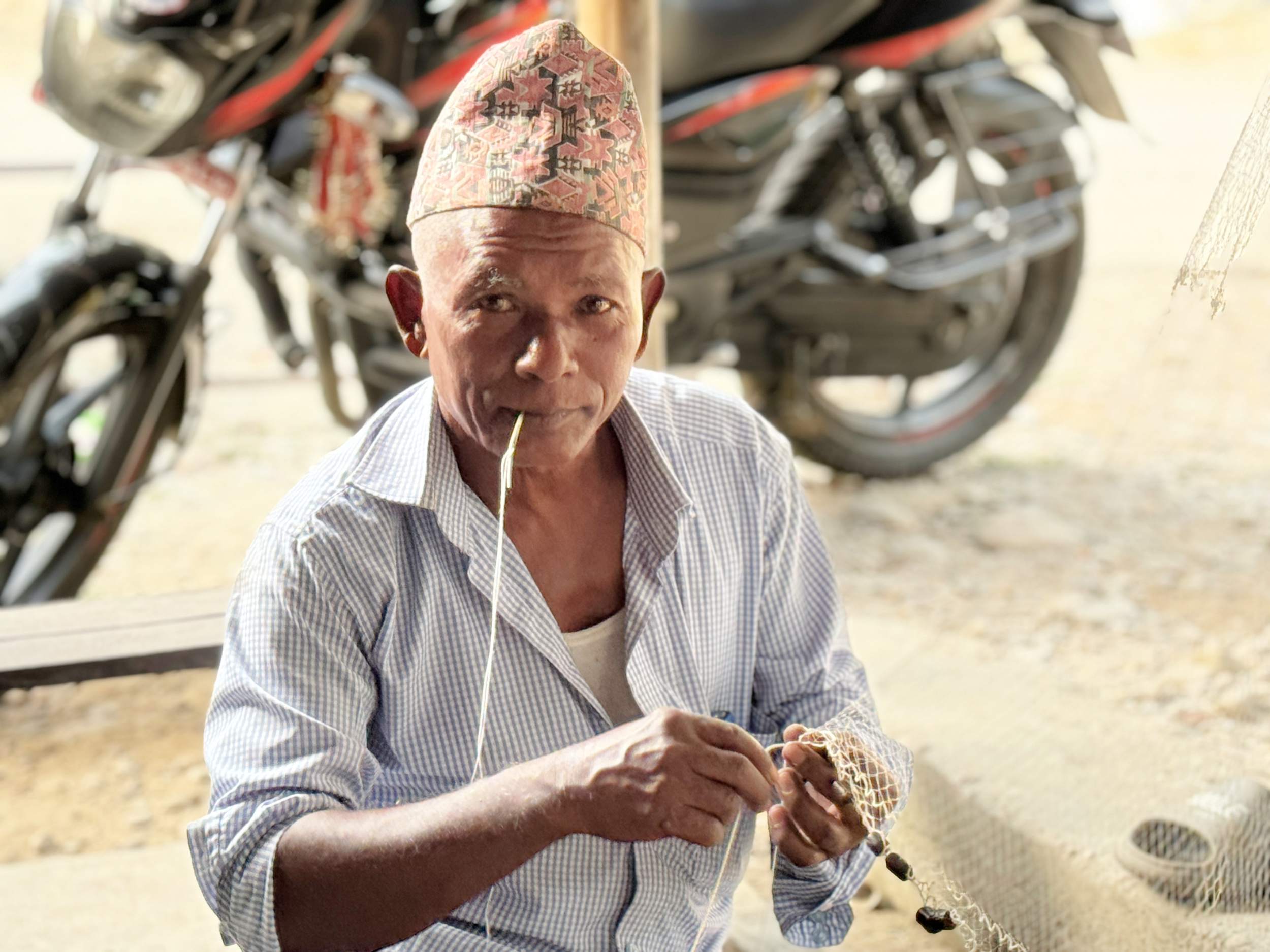
Sankar Badi Nepali makes and uses fishing nets
Next: Badi Fishing
Posted By Iain Guest
Posted Nov 15th, 2024