
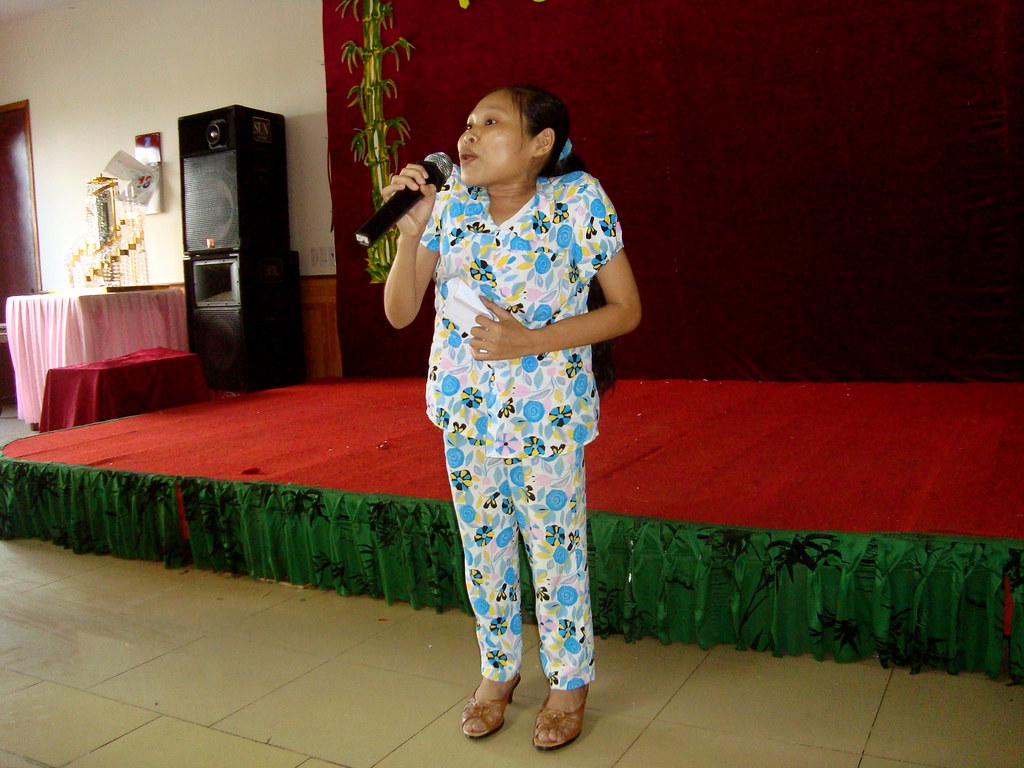
AP was introduced to Agent Orange by Nguyen Thi My Hue in 2010. Mrs Hue’s father was exposed to the herbicide during the war and passed dioxin poisoning to his daughter. Mrs Hue opened a grocery store and dreamed of becoming an opera singer. She struck up a friendship with our Peace Fellow Simon Klantschi, who wrote about Mrs Hue’s spirit and optimism in an affectionate blog while volunteering as an AP Peace Fellow at AEPD. In the 14 years since, AP has partnered with AEPD to raise funds for 15 families damaged by Agent Orange.
My next eleven blogs will look at the human cost of Agent Orange, the herbicide that was widely used by US forces during the Vietnam war.
I propose to tell this tragic story through the lens of fifteen Vietnamese families that were poisoned by dioxin after being exposed to Agent Orange. All live in the province of Quang Binh, in what used to be North Vietnam. All have received support from The Advocacy Project (AP) in Washington and the Association for the Empowerment of Persons with Disability (AEPD) in Quang Binh.
AP has made two contributions to this partnership. First, we have raised $16,134 for the families in Vietnam from 148 generous individuals who care deeply about Vietnam and its people. Second, we have deployed thirteen American students (“Peace Fellows”) since 2008 to volunteer at AEPD, get to know the families and update their stories through blogs and photos.
In Vietnam, our Fellows have worked alongside four AEPD outreach workers who help the families turn their grants into a source of sustained income. All four were seriously injured in fighting and one was himself exposed to Agent Orange. Experiencing the horror of war has given them a deep understanding of the challenges that face the Agent Orange families. Such peer support is at the heart of AEPD’s work with disability.
Aid experts would describe this partnership between our two small community-based organizations in Vietnam and the US as a “people to people” project. We would heartily concur. Our commitment to the Agent Orange issue, and our advocacy, is built entirely on personal relationships and mutual respect.
*
People to people projects could become increasingly important in the months ahead, following the decision by the Trump Administration last March to close USAID.
This decision ended US government funding for war victims in eight Vietnamese provinces that were heavily sprayed by Agent Orange during the war. It came as a nasty shock to Americans who care deeply about Vietnam.
A recent webinar hosted by The Stimson Center and War Legacies Project reviewed options for going forward.
Several speakers favored a return to the activism of the 1980s when committed individuals joined forces with NGOs and foundations to prod the US government into action. But it seems unlikely that the current US administration would cooperate even though the US Embassy in Hanoi agreed in September to continue supporting Agent Orange victims as part of a larger strategic partnership between the US and Vietnam. I discuss this in my third blog.
Nor are there any obvious champions in the US Congress like Senator Patrick Leahy, who played a decisive role through the Leahy War Victims Fund, and by earmarking money for USAID’s program in the eight provinces.
People to people projects can certainly help, but personal relationships alone will not make up for the financial hole left by USAID. Foundations could contribute and act as a catalyst for action, as the Ford Foundation did back in the day. But foundations are also facing many other demands on their money.
In short, there seems no obvious way forward, and no clear target for advocates.
Given this, perhaps we need to go back to basics and ask this question: why would anyone care about the victims of a war that ended fifty years ago? I will attempt an answer in the next ten blogs.
Posted By Iain Guest
Posted Jan 20th, 2026