
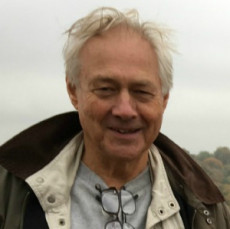

Pham Thi Do and her son Tuan before Tuan died in 2018 from hemofila associated with dioxin poisoning. Tuan was a talented craftsman and his model of Hue University is displayed at the AP office in Washington.
The most devilish feature of Agent Orange is that it has fallen more heavily on the children of veterans than their parents.
Nguyen Van Xoan, who we met in an earlier blog, suffered from headaches and nausea after ingesting the herbicide. But this was hardly life-threatening and when we met forty years later, Mr Xoan was a fit man.
His family, in contrast, had been destroyed. The first two children born to Mr Xoan and his wife Pham Thi Do died from “brain damage.” Their third child died after a miscarriage. The next two children were healthy, but the couple’s youngest sons, Trung and Tuan, came down with creeping paralysis in their early teens. Their eighth child Luyen was born in 1992 with cerebral palsy and had been bed-ridden since childhood.
When I first visited Mr Xoan’s family in 2015 Tuan, 20, was in a wheelchair and making models out of discarded popsicle sticks. He had felt the onset of paralysis in his legs around the age of fifteen and dropped out of school after being bullied. Restless and talented, he turned to his popsicle sticks and was grateful when I purchased his model of the revered University of Hue.
We were introduced to Tuan’s older sister, Luyen, during the same visit. It was a stormy day and Luyen lay in bed, pressing her nails into her hands and grinding her teeth. Her mother Pham Thi Do said that this was a sure sign that the weather was about to change and that she would give Luyen a folded carton to hold to prevent her from cutting into her hands. Luyen’s brother Trung – another Agent Orange victim – was in hospital when we visited receiving a blood transfusion.
Tuan’s grin was infectious and I remember thinking that if anyone could beat the odds he could. But it was not to be and Tuan died two years later. I still have his model of Hue University on my desk in Washington.
Not every affected family member has died, and some with lesser symptoms have even shown signs of improvement. When our Peace Fellow Mia Coward visited Tuan’s family in 2018, shortly after Tuan died, his older brother Trung was no longer receiving blood transfusions and hoped to apply to a vocational training college.
But most children of exposed veterans have been less fortunate and watching them waste away has produced a deep sense of guilt in the parents. Like Mai Thi Loi, many are also terrified at what awaits their children, as they themselves grow old and infirm.
This is the overriding concern of all ageing caregivers. No doubt there is more institutional and medical care available today in Quang Binh province than there was when we first met these families. There is even a social center in Quang Binh that caters to severe Agent Orange cases, and Mai Thi Loi’s son Kien would no doubt qualify.
But right now Mai Thi Loi cannot bear to think of that. Nor can she count on the support and understanding of her neighbors, who insisted that she chain up Kien when he tried to burn down a neighbor’s house and even put up the money to help her build the new room.
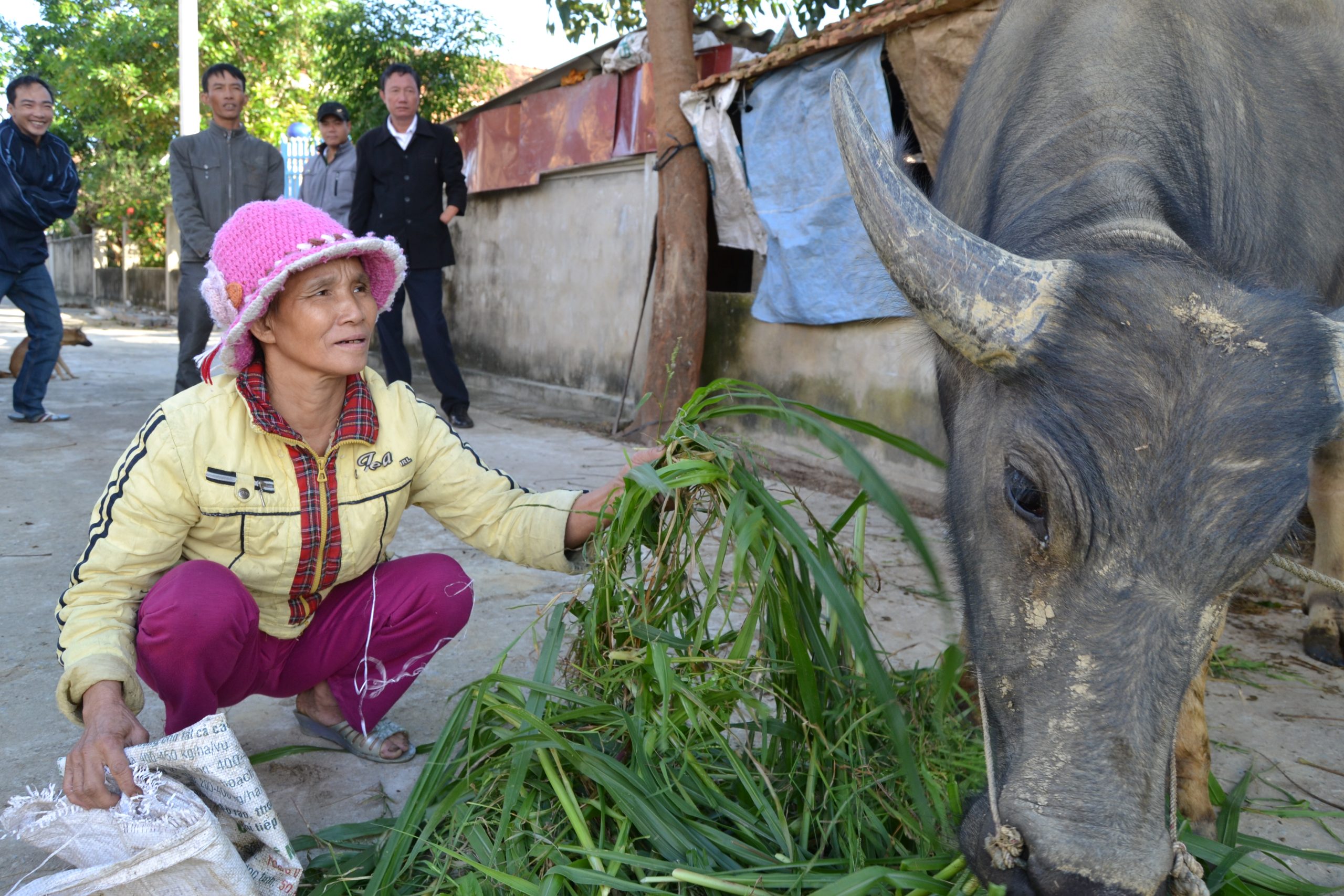
Pham Thi Do with her cow, donated through AP in Washington and managed with help from AEPD in Vietnam.
Read the story of Pham Thi Do’s and her family
*
Posted By Iain Guest
Posted Jan 20th, 2026