

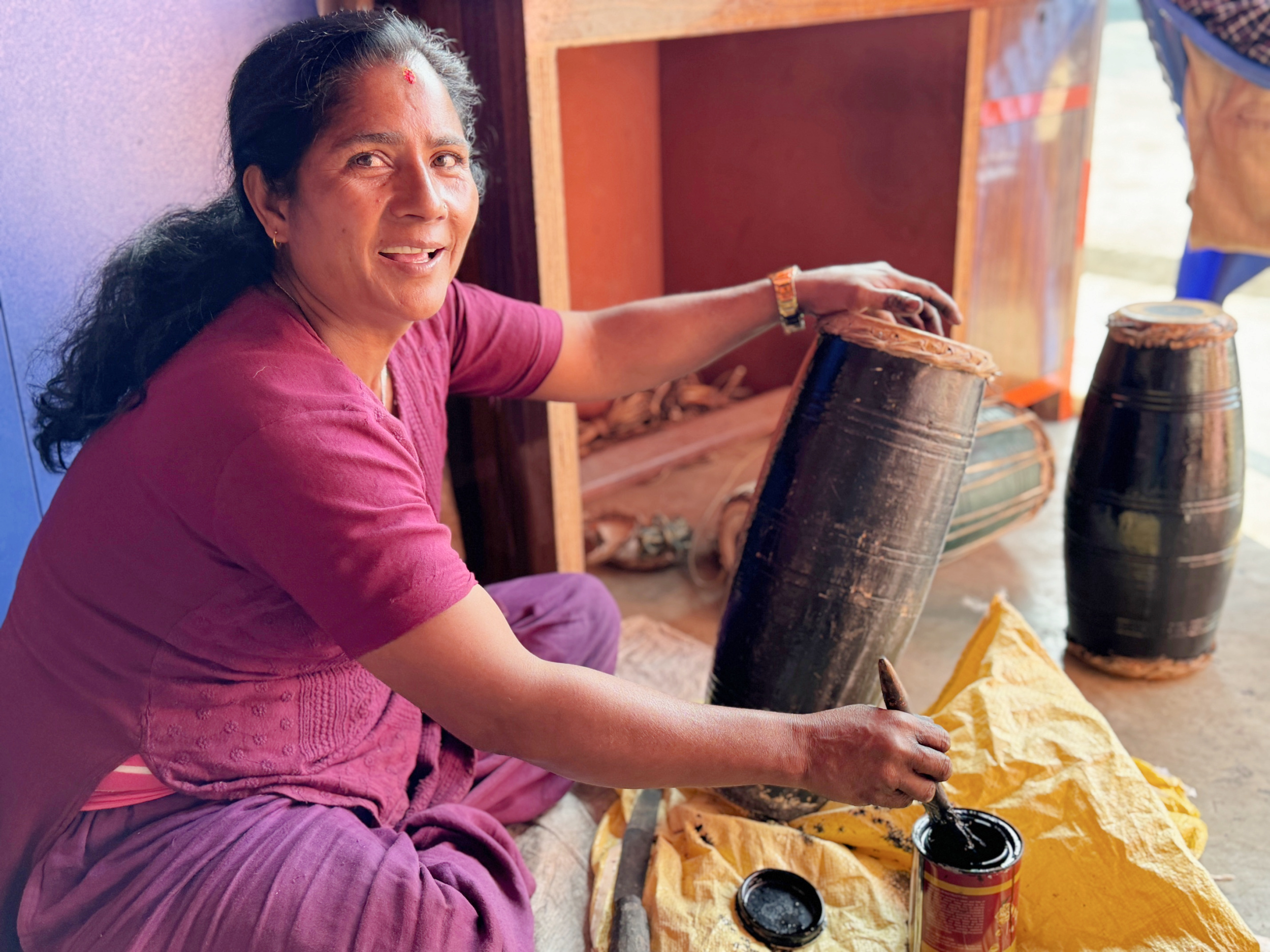
Pabitra Badi makes and plays madal drums, and is a hero to the LGBTQ+ community in Nepal. Scroll down to appreciate her drumming skills!
It’s time for a brief review.
With each meeting our understanding of the legacy of caste becomes clearer. Yet something is missing. I think it comes down to pride – the sort of pride shown by Dilli Chaudhary when he talks of how the Tharu overcame decades of exploitation. Pride that shouts from the rooftops and brims with optimism for the future.
This may be about to change.
*
We visit Pabitra Badi, 51, at her workshop in Tulsipor and are met with a tranquil scene. Pabitra squats on the floor mending a madal traditional drum, while neighbors wander by and stop to listen to her latest exchange with a visitor. They are curious and also respectful, because Pabitra is something of a celebrity in Tulsipor.
Some of it has to do with her skills as a drum-maker. She repairs half a dozen drums during our meeting and is so good at her trade that she has led several trainings and also launched a BASE savings group for other Badi women.
But the main reason for Pabitra’s fame is that she is in a same-sex union that goes against the grain in a largely conservative part of the world and a society that is still constrained by caste and tradition. What is more, Pabitra and her partner, Bimala BK, are from different sub-castes. Bimala is from the elite Biswokarma, while Pabitra is a Badi. This is the next best thing to an inter-caste marriage.
Pabitra tells her story gradually but without any hesitation. She is small in stature and has a dazzling smile. She fell for Bimala at the age of nine when the two girls were herding animals together. “I was mad for love!” she says with a grin and a giggle.
Pabitra and Bimala have been partners for 28 years and the journey has been as difficult for them as it has been for so many other same-sex couples. Pabitra’s parents were so opposed to their friendship that they forced Pabitra to sign a declaration pledging not to see Bimala. At one point they even sent the police after their daughter. The gossip and finger-pointing were merciless.
Eventually the two women fled for the anonymity of Kathmandu, where they found kindred spirits and joined an LGBTQ+ support group with about 300 active members. They decided to return to Tulsipor about seven years ago, drawn by Pabitra’s love of the madal drums for which her village was famous.
It cannot have been easy, but Pabitra is now so well known that the gossiping has stopped and when she hears from neighbors it is with admiration. She has become an advocate for gay rights and is disturbed when she learns of acts of prejudice. In one recent incident, two girls aged 8 and 9 were shown on social media being beaten by their parents.
Pabitra’s personal journey has also shown the way to other Nepalis. The struggle for gender rights started in 2007 when the Supreme Court of Nepal – easily the most progressive force for change in the country – recognized LGBTQ+ rights and ordered the government to prepare a law legalizing same-sex marriage. The government balked at drafting a new law, but the issue refused to go away and the rights of sexual and gender minorities were enshrined in the new constitution in 2015.
That same year the Court again ordered the national government to legalize same-sex marriage. But the government continued to drag its feet and the Court continued to make the running. On June 27, 2023 the Court permitted same-sex couples to register. Later in the year, on November 30, the municipality of Dordi in the district of Lamjung legally recognized the marriage of Maya Gurung and Surendra Pandey, a same sex couple.
LGBTQ+ advocates in Nepal point out that there is still a long way to go and that same-sex couples still cannot own land, make joint wills and adopt children together. That will require a new law. But the social norm has been shattered, and Nepal is generally viewed as only the second country in Asia to recognize same-sex marriage after Taiwan (2019). Thailand passed a same-sex law on June 18 2024.
Pabitra is delighted to have helped to pave the way.
*
Like other Badi women we have met, the years of prostitution are seared in Pabitra’s memory. She even remembers being arrested on one occasion, when a brawl got out of hand. But Pabitra avoided the worst and fled to Kathmandu at an age when her closest school friends were being drawn into prostitution.
For some it started as young as 13 and Pabitra says that they were pressured by their mothers and grandparents, who kept the money. Some of her friends gave birth to children, who remained stateless until the law changed in 2007. Some were disowned by their families and children even though they gave up prostitution. Some fell ill. Two died from HIV-AIDS.
It’s a desperately sad story. The friends who survive have remained close and when they meet up during festivals, Pabitra says there are plenty of tears. She does what she can to console them and tells us that life is too short for regrets.
*
Pabitra’s drum-making also fills out our information about Badi income-generation.
Babitra has been making drums for about 15 years and sold enough to have invested around 100,000 rupees in the business. The wood comes from the Pokhara region and costs about 500 rupees per drum but the drums themselves sell for up to 10,000 rupees, so this is a good business. She sold around 50 drums during the recent Dashain and Tihar festivals, and is gearing up for the next festival, the Marg.
As well as making drums Pabitra also plays and sings and gives us a short impromptu concert. Her neighbors join in and their clapping reverberates down the street.
Impressed by Pabitra’s skills and influence, BASE invited her to train other Badi women to make drums, with funding from the local provincial government. Fifteen women took part but only about five are still making drums because the raw materials are hard to find. They are also living on unregistered land, which makes them less inclined to take risks with their money. Pabitra also launched a savings scheme for BASE but says it fell apart after one of the members disappeared with most of the money.
But Pabitra’s own business model is a big success and this raises a question about whether there might be wider market for Badi drums. Demand for Pabitra’s drums is highest during festivals. Nepalis love their festivals but I wonder if this is too limiting. For example, before we set out, Dilli Chaudhary told us that the madal is such an integral part of life in Nepal that every family probably owns at least one. This suggests that there may be a larger market out there for madal drums.
We had a similar reaction after seeing the Kewat making duma plates out of leaves in Nepalgunj. Like Pabitra’s drums, the duma leaves are much in demand during festivals but may have a wider year-round appeal, like disposable plates here in the US. If this is right BASE might want to focus on marketing rather than producing. I also think of Pabitra’s sister, who drives a tut tuk taxi. How about tuk tuk training for Badi women?
*
Before leaving, I ask Pabitra if she is proud of being a Badi. She does not answer directly but she does admit to having had doubts. At one point she even tried to change her name from Badi, but all that is now in the past: “I am earning. I have my partner. Our children are young and studying. We are not backward because we are Badi!”
This sounds like a lukewarm endorsement and suggests that Pabitra’s is less committed to her caste than her gender. When it comes to gender, Pabitra is definitely out and proud. But to the extent that she is an advocate for the Badi it is through her personal example, talent and charm rather than outspokenness.
As a successful businesswoman, Pabitra also has the luxury of choice. This contrasts with other Badi families we have met that are under relentless pressure from poverty and social exclusion. This might make them more hungry for change, but it also gives them far fewer options to act.
Next: The Badi Advocate
Posted By Iain Guest
Posted Dec 3rd, 2024